1
Chapter I
Introduction and Methodology
An Introduction to Human Resource Accounting:
Measuring Human Resource Accounting is a process of identifying data about human
resource and communicating this information to interested parties. Therefore, it is an
attempt to identify and report investment made in resources of an organization that are
not presently accounted for under conventional accounting practices. Moreover,
human resource accounting helps to measure the value of employees, which helps the
management take vital decisions related to human resources in order to increase
production. It requires the measurement of the performances of an organization and
the optimum use of the resources under the direct and indirect control. Hence, the
overall valuation is important for decision making in order to achieve the
organizational objectives and improve the output.
Definition:
“Human Resource Accounting is the process of identifying and measuring data
about human resources and communicating this information to interested
parties.”(American Accounting Society Committee on HRA)
“Human Resource Accounting is an attempt to identify and report investments
made in human resources of an organisation that are presently not accounted for in
conventional accounting practice. Basically it is an information system that tells the
management what changes over time are happening to the human resource in the
business.” (Woodruff).
“A term used to describe a variety of proposals that seek to report and emphasize
the importance of human resources – knowledgeable, trained and loyal employees in a
company earning process and total assets.” (Davidson and Roman L Weel).
2
“Human Resource Accounting is the measurement of the cost and value of the
people for the organisation.” (Eric Flamholtz of University of California, Los
Angeles).
The current accounting system is not able to provide the actual value of
employees’ capabilities and knowledge. This indirectly affects future investments of a
company, as each year, the cost on human resource development and recruitment
increases. The human resource accounting system generates information on various
aspects of human resources (such as acquisition, development, allocation, utilization
and replacement) in the same manner the financial accounting system is for physical
assets. So, it also measures the value of human resources to the organization in terms
of monetary units.
Even though many efforts have been made by thinkers in this field, a suitable
and fully validated model of performance based accounting in the Indian context is
not available. The past few decades have witnessed a global transition from
manufacturing to service based economies. Human resource accounting is of recent
origin and is struggling for acceptance. Human resource is the vital input of any
organization in this era of globalization, as it pulls on all other physical and financial
assets/resources towards the achievement of organizational goals. Conveniently
financial assets are accounted in the books of accounts as per the general principles of
accounting except human asset.
Though Human Resources Accounting (HRA) was introduced way back in the 1980s,
it started gaining popularity in India recently. In order to estimate and project the
worth of the human capital, it is necessary that some method of quantifying the worth
of the knowledge, motivation, skill and contribution of the human elements as well as
that of the organizational processes like recruitment, selection, training, etc which are
used to build and support these human aspects is developed.
Globalization means, “Integration of business activities across geographical and
organizational boundaries. It is the capacity to treat the world as one market
while…dealing with many culturally diverse merchants. It is a process by which
markets expands to include competitors for customers and productive inputs without
regard to national boundaries.” Physical assets such as land, building, plant and
3
machinery. It is recorded in the books of accounts at their purchase price.
Depreciation on these assets are considered as the cost for the particular year and
debited to profit and loss accounts and the remaining balance is shown in the balance
sheet as written down value of the assets. Hence, on similar lines the human resources
should also be evaluated, recorded in the books, operated and disclosed in the
financial statements.
It is widely recognised that human resources are no lesser important than other
productive resources. However the recognition of importance of people in
organisations as productive resources by the accountants is a recent origin. It was in
1960’s that behavioural scientists attacked the conventional accounting practice for its
failure to value the human resource of the organisation along with other productive
resources. They pointed out that the failure of accountants of value human resources
was a serious handicap for effective management. As a consequence, valuation of
human resources has received widespread recognition. In the course of time a number
of accounting models have been developed to value and report human resources of an
organisation. In the management terminology this is called as Human Resource
Accounting (HRA). Advocates of HRA consider the importance of the human element
in organisations and the failure of conventional accounting in dealing with it as an
asset. In its simplest form HRA involves the identification of the costs of recruitment,
training and maintenance of an entity’s human assets.
Review of Literature:
Review of Literature are the literature available related to any field done by the
researchers and authors. I have gone through so many research articles and papers to
review of literature in which some reviews are as follows:
Dilip Kumar Sen. ("Human Resource Accounting: Where does it stand today?”
The Cost and Management, July-Aug. 1991, pp. 7-14.) Another article on "Human
Resource Accounting: Where does it Stand Today?" No Doubt HRA has some
practical problems on the road to the services of manpower in future. HRA measures
lack quantifiability, objectivity and verifiability. It is really very hard to put a
4
quantitative value to such attributes as morale, loyalty, proficiency, intelligence, skill
etc.
Baird (1992, 9) notes that labour “was viewed as a commodity to be bought,
used and then discarded”. During this period, the major investment of a long-term
nature was property, plant, and equipment. Labour moved from the farm to the factory
due to the capital concentration in and near major cities. This pressure to commodify
labour originated with the investor view of the firm the view that holds that
stockholders are only constituency requiring the accountability of managers for the
effects of managerial decisions.
Merino (1993) suggests that the private property rights paradigm has dominated
accounting theory, specifically represented by the residual-equity, historical cost
accounting model. Under the residual equity view, managers see human resources as
costs they should control for the benefit of shareholders.
Porter (1995, 95) suggests that accountants confounded different notions of
objectivity when they suggested that an "objective statement is one that any other
informed person would make about the same subject matter." Porter (1995) notes that
accounting would be quite different and better equipped to use the latter form of
objectivity if it were less subject to external influences. He suggests that if accounting
were a secure profession, then "accounting realism might be allied to faith in the
discretion of experts" rather than to the strict application of rules.
Koretz (1997) also cites a national poll providing evidence that the public
believes corporations fill multiple purposes in society. Results of this poll suggest that
firms are accountable to their employees as well as the communities within which
such firms operate. This poll provides further evidence of public sentiment that firms
should at least sometimes forgo profit in order to benefit workers and communities.
M. Nazrul Islam ( "A Survey of Human Resource Accounting", the Cost and
Management, July-August, 1998, pp. 4-7.) prepared an article on "A Survey of Human
Resource Accounting". Though the theory of human resource accounting was
developed much earlier, no universally accepted method of human resource valuation
is hitherto developed. In India some public sector companies report the value in the
5
Annual Report as supplementary information but not in the Balance Sheet. The cost
and value of people should be shown in the published financial statements. Research
on human resource accounting is still in infancy.
Flamholtz (1985), Sackman et al. (1989), and Lev (1997) all suggest that failing
to describe human resource investments as assets results in valuing the future benefit
of such investment with perhaps the most subjective measure of all - zero.
Hopper et al., ( 2001). Due to influence of economics, there is much
Emphasis on monetary measurement since it is believed to lead to a dominant
financial reporting regarding the perspectives of company’s performance
measurement, managerial control and efficacy.
Bassi et al. (2004) in which training investments predict future stock returns. The
mispricing of stocks reported in this study suggests that, because of lack of standards,
investors are not able to penetrate information about training investments. This result
further suggests that capital needed for training investments with above average
returns is incorrectly allocated by the market. The allocation problem might not only
be confined to capital markets; but maybe more importantly, the lack of information
about training might also distort the allocation of human capital in the labour market.
Oracle (2007), service organisations of all types recognise the
critical impact of human resources on their strategic and operational success. They
also added that service companies spend, on average, over 50% of their revenues on
human resource-related expenses. The financial expenses committed to the human
resources are expected to enhance the competitive advantage of the companies.
Daft and Lewin, (2008).The emerging fields including human resource
accounting has demonstrated the migration of knowledge across the artificial edifices
those have been erected by scientific disciplines.
Verma and Dewe, (2008). Similar to the field of accounting, HRM is also found
to be influenced by economics and scientific management thinking, as it is a scientific
field of inquiry. As a result, the resource based review (RBV) of the firm has become
popular in recent years. The main objective of the RBV is to provide accurate
information on how certain rare, peerless and unique source could provide competitive
advantage.
6
Bo Hansson ("Is it time to disclose information about human capital
investments", JPF Samsung Research Institute, 2012.) wrote an article on "Is it time to
disclose information about human capital investments?" Firms' investments in training
their employees constitute a substantial part of the overall investments for an average
firm. Despite difficulties in accessing company based data on training, recent research
has shown that these investments generate considerable gains for firms in terms of
increased productivity and profitability.
Ravindra Tiwari("Human Resource Accounting-A New Dimension", Collected
from SSRN) authored an article on "Human Resource Accounting-A New
Dimension". Human resource accounting (HRA) is an attempt to identify, quantify
and report investment made in Human resources of an organization that are not
presently accounted for under conventional accounting practice.
Objectives of the Study:
Human resource accounting identifies, quantifies and reports the amount of
expenditure incurred and the capital employed to recruit, train and familiarize and
develop the human resources. So, the objective of this paper is to:
i. to study the Human Resources accounting practices
ii. to identify the issues and challenges
iii. to examine the issues and challenges
iv. to give suggestions based on the findings of the study
Research Methodology:
The study is of both descriptive and analytical type. So both Primary and
secondary data will be used for the study.
For secondary data I go through the reputed journals, magazines, news papers,
books published data of government agencies related to Aviation Industry.
7
Primary Data:
Primary data are those data which is collected first time by researchers or any
agencies.
To acquire primary data for this study, primary research had to be conducted. This
makes a discussion on research design necessary to explain how the research was
conducted.
Secondary Data:
Secondary data is defined as any data originated for some purpose other than the
present research objectives. This type of data includes findings based on research done
by research organizations, data generated for in-house studies by organizations and
even customer information collected by an organization’s sales or credit department.
Secondary data plays a vital role in the research process (Tustin et al 2005:150).Due
to the fact that secondary data already exists, it has the advantage of already being
available, whereas in the case of primary data there is a delay until the results become
available. In addition to this advantage, secondary data is also much easier and
relatively inexpensive to gather than primary data, which is one of the most beneficial
aspects of utilizing secondary data. However, the use of secondary data does have
various disadvantages, namely (McDaniel & Gates 2003:85):
• Lack of Availability- This occurs when for some research questions there are
simply no available data.
• Lack of relevance- It is common for secondary data to be expressed in units and
measures that cannot be used by the researcher for the study at hand.
• Inaccuracy- Users of secondary data should always access the accuracy of the data
as there are a number of potential sources of error when a researcher gathers,
codes, analyses and presents data. Any report that does not mention possible
sources and ranges of errors should be suspect.
8
• Insufficient Data- Even if data are available, relevant and accurate, there still
might not be sufficient data to make a decision or bring closure to a problem.
External sources can be published data (such as that obtainable from libraries),
syndicated sources (standardized on behalf of a group of clients by organizations or
external databases (such as the Internet), while internal sources include sales invoices,
customer complaints, service records and warranty card returns.
When evaluating secondary data obtained, it is vitally important to consider factors
such as when the information was collected, who the information was collected by and
how it was collected (Cant 2005:68), since incorrect data could have a large impact on
the outcome of the study. Secondary data can be obtained from the internal records of
an organization or sources external to the organization.
If secondary research is insufficient to answer the research problem, the researcher
should not automatically pursue primary research, as primary research is very costly
and researchers should first estimate the value of the information that could be
obtained. If the benefit gained by the research is greater than the cost, researchers may
pursue primary research (Gerber-Nel 2004:164). If, however, the cost is greater than
the benefit sought, researchers should reassess the necessity of primary research and
consider using only secondary data. In this exploratory study, secondary research was
undertaken to investigate customer service in selected restaurants to establish criteria
for excellent customer service to be used as a benchmark for establishing relationships
with customers.
Scope of the Study:
The Scope of the study title “Human Resource Accounting Practices in India”
limited to Human Resource Accounting Practices of air India company for the period
of five year commencing from 2003-04 to 2007-08. The research has identified
various reporting practices of Human Resource Accounting in its annual report.
Reporting Practices of Selected Air India Company has been explored. Air India
company were taken as sample comparative and analytical study has also done.
9
Chapter Scheme:
i. Deals with introduction of human resource accounting in India.
ii. Associated with introduction to civil aviation industry.
iii. Allied to human resource accounting in air India
iv. Integrated to conclusion and suggestion.
v. Affiliated to bibliography.
References:
(1) American Accounting Association Committee of Accounting for Human
Resources. (1973). Report of the Committee on Human Resource Accounting.
The Accounting review Supplement, 48.
(2) Flamholtz, E. G. (1999). Human resource accounting: Advances, concepts,
methods and applications.
(3) Hopper, T., Otley, D., & Scapens, B. (2001). British management
accounting research: Whence and whither, opinions and recollections. British
Accounting Review, 33, 263–91.
(4) Rynes, S. (2004). Where do we go from here? Imagining new roles for human
resources. Journal of Management Inquiry, 13(3), 203–13.
(5) Deo Amitabh Kodwani, Tiwari Ravindra, “Human Resource Accounting- A
new dimension”, Canadian Accounting Association 2006 Annual conference
2007.
(6) Flamholtz Eric (1974), “Human Resource Accounting”, Distension publishing
Co. Inc US.
(7) Flamholtz Eric. G. (1999), “Human Resource Account Advances in Concepts,
Methods and Applications”; Third Edition, Kulwer Academic Publishers.
10
(8) Kalse Kenneth A. (1996), “Accounting for human Resource Development in
the Public sector”,International Journal of public Administration Vol. 19, Page
661-688.
(9) Khatik S.K., Patra Ramakanta (2003), “International Journal of Human
resource Development and Management”, Vol.3.
(10) Likert Pensis (1973), “Human resource Accounting: Building and
Assessing Productive organization”,May.
(11) Brummet, R.L., Flamholtz, E.G., (1969), “Human Resource Accounting
Tool to Increase Managerial, Effectiveness”, Management Accounting, August.
(12) Fran Ferrier, Rob wells (1999), “Human Resource reporting some
exploratory case studies in Australian Enterprises” ,CEET working paper No
23.
11
Chapter II
Human Resource Accounting In India
Introduction:
Human Resource Accounting (HRA) involves accounting for the company’s
management and employees as human capital that provides future benefits. In the
HRA approach, expenditures related to human resources are reported as assets on the
balance sheet as opposed to the traditional accounting approach which treats costs
related to a company’s human resources as expenses on the income statement that
reduce profit. Objective of human resource accounting is to facilitate the management
to get information on the cost and value of human resources which will enhance the
quantity and quality of goods and services. It provides data to the interested persons
about the cost of human resources and correspondingly comparing it with the benefit
obtained out of its utilization. The human resource accounting is used to furnish cost
value information for making proper and effective management decisions about
acquiring, allocating, developing and maintaining human resources in order to achieve
cost effective organizational objectives. Further, it helps the organization in decision
making in the various areas like Direct Recruitment vs. Promotion, Transfer vs.
Retention, Retrenchment vs. Retention, Impact on budgetary controls of human
relations and organizational behaviour, decision on reallocation of plants, closing
down existing units and developing overseas subsidiaries etc. It helps in evaluating the
expenditure incurred for imparting further education and training in employees in
terms of the benefits. It helps an organization to take managerial decisions based on
the availability and the necessity of human resources. When the human resources are
quantified, it gives the investor and other client’s true insight in to the organization
and its future potential. Proper valuation of human resources helps an organization to
eliminate the negative effects of redundant labour.
The past few decades have witnessed a global transition from manufacturing to
service based economies. Human elements are becoming more important input for the
success of any corporate enterprise. It helps the management to frame policies for
human resources. Human resource accounting is a process of identifying and
12
measuring data about human resources. It means accounting for people as an
organizational resource. It involves measuring the cost incurred by an organization to
recruit, select, hire, train and develop human assets and also involves measuring the
economic value of people in the organization. It is concerned with measurement of
cost and value of people in the organization.
Human resource accounting (HRA) is one of the latest concepts adopted by Indian
companies in recent times. Most of the enterprises which follow HRA spare a separate
section in their annual reports for a detailed account of their human resources. Human
asset reporting in India usually includes a profile of human assets, the compensation
pattern, training and development, human asset productivity, human asset value, and
the total wealth of the organization. In every business concern physical assets as well
as human resources are required for its success. Physical assets like plants, machinery,
building etc. are unproductive without human resources. In the present context, most
of the organizations have realized that human resources are their most precious
resources. Therefore, they have not only taken measures to develop their human
resources but also taken measures to value these resources. This is happening
throughout the world including India. Many Indian companies have taken steps for the
valuation of their human resources. For example, Infosys Technologies valued its
human resources in 1995-96 which was Rs. 184 crores, much more than the value of
its physical assets of Rs. 84 crores. Similarly, Balrampur, Chini valued its human
resources at Rs. 10.43 crores and BPL Limited at Rs. 125.44 crores. There are
numerous such examples. Human resource accounting provides tools for valuation of
human resources and measures to take appropriate actions. Financial accounting has
developed various tools that largely measure activities and their results in such areas
as costs, profit, etc.; these do not make attempt to measure the value of human assets,
more important than financial assets, which make the most difference in the ultimate
results. In order to bridge this gap, behavioural scientists have made attempts to
measure the value of human assets. An early attempt was made by Likert and Browers
(1969). This attempt was further extended by others to give some concrete shape
which has generated human resources / asset accounting. Flamholtz (1974), who has
13
done considerable work in the area of human resource accounting, has defined it as
follows: “Human resource accounting is accounting for people as an organizational
resource. It involves measuring the costs incurred by business firms and other
organizations to recruit, select, hire, train, and develop human assets. It also involves
measuring the economic value of people to the organizations”. American Accounting
Association (1980) has defined human resource accounting as follows: “Human
resource accounting is the process of identifying and measuring data about human
resources and communicating this information to interested parties” Thus, human
resource accounting is primarily involved in measuring the various aspects related to
human assets. Its basic purpose is to facilitate the effective management of human
resources by providing information to acquire, develop, retain, utilize, and evaluate
human resources.
Moore (2007) suggests that the value of human capital should be considered when
making decisions about the acquisition and disposal of people and accounting
practices currently employed by companies can have an undue influence in driving the
strategic decisions of these companies. Moore notes that there are link between the
process of acquiring an employee (a human capital asset) and that of acquiring a fixed
capital asset. However while most companies acknowledge the contributions of its
employees, they do not think of the acquisition or disposal of human capital assets in
the same way or with the same thoughtful planning or strategic thinking as they do
fixed capital assets.
Davidove & Schroeder (1992) indicate that although many business leaders still view
training as an overhead expense, with thorough ROI evaluations, training departments
can convince business to view them as partners in creating the assets crucial to
organizational success.
Johanson & Mabon(l 998) indicate that expressing human resource interventions in
financial terms and or cost benefit terms is more effective than using soft accounting
information such as data on job satisfaction. Toulson& Dewe (2004) conducted a
survey study utilizing component analysis and found two reasons for human resources
14
to be important. The first is that measurement reflects the strategic and competitive
importance of human resources, and the second suggests that to earn credibility,
human resources must be expressed in financial terms.
McKenzie& Melling (2001) suggest that, if properly implemented, the human capital
planning and budgeting process will become a key driver of strategy as strategic
human capital planning and budgeting ensures that the best resources are mobilized
for each internal process..
Human Resource Accounting (HRA) In India:
The concept of human resource accounting was first incorporated by Bharat Heavy
Electrical Ltd. (BHEL), a leading public enterprise, during the financial year l973-74.
Later, it was adopted by other leading public and private sector organization in the
subsequent years. Some of these organizations are Oil and Natural Gas Commission
(ONGC), Minerals and Metal Trading Corporation of India (MMTC), Steel Authority
of India Ltd (SAIL), National Thermal Power Corporation (NTPC), Engineers India
Ltd. (EIL), Hindustan Machine Tools Ltd. (HMTL), Cochin Refineries Ltd. (CRL),
Madras Refineries Ltd. (MRL), Associated Cement Company Ltd. (ACC) and Infosys
Technologies Ltd. (ITL).
Infosys leads all companies in thorough disclosure of non-financial metrics. Explicitly
adopting and combining the Lev & Schwartz (1974), Lev (2001) and Sveiby (1997)
models as their bases for disclosure, Infosys provides a prototype for non-financial
metric disclosure. Infosys provide additional information of the firm from intangible
assets score sheet, Human Resource Accounting and Value-Added statement. Infosys
provides the information regarding particular of employees under the provision of
section 21 7(2A) of the Companies Rules 1975. Infosys used the Lev & Schwartz
model to compute the value of human resources. The evaluation is based on the
present value of future earnings of employees and on the following assumptions:
(a) Employee compensation includes all direct and indirect benefits earned both in
India and overseas.
15
(b) The incremental earnings based on group/age have been considered.
(c) The future earnings have been discounted at the cost of capital of 11.21%
(previous year 10.60%). Infosys provide the information like No of Employee, Age
wise Distribution and Category wise Distribution of Employee, Net Worth, Value
Added, Value of Human Resource and also present the ratio like Value of Human
Resource/Employee, Total income/Human Resource Value, Employee Cost/human
Resources Value, Value Added/Human Resource Value, and Return on Human
Resource Value. The number of employees have increased to 1,30,820 from 1,13,796
and value of human resources increase to 1,35,105 Cr from 1,13,287Cr in year 2011
from 2010.This gives increase in value of human resource per employee to 1,03 Cr in
year 2011 from 1.00 Cr in 2010.
Mahalingam (2001) notes that each person has a set of competencies and a value is
assigned to each, with the sum total of these values making up the value of the
employee and the value of all the employees making up the human capital of the
organization—which together with the customer and structural capital produces the
revenue. In a case study conducted in India, Patra, Khatik &Kolhe (2003) studied a
profit making heavy engineering public sector company which used the Lev &
Schwartz (1971) model to evaluate HRA measures. They examined the correlation
between the total human resources and personnel expenses for their fitness and impact
on production and found that HRA valuation was important for decision-making in
order to achieve the organization’s objectives and improve output.
Bhat (20000) provides a definition of “Human Resources Accounting” as depicting
the human resources potential in money terms while casting the organization’s
financial statements. Bhat (2000) notes that with global trade and foreign exchange
transactions becoming more complex with innovations in derivatives, more uniformity
in accounting practices and transparency will emerge. He further suggests that
accounting and financial management issues will soon be integrated in accounting
statements facilitating more meaningful use of accounts, as opposed to history and
book keeping. Following companies annual reports were studied and data were
16
collected from their website between 30th August 2011 to 30th January 2012. These
case analyses help us to understand how Human Resource Accounting Practices are
followed in some of the leading PSUs in India.
Human Resource Accounting (HRA) Objectives:
The more specific objectives of human resources accounting are as follows:
• To provide cost-value data for managerial decision regarding acquiring,
developing, allocating, and maintaining human resources so as to attain cost-
effective organizational objectives.
• To provide information to monitor the effectiveness of human resource
utilization.
• To provide information for determining the status of human asset whether it is
conserved properly; it is appreciating or depleting.
• To assist in the development of effective human resource management
practices by classifying the financial sequences of these practices.
Human Resource Accounting (HRA) Measurements:
It is known facts that measurement is the process of representing the properties or
qualities of objects in numerical terms. But the biggest challenge in HRA is that of
assigning monetary values to different dimensions of HR costs, investments and the
worth of employees. The two main approaches usually employed for this are:
Cost Approach:
It involves methods based on the costs incurred by the company, with regard to an
employee. Cost is a sacrifice incurred to obtain some anticipated benefit or service.
The various methods of measurements of costs and valuation of human resources are
Historical cost method, Replacement cost method, and Standard cost method, Present
value of future earnings method, Expected realisable value method and Economic
value method.
17
Economic Value Approach:
It includes methods based on the economic value of the human resources and their
contribution to the company’s gains. This approach looks at human resources as assets
and tries to identify the stream of benefits flowing from the asset. The value of an
object, in economic terms is the present value of the services that it is expected to
render in future. The methods for calculating the economic value of individuals are
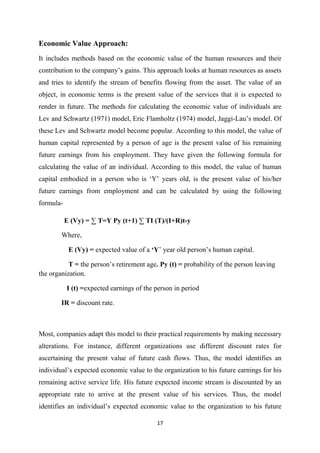
Lev and Schwartz (1971) model, Eric Flamholtz (1974) model, Jaggi-Lau’s model. Of
these Lev and Schwartz model become popular. According to this model, the value of
human capital represented by a person of age is the present value of his remaining
future earnings from his employment. They have given the following formula for
calculating the value of an individual. According to this model, the value of human
capital embodied in a person who is ‘Y’ years old, is the present value of his/her
future earnings from employment and can be calculated by using the following
formula-
E (Vy) = ∑ T=Y Py (t+1) ∑ TI (T)/(I+R)t-y
Where,
E (Vy) = expected value of a ‘Y’ year old person’s human capital.
T = the person’s retirement age. Py (t) = probability of the person leaving
the organization.
I (t) =expected earnings of the person in period
IR = discount rate.
Most, companies adapt this model to their practical requirements by making necessary
alterations. For instance, different organizations use different discount rates for
ascertaining the present value of future cash flows. Thus, the model identifies an
individual’s expected economic value to the organization to his future earnings for his
remaining active service life. His future expected income stream is discounted by an
appropriate rate to arrive at the present value of his services. Thus, the model
identifies an individual’s expected economic value to the organization to his future
18
earnings for his remaining active service life. His future expected income stream is
discounted by an appropriate rate to arrive at the present value of his services. Besides
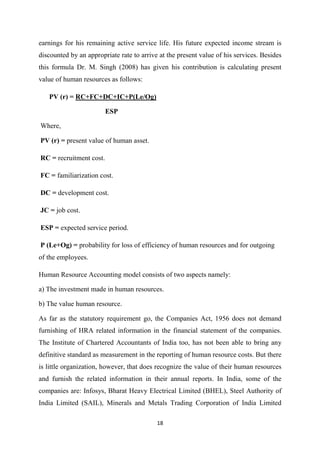
this formula Dr. M. Singh (2008) has given his contribution is calculating present
value of human resources as follows:
PV (r) = RC+FC+DC+IC+P(Le/Og)
ESP
Where,
PV (r) = present value of human asset.
RC = recruitment cost.
FC = familiarization cost.
DC = development cost.
JC = job cost.
ESP = expected service period.
P (Le+Og) = probability for loss of efficiency of human resources and for outgoing
of the employees.
Human Resource Accounting model consists of two aspects namely:
a) The investment made in human resources.
b) The value human resource.
As far as the statutory requirement go, the Companies Act, 1956 does not demand
furnishing of HRA related information in the financial statement of the companies.
The Institute of Chartered Accountants of India too, has not been able to bring any
definitive standard as measurement in the reporting of human resource costs. But there
is little organization, however, that does recognize the value of their human resources
and furnish the related information in their annual reports. In India, some of the
companies are: Infosys, Bharat Heavy Electrical Limited (BHEL), Steel Authority of
India Limited (SAIL), Minerals and Metals Trading Corporation of India Limited
19
(MMTC), Southern Petrochemicals Industries Corporation of India, Associated
Cement Companies Limited, Madras Refineries Limited, The Hindustan Zinc Limited,
The Oil and Natural Gas Commission, The Cement Corporation of India Limited, etc.
Methods of Valuation of Human Assets:
There are a number of methods suggested for the valuation of human assets. Many of
these methods are based on the valuation of physical and financial assets while others
take into account human consideration. Major methods of valuation of human assets
are historical cost, replacement cost, standard cost, present value of future earnings,
and expected realizable value.
Historical Cost:
Historical cost is based on actual cost incurred on human resources. Such a cost may
be of two types – acquisition cost and learning cost. Acquisition cost is the expense
incurred on recruitment, selection, and placement. While calculating the cost of
recruitment and selection, entire cost is taken into consideration including incurred
on those who are not selected. Learning cost involves expenses incurred on training
and development. This method is very simple in its application but it does not reflect
the true value of human assets. For example, an experienced employee may not
require much training and, therefore, his value may appear to be low though his real
value is much more than what is suggested by historical cost method.
Replacement Cost:
As against historical cost method which takes into account the actual cost incurred on
employees, replacement cost takes into account the notional cost that may be required
to acquire a new employee to replace the present one. In calculating the replacement
cost, different types of expenses are taken into account which may be in the form of
acquisition and learning cost. Replacement cost is generally much higher than the
historical cost. For example, Friedman (2000) has estimated that the replacement cost
of an executive in middle management level is about 1.5 to 2 times the current salary
20
paid in that position. Replacement cost is much better indicator of value of human
assets though it may present certain operational problems. For example, true
replacement of a person may not be found easily with whose cost whose cost the
valuation is done.
Standard Cost:
Instead of using historical or replacement cost, many companies use standard cost for
the valuation of human assets just as it is used for physical and financial assets. For
using standard cost, employees of an organization are categorized into different
groups based on their hierarchical positions. Standard cost is fixed for each category
of employees and their value is calculated. This method is simple but does not take
into account differences in employees put in the same group. In many cases, these
differences may be quite vital.
Present Value of Future Earnings:
In this method, the future earnings of various groups of employees are estimated up to
the age of their retirement and are discounted at a predetermined rate to obtain the
present value of such earnings. This method is similar to the present value of future
earnings used in the case of financial assets. However, this method does not give
correct value of human assets as it does not measure their contributions to achieving
organizational effectiveness.
Expected Realisable Value:
The above methods discussed so far are based on cost consideration. Therefore, these
methods may provide information for record purpose but do not reflect the true value
of human assets. As against these methods, expected realizable value is based on the
assumption, and this is true also. That there is no direct relationship between costs
incurred on an individual and his value to the organization at a particular point of
time. An individual’s value to the organization can be defined as the present worth of
the set of future services that he is expected to provide during the period he remains in
the organization. Flamholtz has given the variables affecting an individual’s expected
realizable value (IERV): individual conditional values and his likelihood of remaining
21
in the organization. The former is a function of the individual's abilities and activation
level, while the latter is a function of such variable as job satisfaction, commitment,
motivation.
Human Resource Accounting (HRA) Advantages:
Many organizations, particularly in the USA, are following the human resource
accounting approach. In our country, too, there is a need for establishing systems
which can generate monetary and non-monetary information about human beings in
the organizations, particularly about managerial talents whose dearth is felt by
business organizations. This is due to the fact that human resource accounting offers
following advantages:
• It helps in giving valuable information to the management for effective
planning and managing human resources.
• It helps in measurement of standard cost of recruitment, selecting, hiring, and
training people and organization can select a person with highest expected
realizable value.
• Human resource accounting can change the attitude of managers completely,
thereby; they would try to maximize the exempted value of human resources
and effective use of human resources in the organization.
• It also provides necessary data to devise suitable promotion policy, congenial
work environment, and job satisfaction to the people.
Human Resource Accounting (HRA) Problems:
There are certain operational problems in human resource accounting because it
attempts to measure intangibles. Therefore, subjective factors may play crucial role.
Thus, the major operational problems involved in human resource accounting are of
the following types:
• There is no well-set standard accounting practice for measuring the value of
human resources. In the case of financial accounting, there are certain specified
standards which every organization follows. However, in the case of human
22
resource accounting there are no such standards. Therefore, various
organizations that adopt human asset valuation use their own models. With the
result, value of human assets of two organizations may not be comparable.
• The valuation of human assets is based on the assumption that the employees
may remain with the organization for certain specified period. However, this
assumption may not hold true in today’s context because of increased human
resource mobility.
• There is a possibility that human resource accounting may lead to the
dehumanization in the organization if the valuation is not done correctly or
results of the valuation are not utilized properly.
• There is also a possibility that trade unions may oppose the use of human
resource accounting. They may want party of wages/salaries with value of
employees.
However, many of these problems are of operational nature or if attitudinal
nature. These may be overcome by developing suitable organizational climate
and culture.
References:
(1) Eric G. Flamholtz (1974). Human Resource Accounting, Elcino, Cliff;
Dickenson Publishing.
(2) Parameswaram R., and Jothi K. (2005). “Human Resource Accounting”,
Accounting, January pp. 867-874
(3) Rensis Likert and David G. Bowers (1969). “Organization Theory and
Human Resources Accounting”, Psychologist, Vol. 24, pp. 582-592.
(4) Singh M. (2008). “Human Resource Accounting Challenge for Accountant,
Shodh Samiksha aur Mulyankan, International Research Journal, November.
(5) Prasad, L. M. (2010). “Principles and Practice of Management”, Sultan
Chand & Sons, Educational Publishers, New Delhi, pp. 852-856.
(6) American Accounting Association (1980). Terms and Concepts in
Accounts, New York.
(7) Bhat, V.P. (2000, January 13). India: Towards transparency and uniformity.
Business line. Chennai, l.
23
(8) Mahalingam, S. (2001),Of human capital. Praxis, Business Line. Meeting,
D.T., Luecke,R.W. &
(9) Garceau, L.(2001).Future cash flow measurements. Journal of
Accountancy, 192(4), 57-67.
(10) Moore, R. (2007). Measuring how ‘human capital’ appreciates in value
over time. Plant Engineering 61(4), 29.
(11) Sveiby, Karl E. (1997). The New Organizational Wealth. San Francisco:
Berrett-Koehler. 1997.
(12) Patra R., Khatik, 5K. & Kolhe, M. (2003). Human resource accounting
policies and practices: A case study of Bharat Heavy Electricals Limited,
Bhopal, India. International Journal of Human Resources Development and
Management, 3 (4), 285.
24
Chapter III
An Introduction to Civil Aviation Industry
Civil Aviation:
Civil aviation is one of two major categories of flying, representing all non-
military aviation, both private and commercial. Most of the countries in the world are
members of the International Civil Aviation Organization (ICAO) and work together
to establish common standards and recommended practices for civil aviation through
that agency.
Civil aviation includes two major categories:
• Scheduled air transport, including all passenger and cargo flights operating on
regularly scheduled routes; and
• General aviation (GA), including all other civil flights, private or commercial
Some countries also make a regulatory distinction based on whether aircraft are flown
for hire like:
• Commercial aviation includes most or all flying done for hire, particularly
scheduled service on airlines; and
• Private aviation includes pilots flying for their own purposes (recreation, business
meetings, etc.) without receiving any kind of remuneration.
All scheduled air transport is commercial, but general aviation can be either
commercial or private. Normally, the pilot, aircraft, and operator must all be
authorized to perform commercial operations through separate commercial licensing,
registration, and operation certificates.
25
Civil Aviation in India:
Aviation sector in India has been transformed from an over regulated and under
managed sector to a more open, liberal and investment friendly sector since 2004
Entry of low cost carriers, higher house hold incomes, strong economic growth,
increased FDI inflows, surging tourist inflow, increased cargo movement, sustained
business growth and supporting government policies are the major drivers for the
growth of aviation sector in India. Forecasts by AAI for the next 5 years have
projected a sustainable growth rate of 16% for international and 20% for domestic
aviation sector. Recognizing the exponential growth of air traffic in India, the Ministry
of Civil Aviation has been following a very liberal policy in the exchange of capacity
entitlements / traffic rights. Domestic airlines have been allowed to fly overseas, forge
partnerships with foreign carriers while foreign carriers in turn have been interlining
with domestic airlines to access secondary destinations. The government has also tried
to ensure an environment conducive for growth of all stakeholders associated with
Indian aviation segment. With the rise in the number of airlines, growing passenger
segment and route expansion, there is however a need for Indian airports to have their
infrastructure in lace, which unfortunately at present is the weakest link in the chain.
Greenfield and modernisation projects are being developed on PPP model to develop
facilities conforming to international standards and to encourage the domestic
operators to shift base, so as to decongest major airports. To monitor the quality of
services rendered by various airports and their tariff, an independent regulator, Airport
Economic Regulatory Authority (AERA), is proposed to be appointed. To ensure
competitive practices in ground handling services, the government has proposed
adoption of a new ground handling policy from January 2009. Global and domestic
aircraft manufacturers are upbeat on the aircraft demands from India. Non scheduled
services have also steadily picked up and are growing at a CAGR of 19% primarily
driven by a sustained growth in the economy and facilitated by the need of Indian
corporate captains to invest in more productive hours every day. In addition, total
cargo traffic of all airports has increased from 10% during 2006-07 to 14% in 2007-
08, recording a CAGR of 13% for last six years. With the growth in the passenger and
aircraft traffic in India, there has also been a significant focus on requirement of
26
maintenance, repair and overhaul (MRO) facilities. The Indian MRO market is
growing at about 15% annually. However, on the manpower front, currently there is a
shortage of qualified pilots and other technical staff including Aircraft Maintenance
Engineers and Air Traffic Controllers. While there are a lot of new avenues in
aerospace services in the coming decades, the constraints associated need to be
addressed to enable the smooth growth of the sector. Some of the issues faced by the
sector include mounting losses of the airlines, rising aviation fuel prices, congestion at
airports, shortage of qualified pilots and technical manpower, up gradation of security,
land acquisition, high taxation, high airport charges etc. There is a need to study the
causes of the issues and address the same thereby paving an unobstructed growth path
for the various opportunities requirement of maintenance, repair and overhaul (MRO)
facilities. The Indian MRO market is growing at about 15% annually. However, on the
manpower front, currently there is a shortage of qualified pilots and other technical
staff including Aircraft Maintenance Engineers and Air Traffic Controllers.
While there are a lot of new avenues in aerospace services in the coming decades,
the constraints associated need to be addressed to enable the smooth growth of the
sector. Some of the issues faced by the sector include mounting losses of the airlines,
rising aviation fuel prices, congestion at airports, shortage of qualified pilots and
technical manpower, up gradation of security, land acquisition, high taxation, high
airport charges etc. There is a need to study the causes of the issues and address the
same thereby paving an unobstructed growth path for the various opportunities.
A country‘s transportation sector plays an integral role in the growth and
development of an economy. According to the ―Indian Aerospace Industry Analysisǁ
report, in terms of passenger traffic, India is currently the ninth largest aviation market
in the world. With regards to air cargo tonnage, India leads the South Asian region -
consisting of Afghanistan, Bangladesh, Bhutan, India, the Maldives, Nepal, Pakistan
and Sri Lanka. Currently, India has 128 airports - including 15 international airports.
Over the past ten years the Indian civil aviation sector grew by 14.2% in terms of
domestic passengers and 7.8% in terms of air cargo (in CAGR - compound annual
growth rate).5 In 2010- 11 six major Indian carriers with around 400 aircraft catered
to 143 million passengers, including 38 million passengers that originated abroad. In
27
2010-11, Indian airlines carried approximately 1.6 million tons of air cargo. Further
growth of the aviation sector between 2011- 2013 is estimated at 15%. India‘s civil
aviation sector has evolved over time. On February 18, 1911 India‘s first commercial
airplane flew between Allahabad and Naini. In 1912, India‘s first commercial
international flight operated by the erstwhile Imperial Airways took place and
connected Delhi to Karachi and beyond. In 1932, J.R.D. Tata flew an air mail service
airplane, after which Tata Airlines ventured into scheduled air transport services.
At the time of India‘s independence in 1947, nine air transport companies,
carrying both air cargo and passengers, operated in the country. To further strengthen
the national aviation sector, the Government of India and Air India - Tata Airlines was
renamed Air India in 1946 – set up a joint sector company, Air India International Ltd.
In order to address the deteriorating financial health of India‘s civil aviation sector, the
Government of India passed the Air Corporations Act of 1953, which nationalized all
carriers providing services within India‘s civil aviation industry. Up until the late
1980s, India‘s civil aviation sector remained monopolized by India‘s government
owned airlines. However in 1986, the Indian government once again granted
permission to private sector companies to provide air taxi service. Additionally,
India‘s Open Sky Policy of 1990 and the Air Corporations (Transfer of Undertakings
and Repeal) Act of 1994. further freed up India‘s civil aviation industry and eradicated
the government carrier monopoly.
While these policy changes led to a dramatic increase in the number of private
airline carriers; due to viability issues, by the end of the 20th century all private air
carriers, except Jet Airlines and Air Sahara, exited the market. In 2003 the
introduction of a new type of airline service called low cost carriers - LCCs or no frills
air service - by Air Deccan, reinvigorated India‘s civil aviation sector. By bringing
competition into the Jet Airlines-Air Sahara duopoly, Air Deccan brought a new
competitive spirit to India‘s civil aviation. Furthermore, introduction of low cost
airlines also changed the perception that air travel was reserved only for the elites. By
2007 mergers and acquisitions became common in India‘s civil aviation sector. Within
a span of two years Air India and Indian Airlines merged, as did Jet Airways and Air
Sahara, and Kingfisher Airlines and Air Deccan. Currently, India maintains bilateral
28
Air Service Agreements (ASAs) with 108 countries. While 72 foreign airlines fly in
and out of India,16 four private domestic carriers - Jet Air, Indigo, SpiceJet17 and
Kingfisher - fly to 35 destinations in 25 countries. Air India, the national carrier
maintains a number of international routes: seven destinations in North America, nine
destinations in Europe, 12 destinations in the Gulf, two destinations in the Middle
East, two destinations in Africa, and 13 destinations in West and East Asia. Recently,
India‘s Ministry of Civil Aviation hosted 65 International Civil Aviation member
nations (ICAO) at the 4th International Civil Aviation Negotiation Conference (ICAN
2011) during the week of 17 October 2011. The conference provided a forum for
nations to amend and modernize existing ASAs. While India‘s international carriers
lobbied the Indian government to
Allow them to run more flights to Oman, Saudi Arabia and Hong Kong,
representatives from the Persian Gulf lobbied the Indian government for additional
seats.
Developments in the Indian Aviation Industry:
As India‘s civil aviation sector developed and evolved over time, in order to guide
market participants the Ministry of Civil Aviation and Government of India
periodically responded to new industry challenges by setting up and amending
existing regulatory frameworks. Until 1994 the Directorate General of Civil Aviation
(DGCA) controlled every aspect of flying including the licensing of pilots, certifying
aircraft and issuing all rules and procedures governing Indian airports and airspace.
However, in 1994 an Act of Parliament established the Airports Authority of India
(AAI). This Act gave the AAI the power to manage all national and international
airports and administer every aspect of air transport operation through the air traffic
control. In 2008, the Airports Economic Regulatory Authority of India Act established
the Airports Economic Regulatory Authority (AERA) of India. AERA regulates tariffs
and other aeronautical charges, as well as monitors airports‘performance standards.
Within the Indian context of airport regulation, AERA takes the following things into
consideration: airports are natural monopolies; airports are public goods, both in the
case of Brownfield and Greenfield airports the Government of India has made land
29
available for acquisition, often under the Land Acquisition Act, to airport developers
at a very low cost. Lastly, the same Act established the Appellate Tribunal which
handles appeals from service providers and consumer groups.
Market Structure and Competition Issues:
According to economic theory, market structures range from a perfectly competitive
market to a monopoly. A perfectly competitive market is one where there are
numerous producers selling the same product or service to a very large number of
customers. Each producer supplies the good or service to a fraction of the market and
hence does not have any influence on the market price. Competition among the
suppliers drives the prices down to a point where they just recover their average cost.
On the other hand, in a monopoly there exists only one producer/service provider.
The monopolist has the ability to set the price by restricting the output. This in turn
results in the consumers being worse off than in a perfectly competitive market where
consumers enjoy the benefits of competition among the producers. A market structure
that falls between the two extremes - perfect competition and monopoly - is an
oligopoly. In an oligopoly there are few suppliers who control a significant share of
the market. Pricing in an oligopoly falls between a perfectly competitive market where
the market players have no pricing power and a monopoly where a single producer
can fix the highest price possible, subject to demand. Competition in an oligopoly can
lead to two outcomes. Producers can engage in ‗ruinous competition, to the detriment
of all of them, or set output and prices taking into account the market conditions and
the reactions of their competitors. The non-competitive outcome of an oligopoly is
cartel behaviour, i.e., when producers/service providers explicitly agree to coordinate
their output and pricing decisions to mimic the behaviour of a monopolist. There are
no civil aviation markets in the world that could be characterized as a perfectly
competitive market. Generally civil aviation markets exhibit either monopolistic or
oligopolistic market characteristics. The Indian civil aviation market post deregulation
can be characterized as an oligopoly. Keeping in mind the characteristics of the
oligopolistic market structure, the regulator of such a market needs to engage in
positive regulation that both creates a level competitive playing field and mitigates
30
anti-competitive behaviour of market participants. In order to mitigate anticompetitive
behaviour regulation should ensure the reduction of artificial and natural barriers to
market entry, to the extent that this is practically possible. Furthermore, the regulator
would need to ensure that regulation does not create artificial barriers to entry. In
order to monitor firms‘behaviour, assess whether or not anti-competitive behaviour is
taking place, the regulator needs to put in place a system that allows the agency to
collect and analyze market information. Lastly, the regulator needs to install
regulatory mechanisms ensuring transparency in behaviour of market participants.
India’s Civil Aviation - Market Structure:
India‘s civil aviation sector is much younger than other modes of transportation,
and its market structure has changed frequently over the last few decades. India‘s civil
aviation sector evolved from a market tightly controlled by the government with two
air carrier service providers to a relatively competitive market with a somewhat small
number of domestic and international air carriers. Some features of India‘s civil
aviation sector include a large number of consumers (passengers and cargo), a
relatively small number of airlines with significant market share, significant cost
barriers to market entry, differentiated services, and competitive firms affecting each
other‘s business decisions. These market characteristics indicate that India‘s civil
aviation sector has an inherent oligopolistic market structure. Since within India‘s
civil aviation sector, economies of scale and scope exist; in order for each market
participant to break even, the firm must achieve a minimum efficient scale of
operation. The key characteristics of India‘s aviation sector are as follows:
31
Market Share by Airlines
Source DGCA
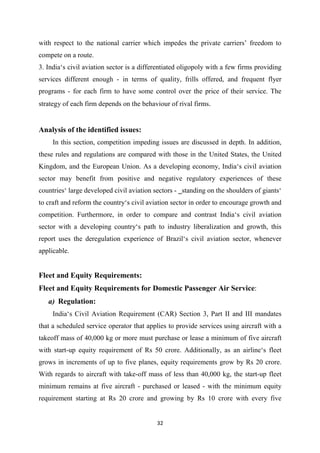
1. A small number of large carriers such as Air India, Go Air, IndiGo, Spice Jet, and
Jet dominate this industry. Currently, India‘s civil aviation sector is made up of just
six domestic air carriers with each maintaining a market share of at least five percent.
The top four firms‘concentration ratio adds up to 81.3% and the Herfindahl-
Hirschman Index (HHI) stands at 1,905. A high four firm concentration ratio and HHI
above the 1,800 benchmark, indicates a high degree of concentration within the
industry. This type of market concentration can be defined as a tight oligopoly, where
India‘s four firms hold more than 60% of the market share.
2. Barriers to market entry in India‘s civil aviation sector include a high mortality rate
within the airline business with respect to both regular and low cost private carriers.
Additionally, during the gestation period, a private carrier needs adequate staying
power to buy aircraft and capacity in order to absorb initial operating losses.
Furthermore, to succeed, new market entrants must be able to absorb market entry
costs (sunk costs27 in nature) and withstand the incumbents’ response to the entry of a
new competitor. Other important barriers to entry include capacity and investment
constraints, as well as the absence of a level playing field or competitive neutrality
32
with respect to the national carrier which impedes the private carriers’ freedom to
compete on a route.
3. India‘s civil aviation sector is a differentiated oligopoly with a few firms providing
services different enough - in terms of quality, frills offered, and frequent flyer
programs - for each firm to have some control over the price of their service. The
strategy of each firm depends on the behaviour of rival firms.
Analysis of the identified issues:
In this section, competition impeding issues are discussed in depth. In addition,
these rules and regulations are compared with those in the United States, the United
Kingdom, and the European Union. As a developing economy, India‘s civil aviation
sector may benefit from positive and negative regulatory experiences of these
countries‘ large developed civil aviation sectors - ‗standing on the shoulders of giants‘
to craft and reform the country‘s civil aviation sector in order to encourage growth and
competition. Furthermore, in order to compare and contrast India‘s civil aviation
sector with a developing country‘s path to industry liberalization and growth, this
report uses the deregulation experience of Brazil‘s civil aviation sector, whenever
applicable.
Fleet and Equity Requirements:
Fleet and Equity Requirements for Domestic Passenger Air Service:
a) Regulation:
India‘s Civil Aviation Requirement (CAR) Section 3, Part II and III mandates
that a scheduled service operator that applies to provide services using aircraft with a
takeoff mass of 40,000 kg or more must purchase or lease a minimum of five aircraft
with start-up equity requirement of Rs 50 crore. Additionally, as an airline‘s fleet
grows in increments of up to five planes, equity requirements grow by Rs 20 crore.
With regards to aircraft with take-off mass of less than 40,000 kg, the start-up fleet
minimum remains at five aircraft - purchased or leased - with the minimum equity
requirement starting at Rs 20 crore and growing by Rs 10 crore with every five
33
additional aircraft. For non-scheduled operators, the fleet requirements as stated in
Civil Aviation Requirement Section 3, Series C, Part III Section 4.2 are minimal -
requires possession of just one aircraft - there exist equity requirements based on the
number of aircraft owned or leased by the operator, which create an additional
financial barrier to entry.
b) Impact on Competition:
Given that the cost of entry into the civil aviation sector is naturally high (even in
the absence of fleet and equity requirements), these regulations unnecessarily raise
barriers to entry. Therefore, fleet and equity requirements instituted by these
regulations limit not only the number of new market entrants, but also the size of firms
that enter, as they should possess enough capital to fulfill these requirements.
Incumbent market participants are cognizant of these barriers, thus their business
decisions take into account a reduced chance of new market competitors that may
potentially enter and reduce the incumbent carriers‘ market share. Since all market
participants will likely come to similar conclusions, incumbent market participants
will feel no urgency to change their prices, services and business models. In the case
of India‘s civil aviation sector, there are relatively few market participants, who are
fairly large service providers and are generally familiar with their competitors‘
strategies, tactics and pricing. Without new and unfamiliar competitors entering the
market, there
Exists no incentive to change the way these established airlines operate and therefore,
customer service and choice are adversely affected.
c) Comparison-International and Cargo Regulations in India:
In countries like Australia, the European Union and the United States, the fleet
requirement is minimal (one aircraft) and equity requirements do not exist; rather
financial viability of the potential entrant is taken into consideration.33 For example,
the US Federal Aviation Administration (FAA) requires financial information
regarding assets and liabilities, ongoing litigation, insurance policy
Information, as well as a six month plan of operation from applicants for the Air
Carrier Certificate.35 Similarly, both Australia and EU require no fixed paid-up
34
capital; potential market entrants must only provide information on the firms‘financial
background.
These international regulations are similar to India‘s operational requirements for
cargo air carriers. An Indian company that wants to engage in providing air cargo
carrier services needs a minimum of one plane - leased or purchased - and has to
submit details of proposed operations, a project feasibility report, proposed financial
structure, proof that the applicant firm can run air cargo services on a sustained basis,
and a timeline of the firm‘s proposed realization of various stages of the project. The
Civil Aviation Requirement Section 3, Series C, Part IV, states that barriers to entry
for cargo air carrier services have been removed. According to AERA‘s assessment of
the size of India‘s civil aviation sector, the minimum fleet requirements were
introduced to ensure that only viable carriers enter the market; competition within the
sector was not a priority at that time.36 However, there are instances in other countries
where a viable airline started its operation with a single aircraft.
d) Recommendation:
While minimum fleet and equity requirements, with respect to air carrier service
providers are one way of assessing the firms’ viability in the market, we suggest an
alternative approach. Instead of fleet and equity requirements, new and incumbent air
carrier service providers can submit financial information which establishes their
financial viability and illustrates how they plan on succeeding within the civil aviation
sector. Financial disclosures of potential airlines should demonstrate the new entrant‘s
knowledge of India‘s aviation sector‘s dynamics and adequate liquidity to cover
aviation business startup and initial operational costs. As in the United States‘, UK
Europe, Australia in order to demonstrate viability potential air carriers in India
should disclose assets, liabilities, past and ongoing litigation, and operational
insurance. Furthermore, new market entrants should also submit a concrete six month
or yearlong business plan detailing how the firm plans to finance its operational
expenses. Lastly, India‘s cargo sector regulations can serve as a model for reduction
of artificial barriers to entry in the industry.
35
Fleet, Equity and Experience Requirements for International Air Transport
A. Regulation:
According to the Aeronautical Information Circulars No. 08 of 2009, a domestic
carrier that wishes to start international air carrier service must fulfil the following
conditions: possess a valid permit of operation, lease or purchase at least 20 aircraft
and have at least five years domestic scheduled transport experience.
B. Impact on Competition:
Such fleet, equity and experience requirements deter entry and thereby reduce
consumer choice of international passenger air carriers. For example, from 2004 to
2010 the Indian government raised capacity entitlements for international carriers
four-fold; however, Indian carriers were unable to take advantage of this increase,
because these carriers did not have enough planes - as required by Civil Aviation
Requirements (CAR) - while foreign carriers such as Emirates benefited from this
policy tremendously. Consumers choose from a limited number of passenger air
carriers and if they find their current airline service provider unsatisfactory, their
choice of another service provider is constrained by the relatively small number of
carriers. For example, currently, a passenger who wishes to fly directly to Paris
chooses from two international carriers: Air India and Air France. Jet Air has thus far
unsuccessfully sought flying rights to Paris from the Indian government.38
Furthermore, due to prevailing market conditions, these incumbents have lower
incentive - than their domestic counterparts in other countries - to significantly change
their operations in order to maintain their customer base as well as attract new
customers. Furthermore, the Open Sky policy allows foreign airlines into India as long
as they abide by Indian safety regulations and are licensed by their home country,
which may not require minimum 20 aircraft fleet size and five years operational
experience. In effect, this policy creates a two-tier competitive environment for
international carriers - foreign and Indian - putting Indian domestic carriers that want
to provide international services at a disadvantage.
36
C. International Comparison:
In Australia, the United States, and the European Union, a carrier needs to show
financial viability and operational income to implement the firm‘s business plan; no
explicit equity or fleet requirement exists. For example, in order to provide
international air carrier service, a US carrier must only comply with the air traffic
rules of the foreign country, the pertinent U.S. airports‘ rules, and other regulations
related to safety and environment.39 EU regulations40 require an operational history
of only two years.
D. Recommendation:
The current state of the civil aviation sector in India indicates that air traffic has
increased considerably in the past few years and removing historic barriers to entry
would infuse competition into the sector and expand the provision of air carrier
services as recommended by Naresh Chandra in his "Competition Issues in Civil
Aviation sectorǁ report.42 Therefore, the regulator may want to consider removing
fleet, equity and experience requirements for international carrier service providers.
Specifically, equity requirements should be replaced by requirements for carrier
service providers to demonstrate financial viability, using India‘s cargo service sector
as well as international practices as models of reform.
Air Traffic Forecast for Indian Aviation:
Results of Air Passenger Traffic Forecasts:
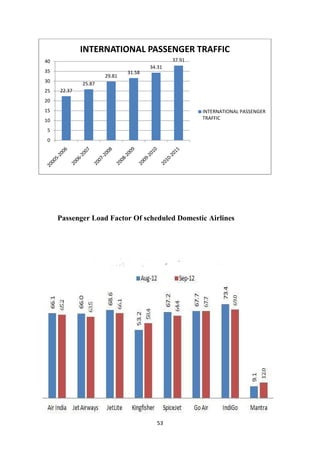
Domestic air traffic that would be carried by Scheduled Carriers in India in 2020-
2021 is set to cross 159 Million Passengers as against 54 Million in 2010 -11
suggesting a growth of approximately three times the present traffic in ten years. In
fact Domestic Passengers carried grew 3.9 times during the previous decade i.e. 2000-
01 to 2010-11. International passengers to and from India by 2020-21 will be 92
Million implying a growth of about 2.4 times the traffic of 38 Million in 2010-11. The
decade 2000-01 to 2010-11 witnessed a growth of 2.7 times in international segment.
Forecast for 2031-32 suggests that domestic air passengers to be carried in India will
be 448 Million. For the same year international passengers will be 237 Million
(excluding transhipment passengers). GDP elasticity of 1.5 in case of domestic
37
passengers and global income elasticity of 3.1 in case of international passengers is
applied to derive the numbers for domestic and international segments of air traffic.
Domestic passenger traffic is relatively less sensitive to domestic GDP as compared to
international passenger traffic to global GDP.
Comparison of Results with Forecast Made by Other Agencies:
Overall air traffic is set to grow at an annual average growth rate of 10.1% in the
next two decades. Over the period from 2010-11 to 2020-21 the rate of growth will be
10.7%. Domestic traffic growth will be higher at 11.4% than International traffic to
and from India at 9.5% for the next 20 years. This pattern is consistent with the long
term trends noticed in India for the last 20 years i.e.1990-91 to 2010-11. Air Bus39
Forecast made for India arrived at a growth rate of 9.8% for twenty years from 2009-
2029 in respect of domestic revenue passengers which is also closer to the annual
average growth rate for the period covering 2010-2030 in this exercise. CAPA40 has
forecast that 180 Million domestic and 90 Million International passengers will be
there for India by 2020.
Forecasts obtained from our econometric modeling exercise are in line with the
forecasts obtained by independent agencies like CAPA where the estimates
correspond to the most likely scenario as exhibited in. According to MOCA estimates,
the domestic passenger carried would be 159 million, international passenger carried
would be 96.5 million and total throughput would stand at 415 million by the year
2020-21.
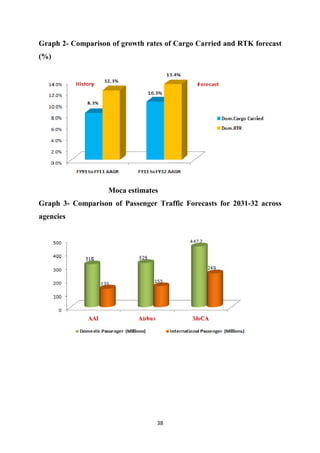
Similarly, forecasts of independent agencies have been compared with those of
MOCA estimates in Graph 2 for the year 2031-32. It states that the domestic
passenger traffic will push the overall passenger traffic in comparison to the
international passenger traffic to and from India.
38
Graph 2- Comparison of growth rates of Cargo Carried and RTK forecast
(%)
Moca estimates
Graph 3- Comparison of Passenger Traffic Forecasts for 2031-32 across
agencies
39
Graph 4- Comparison of RPK and Domestic Air Passenger (Carried)
growth rates
Average annual growth rate of domestic passenger carried historically in the last 20
years has been 10.4% and is expected to grow at 10.6% in the next 20 years according
to MOCA estimates. On the other hand, domestic RPK grew at an annual average
growth rate of 12.5% in the last 20 years and is expected to grow at 13.7% in the next
20 years.
It is evident that domestic RPK has grown in the past and is expected to grow at a
faster rate in future in comparison to domestic passenger carried indicating that
passenger traffic growth alone will not reflect the actual utilization of air transport
during a phase when market is growing. Newer areas of growth in context of air traffic
have emerged in the last 20 years and in the next 20 years newer regions are expected
to emerge. With newer destination pairs being added aggressively by airlines
especially in Tier II and Tier III markets, faster growth in domestic passenger carried
due to affordability of air transport, rising personal disposable income and growing
urban young middle income population will push up the growth rate in domestic RPK.
Over the long haul, air travel will increasingly be the preferred mode of transport
without the prospect of intermodal substitution. Such a comparison for international
passenger traffic could not be carried out due to non-availability of RPK for
international passengers.
40
Results of Air Cargo Traffic Forecasts:
Modelling, the domestic and international cargo traffic is forecasted keeping
domestic GDP as an explanatory variable. For the forecast of air cargo traffic from
2011-12 to 2031-32, GDP growth rate assumptions are the same as the ones used for
passenger forecast discussed earlier. Elasticity coefficients obtained from the
econometric exercise are 1.39 for domestic Using econometric cargo and 1.37 for
international cargo. A sensitivity analysis has been undertaken; the results for the
same are given in Annex III. The forecast numbers that have been used in this report
pertain to the Base Case scenario. (For details on econometric model see Annex III)
Domestic cargo, international freight and total cargo traffic are set to grow at a
CAGR of approximately 10-11% till the period 2031-32. Higher domestic cargo
traffic is also indicative of the general health of the economy. Higher cargo volume
indicates greater final consumption, better performance of domestic manufacturing
and services sector. By 2031-32, domestic cargo traffic might witness over two and
half times the traffic of 2020 while the international cargo traffic will also witness
over two times the traffic of 2020-21.
General Aviation:
General aviation may include business flights, air charter, private aviation, flight
training, ballooning, parachuting, gliding, hang gliding, aerial photography, foot-
launched powered hang gliders, air ambulance, crop dusting, charter flights, traffic
reporting, police air patrols and forest fire fighting. General aviation includes all non-
scheduled civil flying, both private and commercial. Each country regulates aviation
differently, but general aviation usually falls under different regulations depending on
whether it is private or commercial and on the type of equipment involved.
Many small aircraft manufacturers serve the general aviation market, with a focus on
private aviation and flight training.
The most important recent developments for small aircraft (which form the bulk of the
GA fleet) have been the introduction of advanced avionics (including GPS) that were
formerly found only in large airliners, and the introduction of composite materials to
41
make small aircraft lighter and faster. Ultra light and homebuilt aircraft have also
become increasingly popular for recreational use, since in most countries that allow
private aviation, they are much less expensive and less heavily regulated than certified
aircraft.
The largest aircraft to be built, to date, is the Antonov An-225. This aircraft
comes from the Ukraine, and it was built back in the 1980s. This aircraft includes 6
engines, mounted on the wing. Its wingspan is 88 metres (289 feet) and it is 84 metres
long (276 feet). This aircraft holds the world payload record, after it transported
428,834 pounds worth of goods. Weighing in at 1.4 million pounds, it is also the
heaviest aircraft to be built.
National:
Many countries have national airlines that the government owns and operates.
Fully private airlines are subject to a great deal of government regulation for
economic, political, and safety concerns. For instance, governments often intervene to
halt airline labour actions to protect the free flow of people, communications, and
goods between different regions without compromising safety.The United States,
Australia, and to a lesser extent Brazil, Mexico, India, the United Kingdom, and Japan
have "deregulated" their airlines. In the past, these governments dictated airfares,
route networks, and other operational requirements for each airline. Since
deregulation, airlines have been largely free to negotiate their own operating
arrangements with different airports, enter and exit routes easily, and to levy airfares
and supply flights according to market demand.
The entry barriers for new airlines are lower in a deregulated market, and so the
U.S. has seen hundreds of airlines start up (sometimes for only a brief operating
period). This has produced far greater competition than before deregulation in most
markets, and average fares tend to drop 20% or more. The added competition, together
with pricing freedom, means that new entrants often take market share with highly
reduced rates that, to a limited degree, full service airlines must match. This is a major
constraint on profitability for established carriers, which tend to have a higher cost
base. As a result, profitability in a deregulated market is uneven for most airlines.
42
These forces have caused some major airlines to go out of business, in addition to
most of the poorly established new entrants.
International:
Groups such as the International Civil Aviation Organization establish worldwide
standards for safety and other vital concerns. Most international air traffic is regulated
by bilateral agreements between countries, which designate specific carriers to operate
on specific routes. The model of such an agreement was the Bermuda
Agreement between the US and UK following World War II, which designated
airports to be used for transatlantic flights and gave each government the authority to
nominate carriers to operate routes.
Bilateral agreements are based on the "freedoms of the air", a group of generalized
traffic rights ranging from the freedom to overfly a country to the freedom to provide
domestic flights within a country (a very rarely granted right known as cabotage).
Most agreements permit airlines to fly from their home country to designated airports
in the other country: some also extend the freedom to provide continuing service to a
third country, or to another destination in the other country while carrying passengers
from overseas.
In the 1990s, "open skies" agreements became more common. These agreements
take many of these regulatory powers from state governments and open up
international routes to further competition. Open skies agreements have met some
criticism, particularly within the European Union, whose airlines would be at a
comparative disadvantage with the United States' because of cabotage restrictions.
Industry Trends:
The pattern of ownership has been privatized in the recent years, that is, the
ownership has gradually changed from governments to private and individual sectors
or organizations. This occurs as regulators permit greater freedom and non-
government ownership, in steps that are usually decades apart. This pattern is not seen
for all airlines in all regions.
43
The overall trend of demand has been consistently increasing. In the 1950s and
1960s, annual growth rates of 15% or more were common. Annual growth of 5-6%
persisted through the 1980s and 1990s. Growth rates are not consistent in all regions,
but countries with a de-regulated airline industry have more competition and greater
pricing freedom. This results in lower fares and sometimes dramatic spurts in traffic
growth. The U.S., Australia, Canada, Japan, Brazil, India and other markets exhibit
this trend. The industry has been observed to be cyclical in its financial performance.
Four or five years of poor earnings proceed five or six years of improvement. But
profitability even in the good years is generally low, in the range of 2-3% net profit
after interest and tax. In times of profit, airlines lease new generations of airplanes and
upgrade services in response to higher demand. Since 1980, the industry has not
earned back the cost of capital during the best of times. Conversely, in bad times
losses can be dramatically worse. Warren Buffett once said that despite all the money
that has been invested in all airlines, the net profit is less than zero. He believes it is
one of the hardest businesses to manage. As in many mature industries, consolidation
is a trend. Airline groupings may consist of limited bilateral partnerships, long-term,
multi-faceted alliances between carriers, equity arrangements, mergers, or takeovers.
Since governments often restrict ownership and merger between companies in
different countries, most consolidation takes place within a country. In the U.S., over
200 airlines have merged, been taken over, or gone out of business since deregulation
in 1978. Many international airline managers are lobbying their governments to permit
greater consolidation to achieve higher economy and efficiency.
Air Traffic Control:
Air traffic control (ATC) involves communication with aircraft to help maintain
separation — that is, they ensure that aircraft are sufficiently far enough apart
horizontally or vertically for no risk of collision. Controllers may co-ordinate position
reports provided by pilots, or in high traffic areas (such as the United States) they may
use radar to see aircraft positions.
There are generally four different types of (ATC) air traffic control:
44
• Centre controllers, who control aircraft en route between airports
• Control towers (including tower, ground control, clearance delivery, and other
services), which control aircraft within a small distance (typically 10–15 km
horizontal, and 1,000 m vertical) of an airport.
• Oceanic controllers, who control aircraft over international waters between
continents, generally without radar service.
• Terminal controllers, who control aircraft in a wider area (typically 50–80 km)
around busy airports.
ATC is especially important for aircraft flying under instrument flight rules (IFR),
where they may be in weather conditions that do not allow the pilots to see other
aircraft. However, in very high-traffic areas, especially near major airports, aircraft
flying under visual flight rules (VFR) are also required to follow instructions from
ATC. In addition to separation from other aircraft, ATC may provide weather
advisories, terrain separation, navigation assistance, and other services to pilots,
depending on their workload.
ATC do not control all flights. The majority of VFR flights in North America are
not required to talk to ATC (unless they are passing through a busy terminal area or
using a major airport), and in many areas, such as northern Canada and low altitude in
northern Scotland, Air traffic control services are not available even for IFR flights at
lower altitudes.
International Civil Aviation Organization (ICAO):
International civil aviation organization is a specialized agency of the United
Nations. It codifies the principles and techniques of international air navigation and
fosters the planning and development of international air transport to ensure safe and
orderly growth. Its headquarters are located in the Quartier
International of Montreal, Quebec, Canada. The ICAO Council adopts standards and
recommended practices concerning air navigation, its infrastructure, flight inspection,
prevention of unlawful interference, and facilitation of border-crossing procedures for
international civil aviation. ICAO defines the protocols for air accident investigation
45
followed by transport safety authorities in countries signatory to the Convention on
International Civil Aviation (Chicago Convention).
The Air Navigation Commission (ANC) is the technical body within ICAO. The
Commission is composed of 19 Commissioners, nominated by the ICAO's contracting
states, and appointed by the ICAO Council. Commissioners serve as independent
experts, who although nominated by their states, do not serve as state or political
representatives. The development of Aviation Standards and Recommended Practices
is done under the direction of the ANC through the formal process of ICAO Panels.
Once approved by the Commission, standards are sent to the Council, the political
body of ICAO, for consultation and coordination with the Member States before final
adoption.
ICAO should not be confused with the International Air Transport
Association (IATA), the trade association for the world’s airlines, also headquartered
in Montreal, or with the Civil Air Navigation Services Organisation (CANSO), an
organization for Air Navigation Service Providers (ANSPs) with its headquarters
at Amsterdam Airport Schiphol in the Netherlands. These are trade associations
representing specific aviation interests, whereas ICAO is a body of the United
Nations.
Air Transport:
There are five major manufacturers of civil transport aircraft :
• Airbus, based in Europe
• Boeing, based in the United States
• Bombardier, based in Canada
• Embraer, based in Brazil
• United Aircraft Corporation, based in Russia
Boeing, Airbus, Ilyushin and Tupolev concentrate on wide-body and narrow-body
jet airliners, while Bombardier, Embraer and Sukhoiconcentrate on regional airliners.
Large networks of specialized parts suppliers from around the world support these
manufacturers, who sometimes provide only the initial design and final assembly in
46
their own plants. The Chinese ACAC consortium will also soon enter the civil
transport market with its ACAC ARJ21 regional jet.
Until the 1970s, most major airlines were flag carriers, sponsored by their
governments and heavily protected from competition. Since then, open
skies agreements have resulted in increased competition and choice for consumers,
coupled with falling prices for airlines. The combination of high fuel prices, low fares,
high salaries, and crises such as the September 11, 2001 attacks and the SARS
epidemic have driven many older airlines to government-bailouts, bankruptcy or
mergers. At the same time, low-cost carriers such as
Ryanair, Southwest and Westjet have flourished.
Reference:
(1) Papers and Newspaper Articles: AAI Materials Management Manual
2005<http://www.aai.aero/righttoinformation/MATERIALS_MANAGEMENT_MA
NUAL.
(2) Airlines shares rally as minister says FDI is under considerationǁ NDTV Profit 19
October 2011.
http://profit.ndtv.com/news/show/airlines-shares-rally-as-minister-says-fdi-is-
underconsideration
(3) Airportsǁ, Indian Business Equity Foundation, November 2010
(4) ―Airports Economic Regulatory Authority of India Actǁ, 2008
(5) ―Airport Slot Allocation: The Commission clarifies the existing rulesǁ European
Commission, Brussels 30 April 2008. http://europa.eu/rapid/pressReleasesAction.
(6) Airports Economic Regulatory Authority Order No.13 of 2010-11<
http://www.aera.gov.in
(7) Airports to light up for 100 years of aviationǁ, Times of India, 15 February 2011
<http://articles.timesofindia.indiatimes.com/2011-02-15/mangalore.
47
(8) Boyfield, Keith (editor), Bass, Tom, Humphreys, Barry, and Starkie ―A Market
in Airport Slots Institute for Economic Affairs 2003
<http://www.slottrade.aero/library/IEA%20A%20Market%20In%20Airport%20Slots.
(9) Brough, Wayne, Clarke, Edward and Tideman, Nicolaus ―Airport Congestion
and Noise: Interplay of Allocation and Distributionǁ Transportation Research Record,
National Academy Sciences (1450), 1995, pp 3-7)
<http://clarke.pair.com/ANCW.html#N_2_ >
(10) Carlson Dylan, Farouq Nadine, Shepherd Justin, ―Global FDI Trends an
International Trade and Investment Policy Capstone Projectǁ, The U.S. Department of
Commerce International Trade Administration , 17 April 2009
<http://elliott.gwu.edu/assets/docs/acad/itip/globalFDI_commerce_ita.
(11) Central Vigilance Commission‘s (CVC‘s) Observationsǁ Indian Institute of
Materials and Management <http://www.iimm.org/knowledge_bank/10_central-
vigilance-commission observation-july.htm.
(12) Competition Issues in the Air Transport Sector in Indiaǁ, Competition
Commission of India ―Cost of ATF in Indiaǁ Federation of Indian Airlines
<http://www.fiaindia.in/Cost_of_ATF.htm.
48
Chapter IV
Human Resource Accounting In Air India
Air India:
Scheduled air services in India began in October 1932 under the Aviation
Department of Tata Sons Ltd, which was succeeded by Tata Airlines. This was
subsequently renamed in July 1946 as Air India Ltd., and incorporated as Air India
International Ltd. in March 1948. In 1953, the Air Corporations Act was passed. Air
India International Ltd. was nationalised, and two corporations came into existence –
Indian Airlines Corporation (as the national domestic carrier) and Air India (as the
international carrier). In 1994, the Air Corporations Act was repealed, and Air India
Ltd. (AIL) and Indian Airlines Ltd. (IAL) were incorporated under the Companies
Act, 1956. Government-owned airlines dominated the Indian aviation industry till the
mid 1990’s, when, as part of the open sky policy, the Government of India (GOI)
ended the monopoly of AIL and IAL in air transport services, and allowed private
operators to provide air transport services. In March 2007, National Aviation
Company of India Ltd. (NACIL) was incorporated. The scheme of amalgamation of
Air India Ltd. and Indian Airlines Ltd. into NACIL was approved in August 2007,
with the “appointed” date of the merger being set as 1 April 2007. Subsequently, in
November 2010, NACIL was renamed as Air India Ltd. (AI). The administrative
Ministry for these Government airline(s) is the Ministry of Civil Aviation (MOCA).
• J. R. D. Tata founded Tata Airlines in 1932 as a division of Tata Sons Ltd. (now Tata
Group). After World War II, regular commercial service in India went back to normal,
Tata Airlines changing its name to Air India and becoming a public limited company
on the 29th
of July 1946
• On the 8th
of June 1948, Air India introduced a regular service from Bombay to
London, and two years later, Air India started regular flights to Nairobi.
• In 1954, with the delivery of its first L-1049 Super Constellations, Air India
inaugurated services to Tokyo, Bangkok, Hong Kong and Singapore.
49
• In 1960, with the introduction of the first Boeing 707-420 aircraft, Air India started
using jets, and two years later, in June 1962, it became the world's first all-jet airline.
• In 1970, Air India moved its offices to downtown Bombay.
• In 1986, Air India took delivery of the Airbus A310-300, being at that moment the
largest operator of this type in passenger service.
• In 1988, the company started using two Boeing 747-300Ms in a mixed passenger-
cargo configuration.
• In 1993, Air India's first Boeing 747-400, named Konark, operated the first non-stop
flight between New York City and Delhi.
• After a five-year absence from Amsterdam, twice-a-week flights were introduced
from Mumbai (via New Delhi and Frankfurt), on the 3rd
of December 1995.
• In 1996, Air India started using its second US gateway at O'Hare International Airport
in Chicago.
• May 28, 1997 marks the date when Air India came online, its official website
being www.airindia.com. Later on, on the 1st
of November, a major global alliance
tied Air India and Air France.
• Two years later, in 1999, the airline opened its dedicated Terminal 2-C at the newly
renamed Chatrapati Shiva ji International Airport in Mumbai.
• Services to Shanghai and to Air India's third US gateway at Newark Liberty
International Airport in Newark were introduced in the year 2000.
• Starting with 1st
of November 2001, Air India launched its Frequent Flyer program
(“Flying Returns”) for the Canada, UK and USA routes.
• On the 20th
of March 2003, Air India dedicated several special flights to Kuwait, with
the purpose of evacuating Indian citizens from Iraq.
• The year 2003 had another two events important for the airline’s history. Thus, on the
12th
of July, a Global Call Centre for UK and USA was inaugurated in Mumbai.
Secondly, on the 11th
of December, Air India started operating flights to Shanghai
through Bangkok.
• A strategic alliance was signed on the 10th
of August 2004 with Lufthansa.
50
• A year later, in April 2005, was launched Air India Express - Air India’s low cost
airline. Later on, in June, the advance check-in facility became available in Mumbai,
at Air India building (Nariman Point).
• On the 27th
of June 2007, Air India initiated its Cargo service. By the end July, the
airline started carrying non-stop flights to USA.
• Air India was invited to join the Star Alliance in December 2007, and was set to
become a full member in 2010. However, by August 2011 it was considered that Air
India did not meet the minimum standard requirements for membership, so the
invitation was postponed.
• The 1st
of June 2008 marks the date when Air India became 100& electronic ticket
compliant.
• On the 29th
of March 2009, Air India made Frankfurt Airport its European Hub for its
transatlantic North American Operations. In the same years, on the 1st
of December,
the daily non-stop flight on the Delhi - New York route was extended to Washington.
• Although Air India did not carry any flights to Egypt, a special exception was made
on the 12th
of March 2011, when 36 flights were dispatched to evacuate 11.345
stranded Indian civilians from Cairo. This extraordinary measure was taken as a result
of the unstable political climate in Egypt.
• 2012 was a year of significant economic loss, and this influenced the airline’s status
on the Indian aviation market, placing it in the fourth place, behind Jet Airways,
IndiGo and Spicejet.
• Since its operations were initiated, Air India managed to achieve a record of about
6.82 fatal events per million flights. First such accident happened in November 1950,
all 48 people on board dying, and the last one on the 23rd
of June 1985, when a Boeing
747-237B was blown up in mid-air by a suitcase-bomb and all 307 passengers and 22
crew on board perished.
Air India International Sector:
Air India connects to major international destinations across continents. The airlines
international flights are available for American cities like Los Angeles, New York and
Washington, as well as for European destinations like London, Paris and Amsterdam.
51
AI international routes extend to as far as Sydney as well as to nearby Colombo and
Kathmandu. For booking, passengers can always take assistance of AI call centre.
Air India Domestic Sector:
Air India is one of the few airlines that connect different parts of the country through
regular flights. These short-haul routes are connected by Airbus A320 family and
recently, by Boeing 787. There are around 50 cities and towns connected by AI
flights, including Delhi, Mumbai, Chennai, Kolkata, Bangalore, Hyderabad and Pune.
It also connects capital cities, such as Patna, Jaipur, Imphal, Agartala, Bhopal,
Chandigarh, Lucknow and Thiruvananthapuram. Moreover, all the popular tourist
destinations are connected by AI flights, such as Agra, Goa and Leh. For travelling to
these domestic destinations, travellers can easily book tickets online.
Air India Baggage, Flight Status:
Air India has made efforts to make travelling a fun experience for passengers by
offering a range of facilities, including online ticket booking and flight
schedule information. Throughout its history, AI has upgraded its existing services as
well as introduced many to help passengers manage their trip without hassle. Among
its many offerings, the web check in option has made life simpler for travellers. Also,
the availability of flight status as well as information regarding baggage on the web
has proved to be extremely beneficial. There is also free baggage allowance option
available for certain destinations, which not many passengers know about. To know
about all the services and facilities, passengers can check the website. There is also a
call centre managed by Air India in different regions, including India, USA, Canada
and UK for assistance of passengers. They can easily get information regarding
anything, be it ticket booking, routes.
Airport Served for Air India:
There are several international city airports served by Air India, including
Washington, New York, Los Angeles, London, Paris, Zurich, Vienna, Istanbul, Gulf,
Muscat, Colombo, Tokyo, Osaka, Hong Kong, Sydney etc. Besides, innumerable
domestic destinations are connected by Air India airlines, such as Agra, Bhopal,
52
Coimbatore, Dimapur, Goa, Imphal, Jammu, Kochi, Leh, Madurai, Nagpur, Patna,
Ranchi, Shillong, Trichy, Udaipur, Vadodara and many more.
Air India to offer Wi-Fi in Flights:
Debt laden National carrier Air India will have Wi-Fi access aboard its flights
sometime in the future. That is, if the loss making carrier hasn’t sold all of its planes
to pay off debts by then. Of course the Wi-Fi service won’t be free.
The service is said to help Air India plug the losses emerging out of its
international routes that contribute to over 80% of its losses (that’s like nearly Rs
4,000 cr this year). Or in other words, a drop in the ocean. The flying allowance to its
pilots can wait. Air India is the largest international carrier from the country and with
the entry of Tata-SIA, Jet-Etihad, is set to face higher competition on international
routes. It is yet to make an entry into the LCC space to compete with local carriers.
French in-flight entertainment and Service Company – Thales could be responsible for
the implementation of the wifi service. The company has been asked to make a
presentation by the Air India management. “There are two aspects of providing Wi-Fi
on planes. While the hardware will have be installed on aircraft, Thales is perhaps the
only company globally that provides the software and connectivity for internet
connectivity in air,” said a senior official to the Times of India. The Air India
management will examine the technical aspects of the step, and will also ensure that
the service is implemented in a cost-neutral way. The Federal Aviation
Administration in the US recently ruled in favour of allowing the usage of personal
electronic devices like e-books and being able to watch video on their devices while in
flight.
53
Passenger Load Factor Of scheduled Domestic Airlines
22.37
25.87
29.81
31.58
34.31
37.91
0
5
10
15
20
25
30
35
40
INTERNATIONAL PASSENGER TRAFFIC
INTERNATIONAL PASSENGER
TRAFFIC
54
Company Profile- Air India:
Air India is the national airline of India. Based in Mumbai, Air India is the 16th
largest airline in Asia, they offer airline tickets to 24 worldwide destinations and with
its affiliated carriers, they provide international air travel to over 100 cities and flight
deals to a worldwide network of passengers. Air India has code share agreements
with 13 other international airlines and in 2010; Air India is expected to join the Star
Alliance, the world's largest airline alliance. Air India offers airline tickets to 9
domestic destinations and International Flights to 15 destinations in 8 countries
across Asia, Europe and North America. It is part of the government owned Air India
Limited (AIL). Air India Limited is a company that was formed as National Aviation
Company of India Limited by the government of India to oversee the merger of Air
India and Indian airlines.The company was renamed as Air India Limited on October
26, 2010.
55
SUBSIDARIES
1-AIR INDIA CARGO
2-AIR INDIA EXPRESS
3-AIR INDIA REGIONAL
Air India Cargo:
A member of IATA, Air India carries all types of cargo including dangerous
goods (hazardous materials) and live animals, provided such shipments are tendered
according to IATA Dangerous Goods Regulations and IATA Live Animals
Regulations. At the warehouse in Mumbai, Air India has developed a system of
inventory management for cargo handling of import/export functions. This takes care
of the entire management of cargo, supports Electronic Data Interface (EDI)
messages with Indian Customs and replaces to a great extent existing paper
correspondence between Customs, Airlines, and the custodians. This also replaces
manual handling and binning of cargo at the warehouse in Mumbai by Air India.
56
Air India Express History:
Air India Express was established in May 2004 as a subsidiary of Air India
under a new business strategy. Air India Express got the delivery of first aircraft
Boeing 737 – 800 on February 22, 2005. The airline began operations on April 29,
2005 with inaugural flight from Thiruvananthapuram to Abu Dhabi.
Fleet Size:
AIL will expand its Fleet to around 160 by the end of the next fiscal, inducting as
many as 30 new aircraft manufactured by the US-based Boeing Commercial
Airplanes and France-based Airbus S.A.S. over the next 12 months. NACIL will
induct 4 737-800s, 8777-200LRs and 12 777-300ERs from Boeing Commercial
Airplanes&24 A319-100s, 18 A320-200s and 20 A321-200s from Airbus S.A.S.
AIRCRAFT IN
SERVICE
ORDER PASSENGERS NOTES
AIR BUS319-100 24 122 12 LEASED
AIRBUS320-200 18 146
AIRBUS321-200 20 172 9LEASED
AIRBUS330-200 2 279 BOTH LEASED
57
BOEING747-400 5 423 2LEASED
BOEING777-
200LR
8 238 2LEASED Air
India announced
that they are trying
to sell 5 of their
Boeing 777-
200LR's.
BOEING777-
300ER
12 342
BOEING787-800 3 24 256 First aircraft delivered on 6
September 2012
First commercial flight 19
September 2012
TOTAL 91 24
58
PERFORMANCE OF AIR INDIA
Net loss Rs crore
Apr-Jul2011 2,290
Apr-Jul 2012 1,733
Net losses down by Rs 557 crore
Net revenue (overall)
Apr-Aug,2011 4,467
Apr-Aug,2012 4,757
Net revenue up by 6.5 % despite
17% decresae in capacity because of pilot strike
Domestic performance
Apr-Aug,2011 1,588
Apr-Aug,2012 2,119
Ground Handling Department of Air India:
Basically ground handling department is a core service of any airlines service at an
airport. This department is directly interacting with the passengers at the airport.
Ground handling department comprises of following services.
I. Costumer services
II. Ticketing
III. Check in
IV. Check Baggage
59
Customer Services:
It manages the problems and queries of the passengers under this the following
services is provide to the passengers.
Provide the information about airlines.
Provide the information about the flights.
Provide special exit to the passengers who want to leave the airport
compound in case of missing, delayed or cancellation of flight.
Dealing with v.v.ip.
Dealing with commercially very important persons.
Providing hotel and food in certain cases to the passengers.
Provide attendant to the children’s and senior citizens from the purpose of
having a customer services centre at an airport is to entrance of the airport
to the seat in the aircraft.
Ticketing:
The main purpose of ticketing counter at the airport is to provide airlines
ticket to the passengers including this they perform several tasks related to
the ticketing. These tasks are given as follows:
Booking of tickets.
Provide ticket to the passengers.
Cancellation of tickets.
Conversion of flights as passengers needs.
Print tickets for those who booked their tickets through internet.
Booking and Ticketing Policy:
• Purpose
• Definitions
• Booking and Ticketing Practices
60
• Non-Accredited Subscribers
• Booking Fees
• Group Bookings
• Fees and Penalties for Non-Compliance
• Miscellaneous
Purpose:
This Booking and Ticketing Policy ("Policy") sets forth procedures that must be
followed by any Travel Service Provider booking and/or ticketing air transportation
on Continental Airlines, Inc., Continental Micronesia, Inc., any carrier d/b/a
Continental Express, and/or certain "Continental Connection" carriers as applicable
(hereafter collectively referred to as "Continental", unless the context otherwise
requires that the provision should reference only Continental Airlines, Inc.). This
Policy is incorporated by reference and is a part of any applicable agreement or
arrangement pursuant to which Travel Service Provider is authorized to act on behalf
of Continental, including but not limited to, the ARC Agent Reporting Agreement, to
which this is a Supplement. Any of such applicable authorizing agreements or
arrangements is referred to herein as an "Authorizing Agreement".
Terms and conditions of transportation on Continental are also contained in
Continental's Contract of Carriage. Travel Service Providers should conduct business
within the parameters of the Authorizing Agreement, this Policy and the Contract of
Carriage. In the event of any conflict between such documents, the foregoing
documents shall be given priority in reverse order, such that the provisions of
Continental's Contract of Carriage control, where applicable.
This Policy applies to all Travel Service Providers. It is the Travel Service Provider's
responsibility to ensure that all of its employees and contractors, in all of its
locations, comply with this Policy, including future updates.
61
Definitions:
1. Accredited Subscriber - a Travel Service Provider, including a
corporate travel department (CTD), appointed by ARC or IATA to issue
airline traffic documents.
2. Administrative Booking - bookings created for administrative or
accounting purposes such as for printing itineraries or invoices.
3. ADP - Alternative Distribution Provider.
4. ARC - Airlines Reporting Corporation.
5. Back Date Ticketing - the issuance of a ticket with an indicated date of
issuance that is earlier than the actual date of issuance.
6. Back-to-Back Ticketing - the booking and/or issuance and/or use of
Flight Coupons from two or more different Tickets at round trip fares for
the purpose of circumventing applicable tariff rules (such as advance
purchase/minimum stay requirements or other restrictions).
7. Booking Fee - has the meaning set forth in Article V.
8. Churning - excessive or constant book/cancel activity.
9. Corporate Travel Department (CTD) - The ARC Approved CTD is
intended for the purpose of purchasing carrier transportation and services
for its own employees, owners, and officers. (i.e. in-house travel
department).
10.CRS/GDS - Computer Reservation System/Global Distribution System.
11.Duplicate Booking - booking more than one reservation for the same
passenger travelling on or about the same date to one or more of the same
or nearby airport destinations (such as, IAHMIA and IAHFLL or
EWRSNA and EWRSFO), or creating another PNR for a passenger when
one already exists in Continental's internal reservation system or in a
62
different CRS/GDS. Duplicate Bookings also include, but are not limited
to, a similar or same itinerary booked on both Continental and another air
carrier.
12.Fare Rules - applicable requirements or restrictions associated with a
particular fare, including, but not limited to, non-refund ability, Ticket
Time Limits, class of service requirements, minimum/maximum stay
requirements, or advance purchase ticketing requirements.
13.Flight Coupon - a portion of the Ticket that indicates travel points
between which the coupon is good for carriage.
14.Group Booking - booking 10 or more passengers on at least one
common flight segment within their itinerary to a common destination in a
single PNR or multiple PNRs.
15.Hidden Cities Ticketing or Points Beyond Ticketing - the booking
and/or issuance and/or use of a reservation or ticket from an initial
departure point on the ticket which is before the passenger's actual point of
origin of travel, or to a more distant point(s) than the passenger's actual
destination being travelled even when the booking or purchase and use of
such tickets would produce a lower fare.
16.IATA - International Air Transport Association.
17.Impossible/Illogical Booking - includes, but is not limited to, bookings
for the same passenger on concurrent flights that fly in the same time
period, on or near the same day; multiple bookings for the same passenger
between the same origin/destination; Duplicate Bookings; or, bookings
with connections that depart before the arrival of the inbound flight.
18.Inactive Segments - flight segments within the CRS/GDS PNR with
status codes HX, NO, SC, TK, UC, UN, US or WK.
63
19.Married Segments - a travel itinerary that contains at least one
connection but which is sold as a single origin/destination.
20.Non-Accredited Subscriber - a Travel Service Provider not appointed
by ARC or IATA to issue airline traffic documents.
21.No-Show - inventory spoilage caused by Travel Service Provider's failure
to issue tickets and/or cancel unticketed reservations.
22.Off Plating - validating a Continental itinerary on another airline's ticket
stock.
23.Passive Bookings - these are listed in the Travel Service Provider's
CRS/GDS system under passive segment status codes. Passive segments
do not decrement Continental's inventory and are only to be used to ticket
reservations booked directly with Continental.
24.PNR - Passenger Name Record.
25.Throwaway Ticketing - the booking and/or issuance and/or use of
connecting and/or round-trip tickets for the purpose of one-way or partial
travel only.
26.Ticket - the record of agreement, including electronic tickets, e.g.,
"Continental Electronic Tickets" or "e -tickets," for the carrier(s) to
provide transportation and related services under certain terms and
conditions to the Passenger named on the Ticket in accordance with
applicable governing tariffs and regulations.
27.Ticket Time Limit - date or time deadline required for ticket issuance as
set forth in the applicable Fare Rule.
28.Travel Service Intermediary (TSI) - a Travel Service Provider that is
engaged in the sale or brokerage of travel-related services or the provision
of such services to the general public but is not appointed to issue airline
tickets or travel related documents.
64
29.Travel Service Provider - any travel agency, Accredited Subscriber,
Non-Accredited Subscriber, CTD, CRS/GDS subscriber, and any other
person or entity accessing Continental's internal reservation system
content via the Internet or any other electronic means.
30.Verified Travel Consultant (VTC) - a Travel Service Provider that is
engaged in the sale or brokerage of travel-related services or the provision
of such services to the general public but is not appointed to issue airline
tickets or travel related documents.
Booking and ticketing practices:
1. Administrative Bookings - Travel Service Provider must utilize
auxiliary segments or non-billable status codes to produce invoices and
itineraries or for administrative or accounting purposes. For example, non-
billable status codes include the following: AMADEUS - GK, APOLLO -
BK, SABRE - YK, WORLDSPAN - use a TVL Air Segment.
2. Cancellations - If a customer cancels his or her reservation with Travel
Service Provider, Travel Service Provider must immediately cancel the
reservation and release Continental's inventory. Otherwise, it may result in
a No-Show for which Travel Service Provider will be responsible. Travel
Service Provider must not use the cancelled inventory for another
customer, even if the other customer desires the identical itinerary.
3. Claiming Reservations - Travel Service Provider must use CRS/GDS
claim functionality wherever possible to issue a ticket for a reservation
booked directly with Continental. Travel Service Provider is not permitted
to claim PNRs between agencies, branches and/or CRS/GDS systems.
4. Class of Service - Travel Service Provider must not issue a ticket unless
the requested class of service is available for sale and confirmed in
Continental's internal reservation system.
65
5. CRS/GDS Migration - If Travel Service Provider changes from one
CRS/GDS provider to another, Travel Service Provider must notify
Continental at GDS.Distribution@coair.com at least thirty (30) days prior
to the migration.
6. Customer Name/ID - Customers' full first and last names are required
in all bookings. Additional security information about the customer may
be required by government agencies and Travel Service Provider should
ensure that the PNR satisfies the applicable government requirements,
including that the customer's name in the reservation matches customer's
name as it appears on customer's passport or government issued photo
identification.
7. Duplicate Bookings - Travel Service Provider must not create a
Duplicate Booking for any reason, or duplicate any reservation booked by
another agency or that exists in another CRS/GDS or Continental's
internal reservation system. It is the responsibility of the Travel Service
Provider to determine if the customer already made a reservation.
8. Fare Rules - Travel Service Provider must adhere to all Fare Rules.
Continental prohibits, and Travel Service Provider is liable for, any
booking or ticketing practice that circumvents the applicable Fare Rules,
including but not limited to Back-to-Back Ticketing, Hidden Cities, Points
Beyond, or Throwaway Ticketing.
9. Fictitious Name and Other Speculative Bookings - Travel Service
Provider must not make any speculative bookings using fraudulent or
fictitious names. Non-exclusive examples of such bookings include the
use of a valid surname followed by initials (e.g., Williams/A/B/C,
Lee/A/S/D/F, Johnson/X/Y/Z) and fictitious or celebrity names (e.g.,
Test/PNR, Mouse/Mickey, Lincoln/Abraham). Travel Service Provider
must not block seats or hold any speculative bookings in anticipation of
expected demand.
66
10.Inactive Segments - Travel Service Provider must remove Inactive
Segments from their CRS/GDS PNR at least 24 hours prior to the
scheduled departure of each flight segment.
11.Interline Ticketing - Travel Service Provider must not validate any
ticket on Continental if the ticket contains a flight segment(s) on any other
airline unless the other airline is a Continental Interline Partner. In
addition, any ticket that is validated on Continental must contain at least
one Continental flight segment. A listing of Continental's Interline
Partners is available at www.continental.com/agency.
12.Married Segments - Continental may provide a level of availability on
Married Segments that differs from the level of availability provided by
Continental if the segments were sold separately. Travel Service Provider
must not separate Married Segments for any purpose nor manipulate the
CRS/GDS system to circumvent Continental's Married Segment Control
logic.
13.Passive Bookings - Only an Accredited Subscriber can book passive
segments in its CRS/GDS system for the purpose of ticketing an already
existing reservation in Continental's internal reservation system. Invalid
passive segments will be rejected. Non-Accredited Subscribers are
prohibited from booking any passive segments.
14.Passports and Visas - Travel Service Provider must not book an
itinerary for the sole purpose of obtaining customer's visa, passport, or any
other documents.
15.Prohibited Practices - Continental strictly prohibits, and will hold the
Travel Service Provider responsible for any losses due to Travel Service
Provider's actions in violation of this Policy or the applicable Authorizing
Agreement, including but not limited to Travel Service Provider's actions
with respect to any Back Date Ticketing, Back-to-Back Ticketing,
Churning, Duplicate Booking, Group Booking in violation of Article VI
67
below, Hidden Cities/Points Beyond Ticketing, Impossible/Illogical
Booking, No-Show, Off Plating, and Throwaway Ticketing, and any other
Prohibited Practices outlined in the Contract of Carriage. In addition to
other legal or equitable remedies available, Continental may charge Travel
Service Provider and Travel Service Provider agrees to pay to Continental
the fees described in Article VII for any such violation. For the avoidance
of doubt, Travel Service Provider shall be responsible for its actions in
violation of these policies, including booking violations, regardless of
whether or not a ticket is issued.
16.Protection Bookings - Travel Service Provider must not create any
booking on Continental for the purpose of protecting or re-protecting any
customer in connection with irregular flight operations. This includes
misconnections, an over-sale on Continental or any other carrier, flight
cancellations, delays or any other flight interruption on Continental or any
other carrier. Any such booking for the purpose of protecting or re-
protecting a customer must be made only by the original carrier.
17.Queues - Travel Service Provider is responsible for promptly working all
queues.
18.Secure Flight Passenger Data (SFPD) - Travel Service Provider must
include Secure Flight Passenger Data (SFPD) including full name, date of
birth, gender, and Redress Number if applicable, for each customer in
every PNR as required by the TSA. Failure to provide the required SFPD
at least 72 hours prior to departure may result in a debit memo. PNRs
created within 72 hours of departure must include SFPD when the PNR is
initially booked.
19.Taxes/Fees/Surcharges - Travel Service Provider must collect, report
and accurately code all taxes, fees and charges/surcharges imposed by the
U.S. government, levied by foreign countries and/or are required by
Continental Airlines.
68
20.Ticket Numbers - Travel Service Provider must issue and report a valid
ticket number for the customer and itinerary in the PNR. Continental
prohibits Travel Service Provider from providing a ticket number that
does not match the customer and/or itinerary to circumvent ticketing
requirements or to satisfy a Ticket Time Limit.
21.Ticket Time Limit - Travel Service Provider must issue a valid ticket or
cancel the PNR by the applicable Ticket Time Limit. In certain
circumstances, Continental uses an automatic program to cancel segments
when ticketing has not occurred by the applicable Ticket Time Limit,
however, Travel Service Provider is responsible for any unticketed PNR
that Travel Service Provider booked and Continental determines to be a
No-Show.
22.Trademark and Keyword Usage Restriction - Travel Service
Provider shall not, without Continental's prior written consent, purchase as
keywords, or otherwise use to drive consumers to its website or business,
any Continental trademarks or common misspellings or variants thereof.
This restriction applies to, but is not limited to, any participation by the
Travel Service Provider in search related advertising services with any
Internet search engine or similar company such as Google, Yahoo, and the
like.
23.Training and Testing - Travel Service Provider can create test or
training PNRs only in the "training mode" of its own CRS/GDS system,
but not with live inventory in Continental's internal reservation system.
Non-Accredited Agencies:
1. Non-Accredited Subscriber - Any Travel Service Provider whose
bookings do not contain a valid ARC/IATA number in the point of sale of
the PNR is deemed a Non-Accredited Subscriber by Continental. It is the
69
Travel Service Provider's responsibility to ensure that its CRS/GDS
provider transmits the correct point of sale information.
2. Adherence to Policy - Although many Non-Accredited Subscribers are
affiliated with an Accredited Subscriber that issues tickets on their behalf,
each booking source and Travel Service Provider, whether accredited or
not, is considered unique and is required to comply with all Continental
policies, including but not limited to this Policy and the Contract of
Carriage.
3. Approved Industry Registration Number - Each Non-Accredited
Subscriber must obtain an approved industry registration number.
Continental currently accepts the following approved industry registration
Verified Travel Consultant (VTC) Issued by ARC, see www.arccorp.com
Travel Service Intermediary (TSI) Issued by IATAN, see www.iatan.org
Travel Industry Designator Service (TIDS) Issued by IATA, see
www.iata.org/tids
Any Non-Accredited Subscriber that is not located in the 50 United States,
the District of Columbia, the U.S. Virgin Islands or Puerto Rico must
obtain a TIDS number from IATA.
4. Notice to Continental - Upon receipt of an approved industry number,
the Non-Accredited Subscriber must send the VTC, TSI or TIDS number
to Continental at GDS.Distribution@coair.com. The following
information must be included in the notice: Non-Accredited Subscriber
name and address, CRS/GDS provider and pseudo city code, phone and
fax numbers, email address and affiliated ticketing travel agency's name,
ARC/IATA number and pseudo city code.
5. Point of Sale Information - Each Non-Accredited Subscriber must
advise its CRS/GDS provider(s) to update its point of sale information
with the approved industry registration number. All Travel Service
70
Providers are encouraged to check their point of sale to ensure that current
and accurate information is transmitted to Continental (contact you’re
CRS/GDS for verification).
6. Enforcement - Failure to obtain an approved industry registration
number, notify Continental and update the CRS/GDS point of sale may
cause the loss of access to view and book Continental's inventory whether
or not a policy violation has occurred. The Non-Accredited Subscriber
will remain inhibited until the approved industry registration number is
obtained and updated in the subscriber profile so that it is transmitted
automatically in the point of sale of a PNR. Unticketed PNRs are subject
to cancellation.
7. Reinstatement - Access to the Continental internal reservation system
may be reinstated only if the Non-Accredited Subscriber obtains an
approved industry registration number and pays any fee required by
Continental as provided below. A Non-Accredited Subscriber that has
been restricted should contact Continental at
GDS.Distribution@coair.com. The Non-Accredited Subscriber will be
responsible for payment of any booking violation contained in this policy.
Persistent violations of the Policy will result in permanent restriction from
Continental's inventory.
Booking Fees:
1. Overview - Amadeus, Apollo/Galileo, Sabre and World span offer
optional participation levels for their subscribers. The specified CRS/GDS
Opt-In program and ADP options are referred to herein as "Preferred
Booking Channels". Travel Service Providers that do not utilize a
Preferred Booking Channel, and connect to Continental through "Other
Booking Channels", must pay Continental a distribution service fee of
$3.50 per net booked segment (herein, a "Booking Fee"). Travel Service
Providers that utilize Other Booking Channels may have limited access to
71
Continental's inventory and fares. Travel Service Providers who utilize
Preferred Booking Channels are not subject to Booking Fees from
Continental.
2. Applicability - The policies and procedures outlined in this Article V
only apply to bookings originated by, or on behalf of, ARC Accredited
Agencies and outlets, including corporations with a CTD designation; and
Non-Accredited Subscribers, located within the 50 United States, the
District of Columbia, the U. S. Virgin Islands or Puerto Rico, with respect
to bookings originated in or via the United States, the U. S. Virgin Islands
or Puerto Rico.
Group Bookings:
1. Group Works - Travel Service Provider must make all Group Bookings
for travel on Continental directly through Continental's Group Works
Department at any Continental Airlines Reservation Office, 1-800-525-
1700 or 1-281-821-9549.
2. Violation - Violation of Continental's Group Booking Policy may result
in cancellation of bookings and assessment of fees against Travel Service
Provider as stated in Article VII of this Policy. Travel Service Provider
may be required to provide proof of ticketing for all customers in any
associated Group Booking that Continental deems to be a No-Show. In
addition, Continental and Travel Service Provider may be parties to a
Group Booking contract that provides for additional or alternative fees.
Fees and Penalties for Non-Compliance:
1. Fees - In addition to other legal or equitable remedies available to
Continental for Travel Service Provider's violation of this Policy,
Continental reserves the right to charge Travel Service Provider, and
Travel Service Provider agrees to pay, a fee of $50.00US per passenger,
72
per PNR for each Policy violation. In addition, Continental reserves the
right to assess additional fees if the applicable Policy violation(s) involve
First Class or Business First inventory.
2. Loss of Access/Termination - Frequent violations of this Policy and/or
failure to pay any outstanding fee(s) may result in (i) the loss of access to
view, book and ticket Continental inventory and/or (ii) the termination of
Travel Service Provider's ARC/IATA appointment. Continental may
assess an additional fee(s) to restore access capabilities through Travel
Service Provider's CRS/GDS(s) if Travel Service Provider is reinstated.
Travel Service Provider also must pay any other outstanding monies owed
to Continental at the time of termination, including any such amounts that
are identified by Continental following such termination.
3. Damages - In addition to the other remedies set forth in this Article,
Continental may charge Travel Service Provider, and Travel Service
Provider agrees to pay, for any losses incurred by Continental arising out
of or in connection with any violation of this Policy. These damages could
include, but are not limited to, loss of revenue and the difference between
the fare charged and the actual fare available at the time of the violation or
booking, use or issuance of the ticket.
4. Other Remedies - Continental reserves the right to terminate any and all
applicable agency appointment(s) of any Travel Service Provider that does
not comply with this Policy. Continental reserves the right to offset from
any available source any amount owed to Travel Service Provider by
Continental in order to satisfy any of the fees, costs, damages or other
remedies owed to Continental as a result of Travel Service Provider's
violation of this Policy.
73
Miscellaneous:
1. Travel service provider's continued booking and/or sale of air
transportation on continental shall evidence the mutual agreement of
continental and travel service provider that the terms and conditions set
forth in this policy shall be applicable to all actions by travel service
provider in connection with the booking or sale of air transportation on
continental and shall constitute additional terms and conditions of travel
service provider's appointment (i) pursuant to the arc agent reporting
agreement or (ii) as an IATA agency, as applicable.
2. Notices to Travel Service Provider by Continental - In addition to
the methods for sending notice provided by the applicable Authorizing
Agreement with respect to Accredited Agencies, any notices authorized or
permitted to be given by Continental to Travel Service Provider under this
Policy or any applicable Authorizing Agreement may be given to any
accredited Travel Service Provider via the Travel Agency Information
Centre maintained by Continental and accessible at
www.continental.com/agency.
3. Right to Inspect and Audit - Continental shall have the right to enter
any of Travel Service Provider's office locations upon reasonable notice
for the purpose of inspecting Travel Service Provider's books and records
relating to air transportation sold directly or indirectly on Continental and
to ensure Travel Service Provider's compliance with the provision of the
applicable Authorizing Agreement, this Policy and/or Continental's
Contract of Carriage.
4. Compliance with Laws - Travel Service Provider, in booking and/or
ticketing pursuant to this Policy, will comply with all applicable laws,
including, but not limited to, those set forth in 14 CFR 257.5(d) and 14
CFR 399.
74
Administrative structure of Air India:
Name Designation
Mr. R. Dayal ED – Eastern Region
Mr. Amod. Sharma ED – Related Business
ED – Customer Service
Mr. G. D. Brara ED – Headquarters
Mr. A. K.
Srivastava
ED – Legal & Internal Audit
Mr. S. Venkat ED – Finance & CS
Capt. A. K.
Sharma
ED – Western Region
Mrs.
VineetaBhandari
ED – Integration Cell and ED
Industrial Rels.
Mr. Sunil Kishen ED – Southern Region.
Mr. R. Harihar ED – Project Management
Mr. S. C. Mathur ED – Security & SBU Head-
Ground Handling & COO-
AIATSL
Shri Vijay Paul ED – Northern Region
Mr. T. K. Palit ED – Fleet Planning &
International Relations
75
Mr. Anil Kumar
Sondhi
ED – Information Technology
Shri R. R. Rao ED – (Engineering) I -PAX-
SBU
Mrs. Chitra Sarkar ED – Americas and Europe
Shri S. Rotkar ED – (Sales & Marketing) -
MRO – SBU
Mr. F. J. Vaz ED – Commercial & ED -
Middle East & Africa &Asia
Pacific
Capt. R. Anand ED – Training I
Capt. A. S. Soman ED – Operations
Dr. (Ms.) L. P.
Nakhwa
ED – MS
Mr. K. D. Row ED – S & M (India Region) (O)
Capt. S. Nigam ED – Flight Safety (O)
Mrs.
DeepaMahajan
ED – Personnel (O)
76
Human Resource Management in Air India:
With the parliament passing the air corporation act 1953.the air transport
industry was rationalised and two autonomous corporations was created in august
1953.indian airlines was formed with the merger of light domestic airlines services
with Air India international was operate overseas services.
Keeping in view of objectives of corporation and guidelines provided by the
government of India, the general superintendence, direction and management of
affairs of corporation rest in the board of directors. The board of directors is
continued once in two years by the government. The board consists of chairman and
managing director, and 10 directors, each of them holding position of eminence in
their respective fields.
Air India many structures attempts to ensure proper functioning of the
department and coordination of their efforts for accomplishment of its overall
objectives. In order to that proper activity planning is done at periodic intervals, the
functions and role of various department have been specified. The process of decision
making has been streamlined by clearly defining the administrative and financial
powers of various functionaries with clear-cut accountability. The operation has been
broadly organised into the following 15 international department and eight regions.
Department:
Headquarter, finance, manpower planning and development, commercial
operations and engineering, ground services, management services, communication,
stocks and purchase, planning and international, civil work and properties, in-flight
services, personnel and establishment.
Regions:
India, USA and Canada, UK, continental Europe, middle east and gulf, Africa,
far east, and south east Asia and Australia.
77
Manpower Planning:
Manpower planning is a complex function in the airlines industry. In operational
terms, it involves the analysis of current and future human resource to ensure that
needs and resources are always kept in proper balance, both in terms of quality and
quantity. Despite maintaining and adequate information systems at times, the work
load spirals an increase in the number of flights, changes in the pattern of operation,
schedule and frequency which cannot be easily forecasted and planned.
The time schedule of Air India flights and those of the flights are normally drawn
up in such a manner so as to avoid the flight curfew which is prevalent in some of the
busiest airports in the west and east. This results in the bunching of flights mostly in
Delhi and Mumbai during the night. Air India has 18,000 of employees who managed
26 aircrafts while Lufthansa’s 44,000 employees manage 208 aircrafts.
A point to ponder is as to now air India manages to maintain such high
inefficiencies to its employees.
Resistance to Contracting of Jobs:
There are several peripherals in the operations and maintenance of aircrafts. Some
of the supporting functions such as cargo palletization, printing, computer data entry,
baggage handling and cabin clearing could be sub-contracted.
Wage Determination:
When the airlines placed new Boeing 747-400s into operation two years ago,
all employees across the board were given various kind of raises which increased the
airlines wage bill by RS 100 crore annually. The pilot negotiated a deal in June 1993
with the management as per which they are paid RS 107 us dollar for every hour of
flying. It ensured that the pilot’s monthly salary was around Rs 2.5 lakh and would be
protected from vagaries of Indian inflation by linking it with the dollar.
78
Promotion by Seniority:
Promotion in Air India invariably rest on seniority rather than merit.
Meritorious and deserving employees rarely get any reward or compensation for
performance. This affects the quality of their work performance.
Strikes:
This has become more of a routine nowadays. Unions have gained the most out
of this wishy-washy style of management. There have been as many as 17 strikes that
affected the working of airline in the last five years leading to the loss of more than
10,000 man days and over a 1,000 cancelled flights. Air India will have to learn fly on
its own and it should fly as an airline company, not as a public service department.
But will this happen before it is too late.
Human Resource Accounting In Air India:
Human resource accounting is a management tool which is designed to assist
senior management in understanding the long term cost and benefit implication of
their Human resource decision so that better business decision can be taken. If such
accounting is not there , then the management runs the risk of taking decision that may
improve profit in the short run but may also have severe repercussions in future.HRA
is an attempt to identify and report investment made in the human resource of an
organization that are not presently accounted for under conventional accounting
practice. “Human Resource Accounting is the measurement of the cost and value of
the people for the organization” (Eric flamholtz of University of California, Los
Angeles.)
“Human Resource Accounting is the process of identifying and measuring data about
human resource and communicating this information to interested parties”. -
(American Accounting Society Committee on HRA)
Air India had started providing information related to Human Resource Accounting
(HRA) in its annual report from the financial year 2006-07 by using Lev and Schwartz
model. It is the top most company in India who provided Human resource accounting.
79
Air India also started considering efficiency factor for the purpose of Human Resource
Valuation from the year 2007-08.Air India divides total employees of the organization
according to group wise, category wise and also as per physically challenged
employee. The company followed the 12% as discount rate. Company provide the
information regarding particular of employee under section 217(2A) of the companies
Act, 1956 with companies rules 1932.
Air India was reporting information like total No of Employee, Value Added,
Employee Remuneration and Benefit, Value Added per Employee, Turnover per
Employee. It also calculated the different ratio related to Human Resource. Air India
started valuation and reporting of its human resource from the financial year 2006-
07.Air India follows the human resource valuation model suggested by Lev and
Schwartz by accommodating some adjustments suggested by Flamholtz and Jaggi and
Lou. Air India uses the constant rate of discounting the future expected return at
15%.Company provide the information regarding employee under section 217(2A) of
the Companies Act 1956 with Companies Rules 1932.Air India provides the
information regarding No of Employee, as well as Category wise Distribution of
Employee . Company also provides the information about Turnover, Value Added,
and Capital Employed, EPS, Net worth per Share, Employee Remuneration and
Benefit. It also communicate
Different ratio like PAT/Average Capital Employed.
References:
(1) Porwal, L.S., Accounting Theory Tata McGraw Hill Publishing Company Ltd.,
New Delhi.
(2) Report of the American Accounting Assosiation Committee on Accounting for
Human Resource, Accounting Review, Supplement to Vol. 49, 1974, pp. 115-118.
(3) Muscove, S.A., A Further Investigation into Human Resource Accounting, Journal
of Accountancy, August, 1983.
(4) Flamholtz, E.; Human Resource Accounting, Dickenon Publishing, Los Angeles,
1974.
80
(5) Lev, B. and Schwartz, A., on the use of the Economic concept of Human capital in
Financial Statements, Accounting Review, 1971, pp. 103-112.
(6) Report of human resource accountings in Air India at official page of company
website.
(7) Contribution and roles of Air India Company in India’s present market of civil
aviation industry.
(8) Performance by Air India Company at nation perspective after 2000 century.
(9) Present market structure of Air India and their organisational structure.
(10) Human resource management strategy and policy of Air India and company
profile.
81
Chapter V
Conclusion and Suggestions:
Conclusion:
After study the researcher found that Air India is an important industry that
generates the large number of employment; contribute to the GDP and national
income of country. The airlines industry has to give the country’s largest number of
balance of payment and foreign exchange.
Emergence of low cost airlines is having a strong impact on aviation market all
around the world. On the basis of findings the researcher split the Airline market into
two categories. On the one hand will be the middle class, who are holiday or leisure
travellers, along with the price conscious business travellers who would prefer to
travel by low cost Airline.
On the other hand would be the upper class travellers who want to maintain
certain standards of living in the society, along with time punctual business travellers
who would rather pay a higher price to get quality service at reach their destination on
time.
This study also reveals that the human resource accounting has by and large
played its role: quite effectively and has always upheld the basic principles of human
resource by promoting, protecting and implementing human resource in Air India.
In regard of Issues and challenges the researcher found the following things:
Customers generally have problems with the Air India as they are not happy with
the services and the general problem with the customers is that the Air India is much
costlier than the other.
Most of the people are of the opinion that the trip of the Air India is not pleasant
for them, the services being not better. So, one can make the trip pleasant by its
services mainly apart from other things.
82
The flights of Air India are generally used be delayed because of their technical
problems and so on so that the passengers feel their journey very tough one. One of
the problem is also the shortage of pilots.
The problem generally with customers is also that their baggage usually is
delayed and not loaded when they changed their flight and because of that their
connecting flights are missed. One of the problems with the customers is that of
baggage tag when they change their flights and because of that the customers miss
their baggage.
Air India faced problems in respect to the Human Resource Management.
The study reveals how poor management and stubborn work force can drive a
monopoly into losses. It also throws light on other lapses such as poor canteen
management and payment of excessive allowances.
The biggest problem in Air India is of over staffing because of that the system
does not works in a proper manner and much difficulty is faced by the organization
because of this.
Air India is facing with many challenges in the field of human resource. The role
of HR manager is very crucial as it involves selection and recruitment of the right
person who can prove to be an asset for the industry.The training and development
programmes has been effectively implied so that the personnel can develop talent and
hence perform effectively in more challenging work situations.
Suggestions:
The Air India has faced the many challenges in the field of Human Resource and
one of the major issues in this regard is the quality of human resource. The industry is
indire need of qualified quality personnel. Today, human resource planning is
considered as the way management comes to solve the ill defined and tough-to-solve
human resource problems faced by an organization. It should be supportive which
helps to build team spirit and shows that employees are wanted. Much technological
83
advancement can also be done through the trained personnel. HRD system has to be
groomed to its fullest to achieve competitiveness on international platform. Quality of
manpower is the major challenge faced by the Air India. To promote Air India,
Government of India has shown some interest, but unfortunately the steps taken are
not enough. The government has realized the importance of the skilled personnel at
different levels. For this, initiatives are being undertaken to train and develop human
resources. Apart from above, the following suggestions are as follows-
• Most of the customers generally have problems with the Air India as they are
not happy with the services. So, the Air India should try to change its services
so as to cope up with the needs of the customers.
• The general problem with the customers is that the Air India is much costlier
than the others. So, here as well the Air India should keep in mind the financial
position of the customers as everyone in our country or on this planet is not
bourgeoisie.
• Most of the people are of the opinion that the trip of the Air India is not
pleasant for them, the services being not better. So, one can make the trip
pleasant by its services mainly apart from other things. So, the Air India should
provide to its customers good services so that they may make their trip
memorable and pleasant.
• The problem generally with customers is also that their baggage usually is
delayed and not loaded when they changed their flight and because of that their
connecting flights are missed. So, the Air India should consider these things so
that the customers may not face such kind of problems.
• One of the problems with the customers is that of baggage tag when they
change their flights and because of that the customers miss their baggage. So,
the Air India should make steps in this regard and put proper baggage tag so
the same should not happen again.
• The main problem with the Air India is of service. Generally the
customers/passengers are not happy with it, some of them are of the opinion
that what Air India does in the name of service is against the humanity. As few
84
passengers were travelling by Air India in the winter season with their small
children and they were not provided the blankets. They even asked for blankets
and they were told that Air India cannot provide blankets to every passenger.
• The flights of Air India are generally used be delayed because of their technical
problems and so on so that the passengers feel their journey very tough one.
• The one of the problem is also the shortage of pilots.
• Air India problems faced in respect to the Human Resource Management.
The study reveals how poor management and stubborn work force can drive a
monopoly into losses. It also throws light on other lapses such as poor canteen
management and payment of excessive allowances. The airline is entering a
defining period. The human resources integration following the merger of the
Indian Airlines with Air India has been handled badly; It adds that this issues
has been almost deliberately ignored, with nobody in senior management or
government taking responsibility.
• The biggest problem in Air India is of over staffing because of that the system
does not works in a proper manner and much difficulty is faced by the
organization because of this.
• Problem of strike is also there in Air India. Due to the insufficient wages and
salaries the staffs of the Air India generally goes on strike and because of that
the passengers suffers mainly apart from the company.
• As with all state-owned enterprises, Air India is riddled with incompetent
employees. Mismanagement, labour disputes and corruption are rife in Air
India, as is political interference. Talks about privatization are often stymied by
political groups and labour unions.
85
Bibliography
• Journal of AIR INDIA Accounting Review. NEW DELHI. Volume II.1991.
• Aviation Industry in India, Challenges by Low Cost Carriers by Shashi
Sharma.
• International & Domestic Air Transport Policy, Ministry of Civil Aviation’s
website.
• Annual Reports of DGCA, 2005-06
• Indian Aviation – A good Investment by Andrew Miller, CAPA Consulting;
Aviation & tourism Summit, 2010.
• Aviation Analyst, Asia Pacific; CAPA Journal. Issue: 77; May, 2011.
• The descent of Air India by Jitender Bhargava.
• Human Resource Accounting by Eric Flamholtz.
• Civil Aviation in India
• Business & Economics.
• International Airfare and Ticketing methods and Technique
• Air to Ground Operations
• Forbes India.
• Shubh yatra
• Young stars
• Travel talk
• Outlook Traveller
• Accounting Today
• The Hindu
• The Times of India
• The Hindustan Times
• The Financial Express
• The Economic Times
• www.Air India.com
86
• www.wikipedia.org
• www.shodhganga.com
• www.googlescholar.com
• www.scribd.com

Dissertation on Human Resource Accounting in Airlines industry in India

  • 1.
    1 Chapter I Introduction andMethodology An Introduction to Human Resource Accounting: Measuring Human Resource Accounting is a process of identifying data about human resource and communicating this information to interested parties. Therefore, it is an attempt to identify and report investment made in resources of an organization that are not presently accounted for under conventional accounting practices. Moreover, human resource accounting helps to measure the value of employees, which helps the management take vital decisions related to human resources in order to increase production. It requires the measurement of the performances of an organization and the optimum use of the resources under the direct and indirect control. Hence, the overall valuation is important for decision making in order to achieve the organizational objectives and improve the output. Definition: “Human Resource Accounting is the process of identifying and measuring data about human resources and communicating this information to interested parties.”(American Accounting Society Committee on HRA) “Human Resource Accounting is an attempt to identify and report investments made in human resources of an organisation that are presently not accounted for in conventional accounting practice. Basically it is an information system that tells the management what changes over time are happening to the human resource in the business.” (Woodruff). “A term used to describe a variety of proposals that seek to report and emphasize the importance of human resources – knowledgeable, trained and loyal employees in a company earning process and total assets.” (Davidson and Roman L Weel).
  • 2.
    2 “Human Resource Accountingis the measurement of the cost and value of the people for the organisation.” (Eric Flamholtz of University of California, Los Angeles). The current accounting system is not able to provide the actual value of employees’ capabilities and knowledge. This indirectly affects future investments of a company, as each year, the cost on human resource development and recruitment increases. The human resource accounting system generates information on various aspects of human resources (such as acquisition, development, allocation, utilization and replacement) in the same manner the financial accounting system is for physical assets. So, it also measures the value of human resources to the organization in terms of monetary units. Even though many efforts have been made by thinkers in this field, a suitable and fully validated model of performance based accounting in the Indian context is not available. The past few decades have witnessed a global transition from manufacturing to service based economies. Human resource accounting is of recent origin and is struggling for acceptance. Human resource is the vital input of any organization in this era of globalization, as it pulls on all other physical and financial assets/resources towards the achievement of organizational goals. Conveniently financial assets are accounted in the books of accounts as per the general principles of accounting except human asset. Though Human Resources Accounting (HRA) was introduced way back in the 1980s, it started gaining popularity in India recently. In order to estimate and project the worth of the human capital, it is necessary that some method of quantifying the worth of the knowledge, motivation, skill and contribution of the human elements as well as that of the organizational processes like recruitment, selection, training, etc which are used to build and support these human aspects is developed. Globalization means, “Integration of business activities across geographical and organizational boundaries. It is the capacity to treat the world as one market while…dealing with many culturally diverse merchants. It is a process by which markets expands to include competitors for customers and productive inputs without regard to national boundaries.” Physical assets such as land, building, plant and
  • 3.
    3 machinery. It isrecorded in the books of accounts at their purchase price. Depreciation on these assets are considered as the cost for the particular year and debited to profit and loss accounts and the remaining balance is shown in the balance sheet as written down value of the assets. Hence, on similar lines the human resources should also be evaluated, recorded in the books, operated and disclosed in the financial statements. It is widely recognised that human resources are no lesser important than other productive resources. However the recognition of importance of people in organisations as productive resources by the accountants is a recent origin. It was in 1960’s that behavioural scientists attacked the conventional accounting practice for its failure to value the human resource of the organisation along with other productive resources. They pointed out that the failure of accountants of value human resources was a serious handicap for effective management. As a consequence, valuation of human resources has received widespread recognition. In the course of time a number of accounting models have been developed to value and report human resources of an organisation. In the management terminology this is called as Human Resource Accounting (HRA). Advocates of HRA consider the importance of the human element in organisations and the failure of conventional accounting in dealing with it as an asset. In its simplest form HRA involves the identification of the costs of recruitment, training and maintenance of an entity’s human assets. Review of Literature: Review of Literature are the literature available related to any field done by the researchers and authors. I have gone through so many research articles and papers to review of literature in which some reviews are as follows: Dilip Kumar Sen. ("Human Resource Accounting: Where does it stand today?” The Cost and Management, July-Aug. 1991, pp. 7-14.) Another article on "Human Resource Accounting: Where does it Stand Today?" No Doubt HRA has some practical problems on the road to the services of manpower in future. HRA measures lack quantifiability, objectivity and verifiability. It is really very hard to put a
  • 4.
    4 quantitative value tosuch attributes as morale, loyalty, proficiency, intelligence, skill etc. Baird (1992, 9) notes that labour “was viewed as a commodity to be bought, used and then discarded”. During this period, the major investment of a long-term nature was property, plant, and equipment. Labour moved from the farm to the factory due to the capital concentration in and near major cities. This pressure to commodify labour originated with the investor view of the firm the view that holds that stockholders are only constituency requiring the accountability of managers for the effects of managerial decisions. Merino (1993) suggests that the private property rights paradigm has dominated accounting theory, specifically represented by the residual-equity, historical cost accounting model. Under the residual equity view, managers see human resources as costs they should control for the benefit of shareholders. Porter (1995, 95) suggests that accountants confounded different notions of objectivity when they suggested that an "objective statement is one that any other informed person would make about the same subject matter." Porter (1995) notes that accounting would be quite different and better equipped to use the latter form of objectivity if it were less subject to external influences. He suggests that if accounting were a secure profession, then "accounting realism might be allied to faith in the discretion of experts" rather than to the strict application of rules. Koretz (1997) also cites a national poll providing evidence that the public believes corporations fill multiple purposes in society. Results of this poll suggest that firms are accountable to their employees as well as the communities within which such firms operate. This poll provides further evidence of public sentiment that firms should at least sometimes forgo profit in order to benefit workers and communities. M. Nazrul Islam ( "A Survey of Human Resource Accounting", the Cost and Management, July-August, 1998, pp. 4-7.) prepared an article on "A Survey of Human Resource Accounting". Though the theory of human resource accounting was developed much earlier, no universally accepted method of human resource valuation is hitherto developed. In India some public sector companies report the value in the
  • 5.
    5 Annual Report assupplementary information but not in the Balance Sheet. The cost and value of people should be shown in the published financial statements. Research on human resource accounting is still in infancy. Flamholtz (1985), Sackman et al. (1989), and Lev (1997) all suggest that failing to describe human resource investments as assets results in valuing the future benefit of such investment with perhaps the most subjective measure of all - zero. Hopper et al., ( 2001). Due to influence of economics, there is much Emphasis on monetary measurement since it is believed to lead to a dominant financial reporting regarding the perspectives of company’s performance measurement, managerial control and efficacy. Bassi et al. (2004) in which training investments predict future stock returns. The mispricing of stocks reported in this study suggests that, because of lack of standards, investors are not able to penetrate information about training investments. This result further suggests that capital needed for training investments with above average returns is incorrectly allocated by the market. The allocation problem might not only be confined to capital markets; but maybe more importantly, the lack of information about training might also distort the allocation of human capital in the labour market. Oracle (2007), service organisations of all types recognise the critical impact of human resources on their strategic and operational success. They also added that service companies spend, on average, over 50% of their revenues on human resource-related expenses. The financial expenses committed to the human resources are expected to enhance the competitive advantage of the companies. Daft and Lewin, (2008).The emerging fields including human resource accounting has demonstrated the migration of knowledge across the artificial edifices those have been erected by scientific disciplines. Verma and Dewe, (2008). Similar to the field of accounting, HRM is also found to be influenced by economics and scientific management thinking, as it is a scientific field of inquiry. As a result, the resource based review (RBV) of the firm has become popular in recent years. The main objective of the RBV is to provide accurate information on how certain rare, peerless and unique source could provide competitive advantage.
  • 6.
    6 Bo Hansson ("Isit time to disclose information about human capital investments", JPF Samsung Research Institute, 2012.) wrote an article on "Is it time to disclose information about human capital investments?" Firms' investments in training their employees constitute a substantial part of the overall investments for an average firm. Despite difficulties in accessing company based data on training, recent research has shown that these investments generate considerable gains for firms in terms of increased productivity and profitability. Ravindra Tiwari("Human Resource Accounting-A New Dimension", Collected from SSRN) authored an article on "Human Resource Accounting-A New Dimension". Human resource accounting (HRA) is an attempt to identify, quantify and report investment made in Human resources of an organization that are not presently accounted for under conventional accounting practice. Objectives of the Study: Human resource accounting identifies, quantifies and reports the amount of expenditure incurred and the capital employed to recruit, train and familiarize and develop the human resources. So, the objective of this paper is to: i. to study the Human Resources accounting practices ii. to identify the issues and challenges iii. to examine the issues and challenges iv. to give suggestions based on the findings of the study Research Methodology: The study is of both descriptive and analytical type. So both Primary and secondary data will be used for the study. For secondary data I go through the reputed journals, magazines, news papers, books published data of government agencies related to Aviation Industry.
  • 7.
    7 Primary Data: Primary dataare those data which is collected first time by researchers or any agencies. To acquire primary data for this study, primary research had to be conducted. This makes a discussion on research design necessary to explain how the research was conducted. Secondary Data: Secondary data is defined as any data originated for some purpose other than the present research objectives. This type of data includes findings based on research done by research organizations, data generated for in-house studies by organizations and even customer information collected by an organization’s sales or credit department. Secondary data plays a vital role in the research process (Tustin et al 2005:150).Due to the fact that secondary data already exists, it has the advantage of already being available, whereas in the case of primary data there is a delay until the results become available. In addition to this advantage, secondary data is also much easier and relatively inexpensive to gather than primary data, which is one of the most beneficial aspects of utilizing secondary data. However, the use of secondary data does have various disadvantages, namely (McDaniel & Gates 2003:85): • Lack of Availability- This occurs when for some research questions there are simply no available data. • Lack of relevance- It is common for secondary data to be expressed in units and measures that cannot be used by the researcher for the study at hand. • Inaccuracy- Users of secondary data should always access the accuracy of the data as there are a number of potential sources of error when a researcher gathers, codes, analyses and presents data. Any report that does not mention possible sources and ranges of errors should be suspect.
  • 8.
    8 • Insufficient Data-Even if data are available, relevant and accurate, there still might not be sufficient data to make a decision or bring closure to a problem. External sources can be published data (such as that obtainable from libraries), syndicated sources (standardized on behalf of a group of clients by organizations or external databases (such as the Internet), while internal sources include sales invoices, customer complaints, service records and warranty card returns. When evaluating secondary data obtained, it is vitally important to consider factors such as when the information was collected, who the information was collected by and how it was collected (Cant 2005:68), since incorrect data could have a large impact on the outcome of the study. Secondary data can be obtained from the internal records of an organization or sources external to the organization. If secondary research is insufficient to answer the research problem, the researcher should not automatically pursue primary research, as primary research is very costly and researchers should first estimate the value of the information that could be obtained. If the benefit gained by the research is greater than the cost, researchers may pursue primary research (Gerber-Nel 2004:164). If, however, the cost is greater than the benefit sought, researchers should reassess the necessity of primary research and consider using only secondary data. In this exploratory study, secondary research was undertaken to investigate customer service in selected restaurants to establish criteria for excellent customer service to be used as a benchmark for establishing relationships with customers. Scope of the Study: The Scope of the study title “Human Resource Accounting Practices in India” limited to Human Resource Accounting Practices of air India company for the period of five year commencing from 2003-04 to 2007-08. The research has identified various reporting practices of Human Resource Accounting in its annual report. Reporting Practices of Selected Air India Company has been explored. Air India company were taken as sample comparative and analytical study has also done.
  • 9.
    9 Chapter Scheme: i. Dealswith introduction of human resource accounting in India. ii. Associated with introduction to civil aviation industry. iii. Allied to human resource accounting in air India iv. Integrated to conclusion and suggestion. v. Affiliated to bibliography. References: (1) American Accounting Association Committee of Accounting for Human Resources. (1973). Report of the Committee on Human Resource Accounting. The Accounting review Supplement, 48. (2) Flamholtz, E. G. (1999). Human resource accounting: Advances, concepts, methods and applications. (3) Hopper, T., Otley, D., & Scapens, B. (2001). British management accounting research: Whence and whither, opinions and recollections. British Accounting Review, 33, 263–91. (4) Rynes, S. (2004). Where do we go from here? Imagining new roles for human resources. Journal of Management Inquiry, 13(3), 203–13. (5) Deo Amitabh Kodwani, Tiwari Ravindra, “Human Resource Accounting- A new dimension”, Canadian Accounting Association 2006 Annual conference 2007. (6) Flamholtz Eric (1974), “Human Resource Accounting”, Distension publishing Co. Inc US. (7) Flamholtz Eric. G. (1999), “Human Resource Account Advances in Concepts, Methods and Applications”; Third Edition, Kulwer Academic Publishers.
  • 10.
    10 (8) Kalse KennethA. (1996), “Accounting for human Resource Development in the Public sector”,International Journal of public Administration Vol. 19, Page 661-688. (9) Khatik S.K., Patra Ramakanta (2003), “International Journal of Human resource Development and Management”, Vol.3. (10) Likert Pensis (1973), “Human resource Accounting: Building and Assessing Productive organization”,May. (11) Brummet, R.L., Flamholtz, E.G., (1969), “Human Resource Accounting Tool to Increase Managerial, Effectiveness”, Management Accounting, August. (12) Fran Ferrier, Rob wells (1999), “Human Resource reporting some exploratory case studies in Australian Enterprises” ,CEET working paper No 23.
  • 11.
    11 Chapter II Human ResourceAccounting In India Introduction: Human Resource Accounting (HRA) involves accounting for the company’s management and employees as human capital that provides future benefits. In the HRA approach, expenditures related to human resources are reported as assets on the balance sheet as opposed to the traditional accounting approach which treats costs related to a company’s human resources as expenses on the income statement that reduce profit. Objective of human resource accounting is to facilitate the management to get information on the cost and value of human resources which will enhance the quantity and quality of goods and services. It provides data to the interested persons about the cost of human resources and correspondingly comparing it with the benefit obtained out of its utilization. The human resource accounting is used to furnish cost value information for making proper and effective management decisions about acquiring, allocating, developing and maintaining human resources in order to achieve cost effective organizational objectives. Further, it helps the organization in decision making in the various areas like Direct Recruitment vs. Promotion, Transfer vs. Retention, Retrenchment vs. Retention, Impact on budgetary controls of human relations and organizational behaviour, decision on reallocation of plants, closing down existing units and developing overseas subsidiaries etc. It helps in evaluating the expenditure incurred for imparting further education and training in employees in terms of the benefits. It helps an organization to take managerial decisions based on the availability and the necessity of human resources. When the human resources are quantified, it gives the investor and other client’s true insight in to the organization and its future potential. Proper valuation of human resources helps an organization to eliminate the negative effects of redundant labour. The past few decades have witnessed a global transition from manufacturing to service based economies. Human elements are becoming more important input for the success of any corporate enterprise. It helps the management to frame policies for human resources. Human resource accounting is a process of identifying and
  • 12.
    12 measuring data abouthuman resources. It means accounting for people as an organizational resource. It involves measuring the cost incurred by an organization to recruit, select, hire, train and develop human assets and also involves measuring the economic value of people in the organization. It is concerned with measurement of cost and value of people in the organization. Human resource accounting (HRA) is one of the latest concepts adopted by Indian companies in recent times. Most of the enterprises which follow HRA spare a separate section in their annual reports for a detailed account of their human resources. Human asset reporting in India usually includes a profile of human assets, the compensation pattern, training and development, human asset productivity, human asset value, and the total wealth of the organization. In every business concern physical assets as well as human resources are required for its success. Physical assets like plants, machinery, building etc. are unproductive without human resources. In the present context, most of the organizations have realized that human resources are their most precious resources. Therefore, they have not only taken measures to develop their human resources but also taken measures to value these resources. This is happening throughout the world including India. Many Indian companies have taken steps for the valuation of their human resources. For example, Infosys Technologies valued its human resources in 1995-96 which was Rs. 184 crores, much more than the value of its physical assets of Rs. 84 crores. Similarly, Balrampur, Chini valued its human resources at Rs. 10.43 crores and BPL Limited at Rs. 125.44 crores. There are numerous such examples. Human resource accounting provides tools for valuation of human resources and measures to take appropriate actions. Financial accounting has developed various tools that largely measure activities and their results in such areas as costs, profit, etc.; these do not make attempt to measure the value of human assets, more important than financial assets, which make the most difference in the ultimate results. In order to bridge this gap, behavioural scientists have made attempts to measure the value of human assets. An early attempt was made by Likert and Browers (1969). This attempt was further extended by others to give some concrete shape which has generated human resources / asset accounting. Flamholtz (1974), who has
  • 13.
    13 done considerable workin the area of human resource accounting, has defined it as follows: “Human resource accounting is accounting for people as an organizational resource. It involves measuring the costs incurred by business firms and other organizations to recruit, select, hire, train, and develop human assets. It also involves measuring the economic value of people to the organizations”. American Accounting Association (1980) has defined human resource accounting as follows: “Human resource accounting is the process of identifying and measuring data about human resources and communicating this information to interested parties” Thus, human resource accounting is primarily involved in measuring the various aspects related to human assets. Its basic purpose is to facilitate the effective management of human resources by providing information to acquire, develop, retain, utilize, and evaluate human resources. Moore (2007) suggests that the value of human capital should be considered when making decisions about the acquisition and disposal of people and accounting practices currently employed by companies can have an undue influence in driving the strategic decisions of these companies. Moore notes that there are link between the process of acquiring an employee (a human capital asset) and that of acquiring a fixed capital asset. However while most companies acknowledge the contributions of its employees, they do not think of the acquisition or disposal of human capital assets in the same way or with the same thoughtful planning or strategic thinking as they do fixed capital assets. Davidove & Schroeder (1992) indicate that although many business leaders still view training as an overhead expense, with thorough ROI evaluations, training departments can convince business to view them as partners in creating the assets crucial to organizational success. Johanson & Mabon(l 998) indicate that expressing human resource interventions in financial terms and or cost benefit terms is more effective than using soft accounting information such as data on job satisfaction. Toulson& Dewe (2004) conducted a survey study utilizing component analysis and found two reasons for human resources
  • 14.
    14 to be important.The first is that measurement reflects the strategic and competitive importance of human resources, and the second suggests that to earn credibility, human resources must be expressed in financial terms. McKenzie& Melling (2001) suggest that, if properly implemented, the human capital planning and budgeting process will become a key driver of strategy as strategic human capital planning and budgeting ensures that the best resources are mobilized for each internal process.. Human Resource Accounting (HRA) In India: The concept of human resource accounting was first incorporated by Bharat Heavy Electrical Ltd. (BHEL), a leading public enterprise, during the financial year l973-74. Later, it was adopted by other leading public and private sector organization in the subsequent years. Some of these organizations are Oil and Natural Gas Commission (ONGC), Minerals and Metal Trading Corporation of India (MMTC), Steel Authority of India Ltd (SAIL), National Thermal Power Corporation (NTPC), Engineers India Ltd. (EIL), Hindustan Machine Tools Ltd. (HMTL), Cochin Refineries Ltd. (CRL), Madras Refineries Ltd. (MRL), Associated Cement Company Ltd. (ACC) and Infosys Technologies Ltd. (ITL). Infosys leads all companies in thorough disclosure of non-financial metrics. Explicitly adopting and combining the Lev & Schwartz (1974), Lev (2001) and Sveiby (1997) models as their bases for disclosure, Infosys provides a prototype for non-financial metric disclosure. Infosys provide additional information of the firm from intangible assets score sheet, Human Resource Accounting and Value-Added statement. Infosys provides the information regarding particular of employees under the provision of section 21 7(2A) of the Companies Rules 1975. Infosys used the Lev & Schwartz model to compute the value of human resources. The evaluation is based on the present value of future earnings of employees and on the following assumptions: (a) Employee compensation includes all direct and indirect benefits earned both in India and overseas.
  • 15.
    15 (b) The incrementalearnings based on group/age have been considered. (c) The future earnings have been discounted at the cost of capital of 11.21% (previous year 10.60%). Infosys provide the information like No of Employee, Age wise Distribution and Category wise Distribution of Employee, Net Worth, Value Added, Value of Human Resource and also present the ratio like Value of Human Resource/Employee, Total income/Human Resource Value, Employee Cost/human Resources Value, Value Added/Human Resource Value, and Return on Human Resource Value. The number of employees have increased to 1,30,820 from 1,13,796 and value of human resources increase to 1,35,105 Cr from 1,13,287Cr in year 2011 from 2010.This gives increase in value of human resource per employee to 1,03 Cr in year 2011 from 1.00 Cr in 2010. Mahalingam (2001) notes that each person has a set of competencies and a value is assigned to each, with the sum total of these values making up the value of the employee and the value of all the employees making up the human capital of the organization—which together with the customer and structural capital produces the revenue. In a case study conducted in India, Patra, Khatik &Kolhe (2003) studied a profit making heavy engineering public sector company which used the Lev & Schwartz (1971) model to evaluate HRA measures. They examined the correlation between the total human resources and personnel expenses for their fitness and impact on production and found that HRA valuation was important for decision-making in order to achieve the organization’s objectives and improve output. Bhat (20000) provides a definition of “Human Resources Accounting” as depicting the human resources potential in money terms while casting the organization’s financial statements. Bhat (2000) notes that with global trade and foreign exchange transactions becoming more complex with innovations in derivatives, more uniformity in accounting practices and transparency will emerge. He further suggests that accounting and financial management issues will soon be integrated in accounting statements facilitating more meaningful use of accounts, as opposed to history and book keeping. Following companies annual reports were studied and data were
  • 16.
    16 collected from theirwebsite between 30th August 2011 to 30th January 2012. These case analyses help us to understand how Human Resource Accounting Practices are followed in some of the leading PSUs in India. Human Resource Accounting (HRA) Objectives: The more specific objectives of human resources accounting are as follows: • To provide cost-value data for managerial decision regarding acquiring, developing, allocating, and maintaining human resources so as to attain cost- effective organizational objectives. • To provide information to monitor the effectiveness of human resource utilization. • To provide information for determining the status of human asset whether it is conserved properly; it is appreciating or depleting. • To assist in the development of effective human resource management practices by classifying the financial sequences of these practices. Human Resource Accounting (HRA) Measurements: It is known facts that measurement is the process of representing the properties or qualities of objects in numerical terms. But the biggest challenge in HRA is that of assigning monetary values to different dimensions of HR costs, investments and the worth of employees. The two main approaches usually employed for this are: Cost Approach: It involves methods based on the costs incurred by the company, with regard to an employee. Cost is a sacrifice incurred to obtain some anticipated benefit or service. The various methods of measurements of costs and valuation of human resources are Historical cost method, Replacement cost method, and Standard cost method, Present value of future earnings method, Expected realisable value method and Economic value method.
  • 17.
    17 Economic Value Approach: Itincludes methods based on the economic value of the human resources and their contribution to the company’s gains. This approach looks at human resources as assets and tries to identify the stream of benefits flowing from the asset. The value of an object, in economic terms is the present value of the services that it is expected to render in future. The methods for calculating the economic value of individuals are Lev and Schwartz (1971) model, Eric Flamholtz (1974) model, Jaggi-Lau’s model. Of these Lev and Schwartz model become popular. According to this model, the value of human capital represented by a person of age is the present value of his remaining future earnings from his employment. They have given the following formula for calculating the value of an individual. According to this model, the value of human capital embodied in a person who is ‘Y’ years old, is the present value of his/her future earnings from employment and can be calculated by using the following formula- E (Vy) = ∑ T=Y Py (t+1) ∑ TI (T)/(I+R)t-y Where, E (Vy) = expected value of a ‘Y’ year old person’s human capital. T = the person’s retirement age. Py (t) = probability of the person leaving the organization. I (t) =expected earnings of the person in period IR = discount rate. Most, companies adapt this model to their practical requirements by making necessary alterations. For instance, different organizations use different discount rates for ascertaining the present value of future cash flows. Thus, the model identifies an individual’s expected economic value to the organization to his future earnings for his remaining active service life. His future expected income stream is discounted by an appropriate rate to arrive at the present value of his services. Thus, the model identifies an individual’s expected economic value to the organization to his future
  • 18.
    18 earnings for hisremaining active service life. His future expected income stream is discounted by an appropriate rate to arrive at the present value of his services. Besides this formula Dr. M. Singh (2008) has given his contribution is calculating present value of human resources as follows: PV (r) = RC+FC+DC+IC+P(Le/Og) ESP Where, PV (r) = present value of human asset. RC = recruitment cost. FC = familiarization cost. DC = development cost. JC = job cost. ESP = expected service period. P (Le+Og) = probability for loss of efficiency of human resources and for outgoing of the employees. Human Resource Accounting model consists of two aspects namely: a) The investment made in human resources. b) The value human resource. As far as the statutory requirement go, the Companies Act, 1956 does not demand furnishing of HRA related information in the financial statement of the companies. The Institute of Chartered Accountants of India too, has not been able to bring any definitive standard as measurement in the reporting of human resource costs. But there is little organization, however, that does recognize the value of their human resources and furnish the related information in their annual reports. In India, some of the companies are: Infosys, Bharat Heavy Electrical Limited (BHEL), Steel Authority of India Limited (SAIL), Minerals and Metals Trading Corporation of India Limited
  • 19.
    19 (MMTC), Southern PetrochemicalsIndustries Corporation of India, Associated Cement Companies Limited, Madras Refineries Limited, The Hindustan Zinc Limited, The Oil and Natural Gas Commission, The Cement Corporation of India Limited, etc. Methods of Valuation of Human Assets: There are a number of methods suggested for the valuation of human assets. Many of these methods are based on the valuation of physical and financial assets while others take into account human consideration. Major methods of valuation of human assets are historical cost, replacement cost, standard cost, present value of future earnings, and expected realizable value. Historical Cost: Historical cost is based on actual cost incurred on human resources. Such a cost may be of two types – acquisition cost and learning cost. Acquisition cost is the expense incurred on recruitment, selection, and placement. While calculating the cost of recruitment and selection, entire cost is taken into consideration including incurred on those who are not selected. Learning cost involves expenses incurred on training and development. This method is very simple in its application but it does not reflect the true value of human assets. For example, an experienced employee may not require much training and, therefore, his value may appear to be low though his real value is much more than what is suggested by historical cost method. Replacement Cost: As against historical cost method which takes into account the actual cost incurred on employees, replacement cost takes into account the notional cost that may be required to acquire a new employee to replace the present one. In calculating the replacement cost, different types of expenses are taken into account which may be in the form of acquisition and learning cost. Replacement cost is generally much higher than the historical cost. For example, Friedman (2000) has estimated that the replacement cost of an executive in middle management level is about 1.5 to 2 times the current salary
  • 20.
    20 paid in thatposition. Replacement cost is much better indicator of value of human assets though it may present certain operational problems. For example, true replacement of a person may not be found easily with whose cost whose cost the valuation is done. Standard Cost: Instead of using historical or replacement cost, many companies use standard cost for the valuation of human assets just as it is used for physical and financial assets. For using standard cost, employees of an organization are categorized into different groups based on their hierarchical positions. Standard cost is fixed for each category of employees and their value is calculated. This method is simple but does not take into account differences in employees put in the same group. In many cases, these differences may be quite vital. Present Value of Future Earnings: In this method, the future earnings of various groups of employees are estimated up to the age of their retirement and are discounted at a predetermined rate to obtain the present value of such earnings. This method is similar to the present value of future earnings used in the case of financial assets. However, this method does not give correct value of human assets as it does not measure their contributions to achieving organizational effectiveness. Expected Realisable Value: The above methods discussed so far are based on cost consideration. Therefore, these methods may provide information for record purpose but do not reflect the true value of human assets. As against these methods, expected realizable value is based on the assumption, and this is true also. That there is no direct relationship between costs incurred on an individual and his value to the organization at a particular point of time. An individual’s value to the organization can be defined as the present worth of the set of future services that he is expected to provide during the period he remains in the organization. Flamholtz has given the variables affecting an individual’s expected realizable value (IERV): individual conditional values and his likelihood of remaining
  • 21.
    21 in the organization.The former is a function of the individual's abilities and activation level, while the latter is a function of such variable as job satisfaction, commitment, motivation. Human Resource Accounting (HRA) Advantages: Many organizations, particularly in the USA, are following the human resource accounting approach. In our country, too, there is a need for establishing systems which can generate monetary and non-monetary information about human beings in the organizations, particularly about managerial talents whose dearth is felt by business organizations. This is due to the fact that human resource accounting offers following advantages: • It helps in giving valuable information to the management for effective planning and managing human resources. • It helps in measurement of standard cost of recruitment, selecting, hiring, and training people and organization can select a person with highest expected realizable value. • Human resource accounting can change the attitude of managers completely, thereby; they would try to maximize the exempted value of human resources and effective use of human resources in the organization. • It also provides necessary data to devise suitable promotion policy, congenial work environment, and job satisfaction to the people. Human Resource Accounting (HRA) Problems: There are certain operational problems in human resource accounting because it attempts to measure intangibles. Therefore, subjective factors may play crucial role. Thus, the major operational problems involved in human resource accounting are of the following types: • There is no well-set standard accounting practice for measuring the value of human resources. In the case of financial accounting, there are certain specified standards which every organization follows. However, in the case of human
  • 22.
    22 resource accounting thereare no such standards. Therefore, various organizations that adopt human asset valuation use their own models. With the result, value of human assets of two organizations may not be comparable. • The valuation of human assets is based on the assumption that the employees may remain with the organization for certain specified period. However, this assumption may not hold true in today’s context because of increased human resource mobility. • There is a possibility that human resource accounting may lead to the dehumanization in the organization if the valuation is not done correctly or results of the valuation are not utilized properly. • There is also a possibility that trade unions may oppose the use of human resource accounting. They may want party of wages/salaries with value of employees. However, many of these problems are of operational nature or if attitudinal nature. These may be overcome by developing suitable organizational climate and culture. References: (1) Eric G. Flamholtz (1974). Human Resource Accounting, Elcino, Cliff; Dickenson Publishing. (2) Parameswaram R., and Jothi K. (2005). “Human Resource Accounting”, Accounting, January pp. 867-874 (3) Rensis Likert and David G. Bowers (1969). “Organization Theory and Human Resources Accounting”, Psychologist, Vol. 24, pp. 582-592. (4) Singh M. (2008). “Human Resource Accounting Challenge for Accountant, Shodh Samiksha aur Mulyankan, International Research Journal, November. (5) Prasad, L. M. (2010). “Principles and Practice of Management”, Sultan Chand & Sons, Educational Publishers, New Delhi, pp. 852-856. (6) American Accounting Association (1980). Terms and Concepts in Accounts, New York. (7) Bhat, V.P. (2000, January 13). India: Towards transparency and uniformity. Business line. Chennai, l.
  • 23.
    23 (8) Mahalingam, S.(2001),Of human capital. Praxis, Business Line. Meeting, D.T., Luecke,R.W. & (9) Garceau, L.(2001).Future cash flow measurements. Journal of Accountancy, 192(4), 57-67. (10) Moore, R. (2007). Measuring how ‘human capital’ appreciates in value over time. Plant Engineering 61(4), 29. (11) Sveiby, Karl E. (1997). The New Organizational Wealth. San Francisco: Berrett-Koehler. 1997. (12) Patra R., Khatik, 5K. & Kolhe, M. (2003). Human resource accounting policies and practices: A case study of Bharat Heavy Electricals Limited, Bhopal, India. International Journal of Human Resources Development and Management, 3 (4), 285.
  • 24.
    24 Chapter III An Introductionto Civil Aviation Industry Civil Aviation: Civil aviation is one of two major categories of flying, representing all non- military aviation, both private and commercial. Most of the countries in the world are members of the International Civil Aviation Organization (ICAO) and work together to establish common standards and recommended practices for civil aviation through that agency. Civil aviation includes two major categories: • Scheduled air transport, including all passenger and cargo flights operating on regularly scheduled routes; and • General aviation (GA), including all other civil flights, private or commercial Some countries also make a regulatory distinction based on whether aircraft are flown for hire like: • Commercial aviation includes most or all flying done for hire, particularly scheduled service on airlines; and • Private aviation includes pilots flying for their own purposes (recreation, business meetings, etc.) without receiving any kind of remuneration. All scheduled air transport is commercial, but general aviation can be either commercial or private. Normally, the pilot, aircraft, and operator must all be authorized to perform commercial operations through separate commercial licensing, registration, and operation certificates.
  • 25.
    25 Civil Aviation inIndia: Aviation sector in India has been transformed from an over regulated and under managed sector to a more open, liberal and investment friendly sector since 2004 Entry of low cost carriers, higher house hold incomes, strong economic growth, increased FDI inflows, surging tourist inflow, increased cargo movement, sustained business growth and supporting government policies are the major drivers for the growth of aviation sector in India. Forecasts by AAI for the next 5 years have projected a sustainable growth rate of 16% for international and 20% for domestic aviation sector. Recognizing the exponential growth of air traffic in India, the Ministry of Civil Aviation has been following a very liberal policy in the exchange of capacity entitlements / traffic rights. Domestic airlines have been allowed to fly overseas, forge partnerships with foreign carriers while foreign carriers in turn have been interlining with domestic airlines to access secondary destinations. The government has also tried to ensure an environment conducive for growth of all stakeholders associated with Indian aviation segment. With the rise in the number of airlines, growing passenger segment and route expansion, there is however a need for Indian airports to have their infrastructure in lace, which unfortunately at present is the weakest link in the chain. Greenfield and modernisation projects are being developed on PPP model to develop facilities conforming to international standards and to encourage the domestic operators to shift base, so as to decongest major airports. To monitor the quality of services rendered by various airports and their tariff, an independent regulator, Airport Economic Regulatory Authority (AERA), is proposed to be appointed. To ensure competitive practices in ground handling services, the government has proposed adoption of a new ground handling policy from January 2009. Global and domestic aircraft manufacturers are upbeat on the aircraft demands from India. Non scheduled services have also steadily picked up and are growing at a CAGR of 19% primarily driven by a sustained growth in the economy and facilitated by the need of Indian corporate captains to invest in more productive hours every day. In addition, total cargo traffic of all airports has increased from 10% during 2006-07 to 14% in 2007- 08, recording a CAGR of 13% for last six years. With the growth in the passenger and aircraft traffic in India, there has also been a significant focus on requirement of
  • 26.
    26 maintenance, repair andoverhaul (MRO) facilities. The Indian MRO market is growing at about 15% annually. However, on the manpower front, currently there is a shortage of qualified pilots and other technical staff including Aircraft Maintenance Engineers and Air Traffic Controllers. While there are a lot of new avenues in aerospace services in the coming decades, the constraints associated need to be addressed to enable the smooth growth of the sector. Some of the issues faced by the sector include mounting losses of the airlines, rising aviation fuel prices, congestion at airports, shortage of qualified pilots and technical manpower, up gradation of security, land acquisition, high taxation, high airport charges etc. There is a need to study the causes of the issues and address the same thereby paving an unobstructed growth path for the various opportunities requirement of maintenance, repair and overhaul (MRO) facilities. The Indian MRO market is growing at about 15% annually. However, on the manpower front, currently there is a shortage of qualified pilots and other technical staff including Aircraft Maintenance Engineers and Air Traffic Controllers. While there are a lot of new avenues in aerospace services in the coming decades, the constraints associated need to be addressed to enable the smooth growth of the sector. Some of the issues faced by the sector include mounting losses of the airlines, rising aviation fuel prices, congestion at airports, shortage of qualified pilots and technical manpower, up gradation of security, land acquisition, high taxation, high airport charges etc. There is a need to study the causes of the issues and address the same thereby paving an unobstructed growth path for the various opportunities. A country‘s transportation sector plays an integral role in the growth and development of an economy. According to the ―Indian Aerospace Industry Analysisǁ report, in terms of passenger traffic, India is currently the ninth largest aviation market in the world. With regards to air cargo tonnage, India leads the South Asian region - consisting of Afghanistan, Bangladesh, Bhutan, India, the Maldives, Nepal, Pakistan and Sri Lanka. Currently, India has 128 airports - including 15 international airports. Over the past ten years the Indian civil aviation sector grew by 14.2% in terms of domestic passengers and 7.8% in terms of air cargo (in CAGR - compound annual growth rate).5 In 2010- 11 six major Indian carriers with around 400 aircraft catered to 143 million passengers, including 38 million passengers that originated abroad. In
  • 27.
    27 2010-11, Indian airlinescarried approximately 1.6 million tons of air cargo. Further growth of the aviation sector between 2011- 2013 is estimated at 15%. India‘s civil aviation sector has evolved over time. On February 18, 1911 India‘s first commercial airplane flew between Allahabad and Naini. In 1912, India‘s first commercial international flight operated by the erstwhile Imperial Airways took place and connected Delhi to Karachi and beyond. In 1932, J.R.D. Tata flew an air mail service airplane, after which Tata Airlines ventured into scheduled air transport services. At the time of India‘s independence in 1947, nine air transport companies, carrying both air cargo and passengers, operated in the country. To further strengthen the national aviation sector, the Government of India and Air India - Tata Airlines was renamed Air India in 1946 – set up a joint sector company, Air India International Ltd. In order to address the deteriorating financial health of India‘s civil aviation sector, the Government of India passed the Air Corporations Act of 1953, which nationalized all carriers providing services within India‘s civil aviation industry. Up until the late 1980s, India‘s civil aviation sector remained monopolized by India‘s government owned airlines. However in 1986, the Indian government once again granted permission to private sector companies to provide air taxi service. Additionally, India‘s Open Sky Policy of 1990 and the Air Corporations (Transfer of Undertakings and Repeal) Act of 1994. further freed up India‘s civil aviation industry and eradicated the government carrier monopoly. While these policy changes led to a dramatic increase in the number of private airline carriers; due to viability issues, by the end of the 20th century all private air carriers, except Jet Airlines and Air Sahara, exited the market. In 2003 the introduction of a new type of airline service called low cost carriers - LCCs or no frills air service - by Air Deccan, reinvigorated India‘s civil aviation sector. By bringing competition into the Jet Airlines-Air Sahara duopoly, Air Deccan brought a new competitive spirit to India‘s civil aviation. Furthermore, introduction of low cost airlines also changed the perception that air travel was reserved only for the elites. By 2007 mergers and acquisitions became common in India‘s civil aviation sector. Within a span of two years Air India and Indian Airlines merged, as did Jet Airways and Air Sahara, and Kingfisher Airlines and Air Deccan. Currently, India maintains bilateral
  • 28.
    28 Air Service Agreements(ASAs) with 108 countries. While 72 foreign airlines fly in and out of India,16 four private domestic carriers - Jet Air, Indigo, SpiceJet17 and Kingfisher - fly to 35 destinations in 25 countries. Air India, the national carrier maintains a number of international routes: seven destinations in North America, nine destinations in Europe, 12 destinations in the Gulf, two destinations in the Middle East, two destinations in Africa, and 13 destinations in West and East Asia. Recently, India‘s Ministry of Civil Aviation hosted 65 International Civil Aviation member nations (ICAO) at the 4th International Civil Aviation Negotiation Conference (ICAN 2011) during the week of 17 October 2011. The conference provided a forum for nations to amend and modernize existing ASAs. While India‘s international carriers lobbied the Indian government to Allow them to run more flights to Oman, Saudi Arabia and Hong Kong, representatives from the Persian Gulf lobbied the Indian government for additional seats. Developments in the Indian Aviation Industry: As India‘s civil aviation sector developed and evolved over time, in order to guide market participants the Ministry of Civil Aviation and Government of India periodically responded to new industry challenges by setting up and amending existing regulatory frameworks. Until 1994 the Directorate General of Civil Aviation (DGCA) controlled every aspect of flying including the licensing of pilots, certifying aircraft and issuing all rules and procedures governing Indian airports and airspace. However, in 1994 an Act of Parliament established the Airports Authority of India (AAI). This Act gave the AAI the power to manage all national and international airports and administer every aspect of air transport operation through the air traffic control. In 2008, the Airports Economic Regulatory Authority of India Act established the Airports Economic Regulatory Authority (AERA) of India. AERA regulates tariffs and other aeronautical charges, as well as monitors airports‘performance standards. Within the Indian context of airport regulation, AERA takes the following things into consideration: airports are natural monopolies; airports are public goods, both in the case of Brownfield and Greenfield airports the Government of India has made land
  • 29.
    29 available for acquisition,often under the Land Acquisition Act, to airport developers at a very low cost. Lastly, the same Act established the Appellate Tribunal which handles appeals from service providers and consumer groups. Market Structure and Competition Issues: According to economic theory, market structures range from a perfectly competitive market to a monopoly. A perfectly competitive market is one where there are numerous producers selling the same product or service to a very large number of customers. Each producer supplies the good or service to a fraction of the market and hence does not have any influence on the market price. Competition among the suppliers drives the prices down to a point where they just recover their average cost. On the other hand, in a monopoly there exists only one producer/service provider. The monopolist has the ability to set the price by restricting the output. This in turn results in the consumers being worse off than in a perfectly competitive market where consumers enjoy the benefits of competition among the producers. A market structure that falls between the two extremes - perfect competition and monopoly - is an oligopoly. In an oligopoly there are few suppliers who control a significant share of the market. Pricing in an oligopoly falls between a perfectly competitive market where the market players have no pricing power and a monopoly where a single producer can fix the highest price possible, subject to demand. Competition in an oligopoly can lead to two outcomes. Producers can engage in ‗ruinous competition, to the detriment of all of them, or set output and prices taking into account the market conditions and the reactions of their competitors. The non-competitive outcome of an oligopoly is cartel behaviour, i.e., when producers/service providers explicitly agree to coordinate their output and pricing decisions to mimic the behaviour of a monopolist. There are no civil aviation markets in the world that could be characterized as a perfectly competitive market. Generally civil aviation markets exhibit either monopolistic or oligopolistic market characteristics. The Indian civil aviation market post deregulation can be characterized as an oligopoly. Keeping in mind the characteristics of the oligopolistic market structure, the regulator of such a market needs to engage in positive regulation that both creates a level competitive playing field and mitigates
  • 30.
    30 anti-competitive behaviour ofmarket participants. In order to mitigate anticompetitive behaviour regulation should ensure the reduction of artificial and natural barriers to market entry, to the extent that this is practically possible. Furthermore, the regulator would need to ensure that regulation does not create artificial barriers to entry. In order to monitor firms‘behaviour, assess whether or not anti-competitive behaviour is taking place, the regulator needs to put in place a system that allows the agency to collect and analyze market information. Lastly, the regulator needs to install regulatory mechanisms ensuring transparency in behaviour of market participants. India’s Civil Aviation - Market Structure: India‘s civil aviation sector is much younger than other modes of transportation, and its market structure has changed frequently over the last few decades. India‘s civil aviation sector evolved from a market tightly controlled by the government with two air carrier service providers to a relatively competitive market with a somewhat small number of domestic and international air carriers. Some features of India‘s civil aviation sector include a large number of consumers (passengers and cargo), a relatively small number of airlines with significant market share, significant cost barriers to market entry, differentiated services, and competitive firms affecting each other‘s business decisions. These market characteristics indicate that India‘s civil aviation sector has an inherent oligopolistic market structure. Since within India‘s civil aviation sector, economies of scale and scope exist; in order for each market participant to break even, the firm must achieve a minimum efficient scale of operation. The key characteristics of India‘s aviation sector are as follows:
  • 31.
    31 Market Share byAirlines Source DGCA 1. A small number of large carriers such as Air India, Go Air, IndiGo, Spice Jet, and Jet dominate this industry. Currently, India‘s civil aviation sector is made up of just six domestic air carriers with each maintaining a market share of at least five percent. The top four firms‘concentration ratio adds up to 81.3% and the Herfindahl- Hirschman Index (HHI) stands at 1,905. A high four firm concentration ratio and HHI above the 1,800 benchmark, indicates a high degree of concentration within the industry. This type of market concentration can be defined as a tight oligopoly, where India‘s four firms hold more than 60% of the market share. 2. Barriers to market entry in India‘s civil aviation sector include a high mortality rate within the airline business with respect to both regular and low cost private carriers. Additionally, during the gestation period, a private carrier needs adequate staying power to buy aircraft and capacity in order to absorb initial operating losses. Furthermore, to succeed, new market entrants must be able to absorb market entry costs (sunk costs27 in nature) and withstand the incumbents’ response to the entry of a new competitor. Other important barriers to entry include capacity and investment constraints, as well as the absence of a level playing field or competitive neutrality
  • 32.
    32 with respect tothe national carrier which impedes the private carriers’ freedom to compete on a route. 3. India‘s civil aviation sector is a differentiated oligopoly with a few firms providing services different enough - in terms of quality, frills offered, and frequent flyer programs - for each firm to have some control over the price of their service. The strategy of each firm depends on the behaviour of rival firms. Analysis of the identified issues: In this section, competition impeding issues are discussed in depth. In addition, these rules and regulations are compared with those in the United States, the United Kingdom, and the European Union. As a developing economy, India‘s civil aviation sector may benefit from positive and negative regulatory experiences of these countries‘ large developed civil aviation sectors - ‗standing on the shoulders of giants‘ to craft and reform the country‘s civil aviation sector in order to encourage growth and competition. Furthermore, in order to compare and contrast India‘s civil aviation sector with a developing country‘s path to industry liberalization and growth, this report uses the deregulation experience of Brazil‘s civil aviation sector, whenever applicable. Fleet and Equity Requirements: Fleet and Equity Requirements for Domestic Passenger Air Service: a) Regulation: India‘s Civil Aviation Requirement (CAR) Section 3, Part II and III mandates that a scheduled service operator that applies to provide services using aircraft with a takeoff mass of 40,000 kg or more must purchase or lease a minimum of five aircraft with start-up equity requirement of Rs 50 crore. Additionally, as an airline‘s fleet grows in increments of up to five planes, equity requirements grow by Rs 20 crore. With regards to aircraft with take-off mass of less than 40,000 kg, the start-up fleet minimum remains at five aircraft - purchased or leased - with the minimum equity requirement starting at Rs 20 crore and growing by Rs 10 crore with every five
  • 33.
    33 additional aircraft. Fornon-scheduled operators, the fleet requirements as stated in Civil Aviation Requirement Section 3, Series C, Part III Section 4.2 are minimal - requires possession of just one aircraft - there exist equity requirements based on the number of aircraft owned or leased by the operator, which create an additional financial barrier to entry. b) Impact on Competition: Given that the cost of entry into the civil aviation sector is naturally high (even in the absence of fleet and equity requirements), these regulations unnecessarily raise barriers to entry. Therefore, fleet and equity requirements instituted by these regulations limit not only the number of new market entrants, but also the size of firms that enter, as they should possess enough capital to fulfill these requirements. Incumbent market participants are cognizant of these barriers, thus their business decisions take into account a reduced chance of new market competitors that may potentially enter and reduce the incumbent carriers‘ market share. Since all market participants will likely come to similar conclusions, incumbent market participants will feel no urgency to change their prices, services and business models. In the case of India‘s civil aviation sector, there are relatively few market participants, who are fairly large service providers and are generally familiar with their competitors‘ strategies, tactics and pricing. Without new and unfamiliar competitors entering the market, there Exists no incentive to change the way these established airlines operate and therefore, customer service and choice are adversely affected. c) Comparison-International and Cargo Regulations in India: In countries like Australia, the European Union and the United States, the fleet requirement is minimal (one aircraft) and equity requirements do not exist; rather financial viability of the potential entrant is taken into consideration.33 For example, the US Federal Aviation Administration (FAA) requires financial information regarding assets and liabilities, ongoing litigation, insurance policy Information, as well as a six month plan of operation from applicants for the Air Carrier Certificate.35 Similarly, both Australia and EU require no fixed paid-up
  • 34.
    34 capital; potential marketentrants must only provide information on the firms‘financial background. These international regulations are similar to India‘s operational requirements for cargo air carriers. An Indian company that wants to engage in providing air cargo carrier services needs a minimum of one plane - leased or purchased - and has to submit details of proposed operations, a project feasibility report, proposed financial structure, proof that the applicant firm can run air cargo services on a sustained basis, and a timeline of the firm‘s proposed realization of various stages of the project. The Civil Aviation Requirement Section 3, Series C, Part IV, states that barriers to entry for cargo air carrier services have been removed. According to AERA‘s assessment of the size of India‘s civil aviation sector, the minimum fleet requirements were introduced to ensure that only viable carriers enter the market; competition within the sector was not a priority at that time.36 However, there are instances in other countries where a viable airline started its operation with a single aircraft. d) Recommendation: While minimum fleet and equity requirements, with respect to air carrier service providers are one way of assessing the firms’ viability in the market, we suggest an alternative approach. Instead of fleet and equity requirements, new and incumbent air carrier service providers can submit financial information which establishes their financial viability and illustrates how they plan on succeeding within the civil aviation sector. Financial disclosures of potential airlines should demonstrate the new entrant‘s knowledge of India‘s aviation sector‘s dynamics and adequate liquidity to cover aviation business startup and initial operational costs. As in the United States‘, UK Europe, Australia in order to demonstrate viability potential air carriers in India should disclose assets, liabilities, past and ongoing litigation, and operational insurance. Furthermore, new market entrants should also submit a concrete six month or yearlong business plan detailing how the firm plans to finance its operational expenses. Lastly, India‘s cargo sector regulations can serve as a model for reduction of artificial barriers to entry in the industry.
  • 35.
    35 Fleet, Equity andExperience Requirements for International Air Transport A. Regulation: According to the Aeronautical Information Circulars No. 08 of 2009, a domestic carrier that wishes to start international air carrier service must fulfil the following conditions: possess a valid permit of operation, lease or purchase at least 20 aircraft and have at least five years domestic scheduled transport experience. B. Impact on Competition: Such fleet, equity and experience requirements deter entry and thereby reduce consumer choice of international passenger air carriers. For example, from 2004 to 2010 the Indian government raised capacity entitlements for international carriers four-fold; however, Indian carriers were unable to take advantage of this increase, because these carriers did not have enough planes - as required by Civil Aviation Requirements (CAR) - while foreign carriers such as Emirates benefited from this policy tremendously. Consumers choose from a limited number of passenger air carriers and if they find their current airline service provider unsatisfactory, their choice of another service provider is constrained by the relatively small number of carriers. For example, currently, a passenger who wishes to fly directly to Paris chooses from two international carriers: Air India and Air France. Jet Air has thus far unsuccessfully sought flying rights to Paris from the Indian government.38 Furthermore, due to prevailing market conditions, these incumbents have lower incentive - than their domestic counterparts in other countries - to significantly change their operations in order to maintain their customer base as well as attract new customers. Furthermore, the Open Sky policy allows foreign airlines into India as long as they abide by Indian safety regulations and are licensed by their home country, which may not require minimum 20 aircraft fleet size and five years operational experience. In effect, this policy creates a two-tier competitive environment for international carriers - foreign and Indian - putting Indian domestic carriers that want to provide international services at a disadvantage.
  • 36.
    36 C. International Comparison: InAustralia, the United States, and the European Union, a carrier needs to show financial viability and operational income to implement the firm‘s business plan; no explicit equity or fleet requirement exists. For example, in order to provide international air carrier service, a US carrier must only comply with the air traffic rules of the foreign country, the pertinent U.S. airports‘ rules, and other regulations related to safety and environment.39 EU regulations40 require an operational history of only two years. D. Recommendation: The current state of the civil aviation sector in India indicates that air traffic has increased considerably in the past few years and removing historic barriers to entry would infuse competition into the sector and expand the provision of air carrier services as recommended by Naresh Chandra in his "Competition Issues in Civil Aviation sectorǁ report.42 Therefore, the regulator may want to consider removing fleet, equity and experience requirements for international carrier service providers. Specifically, equity requirements should be replaced by requirements for carrier service providers to demonstrate financial viability, using India‘s cargo service sector as well as international practices as models of reform. Air Traffic Forecast for Indian Aviation: Results of Air Passenger Traffic Forecasts: Domestic air traffic that would be carried by Scheduled Carriers in India in 2020- 2021 is set to cross 159 Million Passengers as against 54 Million in 2010 -11 suggesting a growth of approximately three times the present traffic in ten years. In fact Domestic Passengers carried grew 3.9 times during the previous decade i.e. 2000- 01 to 2010-11. International passengers to and from India by 2020-21 will be 92 Million implying a growth of about 2.4 times the traffic of 38 Million in 2010-11. The decade 2000-01 to 2010-11 witnessed a growth of 2.7 times in international segment. Forecast for 2031-32 suggests that domestic air passengers to be carried in India will be 448 Million. For the same year international passengers will be 237 Million (excluding transhipment passengers). GDP elasticity of 1.5 in case of domestic
  • 37.
    37 passengers and globalincome elasticity of 3.1 in case of international passengers is applied to derive the numbers for domestic and international segments of air traffic. Domestic passenger traffic is relatively less sensitive to domestic GDP as compared to international passenger traffic to global GDP. Comparison of Results with Forecast Made by Other Agencies: Overall air traffic is set to grow at an annual average growth rate of 10.1% in the next two decades. Over the period from 2010-11 to 2020-21 the rate of growth will be 10.7%. Domestic traffic growth will be higher at 11.4% than International traffic to and from India at 9.5% for the next 20 years. This pattern is consistent with the long term trends noticed in India for the last 20 years i.e.1990-91 to 2010-11. Air Bus39 Forecast made for India arrived at a growth rate of 9.8% for twenty years from 2009- 2029 in respect of domestic revenue passengers which is also closer to the annual average growth rate for the period covering 2010-2030 in this exercise. CAPA40 has forecast that 180 Million domestic and 90 Million International passengers will be there for India by 2020. Forecasts obtained from our econometric modeling exercise are in line with the forecasts obtained by independent agencies like CAPA where the estimates correspond to the most likely scenario as exhibited in. According to MOCA estimates, the domestic passenger carried would be 159 million, international passenger carried would be 96.5 million and total throughput would stand at 415 million by the year 2020-21. Similarly, forecasts of independent agencies have been compared with those of MOCA estimates in Graph 2 for the year 2031-32. It states that the domestic passenger traffic will push the overall passenger traffic in comparison to the international passenger traffic to and from India.
  • 38.
    38 Graph 2- Comparisonof growth rates of Cargo Carried and RTK forecast (%) Moca estimates Graph 3- Comparison of Passenger Traffic Forecasts for 2031-32 across agencies
  • 39.
    39 Graph 4- Comparisonof RPK and Domestic Air Passenger (Carried) growth rates Average annual growth rate of domestic passenger carried historically in the last 20 years has been 10.4% and is expected to grow at 10.6% in the next 20 years according to MOCA estimates. On the other hand, domestic RPK grew at an annual average growth rate of 12.5% in the last 20 years and is expected to grow at 13.7% in the next 20 years. It is evident that domestic RPK has grown in the past and is expected to grow at a faster rate in future in comparison to domestic passenger carried indicating that passenger traffic growth alone will not reflect the actual utilization of air transport during a phase when market is growing. Newer areas of growth in context of air traffic have emerged in the last 20 years and in the next 20 years newer regions are expected to emerge. With newer destination pairs being added aggressively by airlines especially in Tier II and Tier III markets, faster growth in domestic passenger carried due to affordability of air transport, rising personal disposable income and growing urban young middle income population will push up the growth rate in domestic RPK. Over the long haul, air travel will increasingly be the preferred mode of transport without the prospect of intermodal substitution. Such a comparison for international passenger traffic could not be carried out due to non-availability of RPK for international passengers.
  • 40.
    40 Results of AirCargo Traffic Forecasts: Modelling, the domestic and international cargo traffic is forecasted keeping domestic GDP as an explanatory variable. For the forecast of air cargo traffic from 2011-12 to 2031-32, GDP growth rate assumptions are the same as the ones used for passenger forecast discussed earlier. Elasticity coefficients obtained from the econometric exercise are 1.39 for domestic Using econometric cargo and 1.37 for international cargo. A sensitivity analysis has been undertaken; the results for the same are given in Annex III. The forecast numbers that have been used in this report pertain to the Base Case scenario. (For details on econometric model see Annex III) Domestic cargo, international freight and total cargo traffic are set to grow at a CAGR of approximately 10-11% till the period 2031-32. Higher domestic cargo traffic is also indicative of the general health of the economy. Higher cargo volume indicates greater final consumption, better performance of domestic manufacturing and services sector. By 2031-32, domestic cargo traffic might witness over two and half times the traffic of 2020 while the international cargo traffic will also witness over two times the traffic of 2020-21. General Aviation: General aviation may include business flights, air charter, private aviation, flight training, ballooning, parachuting, gliding, hang gliding, aerial photography, foot- launched powered hang gliders, air ambulance, crop dusting, charter flights, traffic reporting, police air patrols and forest fire fighting. General aviation includes all non- scheduled civil flying, both private and commercial. Each country regulates aviation differently, but general aviation usually falls under different regulations depending on whether it is private or commercial and on the type of equipment involved. Many small aircraft manufacturers serve the general aviation market, with a focus on private aviation and flight training. The most important recent developments for small aircraft (which form the bulk of the GA fleet) have been the introduction of advanced avionics (including GPS) that were formerly found only in large airliners, and the introduction of composite materials to
  • 41.
    41 make small aircraftlighter and faster. Ultra light and homebuilt aircraft have also become increasingly popular for recreational use, since in most countries that allow private aviation, they are much less expensive and less heavily regulated than certified aircraft. The largest aircraft to be built, to date, is the Antonov An-225. This aircraft comes from the Ukraine, and it was built back in the 1980s. This aircraft includes 6 engines, mounted on the wing. Its wingspan is 88 metres (289 feet) and it is 84 metres long (276 feet). This aircraft holds the world payload record, after it transported 428,834 pounds worth of goods. Weighing in at 1.4 million pounds, it is also the heaviest aircraft to be built. National: Many countries have national airlines that the government owns and operates. Fully private airlines are subject to a great deal of government regulation for economic, political, and safety concerns. For instance, governments often intervene to halt airline labour actions to protect the free flow of people, communications, and goods between different regions without compromising safety.The United States, Australia, and to a lesser extent Brazil, Mexico, India, the United Kingdom, and Japan have "deregulated" their airlines. In the past, these governments dictated airfares, route networks, and other operational requirements for each airline. Since deregulation, airlines have been largely free to negotiate their own operating arrangements with different airports, enter and exit routes easily, and to levy airfares and supply flights according to market demand. The entry barriers for new airlines are lower in a deregulated market, and so the U.S. has seen hundreds of airlines start up (sometimes for only a brief operating period). This has produced far greater competition than before deregulation in most markets, and average fares tend to drop 20% or more. The added competition, together with pricing freedom, means that new entrants often take market share with highly reduced rates that, to a limited degree, full service airlines must match. This is a major constraint on profitability for established carriers, which tend to have a higher cost base. As a result, profitability in a deregulated market is uneven for most airlines.
  • 42.
    42 These forces havecaused some major airlines to go out of business, in addition to most of the poorly established new entrants. International: Groups such as the International Civil Aviation Organization establish worldwide standards for safety and other vital concerns. Most international air traffic is regulated by bilateral agreements between countries, which designate specific carriers to operate on specific routes. The model of such an agreement was the Bermuda Agreement between the US and UK following World War II, which designated airports to be used for transatlantic flights and gave each government the authority to nominate carriers to operate routes. Bilateral agreements are based on the "freedoms of the air", a group of generalized traffic rights ranging from the freedom to overfly a country to the freedom to provide domestic flights within a country (a very rarely granted right known as cabotage). Most agreements permit airlines to fly from their home country to designated airports in the other country: some also extend the freedom to provide continuing service to a third country, or to another destination in the other country while carrying passengers from overseas. In the 1990s, "open skies" agreements became more common. These agreements take many of these regulatory powers from state governments and open up international routes to further competition. Open skies agreements have met some criticism, particularly within the European Union, whose airlines would be at a comparative disadvantage with the United States' because of cabotage restrictions. Industry Trends: The pattern of ownership has been privatized in the recent years, that is, the ownership has gradually changed from governments to private and individual sectors or organizations. This occurs as regulators permit greater freedom and non- government ownership, in steps that are usually decades apart. This pattern is not seen for all airlines in all regions.
  • 43.
    43 The overall trendof demand has been consistently increasing. In the 1950s and 1960s, annual growth rates of 15% or more were common. Annual growth of 5-6% persisted through the 1980s and 1990s. Growth rates are not consistent in all regions, but countries with a de-regulated airline industry have more competition and greater pricing freedom. This results in lower fares and sometimes dramatic spurts in traffic growth. The U.S., Australia, Canada, Japan, Brazil, India and other markets exhibit this trend. The industry has been observed to be cyclical in its financial performance. Four or five years of poor earnings proceed five or six years of improvement. But profitability even in the good years is generally low, in the range of 2-3% net profit after interest and tax. In times of profit, airlines lease new generations of airplanes and upgrade services in response to higher demand. Since 1980, the industry has not earned back the cost of capital during the best of times. Conversely, in bad times losses can be dramatically worse. Warren Buffett once said that despite all the money that has been invested in all airlines, the net profit is less than zero. He believes it is one of the hardest businesses to manage. As in many mature industries, consolidation is a trend. Airline groupings may consist of limited bilateral partnerships, long-term, multi-faceted alliances between carriers, equity arrangements, mergers, or takeovers. Since governments often restrict ownership and merger between companies in different countries, most consolidation takes place within a country. In the U.S., over 200 airlines have merged, been taken over, or gone out of business since deregulation in 1978. Many international airline managers are lobbying their governments to permit greater consolidation to achieve higher economy and efficiency. Air Traffic Control: Air traffic control (ATC) involves communication with aircraft to help maintain separation — that is, they ensure that aircraft are sufficiently far enough apart horizontally or vertically for no risk of collision. Controllers may co-ordinate position reports provided by pilots, or in high traffic areas (such as the United States) they may use radar to see aircraft positions. There are generally four different types of (ATC) air traffic control:
  • 44.
    44 • Centre controllers,who control aircraft en route between airports • Control towers (including tower, ground control, clearance delivery, and other services), which control aircraft within a small distance (typically 10–15 km horizontal, and 1,000 m vertical) of an airport. • Oceanic controllers, who control aircraft over international waters between continents, generally without radar service. • Terminal controllers, who control aircraft in a wider area (typically 50–80 km) around busy airports. ATC is especially important for aircraft flying under instrument flight rules (IFR), where they may be in weather conditions that do not allow the pilots to see other aircraft. However, in very high-traffic areas, especially near major airports, aircraft flying under visual flight rules (VFR) are also required to follow instructions from ATC. In addition to separation from other aircraft, ATC may provide weather advisories, terrain separation, navigation assistance, and other services to pilots, depending on their workload. ATC do not control all flights. The majority of VFR flights in North America are not required to talk to ATC (unless they are passing through a busy terminal area or using a major airport), and in many areas, such as northern Canada and low altitude in northern Scotland, Air traffic control services are not available even for IFR flights at lower altitudes. International Civil Aviation Organization (ICAO): International civil aviation organization is a specialized agency of the United Nations. It codifies the principles and techniques of international air navigation and fosters the planning and development of international air transport to ensure safe and orderly growth. Its headquarters are located in the Quartier International of Montreal, Quebec, Canada. The ICAO Council adopts standards and recommended practices concerning air navigation, its infrastructure, flight inspection, prevention of unlawful interference, and facilitation of border-crossing procedures for international civil aviation. ICAO defines the protocols for air accident investigation
  • 45.
    45 followed by transportsafety authorities in countries signatory to the Convention on International Civil Aviation (Chicago Convention). The Air Navigation Commission (ANC) is the technical body within ICAO. The Commission is composed of 19 Commissioners, nominated by the ICAO's contracting states, and appointed by the ICAO Council. Commissioners serve as independent experts, who although nominated by their states, do not serve as state or political representatives. The development of Aviation Standards and Recommended Practices is done under the direction of the ANC through the formal process of ICAO Panels. Once approved by the Commission, standards are sent to the Council, the political body of ICAO, for consultation and coordination with the Member States before final adoption. ICAO should not be confused with the International Air Transport Association (IATA), the trade association for the world’s airlines, also headquartered in Montreal, or with the Civil Air Navigation Services Organisation (CANSO), an organization for Air Navigation Service Providers (ANSPs) with its headquarters at Amsterdam Airport Schiphol in the Netherlands. These are trade associations representing specific aviation interests, whereas ICAO is a body of the United Nations. Air Transport: There are five major manufacturers of civil transport aircraft : • Airbus, based in Europe • Boeing, based in the United States • Bombardier, based in Canada • Embraer, based in Brazil • United Aircraft Corporation, based in Russia Boeing, Airbus, Ilyushin and Tupolev concentrate on wide-body and narrow-body jet airliners, while Bombardier, Embraer and Sukhoiconcentrate on regional airliners. Large networks of specialized parts suppliers from around the world support these manufacturers, who sometimes provide only the initial design and final assembly in
  • 46.
    46 their own plants.The Chinese ACAC consortium will also soon enter the civil transport market with its ACAC ARJ21 regional jet. Until the 1970s, most major airlines were flag carriers, sponsored by their governments and heavily protected from competition. Since then, open skies agreements have resulted in increased competition and choice for consumers, coupled with falling prices for airlines. The combination of high fuel prices, low fares, high salaries, and crises such as the September 11, 2001 attacks and the SARS epidemic have driven many older airlines to government-bailouts, bankruptcy or mergers. At the same time, low-cost carriers such as Ryanair, Southwest and Westjet have flourished. Reference: (1) Papers and Newspaper Articles: AAI Materials Management Manual 2005<http://www.aai.aero/righttoinformation/MATERIALS_MANAGEMENT_MA NUAL. (2) Airlines shares rally as minister says FDI is under considerationǁ NDTV Profit 19 October 2011. http://profit.ndtv.com/news/show/airlines-shares-rally-as-minister-says-fdi-is- underconsideration (3) Airportsǁ, Indian Business Equity Foundation, November 2010 (4) ―Airports Economic Regulatory Authority of India Actǁ, 2008 (5) ―Airport Slot Allocation: The Commission clarifies the existing rulesǁ European Commission, Brussels 30 April 2008. http://europa.eu/rapid/pressReleasesAction. (6) Airports Economic Regulatory Authority Order No.13 of 2010-11< http://www.aera.gov.in (7) Airports to light up for 100 years of aviationǁ, Times of India, 15 February 2011 <http://articles.timesofindia.indiatimes.com/2011-02-15/mangalore.
  • 47.
    47 (8) Boyfield, Keith(editor), Bass, Tom, Humphreys, Barry, and Starkie ―A Market in Airport Slots Institute for Economic Affairs 2003 <http://www.slottrade.aero/library/IEA%20A%20Market%20In%20Airport%20Slots. (9) Brough, Wayne, Clarke, Edward and Tideman, Nicolaus ―Airport Congestion and Noise: Interplay of Allocation and Distributionǁ Transportation Research Record, National Academy Sciences (1450), 1995, pp 3-7) <http://clarke.pair.com/ANCW.html#N_2_ > (10) Carlson Dylan, Farouq Nadine, Shepherd Justin, ―Global FDI Trends an International Trade and Investment Policy Capstone Projectǁ, The U.S. Department of Commerce International Trade Administration , 17 April 2009 <http://elliott.gwu.edu/assets/docs/acad/itip/globalFDI_commerce_ita. (11) Central Vigilance Commission‘s (CVC‘s) Observationsǁ Indian Institute of Materials and Management <http://www.iimm.org/knowledge_bank/10_central- vigilance-commission observation-july.htm. (12) Competition Issues in the Air Transport Sector in Indiaǁ, Competition Commission of India ―Cost of ATF in Indiaǁ Federation of Indian Airlines <http://www.fiaindia.in/Cost_of_ATF.htm.
  • 48.
    48 Chapter IV Human ResourceAccounting In Air India Air India: Scheduled air services in India began in October 1932 under the Aviation Department of Tata Sons Ltd, which was succeeded by Tata Airlines. This was subsequently renamed in July 1946 as Air India Ltd., and incorporated as Air India International Ltd. in March 1948. In 1953, the Air Corporations Act was passed. Air India International Ltd. was nationalised, and two corporations came into existence – Indian Airlines Corporation (as the national domestic carrier) and Air India (as the international carrier). In 1994, the Air Corporations Act was repealed, and Air India Ltd. (AIL) and Indian Airlines Ltd. (IAL) were incorporated under the Companies Act, 1956. Government-owned airlines dominated the Indian aviation industry till the mid 1990’s, when, as part of the open sky policy, the Government of India (GOI) ended the monopoly of AIL and IAL in air transport services, and allowed private operators to provide air transport services. In March 2007, National Aviation Company of India Ltd. (NACIL) was incorporated. The scheme of amalgamation of Air India Ltd. and Indian Airlines Ltd. into NACIL was approved in August 2007, with the “appointed” date of the merger being set as 1 April 2007. Subsequently, in November 2010, NACIL was renamed as Air India Ltd. (AI). The administrative Ministry for these Government airline(s) is the Ministry of Civil Aviation (MOCA). • J. R. D. Tata founded Tata Airlines in 1932 as a division of Tata Sons Ltd. (now Tata Group). After World War II, regular commercial service in India went back to normal, Tata Airlines changing its name to Air India and becoming a public limited company on the 29th of July 1946 • On the 8th of June 1948, Air India introduced a regular service from Bombay to London, and two years later, Air India started regular flights to Nairobi. • In 1954, with the delivery of its first L-1049 Super Constellations, Air India inaugurated services to Tokyo, Bangkok, Hong Kong and Singapore.
  • 49.
    49 • In 1960,with the introduction of the first Boeing 707-420 aircraft, Air India started using jets, and two years later, in June 1962, it became the world's first all-jet airline. • In 1970, Air India moved its offices to downtown Bombay. • In 1986, Air India took delivery of the Airbus A310-300, being at that moment the largest operator of this type in passenger service. • In 1988, the company started using two Boeing 747-300Ms in a mixed passenger- cargo configuration. • In 1993, Air India's first Boeing 747-400, named Konark, operated the first non-stop flight between New York City and Delhi. • After a five-year absence from Amsterdam, twice-a-week flights were introduced from Mumbai (via New Delhi and Frankfurt), on the 3rd of December 1995. • In 1996, Air India started using its second US gateway at O'Hare International Airport in Chicago. • May 28, 1997 marks the date when Air India came online, its official website being www.airindia.com. Later on, on the 1st of November, a major global alliance tied Air India and Air France. • Two years later, in 1999, the airline opened its dedicated Terminal 2-C at the newly renamed Chatrapati Shiva ji International Airport in Mumbai. • Services to Shanghai and to Air India's third US gateway at Newark Liberty International Airport in Newark were introduced in the year 2000. • Starting with 1st of November 2001, Air India launched its Frequent Flyer program (“Flying Returns”) for the Canada, UK and USA routes. • On the 20th of March 2003, Air India dedicated several special flights to Kuwait, with the purpose of evacuating Indian citizens from Iraq. • The year 2003 had another two events important for the airline’s history. Thus, on the 12th of July, a Global Call Centre for UK and USA was inaugurated in Mumbai. Secondly, on the 11th of December, Air India started operating flights to Shanghai through Bangkok. • A strategic alliance was signed on the 10th of August 2004 with Lufthansa.
  • 50.
    50 • A yearlater, in April 2005, was launched Air India Express - Air India’s low cost airline. Later on, in June, the advance check-in facility became available in Mumbai, at Air India building (Nariman Point). • On the 27th of June 2007, Air India initiated its Cargo service. By the end July, the airline started carrying non-stop flights to USA. • Air India was invited to join the Star Alliance in December 2007, and was set to become a full member in 2010. However, by August 2011 it was considered that Air India did not meet the minimum standard requirements for membership, so the invitation was postponed. • The 1st of June 2008 marks the date when Air India became 100& electronic ticket compliant. • On the 29th of March 2009, Air India made Frankfurt Airport its European Hub for its transatlantic North American Operations. In the same years, on the 1st of December, the daily non-stop flight on the Delhi - New York route was extended to Washington. • Although Air India did not carry any flights to Egypt, a special exception was made on the 12th of March 2011, when 36 flights were dispatched to evacuate 11.345 stranded Indian civilians from Cairo. This extraordinary measure was taken as a result of the unstable political climate in Egypt. • 2012 was a year of significant economic loss, and this influenced the airline’s status on the Indian aviation market, placing it in the fourth place, behind Jet Airways, IndiGo and Spicejet. • Since its operations were initiated, Air India managed to achieve a record of about 6.82 fatal events per million flights. First such accident happened in November 1950, all 48 people on board dying, and the last one on the 23rd of June 1985, when a Boeing 747-237B was blown up in mid-air by a suitcase-bomb and all 307 passengers and 22 crew on board perished. Air India International Sector: Air India connects to major international destinations across continents. The airlines international flights are available for American cities like Los Angeles, New York and Washington, as well as for European destinations like London, Paris and Amsterdam.
  • 51.
    51 AI international routesextend to as far as Sydney as well as to nearby Colombo and Kathmandu. For booking, passengers can always take assistance of AI call centre. Air India Domestic Sector: Air India is one of the few airlines that connect different parts of the country through regular flights. These short-haul routes are connected by Airbus A320 family and recently, by Boeing 787. There are around 50 cities and towns connected by AI flights, including Delhi, Mumbai, Chennai, Kolkata, Bangalore, Hyderabad and Pune. It also connects capital cities, such as Patna, Jaipur, Imphal, Agartala, Bhopal, Chandigarh, Lucknow and Thiruvananthapuram. Moreover, all the popular tourist destinations are connected by AI flights, such as Agra, Goa and Leh. For travelling to these domestic destinations, travellers can easily book tickets online. Air India Baggage, Flight Status: Air India has made efforts to make travelling a fun experience for passengers by offering a range of facilities, including online ticket booking and flight schedule information. Throughout its history, AI has upgraded its existing services as well as introduced many to help passengers manage their trip without hassle. Among its many offerings, the web check in option has made life simpler for travellers. Also, the availability of flight status as well as information regarding baggage on the web has proved to be extremely beneficial. There is also free baggage allowance option available for certain destinations, which not many passengers know about. To know about all the services and facilities, passengers can check the website. There is also a call centre managed by Air India in different regions, including India, USA, Canada and UK for assistance of passengers. They can easily get information regarding anything, be it ticket booking, routes. Airport Served for Air India: There are several international city airports served by Air India, including Washington, New York, Los Angeles, London, Paris, Zurich, Vienna, Istanbul, Gulf, Muscat, Colombo, Tokyo, Osaka, Hong Kong, Sydney etc. Besides, innumerable domestic destinations are connected by Air India airlines, such as Agra, Bhopal,
  • 52.
    52 Coimbatore, Dimapur, Goa,Imphal, Jammu, Kochi, Leh, Madurai, Nagpur, Patna, Ranchi, Shillong, Trichy, Udaipur, Vadodara and many more. Air India to offer Wi-Fi in Flights: Debt laden National carrier Air India will have Wi-Fi access aboard its flights sometime in the future. That is, if the loss making carrier hasn’t sold all of its planes to pay off debts by then. Of course the Wi-Fi service won’t be free. The service is said to help Air India plug the losses emerging out of its international routes that contribute to over 80% of its losses (that’s like nearly Rs 4,000 cr this year). Or in other words, a drop in the ocean. The flying allowance to its pilots can wait. Air India is the largest international carrier from the country and with the entry of Tata-SIA, Jet-Etihad, is set to face higher competition on international routes. It is yet to make an entry into the LCC space to compete with local carriers. French in-flight entertainment and Service Company – Thales could be responsible for the implementation of the wifi service. The company has been asked to make a presentation by the Air India management. “There are two aspects of providing Wi-Fi on planes. While the hardware will have be installed on aircraft, Thales is perhaps the only company globally that provides the software and connectivity for internet connectivity in air,” said a senior official to the Times of India. The Air India management will examine the technical aspects of the step, and will also ensure that the service is implemented in a cost-neutral way. The Federal Aviation Administration in the US recently ruled in favour of allowing the usage of personal electronic devices like e-books and being able to watch video on their devices while in flight.
  • 53.
    53 Passenger Load FactorOf scheduled Domestic Airlines 22.37 25.87 29.81 31.58 34.31 37.91 0 5 10 15 20 25 30 35 40 INTERNATIONAL PASSENGER TRAFFIC INTERNATIONAL PASSENGER TRAFFIC
  • 54.
    54 Company Profile- AirIndia: Air India is the national airline of India. Based in Mumbai, Air India is the 16th largest airline in Asia, they offer airline tickets to 24 worldwide destinations and with its affiliated carriers, they provide international air travel to over 100 cities and flight deals to a worldwide network of passengers. Air India has code share agreements with 13 other international airlines and in 2010; Air India is expected to join the Star Alliance, the world's largest airline alliance. Air India offers airline tickets to 9 domestic destinations and International Flights to 15 destinations in 8 countries across Asia, Europe and North America. It is part of the government owned Air India Limited (AIL). Air India Limited is a company that was formed as National Aviation Company of India Limited by the government of India to oversee the merger of Air India and Indian airlines.The company was renamed as Air India Limited on October 26, 2010.
  • 55.
    55 SUBSIDARIES 1-AIR INDIA CARGO 2-AIRINDIA EXPRESS 3-AIR INDIA REGIONAL Air India Cargo: A member of IATA, Air India carries all types of cargo including dangerous goods (hazardous materials) and live animals, provided such shipments are tendered according to IATA Dangerous Goods Regulations and IATA Live Animals Regulations. At the warehouse in Mumbai, Air India has developed a system of inventory management for cargo handling of import/export functions. This takes care of the entire management of cargo, supports Electronic Data Interface (EDI) messages with Indian Customs and replaces to a great extent existing paper correspondence between Customs, Airlines, and the custodians. This also replaces manual handling and binning of cargo at the warehouse in Mumbai by Air India.
  • 56.
    56 Air India ExpressHistory: Air India Express was established in May 2004 as a subsidiary of Air India under a new business strategy. Air India Express got the delivery of first aircraft Boeing 737 – 800 on February 22, 2005. The airline began operations on April 29, 2005 with inaugural flight from Thiruvananthapuram to Abu Dhabi. Fleet Size: AIL will expand its Fleet to around 160 by the end of the next fiscal, inducting as many as 30 new aircraft manufactured by the US-based Boeing Commercial Airplanes and France-based Airbus S.A.S. over the next 12 months. NACIL will induct 4 737-800s, 8777-200LRs and 12 777-300ERs from Boeing Commercial Airplanes&24 A319-100s, 18 A320-200s and 20 A321-200s from Airbus S.A.S. AIRCRAFT IN SERVICE ORDER PASSENGERS NOTES AIR BUS319-100 24 122 12 LEASED AIRBUS320-200 18 146 AIRBUS321-200 20 172 9LEASED AIRBUS330-200 2 279 BOTH LEASED
  • 57.
    57 BOEING747-400 5 4232LEASED BOEING777- 200LR 8 238 2LEASED Air India announced that they are trying to sell 5 of their Boeing 777- 200LR's. BOEING777- 300ER 12 342 BOEING787-800 3 24 256 First aircraft delivered on 6 September 2012 First commercial flight 19 September 2012 TOTAL 91 24
  • 58.
    58 PERFORMANCE OF AIRINDIA Net loss Rs crore Apr-Jul2011 2,290 Apr-Jul 2012 1,733 Net losses down by Rs 557 crore Net revenue (overall) Apr-Aug,2011 4,467 Apr-Aug,2012 4,757 Net revenue up by 6.5 % despite 17% decresae in capacity because of pilot strike Domestic performance Apr-Aug,2011 1,588 Apr-Aug,2012 2,119 Ground Handling Department of Air India: Basically ground handling department is a core service of any airlines service at an airport. This department is directly interacting with the passengers at the airport. Ground handling department comprises of following services. I. Costumer services II. Ticketing III. Check in IV. Check Baggage
  • 59.
    59 Customer Services: It managesthe problems and queries of the passengers under this the following services is provide to the passengers. Provide the information about airlines. Provide the information about the flights. Provide special exit to the passengers who want to leave the airport compound in case of missing, delayed or cancellation of flight. Dealing with v.v.ip. Dealing with commercially very important persons. Providing hotel and food in certain cases to the passengers. Provide attendant to the children’s and senior citizens from the purpose of having a customer services centre at an airport is to entrance of the airport to the seat in the aircraft. Ticketing: The main purpose of ticketing counter at the airport is to provide airlines ticket to the passengers including this they perform several tasks related to the ticketing. These tasks are given as follows: Booking of tickets. Provide ticket to the passengers. Cancellation of tickets. Conversion of flights as passengers needs. Print tickets for those who booked their tickets through internet. Booking and Ticketing Policy: • Purpose • Definitions • Booking and Ticketing Practices
  • 60.
    60 • Non-Accredited Subscribers •Booking Fees • Group Bookings • Fees and Penalties for Non-Compliance • Miscellaneous Purpose: This Booking and Ticketing Policy ("Policy") sets forth procedures that must be followed by any Travel Service Provider booking and/or ticketing air transportation on Continental Airlines, Inc., Continental Micronesia, Inc., any carrier d/b/a Continental Express, and/or certain "Continental Connection" carriers as applicable (hereafter collectively referred to as "Continental", unless the context otherwise requires that the provision should reference only Continental Airlines, Inc.). This Policy is incorporated by reference and is a part of any applicable agreement or arrangement pursuant to which Travel Service Provider is authorized to act on behalf of Continental, including but not limited to, the ARC Agent Reporting Agreement, to which this is a Supplement. Any of such applicable authorizing agreements or arrangements is referred to herein as an "Authorizing Agreement". Terms and conditions of transportation on Continental are also contained in Continental's Contract of Carriage. Travel Service Providers should conduct business within the parameters of the Authorizing Agreement, this Policy and the Contract of Carriage. In the event of any conflict between such documents, the foregoing documents shall be given priority in reverse order, such that the provisions of Continental's Contract of Carriage control, where applicable. This Policy applies to all Travel Service Providers. It is the Travel Service Provider's responsibility to ensure that all of its employees and contractors, in all of its locations, comply with this Policy, including future updates.
  • 61.
    61 Definitions: 1. Accredited Subscriber- a Travel Service Provider, including a corporate travel department (CTD), appointed by ARC or IATA to issue airline traffic documents. 2. Administrative Booking - bookings created for administrative or accounting purposes such as for printing itineraries or invoices. 3. ADP - Alternative Distribution Provider. 4. ARC - Airlines Reporting Corporation. 5. Back Date Ticketing - the issuance of a ticket with an indicated date of issuance that is earlier than the actual date of issuance. 6. Back-to-Back Ticketing - the booking and/or issuance and/or use of Flight Coupons from two or more different Tickets at round trip fares for the purpose of circumventing applicable tariff rules (such as advance purchase/minimum stay requirements or other restrictions). 7. Booking Fee - has the meaning set forth in Article V. 8. Churning - excessive or constant book/cancel activity. 9. Corporate Travel Department (CTD) - The ARC Approved CTD is intended for the purpose of purchasing carrier transportation and services for its own employees, owners, and officers. (i.e. in-house travel department). 10.CRS/GDS - Computer Reservation System/Global Distribution System. 11.Duplicate Booking - booking more than one reservation for the same passenger travelling on or about the same date to one or more of the same or nearby airport destinations (such as, IAHMIA and IAHFLL or EWRSNA and EWRSFO), or creating another PNR for a passenger when one already exists in Continental's internal reservation system or in a
  • 62.
    62 different CRS/GDS. DuplicateBookings also include, but are not limited to, a similar or same itinerary booked on both Continental and another air carrier. 12.Fare Rules - applicable requirements or restrictions associated with a particular fare, including, but not limited to, non-refund ability, Ticket Time Limits, class of service requirements, minimum/maximum stay requirements, or advance purchase ticketing requirements. 13.Flight Coupon - a portion of the Ticket that indicates travel points between which the coupon is good for carriage. 14.Group Booking - booking 10 or more passengers on at least one common flight segment within their itinerary to a common destination in a single PNR or multiple PNRs. 15.Hidden Cities Ticketing or Points Beyond Ticketing - the booking and/or issuance and/or use of a reservation or ticket from an initial departure point on the ticket which is before the passenger's actual point of origin of travel, or to a more distant point(s) than the passenger's actual destination being travelled even when the booking or purchase and use of such tickets would produce a lower fare. 16.IATA - International Air Transport Association. 17.Impossible/Illogical Booking - includes, but is not limited to, bookings for the same passenger on concurrent flights that fly in the same time period, on or near the same day; multiple bookings for the same passenger between the same origin/destination; Duplicate Bookings; or, bookings with connections that depart before the arrival of the inbound flight. 18.Inactive Segments - flight segments within the CRS/GDS PNR with status codes HX, NO, SC, TK, UC, UN, US or WK.
  • 63.
    63 19.Married Segments -a travel itinerary that contains at least one connection but which is sold as a single origin/destination. 20.Non-Accredited Subscriber - a Travel Service Provider not appointed by ARC or IATA to issue airline traffic documents. 21.No-Show - inventory spoilage caused by Travel Service Provider's failure to issue tickets and/or cancel unticketed reservations. 22.Off Plating - validating a Continental itinerary on another airline's ticket stock. 23.Passive Bookings - these are listed in the Travel Service Provider's CRS/GDS system under passive segment status codes. Passive segments do not decrement Continental's inventory and are only to be used to ticket reservations booked directly with Continental. 24.PNR - Passenger Name Record. 25.Throwaway Ticketing - the booking and/or issuance and/or use of connecting and/or round-trip tickets for the purpose of one-way or partial travel only. 26.Ticket - the record of agreement, including electronic tickets, e.g., "Continental Electronic Tickets" or "e -tickets," for the carrier(s) to provide transportation and related services under certain terms and conditions to the Passenger named on the Ticket in accordance with applicable governing tariffs and regulations. 27.Ticket Time Limit - date or time deadline required for ticket issuance as set forth in the applicable Fare Rule. 28.Travel Service Intermediary (TSI) - a Travel Service Provider that is engaged in the sale or brokerage of travel-related services or the provision of such services to the general public but is not appointed to issue airline tickets or travel related documents.
  • 64.
    64 29.Travel Service Provider- any travel agency, Accredited Subscriber, Non-Accredited Subscriber, CTD, CRS/GDS subscriber, and any other person or entity accessing Continental's internal reservation system content via the Internet or any other electronic means. 30.Verified Travel Consultant (VTC) - a Travel Service Provider that is engaged in the sale or brokerage of travel-related services or the provision of such services to the general public but is not appointed to issue airline tickets or travel related documents. Booking and ticketing practices: 1. Administrative Bookings - Travel Service Provider must utilize auxiliary segments or non-billable status codes to produce invoices and itineraries or for administrative or accounting purposes. For example, non- billable status codes include the following: AMADEUS - GK, APOLLO - BK, SABRE - YK, WORLDSPAN - use a TVL Air Segment. 2. Cancellations - If a customer cancels his or her reservation with Travel Service Provider, Travel Service Provider must immediately cancel the reservation and release Continental's inventory. Otherwise, it may result in a No-Show for which Travel Service Provider will be responsible. Travel Service Provider must not use the cancelled inventory for another customer, even if the other customer desires the identical itinerary. 3. Claiming Reservations - Travel Service Provider must use CRS/GDS claim functionality wherever possible to issue a ticket for a reservation booked directly with Continental. Travel Service Provider is not permitted to claim PNRs between agencies, branches and/or CRS/GDS systems. 4. Class of Service - Travel Service Provider must not issue a ticket unless the requested class of service is available for sale and confirmed in Continental's internal reservation system.
  • 65.
    65 5. CRS/GDS Migration- If Travel Service Provider changes from one CRS/GDS provider to another, Travel Service Provider must notify Continental at GDS.Distribution@coair.com at least thirty (30) days prior to the migration. 6. Customer Name/ID - Customers' full first and last names are required in all bookings. Additional security information about the customer may be required by government agencies and Travel Service Provider should ensure that the PNR satisfies the applicable government requirements, including that the customer's name in the reservation matches customer's name as it appears on customer's passport or government issued photo identification. 7. Duplicate Bookings - Travel Service Provider must not create a Duplicate Booking for any reason, or duplicate any reservation booked by another agency or that exists in another CRS/GDS or Continental's internal reservation system. It is the responsibility of the Travel Service Provider to determine if the customer already made a reservation. 8. Fare Rules - Travel Service Provider must adhere to all Fare Rules. Continental prohibits, and Travel Service Provider is liable for, any booking or ticketing practice that circumvents the applicable Fare Rules, including but not limited to Back-to-Back Ticketing, Hidden Cities, Points Beyond, or Throwaway Ticketing. 9. Fictitious Name and Other Speculative Bookings - Travel Service Provider must not make any speculative bookings using fraudulent or fictitious names. Non-exclusive examples of such bookings include the use of a valid surname followed by initials (e.g., Williams/A/B/C, Lee/A/S/D/F, Johnson/X/Y/Z) and fictitious or celebrity names (e.g., Test/PNR, Mouse/Mickey, Lincoln/Abraham). Travel Service Provider must not block seats or hold any speculative bookings in anticipation of expected demand.
  • 66.
    66 10.Inactive Segments -Travel Service Provider must remove Inactive Segments from their CRS/GDS PNR at least 24 hours prior to the scheduled departure of each flight segment. 11.Interline Ticketing - Travel Service Provider must not validate any ticket on Continental if the ticket contains a flight segment(s) on any other airline unless the other airline is a Continental Interline Partner. In addition, any ticket that is validated on Continental must contain at least one Continental flight segment. A listing of Continental's Interline Partners is available at www.continental.com/agency. 12.Married Segments - Continental may provide a level of availability on Married Segments that differs from the level of availability provided by Continental if the segments were sold separately. Travel Service Provider must not separate Married Segments for any purpose nor manipulate the CRS/GDS system to circumvent Continental's Married Segment Control logic. 13.Passive Bookings - Only an Accredited Subscriber can book passive segments in its CRS/GDS system for the purpose of ticketing an already existing reservation in Continental's internal reservation system. Invalid passive segments will be rejected. Non-Accredited Subscribers are prohibited from booking any passive segments. 14.Passports and Visas - Travel Service Provider must not book an itinerary for the sole purpose of obtaining customer's visa, passport, or any other documents. 15.Prohibited Practices - Continental strictly prohibits, and will hold the Travel Service Provider responsible for any losses due to Travel Service Provider's actions in violation of this Policy or the applicable Authorizing Agreement, including but not limited to Travel Service Provider's actions with respect to any Back Date Ticketing, Back-to-Back Ticketing, Churning, Duplicate Booking, Group Booking in violation of Article VI
  • 67.
    67 below, Hidden Cities/PointsBeyond Ticketing, Impossible/Illogical Booking, No-Show, Off Plating, and Throwaway Ticketing, and any other Prohibited Practices outlined in the Contract of Carriage. In addition to other legal or equitable remedies available, Continental may charge Travel Service Provider and Travel Service Provider agrees to pay to Continental the fees described in Article VII for any such violation. For the avoidance of doubt, Travel Service Provider shall be responsible for its actions in violation of these policies, including booking violations, regardless of whether or not a ticket is issued. 16.Protection Bookings - Travel Service Provider must not create any booking on Continental for the purpose of protecting or re-protecting any customer in connection with irregular flight operations. This includes misconnections, an over-sale on Continental or any other carrier, flight cancellations, delays or any other flight interruption on Continental or any other carrier. Any such booking for the purpose of protecting or re- protecting a customer must be made only by the original carrier. 17.Queues - Travel Service Provider is responsible for promptly working all queues. 18.Secure Flight Passenger Data (SFPD) - Travel Service Provider must include Secure Flight Passenger Data (SFPD) including full name, date of birth, gender, and Redress Number if applicable, for each customer in every PNR as required by the TSA. Failure to provide the required SFPD at least 72 hours prior to departure may result in a debit memo. PNRs created within 72 hours of departure must include SFPD when the PNR is initially booked. 19.Taxes/Fees/Surcharges - Travel Service Provider must collect, report and accurately code all taxes, fees and charges/surcharges imposed by the U.S. government, levied by foreign countries and/or are required by Continental Airlines.
  • 68.
    68 20.Ticket Numbers -Travel Service Provider must issue and report a valid ticket number for the customer and itinerary in the PNR. Continental prohibits Travel Service Provider from providing a ticket number that does not match the customer and/or itinerary to circumvent ticketing requirements or to satisfy a Ticket Time Limit. 21.Ticket Time Limit - Travel Service Provider must issue a valid ticket or cancel the PNR by the applicable Ticket Time Limit. In certain circumstances, Continental uses an automatic program to cancel segments when ticketing has not occurred by the applicable Ticket Time Limit, however, Travel Service Provider is responsible for any unticketed PNR that Travel Service Provider booked and Continental determines to be a No-Show. 22.Trademark and Keyword Usage Restriction - Travel Service Provider shall not, without Continental's prior written consent, purchase as keywords, or otherwise use to drive consumers to its website or business, any Continental trademarks or common misspellings or variants thereof. This restriction applies to, but is not limited to, any participation by the Travel Service Provider in search related advertising services with any Internet search engine or similar company such as Google, Yahoo, and the like. 23.Training and Testing - Travel Service Provider can create test or training PNRs only in the "training mode" of its own CRS/GDS system, but not with live inventory in Continental's internal reservation system. Non-Accredited Agencies: 1. Non-Accredited Subscriber - Any Travel Service Provider whose bookings do not contain a valid ARC/IATA number in the point of sale of the PNR is deemed a Non-Accredited Subscriber by Continental. It is the
  • 69.
    69 Travel Service Provider'sresponsibility to ensure that its CRS/GDS provider transmits the correct point of sale information. 2. Adherence to Policy - Although many Non-Accredited Subscribers are affiliated with an Accredited Subscriber that issues tickets on their behalf, each booking source and Travel Service Provider, whether accredited or not, is considered unique and is required to comply with all Continental policies, including but not limited to this Policy and the Contract of Carriage. 3. Approved Industry Registration Number - Each Non-Accredited Subscriber must obtain an approved industry registration number. Continental currently accepts the following approved industry registration Verified Travel Consultant (VTC) Issued by ARC, see www.arccorp.com Travel Service Intermediary (TSI) Issued by IATAN, see www.iatan.org Travel Industry Designator Service (TIDS) Issued by IATA, see www.iata.org/tids Any Non-Accredited Subscriber that is not located in the 50 United States, the District of Columbia, the U.S. Virgin Islands or Puerto Rico must obtain a TIDS number from IATA. 4. Notice to Continental - Upon receipt of an approved industry number, the Non-Accredited Subscriber must send the VTC, TSI or TIDS number to Continental at GDS.Distribution@coair.com. The following information must be included in the notice: Non-Accredited Subscriber name and address, CRS/GDS provider and pseudo city code, phone and fax numbers, email address and affiliated ticketing travel agency's name, ARC/IATA number and pseudo city code. 5. Point of Sale Information - Each Non-Accredited Subscriber must advise its CRS/GDS provider(s) to update its point of sale information with the approved industry registration number. All Travel Service
  • 70.
    70 Providers are encouragedto check their point of sale to ensure that current and accurate information is transmitted to Continental (contact you’re CRS/GDS for verification). 6. Enforcement - Failure to obtain an approved industry registration number, notify Continental and update the CRS/GDS point of sale may cause the loss of access to view and book Continental's inventory whether or not a policy violation has occurred. The Non-Accredited Subscriber will remain inhibited until the approved industry registration number is obtained and updated in the subscriber profile so that it is transmitted automatically in the point of sale of a PNR. Unticketed PNRs are subject to cancellation. 7. Reinstatement - Access to the Continental internal reservation system may be reinstated only if the Non-Accredited Subscriber obtains an approved industry registration number and pays any fee required by Continental as provided below. A Non-Accredited Subscriber that has been restricted should contact Continental at GDS.Distribution@coair.com. The Non-Accredited Subscriber will be responsible for payment of any booking violation contained in this policy. Persistent violations of the Policy will result in permanent restriction from Continental's inventory. Booking Fees: 1. Overview - Amadeus, Apollo/Galileo, Sabre and World span offer optional participation levels for their subscribers. The specified CRS/GDS Opt-In program and ADP options are referred to herein as "Preferred Booking Channels". Travel Service Providers that do not utilize a Preferred Booking Channel, and connect to Continental through "Other Booking Channels", must pay Continental a distribution service fee of $3.50 per net booked segment (herein, a "Booking Fee"). Travel Service Providers that utilize Other Booking Channels may have limited access to
  • 71.
    71 Continental's inventory andfares. Travel Service Providers who utilize Preferred Booking Channels are not subject to Booking Fees from Continental. 2. Applicability - The policies and procedures outlined in this Article V only apply to bookings originated by, or on behalf of, ARC Accredited Agencies and outlets, including corporations with a CTD designation; and Non-Accredited Subscribers, located within the 50 United States, the District of Columbia, the U. S. Virgin Islands or Puerto Rico, with respect to bookings originated in or via the United States, the U. S. Virgin Islands or Puerto Rico. Group Bookings: 1. Group Works - Travel Service Provider must make all Group Bookings for travel on Continental directly through Continental's Group Works Department at any Continental Airlines Reservation Office, 1-800-525- 1700 or 1-281-821-9549. 2. Violation - Violation of Continental's Group Booking Policy may result in cancellation of bookings and assessment of fees against Travel Service Provider as stated in Article VII of this Policy. Travel Service Provider may be required to provide proof of ticketing for all customers in any associated Group Booking that Continental deems to be a No-Show. In addition, Continental and Travel Service Provider may be parties to a Group Booking contract that provides for additional or alternative fees. Fees and Penalties for Non-Compliance: 1. Fees - In addition to other legal or equitable remedies available to Continental for Travel Service Provider's violation of this Policy, Continental reserves the right to charge Travel Service Provider, and Travel Service Provider agrees to pay, a fee of $50.00US per passenger,
  • 72.
    72 per PNR foreach Policy violation. In addition, Continental reserves the right to assess additional fees if the applicable Policy violation(s) involve First Class or Business First inventory. 2. Loss of Access/Termination - Frequent violations of this Policy and/or failure to pay any outstanding fee(s) may result in (i) the loss of access to view, book and ticket Continental inventory and/or (ii) the termination of Travel Service Provider's ARC/IATA appointment. Continental may assess an additional fee(s) to restore access capabilities through Travel Service Provider's CRS/GDS(s) if Travel Service Provider is reinstated. Travel Service Provider also must pay any other outstanding monies owed to Continental at the time of termination, including any such amounts that are identified by Continental following such termination. 3. Damages - In addition to the other remedies set forth in this Article, Continental may charge Travel Service Provider, and Travel Service Provider agrees to pay, for any losses incurred by Continental arising out of or in connection with any violation of this Policy. These damages could include, but are not limited to, loss of revenue and the difference between the fare charged and the actual fare available at the time of the violation or booking, use or issuance of the ticket. 4. Other Remedies - Continental reserves the right to terminate any and all applicable agency appointment(s) of any Travel Service Provider that does not comply with this Policy. Continental reserves the right to offset from any available source any amount owed to Travel Service Provider by Continental in order to satisfy any of the fees, costs, damages or other remedies owed to Continental as a result of Travel Service Provider's violation of this Policy.
  • 73.
    73 Miscellaneous: 1. Travel serviceprovider's continued booking and/or sale of air transportation on continental shall evidence the mutual agreement of continental and travel service provider that the terms and conditions set forth in this policy shall be applicable to all actions by travel service provider in connection with the booking or sale of air transportation on continental and shall constitute additional terms and conditions of travel service provider's appointment (i) pursuant to the arc agent reporting agreement or (ii) as an IATA agency, as applicable. 2. Notices to Travel Service Provider by Continental - In addition to the methods for sending notice provided by the applicable Authorizing Agreement with respect to Accredited Agencies, any notices authorized or permitted to be given by Continental to Travel Service Provider under this Policy or any applicable Authorizing Agreement may be given to any accredited Travel Service Provider via the Travel Agency Information Centre maintained by Continental and accessible at www.continental.com/agency. 3. Right to Inspect and Audit - Continental shall have the right to enter any of Travel Service Provider's office locations upon reasonable notice for the purpose of inspecting Travel Service Provider's books and records relating to air transportation sold directly or indirectly on Continental and to ensure Travel Service Provider's compliance with the provision of the applicable Authorizing Agreement, this Policy and/or Continental's Contract of Carriage. 4. Compliance with Laws - Travel Service Provider, in booking and/or ticketing pursuant to this Policy, will comply with all applicable laws, including, but not limited to, those set forth in 14 CFR 257.5(d) and 14 CFR 399.
  • 74.
    74 Administrative structure ofAir India: Name Designation Mr. R. Dayal ED – Eastern Region Mr. Amod. Sharma ED – Related Business ED – Customer Service Mr. G. D. Brara ED – Headquarters Mr. A. K. Srivastava ED – Legal & Internal Audit Mr. S. Venkat ED – Finance & CS Capt. A. K. Sharma ED – Western Region Mrs. VineetaBhandari ED – Integration Cell and ED Industrial Rels. Mr. Sunil Kishen ED – Southern Region. Mr. R. Harihar ED – Project Management Mr. S. C. Mathur ED – Security & SBU Head- Ground Handling & COO- AIATSL Shri Vijay Paul ED – Northern Region Mr. T. K. Palit ED – Fleet Planning & International Relations
  • 75.
    75 Mr. Anil Kumar Sondhi ED– Information Technology Shri R. R. Rao ED – (Engineering) I -PAX- SBU Mrs. Chitra Sarkar ED – Americas and Europe Shri S. Rotkar ED – (Sales & Marketing) - MRO – SBU Mr. F. J. Vaz ED – Commercial & ED - Middle East & Africa &Asia Pacific Capt. R. Anand ED – Training I Capt. A. S. Soman ED – Operations Dr. (Ms.) L. P. Nakhwa ED – MS Mr. K. D. Row ED – S & M (India Region) (O) Capt. S. Nigam ED – Flight Safety (O) Mrs. DeepaMahajan ED – Personnel (O)
  • 76.
    76 Human Resource Managementin Air India: With the parliament passing the air corporation act 1953.the air transport industry was rationalised and two autonomous corporations was created in august 1953.indian airlines was formed with the merger of light domestic airlines services with Air India international was operate overseas services. Keeping in view of objectives of corporation and guidelines provided by the government of India, the general superintendence, direction and management of affairs of corporation rest in the board of directors. The board of directors is continued once in two years by the government. The board consists of chairman and managing director, and 10 directors, each of them holding position of eminence in their respective fields. Air India many structures attempts to ensure proper functioning of the department and coordination of their efforts for accomplishment of its overall objectives. In order to that proper activity planning is done at periodic intervals, the functions and role of various department have been specified. The process of decision making has been streamlined by clearly defining the administrative and financial powers of various functionaries with clear-cut accountability. The operation has been broadly organised into the following 15 international department and eight regions. Department: Headquarter, finance, manpower planning and development, commercial operations and engineering, ground services, management services, communication, stocks and purchase, planning and international, civil work and properties, in-flight services, personnel and establishment. Regions: India, USA and Canada, UK, continental Europe, middle east and gulf, Africa, far east, and south east Asia and Australia.
  • 77.
    77 Manpower Planning: Manpower planningis a complex function in the airlines industry. In operational terms, it involves the analysis of current and future human resource to ensure that needs and resources are always kept in proper balance, both in terms of quality and quantity. Despite maintaining and adequate information systems at times, the work load spirals an increase in the number of flights, changes in the pattern of operation, schedule and frequency which cannot be easily forecasted and planned. The time schedule of Air India flights and those of the flights are normally drawn up in such a manner so as to avoid the flight curfew which is prevalent in some of the busiest airports in the west and east. This results in the bunching of flights mostly in Delhi and Mumbai during the night. Air India has 18,000 of employees who managed 26 aircrafts while Lufthansa’s 44,000 employees manage 208 aircrafts. A point to ponder is as to now air India manages to maintain such high inefficiencies to its employees. Resistance to Contracting of Jobs: There are several peripherals in the operations and maintenance of aircrafts. Some of the supporting functions such as cargo palletization, printing, computer data entry, baggage handling and cabin clearing could be sub-contracted. Wage Determination: When the airlines placed new Boeing 747-400s into operation two years ago, all employees across the board were given various kind of raises which increased the airlines wage bill by RS 100 crore annually. The pilot negotiated a deal in June 1993 with the management as per which they are paid RS 107 us dollar for every hour of flying. It ensured that the pilot’s monthly salary was around Rs 2.5 lakh and would be protected from vagaries of Indian inflation by linking it with the dollar.
  • 78.
    78 Promotion by Seniority: Promotionin Air India invariably rest on seniority rather than merit. Meritorious and deserving employees rarely get any reward or compensation for performance. This affects the quality of their work performance. Strikes: This has become more of a routine nowadays. Unions have gained the most out of this wishy-washy style of management. There have been as many as 17 strikes that affected the working of airline in the last five years leading to the loss of more than 10,000 man days and over a 1,000 cancelled flights. Air India will have to learn fly on its own and it should fly as an airline company, not as a public service department. But will this happen before it is too late. Human Resource Accounting In Air India: Human resource accounting is a management tool which is designed to assist senior management in understanding the long term cost and benefit implication of their Human resource decision so that better business decision can be taken. If such accounting is not there , then the management runs the risk of taking decision that may improve profit in the short run but may also have severe repercussions in future.HRA is an attempt to identify and report investment made in the human resource of an organization that are not presently accounted for under conventional accounting practice. “Human Resource Accounting is the measurement of the cost and value of the people for the organization” (Eric flamholtz of University of California, Los Angeles.) “Human Resource Accounting is the process of identifying and measuring data about human resource and communicating this information to interested parties”. - (American Accounting Society Committee on HRA) Air India had started providing information related to Human Resource Accounting (HRA) in its annual report from the financial year 2006-07 by using Lev and Schwartz model. It is the top most company in India who provided Human resource accounting.
  • 79.
    79 Air India alsostarted considering efficiency factor for the purpose of Human Resource Valuation from the year 2007-08.Air India divides total employees of the organization according to group wise, category wise and also as per physically challenged employee. The company followed the 12% as discount rate. Company provide the information regarding particular of employee under section 217(2A) of the companies Act, 1956 with companies rules 1932. Air India was reporting information like total No of Employee, Value Added, Employee Remuneration and Benefit, Value Added per Employee, Turnover per Employee. It also calculated the different ratio related to Human Resource. Air India started valuation and reporting of its human resource from the financial year 2006- 07.Air India follows the human resource valuation model suggested by Lev and Schwartz by accommodating some adjustments suggested by Flamholtz and Jaggi and Lou. Air India uses the constant rate of discounting the future expected return at 15%.Company provide the information regarding employee under section 217(2A) of the Companies Act 1956 with Companies Rules 1932.Air India provides the information regarding No of Employee, as well as Category wise Distribution of Employee . Company also provides the information about Turnover, Value Added, and Capital Employed, EPS, Net worth per Share, Employee Remuneration and Benefit. It also communicate Different ratio like PAT/Average Capital Employed. References: (1) Porwal, L.S., Accounting Theory Tata McGraw Hill Publishing Company Ltd., New Delhi. (2) Report of the American Accounting Assosiation Committee on Accounting for Human Resource, Accounting Review, Supplement to Vol. 49, 1974, pp. 115-118. (3) Muscove, S.A., A Further Investigation into Human Resource Accounting, Journal of Accountancy, August, 1983. (4) Flamholtz, E.; Human Resource Accounting, Dickenon Publishing, Los Angeles, 1974.
  • 80.
    80 (5) Lev, B.and Schwartz, A., on the use of the Economic concept of Human capital in Financial Statements, Accounting Review, 1971, pp. 103-112. (6) Report of human resource accountings in Air India at official page of company website. (7) Contribution and roles of Air India Company in India’s present market of civil aviation industry. (8) Performance by Air India Company at nation perspective after 2000 century. (9) Present market structure of Air India and their organisational structure. (10) Human resource management strategy and policy of Air India and company profile.
  • 81.
    81 Chapter V Conclusion andSuggestions: Conclusion: After study the researcher found that Air India is an important industry that generates the large number of employment; contribute to the GDP and national income of country. The airlines industry has to give the country’s largest number of balance of payment and foreign exchange. Emergence of low cost airlines is having a strong impact on aviation market all around the world. On the basis of findings the researcher split the Airline market into two categories. On the one hand will be the middle class, who are holiday or leisure travellers, along with the price conscious business travellers who would prefer to travel by low cost Airline. On the other hand would be the upper class travellers who want to maintain certain standards of living in the society, along with time punctual business travellers who would rather pay a higher price to get quality service at reach their destination on time. This study also reveals that the human resource accounting has by and large played its role: quite effectively and has always upheld the basic principles of human resource by promoting, protecting and implementing human resource in Air India. In regard of Issues and challenges the researcher found the following things: Customers generally have problems with the Air India as they are not happy with the services and the general problem with the customers is that the Air India is much costlier than the other. Most of the people are of the opinion that the trip of the Air India is not pleasant for them, the services being not better. So, one can make the trip pleasant by its services mainly apart from other things.
  • 82.
    82 The flights ofAir India are generally used be delayed because of their technical problems and so on so that the passengers feel their journey very tough one. One of the problem is also the shortage of pilots. The problem generally with customers is also that their baggage usually is delayed and not loaded when they changed their flight and because of that their connecting flights are missed. One of the problems with the customers is that of baggage tag when they change their flights and because of that the customers miss their baggage. Air India faced problems in respect to the Human Resource Management. The study reveals how poor management and stubborn work force can drive a monopoly into losses. It also throws light on other lapses such as poor canteen management and payment of excessive allowances. The biggest problem in Air India is of over staffing because of that the system does not works in a proper manner and much difficulty is faced by the organization because of this. Air India is facing with many challenges in the field of human resource. The role of HR manager is very crucial as it involves selection and recruitment of the right person who can prove to be an asset for the industry.The training and development programmes has been effectively implied so that the personnel can develop talent and hence perform effectively in more challenging work situations. Suggestions: The Air India has faced the many challenges in the field of Human Resource and one of the major issues in this regard is the quality of human resource. The industry is indire need of qualified quality personnel. Today, human resource planning is considered as the way management comes to solve the ill defined and tough-to-solve human resource problems faced by an organization. It should be supportive which helps to build team spirit and shows that employees are wanted. Much technological
  • 83.
    83 advancement can alsobe done through the trained personnel. HRD system has to be groomed to its fullest to achieve competitiveness on international platform. Quality of manpower is the major challenge faced by the Air India. To promote Air India, Government of India has shown some interest, but unfortunately the steps taken are not enough. The government has realized the importance of the skilled personnel at different levels. For this, initiatives are being undertaken to train and develop human resources. Apart from above, the following suggestions are as follows- • Most of the customers generally have problems with the Air India as they are not happy with the services. So, the Air India should try to change its services so as to cope up with the needs of the customers. • The general problem with the customers is that the Air India is much costlier than the others. So, here as well the Air India should keep in mind the financial position of the customers as everyone in our country or on this planet is not bourgeoisie. • Most of the people are of the opinion that the trip of the Air India is not pleasant for them, the services being not better. So, one can make the trip pleasant by its services mainly apart from other things. So, the Air India should provide to its customers good services so that they may make their trip memorable and pleasant. • The problem generally with customers is also that their baggage usually is delayed and not loaded when they changed their flight and because of that their connecting flights are missed. So, the Air India should consider these things so that the customers may not face such kind of problems. • One of the problems with the customers is that of baggage tag when they change their flights and because of that the customers miss their baggage. So, the Air India should make steps in this regard and put proper baggage tag so the same should not happen again. • The main problem with the Air India is of service. Generally the customers/passengers are not happy with it, some of them are of the opinion that what Air India does in the name of service is against the humanity. As few
  • 84.
    84 passengers were travellingby Air India in the winter season with their small children and they were not provided the blankets. They even asked for blankets and they were told that Air India cannot provide blankets to every passenger. • The flights of Air India are generally used be delayed because of their technical problems and so on so that the passengers feel their journey very tough one. • The one of the problem is also the shortage of pilots. • Air India problems faced in respect to the Human Resource Management. The study reveals how poor management and stubborn work force can drive a monopoly into losses. It also throws light on other lapses such as poor canteen management and payment of excessive allowances. The airline is entering a defining period. The human resources integration following the merger of the Indian Airlines with Air India has been handled badly; It adds that this issues has been almost deliberately ignored, with nobody in senior management or government taking responsibility. • The biggest problem in Air India is of over staffing because of that the system does not works in a proper manner and much difficulty is faced by the organization because of this. • Problem of strike is also there in Air India. Due to the insufficient wages and salaries the staffs of the Air India generally goes on strike and because of that the passengers suffers mainly apart from the company. • As with all state-owned enterprises, Air India is riddled with incompetent employees. Mismanagement, labour disputes and corruption are rife in Air India, as is political interference. Talks about privatization are often stymied by political groups and labour unions.
  • 85.
    85 Bibliography • Journal ofAIR INDIA Accounting Review. NEW DELHI. Volume II.1991. • Aviation Industry in India, Challenges by Low Cost Carriers by Shashi Sharma. • International & Domestic Air Transport Policy, Ministry of Civil Aviation’s website. • Annual Reports of DGCA, 2005-06 • Indian Aviation – A good Investment by Andrew Miller, CAPA Consulting; Aviation & tourism Summit, 2010. • Aviation Analyst, Asia Pacific; CAPA Journal. Issue: 77; May, 2011. • The descent of Air India by Jitender Bhargava. • Human Resource Accounting by Eric Flamholtz. • Civil Aviation in India • Business & Economics. • International Airfare and Ticketing methods and Technique • Air to Ground Operations • Forbes India. • Shubh yatra • Young stars • Travel talk • Outlook Traveller • Accounting Today • The Hindu • The Times of India • The Hindustan Times • The Financial Express • The Economic Times • www.Air India.com
  • 86.
    86 • www.wikipedia.org • www.shodhganga.com •www.googlescholar.com • www.scribd.com