Introducing HRA
-- Barcelonacould lose Lionel Messi , Luis Suarez or Neymar because of their wage demands, claimed club economic
vice-president Javier Faus at one time.
The concept underpinning the HRA is that the people in a company (the human resources) represent
a certain value that can be compared to other resources (Flamholtz et al. 2002)*. HRA implies
accounting for people as human assets where it can be used as a tool to measure human resources
and as a management tool (Flamholtz et al. 2002). Non accounting of human resources and the
change occurring therein, of an organization may provide a poor picture of the profits and
profitability of the Organization. The clear dependence of an organization on its human capital for
revenue creation, whether through intellectual endeavours or via physical effort. Human resources
are key to the success or failure in any firm.
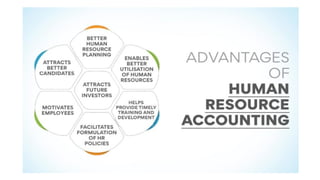
Human Resource Accounting (HRA) helps management frame policies for human resources
especially where it is necessary to identify measure and disclose data about the people within an
organization, where they are recognized as an accounting resource.
To understand the values of Human Resources in Organizations
To familiarize the process and approaches of Human Resources Accounting
* Flamholtz, E.J., M.L. Bullen & w. Hua, (2002), “Human Resource accounting- a historical perspective and future
implications”, Management Decision, 40/10
3.
Unit 1 –Lessons to Learn
This Unit aims to provide a basis for the conceptual framework of Human Resource
Accounting. An attempt is made to highlight the following aspects.
• Development of the Concept
• Historical Score Card
• Meaning & Definition of HRA
• Importance and Objectives of HRA
• Limitations of HRA
• HRA for Managers & HR Professionals
• Enumerating the Assets
• Investment in Human Resources
• Quality of Work Force and Organizations’
Performance
• Efficient use of Human Resources
• Human Capital.
4.
Development of theConcept of HRA
• “Human Resource Accounting” is the
offshoot of various research studies
conducted in the areas of accounting and
finance. Human resource is an asset whose
value gets appreciated over the period of time
provided placed, applied and developed in the
right direction.
• Till the recent past, organizations took few
efforts to assign monetary value to human
resource in its accounting practice.
• Behavioral scientists initiated efforts to
develop appropriate methodology for finding
out the value of human resource to the
organization. They were against the
conventional accounting practice for its
failure to value the human resource of an
organization along with physical resources.
• The traditional concept suggested
that expenditure on human resource
is treated as a charge against
revenue as it does not create any
physical asset.
• At present there is a change in this
concept and the expenses incurred
on any asset (as human resources)
should 5 be treated as capital
expenditure as it yields benefits
which can be derived for a long
period of time and could be
measured in monetary terms.
5.
Importance of HRA
Thefollowing are the reasons why
Human Resources Accounting has been
receiving so much attention in the recent
years.
• ➢➢ Firstly, there is genuine need for
reliable and complete management of
human resources.
• ➢➢ Secondly, a traditional
framework of Accounting is in the
process to include a much broader set
of measurement than was possible in
the past.
Insight
• People/employees are the most important
assets of an organization but the value of this
asset does not explicitly appear in financial
statements. It does not get included in
management information systems too.
• Conventional accounting of human
resources took note of all expenses of Human
capital formation which does not seem to be
correct or meeting the actual needs.
• Human Resource Accounting is the
measurement of the cost and value of people
to the organization. It involves measuring
costs incurred by the organizations to recruit,
select, hire, train and develop employees and
judge their economic value to the
organization.
6.
The concept ofconsidering the human beings as an asset is an old one. Lets us
take a look at the history.
• In Mughal times, the importance that Emperor Akbar gave to the nine jewels
(courtiers) is a strong evidence.
• The history of our freedom movement will not be complete without
mentioning the names of distinguished freedom fighters. No effort was made
to assign monetary value to their contributions in the Balance Sheet of the
nation.
• The first attempt to value the human beings in monetary terms was made by
Sir William Petty in 1691. Petty considered that labour was “the father of
wealth’ and it must be included in any estimate of national wealth without fail.
Further efforts were made by William Far (1833) and Ernst Engel (1853).
• Then came the behavioural scientists who vehemently criticized the
conventional accounting practice of not valuing the human resources along
with other resources.
Historical Score Card of Human Resource Accounting
7.
Historical Score Cardcontd…
Accountants and economists realized the fact that an appropriate methodology has to be
developed for finding the cost and value of the people to the organization. A number of
experts worked on it and produced certain models for evaluating human resources. The
important among them are Shultz, Flamholtz, Lav and Schwartz, and Kennath Sinclare.
Human Resource Accounting was first started with simple measures of trying to convert
output data into contributions. When an HR programme had effected a change in the
output especially for organizations operating on profit basis, its value was determined by
calculating the profit contribution.
Rensis Likert in the 1960s was the first to research in HR and emphasized the importance
of strong pressures on the HR’s qualitative variables and on its benefits in the long-run.
According to Likert’s model, human variables can be divided into three categories:
(i) Causal variables;
(ii) Intervening variables: and
(iii) End-result variables.
The interaction between the causal and intervening variables affect the end-result
variables by way of job satisfaction, costs, productivity and earnings.
8.
Historical Score Cardcontd…
• Historically the first major systematic effort at evaluation was made by RG Barry Corporation of
Columbus in 1967. Their annual report detailed the inauguration of HRA procedures developed by
the company to enable them to report accurate estimates of the worth of the organization’s human
assets. Accumulated costs under the categories namely recruiting and acquisition; formal training
and familiarization; informal training and familiarization; experience; and development were
accounted. Costs for the expected working lives of individuals (or sometimes shorter periods) were
amortized, and unamortized costs (for example, when an individual left the company) were written
off. That is, today, known as the Historical Cost Approach to employee valuation.
• Subsequently other improved bases of valuation were developed. Today, they fall under three major
categories namely replacement cost, present value of future earnings and present value to the
organization, i.e. profit contribution. Indian Government today has a separate Ministry for human
resources development by Government of India.
• Creating a Human Resources portfolio by every company creates the necessity of accounting for the
same. Human beings co-ordinate the best of machines, men and money. Computers, of course, may
challenge the human resources but computer is not a brain and it simply carries out human
commands. Therefore, Accounting for such human resources is very essential for the organization.
9.
Meaning and Definitionof Human Resource Accounting
Some of the important definitions given by the competent authors in the accounting field.
The American Accounting Society Committee on Human Resource Accounting defines it
as follows: “Human Resource Accounting is the process of identifying and measuring
data about human resources and communicating this information to interested parties.” In
simple terms, it is an extension of the accounting principles of matching costs and
revenues and of organizing data to communicate relevant information in financial terms
M.N. Baker defines Human Resource Accounting as follows: “Human resource
accounting is the term applied by the accountancy profession to quantify the cost and
value of employees to their employing organization”
Another management consultant Stephen Knauf has defined HRA as: “The measurement
of quantification of human organization inputs such as recruitment, training, experience
and commitment”
Thus, human resources accounting may be defined as, “a process of accounting which
identifies, quantifies and measures human resources for the use of management to
cope up with the changes in its quantum and quality so that equilibrium could be
achieved in between the required resources and the provided human resources”
10.
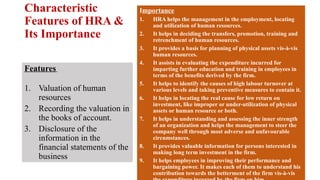
Characteristic
Features of HRA&
Its Importance
Features
1. Valuation of human
resources
2. Recording the valuation in
the books of account.
3. Disclosure of the
information in the
financial statements of the
business
Importance
1. HRA helps the management in the employment, locating
and utilization of human resources.
2. It helps in deciding the transfers, promotion, training and
retrenchment of human resources.
3. It provides a basis for planning of physical assets vis-à-vis
human resources.
4. It assists in evaluating the expenditure incurred for
imparting further education and training in employees in
terms of the benefits derived by the firm.
5. It helps to identify the causes of high labour turnover at
various levels and taking preventive measures to contain it.
6. It helps in locating the real cause for low return on
investment, like improper or under-utilization of physical
assets or human resource or both.
7. It helps in understanding and assessing the inner strength
of an organization and helps the management to steer the
company well through most adverse and unfavourable
circumstances.
8. It provides valuable information for persons interested in
making long term investment in the firm.
9. It helps employees in improving their performance and
bargaining power. It makes each of them to understand his
contribution towards the betterment of the firm vis-à-vis
11.
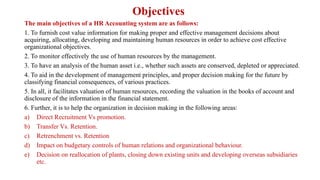
Objectives
The main objectivesof a HR Accounting system are as follows:
1. To furnish cost value information for making proper and effective management decisions about
acquiring, allocating, developing and maintaining human resources in order to achieve cost effective
organizational objectives.
2. To monitor effectively the use of human resources by the management.
3. To have an analysis of the human asset i.e., whether such assets are conserved, depleted or appreciated.
4. To aid in the development of management principles, and proper decision making for the future by
classifying financial consequences, of various practices.
5. In all, it facilitates valuation of human resources, recording the valuation in the books of account and
disclosure of the information in the financial statement.
6. Further, it is to help the organization in decision making in the following areas:
a) Direct Recruitment Vs promotion.
b) Transfer Vs. Retention.
c) Retrenchment vs. Retention
d) Impact on budgetary controls of human relations and organizational behaviour.
e) Decision on reallocation of plants, closing down existing units and developing overseas subsidiaries
etc.
13.
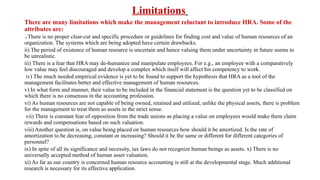
Limitations
There are manylimitations which make the management reluctant to introduce HRA. Some of the
attributes are:
i) There is no proper clear-cut and specific procedure or guidelines for finding cost and value of human resources of an
organization. The systems which are being adopted have certain drawbacks.
ii) The period of existence of human resource is uncertain and hence valuing them under uncertainty in future seems to
be unrealistic.
iii) There is a fear that HRA may de-humanize and manipulate employees. For e.g., an employee with a comparatively
low value may feel discouraged and develop a complex which itself will affect his competency to work.
iv) The much needed empirical evidence is yet to be found to support the hypothesis that HRA as a tool of the
management facilitates better and effective management of human resources.
v) In what form and manner, their value to be included in the financial statement is the question yet to be classified on
which there is no consensus in the accounting profession.
vi) As human resources are not capable of being owned, retained and utilized, unlike the physical assets, there is problem
for the management to treat them as assets in the strict sense.
vii) There is constant fear of opposition from the trade unions as placing a value on employees would make them claim
rewards and compensations based on such valuation.
viii) Another question is, on value being placed on human resources how should it be amortized. Is the rate of
amortization to be decreasing, constant or increasing? Should it be the same or different for different categories of
personnel?
ix) In spite of all its significance and necessity, tax laws do not recognize human beings as assets. x) There is no
universally accepted method of human asset valuation.
xi) As far as our country is concerned human resource accounting is still at the developmental stage. Much additional
research is necessary for its effective application.
14.
HRA for Managers& HR Professionals
For HR Executives/Managers
The HR executive/manager has primary responsibility for all HR
activities. This person must integrate the HRD programs with the
goals and strategies of the organization, and normally assumes a
leadership role in the executive development program, if one
exists. The outputs of this role include long-range plans and
strategies, policies, and budget allocation schedules.
One of the important tasks of the HR executive is to promote the
value of HRD as means of ensuring that organizational members
have the competencies to meet current and future job demands. If
senior managers do not understand the value of HRD, it will be
difficult for the HRD executive to get their commitment to HRD
efforts and to justify the expenditure of funds during tough times.
15.
HRA for HRProfessionals
1.The HR strategic adviser consults strategic decision makers on HRD issues that directly affect the articulation of
organization strategies and performance goals. Output includes HR strategic plans and strategic planning education and
training programs.
2. The HR systems designer and developer assist HR management in the design and development of HR systems that
affect organization performance. Outputs include HR program designs, intervention strategies, and implementation of
HR Programs.
3. The organization change agent advises management in the design and implementation of change strategies used in
transforming organizations. The outputs include more efficient work teams, quality management, intervention strategies,
implementation, and change reports.
4. The organization design consultant advises management on work systems design and the efficient use of human
resources. Outputs include intervention strategies, alternative work designs, and implementation.
5. The learning program specialist (or instructional designer) identifies needs of the learner, develops and designs
appropriate learning programs, and prepares materials and other learning aids. Outputs include program objectives,
lesson plans, and intervention strategies.
6. The instructor/facilitator presents materials and leads and facilitates structured learning experiences. Outputs include
the selection of appropriate instructional methods and techniques and the actual HRD program itself.
7. The individual development and career counselor assists individual employees in assessing their competencies and
goals in order to develop a realistic career plan. Outputs include individual assessment sessions, workshop facilitation,
and career guidance.
8. The performance consultant (or coach) advises line management on appropriate interventions designed to improve
individual and group performance. Outputs include intervention strategies, coaching design, and implementation.
9. The researcher assesses HR practices and programs using appropriate statistical procedures to determine their overall
effectiveness and communicates the results to the organization. Outputs include research designs, research findings, and
recommendations and reports.
16.
Challenges to Organizationsand HR Professionals
Many challenges face organizations as a new century unfolds before us Increasing globalization and the
technological revolution, in particular, the internet has a two primary factor that make for a new
competitive landscape.
Organizations today may take a number of actions address the uncertainty and turbulence in the external
environments. These actions include-
developing employee’s skills,
effectively using new technology,
developing new organizational structures and
building cultures that fosters learning and innovation.
All the above can be added to the list to present five challenges currently facing the field of HRD. These
challenges include:
1. Changing workforce demography
2. Competing in a global economy
3. Eliminating the skills gap
4. Meeting the need for lifelong individual learning
5. Facilitating organizational learning. Each of these challenges has potential impact on HRD.
17.
Enumerating the Assets
•The need to convert Human Resource
Management (HRM) activities in
economic terms has become vital in
this competitive scenario. And truly
enough HR has also evolved wherein
its functions of hiring, paying salaries,
administration, benefits, developing
and retaining employees, etc., have
been translated into quantitative terms
in order to monitor results and
facilitate changes. And today the data
that is collected as such is being
converted to monetary values and thus
the emergence of Human Resource
Accounting (HRA).
• When we refer to assets, we remember only
two assets, viz, fixed assets and current assets.
Fixed assets are valued at historical cost basis
and current asset at current price.
• There is a widening gap between the
perceived value and the accounting value of
the business. It necessitated the accounting for
intangibles and the accountants have handled
several such areas of accounting the
intangibles too.
• The traditional “bricks and mortar”
accounting is of little use in modern business
where more than three fourths of value
addition is derived from knowledge, an
intangible asset. For example, the accounting
implications of R and D have been examined
and analysis on that has been referred in the
financial statements by some of the foreign
companies.
18.
Enumerating the Assetscontd…
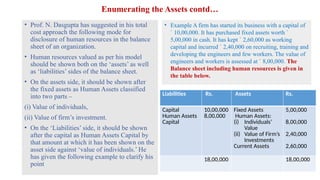
• Prof. N. Dasgupta has suggested in his total
cost approach the following mode for
disclosure of human resources in the balance
sheet of an organization.
• Human resources valued as per his model
should be shown both on the ‘assets’ as well
as ‘liabilities’ sides of the balance sheet.
• On the assets side, it should be shown after
the fixed assets as Human Assets classified
into two parts –
(i) Value of individuals,
(ii) Value of firm’s investment.
• On the ‘Liabilities’ side, it should be shown
after the capital as Human Assets Capital by
that amount at which it has been shown on the
asset side against ‘value of individuals.’ He
has given the following example to clarify his
point
• Example A firm has started its business with a capital of
` 10,00,000. It has purchased fixed assets worth `
5,00,000 in cash. It has kept ` 2,60,000 as working
capital and incurred ` 2,40,000 on recruiting, training and
developing the engineers and few workers. The value of
engineers and workers is assessed at ` 8,00,000. The
Balance sheet including human resources is given in
the table below.
Liabilities Rs. Assets Rs.
Capital
Human Assets
Capital
10,00,000
8,00,000
Fixed Assets
Human Assets:
(i) Individuals’
Value
(ii) Value of Firm’s
Investments
Current Assets
5,00,000
8,00,000
2,40,000
2,60,000
18,00,000 18,00,000
19.
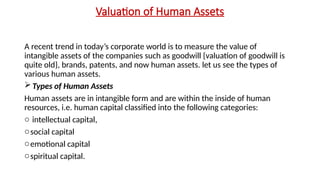
Valuation of HumanAssets
A recent trend in today’s corporate world is to measure the value of
intangible assets of the companies such as goodwill {valuation of goodwill is
quite old}, brands, patents, and now human assets. let us see the types of
various human assets.
Types of Human Assets
Human assets are in intangible form and are within the inside of human
resources, i.e. human capital classified into the following categories:
o intellectual capital,
osocial capital
oemotional capital
ospiritual capital.
20.
Valuation of HumanAssets contd….
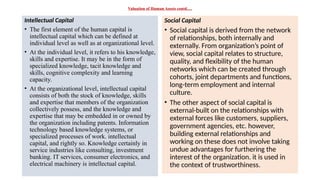
Intellectual Capital
• The first element of the human capital is
intellectual capital which can be defined at
individual level as well as at organizational level.
• At the individual level, it refers to his knowledge,
skills and expertise. It may be in the form of
specialized knowledge, tacit knowledge and
skills, cognitive complexity and learning
capacity.
• At the organizational level, intellectual capital
consists of both the stock of knowledge, skills
and expertise that members of the organization
collectively possess, and the knowledge and
expertise that may be embedded in or owned by
the organization including patents. Information
technology based knowledge systems, or
specialized processes of work. intellectual
capital, and rightly so. Knowledge certainly in
service industries like consulting, investment
banking. IT services, consumer electronics, and
electrical machinery is intellectual capital.
Social Capital
• Social capital is derived from the network
of relationships, both internally and
externally. From organization’s point of
view, social capital relates to structure,
quality, and flexibility of the human
networks which can be created through
cohorts, joint departments and functions,
long-term employment and internal
culture.
• The other aspect of social capital is
external-built on the relationships with
external forces like customers, suppliers,
government agencies, etc. however,
building external relationships and
working on these does not involve taking
undue advantages for furthering the
interest of the organization. it is used in
the context of trustworthiness.
21.
Valuation of HumanAssets contd….
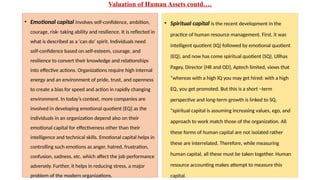
• Emotional capital involves self-confidence, ambition,
courage, risk- taking ability and resilience. It is reflected in
what is described as a ‘can do’ spirit. Individuals need
self-confidence based on self-esteem, courage, and
resilience to convert their knowledge and relationships
into effective actions. Organizations require high internal
energy and an environment of pride, trust, and openness
to create a bias for speed and action in rapidly changing
environment. In today’s context, more companies are
involved in developing emotional quotient {EQ} as the
individuals in an organization depend also on their
emotional capital for effectiveness other than their
intelligence and technical skills. Emotional capital helps in
controlling such emotions as anger, hatred, frustration,
confusion, sadness, etc. which affect the job performance
adversely. Further, it helps in reducing stress, a major
problem of the modern organizations.
• Spiritual capital is the recent development in the
practice of human resource management. First, it was
intelligent quotient (IQ) followed by emotional quotient
(EQ), and now has come spiritual quotient (SQ). Ullhas
Pagey, Director {HR and OD}, Aptech limited, views that
“whereas with a high IQ you may get hired: with a high
EQ, you get promoted. But this is a short –term
perspective and long-term growth is linked to SQ.
“spiritual capital is assuming increasing values, ego, and
approach to work match those of the organization. All
these forms of human capital are not isolated rather
these are interrelated. Therefore, while measuring
human capital, all these must be taken together. Human
resource accounting makes attempt to measure this
capital.
22.
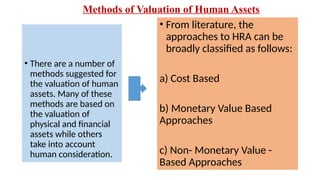
Methods of Valuationof Human Assets
• There are a number of
methods suggested for
the valuation of human
assets. Many of these
methods are based on
the valuation of
physical and financial
assets while others
take into account
human consideration.
• From literature, the
approaches to HRA can be
broadly classified as follows:
a) Cost Based
b) Monetary Value Based
Approaches
c) Non- Monetary Value -
Based Approaches
23.
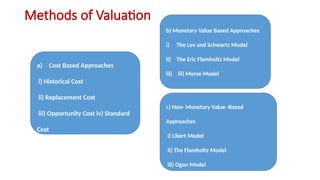
Methods of Valuation
b)Monetary Value Based Approaches
i) The Lev and Schwartz Model
ii) The Eric Flamholtz Model
iii) iii) Morse Model
c) Non- Monetary Value -Based
Approaches
i) Likert Model
ii) The Flamholtz Model
iii) Ogan Model
a) Cost Based Approaches
i) Historical Cost
ii) Replacement Cost
iii) Opportunity Cost iv) Standard
Cost
24.
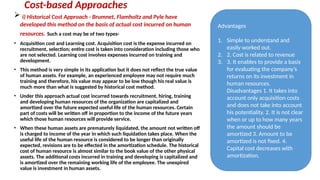
Cost-based Approaches
i)Historical Cost Approach - Brumnet, Flamholtz and Pyle have
developed this method on the basis of actual cost incurred on human
resources. Such a cost may be of two types-
• Acquisition cost and Learning cost. Acquisition cost is the expense incurred on
recruitment, selection; entire cost is taken into consideration including those who
are not selected. Learning cost involves expenses incurred on training and
development.
• This method is very simple in its application but it does not reflect the true value
of human assets. For example, an experienced employee may not require much
training and therefore, his value may appear to be low though his real value is
much more than what is suggested by historical cost method.
• Under this approach actual cost incurred towards recruitment, hiring, training
and developing human resources of the organization are capitalized and
amortized over the future expected useful life of the human resources. Certain
part of costs will be written off in proportion to the income of the future years
which those human resources will provide service.
• When these human assets are prematurely liquidated, the amount not written off
is charged to income of the year in which such liquidation takes place. When the
useful life of the human resource is considered to be longer than originally
expected, revisions are to be effected in the amortization schedule. The historical
cost of human resource is almost similar to the book value of the other physical
assets. The additional costs incurred in training and developing is capitalized and
is amortized over the remaining working life of the employee. The unexpired
value is investment in human assets.
Advantages
1. Simple to understand and
easily worked out.
2. 2. Cost is related to revenue
3. 3. It enables to provide a basis
for evaluating the company’s
returns on its investment in
human resources.
Disadvantages 1. It takes into
account only acquisition costs
and does not take into account
his potentiality. 2. It is not clear
when or up to how many years
the amount should be
amortized 3. Amount to be
amortized is not fixed. 4.
Capital cost decreases with
amortization.
25.
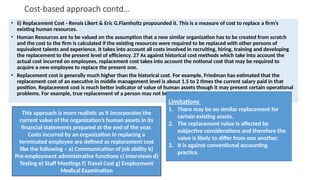
Cost-based approach contd…
•ii) Replacement Cost - Rensis Likert & Eric G.Flamholtz propounded it. This is a measure of cost to replace a firm’s
existing human resources.
• Human Resources are to be valued on the assumption that a new similar organization has to be created from scratch
and the cost to the firm is calculated if the existing resources were required to be replaced with other persons of
equivalent talents and experience. It takes into account all costs involved in recruiting, hiring, training and developing
the replacement to the present level of efficiency. 27 As against historical cost methods which take into account the
actual cost incurred on employees, replacement cost takes into account the notional cost that may be required to
acquire a new employee to replace the present one.
• Replacement cost is generally much higher than the historical cost. For example, Friedman has estimated that the
replacement cost of an executive in middle management level is about 1.5 to 2 times the current salary paid in that
position. Replacement cost is much better indicator of value of human assets though it may present certain operational
problems. For example, true replacement of a person may not be found easily with whose cost the valuation is done.
Limitations
1. There may be no similar replacement for
certain existing assets.
2. The replacement value is affected by
subjective considerations and therefore the
value is likely to differ from one another.
3. It is against conventional accounting
practice.
This approach is more realistic as it incorporates the
current value of the organization’s human assets in its
financial statements prepared at the end of the year.
Costs incurred by an organization in replacing a
terminated employee are defined as replacement cost
like the following – a) Communication of job ability b)
Pre-employment administrative functions c) Interviews d)
Testing e) Staff Meetings f) Travel Cost g) Employment
Medical Examination
26.
Cost-based approach continued
•iii) Opportunity Cost Method Heckiman and Jones
first advocated this approach.
• This is also known as “Market Value Method”. This
method of measuring the value of human resources
is based on the economist’s concept of ‘opportunity
cost’.
• Opportunity cost is the value of an asset when there
is an alternative opportunity of using it. In this
method there is no opportunity cost for those
employees who are not scarce. As such only scarce
people should form part of the value of human
resources. The employee is considered as scarce only
when the employment in one division of an
individual or group denies this kind of talent to
another division.
• Thus the opportunity cost of an employee in one
department is calculated on the basis of offer made
by another department for the employees working
in this department in the same organization
Limitations
1. The total valuation of human resource
on the competitive bid price may be
misleading and inaccurate. A person
may be a valuable person for the
department in which he is working and
may have a lower price in the bid by
other departments.
2. Only scare employees are included in
this method and as a result unscare
employees may lose their morale, as
they are not counted.
3. It would be difficult to identify the
alternative use of an employee in the
organization
27.
Cost-based approach continued
•iv) Standard Cost Method
• David Watson has suggested this approach. Instead of using historical or
replacement cost, many companies use standard cost for the valuation of human
assets just as it is used for physical and financial assets. For using standard cost,
employees of an organization are categorized into different groups based on their
hierarchical positions.
• Standard cost is fixed for each category of employees and their value is calculated.
This method is simple but does not take into account differences in employees put
in the same group. In many cases, these differences may be quite vital.
• According to this approach, standard costs of recruiting, hiring, training and
developing per grade of employees are determined year after year. The standard
cost so arrived at for all human beings employed in the organization are the value
of human resources for accounting purposes.
• The approach is easy to explain and can work as a suitable basis for control
purposes through the technique of variance analysis. However, determination of
the standard cost for each grade of employee is a ticklish issue.
28.
Monetary Value-based Approach
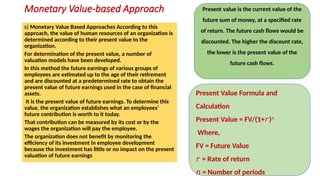
B)Monetary Value Based Approaches According to this
approach, the value of human resources of an organization is
determined according to their present value to the
organization.
For determination of the present value, a number of
valuation models have been developed.
In this method the future earnings of various groups of
employees are estimated up to the age of their retirement
and are discounted at a predetermined rate to obtain the
present value of future earnings used in the case of financial
assets.
It is the present value of future earnings. To determine this
value, the organization establishes what an employees’
future contribution is worth to it today.
That contribution can be measured by its cost or by the
wages the organization will pay the employee.
The organization does not benefit by monitoring the
efficiency of its investment in employee development
because the investment has little or no impact on the present
valuation of future earnings
Present value is the current value of the
future sum of money, at a specified rate
of return. The future cash flows would be
discounted. The higher the discount rate,
the lower is the present value of the
future cash flows.
Present Value Formula and
Calculation
Present Value = FV/(1+ )
𝑟 𝑛
Where,
FV = Future Value
𝑟 = Rate of return
𝑛 = Number of periods
29.
Non-monetary Value-based approach
•S.K. Chakraborthy Model (Aggregate Payment Approach) Indian author Prof. S.K. Chakraborty in 1976
advocated this model. He has valued the human resources in aggregate and not on an individual basis.
• He suggested that managerial and non managerial man power can be evaluated separately. The value of
human resource on a collective or group basis can be is multiplied by the average tenure of employment
of the employees in that group and is the investment in human resource.
• The average annual salary payments for the next few years could be found out from the salary grade
structure and promotion schemes of the enterprise.
• The recruitment, including selection, development and training costs of each employee could be
recorded separately and considered as deferred revenue expenditure to be written off over the expected
average tenure of the employee in the organisation.
• The deferred portion should be shown in the financial statement of the organisation.
• In case of permanent exit on account of death, retrenchment etc. then the balance on the deferred
revenue account of that year of that person should be written off against the income in the year of exit
itself.
• For the purpose of finding the present value of estimated payments the expected average after tax return
on capital employed over the average tenure period should be taken as the discount rate.
• As for disclosure of accounting information on human resources as an asset, he has suggested to include
human assets under investments in the ‘financial statement’ of the organisation. He is not for taking it as
‘fixed assets’ as it will cause problems of depreciation, capital gains or losses upon exit etc.; neither it
could be taken as ‘current asset’ as it will not be in conformity with the general meaning of the term.
30.
Human Capital
• Basically,when we talk of human capital it refers to the human
knowledge, their inner capabilities and creativity. The
development of technology cannot be fully utilized without
knowledge and skill. The capabilities of the human capital in
relation to the needs of the organization should be improved by
creating a climate in which the human knowledge, skill,
capabilities and creativity can be developed. How do we develop
our human capital and put it to optimum use is the challenge
faced by the present day corporate sector. Technological
improvements, business strategies, quality concerns etc., will have
no meaning without people (human capital). So it is people who
make all the difference.
31.
Unit II- HumanResource Planning & Accounting
• The most valuable input in an
organization is the human element. Loose
one extra – ordinary player of a team and
who will replace him/her?
• How much time will pass before the
organization to require the know-how,
drive and the strength diffused by his/her
presence amongst the team members? A
healthy organization not only aims at the
designation but also how to step forward
and with whom to proceed.
• Hence, in the process of managing an
organization, human resources are not to
be neglected, with all-out attention
towards financial resources (like money
and credit), physical resources (like land,
building, machinery).
The importance of
sustained manpower is
evident from the famous
saying:
• If you wish to plan for a
year, Cultivate flowers’ ;
• If you wish to plan for ten
years, Plant trees’;
• If you wish to plan for
eternity, Develop men’
32.
Basic Elements ofHuman Capital
• The basic elements of human capital are projected as under
➢ Know-how
➢ Education
➢ Vocational qualification
➢ Work related knowledge
➢ Occupational assessments
➢ Psychometric assessments
➢ Work related competencies
➢ Entrepreneurial innovativeness, proactive and reactive abilities.
➢ Changeability.
(Source: SMAC, 1998)