• Formed under the act of parliament-
AIRPORTS AUTHORITY OF INDIA ACT 1994.
• Organization under the Ministry of Civil
Aviation that manages all the airports in India.
• Major revenue is generated from airports
development, landing/parking fees and fees
charged for providing Air Traffic Control
services to aircraft over the Indian airspace.
Airports Authority of India (AAI)
Services Provided by AAI
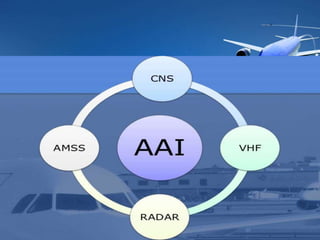
• Control and management of the Indian air space.
• Installation and maintenance of various
communication, navigation and surveillance aids.
• Design, development, operation and
maintenance of passenger terminals.
• Development and management of cargo
terminals.
• Passenger facilities and information system.
• Rescue and fire services.
• Anti-Hijacking cell.
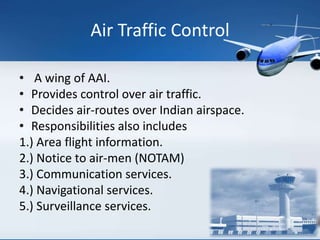
Air Traffic Control
• A wing of AAI.
• Provides control over air traffic.
• Decides air-routes over Indian airspace.
• Responsibilities also includes
1.) Area flight information.
2.) Notice to air-men (NOTAM)
3.) Communication services.
4.) Navigational services.
5.) Surveillance services.
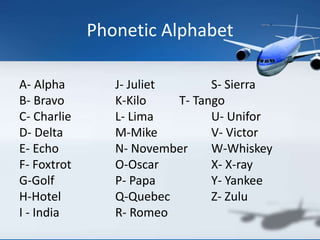
Phonetic Alphabet
A- Alpha J- Juliet S- Sierra
B- Bravo K-Kilo T- Tango
C- Charlie L- Lima U- Unifor
D- Delta M-Mike V- Victor
E- Echo N- November W-Whiskey
F- Foxtrot O-Oscar X- X-ray
G-Golf P- Papa Y- Yankee
H-Hotel Q-Quebec Z- Zulu
I - India R- Romeo
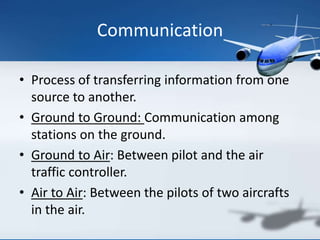
Communication
• Process of transferring information from one
source to another.
• Ground to Ground: Communication among
stations on the ground.
• Ground to Air: Between pilot and the air
traffic controller.
• Air to Air: Between the pilots of two aircrafts
in the air.
Communication
• HF or VHF is used for communication between
controller and pilot.
• Aeronautical Fixed Telecommunication
Network(AFTN) is used for communication
among ground stations.
• AFTN uses basic copper wire as
communication media.
Navigation and NAV-AIDS
• It is a process of reading and controlling the
movement of an aircraft from one place to
another.
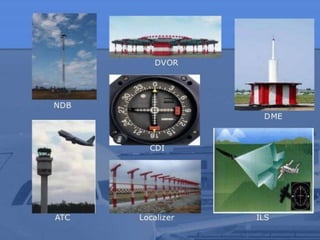
• NDB: Transmits guiding signals towards a
particular aircraft at a particular frequency.
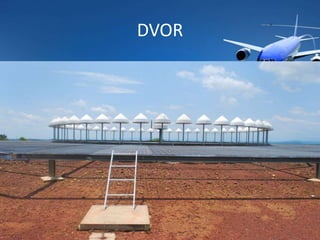
• DVOR: Directional VHF omni-range measures
the angular orientation of the aircraft with
respect to the magnetic north.
Navigation and NAV-AIDS
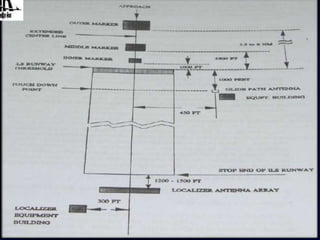
I.L.S. (Instrument Landing System)
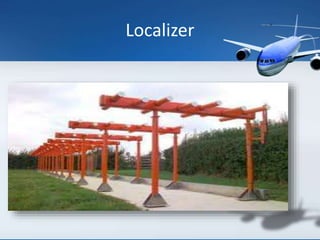
• Localizer : Helps aircraft to identify the central
line of runway.
• Range:- 10-25 NM
• Frequency:- 108-111.9 MHz
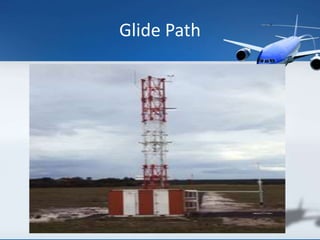
• Glide Path : Gives the glide angle i.e. angle of
declination achieve for safe landing.
• Range:- 10 NM(-8 to +8 degrees)
• Safe glide angle:- 2-4 degrees
Localizer
Glide Path
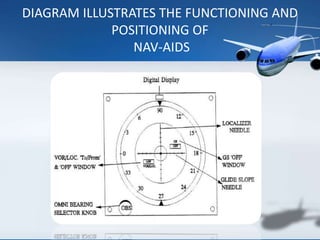
DIAGRAM ILLUSTRATES THE FUNCTIONING AND
POSITIONING OF
NAV-AIDS
DISTANCE MEASURING
EQUIPMENT(DME) :
• DME is used in navigational aid which provide a
pilot with visual info regarding his
position(distance) related to ground base DME
station.
• The frequency range used for DME is between
960 MHz to 1215 MHz . This frequency is used
because it has better frequency stability
comparative to next higher frequencies in
microwave band.
• It has less reflection and attenuation.
DVOR
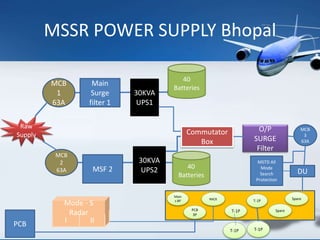
MSSR POWER SUPPLY Bhopal
Raw
Supply
MCB
1
63A
MCB
2
63A
Main
Surge
filter 1
30KVA
UPS1
30KVA
UPS2MSF 2
40
Batteries
40
Batteries
O/P
SURGE
Filter
MCB
3
63A
DU
MSTD All
Mode
Search
Protection
Main
s BP
PCB
3P
T-1P
T-1P SpareRACK
Spare
T-1PT-1P
PCB
Commutator
Box
I II
Mode - S
Radar
Surveillance
• Monitoring from a distance, by means of
equipment installed at each airport, the
movement of all the aircrafts within its region
of operation.
• Primary and secondary radars are used to aid
surveillance in civil as well as military aviation.
• Surface Movement Radar is used to monitor
the movement of the aircraft on runways or
taxiways.
Radars at ATC
Primary Radar :
• No role of target.
• Detection range upto 60NM.
• Frequency range is between 2 to 4 GHz.
• Operates at 15RPM.
• Consumes more power.
Secondary Radar:
• Target has to participate in the detection process.
• Target uses a transponder to reflect signal back.
• Detection range is upto 220 NM.
• Frequency range is between 1 to 2 GHz.
VHF (Very High Frequency)
• The VHF (very high frequency) range of Radio
Spectrum is the band which extends from 30
MHz to 300 Mhz.
• Band used for communication at the airport is
118- 136 MHz.
• Less affected by atmospheric noise and
interference from electrical equipment.
• Easily blocked by land features than HF.
HF(High Frequency)
• The HF (high frequency) range of Radio
Spectrum is the band which extends from 3
MHz to 30 Mhz.
• Ionosphere wave propagation.
• At oceanic regions no LOS communication is
possible, hence HF is used.
• Noise immunity is very low.
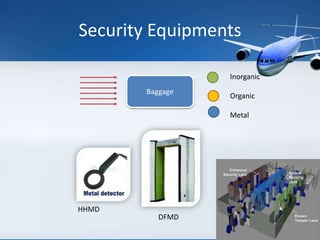
Security Equipments Used in Airport
X-RAYs
• X -ray is used in x-ray baggage systems. In this
a baggage put in scanner ,then it would show
colour according to material.
Metal Detector
• Handheld Metal Detector
• Door Frame Metal Detector
Security Equipments
Baggage
Inorganic
Organic
Metal
HHMD
DFMD
Conclusion
• Very enriching experience
• Practical application of theoretical concepts in
form of various equipments and processes
• Cooperative and encouraging staff makes it a
true learning experience
Thank You

FINAL

  • 2.
    • Formed underthe act of parliament- AIRPORTS AUTHORITY OF INDIA ACT 1994. • Organization under the Ministry of Civil Aviation that manages all the airports in India. • Major revenue is generated from airports development, landing/parking fees and fees charged for providing Air Traffic Control services to aircraft over the Indian airspace. Airports Authority of India (AAI)
  • 3.
    Services Provided byAAI • Control and management of the Indian air space. • Installation and maintenance of various communication, navigation and surveillance aids. • Design, development, operation and maintenance of passenger terminals. • Development and management of cargo terminals. • Passenger facilities and information system. • Rescue and fire services. • Anti-Hijacking cell.
  • 4.
    Air Traffic Control •A wing of AAI. • Provides control over air traffic. • Decides air-routes over Indian airspace. • Responsibilities also includes 1.) Area flight information. 2.) Notice to air-men (NOTAM) 3.) Communication services. 4.) Navigational services. 5.) Surveillance services.
  • 5.
    Phonetic Alphabet A- AlphaJ- Juliet S- Sierra B- Bravo K-Kilo T- Tango C- Charlie L- Lima U- Unifor D- Delta M-Mike V- Victor E- Echo N- November W-Whiskey F- Foxtrot O-Oscar X- X-ray G-Golf P- Papa Y- Yankee H-Hotel Q-Quebec Z- Zulu I - India R- Romeo
  • 7.
    Communication • Process oftransferring information from one source to another. • Ground to Ground: Communication among stations on the ground. • Ground to Air: Between pilot and the air traffic controller. • Air to Air: Between the pilots of two aircrafts in the air.
  • 8.
    Communication • HF orVHF is used for communication between controller and pilot. • Aeronautical Fixed Telecommunication Network(AFTN) is used for communication among ground stations. • AFTN uses basic copper wire as communication media.
  • 9.
    Navigation and NAV-AIDS •It is a process of reading and controlling the movement of an aircraft from one place to another. • NDB: Transmits guiding signals towards a particular aircraft at a particular frequency. • DVOR: Directional VHF omni-range measures the angular orientation of the aircraft with respect to the magnetic north.
  • 10.
    Navigation and NAV-AIDS I.L.S.(Instrument Landing System) • Localizer : Helps aircraft to identify the central line of runway. • Range:- 10-25 NM • Frequency:- 108-111.9 MHz • Glide Path : Gives the glide angle i.e. angle of declination achieve for safe landing. • Range:- 10 NM(-8 to +8 degrees) • Safe glide angle:- 2-4 degrees
  • 11.
  • 12.
  • 13.
    DIAGRAM ILLUSTRATES THEFUNCTIONING AND POSITIONING OF NAV-AIDS
  • 14.
    DISTANCE MEASURING EQUIPMENT(DME) : •DME is used in navigational aid which provide a pilot with visual info regarding his position(distance) related to ground base DME station. • The frequency range used for DME is between 960 MHz to 1215 MHz . This frequency is used because it has better frequency stability comparative to next higher frequencies in microwave band. • It has less reflection and attenuation.
  • 16.
  • 18.
    MSSR POWER SUPPLYBhopal Raw Supply MCB 1 63A MCB 2 63A Main Surge filter 1 30KVA UPS1 30KVA UPS2MSF 2 40 Batteries 40 Batteries O/P SURGE Filter MCB 3 63A DU MSTD All Mode Search Protection Main s BP PCB 3P T-1P T-1P SpareRACK Spare T-1PT-1P PCB Commutator Box I II Mode - S Radar
  • 19.
    Surveillance • Monitoring froma distance, by means of equipment installed at each airport, the movement of all the aircrafts within its region of operation. • Primary and secondary radars are used to aid surveillance in civil as well as military aviation. • Surface Movement Radar is used to monitor the movement of the aircraft on runways or taxiways.
  • 20.
    Radars at ATC PrimaryRadar : • No role of target. • Detection range upto 60NM. • Frequency range is between 2 to 4 GHz. • Operates at 15RPM. • Consumes more power. Secondary Radar: • Target has to participate in the detection process. • Target uses a transponder to reflect signal back. • Detection range is upto 220 NM. • Frequency range is between 1 to 2 GHz.
  • 21.
    VHF (Very HighFrequency) • The VHF (very high frequency) range of Radio Spectrum is the band which extends from 30 MHz to 300 Mhz. • Band used for communication at the airport is 118- 136 MHz. • Less affected by atmospheric noise and interference from electrical equipment. • Easily blocked by land features than HF.
  • 22.
    HF(High Frequency) • TheHF (high frequency) range of Radio Spectrum is the band which extends from 3 MHz to 30 Mhz. • Ionosphere wave propagation. • At oceanic regions no LOS communication is possible, hence HF is used. • Noise immunity is very low.
  • 23.
    Security Equipments Usedin Airport X-RAYs • X -ray is used in x-ray baggage systems. In this a baggage put in scanner ,then it would show colour according to material. Metal Detector • Handheld Metal Detector • Door Frame Metal Detector
  • 24.
  • 25.
    Conclusion • Very enrichingexperience • Practical application of theoretical concepts in form of various equipments and processes • Cooperative and encouraging staff makes it a true learning experience
  • 26.