AI, Machine Learning en Chatbots:
Think AI-first
Filip Maertens (Founder, faction.xyz)

Twitter: @fmaertens

LinkedIn: https://www.linkedin.com/in/fmaertens/ 

Presented at “The Future of IT” - Organised by @itworks on the 20th of September 2017 in Parker Hotel Brussels Airport, Belgium

AI, Machine Learning, and
chatbots: an AI-First approach
Seminar “The Future of IT” by ITWorks
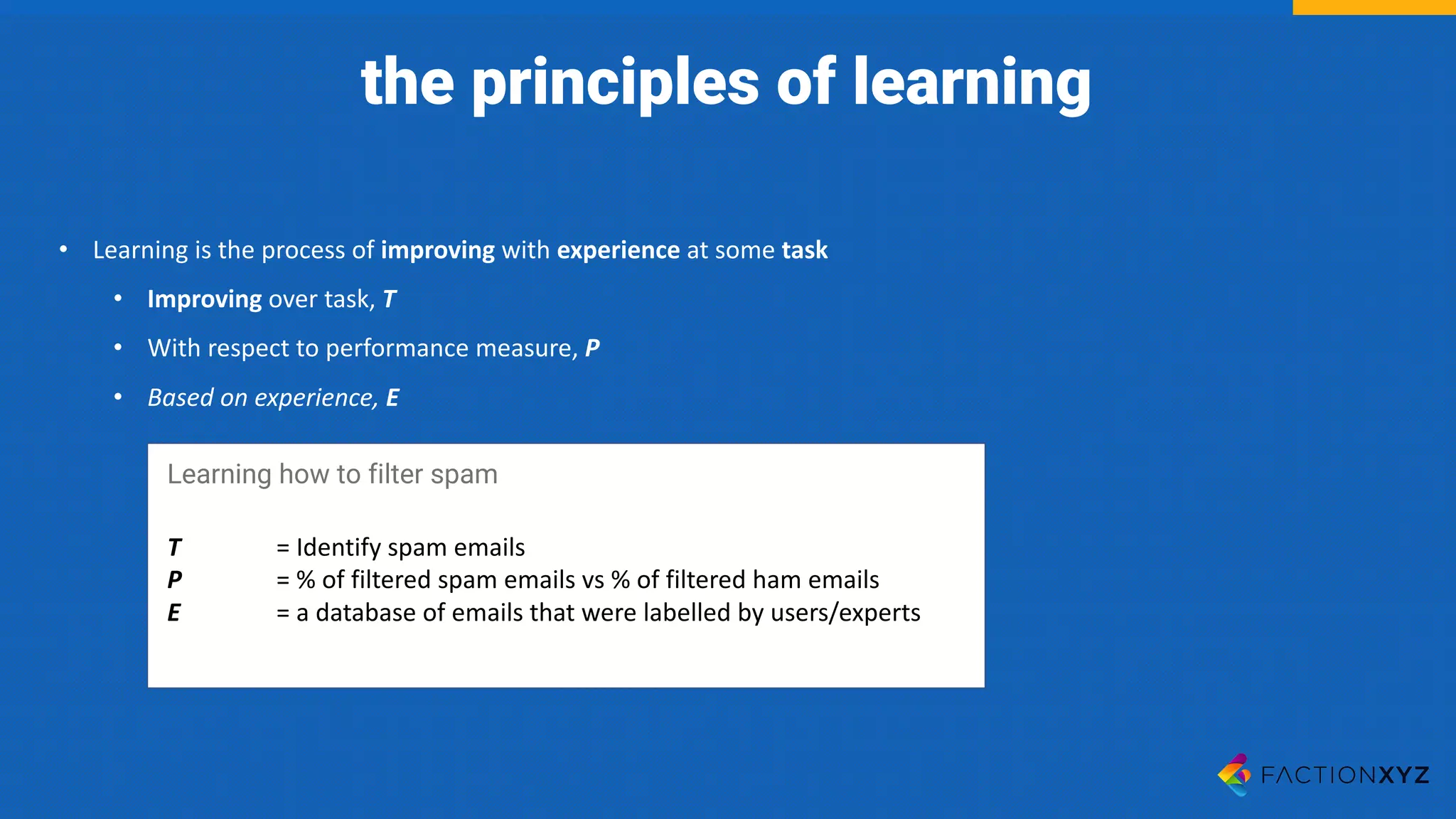
• Learning	is	the	process	of	improving with	experience at	some	task
• Improving over	task,	T
• With	respect	to	performance	measure,	P
• Based	on	experience, E
Learning how to filter spam
T =	Identify	spam	emails
P =	%	of	filtered	spam	emails	vs	%	of	filtered	ham	emails
E =	a	database	of	emails	that	were	labelled	by	users/experts
the principles of learning
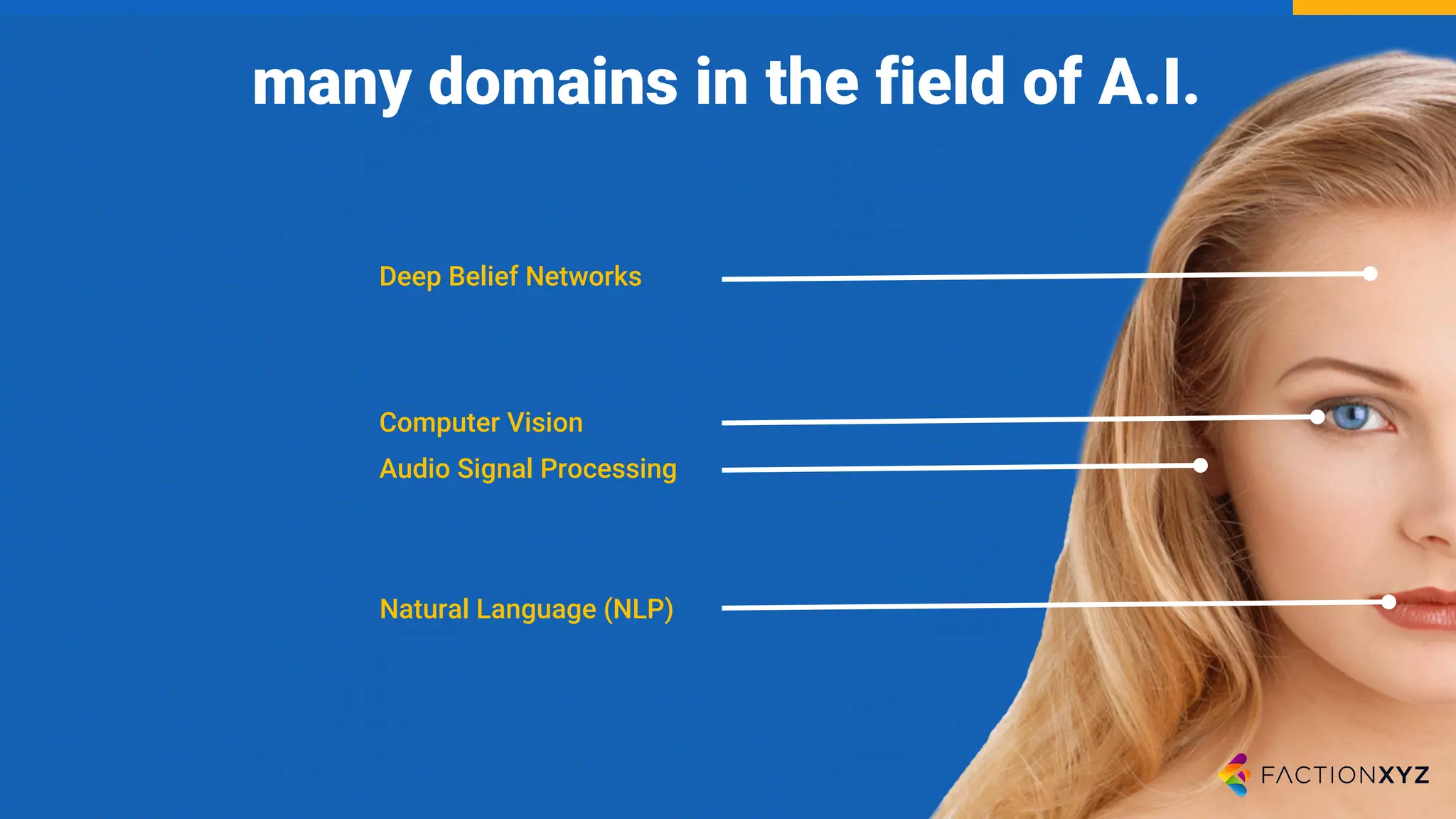
Deep Belief Networks
Computer Vision
Audio Signal Processing
Natural Language (NLP)
many domains in the field of A.I.
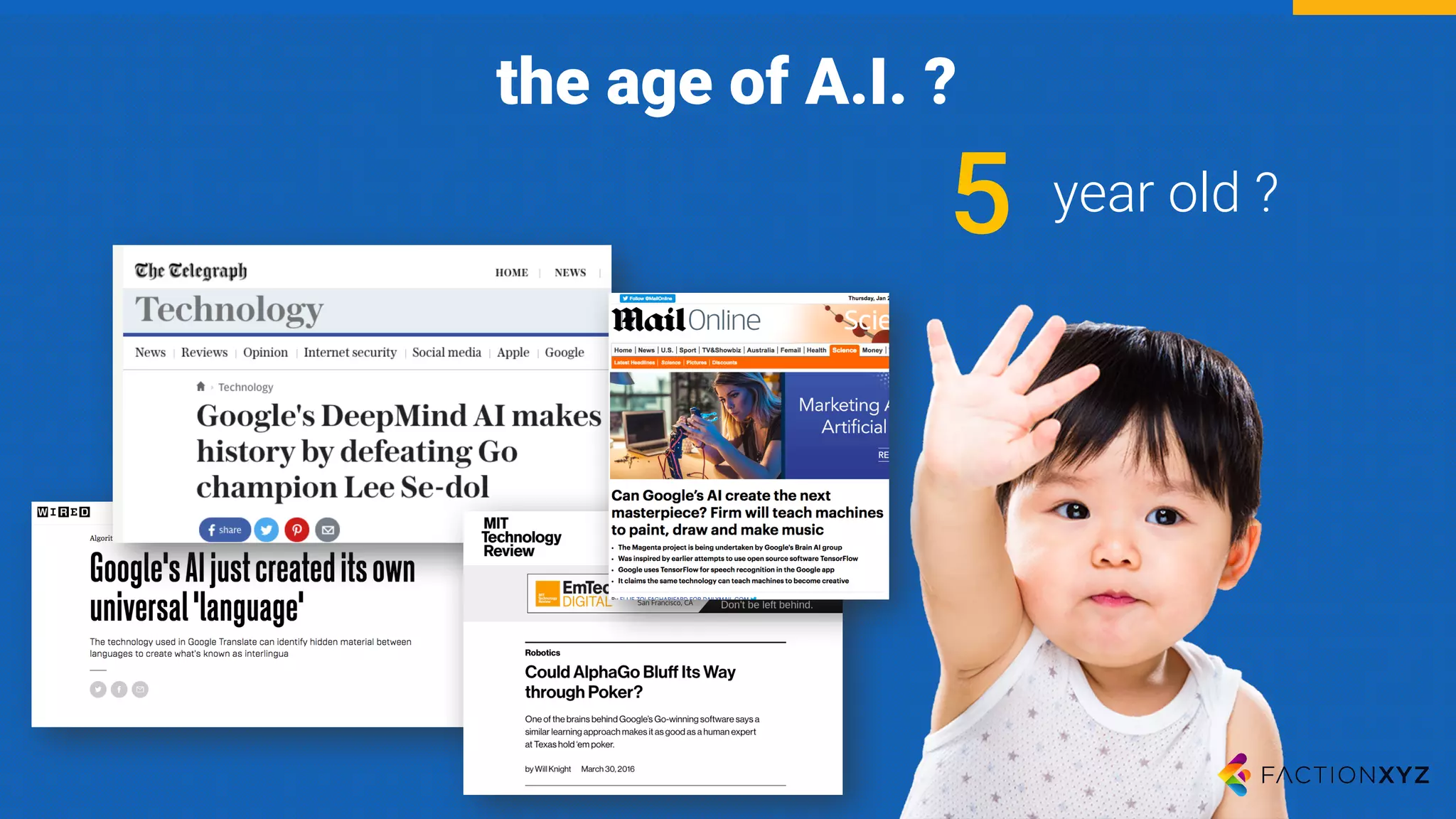
5 year old ?
the age of A.I. ?
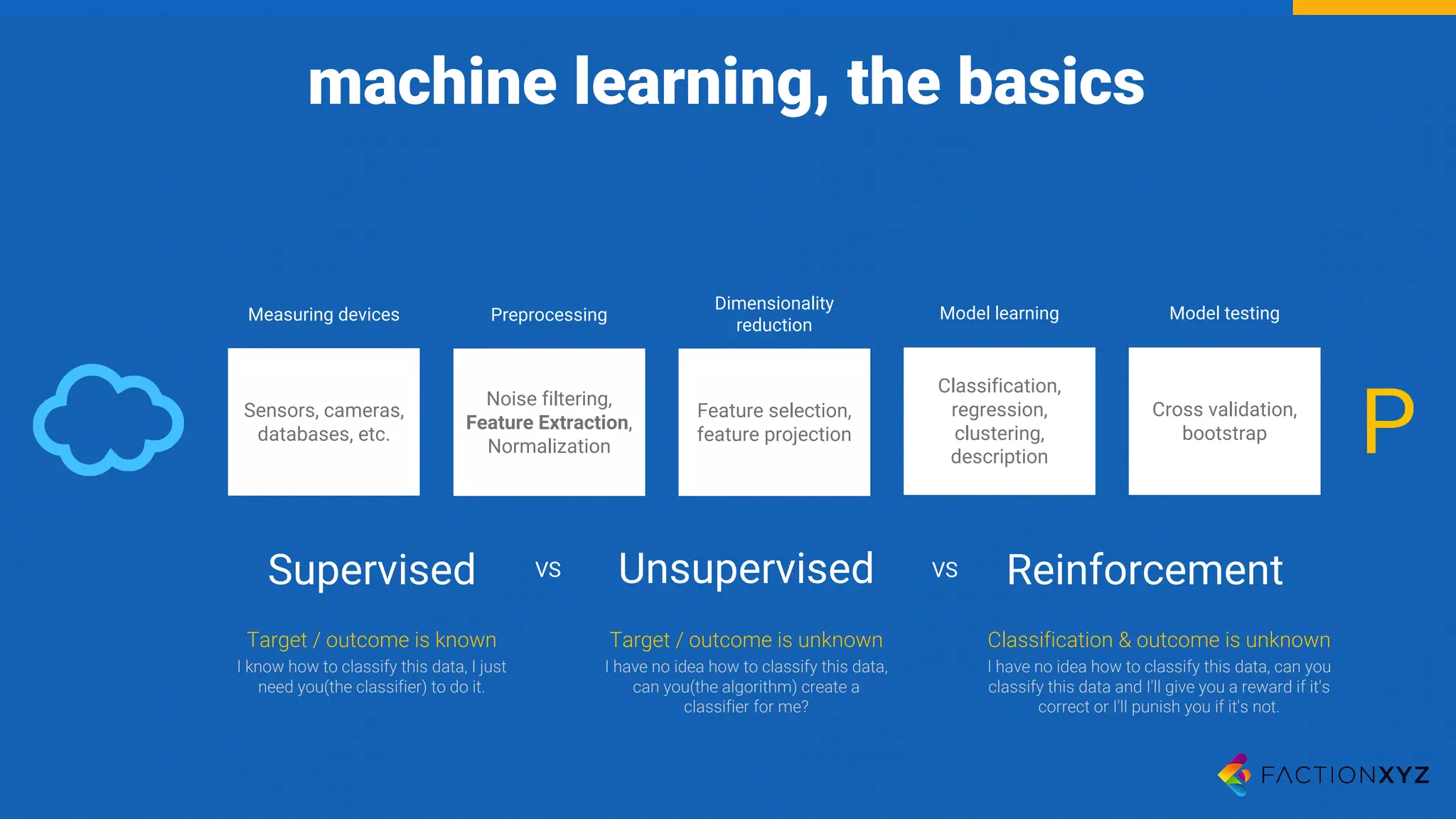
Sensors, cameras,
databases, etc.
Measuring devices
Noise filtering,
Feature Extraction,
Normalization
Preprocessing
Feature selection,
feature projection
Dimensionality
reduction
Classification,
regression,
clustering,
description
Model learning
Cross validation,
bootstrap
Model testing
P
Supervised UnsupervisedVS
Target / outcome is known
I know how to classify this data, I just
need you(the classifier) to do it.
Target / outcome is unknown
I have no idea how to classify this data,
can you(the algorithm) create a
classifier for me?
ReinforcementVS
Classification & outcome is unknown
I have no idea how to classify this data, can you
classify this data and I'll give you a reward if it's
correct or I'll punish you if it's not.
machine learning, the basics
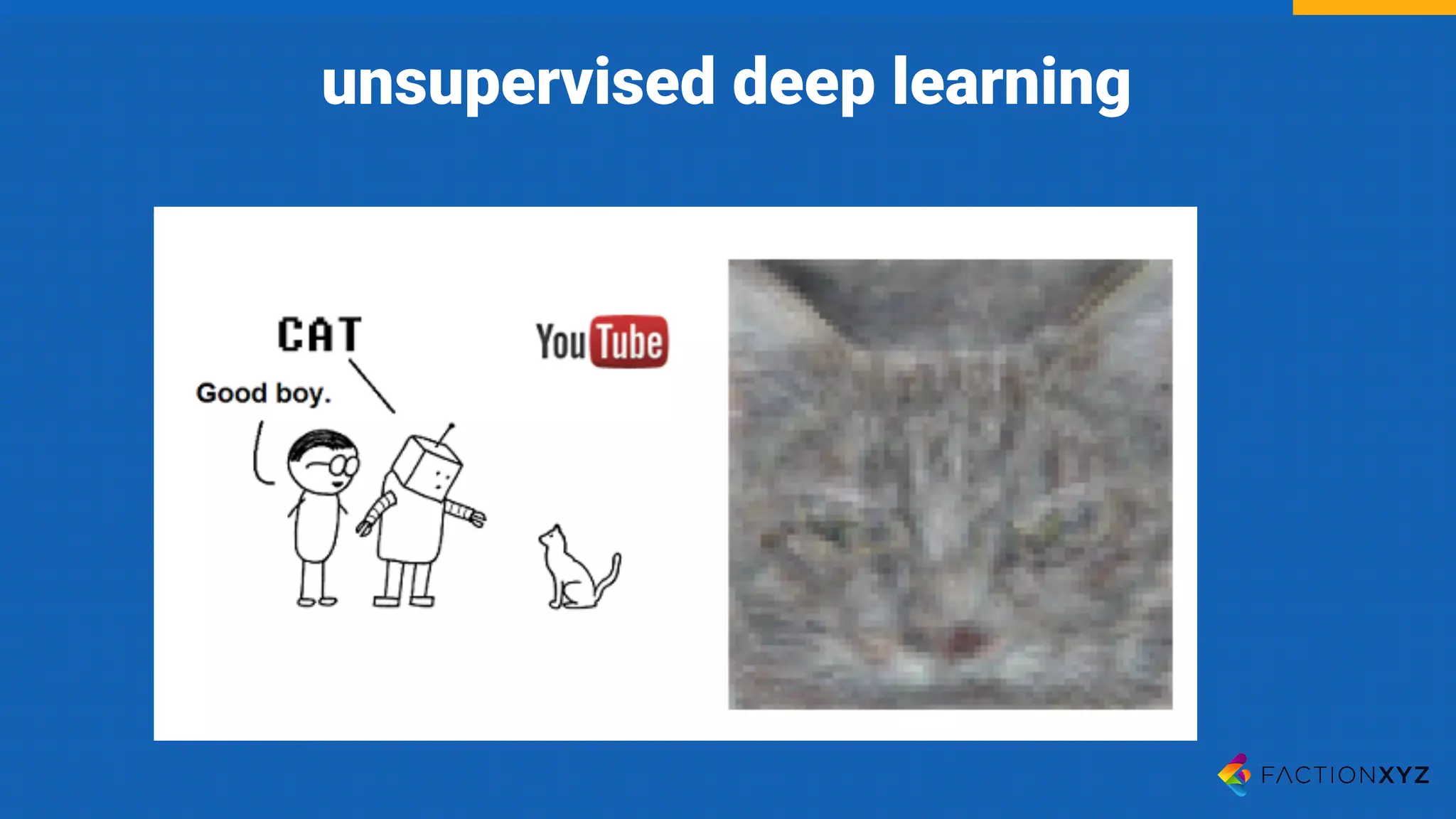
unsupervised deep learning
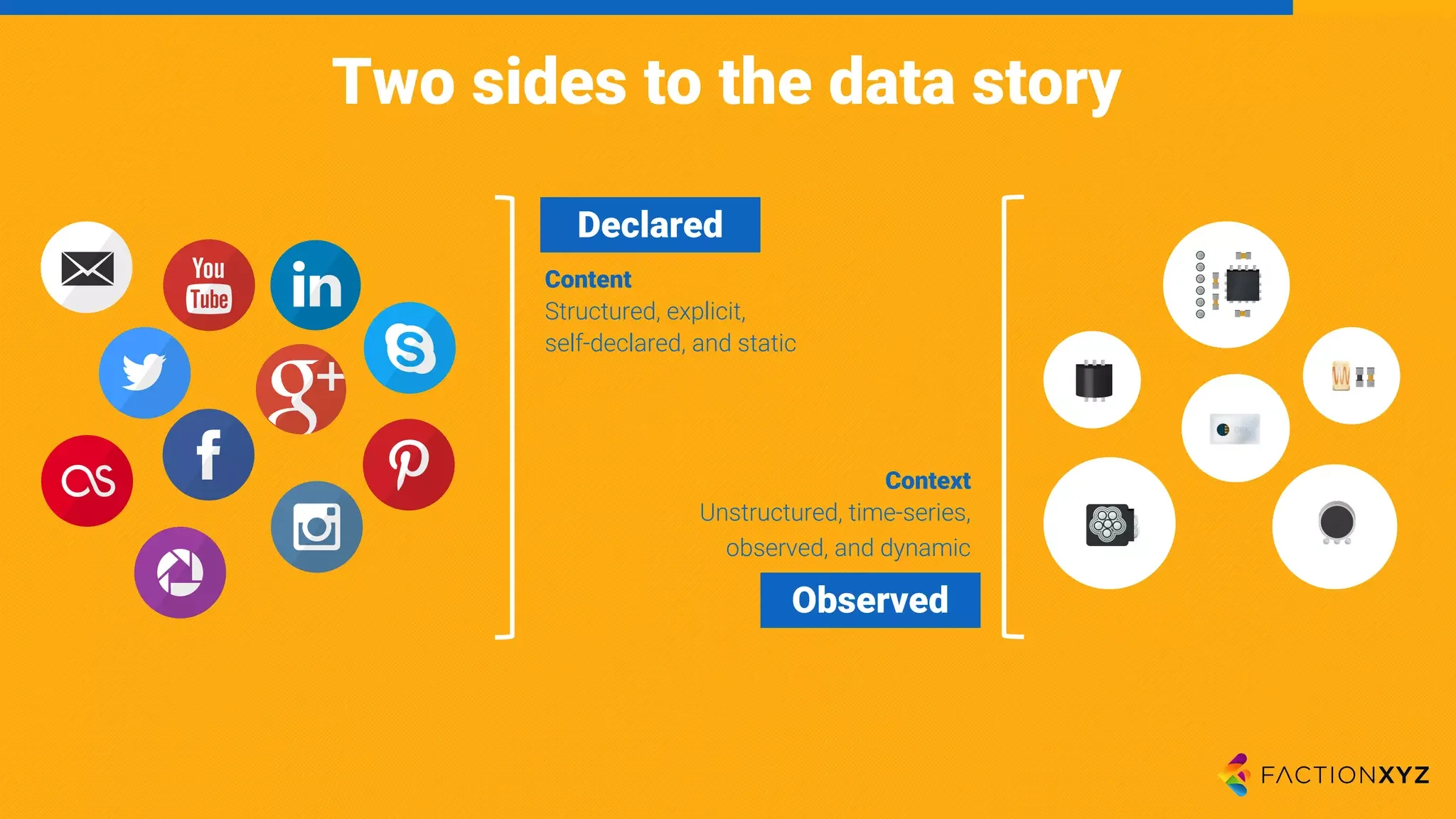
Two sides to the data story
Declared
Observed
Content
Structured, explicit,
self-declared, and static
Context
Unstructured, time-series,
observed, and dynamic
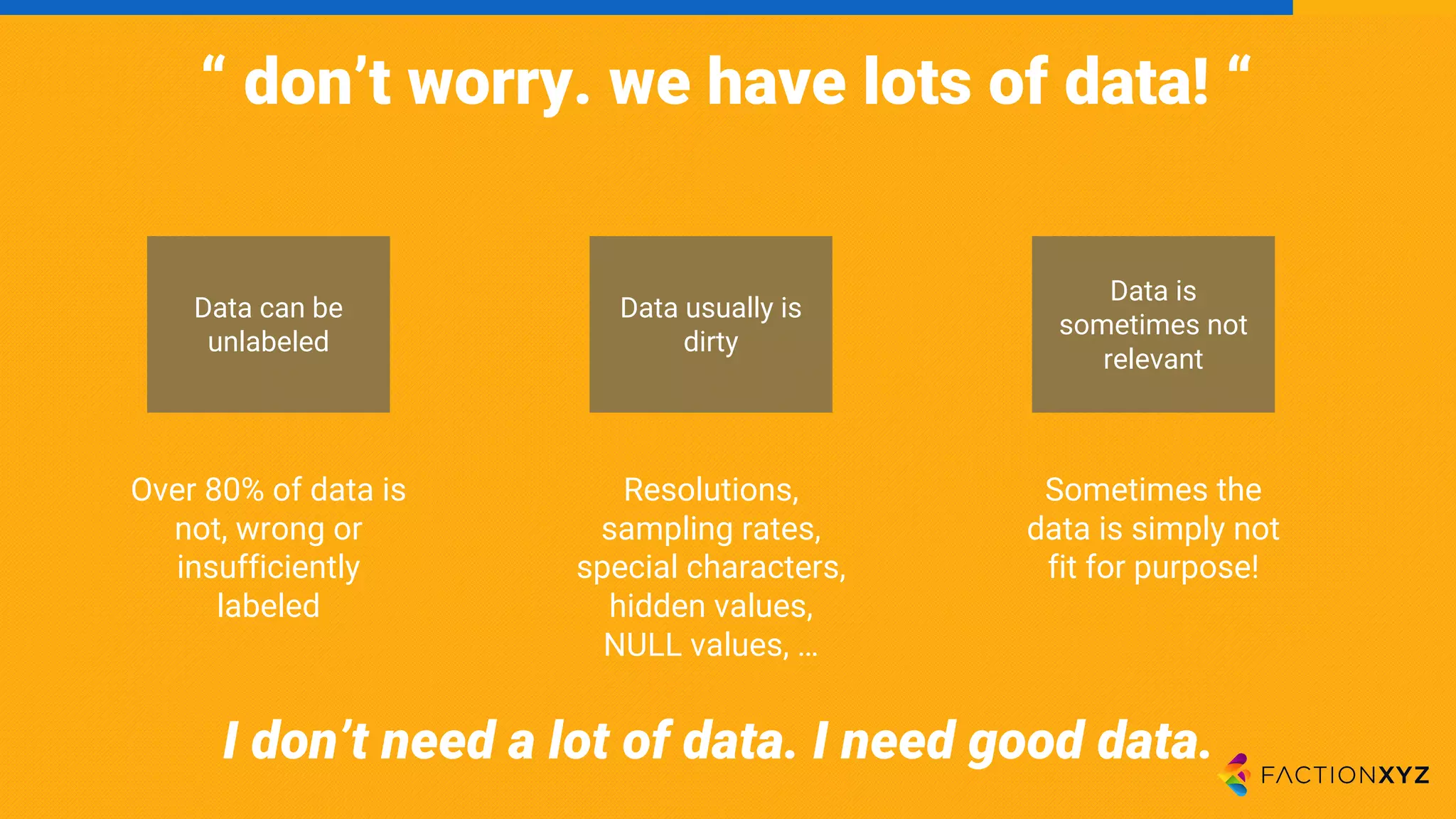
“ don’t worry. we have lots of data! “
Data can be
unlabeled
Data usually is
dirty
Data is
sometimes not
relevant
Over 80% of data is
not, wrong or
insufficiently
labeled
Resolutions,
sampling rates,
special characters,
hidden values,
NULL values, …
Sometimes the
data is simply not
fit for purpose!
I don’t need a lot of data. I need good data.
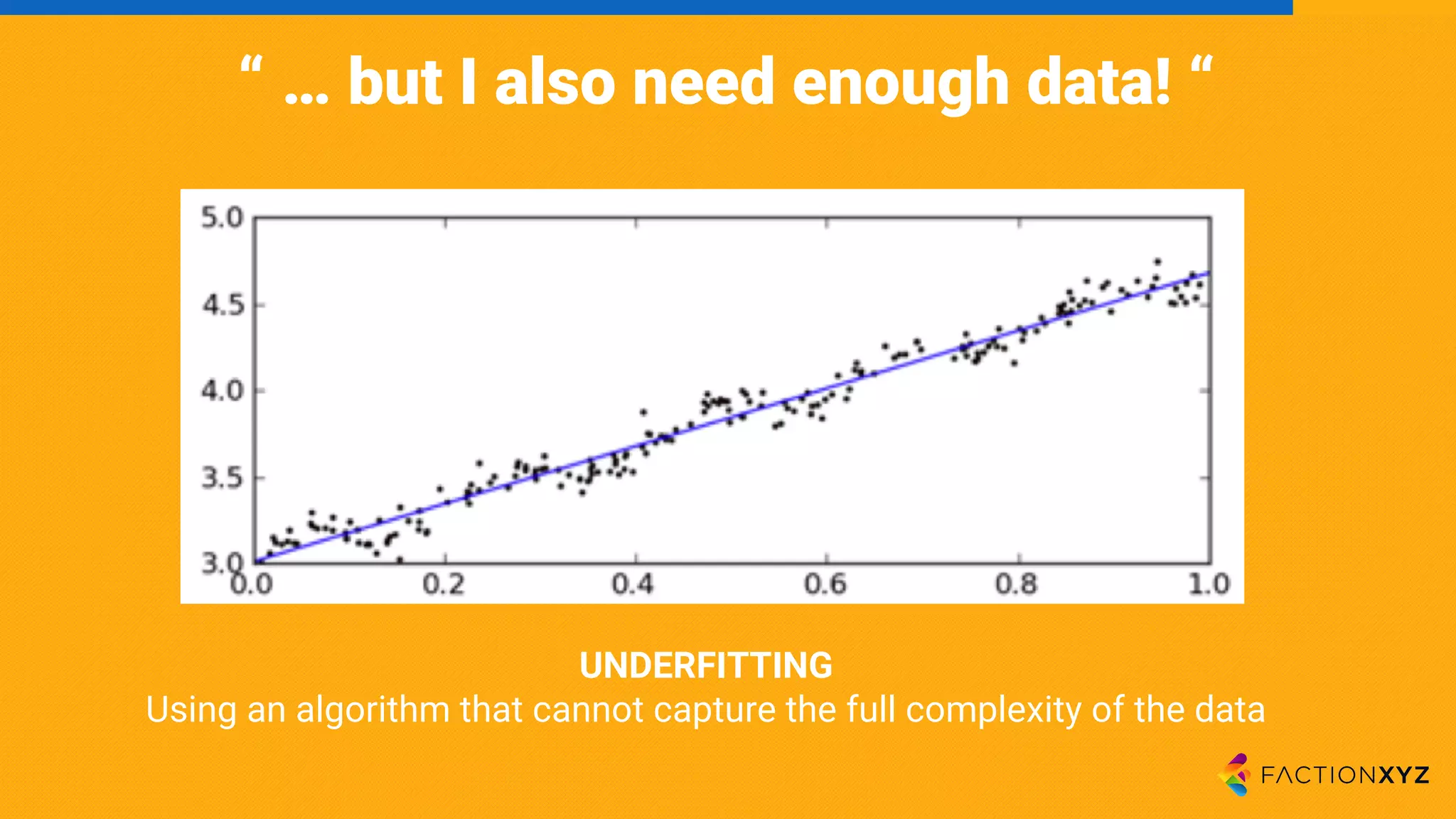
“ … but I also need enough data! “
UNDERFITTING
Using an algorithm that cannot capture the full complexity of the data
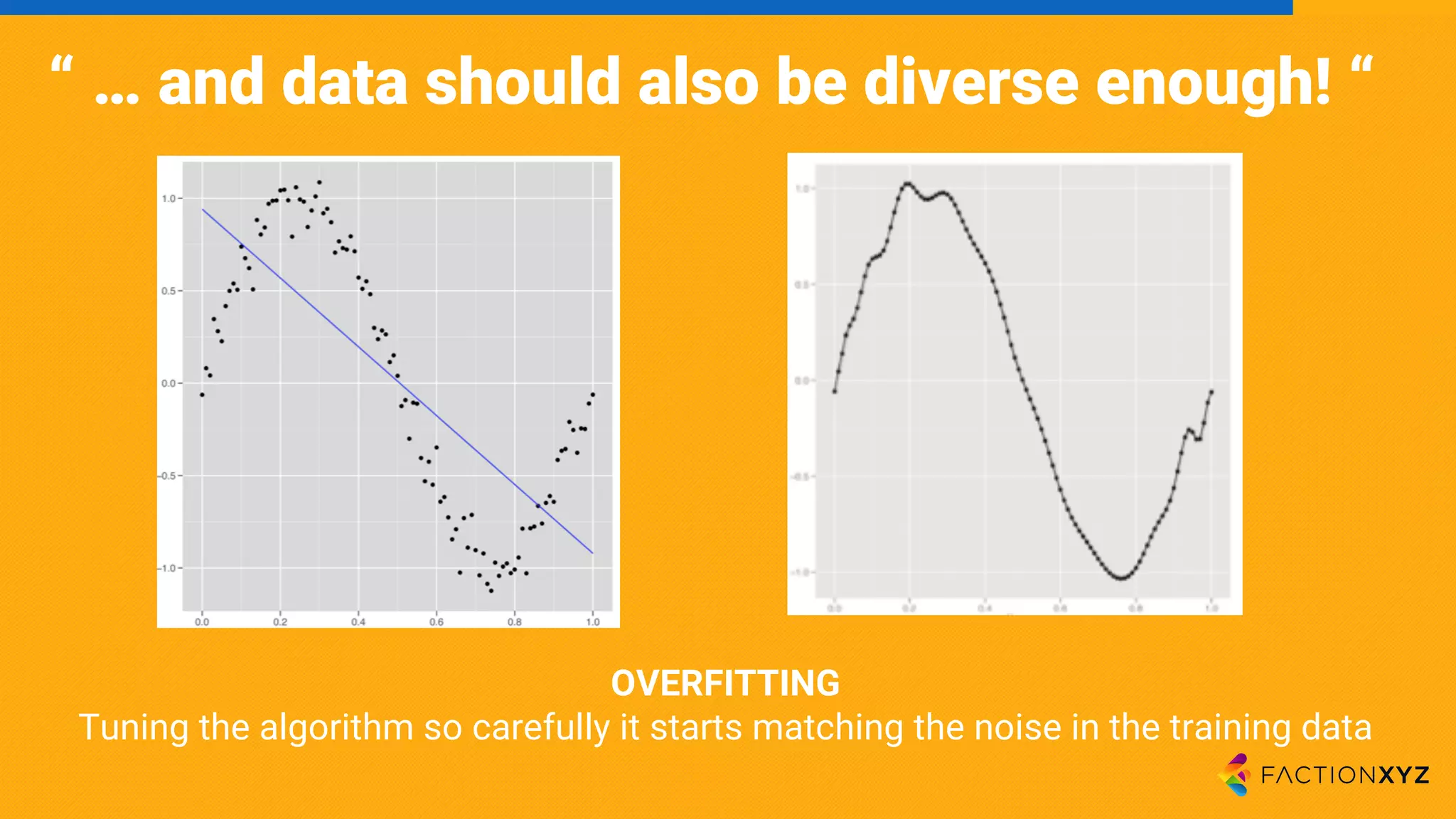
“ … and data should also be diverse enough! “
OVERFITTING
Tuning the algorithm so carefully it starts matching the noise in the training data
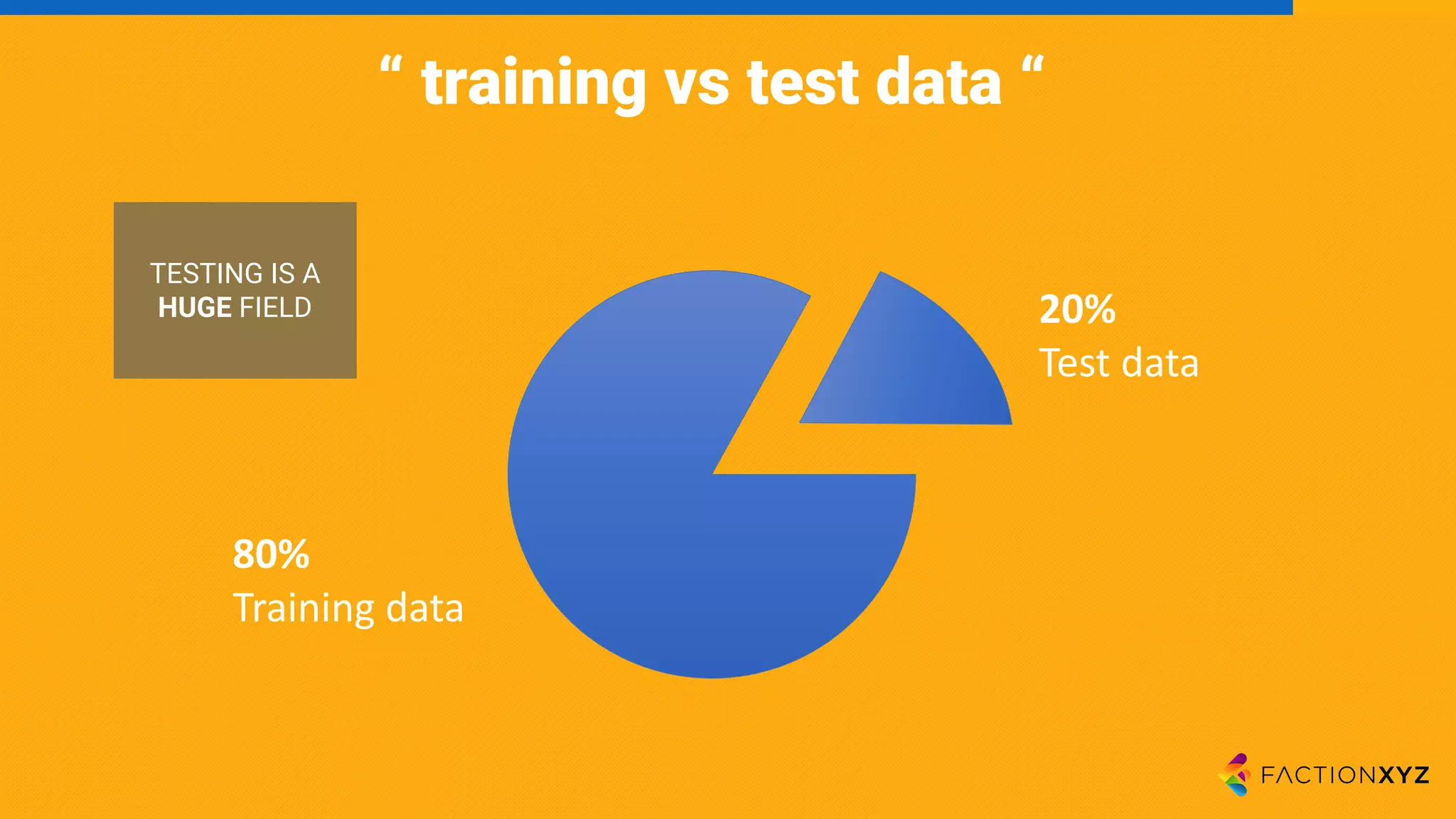
“ training vs test data “
20%
Test	data
80%
Training	data
TESTING IS A
HUGE FIELD
intelligent process automation
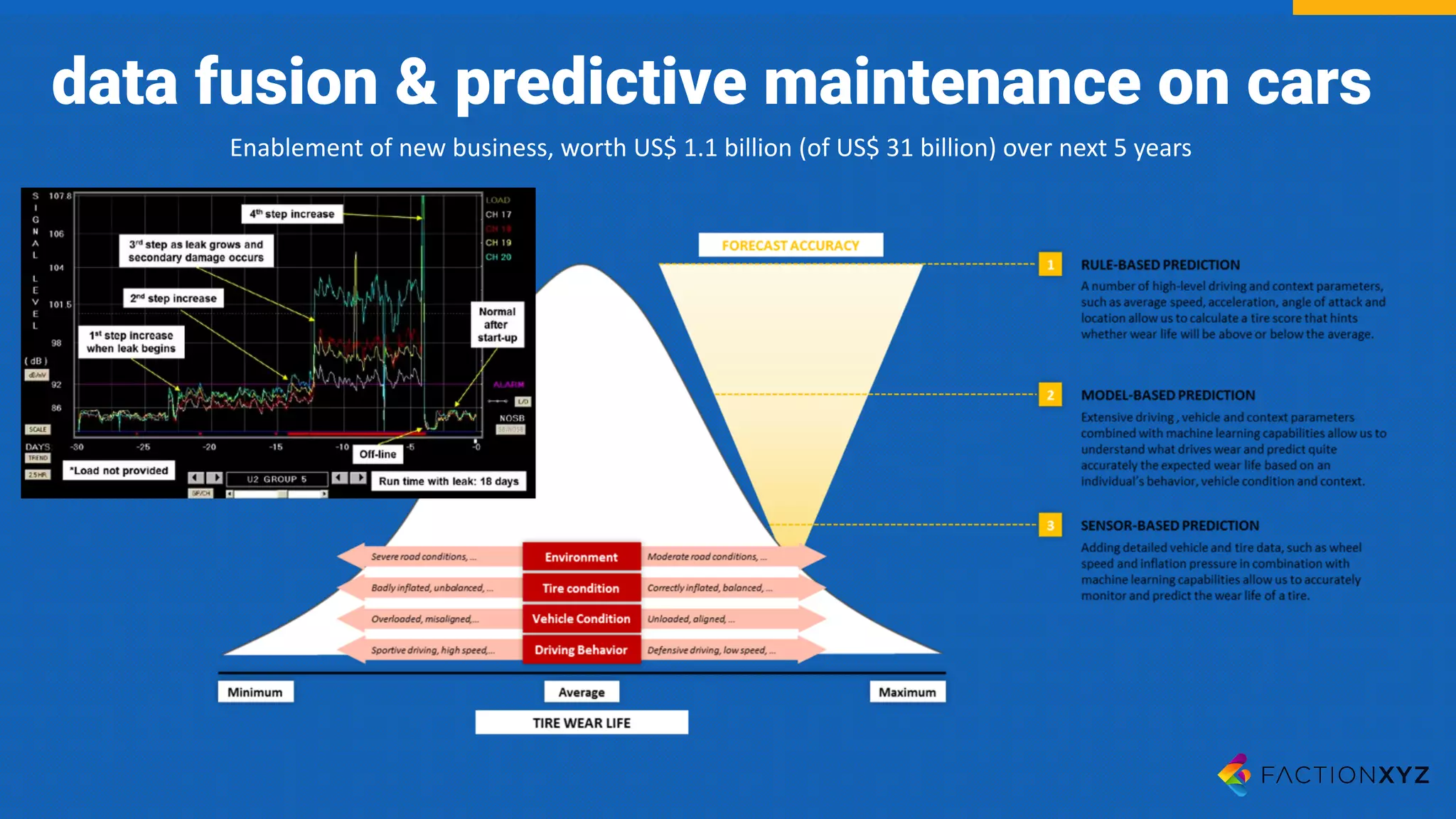
data fusion & predictive maintenance on cars
Enablement	of	new	business,	worth	US$	1.1	billion	(of	US$	31	billion)	over	next	5	years
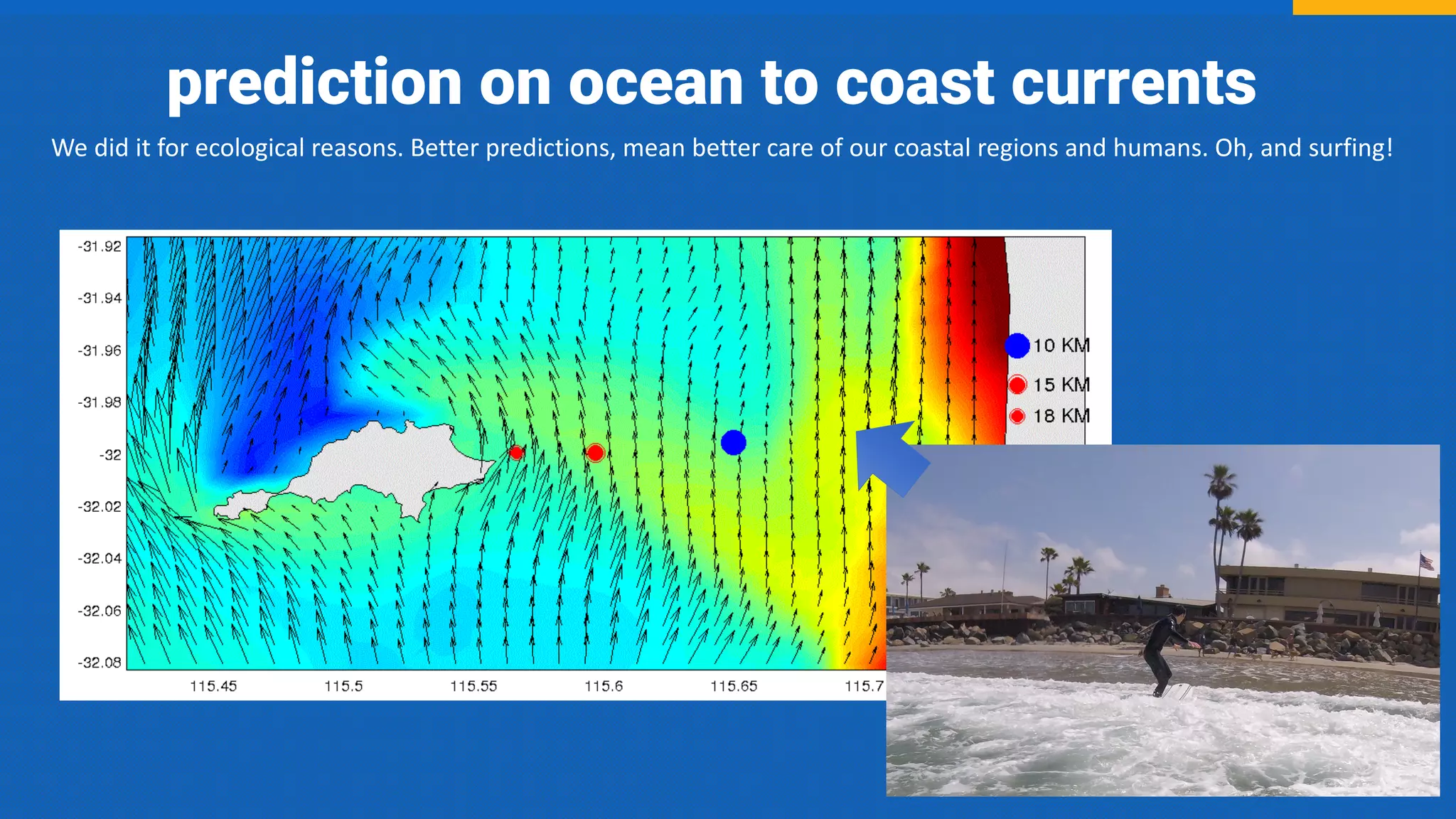
prediction on ocean to coast currents
We	did	it	for	ecological	reasons.	Better	predictions,	mean	better	care	of	our	coastal	regions	and	humans.	Oh,	and	surfing!
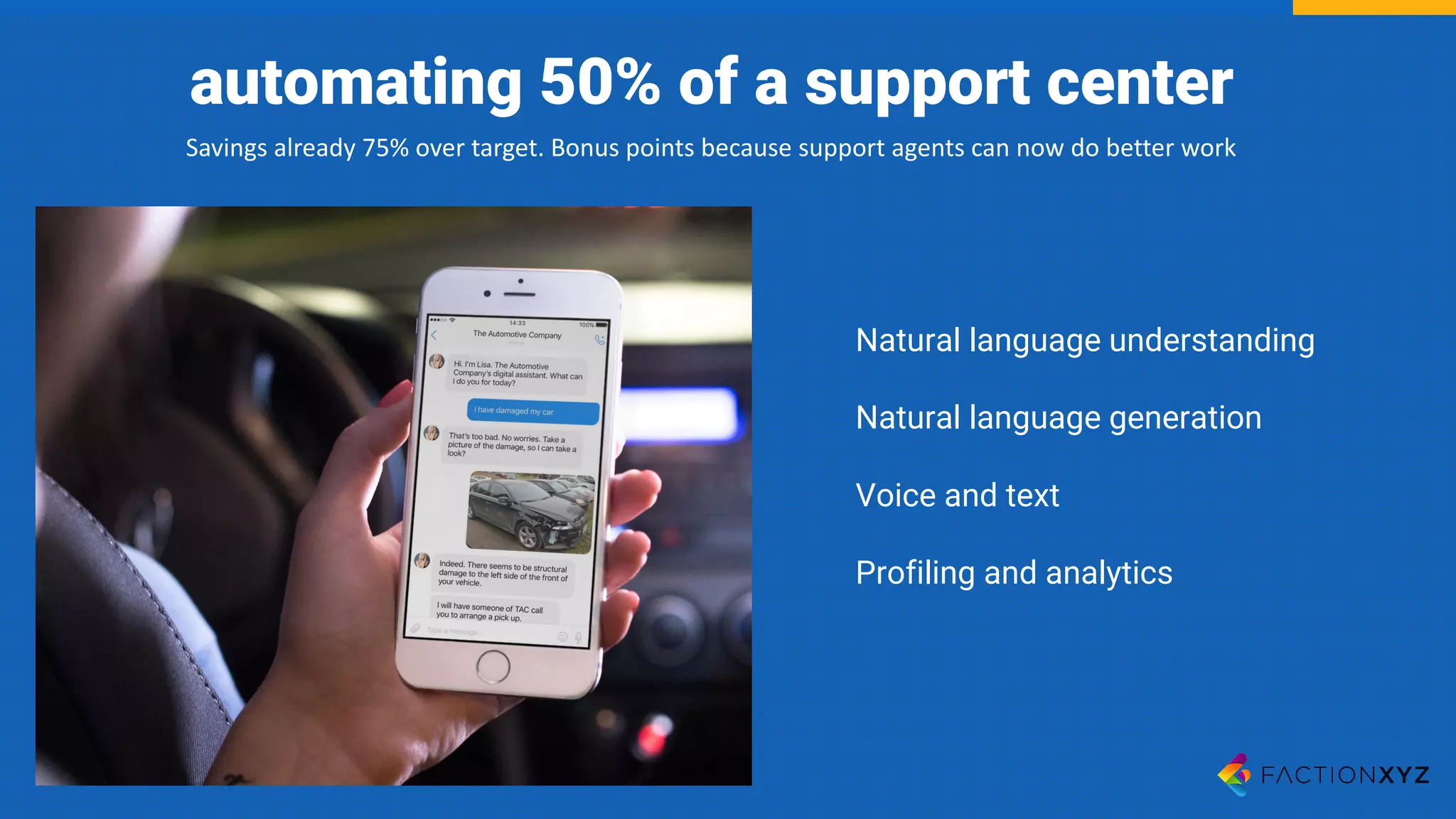
automating 50% of a support center
Savings	already	75%	over	target.	Bonus	points	because	support	agents	can	now	do	better	work
Natural language understanding
Natural language generation
Voice and text
Profiling and analytics
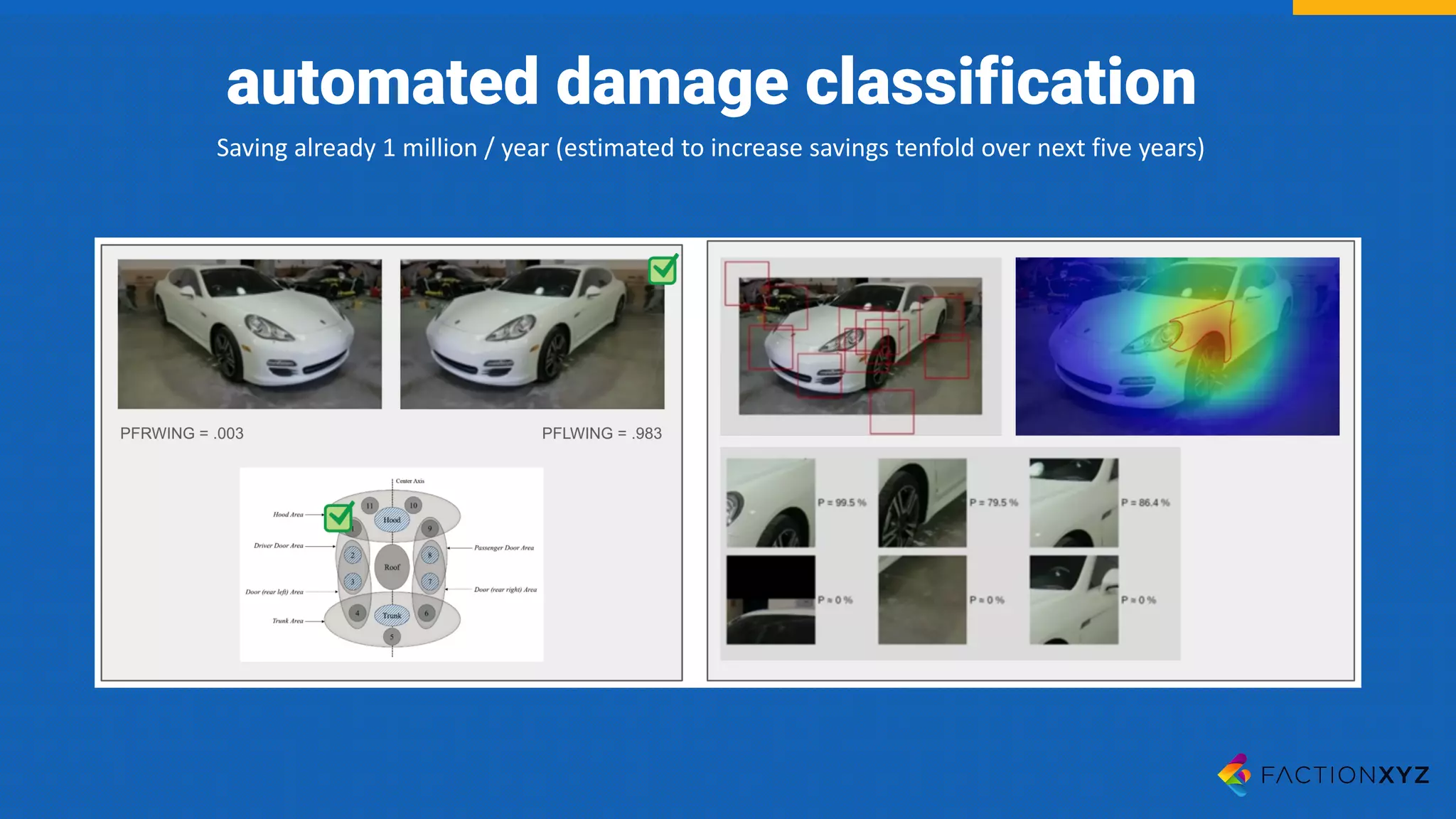
automated damage classification
Saving	already	1	million	/	year	(estimated	to	increase	savings	tenfold	over	next	five	years)
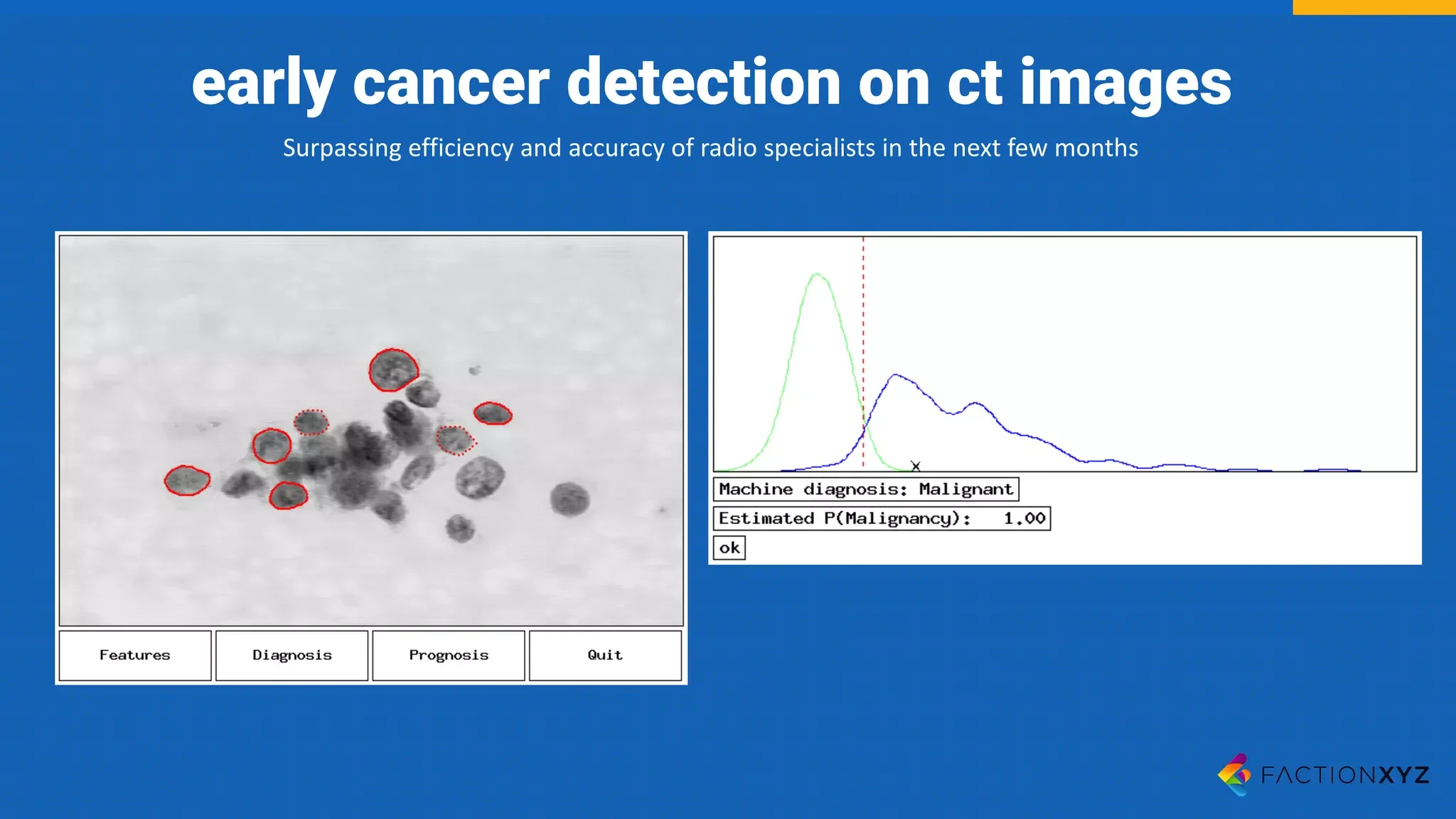
early cancer detection on ct images
Surpassing	efficiency	and	accuracy	of	radio	specialists	in	the	next	few	months
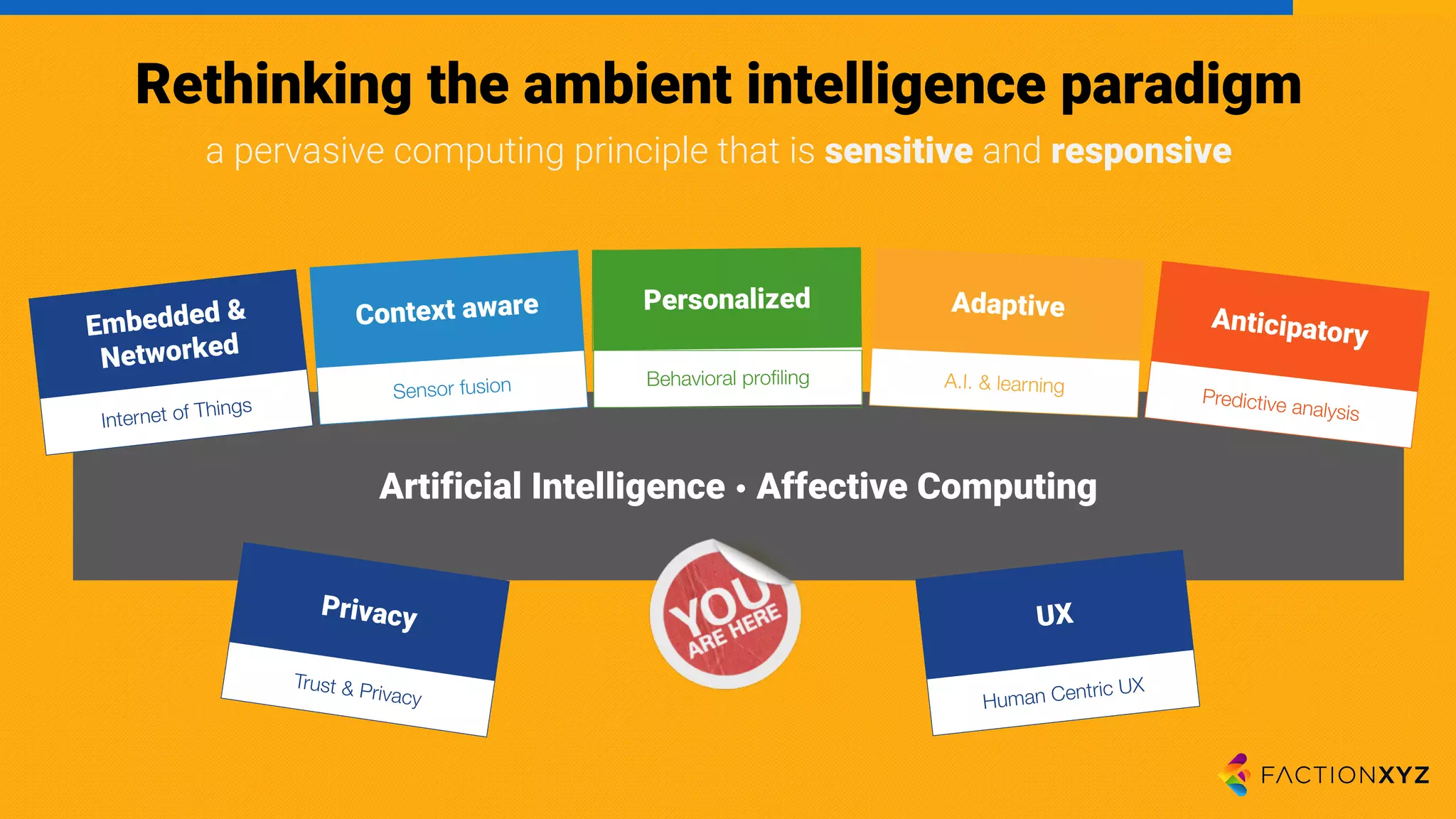
Artificial Intelligence Ÿ Affective Computing
Rethinking the ambient intelligence paradigm
a pervasive computing principle that is sensitive and responsive
Technical challenges
Battery and power consumption
Distributed & Edge Computing
On-Chip classifiers
A.I. on time series data (Reservoir, LSM, DL)
Homomorphic cryptography (Privacy)
Pervasive data collection and storage
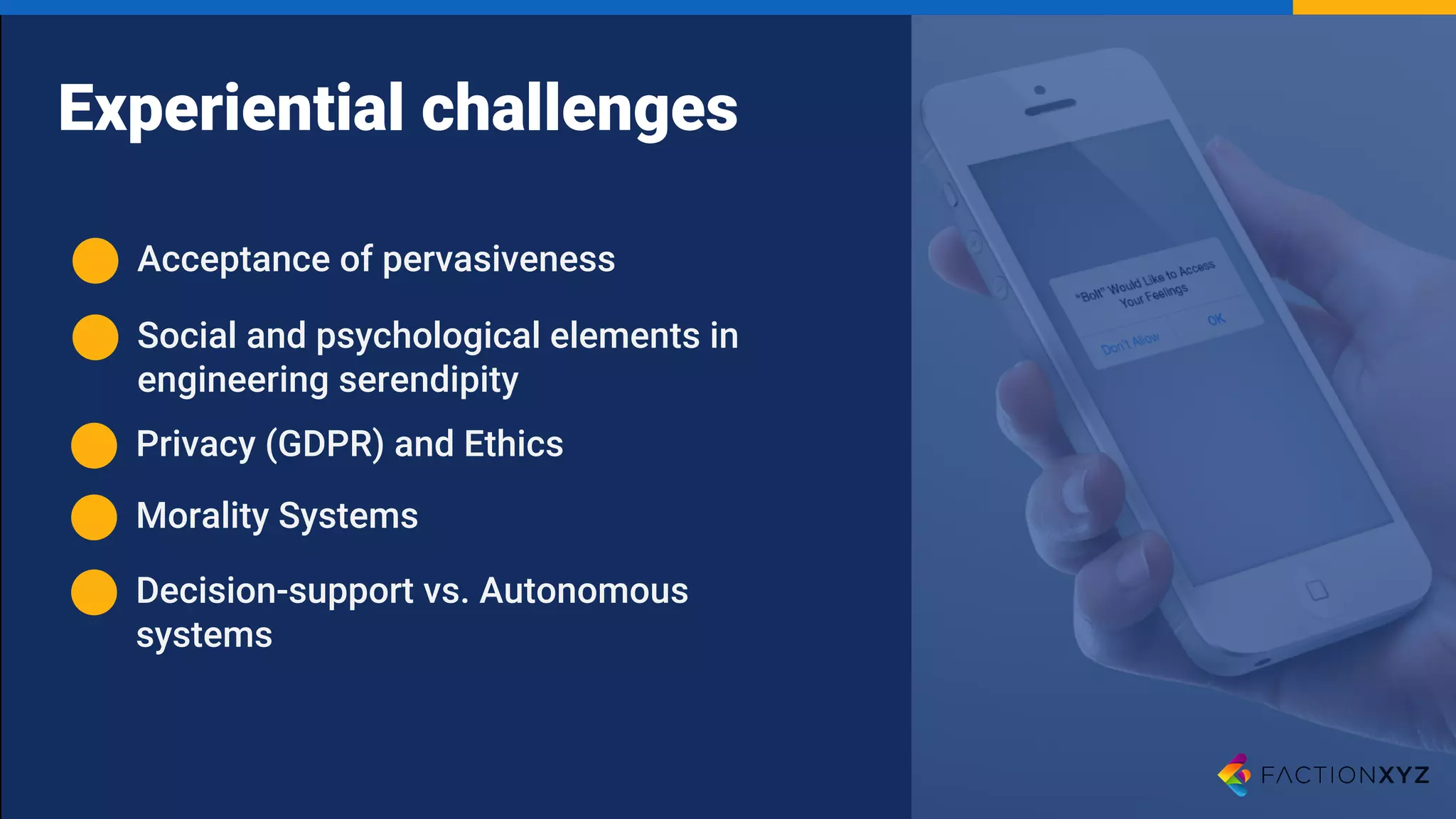
Experiential challenges
Acceptance of pervasiveness
Social and psychological elements in
engineering serendipity
Privacy (GDPR) and Ethics
Morality Systems
Decision-support vs. Autonomous
systems
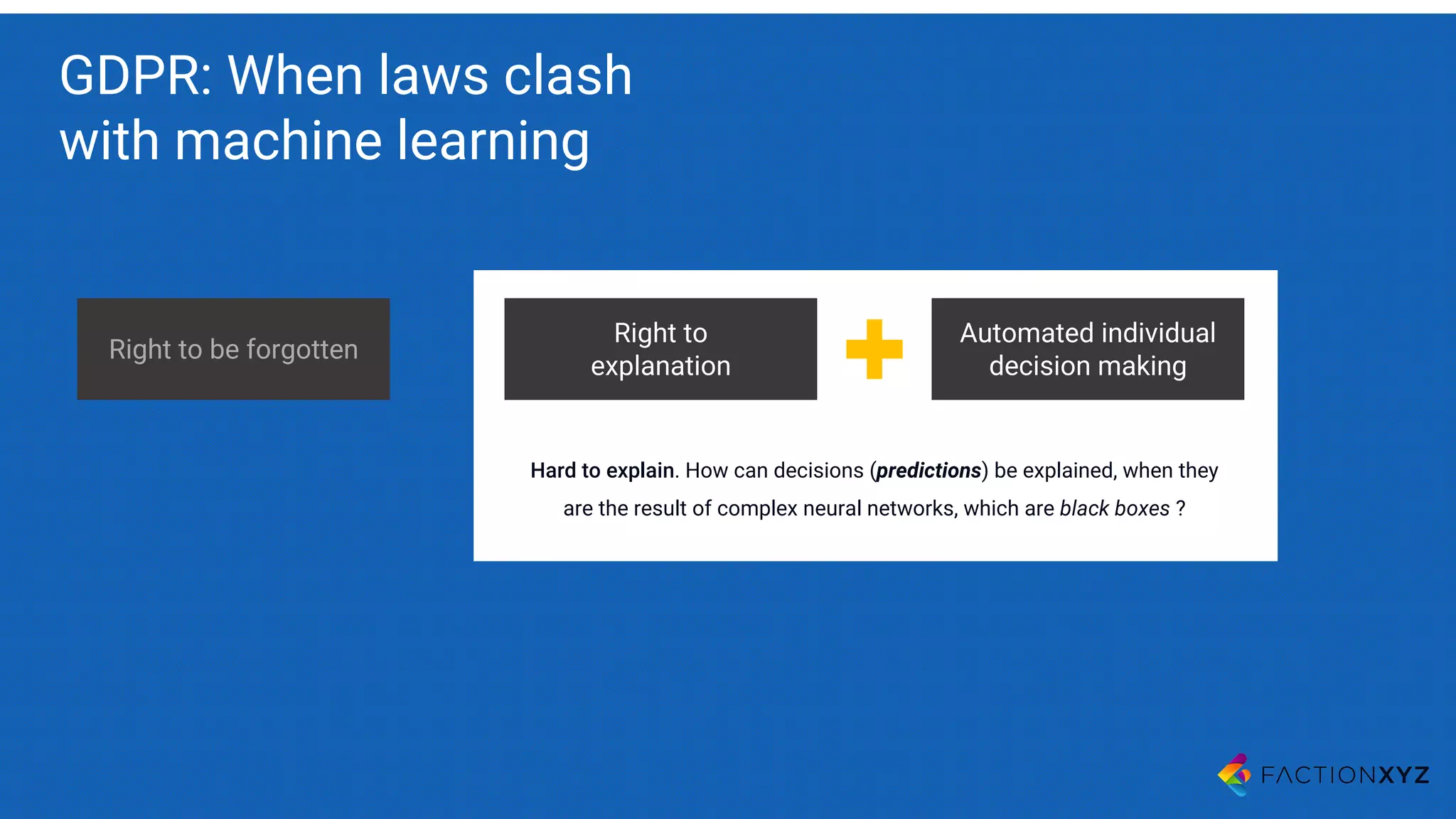
GDPR: When laws clash
with machine learning
Right to be forgotten
Right to
explanation
Automated individual
decision making
Hard to explain. How can decisions (predictions) be explained, when they
are the result of complex neural networks, which are black boxes ?
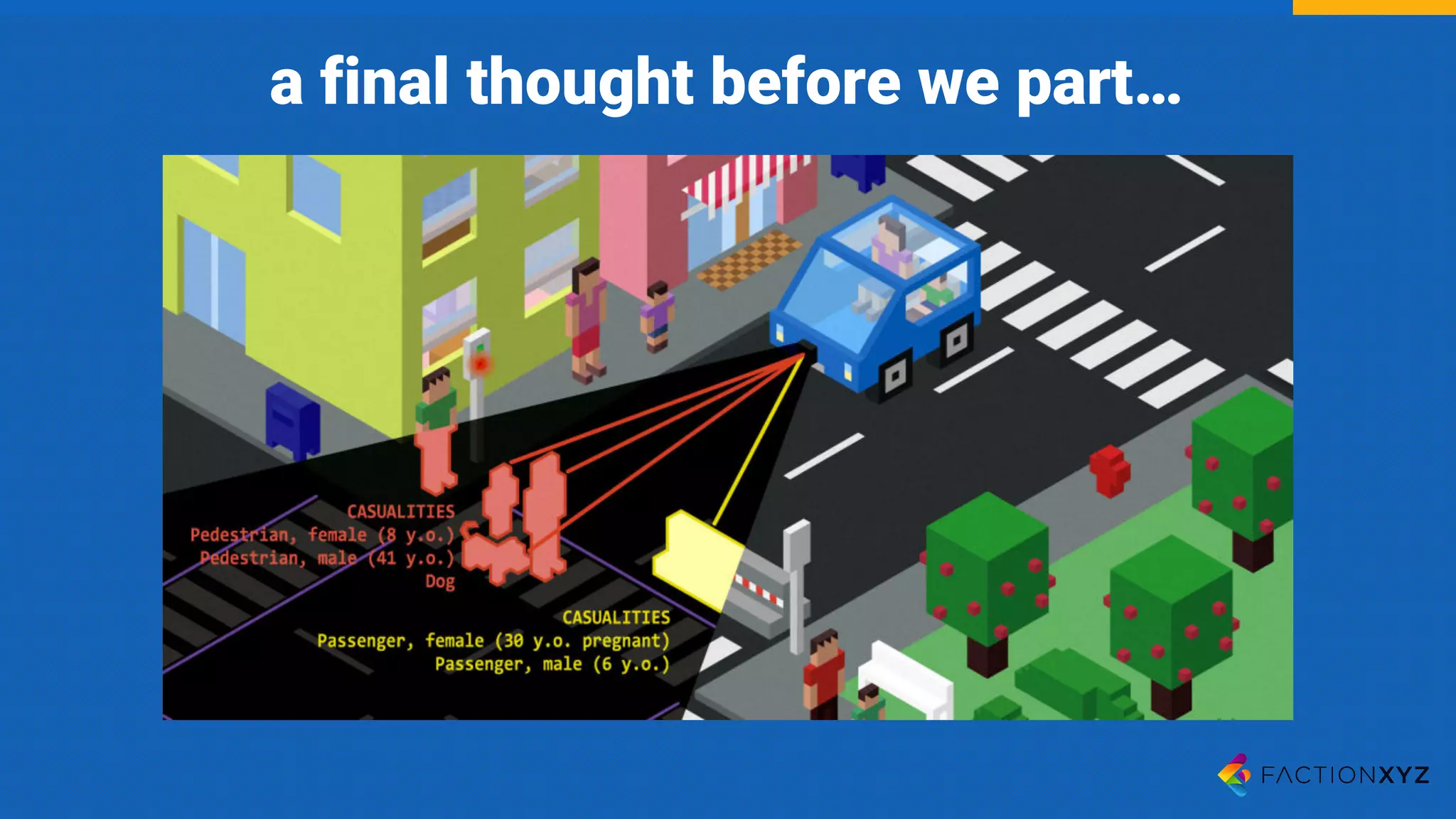
a final thought before we part…
zooming in on chatbots
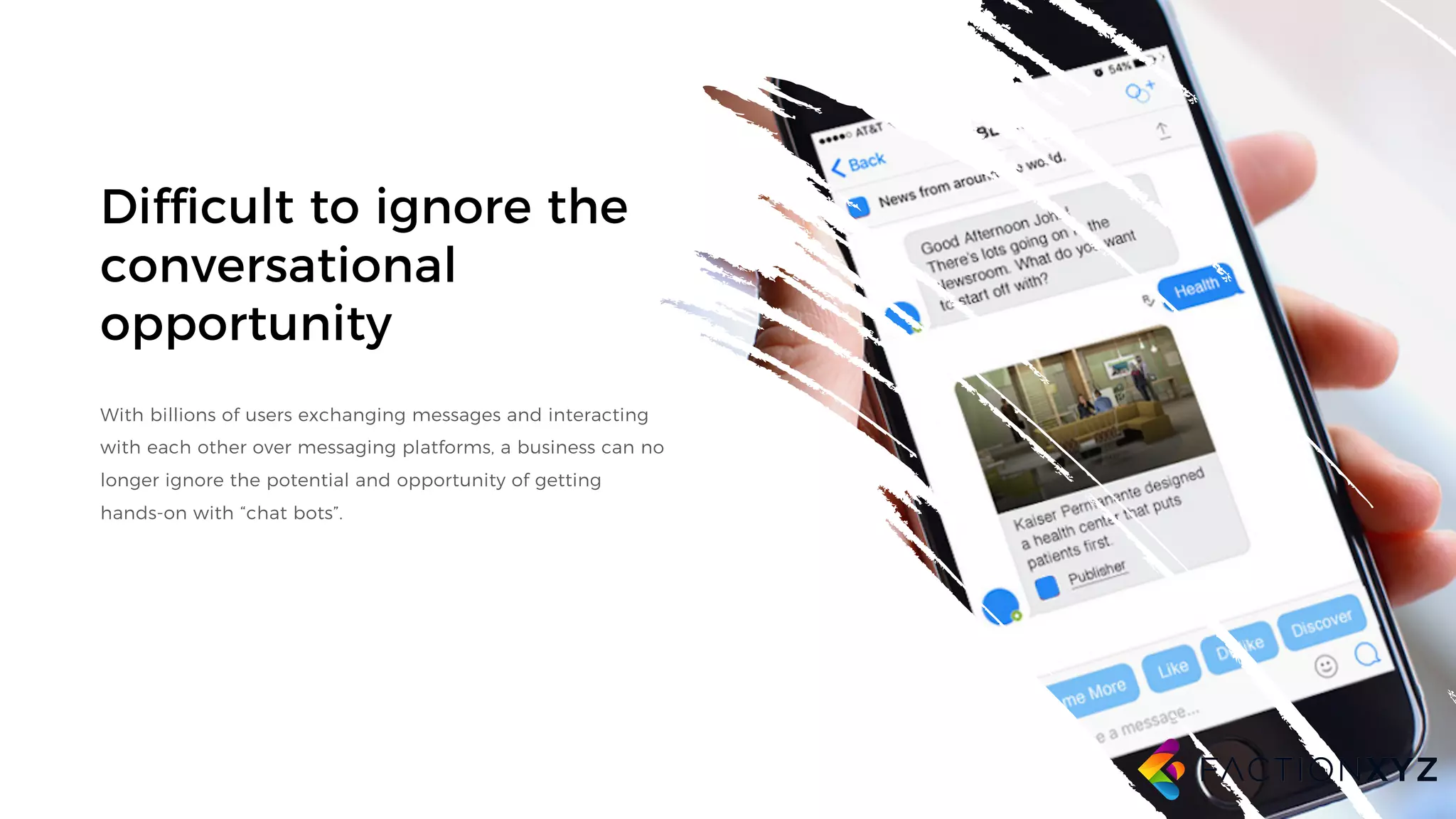
Difficult to ignore the
conversational
opportunity
With billions of users exchanging messages and interacting
with each other over messaging platforms, a business can no
longer ignore the potential and opportunity of getting
hands-on with “chat bots”.
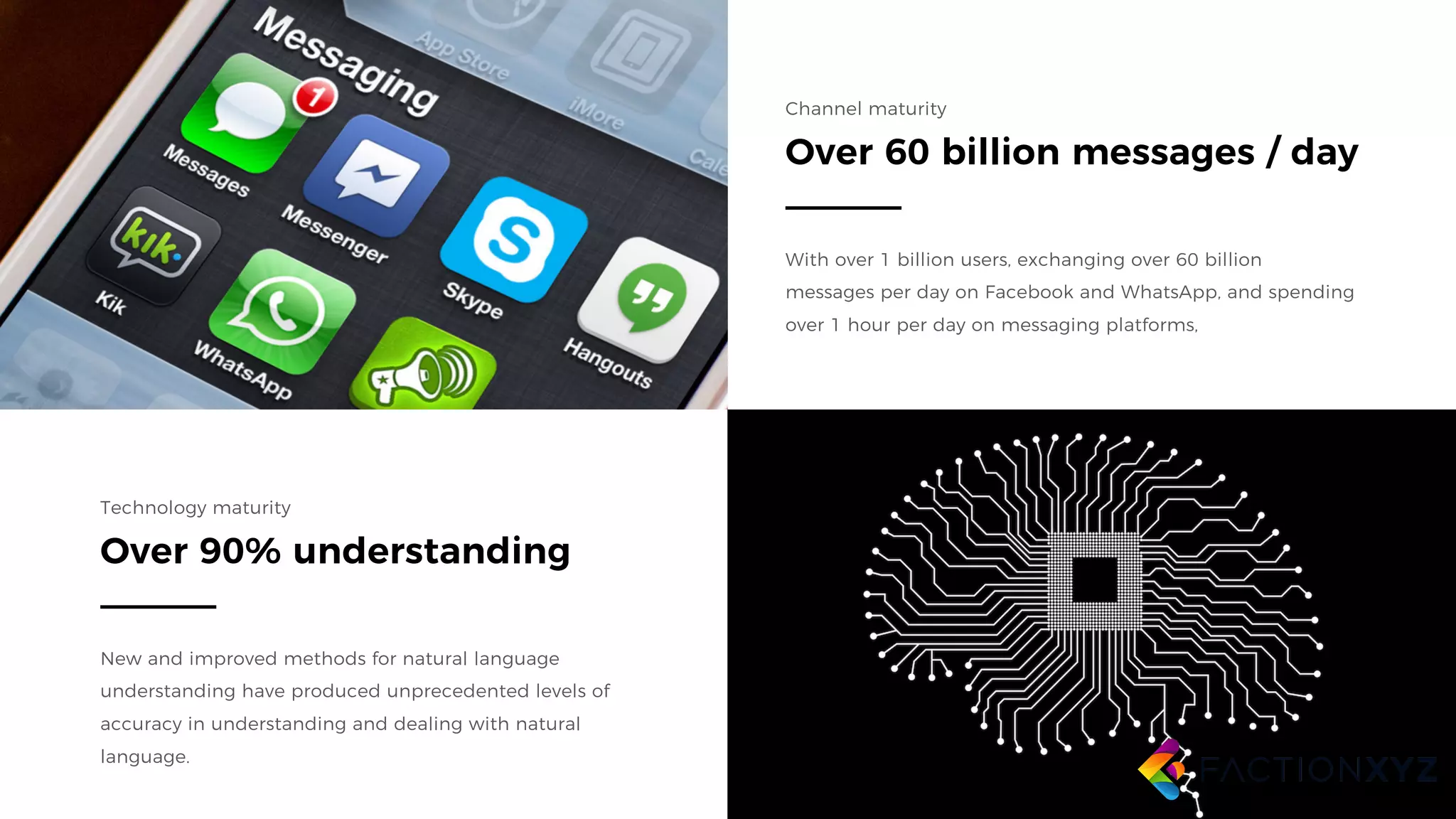
Over 90% understanding
Technology maturity
New and improved methods for natural language
understanding have produced unprecedented levels of
accuracy in understanding and dealing with natural
language.
Channel maturity
With over 1 billion users, exchanging over 60 billion
messages per day on Facebook and WhatsApp, and spending
over 1 hour per day on messaging platforms,
Over 60 billion messages / day
A brief history of
conversational agents
Personal assistants, virtual agents, chat bots or conversational
agents. However you want to call this technology, they all
hint for the need for humans to interact with machines in a
more natural and frictionless manner when dealing with
complex interactions.
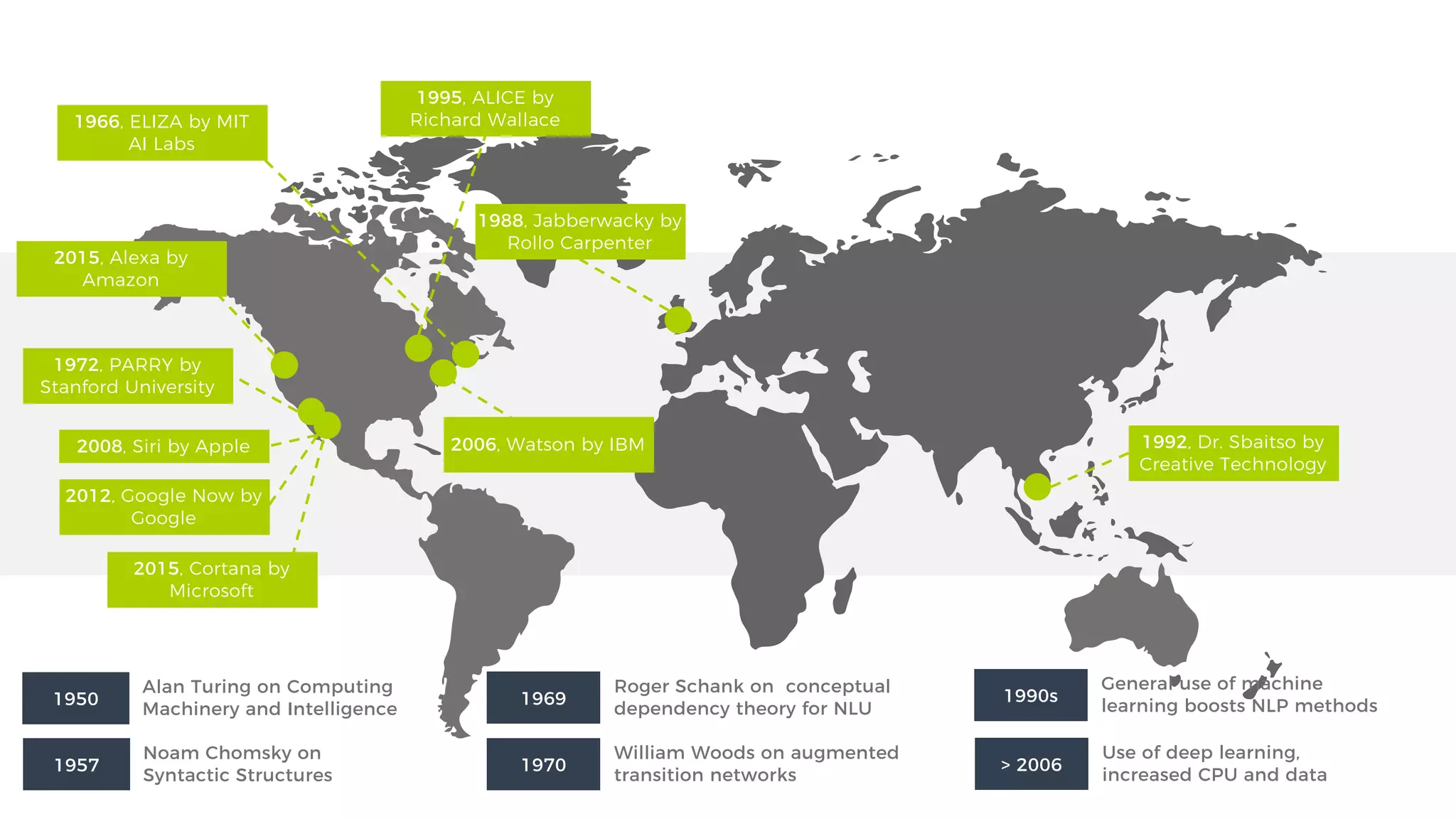
1966, ELIZA by MIT
AI Labs
1972, PARRY by
Stanford University
1988, Jabberwacky by
Rollo Carpenter
1992, Dr. Sbaitso by
Creative Technology
1995, ALICE by
Richard Wallace
2006, Watson by IBM2008, Siri by Apple
2012, Google Now by
Google
2015, Alexa by
Amazon
2015, Cortana by
Microsoft
1950
Alan Turing on Computing
Machinery and Intelligence
1957
Noam Chomsky on
Syntactic Structures
1969
Roger Schank on conceptual
dependency theory for NLU
1970
William Woods on augmented
transition networks
1990s
General use of machine
learning boosts NLP methods
> 2006
Use of deep learning,
increased CPU and data
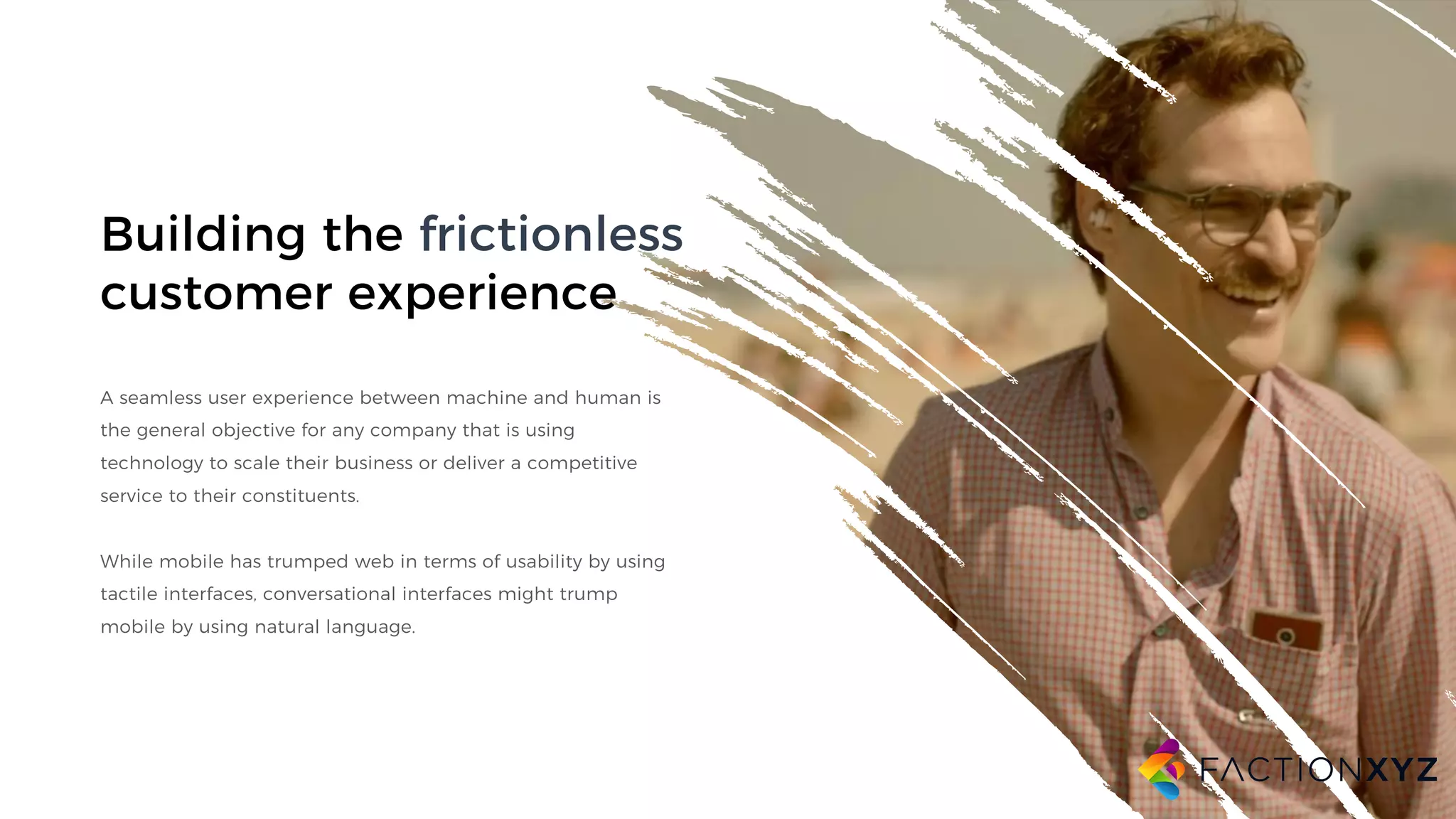
Building the frictionless
customer experience
A seamless user experience between machine and human is
the general objective for any company that is using
technology to scale their business or deliver a competitive
service to their constituents.
While mobile has trumped web in terms of usability by using
tactile interfaces, conversational interfaces might trump
mobile by using natural language.
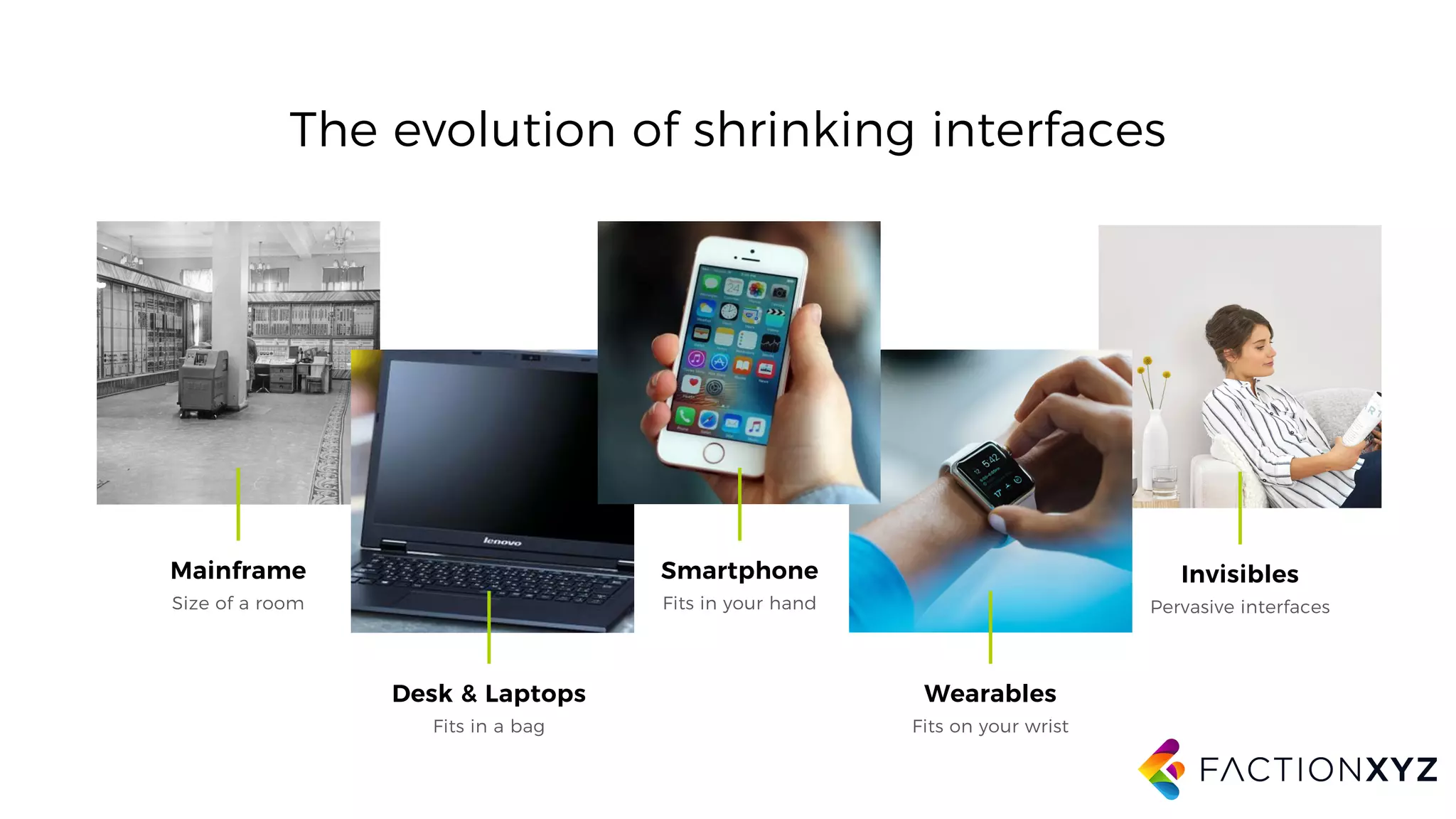
The evolution of shrinking interfaces
Size of a room
Mainframe
Fits in your hand
Smartphone
Fits in a bag
Desk & Laptops
Fits on your wrist
Wearables
Pervasive interfaces
Invisibles
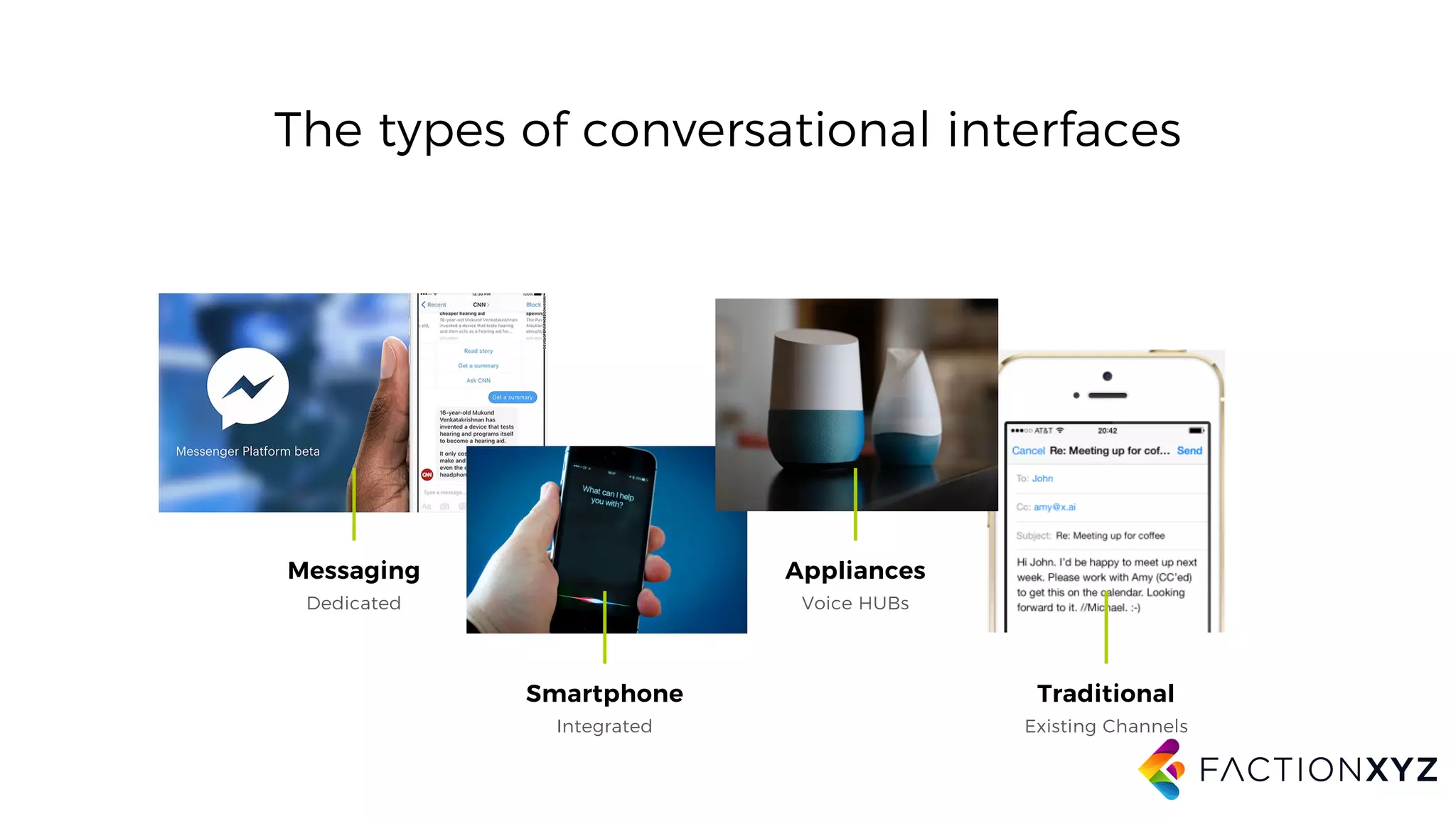
The types of conversational interfaces
Dedicated
Messaging
Voice HUBs
Appliances
Integrated
Smartphone
Existing Channels
Traditional
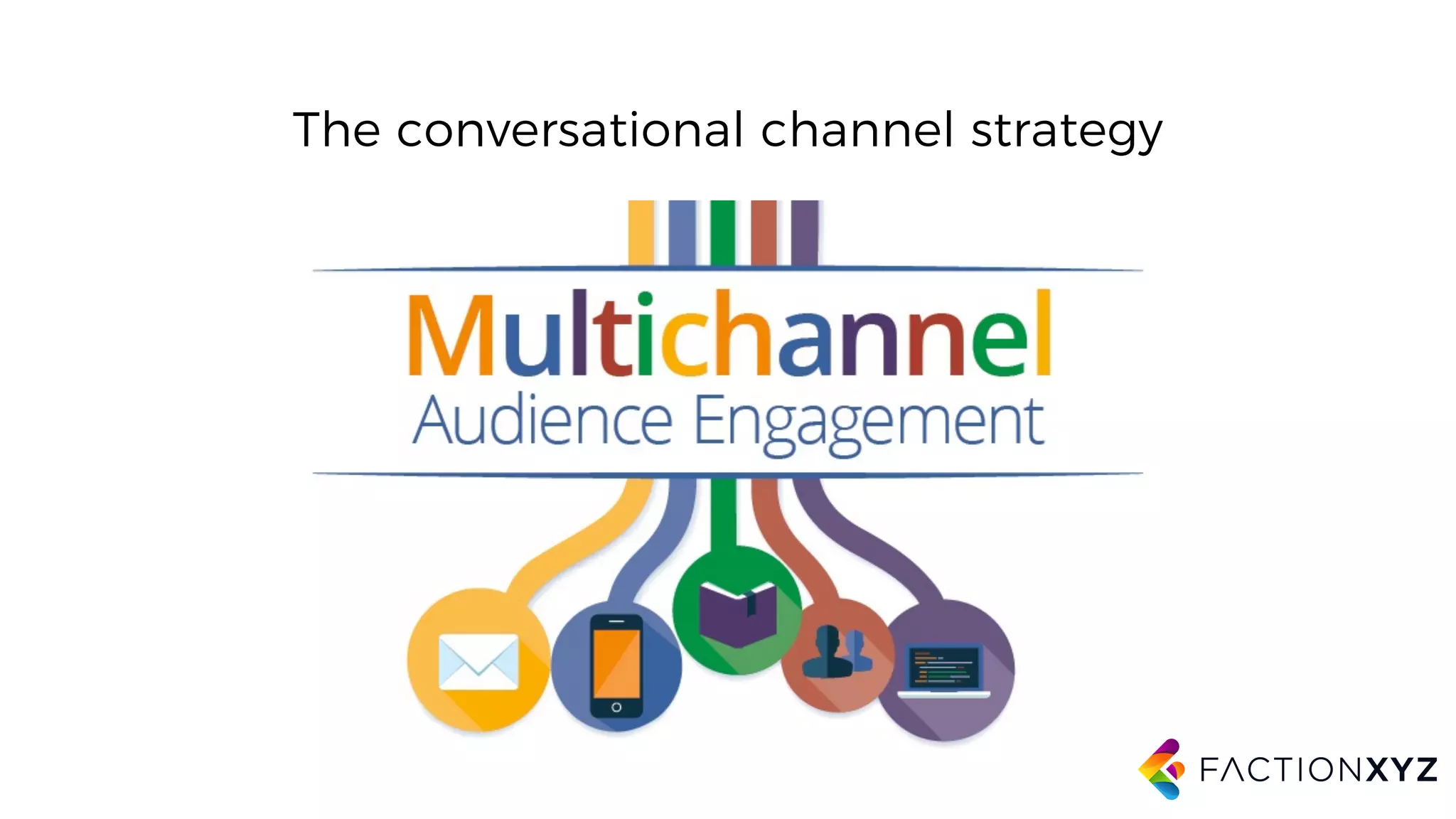
The conversational channel strategy
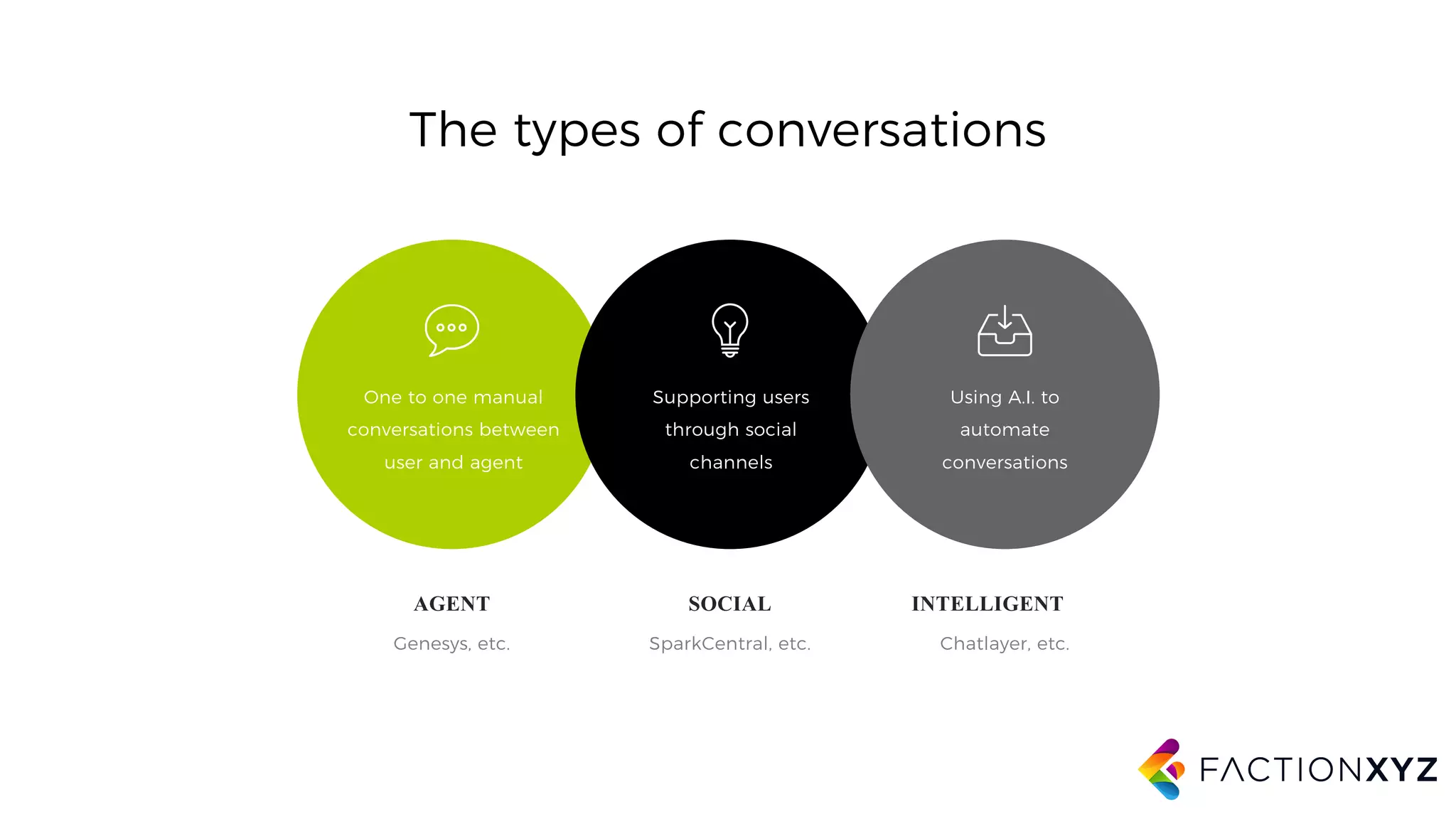
The types of conversations
AGENT
Genesys, etc.
SOCIAL
SparkCentral, etc.
INTELLIGENT
Chatlayer, etc.
One to one manual
conversations between
user and agent
Supporting users
through social
channels
Using A.I. to
automate
conversations
The support business case
Lowering the support cost through natural language processing (NLP) and automating the
conversation, so that the bulk of the load is handled by automated and intelligent platforms.
Built on ROI. Reach an ROI in less than a year (*), making a positive business case.
The user experience & brand case
Increase brand visibility and proximity through new and innovative conversational user
experiences. Reduce churn, increase conversions or raise brand awareness. Built on vision.
AI, Machine Learning, and
chatbots: an AI-First approach
Seminar “The Future of IT” by ITWorks

Filip Maertens - AI, Machine Learning and Chatbots: Think AI-first

  • 1.
    
 AI, Machine Learningen Chatbots: Think AI-first Filip Maertens (Founder, faction.xyz) Twitter: @fmaertens
 LinkedIn: https://www.linkedin.com/in/fmaertens/ Presented at “The Future of IT” - Organised by @itworks on the 20th of September 2017 in Parker Hotel Brussels Airport, Belgium

  • 2.
    AI, Machine Learning,and chatbots: an AI-First approach Seminar “The Future of IT” by ITWorks
  • 3.
    • Learning is the process of improving with experienceat some task • Improving over task, T • With respect to performance measure, P • Based on experience, E Learning how to filter spam T = Identify spam emails P = % of filtered spam emails vs % of filtered ham emails E = a database of emails that were labelled by users/experts the principles of learning
  • 4.
    Deep Belief Networks ComputerVision Audio Signal Processing Natural Language (NLP) many domains in the field of A.I.
  • 5.
    5 year old? the age of A.I. ?
  • 6.
    Sensors, cameras, databases, etc. Measuringdevices Noise filtering, Feature Extraction, Normalization Preprocessing Feature selection, feature projection Dimensionality reduction Classification, regression, clustering, description Model learning Cross validation, bootstrap Model testing P Supervised UnsupervisedVS Target / outcome is known I know how to classify this data, I just need you(the classifier) to do it. Target / outcome is unknown I have no idea how to classify this data, can you(the algorithm) create a classifier for me? ReinforcementVS Classification & outcome is unknown I have no idea how to classify this data, can you classify this data and I'll give you a reward if it's correct or I'll punish you if it's not. machine learning, the basics
  • 7.
  • 8.
    Two sides tothe data story Declared Observed Content Structured, explicit, self-declared, and static Context Unstructured, time-series, observed, and dynamic
  • 9.
    “ don’t worry.we have lots of data! “ Data can be unlabeled Data usually is dirty Data is sometimes not relevant Over 80% of data is not, wrong or insufficiently labeled Resolutions, sampling rates, special characters, hidden values, NULL values, … Sometimes the data is simply not fit for purpose! I don’t need a lot of data. I need good data.
  • 10.
    “ … butI also need enough data! “ UNDERFITTING Using an algorithm that cannot capture the full complexity of the data
  • 11.
    “ … anddata should also be diverse enough! “ OVERFITTING Tuning the algorithm so carefully it starts matching the noise in the training data
  • 12.
    “ training vstest data “ 20% Test data 80% Training data TESTING IS A HUGE FIELD
  • 13.
  • 14.
    data fusion &predictive maintenance on cars Enablement of new business, worth US$ 1.1 billion (of US$ 31 billion) over next 5 years
  • 15.
    prediction on oceanto coast currents We did it for ecological reasons. Better predictions, mean better care of our coastal regions and humans. Oh, and surfing!
  • 16.
    automating 50% ofa support center Savings already 75% over target. Bonus points because support agents can now do better work Natural language understanding Natural language generation Voice and text Profiling and analytics
  • 17.
  • 18.
    early cancer detectionon ct images Surpassing efficiency and accuracy of radio specialists in the next few months
  • 19.
    Artificial Intelligence ŸAffective Computing Rethinking the ambient intelligence paradigm a pervasive computing principle that is sensitive and responsive
  • 20.
    Technical challenges Battery andpower consumption Distributed & Edge Computing On-Chip classifiers A.I. on time series data (Reservoir, LSM, DL) Homomorphic cryptography (Privacy) Pervasive data collection and storage
  • 21.
    Experiential challenges Acceptance ofpervasiveness Social and psychological elements in engineering serendipity Privacy (GDPR) and Ethics Morality Systems Decision-support vs. Autonomous systems
  • 22.
    GDPR: When lawsclash with machine learning Right to be forgotten Right to explanation Automated individual decision making Hard to explain. How can decisions (predictions) be explained, when they are the result of complex neural networks, which are black boxes ?
  • 23.
    a final thoughtbefore we part…
  • 24.
    zooming in onchatbots
  • 25.
    Difficult to ignorethe conversational opportunity With billions of users exchanging messages and interacting with each other over messaging platforms, a business can no longer ignore the potential and opportunity of getting hands-on with “chat bots”.
  • 27.
    Over 90% understanding Technologymaturity New and improved methods for natural language understanding have produced unprecedented levels of accuracy in understanding and dealing with natural language. Channel maturity With over 1 billion users, exchanging over 60 billion messages per day on Facebook and WhatsApp, and spending over 1 hour per day on messaging platforms, Over 60 billion messages / day
  • 29.
    A brief historyof conversational agents Personal assistants, virtual agents, chat bots or conversational agents. However you want to call this technology, they all hint for the need for humans to interact with machines in a more natural and frictionless manner when dealing with complex interactions.
  • 30.
    1966, ELIZA byMIT AI Labs 1972, PARRY by Stanford University 1988, Jabberwacky by Rollo Carpenter 1992, Dr. Sbaitso by Creative Technology 1995, ALICE by Richard Wallace 2006, Watson by IBM2008, Siri by Apple 2012, Google Now by Google 2015, Alexa by Amazon 2015, Cortana by Microsoft 1950 Alan Turing on Computing Machinery and Intelligence 1957 Noam Chomsky on Syntactic Structures 1969 Roger Schank on conceptual dependency theory for NLU 1970 William Woods on augmented transition networks 1990s General use of machine learning boosts NLP methods > 2006 Use of deep learning, increased CPU and data
  • 31.
    Building the frictionless customerexperience A seamless user experience between machine and human is the general objective for any company that is using technology to scale their business or deliver a competitive service to their constituents. While mobile has trumped web in terms of usability by using tactile interfaces, conversational interfaces might trump mobile by using natural language.
  • 32.
    The evolution ofshrinking interfaces Size of a room Mainframe Fits in your hand Smartphone Fits in a bag Desk & Laptops Fits on your wrist Wearables Pervasive interfaces Invisibles
  • 33.
    The types ofconversational interfaces Dedicated Messaging Voice HUBs Appliances Integrated Smartphone Existing Channels Traditional
  • 34.
  • 35.
    The types ofconversations AGENT Genesys, etc. SOCIAL SparkCentral, etc. INTELLIGENT Chatlayer, etc. One to one manual conversations between user and agent Supporting users through social channels Using A.I. to automate conversations
  • 36.
    The support businesscase Lowering the support cost through natural language processing (NLP) and automating the conversation, so that the bulk of the load is handled by automated and intelligent platforms. Built on ROI. Reach an ROI in less than a year (*), making a positive business case.
  • 37.
    The user experience& brand case Increase brand visibility and proximity through new and innovative conversational user experiences. Reduce churn, increase conversions or raise brand awareness. Built on vision.
  • 38.
    AI, Machine Learning,and chatbots: an AI-First approach Seminar “The Future of IT” by ITWorks