FILE SECURITY SYSTEM
Under Guidance Presented By
Er. Alok Jadaun Dheeraj Kumar Singh(1000410015)
Pushpendra Kumar(1100410901)
Rohit Singh(1000410061)
Surendra Kr Kannoujiya(1000410083)
CONTENT
 Introduction
 Objective of file security system
 Technique used in file security system
 Encryption
 Decryption
 Symmetric-key encryption
 Asymmetric-key encryption
 How much module used in the project
 Algorithm is used in the encryption process
 Flow chart of AES algorithm
 Requirement of Software and hardware
 Snapshots
 Conclusion
INTRODUCTION
 The File Security System is a software, which tries
to alter the originality of the text into some
encrypted form.
 It is use to store the information in a form that is
unreadable.
 The Application should have a reversal process as
of which should be in a position to decrypt the data
to its original format upon the proper request by the
user.
OBJECTIVE OF FILE SECURITY SYSTEM
 Secure the file from unauthorized user.
 If hacker get the encrypted file they can not read to
the file.
 It give confidentiality to user that information is
secure.
TECHNIQUE USED IN FILE SECURITY
SYSTEM
 Encryption
 Decryption
ENCRYPTION
 Encryption is the process of encoding messages (or
information) in such a way that eavesdroppers or
hackers cannot read it, but only authorized parties
can access.
 In an Encryption scheme, the message or
information (referred to as plaintext) is encrypted
using an encryption algorithm, turning it into an
unreadable cipher text. This is usually done with the
use of an encryption key.
 This is usually done with the use of an encryption key
which specifies how the message is to be encoded.
There are two basic types of encryption schemes:
 Symmetric-key encryption
 Asymmetric-key(public-key encryption)
DECRYPTION
 Decryption should be a reverse process of encryption
process.
 Decryption is the process of encoding messages (or
information) in such a way that it become readable for
users.
 It convert the cipher text into the plain text after
encryption.
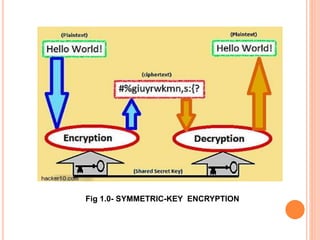
SYMMETRIC-KEY ENCRYPTION
 In symmetric-key schemes, the encryption and
decryption keys are the same.
 It involves a single secret key which both the message-
sender and the message-recipient must have.
 It is used by the sender to encrypt the message and by
the recipient to decrypt it.
Fig 1.0- SYMMETRIC-KEY ENCRYPTION
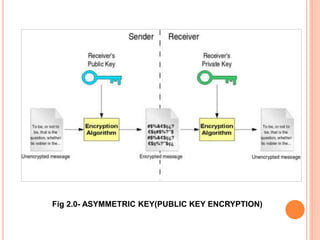
ASYMMETRIC KEY(PUBLIC KEY ENCRYPTION)
 The term "asymmetric" stems from the use of different
keys to perform these opposite functions.
 It requires two separate keys one of which is secret (or
private) and one of which is public.
 The public key is used to encrypt plaintext and the private
key is used to decrypt cipher text.
Fig 2.0- ASYMMETRIC KEY(PUBLIC KEY ENCRYPTION)
MODULES
 We used three module in the project.
(1) Input module.
(2) Process module.
(3) Output module.
INPUT MODULE
 In this module we implement attachment of file in the file
security system.
 In this module we select the file type.
PROCESS MODULE
 In this module we implement the process for the file
security system like as encryption and decryption.
OUTPUT MODULE
 In this module we save the encrypted file in
memory.
ALGORITHM USE IN ENCRYPTION
PROCESS
 AES (Advanced Encryption Standard )
AES:-AES is a symmetric-key algorithm, meaning the
same key is used for both encrypting and
decrypting the data.
The Advanced Encryption Standard (AES) is a
specification for the encryption of electronic data
established by the U.S. National Institute of
Standards and Technology (NIST) in 2001.
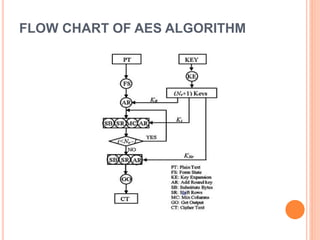
FLOW CHART OF AES ALGORITHM
REQUIREMENT OF SOFTWARE
Software:-The Software used in file security system are as
follows:-
 Operating System
 Windows NT/2000 (Client/Server)
 Front-end: Java JDK 1.4, J2Sdk 1.1.4, Swings.
REQUIREMENT OF HARDWARE
Hardware:-The hardware used in iris recognition are as
follows:-
 Pentium IV Processor with 1.9 GHz Clock Speed
 512 MB RAM, 20 GB HDD, 32 Bit PCI Ethernet Card
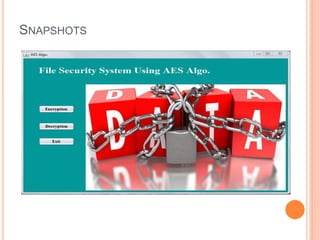
SNAPSHOTS
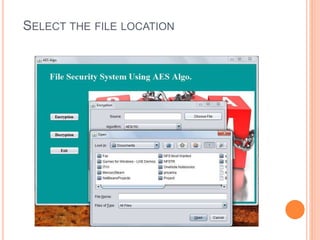
SELECT THE FILE LOCATION
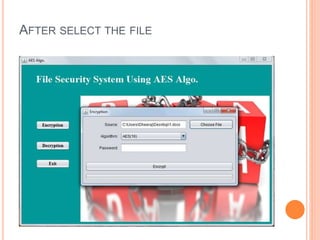
AFTER SELECT THE FILE
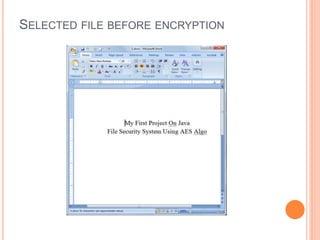
SELECTED FILE BEFORE ENCRYPTION
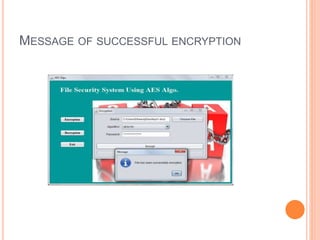
MESSAGE OF SUCCESSFUL ENCRYPTION
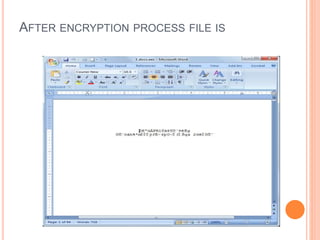
AFTER ENCRYPTION PROCESS FILE IS
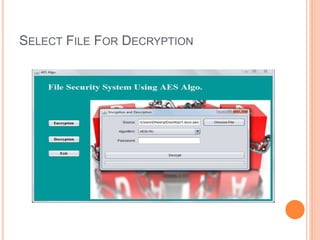
SELECT FILE FOR DECRYPTION
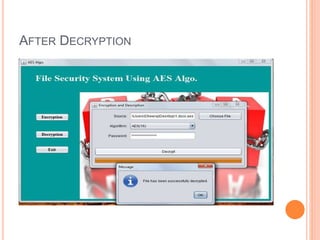
AFTER DECRYPTION
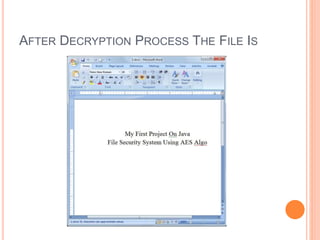
AFTER DECRYPTION PROCESS THE FILE IS
CONCLUSION
A new simple tool has been created, which is
targeted for use inside of a small institution such as
a small university for lecturers’ daily use of sending
exam files and sensitive material such that the
material can be encrypted and the file is sent in one
e-mail while the encryption key is sent in another e-
mail or via any secure communication channel.
REFERENCES
 NVIDIA. High Performance Computing GPU
[EB/OL].(2010-01-09).
http://www.nvidia.cn/object/tesla_computing_solutio
ns_cn.html.
 Sara Tedmori, Nijad Al-Najdawi ” Lossless Image
Cryptography Algorithm Based on Discrete Cosine
Transform” IAJIT First Online Publication
vol.3,2011.
 Dariusz Stanislawek , “Free Software copyright
1997 - 2006 ”
http://members.ozemail.com.au/~nulifetv/freezip/fre
eware
 Vivek Thakur , “NeekProtect”,
http://neekprotect.sourceforge.net , 2006.
 S.Quinlan and S. Dorward. Venti: a new
approach to archival storage. In Proc. of the
Conference on File and Storage Technologies
(FAST), January 2002.
 HweeHwa Pang, Kian-Lee Tan and Xuan Zhou.
“StegFS: Steganographic F System”, IEEE
International Conference on Data Engineering, Mar
2003.
File Security System_2

File Security System_2

  • 1.
    FILE SECURITY SYSTEM UnderGuidance Presented By Er. Alok Jadaun Dheeraj Kumar Singh(1000410015) Pushpendra Kumar(1100410901) Rohit Singh(1000410061) Surendra Kr Kannoujiya(1000410083)
  • 2.
    CONTENT  Introduction  Objectiveof file security system  Technique used in file security system  Encryption  Decryption  Symmetric-key encryption  Asymmetric-key encryption  How much module used in the project  Algorithm is used in the encryption process  Flow chart of AES algorithm  Requirement of Software and hardware  Snapshots  Conclusion
  • 3.
    INTRODUCTION  The FileSecurity System is a software, which tries to alter the originality of the text into some encrypted form.  It is use to store the information in a form that is unreadable.  The Application should have a reversal process as of which should be in a position to decrypt the data to its original format upon the proper request by the user.
  • 4.
    OBJECTIVE OF FILESECURITY SYSTEM  Secure the file from unauthorized user.  If hacker get the encrypted file they can not read to the file.  It give confidentiality to user that information is secure.
  • 5.
    TECHNIQUE USED INFILE SECURITY SYSTEM  Encryption  Decryption
  • 6.
    ENCRYPTION  Encryption isthe process of encoding messages (or information) in such a way that eavesdroppers or hackers cannot read it, but only authorized parties can access.  In an Encryption scheme, the message or information (referred to as plaintext) is encrypted using an encryption algorithm, turning it into an unreadable cipher text. This is usually done with the use of an encryption key.
  • 7.
     This isusually done with the use of an encryption key which specifies how the message is to be encoded. There are two basic types of encryption schemes:  Symmetric-key encryption  Asymmetric-key(public-key encryption)
  • 8.
    DECRYPTION  Decryption shouldbe a reverse process of encryption process.  Decryption is the process of encoding messages (or information) in such a way that it become readable for users.  It convert the cipher text into the plain text after encryption.
  • 9.
    SYMMETRIC-KEY ENCRYPTION  Insymmetric-key schemes, the encryption and decryption keys are the same.  It involves a single secret key which both the message- sender and the message-recipient must have.  It is used by the sender to encrypt the message and by the recipient to decrypt it.
  • 10.
  • 11.
    ASYMMETRIC KEY(PUBLIC KEYENCRYPTION)  The term "asymmetric" stems from the use of different keys to perform these opposite functions.  It requires two separate keys one of which is secret (or private) and one of which is public.  The public key is used to encrypt plaintext and the private key is used to decrypt cipher text.
  • 12.
    Fig 2.0- ASYMMETRICKEY(PUBLIC KEY ENCRYPTION)
  • 13.
    MODULES  We usedthree module in the project. (1) Input module. (2) Process module. (3) Output module.
  • 14.
    INPUT MODULE  Inthis module we implement attachment of file in the file security system.  In this module we select the file type. PROCESS MODULE  In this module we implement the process for the file security system like as encryption and decryption. OUTPUT MODULE  In this module we save the encrypted file in memory.
  • 15.
    ALGORITHM USE INENCRYPTION PROCESS  AES (Advanced Encryption Standard ) AES:-AES is a symmetric-key algorithm, meaning the same key is used for both encrypting and decrypting the data. The Advanced Encryption Standard (AES) is a specification for the encryption of electronic data established by the U.S. National Institute of Standards and Technology (NIST) in 2001.
  • 16.
    FLOW CHART OFAES ALGORITHM
  • 17.
    REQUIREMENT OF SOFTWARE Software:-TheSoftware used in file security system are as follows:-  Operating System  Windows NT/2000 (Client/Server)  Front-end: Java JDK 1.4, J2Sdk 1.1.4, Swings.
  • 18.
    REQUIREMENT OF HARDWARE Hardware:-Thehardware used in iris recognition are as follows:-  Pentium IV Processor with 1.9 GHz Clock Speed  512 MB RAM, 20 GB HDD, 32 Bit PCI Ethernet Card
  • 19.
  • 20.
  • 21.
  • 22.
  • 23.
  • 24.
  • 25.
    SELECT FILE FORDECRYPTION
  • 26.
  • 27.
  • 28.
    CONCLUSION A new simpletool has been created, which is targeted for use inside of a small institution such as a small university for lecturers’ daily use of sending exam files and sensitive material such that the material can be encrypted and the file is sent in one e-mail while the encryption key is sent in another e- mail or via any secure communication channel.
  • 29.
    REFERENCES  NVIDIA. HighPerformance Computing GPU [EB/OL].(2010-01-09). http://www.nvidia.cn/object/tesla_computing_solutio ns_cn.html.  Sara Tedmori, Nijad Al-Najdawi ” Lossless Image Cryptography Algorithm Based on Discrete Cosine Transform” IAJIT First Online Publication vol.3,2011.  Dariusz Stanislawek , “Free Software copyright 1997 - 2006 ” http://members.ozemail.com.au/~nulifetv/freezip/fre eware
  • 30.
     Vivek Thakur, “NeekProtect”, http://neekprotect.sourceforge.net , 2006.  S.Quinlan and S. Dorward. Venti: a new approach to archival storage. In Proc. of the Conference on File and Storage Technologies (FAST), January 2002.  HweeHwa Pang, Kian-Lee Tan and Xuan Zhou. “StegFS: Steganographic F System”, IEEE International Conference on Data Engineering, Mar 2003.