Fields, Innovations and Places: Three Different Strategies for Social Innovators Pete Plastrik and John Cleveland Innovation Network for Communities January 23, 2009
Agenda INC Background Contexts for Social Change Fields Innovations Places Some Examples from INC Work Application to WKKF Work Next Steps
Assumptions Not all philanthropy is focused on social change There are many different kinds of philanthropy: Basic needs support Institutional support Social innovation (aka “social change”, “systems change” or “strategic” philanthropy Kellogg has clearly focused its work in the “social innovation niche” Kellogg’s investment in INC was designed to advance knowledge about the process and discipline of social innovation
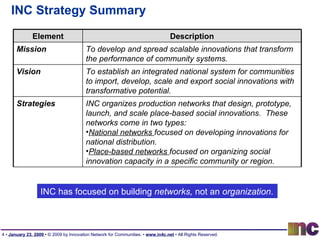
INC Strategy Summary INC has focused on building  networks,  not an  organization . Element Description Mission To develop and spread scalable innovations that transform the performance of community systems. Vision To establish an integrated national system for communities to import, develop, scale and export social innovations with transformative potential. Strategies INC organizes production networks that design, prototype, launch, and scale place-based social innovations.  These networks come in two types: National networks  focused on developing innovations for national distribution. Place-based networks  focused on organizing social innovation capacity in a specific community or region.
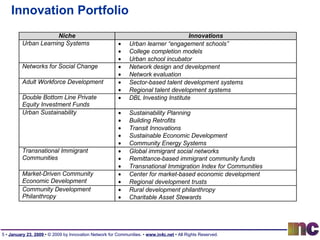
Innovation Portfolio
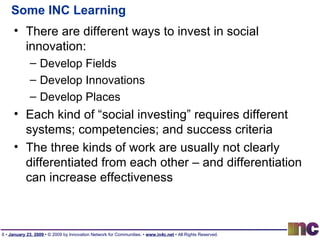
Some INC Learning There are different ways to invest in social innovation: Develop Fields Develop Innovations Develop Places Each kind of “social investing” requires different systems; competencies; and success criteria The three kinds of work are usually not clearly differentiated from each other – and differentiation can increase effectiveness
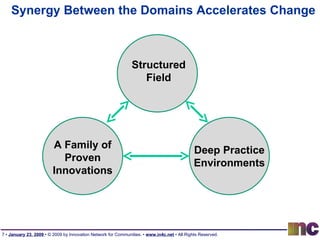
Synergy Between the Domains Accelerates Change Structured Field A Family of Proven Innovations Deep Practice Environments
Field Building
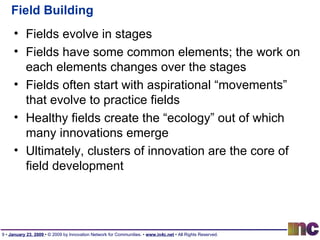
Field Building Fields evolve in stages Fields have some common elements; the work on each elements changes over the stages Fields often start with aspirational “movements” that evolve to practice fields Healthy fields create the “ecology” out of which many innovations emerge Ultimately, clusters of innovation are the core of field development
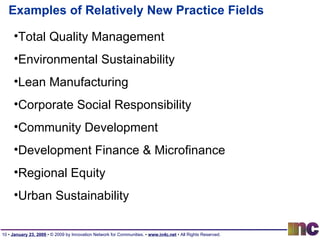
Examples of Relatively New Practice Fields Total Quality Management Environmental Sustainability Lean Manufacturing Corporate Social Responsibility Community Development Development Finance & Microfinance Regional Equity Urban Sustainability
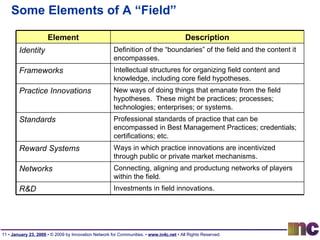
Some Elements of A “Field” Element Description Identity Definition of the “boundaries” of the field and the content it encompasses. Frameworks Intellectual structures for organizing field content and knowledge, including core field hypotheses. Practice Innovations New ways of doing things that emanate from the field hypotheses.  These might be practices; processes; technologies; enterprises; or systems.  Standards Professional standards of practice that can be encompassed in Best Management Practices; credentials; certifications; etc. Reward Systems Ways in which practice innovations are incentivized through public or private market mechanisms. Networks Connecting, aligning and productung networks of players within the field. R&D Investments in field innovations.
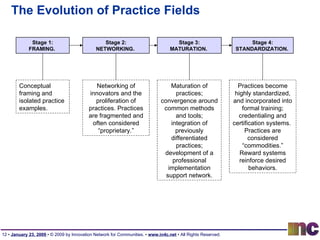
The Evolution of Practice Fields Stage 1: FRAMING.  Stage 2: NETWORKING.  Stage 3: MATURATION.  Stage 4: STANDARDIZATION.  Conceptual framing and isolated practice examples. Networking of innovators and the proliferation of practices. Practices are fragmented and often considered “proprietary.” Maturation of practices; convergence around common methods and tools; integration of previously differentiated practices; development of a professional implementation support network. Practices become highly standardized, and incorporated into formal training; credentialing and certification systems.  Practices are considered “commodities.” Reward systems reinforce desired behaviors.
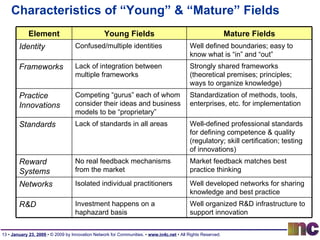
Characteristics of “Young” & “Mature” Fields Element Young Fields Mature Fields Identity Confused/multiple identities Well defined boundaries; easy to know what is “in” and “out” Frameworks Lack of integration between multiple frameworks Strongly shared frameworks (theoretical premises; principles; ways to organize knowledge) Practice Innovations Competing “gurus” each of whom consider their ideas and business models to be “proprietary” Standardization of methods, tools, enterprises, etc. for implementation Standards Lack of standards in all areas  Well-defined professional standards for defining competence & quality (regulatory; skill certification; testing of innovations) Reward Systems No real feedback mechanisms from the market Market feedback matches best practice thinking Networks Isolated individual practitioners Well developed networks for sharing knowledge and best practice R&D Investment happens on a haphazard basis Well organized R&D infrastructure to support innovation
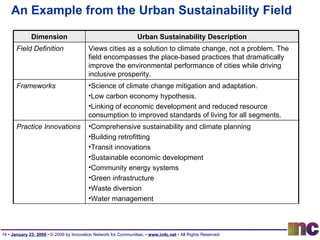
An Example from the Urban Sustainability Field Dimension Urban Sustainability Description Field Definition Views cities as a solution to climate change, not a problem. The field encompasses the place-based practices that dramatically improve the environmental performance of cities while driving inclusive prosperity. Frameworks Science of climate change mitigation and adaptation. Low carbon economy hypothesis. Linking of economic development and reduced resource consumption to improved standards of living for all segments. Practice Innovations Comprehensive sustainability and climate planning Building retrofitting Transit innovations Sustainable economic development Community energy systems Green infrastructure Waste diversion Water management
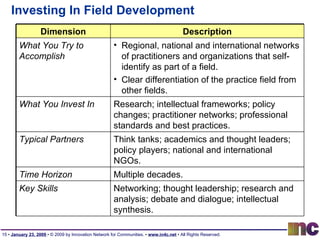
Investing In Field Development Dimension Description What You Try to Accomplish Regional, national and international networks of practitioners and organizations that self-identify as part of a field. Clear differentiation of the practice field from other fields. What You Invest In Research; intellectual frameworks; policy changes; practitioner networks; professional standards and best practices. Typical Partners Think tanks; academics and thought leaders; policy players; national and international NGOs. Time Horizon Multiple decades. Key Skills Networking; thought leadership; research and analysis; debate and dialogue; intellectual synthesis.
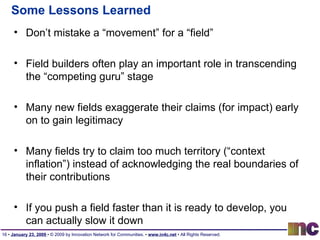
Some Lessons Learned Don’t mistake a “movement” for a “field” Field builders often play an important role in transcending the “competing guru” stage Many new fields exaggerate their claims (for impact) early on to gain legitimacy Many fields try to claim too much territory (“context inflation”) instead of acknowledging the real boundaries of their contributions If you push a field faster than it is ready to develop, you can actually slow it down
Innovation Development
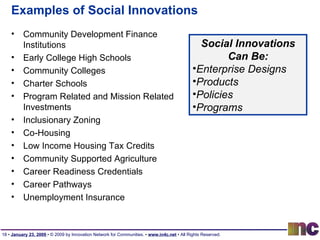
Examples of Social Innovations Community Development Finance Institutions Early College High Schools Community Colleges Charter Schools Program Related and Mission Related Investments Inclusionary Zoning Co-Housing Low Income Housing Tax Credits Community Supported Agriculture Career Readiness Credentials Career Pathways Unemployment Insurance Social Innovations Can Be: Enterprise Designs Products Policies Programs
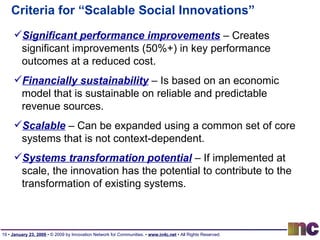
Criteria for “Scalable Social Innovations” Significant performance improvements  – Creates significant improvements (50%+) in key performance outcomes at a reduced cost.  Financially sustainability  – Is based on an economic model that is sustainable on reliable and predictable revenue sources.  Scalable  – Can be expanded using a common set of core systems that is not context-dependent. Systems transformation potential  – If implemented at scale, the innovation has the potential to contribute to the transformation of existing systems.
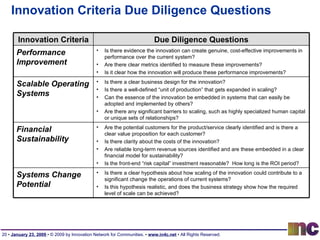
Innovation Criteria Due Diligence Questions Innovation Criteria Due Diligence Questions Performance Improvement Is there evidence the innovation can create genuine, cost-effective improvements in performance over the current system?  Are there clear metrics identified to measure these improvements?  Is it clear how the innovation will produce these performance improvements?  Scalable Operating Systems Is there a clear business design for the innovation? Is there a well-defined “unit of production” that gets expanded in scaling? Can the essence of the innovation be embedded in systems that can easily be adopted and implemented by others? Are there any significant barriers to scaling, such as highly specialized human capital or unique sets of relationships? Financial Sustainability Are the potential customers for the product/service clearly identified and is there a clear value proposition for each customer? Is there clarity about the costs of the innovation? Are reliable long-term revenue sources identified and are these embedded in a clear financial model for sustainability? Is the front-end “risk capital” investment reasonable?  How long is the ROI period? Systems Change Potential Is there a clear hypothesis about how scaling of the innovation could contribute to a significant change the operations of current systems? Is this hypothesis realistic, and does the business strategy show how the required level of scale can be achieved?
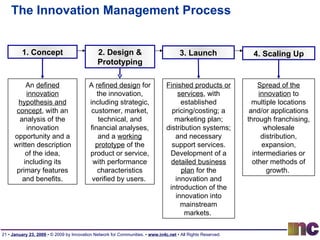
The Innovation Management Process 1. Concept 3. Launch 4. Scaling Up An  defined innovation hypothesis and concept , with an analysis of the innovation opportunity and a written description of the idea, including its primary features and benefits. A  refined design  for the innovation, including strategic, customer, market, technical, and financial analyses, and a  working prototype  of the product or service, with performance characteristics verified by users.  Finished products or services , with established pricing/costing; a marketing plan; distribution systems; and necessary support services. Development of a  detailed business plan  for the innovation and introduction of the innovation into mainstream markets.   Spread of the innovation  to multiple locations and/or applications through franchising, wholesale distribution, expansion, intermediaries or other methods of growth.   2. Design & Prototyping
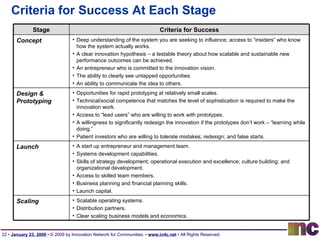
Criteria for Success At Each Stage Stage Criteria for Success Concept Deep understanding of the system you are seeking to influence; access to “insiders” who know how the system actually works. A clear innovation hypothesis – a testable theory about how scalable and sustainable new performance outcomes can be achieved. An entrepreneur who is committed to the innovation vision. The ability to clearly see untapped opportunities. An ability to communicate the idea to others.   Design & Prototyping Opportunities for rapid prototyping at relatively small scales. Technical/social competence that matches the level of sophistication is required to make the innovation work. Access to “lead users” who are willing to work with prototypes. A willingness to significantly redesign the innovation if the prototypes don’t work – “learning while doing.” Patient investors who are willing to tolerate mistakes; redesign; and false starts.   Launch A start up entrepreneur and management team. Systems development capabilities. Skills of strategy development; operational execution and excellence; culture building; and organizational development. Access to skilled team members. Business planning and financial planning skills. Launch capital.   Scaling Scalable operating systems. Distribution partners. Clear scaling business models and economics.
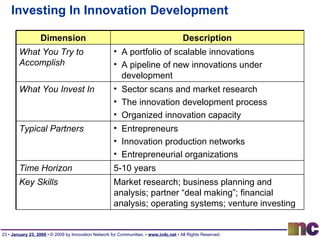
Investing In Innovation Development Dimension Description What You Try to Accomplish A portfolio of scalable innovations A pipeline of new innovations under development What You Invest In Sector scans and market research The innovation development process Organized innovation capacity Typical Partners Entrepreneurs Innovation production networks Entrepreneurial organizations Time Horizon 5-10 years Key Skills Market research; business planning and analysis; partner “deal making”; financial analysis; operating systems; venture investing
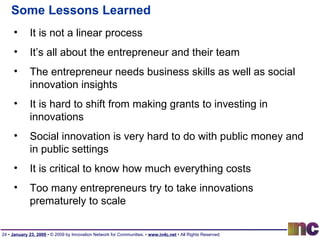
Some Lessons Learned It is not a linear process It’s all about the entrepreneur and their team The entrepreneur needs business skills as well as social innovation insights It is hard to shift from making grants to investing in innovations Social innovation is very hard to do with public money and in public settings It is critical to know how much everything costs Too many entrepreneurs try to take innovations prematurely to scale
Investing In Places (“Community Development Philanthropy”)
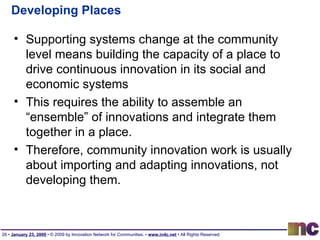
Developing Places Supporting systems change at the community level means building the capacity of a place to drive continuous innovation in its social and economic systems This requires the ability to assemble an “ensemble” of innovations and integrate them together in a place. Therefore, community innovation work is usually about importing and adapting innovations, not developing them.
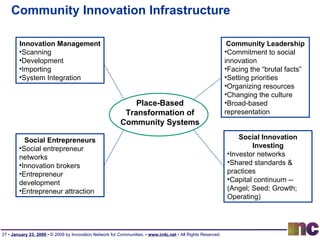
Community Innovation Infrastructure Place-Based Transformation of Community Systems Innovation Management Scanning Development Importing System Integration Social Innovation Investing Investor networks Shared standards & practices Capital continuum --(Angel; Seed; Growth; Operating) Community Leadership Commitment to social innovation Facing the “brutal facts” Setting priorities Organizing resources Changing the culture Broad-based representation Social Entrepreneurs Social entrepreneur networks Innovation brokers Entrepreneur development Entrepreneur attraction
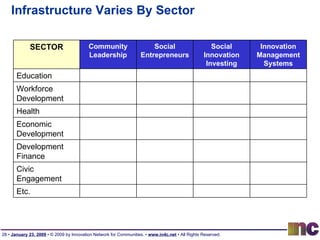
Infrastructure Varies By Sector SECTOR Community Leadership Social Entrepreneurs Social Innovation Investing Innovation Management Systems Education Workforce Development Health Economic Development Development Finance Civic Engagement Etc.
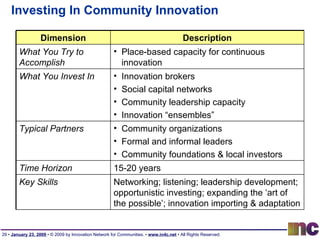
Investing In Community Innovation Dimension Description What You Try to Accomplish Place-based capacity for continuous innovation What You Invest In Innovation brokers Social capital networks Community leadership capacity Innovation “ensembles” Typical Partners Community organizations Formal and informal leaders Community foundations & local investors Time Horizon 15-20 years Key Skills Networking; listening; leadership development; opportunistic investing; expanding the ‘art of the possible’; innovation importing & adaptation
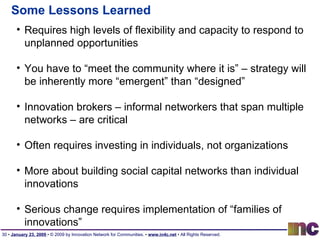
Some Lessons Learned Requires high levels of flexibility and capacity to respond to unplanned opportunities You have to “meet the community where it is” – strategy will be inherently more “emergent” than “designed” Innovation brokers – informal networkers that span multiple networks – are critical Often requires investing in individuals, not organizations More about building social capital networks than individual innovations Serious change requires implementation of “families of innovations”
Summary
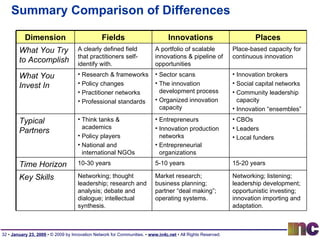
Summary Comparison of Differences Dimension Fields Innovations Places What You Try to Accomplish A clearly defined field that practitioners self-identify with. A portfolio of scalable innovations & pipeline of opportunities Place-based capacity for continuous innovation What You Invest In Research & frameworks  Policy changes  Practitioner networks  Professional standards Sector scans The innovation development process Organized innovation capacity Innovation brokers Social capital networks Community leadership capacity Innovation “ensembles” Typical Partners Think tanks & academics  Policy players National and international NGOs Entrepreneurs Innovation production networks Entrepreneurial organizations CBOs Leaders Local funders Time Horizon 10-30 years 5-10 years 15-20 years Key Skills Networking; thought leadership; research and analysis; debate and dialogue; intellectual synthesis. Market research; business planning; partner “deal making”; operating systems. Networking; listening; leadership development; opportunistic investing; innovation importing and adaptation.

Fields, Innovation, Places

  • 1.
    Fields, Innovations andPlaces: Three Different Strategies for Social Innovators Pete Plastrik and John Cleveland Innovation Network for Communities January 23, 2009
  • 2.
    Agenda INC BackgroundContexts for Social Change Fields Innovations Places Some Examples from INC Work Application to WKKF Work Next Steps
  • 3.
    Assumptions Not allphilanthropy is focused on social change There are many different kinds of philanthropy: Basic needs support Institutional support Social innovation (aka “social change”, “systems change” or “strategic” philanthropy Kellogg has clearly focused its work in the “social innovation niche” Kellogg’s investment in INC was designed to advance knowledge about the process and discipline of social innovation
  • 4.
    INC Strategy SummaryINC has focused on building networks, not an organization . Element Description Mission To develop and spread scalable innovations that transform the performance of community systems. Vision To establish an integrated national system for communities to import, develop, scale and export social innovations with transformative potential. Strategies INC organizes production networks that design, prototype, launch, and scale place-based social innovations. These networks come in two types: National networks focused on developing innovations for national distribution. Place-based networks focused on organizing social innovation capacity in a specific community or region.
  • 5.
  • 6.
    Some INC LearningThere are different ways to invest in social innovation: Develop Fields Develop Innovations Develop Places Each kind of “social investing” requires different systems; competencies; and success criteria The three kinds of work are usually not clearly differentiated from each other – and differentiation can increase effectiveness
  • 7.
    Synergy Between theDomains Accelerates Change Structured Field A Family of Proven Innovations Deep Practice Environments
  • 8.
  • 9.
    Field Building Fieldsevolve in stages Fields have some common elements; the work on each elements changes over the stages Fields often start with aspirational “movements” that evolve to practice fields Healthy fields create the “ecology” out of which many innovations emerge Ultimately, clusters of innovation are the core of field development
  • 10.
    Examples of RelativelyNew Practice Fields Total Quality Management Environmental Sustainability Lean Manufacturing Corporate Social Responsibility Community Development Development Finance & Microfinance Regional Equity Urban Sustainability
  • 11.
    Some Elements ofA “Field” Element Description Identity Definition of the “boundaries” of the field and the content it encompasses. Frameworks Intellectual structures for organizing field content and knowledge, including core field hypotheses. Practice Innovations New ways of doing things that emanate from the field hypotheses. These might be practices; processes; technologies; enterprises; or systems. Standards Professional standards of practice that can be encompassed in Best Management Practices; credentials; certifications; etc. Reward Systems Ways in which practice innovations are incentivized through public or private market mechanisms. Networks Connecting, aligning and productung networks of players within the field. R&D Investments in field innovations.
  • 12.
    The Evolution ofPractice Fields Stage 1: FRAMING. Stage 2: NETWORKING. Stage 3: MATURATION. Stage 4: STANDARDIZATION. Conceptual framing and isolated practice examples. Networking of innovators and the proliferation of practices. Practices are fragmented and often considered “proprietary.” Maturation of practices; convergence around common methods and tools; integration of previously differentiated practices; development of a professional implementation support network. Practices become highly standardized, and incorporated into formal training; credentialing and certification systems. Practices are considered “commodities.” Reward systems reinforce desired behaviors.
  • 13.
    Characteristics of “Young”& “Mature” Fields Element Young Fields Mature Fields Identity Confused/multiple identities Well defined boundaries; easy to know what is “in” and “out” Frameworks Lack of integration between multiple frameworks Strongly shared frameworks (theoretical premises; principles; ways to organize knowledge) Practice Innovations Competing “gurus” each of whom consider their ideas and business models to be “proprietary” Standardization of methods, tools, enterprises, etc. for implementation Standards Lack of standards in all areas Well-defined professional standards for defining competence & quality (regulatory; skill certification; testing of innovations) Reward Systems No real feedback mechanisms from the market Market feedback matches best practice thinking Networks Isolated individual practitioners Well developed networks for sharing knowledge and best practice R&D Investment happens on a haphazard basis Well organized R&D infrastructure to support innovation
  • 14.
    An Example fromthe Urban Sustainability Field Dimension Urban Sustainability Description Field Definition Views cities as a solution to climate change, not a problem. The field encompasses the place-based practices that dramatically improve the environmental performance of cities while driving inclusive prosperity. Frameworks Science of climate change mitigation and adaptation. Low carbon economy hypothesis. Linking of economic development and reduced resource consumption to improved standards of living for all segments. Practice Innovations Comprehensive sustainability and climate planning Building retrofitting Transit innovations Sustainable economic development Community energy systems Green infrastructure Waste diversion Water management
  • 15.
    Investing In FieldDevelopment Dimension Description What You Try to Accomplish Regional, national and international networks of practitioners and organizations that self-identify as part of a field. Clear differentiation of the practice field from other fields. What You Invest In Research; intellectual frameworks; policy changes; practitioner networks; professional standards and best practices. Typical Partners Think tanks; academics and thought leaders; policy players; national and international NGOs. Time Horizon Multiple decades. Key Skills Networking; thought leadership; research and analysis; debate and dialogue; intellectual synthesis.
  • 16.
    Some Lessons LearnedDon’t mistake a “movement” for a “field” Field builders often play an important role in transcending the “competing guru” stage Many new fields exaggerate their claims (for impact) early on to gain legitimacy Many fields try to claim too much territory (“context inflation”) instead of acknowledging the real boundaries of their contributions If you push a field faster than it is ready to develop, you can actually slow it down
  • 17.
  • 18.
    Examples of SocialInnovations Community Development Finance Institutions Early College High Schools Community Colleges Charter Schools Program Related and Mission Related Investments Inclusionary Zoning Co-Housing Low Income Housing Tax Credits Community Supported Agriculture Career Readiness Credentials Career Pathways Unemployment Insurance Social Innovations Can Be: Enterprise Designs Products Policies Programs
  • 19.
    Criteria for “ScalableSocial Innovations” Significant performance improvements – Creates significant improvements (50%+) in key performance outcomes at a reduced cost. Financially sustainability – Is based on an economic model that is sustainable on reliable and predictable revenue sources. Scalable – Can be expanded using a common set of core systems that is not context-dependent. Systems transformation potential – If implemented at scale, the innovation has the potential to contribute to the transformation of existing systems.
  • 20.
    Innovation Criteria DueDiligence Questions Innovation Criteria Due Diligence Questions Performance Improvement Is there evidence the innovation can create genuine, cost-effective improvements in performance over the current system? Are there clear metrics identified to measure these improvements? Is it clear how the innovation will produce these performance improvements? Scalable Operating Systems Is there a clear business design for the innovation? Is there a well-defined “unit of production” that gets expanded in scaling? Can the essence of the innovation be embedded in systems that can easily be adopted and implemented by others? Are there any significant barriers to scaling, such as highly specialized human capital or unique sets of relationships? Financial Sustainability Are the potential customers for the product/service clearly identified and is there a clear value proposition for each customer? Is there clarity about the costs of the innovation? Are reliable long-term revenue sources identified and are these embedded in a clear financial model for sustainability? Is the front-end “risk capital” investment reasonable? How long is the ROI period? Systems Change Potential Is there a clear hypothesis about how scaling of the innovation could contribute to a significant change the operations of current systems? Is this hypothesis realistic, and does the business strategy show how the required level of scale can be achieved?
  • 21.
    The Innovation ManagementProcess 1. Concept 3. Launch 4. Scaling Up An defined innovation hypothesis and concept , with an analysis of the innovation opportunity and a written description of the idea, including its primary features and benefits. A refined design for the innovation, including strategic, customer, market, technical, and financial analyses, and a working prototype of the product or service, with performance characteristics verified by users. Finished products or services , with established pricing/costing; a marketing plan; distribution systems; and necessary support services. Development of a detailed business plan for the innovation and introduction of the innovation into mainstream markets. Spread of the innovation to multiple locations and/or applications through franchising, wholesale distribution, expansion, intermediaries or other methods of growth. 2. Design & Prototyping
  • 22.
    Criteria for SuccessAt Each Stage Stage Criteria for Success Concept Deep understanding of the system you are seeking to influence; access to “insiders” who know how the system actually works. A clear innovation hypothesis – a testable theory about how scalable and sustainable new performance outcomes can be achieved. An entrepreneur who is committed to the innovation vision. The ability to clearly see untapped opportunities. An ability to communicate the idea to others. Design & Prototyping Opportunities for rapid prototyping at relatively small scales. Technical/social competence that matches the level of sophistication is required to make the innovation work. Access to “lead users” who are willing to work with prototypes. A willingness to significantly redesign the innovation if the prototypes don’t work – “learning while doing.” Patient investors who are willing to tolerate mistakes; redesign; and false starts. Launch A start up entrepreneur and management team. Systems development capabilities. Skills of strategy development; operational execution and excellence; culture building; and organizational development. Access to skilled team members. Business planning and financial planning skills. Launch capital. Scaling Scalable operating systems. Distribution partners. Clear scaling business models and economics.
  • 23.
    Investing In InnovationDevelopment Dimension Description What You Try to Accomplish A portfolio of scalable innovations A pipeline of new innovations under development What You Invest In Sector scans and market research The innovation development process Organized innovation capacity Typical Partners Entrepreneurs Innovation production networks Entrepreneurial organizations Time Horizon 5-10 years Key Skills Market research; business planning and analysis; partner “deal making”; financial analysis; operating systems; venture investing
  • 24.
    Some Lessons LearnedIt is not a linear process It’s all about the entrepreneur and their team The entrepreneur needs business skills as well as social innovation insights It is hard to shift from making grants to investing in innovations Social innovation is very hard to do with public money and in public settings It is critical to know how much everything costs Too many entrepreneurs try to take innovations prematurely to scale
  • 25.
    Investing In Places(“Community Development Philanthropy”)
  • 26.
    Developing Places Supportingsystems change at the community level means building the capacity of a place to drive continuous innovation in its social and economic systems This requires the ability to assemble an “ensemble” of innovations and integrate them together in a place. Therefore, community innovation work is usually about importing and adapting innovations, not developing them.
  • 27.
    Community Innovation InfrastructurePlace-Based Transformation of Community Systems Innovation Management Scanning Development Importing System Integration Social Innovation Investing Investor networks Shared standards & practices Capital continuum --(Angel; Seed; Growth; Operating) Community Leadership Commitment to social innovation Facing the “brutal facts” Setting priorities Organizing resources Changing the culture Broad-based representation Social Entrepreneurs Social entrepreneur networks Innovation brokers Entrepreneur development Entrepreneur attraction
  • 28.
    Infrastructure Varies BySector SECTOR Community Leadership Social Entrepreneurs Social Innovation Investing Innovation Management Systems Education Workforce Development Health Economic Development Development Finance Civic Engagement Etc.
  • 29.
    Investing In CommunityInnovation Dimension Description What You Try to Accomplish Place-based capacity for continuous innovation What You Invest In Innovation brokers Social capital networks Community leadership capacity Innovation “ensembles” Typical Partners Community organizations Formal and informal leaders Community foundations & local investors Time Horizon 15-20 years Key Skills Networking; listening; leadership development; opportunistic investing; expanding the ‘art of the possible’; innovation importing & adaptation
  • 30.
    Some Lessons LearnedRequires high levels of flexibility and capacity to respond to unplanned opportunities You have to “meet the community where it is” – strategy will be inherently more “emergent” than “designed” Innovation brokers – informal networkers that span multiple networks – are critical Often requires investing in individuals, not organizations More about building social capital networks than individual innovations Serious change requires implementation of “families of innovations”
  • 31.
  • 32.
    Summary Comparison ofDifferences Dimension Fields Innovations Places What You Try to Accomplish A clearly defined field that practitioners self-identify with. A portfolio of scalable innovations & pipeline of opportunities Place-based capacity for continuous innovation What You Invest In Research & frameworks Policy changes Practitioner networks Professional standards Sector scans The innovation development process Organized innovation capacity Innovation brokers Social capital networks Community leadership capacity Innovation “ensembles” Typical Partners Think tanks & academics Policy players National and international NGOs Entrepreneurs Innovation production networks Entrepreneurial organizations CBOs Leaders Local funders Time Horizon 10-30 years 5-10 years 15-20 years Key Skills Networking; thought leadership; research and analysis; debate and dialogue; intellectual synthesis. Market research; business planning; partner “deal making”; operating systems. Networking; listening; leadership development; opportunistic investing; innovation importing and adaptation.