Welcome
1
Mymensingh Engineering College
Department of Civil Engineering
Course Name: Geotechnical Engineering Sessional
Course Code: CE-506
Presentation Topic
Field Identification of Soil
2
Md Mahmudur Rahman (501)
Nosrat Zahan Shishir (502)
Siam Ul Badhon (503)
Ibrahim Khalil Maruf (504)
Md Rabiul Islam (505)
S M Didarul Alam (507)
Presented by
Abdullah Al Mahin
Lecturer
Dept. of Civil Engineering
Mymensingh Engineering
College
Presented to
3
Content
General Intro
Theory
Experimental Part
 Objective
 Significance
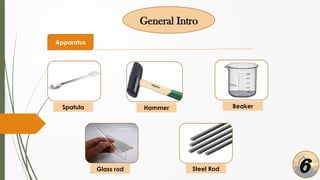
 Apparatus
 Discussion
 Question and Answer Session
 Data sheet
 Result Conclusion
4
 Grain size distribution
 Shape of soil
 Dispersion test
 Dry Strength test
 Di-latency Test
 Toughness Test
 Moisture condition
 Color and odor
General Intro
Visually classification of soil
Objective
Determination of soil particle for constructional purposes
To identify and describe subsoil condition
Significance
For identification of soils in the planning stages of a project.
For getting a general idea about the future of constructional works.
5
General Intro
Apparatus
Spatula Hammer Beaker
Glass rod Steel Rod 6
Theory
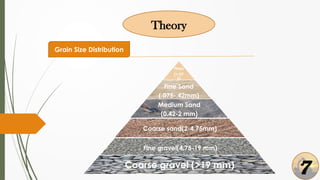
Grain Size Distribution
Fines
(<.07
5)
Fine Sand
(.075-.42mm)
Medium Sand
(0.42-2 mm)
Coarse sand(2-4.75mm)
Fine gravel(4.75-19 mm)
Coarse gravel (>19 mm)
7
Theory
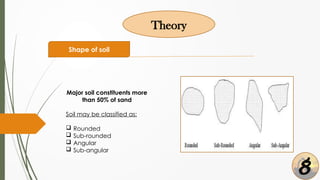
Shape of soil
8
Major soil constituents more
than 50% of sand
Soil may be classified as:
 Rounded
 Sub-rounded
 Angular
 Sub-angular
Theory
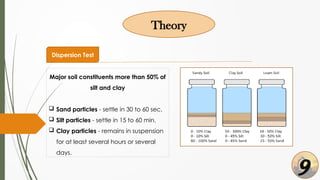
Dispersion Test
Major soil constituents more than 50% of
silt and clay
 Sand particles - settle in 30 to 60 sec.
 Silt particles - settle in 15 to 60 min.
 Clay particles - remains in suspension
for at least several hours or several
days.
9
Theory
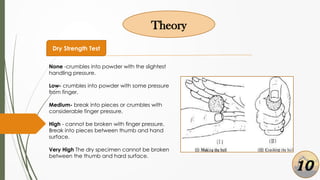
Dry Strength Test
None -crumbles into powder with the slightest
handling pressure.
Low- crumbles into powder with some pressure
from finger.
Medium- break into pieces or crumbles with
considerable finger pressure.
High - cannot be broken with finger pressure.
Break into pieces between thumb and hand
surface.
Very High The dry specimen cannot be broken
between the thumb and hard surface.
10
Theory
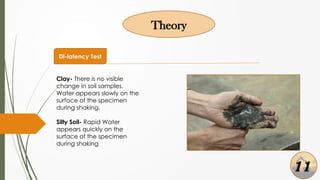
Di-latency Test
Clay- There is no visible
change in soil samples.
Water appears slowly on the
surface of the specimen
during shaking.
Silty Soil- Rapid Water
appears quickly on the
surface of the specimen
during shaking
11
Theory
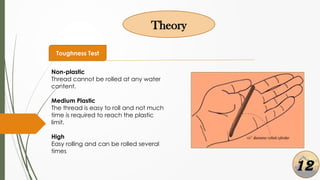
Toughness Test
Non-plastic
Thread cannot be rolled at any water
content.
Medium Plastic
The thread is easy to roll and not much
time is required to reach the plastic
limit.
High
Easy rolling and can be rolled several
times
12
Theory
Moisture Condition
• Dry to touch and dusty
Dry
• Damp and slightly begin to retain molded form
Moist
• Clearly wet and water is visible
Wet
• Easy visibility of water and draining freely
Saturated
13
Theory
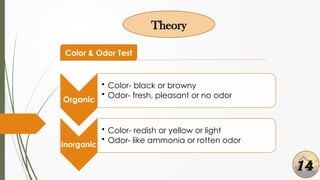
Color & Odor Test
Organic
• Color- black or browny
• Odor- fresh, pleasant or no odor
Inorganic
• Color- redish or yellow or light
• Odor- like ammonia or rotten odor
14
Experimental Part
15
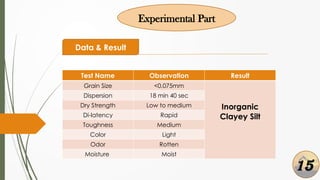
Data & Result
Test Name Observation Result
Grain Size <0.075mm
Inorganic
Clayey Silt
Dispersion 18 min 40 sec
Dry Strength Low to medium
Di-latency Rapid
Toughness Medium
Color Light
Odor Rotten
Moisture Moist
Conclusion
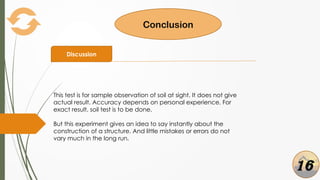
Discussion
This test is for sample observation of soil at sight. It does not give
actual result. Accuracy depends on personal experience. For
exact result, soil test is to be done.
But this experiment gives an idea to say instantly about the
construction of a structure. And little mistakes or errors do not
vary much in the long run.
16
Thank
you
Question
&
Answer

Methods for Field Identification of Soil.pptx

  • 1.
  • 2.
    1 Mymensingh Engineering College Departmentof Civil Engineering Course Name: Geotechnical Engineering Sessional Course Code: CE-506
  • 3.
  • 4.
    Md Mahmudur Rahman(501) Nosrat Zahan Shishir (502) Siam Ul Badhon (503) Ibrahim Khalil Maruf (504) Md Rabiul Islam (505) S M Didarul Alam (507) Presented by Abdullah Al Mahin Lecturer Dept. of Civil Engineering Mymensingh Engineering College Presented to 3
  • 5.
    Content General Intro Theory Experimental Part Objective  Significance  Apparatus  Discussion  Question and Answer Session  Data sheet  Result Conclusion 4  Grain size distribution  Shape of soil  Dispersion test  Dry Strength test  Di-latency Test  Toughness Test  Moisture condition  Color and odor
  • 6.
    General Intro Visually classificationof soil Objective Determination of soil particle for constructional purposes To identify and describe subsoil condition Significance For identification of soils in the planning stages of a project. For getting a general idea about the future of constructional works. 5
  • 7.
    General Intro Apparatus Spatula HammerBeaker Glass rod Steel Rod 6
  • 8.
    Theory Grain Size Distribution Fines (<.07 5) FineSand (.075-.42mm) Medium Sand (0.42-2 mm) Coarse sand(2-4.75mm) Fine gravel(4.75-19 mm) Coarse gravel (>19 mm) 7
  • 9.
    Theory Shape of soil 8 Majorsoil constituents more than 50% of sand Soil may be classified as:  Rounded  Sub-rounded  Angular  Sub-angular
  • 10.
    Theory Dispersion Test Major soilconstituents more than 50% of silt and clay  Sand particles - settle in 30 to 60 sec.  Silt particles - settle in 15 to 60 min.  Clay particles - remains in suspension for at least several hours or several days. 9
  • 11.
    Theory Dry Strength Test None-crumbles into powder with the slightest handling pressure. Low- crumbles into powder with some pressure from finger. Medium- break into pieces or crumbles with considerable finger pressure. High - cannot be broken with finger pressure. Break into pieces between thumb and hand surface. Very High The dry specimen cannot be broken between the thumb and hard surface. 10
  • 12.
    Theory Di-latency Test Clay- Thereis no visible change in soil samples. Water appears slowly on the surface of the specimen during shaking. Silty Soil- Rapid Water appears quickly on the surface of the specimen during shaking 11
  • 13.
    Theory Toughness Test Non-plastic Thread cannotbe rolled at any water content. Medium Plastic The thread is easy to roll and not much time is required to reach the plastic limit. High Easy rolling and can be rolled several times 12
  • 14.
    Theory Moisture Condition • Dryto touch and dusty Dry • Damp and slightly begin to retain molded form Moist • Clearly wet and water is visible Wet • Easy visibility of water and draining freely Saturated 13
  • 15.
    Theory Color & OdorTest Organic • Color- black or browny • Odor- fresh, pleasant or no odor Inorganic • Color- redish or yellow or light • Odor- like ammonia or rotten odor 14
  • 16.
    Experimental Part 15 Data &Result Test Name Observation Result Grain Size <0.075mm Inorganic Clayey Silt Dispersion 18 min 40 sec Dry Strength Low to medium Di-latency Rapid Toughness Medium Color Light Odor Rotten Moisture Moist
  • 17.
    Conclusion Discussion This test isfor sample observation of soil at sight. It does not give actual result. Accuracy depends on personal experience. For exact result, soil test is to be done. But this experiment gives an idea to say instantly about the construction of a structure. And little mistakes or errors do not vary much in the long run. 16
  • 18.
  • 19.