June 11, 2013
HOSTED BY:
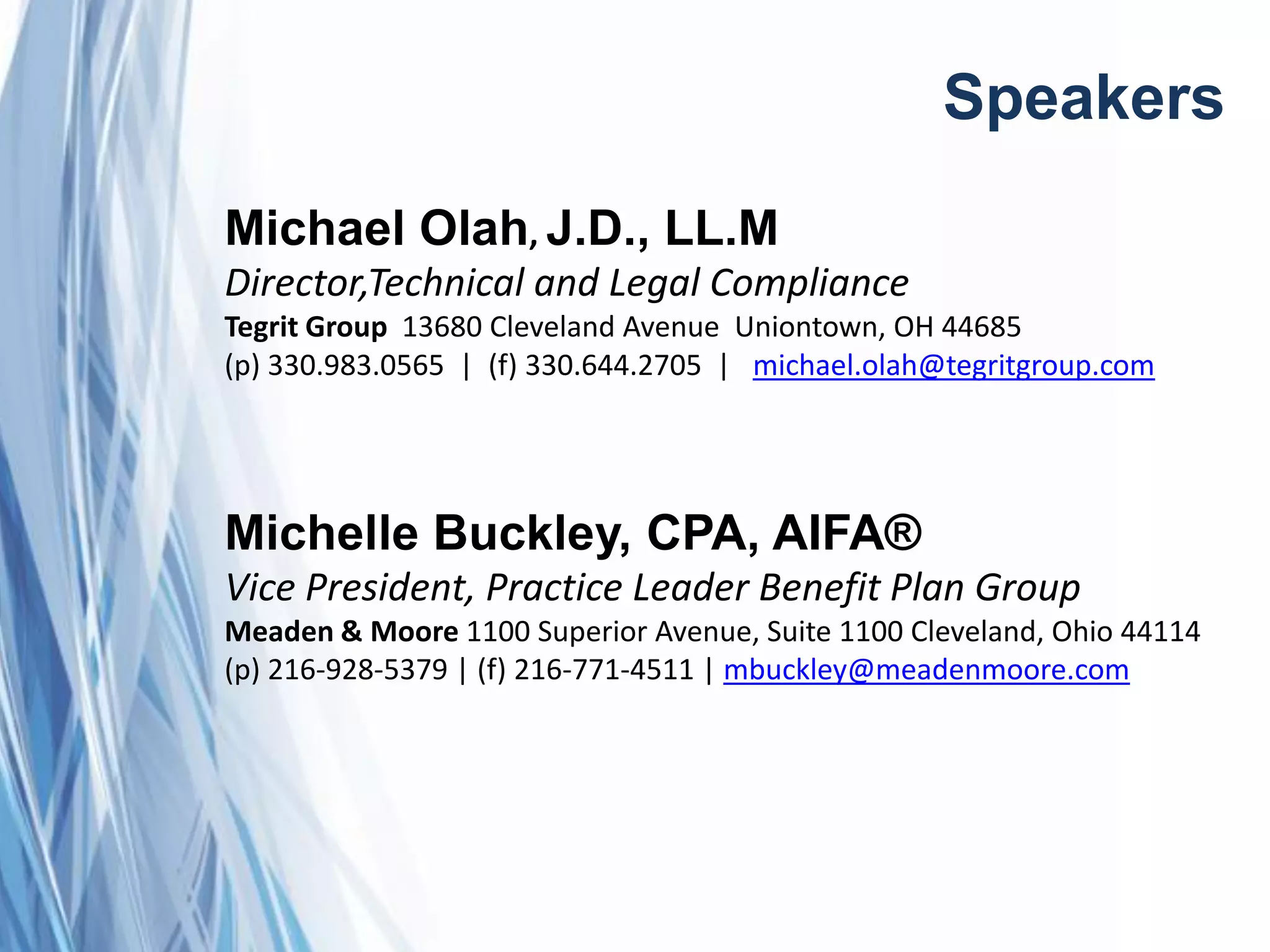
Speakers
Michael Olah, J.D., LL.M
Director,Technical and Legal Compliance
Tegrit Group 13680 Cleveland Avenue Uniontown, OH 44685
(p) 330.983.0565 | (f) 330.644.2705 | michael.olah@tegritgroup.com
Michelle Buckley, CPA, AIFA®
Vice President, Practice Leader Benefit Plan Group
Meaden & Moore 1100 Superior Avenue, Suite 1100 Cleveland, Ohio 44114
(p) 216-928-5379 | (f) 216-771-4511 | mbuckley@meadenmoore.com
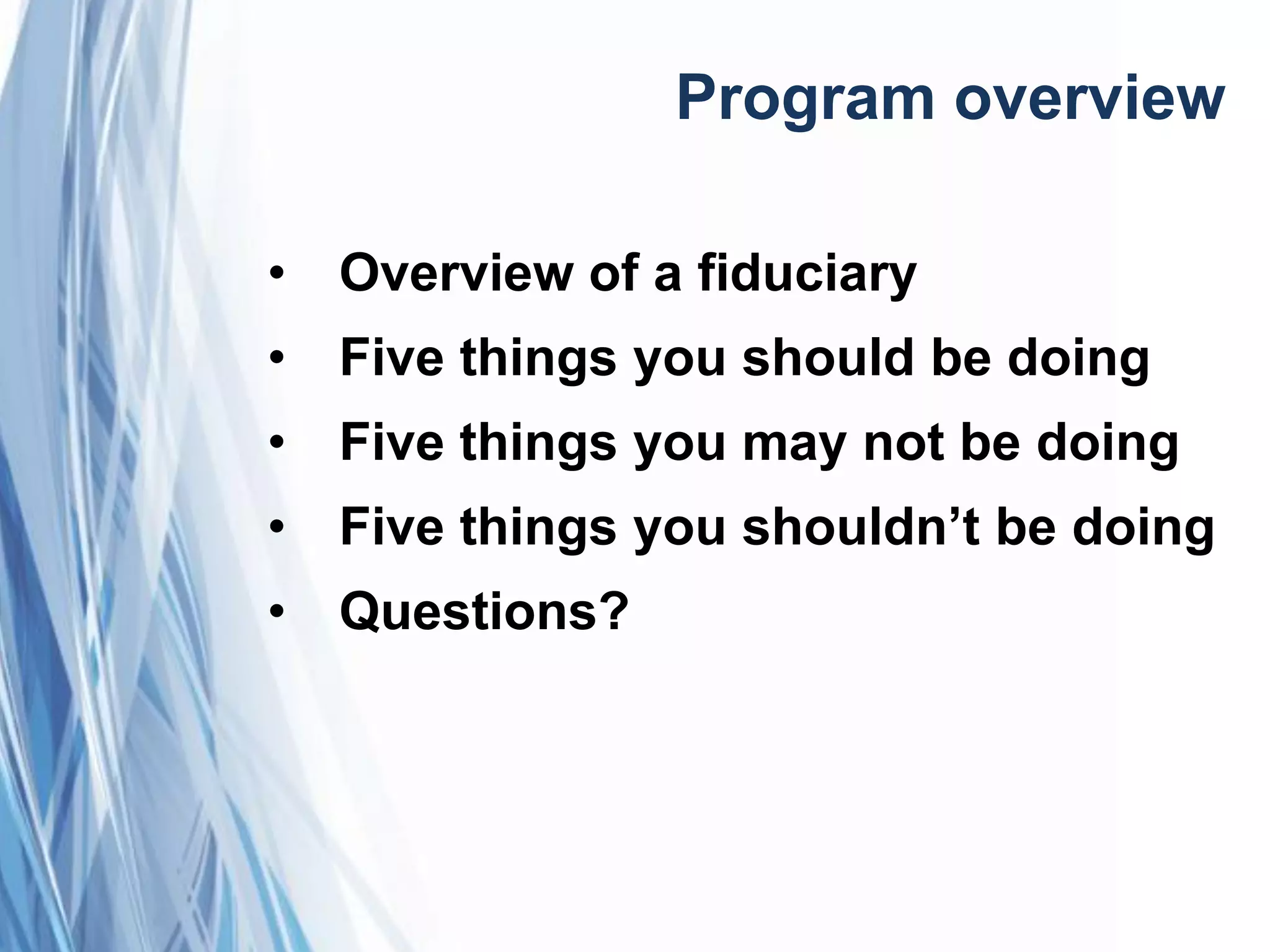
Program overview
• Overview of a fiduciary
• Five things you should be doing
• Five things you may not be doing
• Five things you shouldn’t be doing
• Questions?
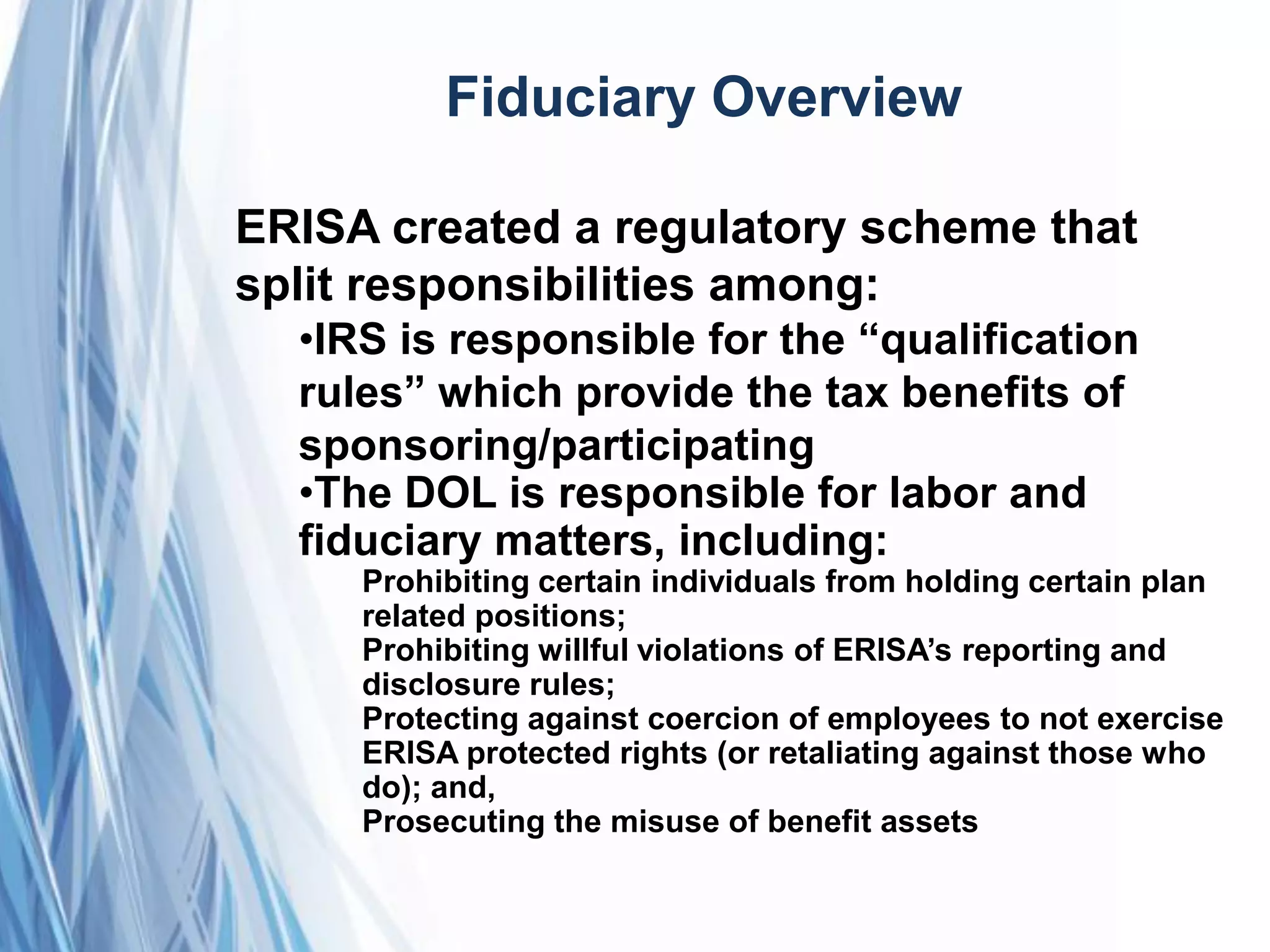
Fiduciary Overview
ERISA created a regulatory scheme that
split responsibilities among:
•IRS is responsible for the ―qualification
rules‖ which provide the tax benefits of
sponsoring/participating
•The DOL is responsible for labor and
fiduciary matters, including:
Prohibiting certain individuals from holding certain plan
related positions;
Prohibiting willful violations of ERISA’s reporting and
disclosure rules;
Protecting against coercion of employees to not exercise
ERISA protected rights (or retaliating against those who
do); and,
Prosecuting the misuse of benefit assets
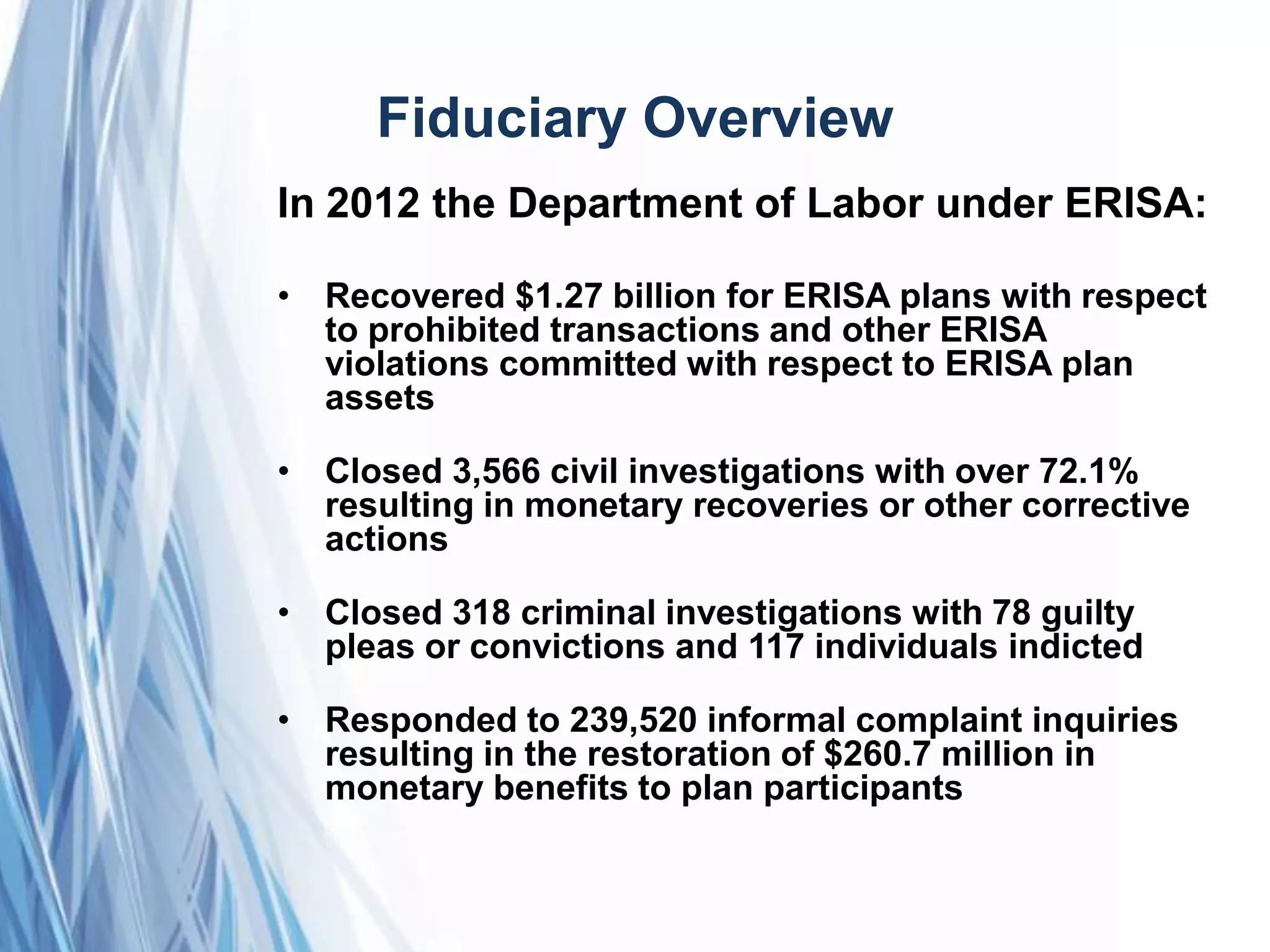
Fiduciary Overview
In 2012 the Department of Labor under ERISA:
• Recovered $1.27 billion for ERISA plans with respect
to prohibited transactions and other ERISA
violations committed with respect to ERISA plan
assets
• Closed 3,566 civil investigations with over 72.1%
resulting in monetary recoveries or other corrective
actions
• Closed 318 criminal investigations with 78 guilty
pleas or convictions and 117 individuals indicted
• Responded to 239,520 informal complaint inquiries
resulting in the restoration of $260.7 million in
monetary benefits to plan participants
Fiduciary Overview
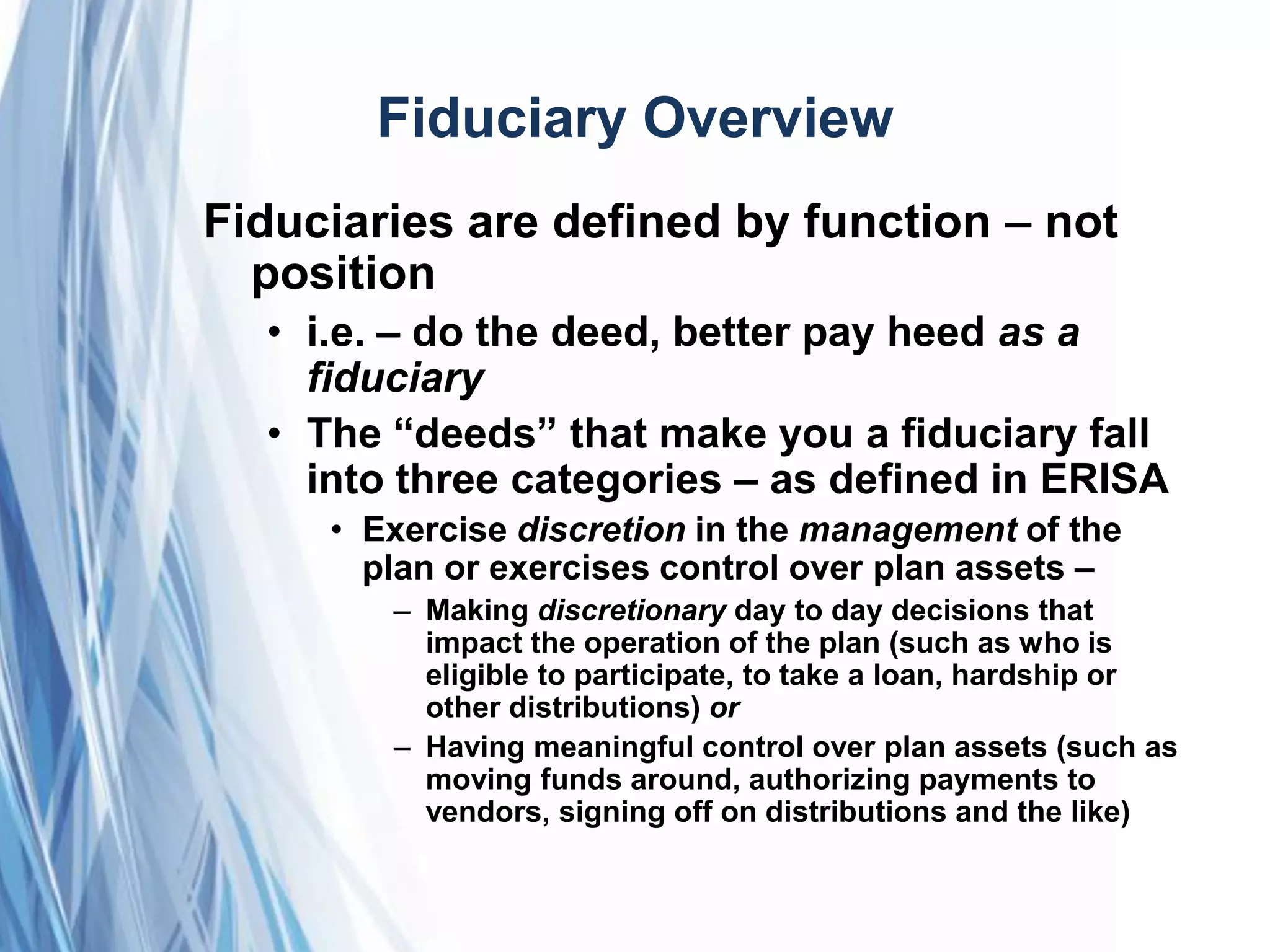
Fiduciaries are defined by function – not
position
• i.e. – do the deed, better pay heed as a
fiduciary
• The ―deeds‖ that make you a fiduciary fall
into three categories – as defined in ERISA
• Exercise discretion in the management of the
plan or exercises control over plan assets –
– Making discretionary day to day decisions that
impact the operation of the plan (such as who is
eligible to participate, to take a loan, hardship or
other distributions) or
– Having meaningful control over plan assets (such as
moving funds around, authorizing payments to
vendors, signing off on distributions and the like)
Fiduciary Overview
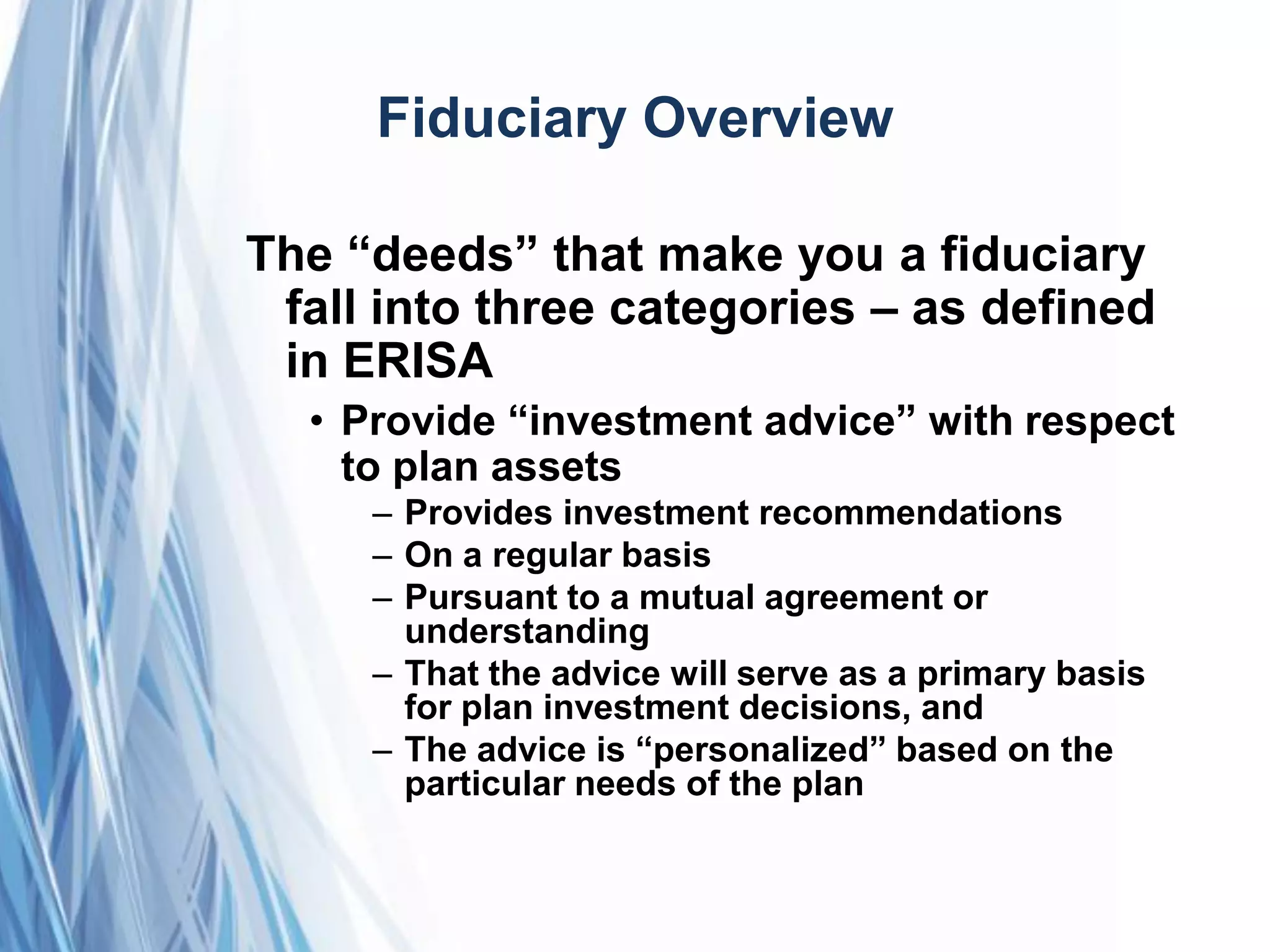
The ―deeds‖ that make you a fiduciary
fall into three categories – as defined
in ERISA
• Provide ―investment advice‖ with respect
to plan assets
– Provides investment recommendations
– On a regular basis
– Pursuant to a mutual agreement or
understanding
– That the advice will serve as a primary basis
for plan investment decisions, and
– The advice is ―personalized‖ based on the
particular needs of the plan
Fiduciary Overview
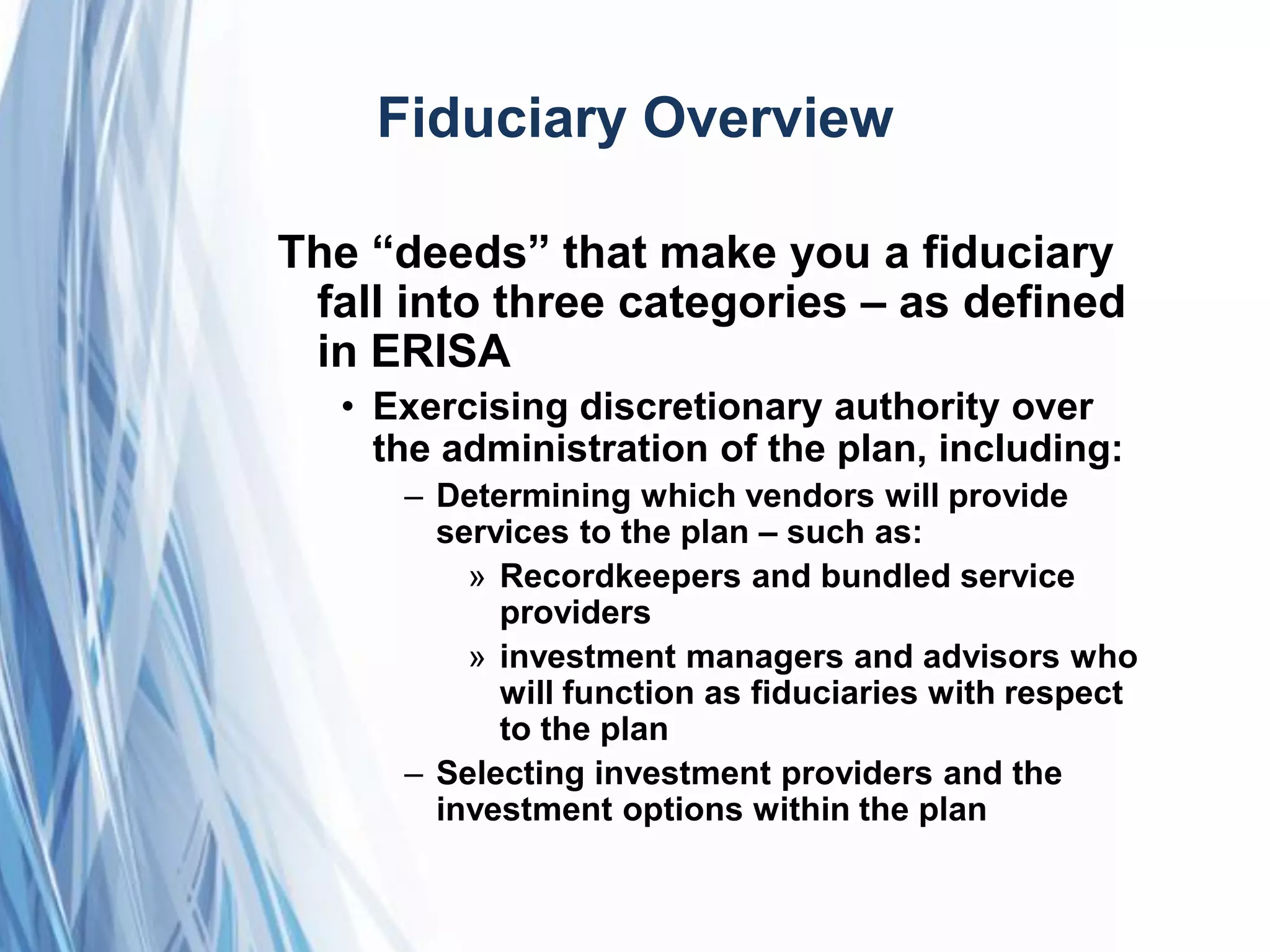
The ―deeds‖ that make you a fiduciary
fall into three categories – as defined
in ERISA
• Exercising discretionary authority over
the administration of the plan, including:
– Determining which vendors will provide
services to the plan – such as:
» Recordkeepers and bundled service
providers
» investment managers and advisors who
will function as fiduciaries with respect
to the plan
– Selecting investment providers and the
investment options within the plan
Fiduciary Overview
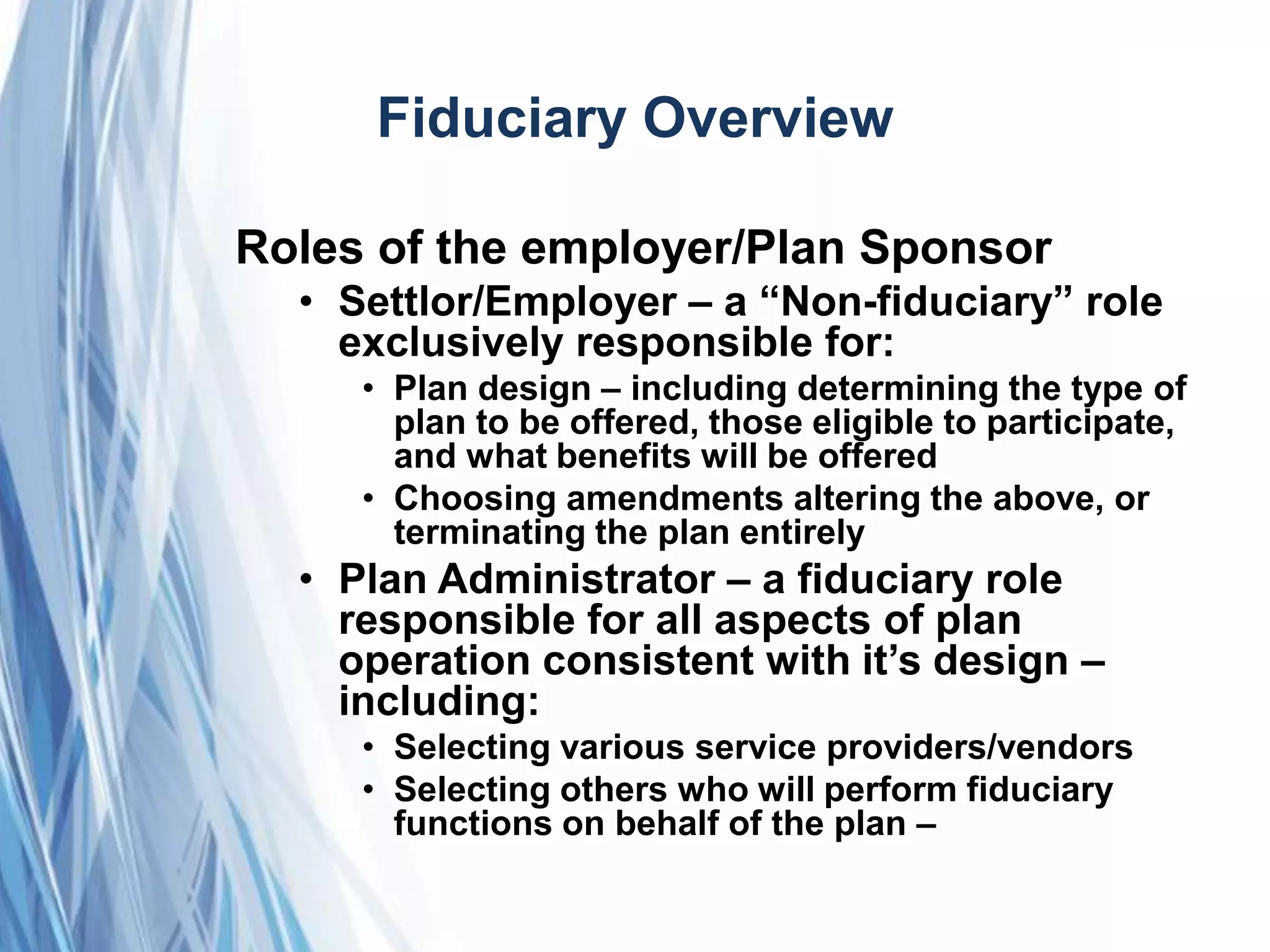
Roles of the employer/Plan Sponsor
• Settlor/Employer – a ―Non-fiduciary‖ role
exclusively responsible for:
• Plan design – including determining the type of
plan to be offered, those eligible to participate,
and what benefits will be offered
• Choosing amendments altering the above, or
terminating the plan entirely
• Plan Administrator – a fiduciary role
responsible for all aspects of plan
operation consistent with it’s design –
including:
• Selecting various service providers/vendors
• Selecting others who will perform fiduciary
functions on behalf of the plan –
Fiduciary Overview
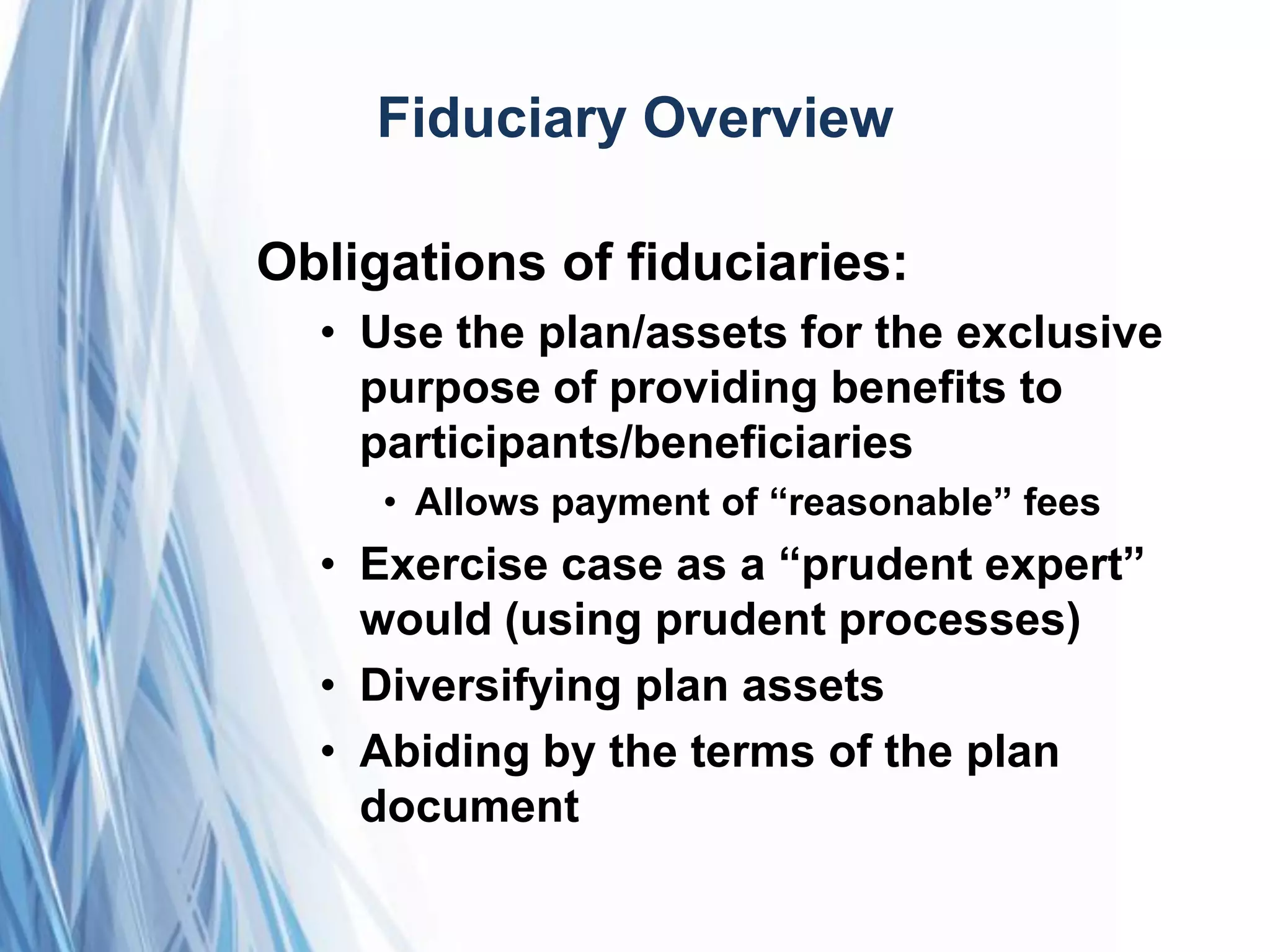
Obligations of fiduciaries:
• Use the plan/assets for the exclusive
purpose of providing benefits to
participants/beneficiaries
• Allows payment of ―reasonable‖ fees
• Exercise case as a ―prudent expert‖
would (using prudent processes)
• Diversifying plan assets
• Abiding by the terms of the plan
document
Fiduciary Overview
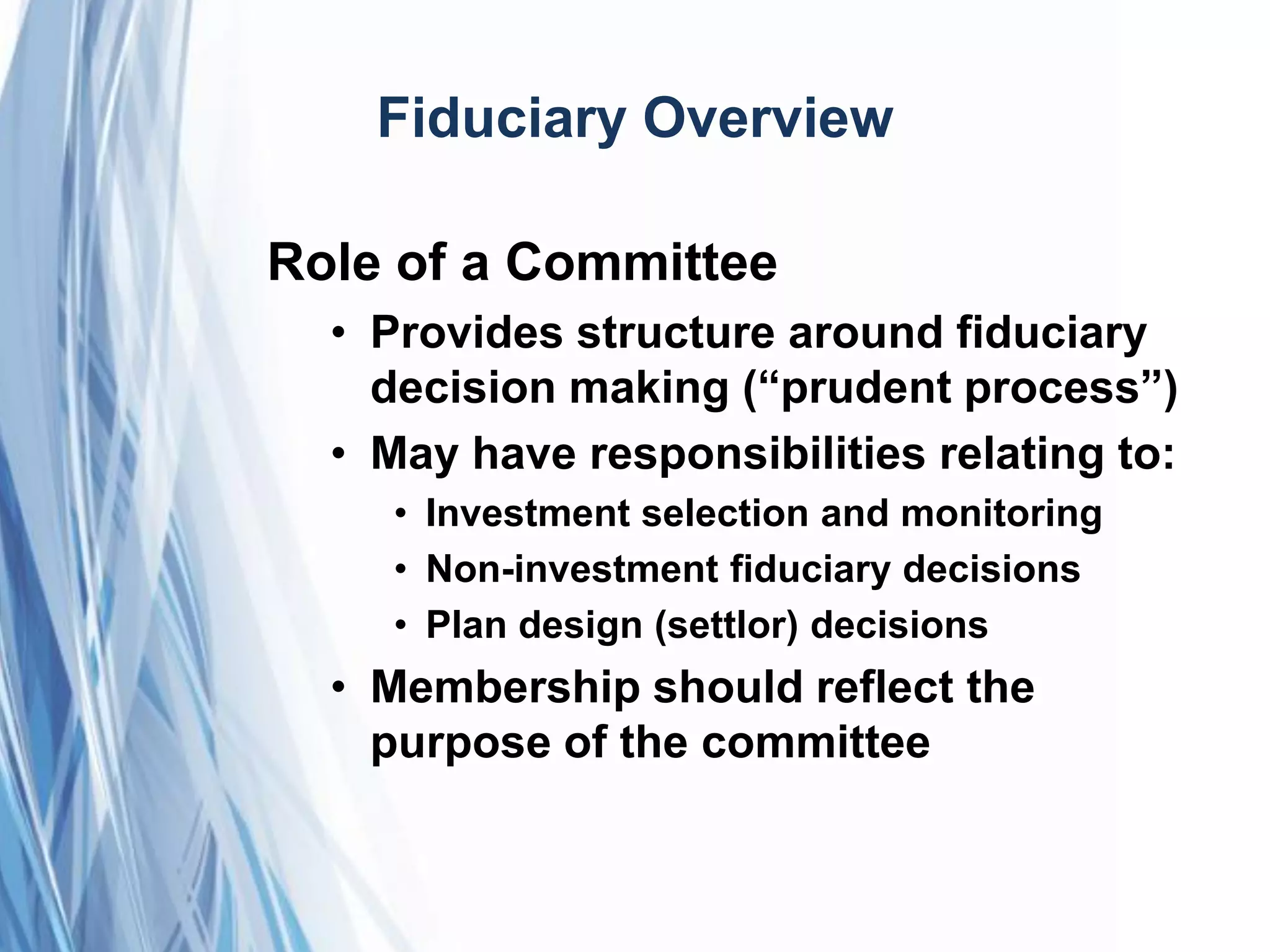
Role of a Committee
• Provides structure around fiduciary
decision making (―prudent process‖)
• May have responsibilities relating to:
• Investment selection and monitoring
• Non-investment fiduciary decisions
• Plan design (settlor) decisions
• Membership should reflect the
purpose of the committee
Fiduciary Overview
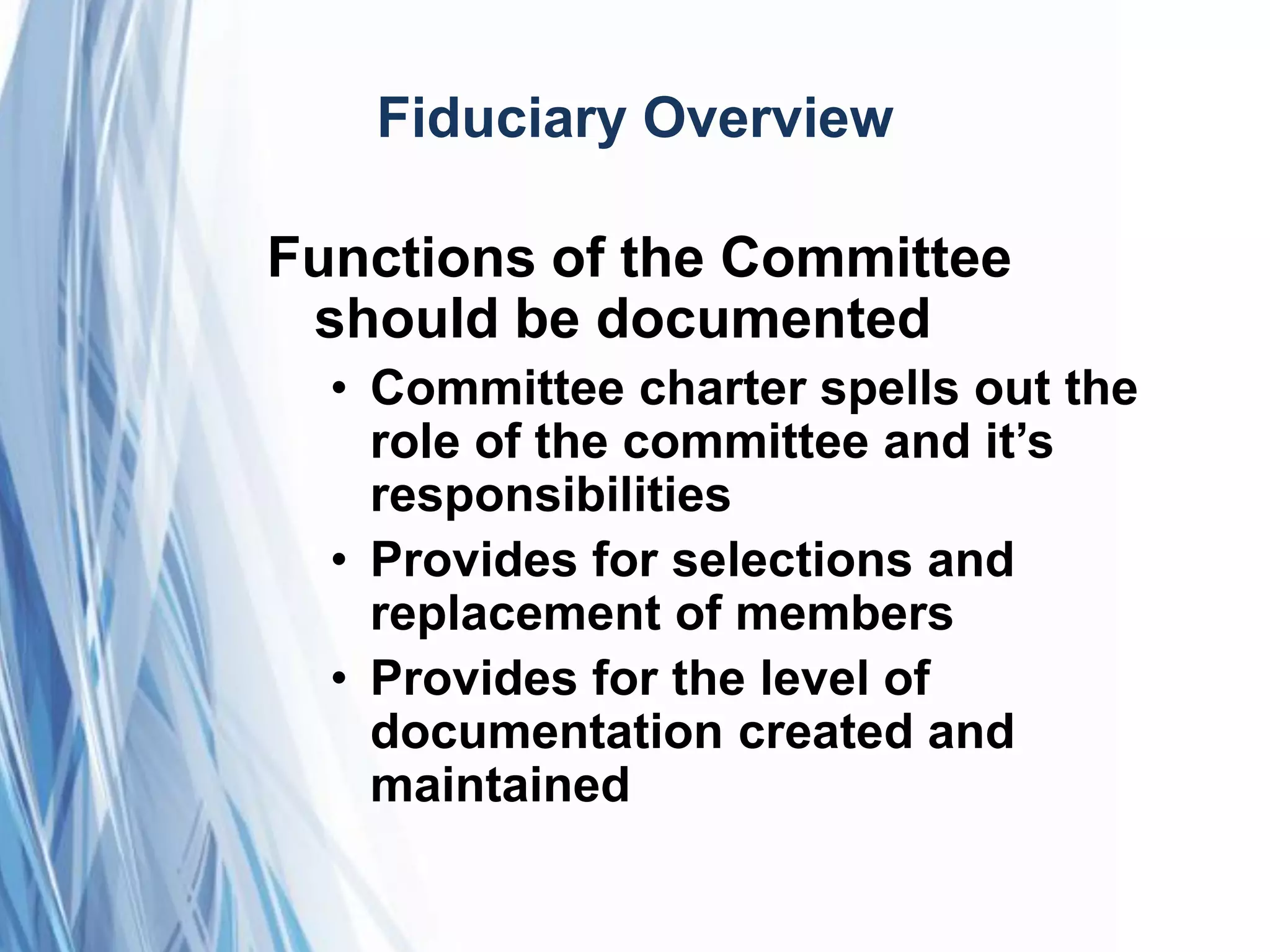
Functions of the Committee
should be documented
• Committee charter spells out the
role of the committee and it’s
responsibilities
• Provides for selections and
replacement of members
• Provides for the level of
documentation created and
maintained
Fiduciary Overview
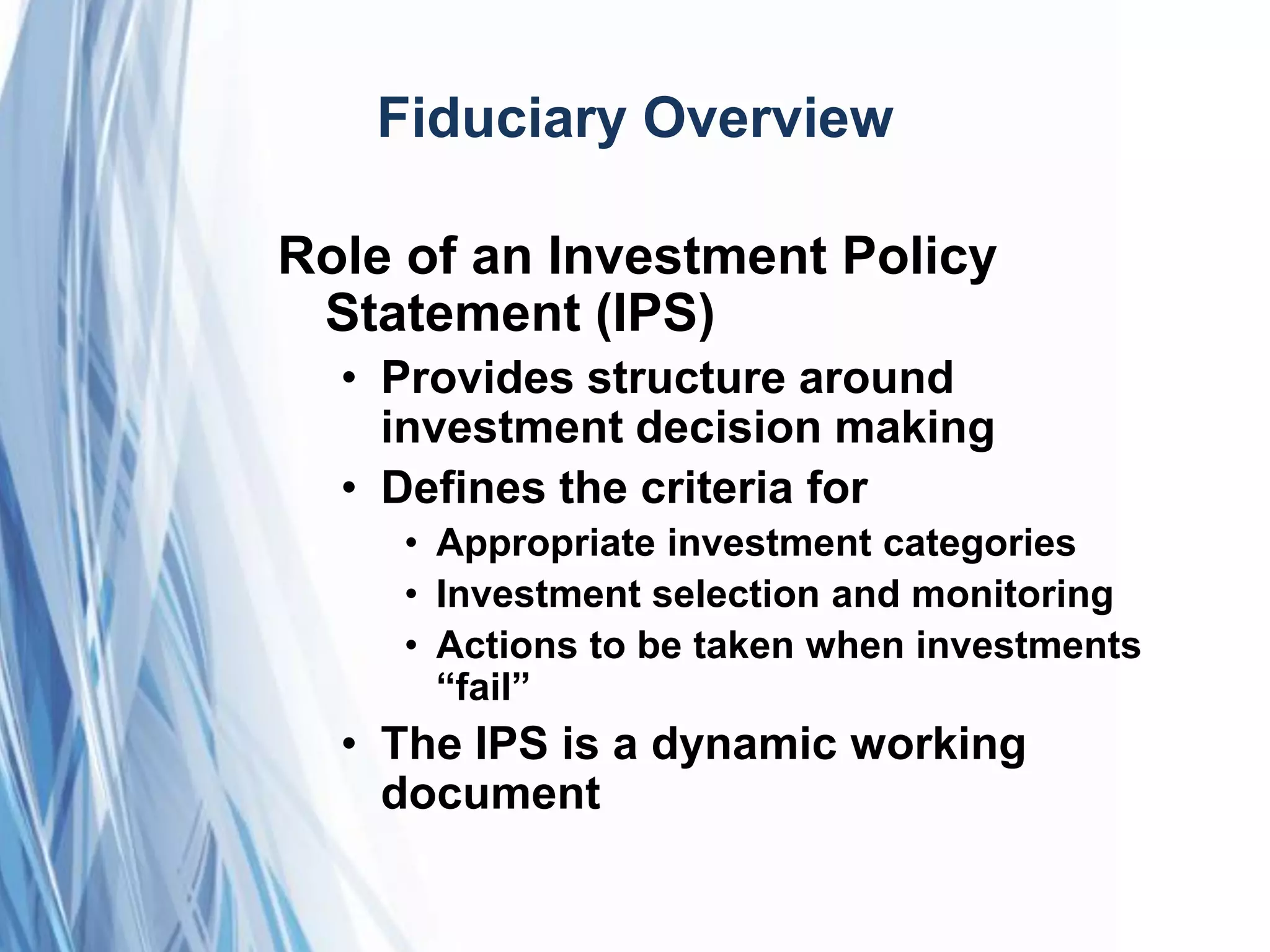
Role of an Investment Policy
Statement (IPS)
• Provides structure around
investment decision making
• Defines the criteria for
• Appropriate investment categories
• Investment selection and monitoring
• Actions to be taken when investments
―fail‖
• The IPS is a dynamic working
document
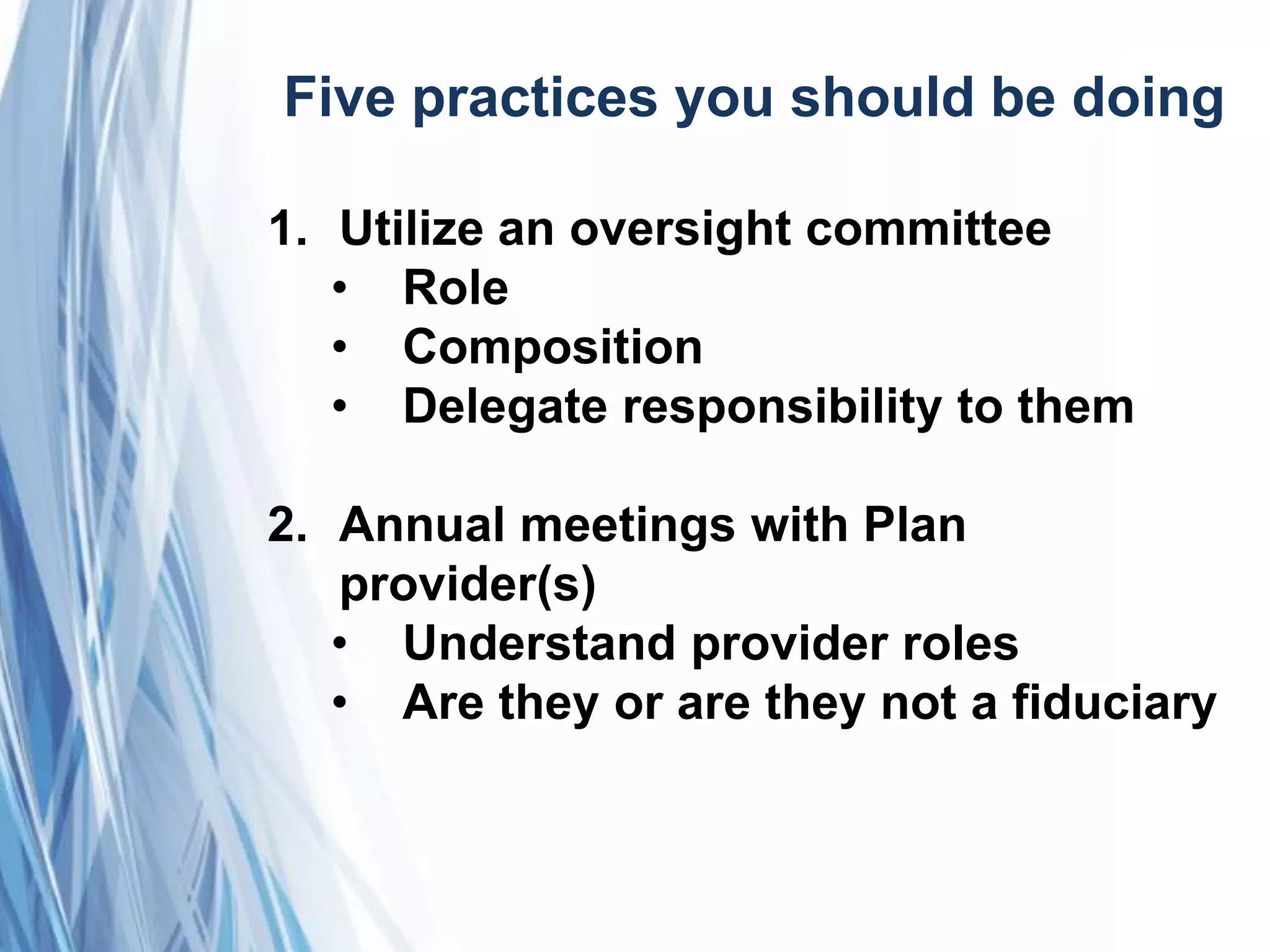
Five practices you should be doing
1. Utilize an oversight committee
• Role
• Composition
• Delegate responsibility to them
2. Annual meetings with Plan
provider(s)
• Understand provider roles
• Are they or are they not a fiduciary
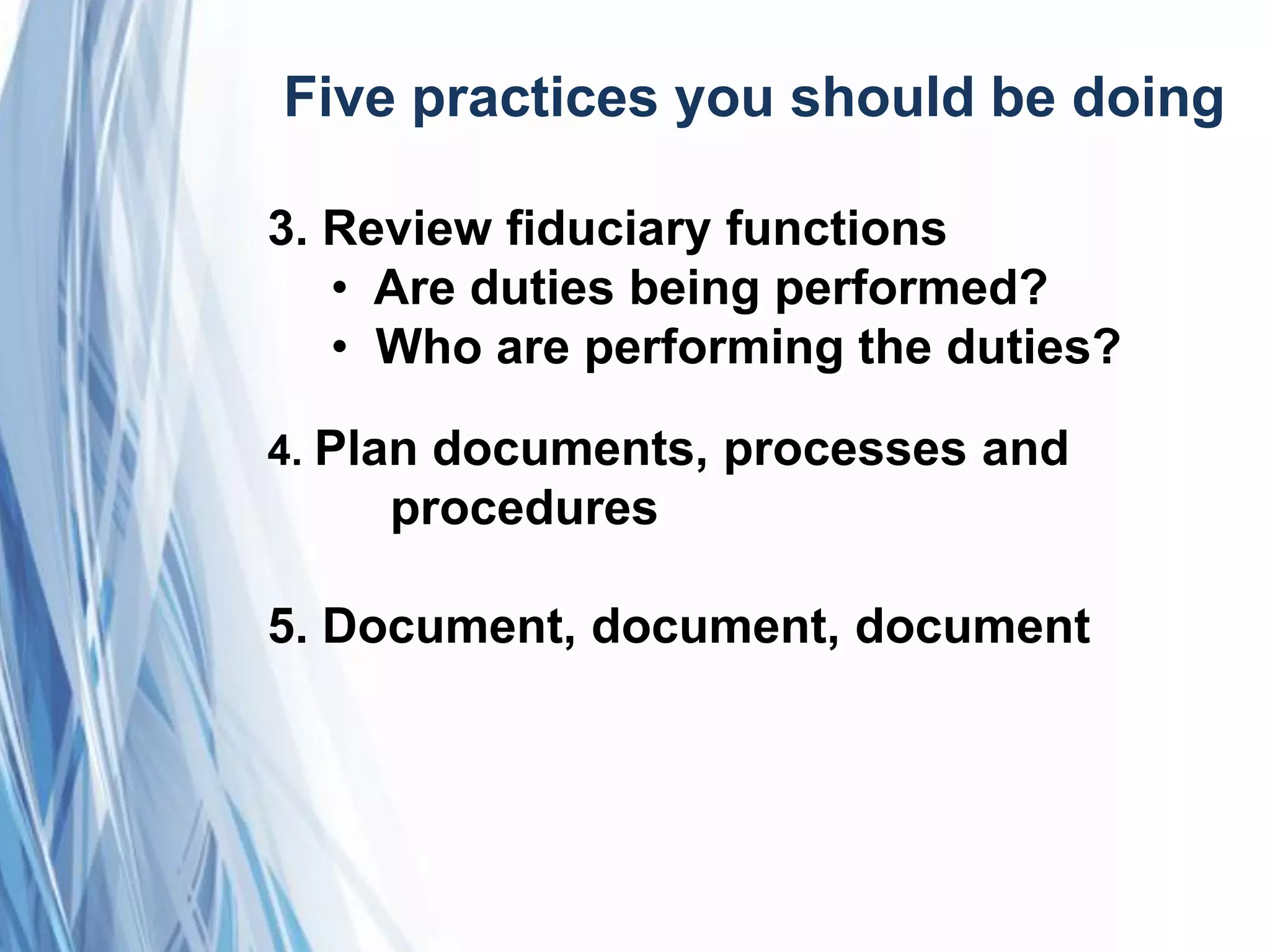
Five practices you should be doing
3. Review fiduciary functions
• Are duties being performed?
• Who are performing the duties?
4. Plan documents, processes and
procedures
5. Document, document, document
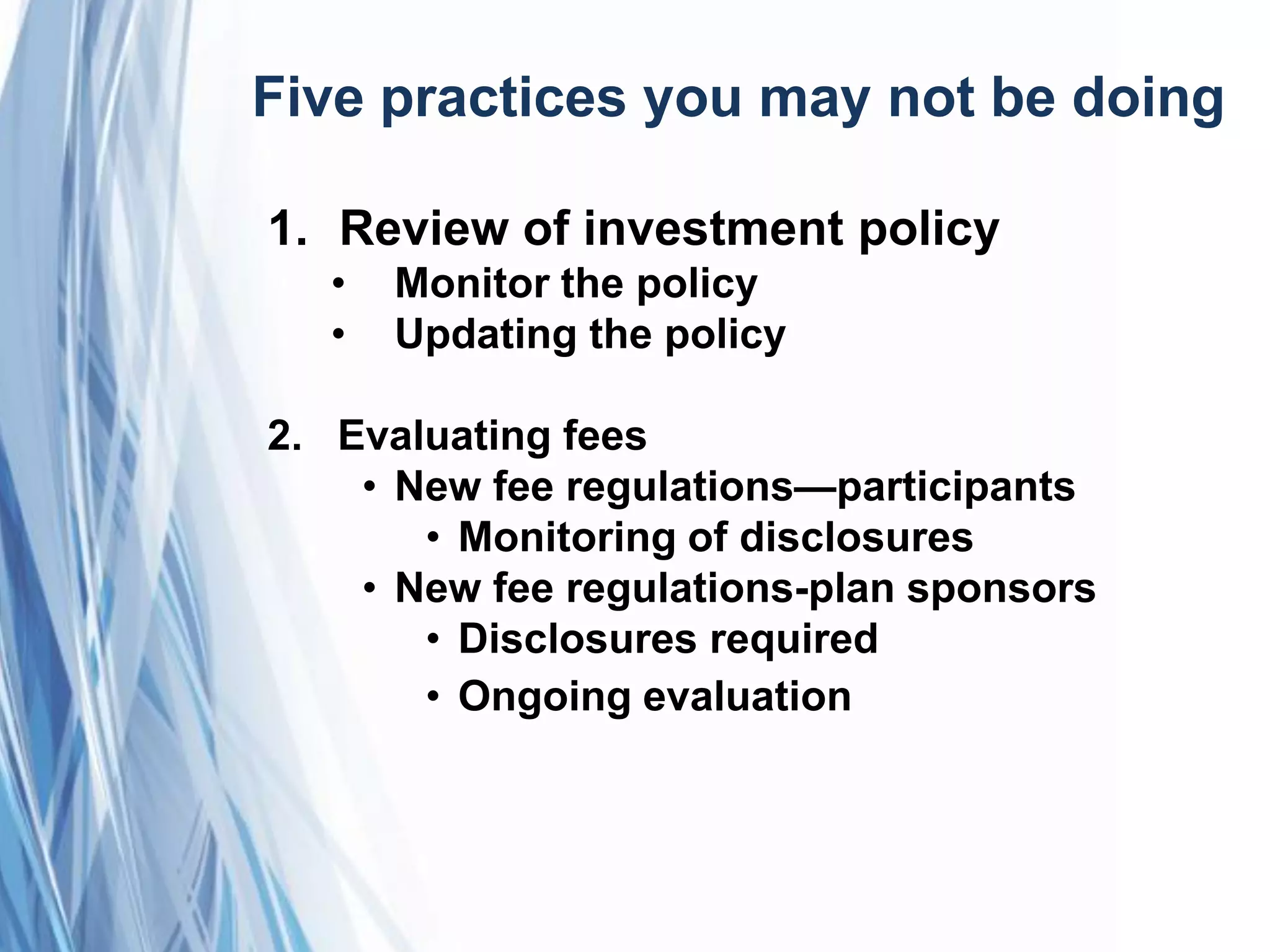
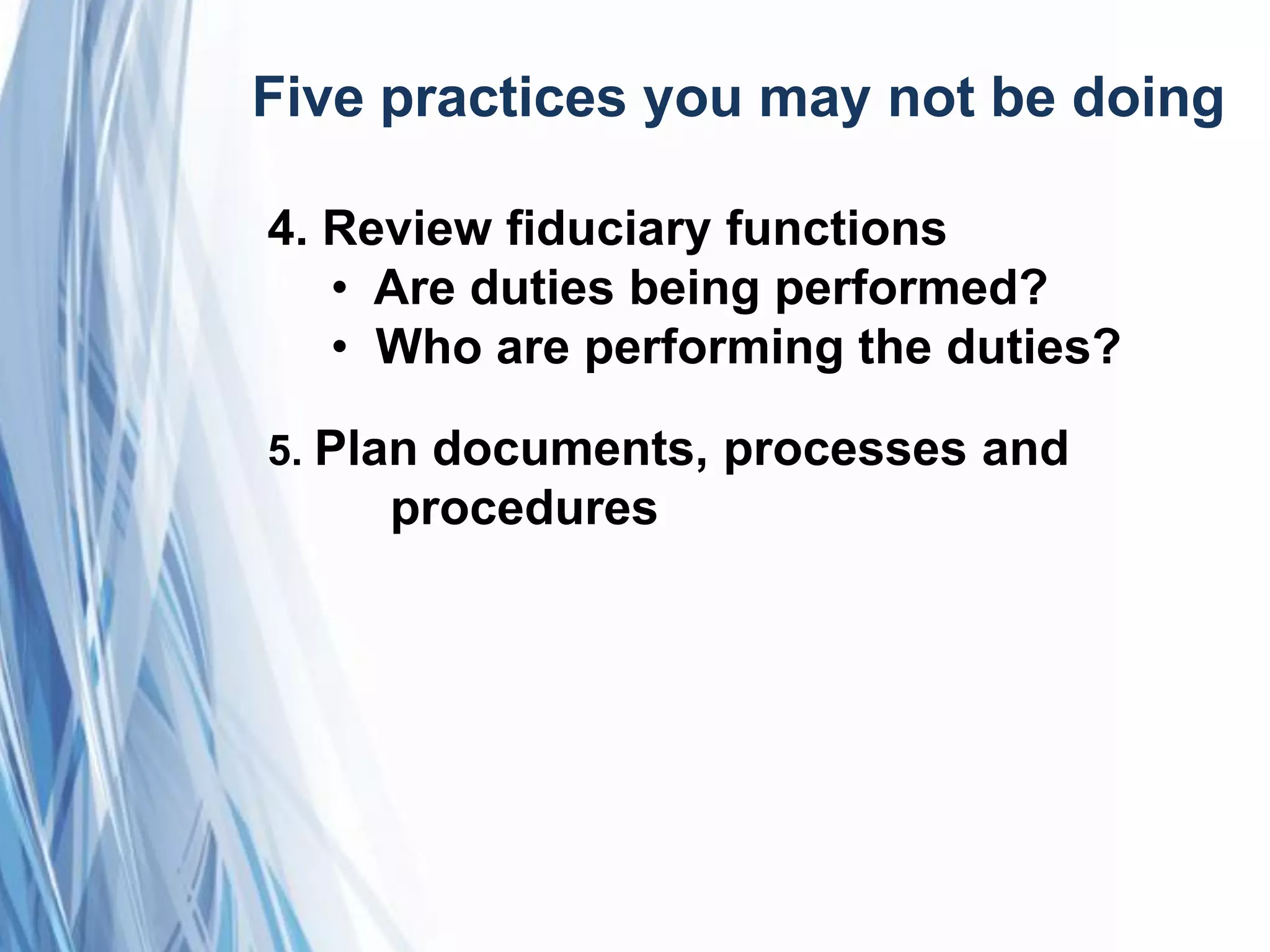
Five practices you may not be doing
1. Review of investment policy
• Monitor the policy
• Updating the policy
2. Evaluating fees
• New fee regulations—participants
• Monitoring of disclosures
• New fee regulations-plan sponsors
• Disclosures required
• Ongoing evaluation
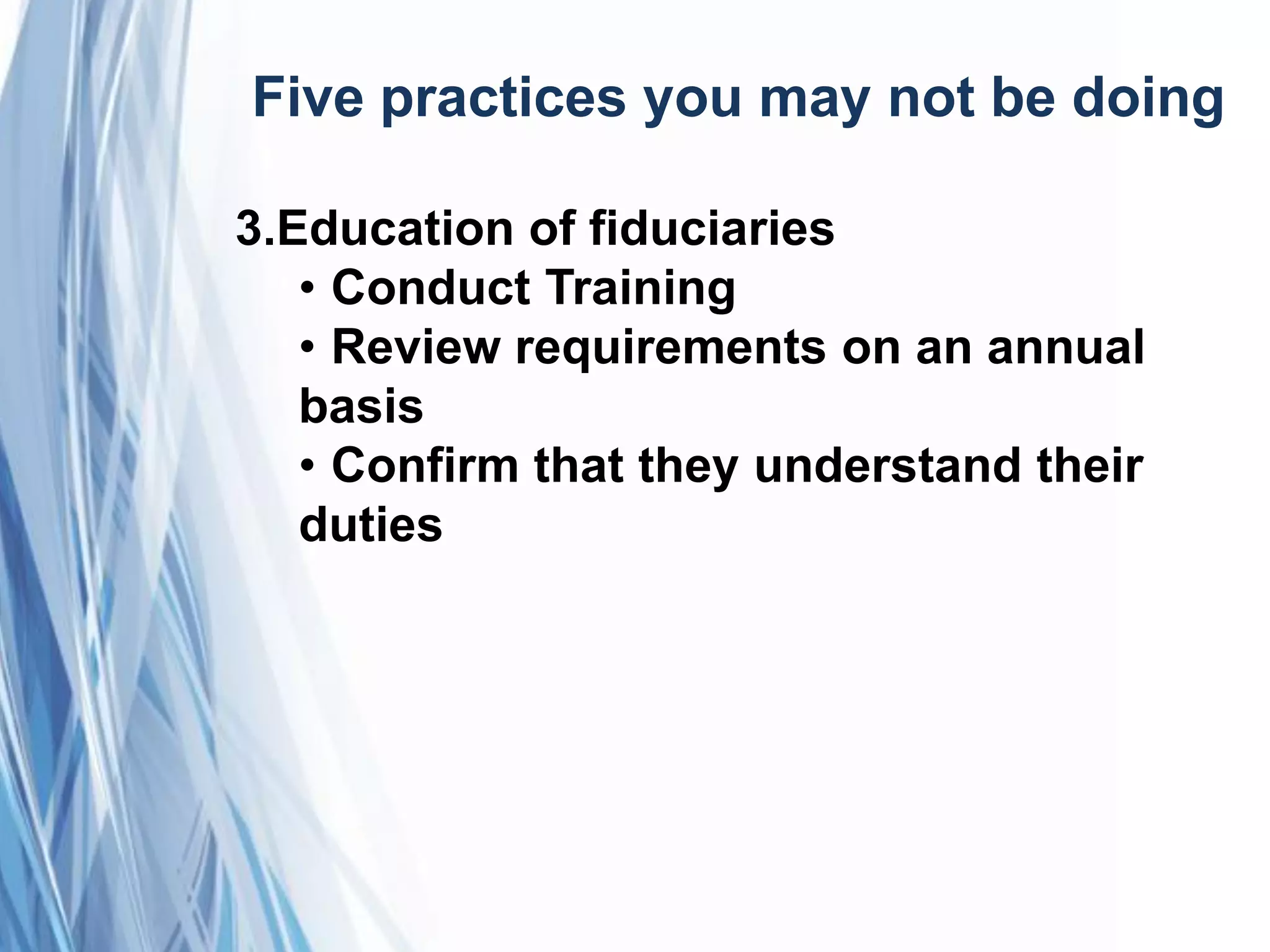
Five practices you may not be doing
3.Education of fiduciaries
• Conduct Training
• Review requirements on an annual
basis
• Confirm that they understand their
duties
Five practices you may not be doing
4. Review fiduciary functions
• Are duties being performed?
• Who are performing the duties?
5. Plan documents, processes and
procedures
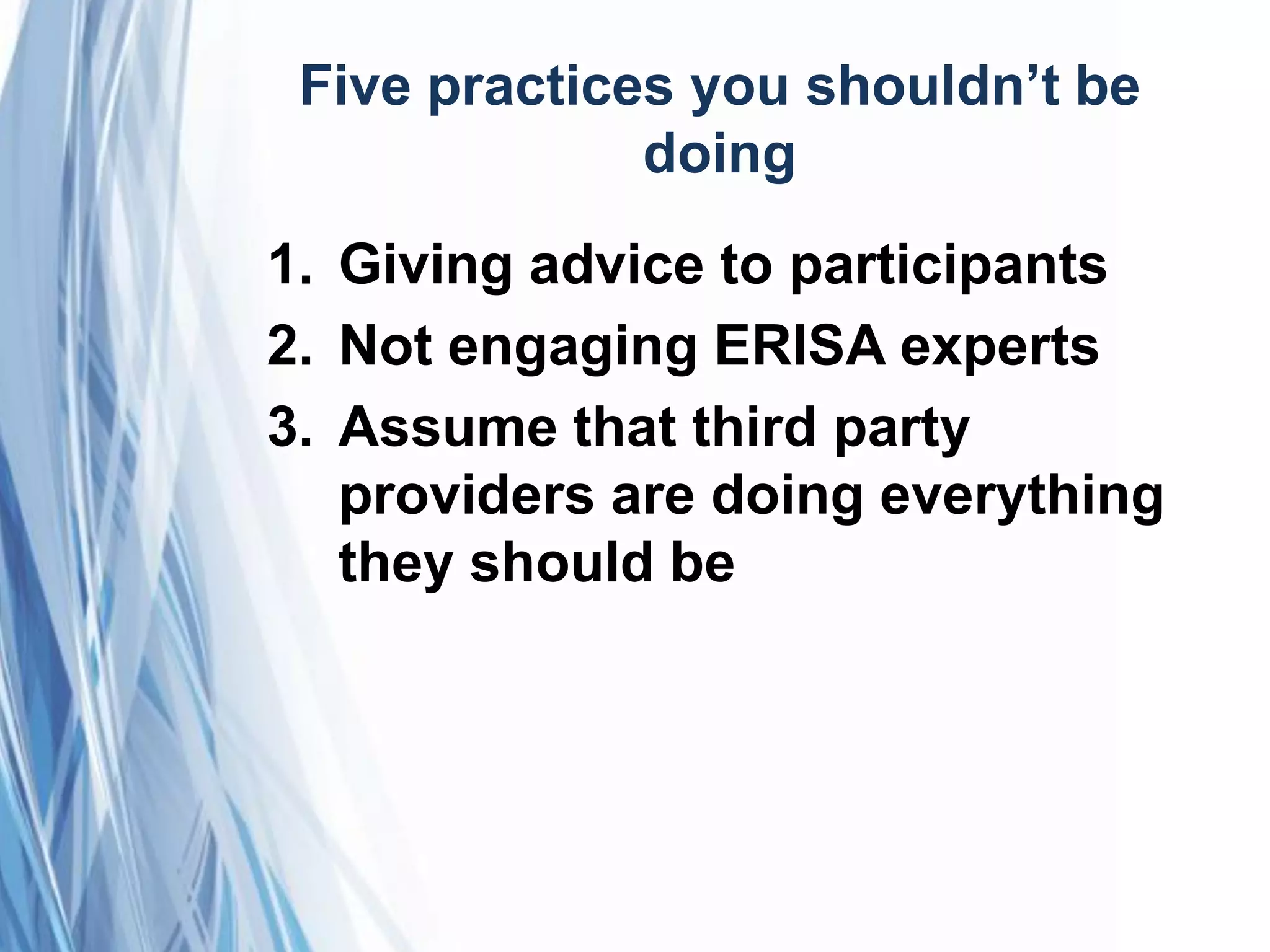
Five practices you shouldn’t be
doing
1. Giving advice to participants
2. Not engaging ERISA experts
3. Assume that third party
providers are doing everything
they should be
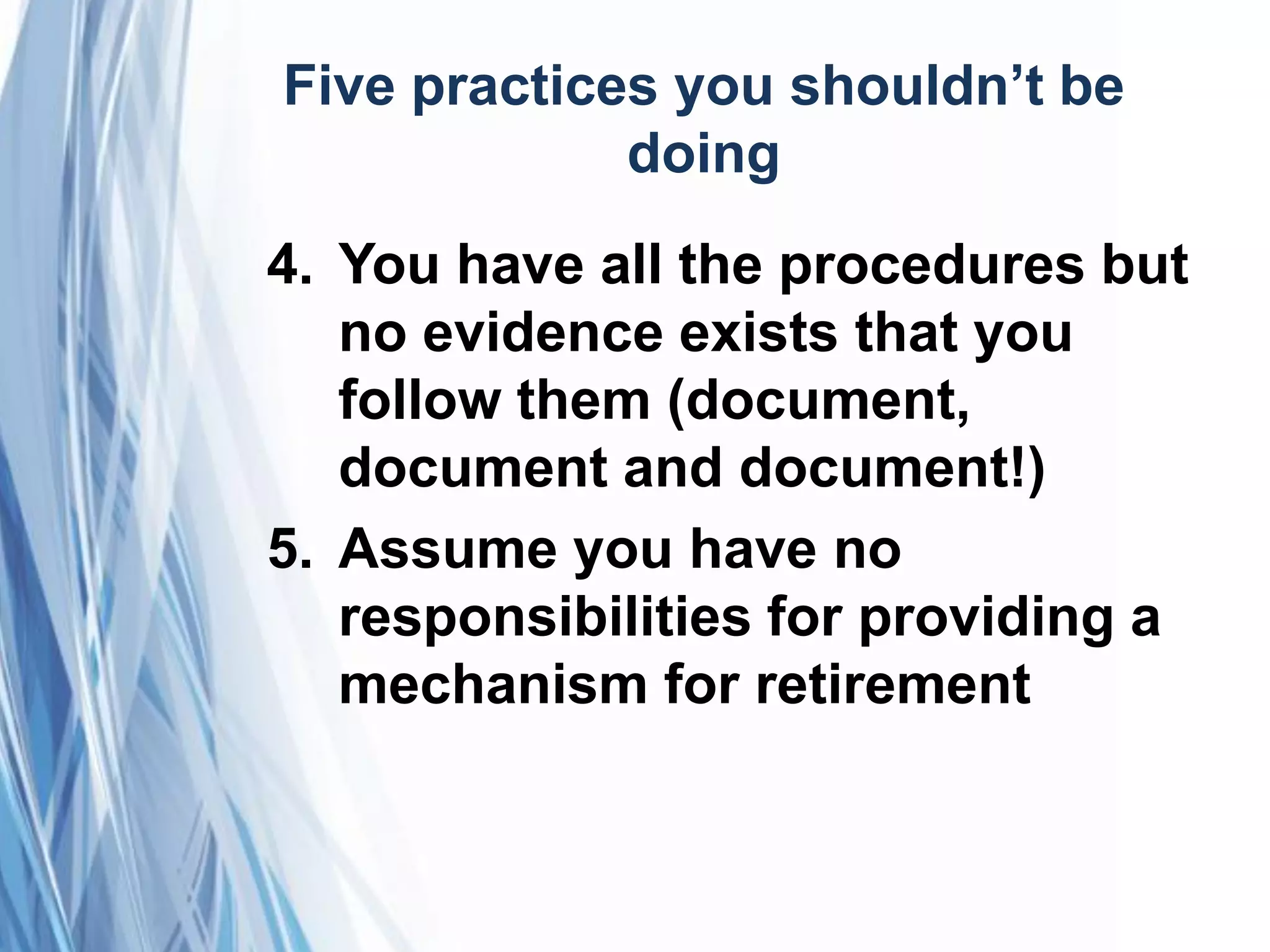
Five practices you shouldn’t be
doing
4. You have all the procedures but
no evidence exists that you
follow them (document,
document and document!)
5. Assume you have no
responsibilities for providing a
mechanism for retirement
Questions?

Fiduciary Wellness 06/11/13 - 5 things you should be, and 5 things you shouldn't be doing!

  • 1.
  • 2.
    Speakers Michael Olah, J.D.,LL.M Director,Technical and Legal Compliance Tegrit Group 13680 Cleveland Avenue Uniontown, OH 44685 (p) 330.983.0565 | (f) 330.644.2705 | michael.olah@tegritgroup.com Michelle Buckley, CPA, AIFA® Vice President, Practice Leader Benefit Plan Group Meaden & Moore 1100 Superior Avenue, Suite 1100 Cleveland, Ohio 44114 (p) 216-928-5379 | (f) 216-771-4511 | mbuckley@meadenmoore.com
  • 3.
    Program overview • Overviewof a fiduciary • Five things you should be doing • Five things you may not be doing • Five things you shouldn’t be doing • Questions?
  • 4.
    Fiduciary Overview ERISA createda regulatory scheme that split responsibilities among: •IRS is responsible for the ―qualification rules‖ which provide the tax benefits of sponsoring/participating •The DOL is responsible for labor and fiduciary matters, including: Prohibiting certain individuals from holding certain plan related positions; Prohibiting willful violations of ERISA’s reporting and disclosure rules; Protecting against coercion of employees to not exercise ERISA protected rights (or retaliating against those who do); and, Prosecuting the misuse of benefit assets
  • 5.
    Fiduciary Overview In 2012the Department of Labor under ERISA: • Recovered $1.27 billion for ERISA plans with respect to prohibited transactions and other ERISA violations committed with respect to ERISA plan assets • Closed 3,566 civil investigations with over 72.1% resulting in monetary recoveries or other corrective actions • Closed 318 criminal investigations with 78 guilty pleas or convictions and 117 individuals indicted • Responded to 239,520 informal complaint inquiries resulting in the restoration of $260.7 million in monetary benefits to plan participants
  • 6.
    Fiduciary Overview Fiduciaries aredefined by function – not position • i.e. – do the deed, better pay heed as a fiduciary • The ―deeds‖ that make you a fiduciary fall into three categories – as defined in ERISA • Exercise discretion in the management of the plan or exercises control over plan assets – – Making discretionary day to day decisions that impact the operation of the plan (such as who is eligible to participate, to take a loan, hardship or other distributions) or – Having meaningful control over plan assets (such as moving funds around, authorizing payments to vendors, signing off on distributions and the like)
  • 7.
    Fiduciary Overview The ―deeds‖that make you a fiduciary fall into three categories – as defined in ERISA • Provide ―investment advice‖ with respect to plan assets – Provides investment recommendations – On a regular basis – Pursuant to a mutual agreement or understanding – That the advice will serve as a primary basis for plan investment decisions, and – The advice is ―personalized‖ based on the particular needs of the plan
  • 8.
    Fiduciary Overview The ―deeds‖that make you a fiduciary fall into three categories – as defined in ERISA • Exercising discretionary authority over the administration of the plan, including: – Determining which vendors will provide services to the plan – such as: » Recordkeepers and bundled service providers » investment managers and advisors who will function as fiduciaries with respect to the plan – Selecting investment providers and the investment options within the plan
  • 9.
    Fiduciary Overview Roles ofthe employer/Plan Sponsor • Settlor/Employer – a ―Non-fiduciary‖ role exclusively responsible for: • Plan design – including determining the type of plan to be offered, those eligible to participate, and what benefits will be offered • Choosing amendments altering the above, or terminating the plan entirely • Plan Administrator – a fiduciary role responsible for all aspects of plan operation consistent with it’s design – including: • Selecting various service providers/vendors • Selecting others who will perform fiduciary functions on behalf of the plan –
  • 10.
    Fiduciary Overview Obligations offiduciaries: • Use the plan/assets for the exclusive purpose of providing benefits to participants/beneficiaries • Allows payment of ―reasonable‖ fees • Exercise case as a ―prudent expert‖ would (using prudent processes) • Diversifying plan assets • Abiding by the terms of the plan document
  • 11.
    Fiduciary Overview Role ofa Committee • Provides structure around fiduciary decision making (―prudent process‖) • May have responsibilities relating to: • Investment selection and monitoring • Non-investment fiduciary decisions • Plan design (settlor) decisions • Membership should reflect the purpose of the committee
  • 12.
    Fiduciary Overview Functions ofthe Committee should be documented • Committee charter spells out the role of the committee and it’s responsibilities • Provides for selections and replacement of members • Provides for the level of documentation created and maintained
  • 13.
    Fiduciary Overview Role ofan Investment Policy Statement (IPS) • Provides structure around investment decision making • Defines the criteria for • Appropriate investment categories • Investment selection and monitoring • Actions to be taken when investments ―fail‖ • The IPS is a dynamic working document
  • 14.
    Five practices youshould be doing 1. Utilize an oversight committee • Role • Composition • Delegate responsibility to them 2. Annual meetings with Plan provider(s) • Understand provider roles • Are they or are they not a fiduciary
  • 15.
    Five practices youshould be doing 3. Review fiduciary functions • Are duties being performed? • Who are performing the duties? 4. Plan documents, processes and procedures 5. Document, document, document
  • 16.
    Five practices youmay not be doing 1. Review of investment policy • Monitor the policy • Updating the policy 2. Evaluating fees • New fee regulations—participants • Monitoring of disclosures • New fee regulations-plan sponsors • Disclosures required • Ongoing evaluation
  • 17.
    Five practices youmay not be doing 3.Education of fiduciaries • Conduct Training • Review requirements on an annual basis • Confirm that they understand their duties
  • 18.
    Five practices youmay not be doing 4. Review fiduciary functions • Are duties being performed? • Who are performing the duties? 5. Plan documents, processes and procedures
  • 19.
    Five practices youshouldn’t be doing 1. Giving advice to participants 2. Not engaging ERISA experts 3. Assume that third party providers are doing everything they should be
  • 20.
    Five practices youshouldn’t be doing 4. You have all the procedures but no evidence exists that you follow them (document, document and document!) 5. Assume you have no responsibilities for providing a mechanism for retirement
  • 21.