Retirement Plan Update:
Dealing with the Dreaded Disclosures

    Speaker: Clint Edgington, CFA


       Mr. Edgington acts as an Investment Advisor with Beacon Hill Investment
       Advisory. As such, he acts in a fiduciary capacity for Plans and their Fiduciaries
       ensuring prudent processes in selecting and monitoring investment decisions.

       Mr. Edgington has been admitted as an expert witness regarding ERISA accounts
       and has testified before the NYSE and NASD.

       Mr. Edgington has acted as a Trustee and Plan Administrator for Defined Benefit
       Pension Plan and Defined Contribution 401(k)/Profit Sharing Plan.

       Clint has been published and quoted for periodicals such as Plan Sponsor
       magazine, The Journal of Financial Planning, and The Chicago Tribune, amongst
       others.

              www.BOSSworkshops.com
401(k) Disclosure and Expense Summary

1. Why you should care

2. New Rules

3. Status of New Rules

4. What to do now
                              These points are very abbreviated and aren’t intended to
                              constitute legal, tax, or financial advise. We recommend
                              reviewing with experienced ERISA counsel.
5. What we do


                    www.BOSSworkshops.com
1. Why you should care:
                             A Primer on Fiduciary Duty

 If you have any responsibility for a company 401(k) plan as an employee,
  you are likely a fiduciary.

 Under ERISA, the fundamental duties of investment fiduciaries are:
         Loyalty: Operate in sole interest of plan and participants
         Prudence: Care, skill, prudence, and diligence that a prudent man familiar with such
          circumstances (Process + Expertise)
         Diversify
         Adhere to plan documents

 Fiduciaries are held to high standards, courts/DOL have said;

     The fiduciary obligations of the trustees [and other ERISA fiduciaries] to the participants
     and beneficiaries of the plan are . . . the highest known to the law1

     A pure heart and empty head are not enough3

     Duty “is not that of a prudent layperson, but rather that of a prudent fiduciary with
     experience dealing with a similar enterprise4


                                www.BOSSworkshops.com
1. Why you should care:
                           Liability has Increased
 The good
       Recruit and Retain: 2nd most important employee benefit
       Dignified retirement for employees and yourself

 The Bad
    •   Enron collapse (2001)
    •   Revocation of the broker-dealer exemption (March 2007)
    •   LaRue v. DeWolff Supreme Court case (October 2007)

 The Ugly
    •   ERISA litigation has increased at a rate of 25%/year over the past four
        years.
    •   Fiduciaries are personally liable
    •   Fidelity Bond only protects plan assets, not fiduciaries

 Requires Plan Sponsor to be proactive


                           www.BOSSworkshops.com
1. Why you should care:
                      From free to fee

 Most employees think
   401(k) is free (71%) AND
   fees are very important in their decision making 7


                     www.BOSSworkshops.com
2. New Rules:
       “Disclosures from Vendors to the Plan                         (408(b)(2))   ”

 Who must provide?
   Vendor that contracts with plan and expects $1,000 or more


 Who must receive?
   Plan fiduciary


 What must be disclosed?
   Description of services, whether provided as a fiduciary or not, compensation
    (direct & indirect)
   Bundled services will have to estimate


 What if they aren’t provided?
   Your responsibility! Must request in writing to vendor that they provide. If not
    received in 90 days must report to DOL.


                              www.BOSSworkshops.com
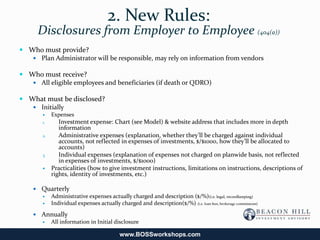
2. New Rules:
      Disclosures from Employer to Employee (404(a))
 Who must provide?
    Plan Administrator will be responsible, may rely on information from vendors

 Who must receive?
    All eligible employees and beneficiaries (if death or QDRO)

 What must be disclosed?
    Initially
            Expenses
        1.      Investment expense: Chart (see Model) & website address that includes more in depth
                information
        2.      Administrative expenses (explanation, whether they’ll be charged against individual
                accounts, not reflected in expenses of investments, $/$1000, how they’ll be allocated to
                accounts)
        3.      Individual expenses (explanation of expenses not charged on planwide basis, not reflected
                in expenses of investments, $/$1000)
            Practicalities (how to give investment instructions, limitations on instructions, descriptions of
             rights, identity of investments, etc.)

     Quarterly
       Administrative expenses actually charged and description ($/%)(i.e. legal, recordkeeping)
       Individual expenses actually charged and description($/%) (i.e. loan fees, brokerage commissions)

     Annually
       All information in Initial disclosure

                                          www.BOSSworkshops.com
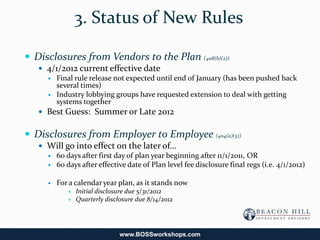
3. Status of New Rules

 Disclosures from Vendors to the Plan (408(b)(2))
    4/1/2012 current effective date
      Final rule release not expected until end of January (has been pushed back
       several times)
      Industry lobbying groups have requested extension to deal with getting
       systems together
    Best Guess: Summer or Late 2012


 Disclosures from Employer to Employee (404(a)(5))
    Will go into effect on the later of…
      60 days after first day of plan year beginning after 11/1/2011, OR
      60 days after effective date of Plan level fee disclosure final regs (i.e. 4/1/2012)


         For a calendar year plan, as it stands now
                Initial disclosure due 5/31/2012
                Quarterly disclosure due 8/14/2012


                                www.BOSSworkshops.com
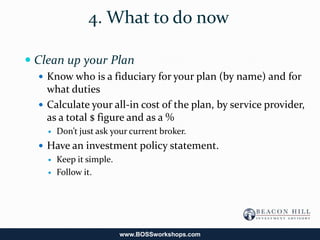
4. What to do now

 Clean up your Plan
   Know who is a fiduciary for your plan (by name) and for
    what duties
   Calculate your all-in cost of the plan, by service provider,
    as a total $ figure and as a %
       Don’t just ask your current broker.
   Have an investment policy statement.
     Keep it simple.

     Follow it.


                         www.BOSSworkshops.com
4. What to do Now
                                  Know who is a fiduciary

 Fiduciary responsibilities can be shared but not abdicated.

 If you are not an expert re: investments, you have a duty to hire one.
       DOL :“Unless they possess the necessary expertise to evaluate such factors, fiduciaries would
       need to obtain the advice of a qualified, independent expert”5

 If you hire an independent expert, you may get the benefit of the doubt if sued.
       Although reliance on an adviser will not immunize a trustee’s [or other fiduciary’s] actions, it
       is a factor to be weighed in determining whether a trustee breached his or her duty.”6

     Registered Investment Advisor, Bank, or Insurance Agent can act as co-fiduciary for the
       investment portion (3(21)). A safe harbor has been carved out where they are assumed to be
       a “prudent expert” if they accept fiduciary duty in writing.

     Broker, or anyone else who does not take the fiduciary duty does not receive the benefit of
       that safe harbor. Your due diligence must prove them to be a “prudent expert”.

     Fiduciary Warrantees: Typically stingy in what they cover, read the fine print.


                                   www.BOSSworkshops.com
4. What to do Now
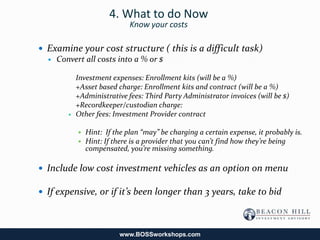
                             Know your costs

 Examine your cost structure ( this is a difficult task)
   Convert all costs into a % or $


           Investment expenses: Enrollment kits (will be a %)
           +Asset based charge: Enrollment kits and contract (will be a %)
           +Administrative fees: Third Party Administrator invoices (will be $)
           +Recordkeeper/custodian charge:
          Other fees: Investment Provider contract

              Hint: If the plan “may” be charging a certain expense, it probably is.
              Hint: If there is a provider that you can’t find how they’re being
               compensated, you’re missing something.

 Include low cost investment vehicles as an option on menu

 If expensive, or if it’s been longer than 3 years, take to bid


                          www.BOSSworkshops.com
4. What to do Now
                          Investment Policy Statement


 Investment Policy Statement
   KISS

   Areas it should address;
       -Who is involved
       -When it was implemented
       -Purpose of plan
       -404(c) compliant (protection from individual participant decisions)
       -Criteria for investments upon inclusion
       -Criteria for investment monitoring
       -Participant Education

Your provider should be able to provide samples or help you with it.


                               www.BOSSworkshops.com
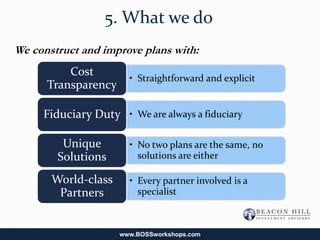
5. What we do
We construct and improve plans with:
          Cost         • Straightforward and explicit
      Transparency

     Fiduciary Duty • We are always a fiduciary

         Unique        • No two plans are the same, no
        Solutions        solutions are either

       World-class     • Every partner involved is a
        Partners         specialist


                     www.BOSSworkshops.com
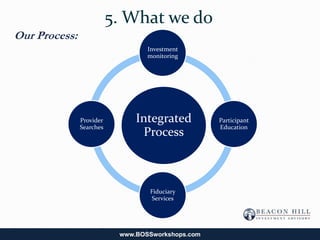
5. What we do
Our Process:
                                  Investment
                                  monitoring


               Provider        Integrated          Participant
               Searches                            Education
                                Process


                                  Fiduciary
                                  Services


                           www.BOSSworkshops.com
Sources

1.   Donovan v. Bierwirth, 680 F.2d 263, 272 (2d Cir. 1982).
2.   ERISA section 404(a)(1)(B).
3.   Donovan v. Cunningham, 716 F.2d 1455, 1467 (5th Cir. 1983).
4.   Marshall v. Snyder, 572 F.2d 894 (2d Cir. 1978).
5.   DOL Reg. § 2509.95-1(c)(6).
6.   17 F.3d 393 (9th Cir. 1994).
7.   AARP: “401(k) participants’ awareness and understanding of fees”, February 2011


                                         www.BOSSworkshops.com

Retirement Plan Update

  • 1.
    Retirement Plan Update: Dealingwith the Dreaded Disclosures Speaker: Clint Edgington, CFA Mr. Edgington acts as an Investment Advisor with Beacon Hill Investment Advisory. As such, he acts in a fiduciary capacity for Plans and their Fiduciaries ensuring prudent processes in selecting and monitoring investment decisions. Mr. Edgington has been admitted as an expert witness regarding ERISA accounts and has testified before the NYSE and NASD. Mr. Edgington has acted as a Trustee and Plan Administrator for Defined Benefit Pension Plan and Defined Contribution 401(k)/Profit Sharing Plan. Clint has been published and quoted for periodicals such as Plan Sponsor magazine, The Journal of Financial Planning, and The Chicago Tribune, amongst others. www.BOSSworkshops.com
  • 2.
    401(k) Disclosure andExpense Summary 1. Why you should care 2. New Rules 3. Status of New Rules 4. What to do now These points are very abbreviated and aren’t intended to constitute legal, tax, or financial advise. We recommend reviewing with experienced ERISA counsel. 5. What we do www.BOSSworkshops.com
  • 3.
    1. Why youshould care: A Primer on Fiduciary Duty  If you have any responsibility for a company 401(k) plan as an employee, you are likely a fiduciary.  Under ERISA, the fundamental duties of investment fiduciaries are:  Loyalty: Operate in sole interest of plan and participants  Prudence: Care, skill, prudence, and diligence that a prudent man familiar with such circumstances (Process + Expertise)  Diversify  Adhere to plan documents  Fiduciaries are held to high standards, courts/DOL have said; The fiduciary obligations of the trustees [and other ERISA fiduciaries] to the participants and beneficiaries of the plan are . . . the highest known to the law1 A pure heart and empty head are not enough3 Duty “is not that of a prudent layperson, but rather that of a prudent fiduciary with experience dealing with a similar enterprise4 www.BOSSworkshops.com
  • 4.
    1. Why youshould care: Liability has Increased  The good  Recruit and Retain: 2nd most important employee benefit  Dignified retirement for employees and yourself  The Bad • Enron collapse (2001) • Revocation of the broker-dealer exemption (March 2007) • LaRue v. DeWolff Supreme Court case (October 2007)  The Ugly • ERISA litigation has increased at a rate of 25%/year over the past four years. • Fiduciaries are personally liable • Fidelity Bond only protects plan assets, not fiduciaries  Requires Plan Sponsor to be proactive www.BOSSworkshops.com
  • 5.
    1. Why youshould care: From free to fee  Most employees think  401(k) is free (71%) AND  fees are very important in their decision making 7 www.BOSSworkshops.com
  • 6.
    2. New Rules: “Disclosures from Vendors to the Plan (408(b)(2)) ”  Who must provide?  Vendor that contracts with plan and expects $1,000 or more  Who must receive?  Plan fiduciary  What must be disclosed?  Description of services, whether provided as a fiduciary or not, compensation (direct & indirect)  Bundled services will have to estimate  What if they aren’t provided?  Your responsibility! Must request in writing to vendor that they provide. If not received in 90 days must report to DOL. www.BOSSworkshops.com
  • 7.
    2. New Rules: Disclosures from Employer to Employee (404(a))  Who must provide?  Plan Administrator will be responsible, may rely on information from vendors  Who must receive?  All eligible employees and beneficiaries (if death or QDRO)  What must be disclosed?  Initially  Expenses 1. Investment expense: Chart (see Model) & website address that includes more in depth information 2. Administrative expenses (explanation, whether they’ll be charged against individual accounts, not reflected in expenses of investments, $/$1000, how they’ll be allocated to accounts) 3. Individual expenses (explanation of expenses not charged on planwide basis, not reflected in expenses of investments, $/$1000)  Practicalities (how to give investment instructions, limitations on instructions, descriptions of rights, identity of investments, etc.)  Quarterly  Administrative expenses actually charged and description ($/%)(i.e. legal, recordkeeping)  Individual expenses actually charged and description($/%) (i.e. loan fees, brokerage commissions)  Annually  All information in Initial disclosure www.BOSSworkshops.com
  • 8.
    3. Status ofNew Rules  Disclosures from Vendors to the Plan (408(b)(2))  4/1/2012 current effective date  Final rule release not expected until end of January (has been pushed back several times)  Industry lobbying groups have requested extension to deal with getting systems together  Best Guess: Summer or Late 2012  Disclosures from Employer to Employee (404(a)(5))  Will go into effect on the later of…  60 days after first day of plan year beginning after 11/1/2011, OR  60 days after effective date of Plan level fee disclosure final regs (i.e. 4/1/2012)  For a calendar year plan, as it stands now  Initial disclosure due 5/31/2012  Quarterly disclosure due 8/14/2012 www.BOSSworkshops.com
  • 9.
    4. What todo now  Clean up your Plan  Know who is a fiduciary for your plan (by name) and for what duties  Calculate your all-in cost of the plan, by service provider, as a total $ figure and as a %  Don’t just ask your current broker.  Have an investment policy statement.  Keep it simple.  Follow it. www.BOSSworkshops.com
  • 10.
    4. What todo Now Know who is a fiduciary  Fiduciary responsibilities can be shared but not abdicated.  If you are not an expert re: investments, you have a duty to hire one. DOL :“Unless they possess the necessary expertise to evaluate such factors, fiduciaries would need to obtain the advice of a qualified, independent expert”5  If you hire an independent expert, you may get the benefit of the doubt if sued. Although reliance on an adviser will not immunize a trustee’s [or other fiduciary’s] actions, it is a factor to be weighed in determining whether a trustee breached his or her duty.”6  Registered Investment Advisor, Bank, or Insurance Agent can act as co-fiduciary for the investment portion (3(21)). A safe harbor has been carved out where they are assumed to be a “prudent expert” if they accept fiduciary duty in writing.  Broker, or anyone else who does not take the fiduciary duty does not receive the benefit of that safe harbor. Your due diligence must prove them to be a “prudent expert”.  Fiduciary Warrantees: Typically stingy in what they cover, read the fine print. www.BOSSworkshops.com
  • 11.
    4. What todo Now Know your costs  Examine your cost structure ( this is a difficult task)  Convert all costs into a % or $ Investment expenses: Enrollment kits (will be a %) +Asset based charge: Enrollment kits and contract (will be a %) +Administrative fees: Third Party Administrator invoices (will be $) +Recordkeeper/custodian charge:  Other fees: Investment Provider contract  Hint: If the plan “may” be charging a certain expense, it probably is.  Hint: If there is a provider that you can’t find how they’re being compensated, you’re missing something.  Include low cost investment vehicles as an option on menu  If expensive, or if it’s been longer than 3 years, take to bid www.BOSSworkshops.com
  • 12.
    4. What todo Now Investment Policy Statement  Investment Policy Statement  KISS  Areas it should address; -Who is involved -When it was implemented -Purpose of plan -404(c) compliant (protection from individual participant decisions) -Criteria for investments upon inclusion -Criteria for investment monitoring -Participant Education Your provider should be able to provide samples or help you with it. www.BOSSworkshops.com
  • 13.
    5. What wedo We construct and improve plans with: Cost • Straightforward and explicit Transparency Fiduciary Duty • We are always a fiduciary Unique • No two plans are the same, no Solutions solutions are either World-class • Every partner involved is a Partners specialist www.BOSSworkshops.com
  • 14.
    5. What wedo Our Process: Investment monitoring Provider Integrated Participant Searches Education Process Fiduciary Services www.BOSSworkshops.com
  • 15.
    Sources 1. Donovan v. Bierwirth, 680 F.2d 263, 272 (2d Cir. 1982). 2. ERISA section 404(a)(1)(B). 3. Donovan v. Cunningham, 716 F.2d 1455, 1467 (5th Cir. 1983). 4. Marshall v. Snyder, 572 F.2d 894 (2d Cir. 1978). 5. DOL Reg. § 2509.95-1(c)(6). 6. 17 F.3d 393 (9th Cir. 1994). 7. AARP: “401(k) participants’ awareness and understanding of fees”, February 2011 www.BOSSworkshops.com