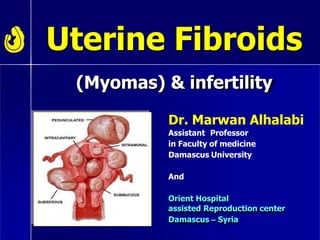
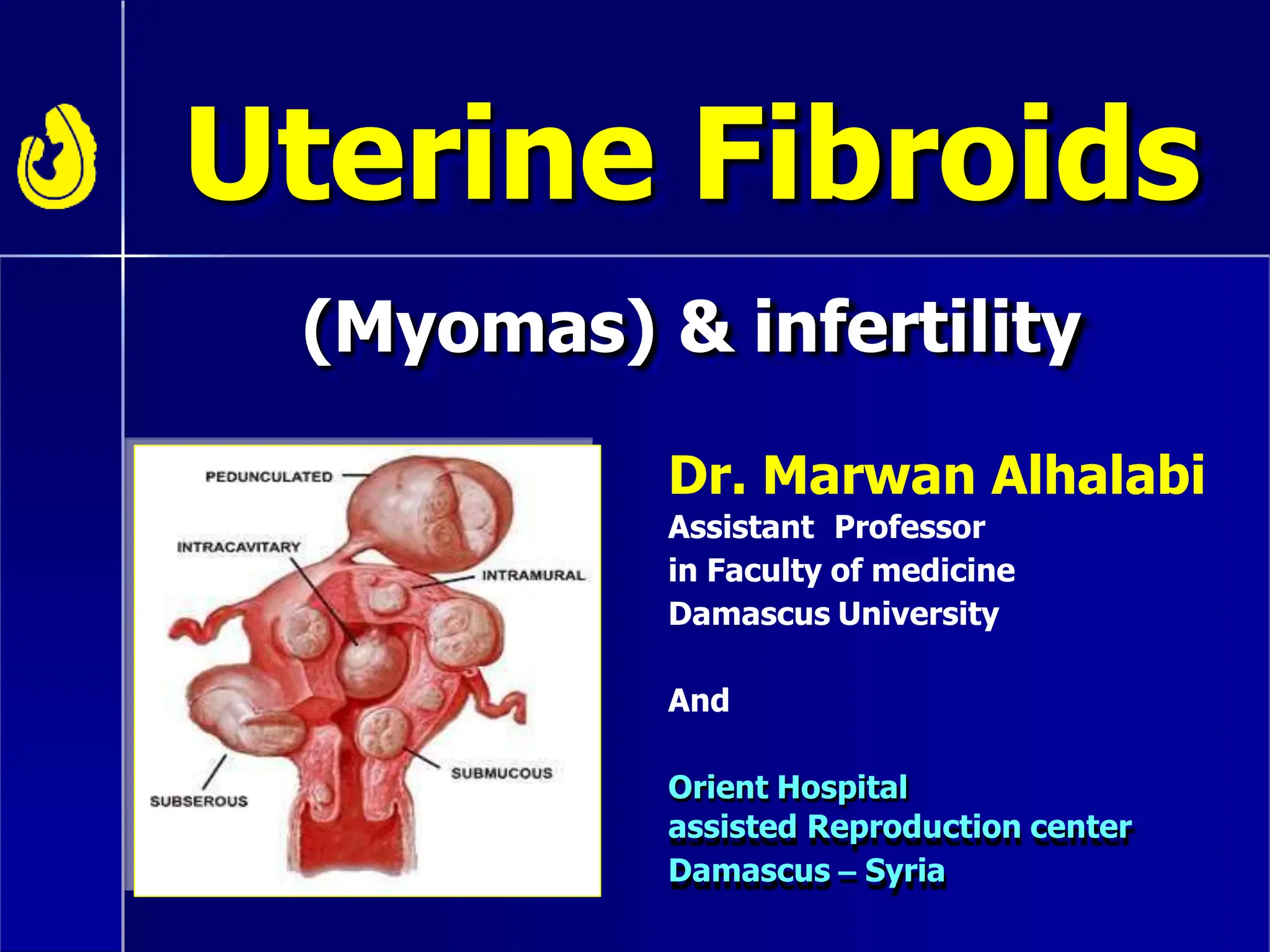
Uterine Fibroids
(Myomas) & infertility
Dr. Marwan Alhalabi
Assistant Professor
in Faculty of medicine
Damascus University
And
Orient Hospital
assisted Reproduction center
Damascus – Syria
Epidemiology of Fibroiods
Fibroids are common in Reproductive
age 20-30%
Incidence of fibroids in infertile women
1-2.4%
140.000 Hysterectomies and 37.000
myomectomies are performed annually
(U.S.A)
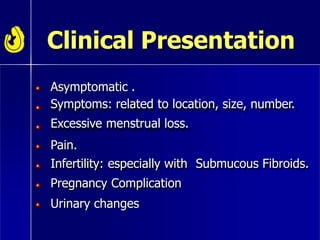
Clinical Presentation
Asymptomatic .
Symptoms: related to location, size, number.
Excessive menstrual loss.
Pain.
Infertility: especially with Submucous Fibroids.
Pregnancy Complication
Urinary changes
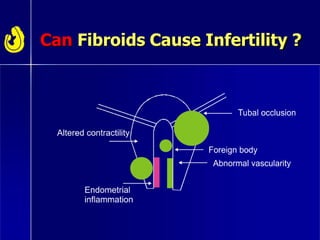
Can Fibroids Cause Infertility ?
Mechanism of reduced fertility
associated with Fibroids
Hindered gamete transportation .
Obstruction of tubal Ostia and endocervix.
Induced Uterine Contraction (Prostaglandine).
Implantation Failure
– Endometrial changes ( atrophy, ulceration, focal
hyperplasia and polyps)
– Vascular alteration ( Venous congestion,…. ) .
– EGF, TGF, IGF.
Complications.
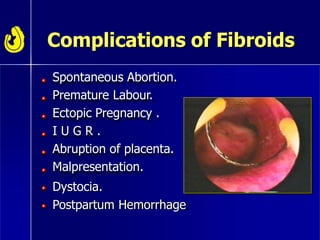
Complications of Fibroids
Spontaneous Abortion.
Premature Labour.
Ectopic Pregnancy .
I U G R .
Abruption of placenta.
Malpresentation.
Dystocia.
Postpartum Hemorrhage
Observation For Reproductive
Dysfunction with Fibroids 1
About half of Infertile women with
Fibroids becomes pregnant after
myomectomy .
( Campo, 2003 )
43% of women with fibroids who
presented in labour, had at least 2 years
history of infertility
( Hasan et al 1990 )
Observation for Reproductive
Dysfunction with Fibroids 2
Fibroids are associated with a high rate of
overall pregnancy loss (60%)
Myomectomy halves the risk of spontaneous
miscarriage .
Surgery reduces first and second trimester loss.
( buttram & Reiter, Li et al 1999 )
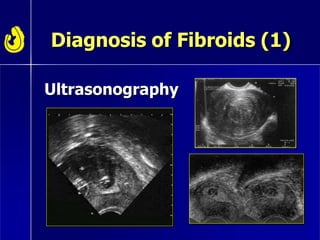
Diagnosis of Fibroids (1)
Ultrasonography
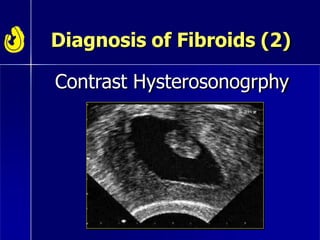
Diagnosis of Fibroids (2)
Contrast Hysterosonogrphy
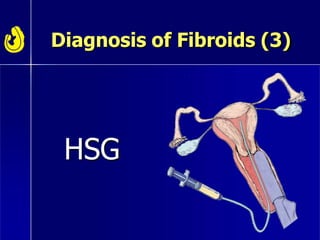
Diagnosis of Fibroids (3)
HSG
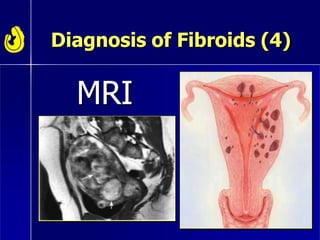
Diagnosis of Fibroids (4)
MRI
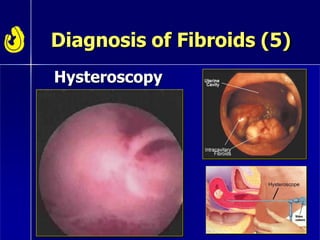
Diagnosis of Fibroids (5)
Hysteroscopy
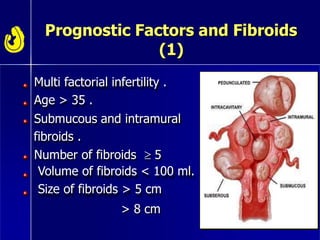
Prognostic Factors and Fibroids
(1)
Multi factorial infertility .
Age > 35 .
Submucous and intramural
fibroids .
Number of fibroids  5
Volume of fibroids < 100 ml.
Size of fibroids > 5 cm
> 8 cm
>2 first trimester pregnancy loss .
Location of intramural myomas ( Posterior ).
Presence of menorrhagia.
Duration of infertility( > 3 years )
Unexplained infertility.
Prognostic Factors and Fibroids
(2)
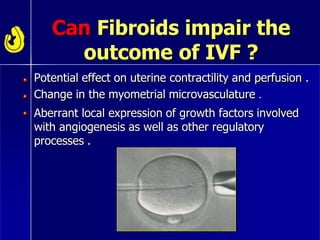
Can Fibroids impair the
outcome of IVF ?
Potential effect on uterine contractility and perfusion .
Change in the myometrial microvasculature .
Aberrant local expression of growth factors involved
with angiogenesis as well as other regulatory
processes .
Submucosal Fibroids
and Fertility
SM Fibroids 5-18% of all Fibroids Cases are
causal factor of infertility .
Low pregnancy and implantation rate in IVF
patients ( Eldar, Geva, et al 1998 )
Pregnancy rate similar to controls following
surgery .
( Narayam, Goswamy 1994
Varasteh et al 1998 )
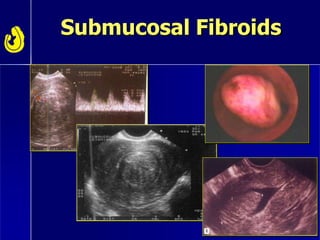
Submucosal Fibroids
Intramural Fibroids
and Fertility
No Effect. ( donnez and Jadoul, 2002. Campo et al, 2003 )
Adverse effect when the cavity is distorted
( Pregnancy rate decreases from 33% to 9 %).
( surrey. 2001 )
Adverse effect even when the cavity is not
distorted.
( Check et al, 2003 )
Adverse effect only when the size exceed 7cm .
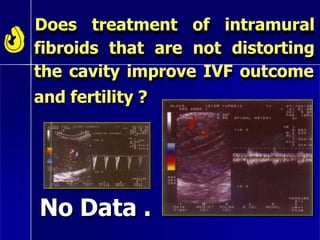
Does treatment of intramural
fibroids that are not distorting
the cavity improve IVF outcome
and fertility ?
No Data .
Subserous Fibroid
and Infertility
No effect.
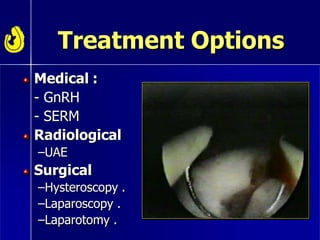
Treatment Options
Medical :
- GnRH
- SERM
Radiological
–UAE
Surgical
–Hysteroscopy .
–Laparoscopy .
–Laparotomy .
Medical Therapy (1)
GnRHa:
– 35-65% reduction in size of fibroid .
– Primarily for pre-operative treatment .
– No significant effect on intra-operative
blood-loss.
– No effect on operating time, degree of
difficulty of the procedure, and
postoperative morbidity
– Current management of fibroids prior
ART does not include GnRHa Treatment .
( vercello et al 2003)
SERM ( raloxifene )
– Low doses (60 mg) for 6 months.
– Maximum effect when used with GnRHa.
– 70% reduction versus 40% for GnRHa alone .
Medical Therapy (2)
(palomba et al, 2002 )
( paloba et al, 2004)
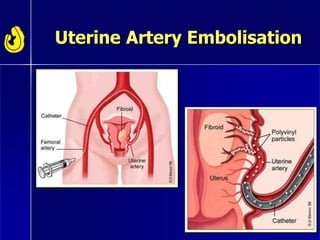
Uterine Artery Embolisation
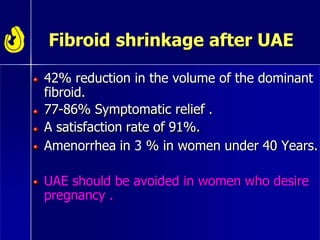
Fibroid shrinkage after UAE
42% reduction in the volume of the dominant
fibroid.
77-86% Symptomatic relief .
A satisfaction rate of 91%.
Amenorrhea in 3 % in women under 40 Years.
UAE should be avoided in women who desire
pregnancy .
Introduction of UAE
Into
clinical practice is
A missed opportunity ??
In the Patient Desiring
Future pregnancy,
The current treatment
Standard for Uterine
fibroids is surgical .
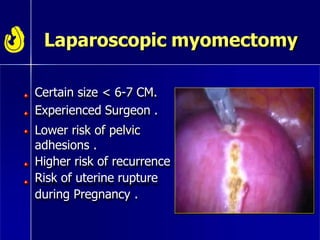
Laparoscopic myomectomy
Certain size < 6-7 CM.
Experienced Surgeon .
Lower risk of pelvic
adhesions .
Higher risk of recurrence
Risk of uterine rupture
during Pregnancy .
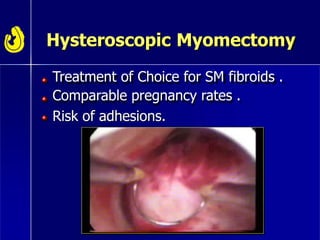
Hysteroscopic Myomectomy
Treatment of Choice for SM fibroids .
Comparable pregnancy rates .
Risk of adhesions.
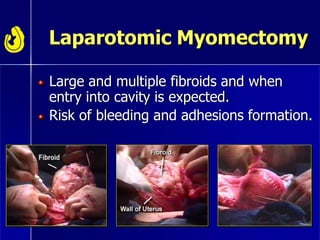
Laparotomic Myomectomy
Large and multiple fibroids and when
entry into cavity is expected.
Risk of bleeding and adhesions formation.
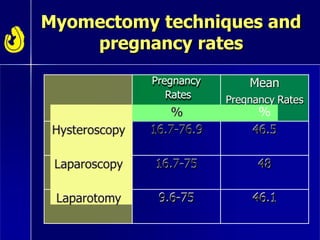
Myomectomy techniques and
pregnancy rates
Mean
Pregnancy Rates
Pregnancy
Rates
% %
Hysteroscopy 16.7-76.9 46.5
Laparoscopy 16.7-75 48
Laparotomy 9.6-75 46.1
Does Myomectomy Has
Risk ???
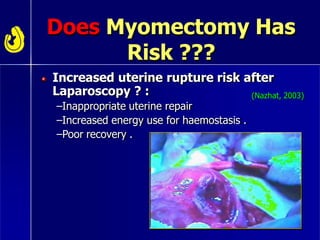
Increased uterine rupture risk after
Laparoscopy ? :
–Inappropriate uterine repair
–Increased energy use for haemostasis .
–Poor recovery .
(Nazhat, 2003)
Does Myomectomy Has
Risk ???
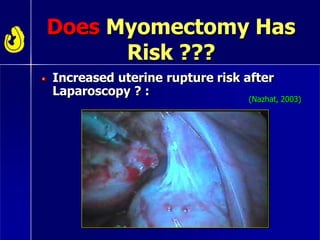
Increased uterine rupture risk after
Laparoscopy ? :
(Nazhat, 2003)
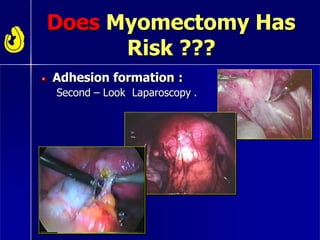
Adhesion formation :
Second – Look Laparoscopy .
Does Myomectomy Has
Risk ???
Does Myomectomy Has
Risk ???
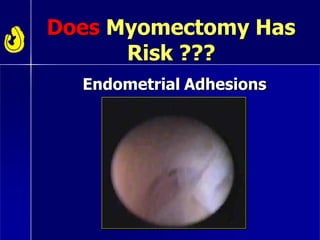
Endometrial Adhesions
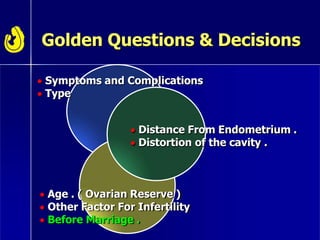
Golden Questions & Decisions
 Symptoms and Complications
 Type
 Distance From Endometrium .
 Distortion of the cavity .
 Age . ( Ovarian Reserve )
 Other Factor For Infertility
 Before Marriage .
There may be “ circumstantial evidence ”
but the case for fibroids causing infertility
remains to be established
Absence of evidence is not
Evidence of absence
Danger of misinterpreting differences that
do not reach significance .
For such a common tumors with
significant health and cost implications, it
is truly remarkable that virtually nothing is
known about its causation, there is little
evidence has to individualize and optimize
treatment and the understanding of
clinical outcomes following treatment is so
rudimentary . ( manyondo et al, 2004)
S. AL SAMAWI
A. TAHA
M. ABDUL WAHED
R. NAGEM
Z. IDLBI
N. ABO HASSAN
F. ABO HASSAN
W. DAWOOD
N. ASSAF
F. HAMAD
A. ALKHATEB
R. ALKHATEB
MD. Gyn. Obs.
MD. Gyn. Obs.
MD. Gyn. Obs.
MD. Gyn. Obs.
Senior Biologist
Androlgist
Androlgist
Biologist
Biologist
Administration Manager
M.D Micro Biologist
MD. Gyn. Obs. Ph. D.
Acknowledgement
Thank You

uterinefibroids-180412190811.pptx

  • 1.
    Uterine Fibroids (Myomas) &infertility Dr. Marwan Alhalabi Assistant Professor in Faculty of medicine Damascus University And Orient Hospital assisted Reproduction center Damascus – Syria
  • 2.
    Epidemiology of Fibroiods Fibroidsare common in Reproductive age 20-30% Incidence of fibroids in infertile women 1-2.4% 140.000 Hysterectomies and 37.000 myomectomies are performed annually (U.S.A)
  • 3.
    Clinical Presentation Asymptomatic . Symptoms:related to location, size, number. Excessive menstrual loss. Pain. Infertility: especially with Submucous Fibroids. Pregnancy Complication Urinary changes
  • 4.
    Can Fibroids CauseInfertility ?
  • 5.
    Mechanism of reducedfertility associated with Fibroids Hindered gamete transportation . Obstruction of tubal Ostia and endocervix. Induced Uterine Contraction (Prostaglandine). Implantation Failure – Endometrial changes ( atrophy, ulceration, focal hyperplasia and polyps) – Vascular alteration ( Venous congestion,…. ) . – EGF, TGF, IGF. Complications.
  • 6.
    Complications of Fibroids SpontaneousAbortion. Premature Labour. Ectopic Pregnancy . I U G R . Abruption of placenta. Malpresentation. Dystocia. Postpartum Hemorrhage
  • 7.
    Observation For Reproductive Dysfunctionwith Fibroids 1 About half of Infertile women with Fibroids becomes pregnant after myomectomy . ( Campo, 2003 ) 43% of women with fibroids who presented in labour, had at least 2 years history of infertility ( Hasan et al 1990 )
  • 8.
    Observation for Reproductive Dysfunctionwith Fibroids 2 Fibroids are associated with a high rate of overall pregnancy loss (60%) Myomectomy halves the risk of spontaneous miscarriage . Surgery reduces first and second trimester loss. ( buttram & Reiter, Li et al 1999 )
  • 9.
    Diagnosis of Fibroids(1) Ultrasonography
  • 10.
    Diagnosis of Fibroids(2) Contrast Hysterosonogrphy
  • 11.
  • 12.
  • 13.
    Diagnosis of Fibroids(5) Hysteroscopy
  • 14.
    Prognostic Factors andFibroids (1) Multi factorial infertility . Age > 35 . Submucous and intramural fibroids . Number of fibroids  5 Volume of fibroids < 100 ml. Size of fibroids > 5 cm > 8 cm
  • 15.
    >2 first trimesterpregnancy loss . Location of intramural myomas ( Posterior ). Presence of menorrhagia. Duration of infertility( > 3 years ) Unexplained infertility. Prognostic Factors and Fibroids (2)
  • 16.
    Can Fibroids impairthe outcome of IVF ? Potential effect on uterine contractility and perfusion . Change in the myometrial microvasculature . Aberrant local expression of growth factors involved with angiogenesis as well as other regulatory processes .
  • 17.
    Submucosal Fibroids and Fertility SMFibroids 5-18% of all Fibroids Cases are causal factor of infertility . Low pregnancy and implantation rate in IVF patients ( Eldar, Geva, et al 1998 ) Pregnancy rate similar to controls following surgery . ( Narayam, Goswamy 1994 Varasteh et al 1998 )
  • 18.
  • 19.
    Intramural Fibroids and Fertility NoEffect. ( donnez and Jadoul, 2002. Campo et al, 2003 ) Adverse effect when the cavity is distorted ( Pregnancy rate decreases from 33% to 9 %). ( surrey. 2001 ) Adverse effect even when the cavity is not distorted. ( Check et al, 2003 ) Adverse effect only when the size exceed 7cm .
  • 20.
    Does treatment ofintramural fibroids that are not distorting the cavity improve IVF outcome and fertility ? No Data .
  • 21.
  • 22.
    Treatment Options Medical : -GnRH - SERM Radiological –UAE Surgical –Hysteroscopy . –Laparoscopy . –Laparotomy .
  • 23.
    Medical Therapy (1) GnRHa: –35-65% reduction in size of fibroid . – Primarily for pre-operative treatment . – No significant effect on intra-operative blood-loss. – No effect on operating time, degree of difficulty of the procedure, and postoperative morbidity – Current management of fibroids prior ART does not include GnRHa Treatment . ( vercello et al 2003)
  • 24.
    SERM ( raloxifene) – Low doses (60 mg) for 6 months. – Maximum effect when used with GnRHa. – 70% reduction versus 40% for GnRHa alone . Medical Therapy (2) (palomba et al, 2002 ) ( paloba et al, 2004)
  • 25.
  • 26.
    Fibroid shrinkage afterUAE 42% reduction in the volume of the dominant fibroid. 77-86% Symptomatic relief . A satisfaction rate of 91%. Amenorrhea in 3 % in women under 40 Years. UAE should be avoided in women who desire pregnancy .
  • 27.
    Introduction of UAE Into clinicalpractice is A missed opportunity ??
  • 28.
    In the PatientDesiring Future pregnancy, The current treatment Standard for Uterine fibroids is surgical .
  • 29.
    Laparoscopic myomectomy Certain size< 6-7 CM. Experienced Surgeon . Lower risk of pelvic adhesions . Higher risk of recurrence Risk of uterine rupture during Pregnancy .
  • 30.
    Hysteroscopic Myomectomy Treatment ofChoice for SM fibroids . Comparable pregnancy rates . Risk of adhesions.
  • 31.
    Laparotomic Myomectomy Large andmultiple fibroids and when entry into cavity is expected. Risk of bleeding and adhesions formation.
  • 32.
    Myomectomy techniques and pregnancyrates Mean Pregnancy Rates Pregnancy Rates % % Hysteroscopy 16.7-76.9 46.5 Laparoscopy 16.7-75 48 Laparotomy 9.6-75 46.1
  • 33.
    Does Myomectomy Has Risk??? Increased uterine rupture risk after Laparoscopy ? : –Inappropriate uterine repair –Increased energy use for haemostasis . –Poor recovery . (Nazhat, 2003)
  • 34.
    Does Myomectomy Has Risk??? Increased uterine rupture risk after Laparoscopy ? : (Nazhat, 2003)
  • 35.
    Adhesion formation : Second– Look Laparoscopy . Does Myomectomy Has Risk ???
  • 36.
    Does Myomectomy Has Risk??? Endometrial Adhesions
  • 37.
    Golden Questions &Decisions  Symptoms and Complications  Type  Distance From Endometrium .  Distortion of the cavity .  Age . ( Ovarian Reserve )  Other Factor For Infertility  Before Marriage .
  • 38.
    There may be“ circumstantial evidence ” but the case for fibroids causing infertility remains to be established Absence of evidence is not Evidence of absence Danger of misinterpreting differences that do not reach significance .
  • 39.
    For such acommon tumors with significant health and cost implications, it is truly remarkable that virtually nothing is known about its causation, there is little evidence has to individualize and optimize treatment and the understanding of clinical outcomes following treatment is so rudimentary . ( manyondo et al, 2004)
  • 40.
    S. AL SAMAWI A.TAHA M. ABDUL WAHED R. NAGEM Z. IDLBI N. ABO HASSAN F. ABO HASSAN W. DAWOOD N. ASSAF F. HAMAD A. ALKHATEB R. ALKHATEB MD. Gyn. Obs. MD. Gyn. Obs. MD. Gyn. Obs. MD. Gyn. Obs. Senior Biologist Androlgist Androlgist Biologist Biologist Administration Manager M.D Micro Biologist MD. Gyn. Obs. Ph. D. Acknowledgement
  • 41.