Fluorescein angiography (FA) allows study of the circulation of the retina and choroid in
normal and diseased states. Photographs of the retina are taken after intravenous injection
of sodium fluorescein.
Properties
1. orange-red crystalline hydrocarbon with a molecular weight of 376 daltons
2. diffuses through most of the body flu ids.
3. available as 2- 3 mL of25% concentration or 5 mL of 10% concentration in a sterile
aqueous solution.
4. It is eliminated primarily through the liver and kidneys within 24-36 hours via the urine.
5. Eighty percent of the fluorescein is protein-bound, primarily to albumin, and not
available for fluorescence; the remaining 20% is unbound and circulates in the vasculature
and tissues of the retina and choroid, where it can be visualized.
Fluorescence
- when a molecule is excited by light of a certain wavelength that raises the molecule to a
higher energy state and then allows it to release a photon of light to bring it back to its
original state.
- To image this fluorescence, special excitation and barrier filters are required.
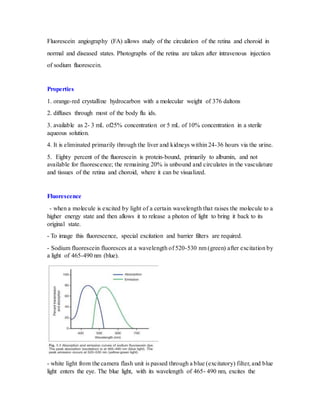
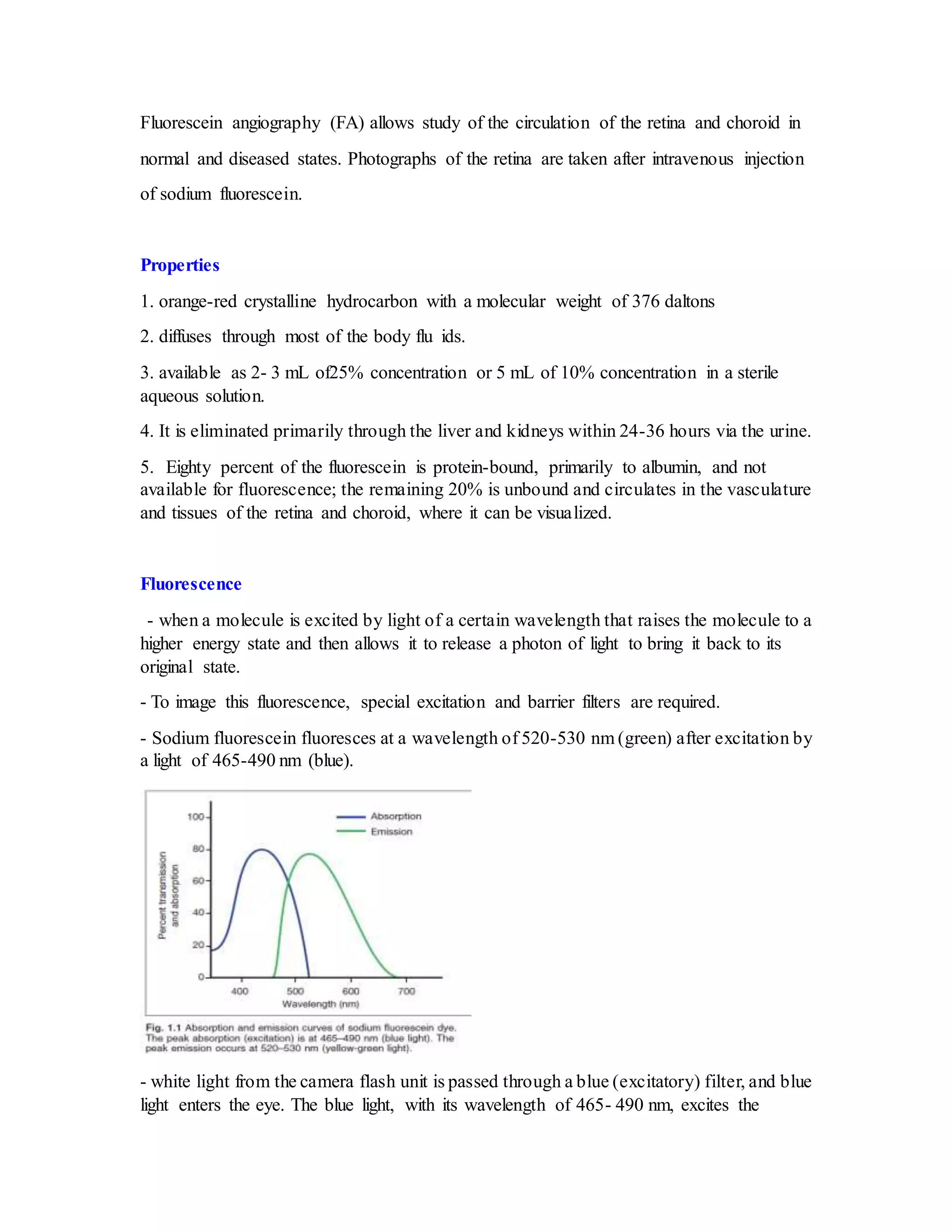
- Sodium fluorescein fluoresces at a wavelength of 520-530 nm (green) after excitation by
a light of 465-490 nm (blue).
- white light from the camera flash unit is passed through a blue (excitatory) filter, and blue
light enters the eye. The blue light, with its wavelength of 465- 490 nm, excites the
unbound fluorescein molecules circulating in the retinal and choroidal layers or that have
leaked out of the vasculature and stimulates them to emit a longer-wavelength
yellow-green light (520-530 nm).
- Both the emitted yellow-green fluorescence and some degree of reflected blue light
from structures that do not contain fluorescein exit the eye and return to the camera.
- A yellow-green (barrier) filter on the camera lens blocks the reflected blue light,
permitting only the yellow-green light, which has originated from the fluorescein
molecules, into the camera.
- The image formed by the emitted fluorescence is recorded on either black-andwhite,
high-contrast 35-mm film, videotape, or a digital camera.
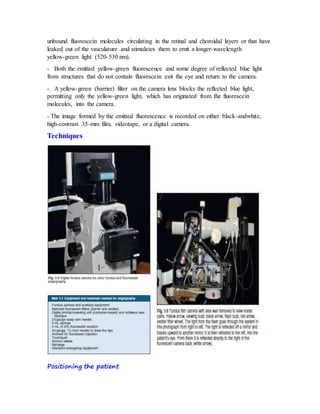
Techniques
Positioning the patient
Before the patient is seated at the camera, the photographer makes sure that the front lens is
free of any dirt or dust. The lens should always be covered by a lens cap when the camera is not
in use. The front of the lens should be kept clean using chloroform and a tightly rolled rod of
lens tissue. To clean the lens, begin at the center and rotate out to the periphery.
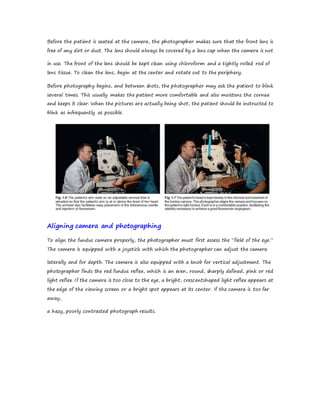
Before photography begins, and between shots, the photographer may ask the patient to blink
several times. This usually makes the patient more comfortable and also moistens the cornea
and keeps it clear. When the pictures are actually being shot, the patient should be instructed to
blink as infrequently as possible.
Aligning camera and photographing
To align the fundus camera properly, the photographer must first assess the “field of the eye.”
The camera is equipped with a joystick with which the photographer can adjust the camera
laterally and for depth. The camera is also equipped with a knob for vertical adjustment. The
photographer finds the red fundus reflex, which is an even, round, sharply defined, pink or red
light reflex. If the camera is too close to the eye, a bright, crescentshaped light reflex appears at
the edge of the viewing screen or a bright spot appears at its center. If the camera is too far
away,
a hazy, poorly contrasted photograph results.
Injecting the fluorescein
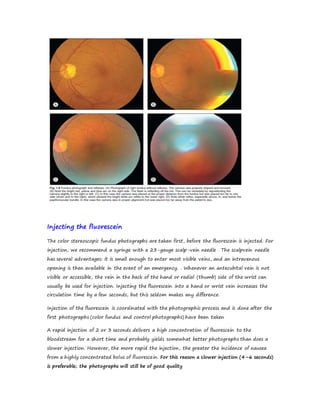
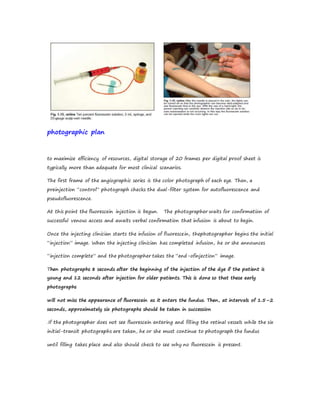
The color stereoscopic fundus photographs are taken first, before the fluorescein is injected. For
injection, we recommend a syringe with a 23-gauge scalp-vein needle . The scalpvein needle
has several advantages: it is small enough to enter most visible veins, and an intravenous
opening is then available in the event of an emergency. . Whenever an antecubital vein is not
visible or accessible, the vein in the back of the hand or radial (thumb) side of the wrist can
usually be used for injection. Injecting the fluorescein into a hand or wrist vein increases the
circulation time by a few seconds, but this seldom makes any difference.
Injection of the fluorescein is coordinated with the photographic process and is done after the
first photographs (color fundus and control photographs) have been taken
A rapid injection of 2 or 3 seconds delivers a high concentration of fluorescein to the
bloodstream for a short time and probably yields somewhat better photographs than does a
slower injection. However, the more rapid the injection, the greater the incidence of nausea
from a highly concentrated bolus of fluorescein. For this reason a slower injection (4–6 seconds)
is preferable; the photographs will still be of good quality
photographic plan
to maximize efficiency of resources, digital storage of 20 frames per digital proof sheet is
typically more than adequate for most clinical scenarios.
The first frame of the angiographic series is the color photograph of each eye. Then, a
preinjection “control” photograph checks the dual-filter system for autofluorescence and
pseudofluorescence.
At this point the fluorescein injection is begun. The photographer waits for confirmation of
successful venous access and awaits verbal confirmation that infusion is about to begin.
Once the injecting clinician starts the infusion of fluorescein, thephotographer begins the initial
“injection” image. When the injecting clinician has completed infusion, he or she announces
“injection complete” and the photographer takes the “end-ofinjection” image.
Then photographs 8 seconds after the beginning of the injection of the dye if the patient is
young and 12 seconds after injection for older patients. This is done so that these early
photographs
will not miss the appearance of fluorescein as it enters the fundus. Then, at intervals of 1.5–2
seconds, approximately six photographs should be taken in succession
.If the photographer does not see fluorescein entering and filling the retinal vessels while the six
initial-transit photographs are taken, he or she must continue to photograph the fundus
until filling takes place and also should check to see why no fluorescein is present.
After the first six initial-transit photographs and approximately 20–30 seconds after
injection, with sufficient fluorescein concentration in the eye, the photographer should take a
photograph
of the fellow eye
Late stage photos at 3min, 5min and 10 min of both eyes taken
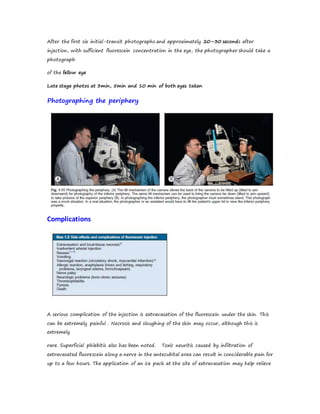
Photographing the periphery
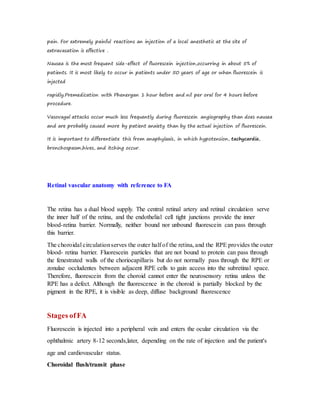
Complications
A serious complication of the injection is extravasation of the fluorescein under the skin. This
can be extremely painful . Necrosis and sloughing of the skin may occur, although this is
extremely
rare. Superficial phlebitis also has been noted. Toxic neuritis caused by infiltration of
extravasated fluorescein along a nerve in the antecubital area can result in considerable pain for
up to a few hours. The application of an ice pack at the site of extravasation may help relieve
pain. For extremely painful reactions an injection of a local anesthetic at the site of
extravasation is effective .
Nausea is the most frequent side-effect of fluorescein injection,occurring in about 5% of
patients. It is most likely to occur in patients under 50 years of age or when fluorescein is
injected
rapidly.Premedication with Phenergan 1 hour before and nil per oral for 4 hours before
procedure.
Vasovagal attacks occur much less frequently during fluorescein angiography than does nausea
and are probably caused more by patient anxiety than by the actual injection of fluorescein.
It is important to differentiate this from anaphylaxis, in which hypotension, tachycardia,
bronchospasm,hives, and itching occur.
Retinal vascular anatomy with reference to FA
The retina has a dual blood supply. The central retinal artery and retinal circulation serve
the inner half of the retina, and the endothelial cell tight junctions provide the inner
blood-retina barrier. Normally, neither bound nor unbound fluorescein can pass through
this barrier.
The choroidal circulationserves the outer half of the retina, and the RPE provides the outer
blood- retina barrier. Fluorescein particles that are not bound to protein can pass through
the fenestrated walls of the choriocapillaris but do not normally pass through the RPE or
zonulae occludentes between adjacent RPE cells to gain access into the subretinal space.
Therefore, fluorescein from the choroid cannot enter the neurosensory retina unless the
RPE has a defect. Although the fluorescence in the choroid is partially blocked by the
pigment in the RPE, it is visible as deep, diffuse background fluorescence
Stages ofFA
Fluorescein is injected into a peripheral vein and enters the ocular circulation via the
ophthalmic artery 8-12 seconds,later, depending on the rate of injection and the patient's
age and cardiovascular status.
Choroidal flush/transit phase
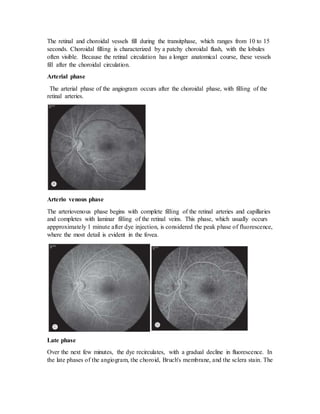
The retinal and choroidal vessels fill during the transitphase, which ranges from 10 to 15
seconds. Choroidal filling is characterized by a patchy choroidal flush, with the lobules
often visible. Because the retinal circulation has a longer anatomical course, these vessels
fill after the choroidal circulation.
Arterial phase
The arterial phase of the angiogram occurs after the choroidal phase, with filling of the
retinal arteries.
Arterio venous phase
The arteriovenous phase begins with complete filling of the retinal arteries and capillaries
and completes with laminar filling of the retinal veins. This phase, which usually occurs
appproximately 1 minute after dye injection, is considered the peak phase of fluorescence,
where the most detail is evident in the fovea.
Late phase
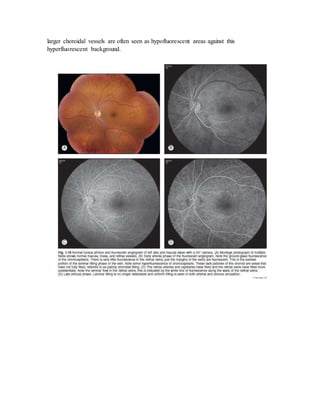
Over the next few minutes, the dye recirculates, with a gradual decline in fluorescence. In
the late phases of the angiogram, the choroid, Bruch's membrane, and the sclera stain. The
larger choroidal vessels are often seen as hypofluorescent areas against this
hyperfluorescent background.
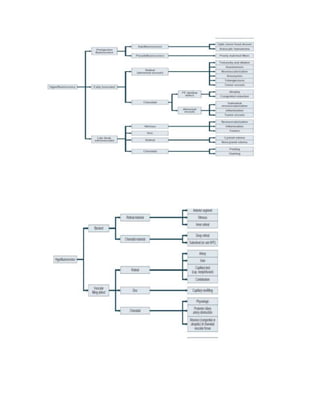
Abnormalities seenwith FA
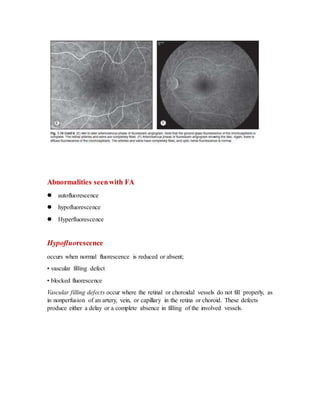
 autofluorescence
 hypofluorescence
 Hyperfluorescence
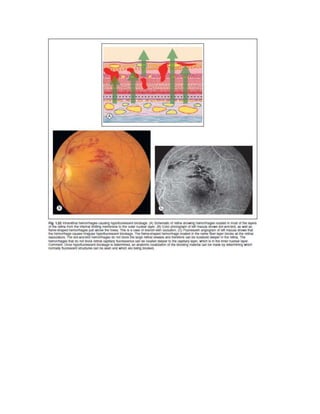
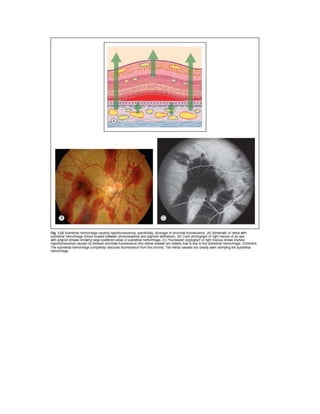
Hypofluorescence
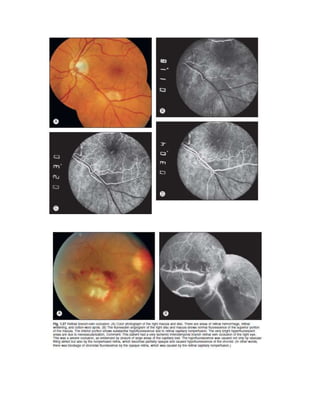
occurs when normal fluorescence is reduced or absent;
• vascular filling defect
• blocked fluorescence
Vascular filling defects occur where the retinal or choroidal vessels do not fill properly, as
in nonperfusion of an artery, vein, or capillary in the retina or choroid. These defects
produce either a delay or a complete absence in filling of the involved vessels.
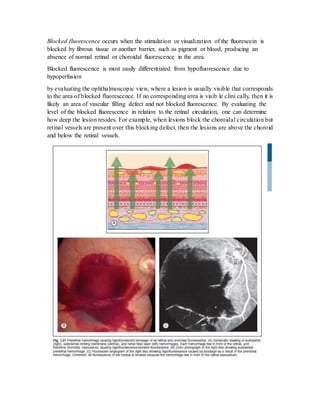
Blocked fluorescence occurs when the stimulation or visualization of the fluorescein is
blocked by fibrous tissue or another barrier, such as pigment or blood, producing an
absence of normal retinal or choroidal fluorescence in the area.
Blocked fluorescence is most easily differentiated from hypofluorescence due to
hypoperfusion
by evaluating the ophthalmoscopic view, where a lesion is usually visible that corresponds
to the area of blocked fluorescence. If no corresponding area is visib le clini cally, then it is
likely an area of vascular filling defect and not blocked fluorescence. By evaluating the
level of the blocked fluorescence in relation to the retinal circulation, one can determine
how deep the lesion resides. For example, when lesions block the choroidal circulation but
retinal vessels are present over this blocking defect, then the lesions are above the choroid
and below the retinal vessels.
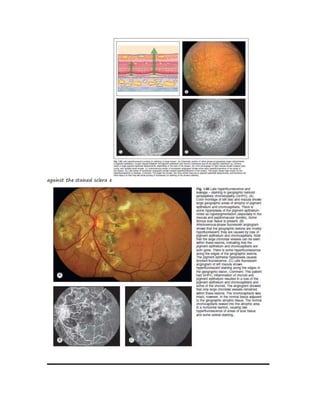
Hyperfluorescence
Hyperfluorescence is any abnormally light area on the positive print of an angiogram, that is,
an area showing fluorescence in excess of what would be expected on a normal angiogram.
There are four possible causes of abnormal hyperfluorescence:
(1) preinjection fluorescence;
(2) transmitted fluorescence;
(3) Abnormal vessels; and
(4) leakage.
Preinjection fluorescence
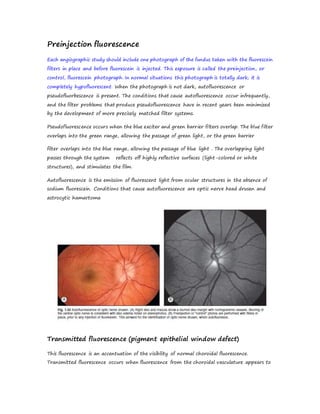
Each angiographic study should include one photograph of the fundus taken with the fluorescein
filters in place and before fluorescein is injected. This exposure is called the preinjection, or
control, fluorescein photograph. In normal situations this photograph is totally dark; it is
completely hypofluorescent. When the photograph is not dark, autofluorescence or
pseudofluorbescence is present. The conditions that cause autofluorescence occur infrequently,
and the filter problems that produce pseudofluorescence have in recent years been minimized
by the development of more precisely matched filter systems.
Pseudofluorescence occurs when the blue exciter and green barrier filters overlap. The blue filter
overlaps into the green range, allowing the passage of green light, or the green barrier
filter overlaps into the blue range, allowing the passage of blue light . The overlapping light
passes through the system reflects off highly reflective surfaces (light-colored or white
structures), and stimulates the film.
Autofluorescence is the emission of fluorescent light from ocular structures in the absence of
sodium fluorescein. Conditions that cause autofluorescence are optic nerve head drusen and
astrocytic hamartoma
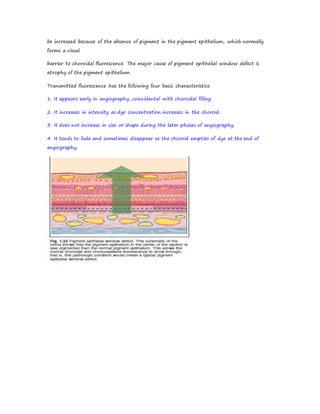
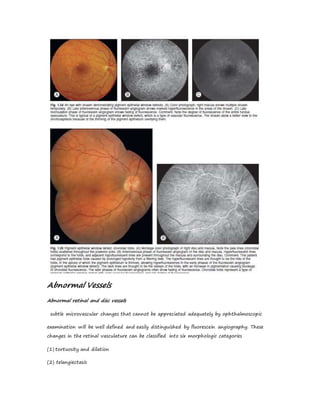
Transmitted fluorescence (pigment epithelial window defect)
This fluorescence is an accentuation of the visibility of normal choroidal fluorescence.
Transmitted fluorescence occurs when fluorescence from the choroidal vasculature appears to
be increased because of the absence of pigment in the pigment epithelium, which normally
forms a visual
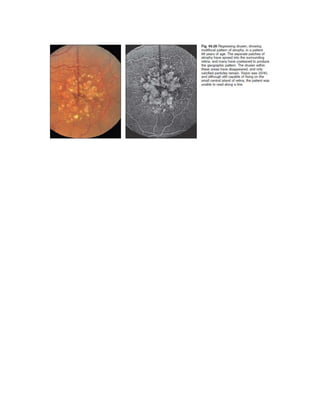
barrier to choroidal fluorescence. The major cause of pigment epithelial window defect is
atrophy of the pigment epithelium
Transmitted fluorescence has the following four basic characteristics:
1. It appears early in angiography, coincidental with choroidal filling.
2. It increases in intensity as dye concentration increases in the choroid.
3. It does not increase in size or shape during the later phases of angiography.
4. It tends to fade and sometimes disappear as the choroid empties of dye at the end of
angiography.
Abnormal Vessels
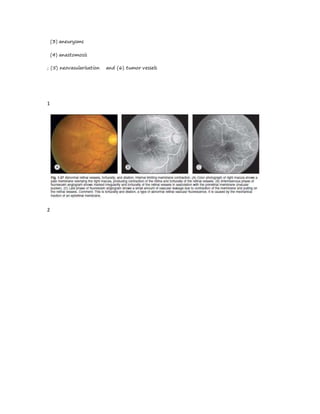
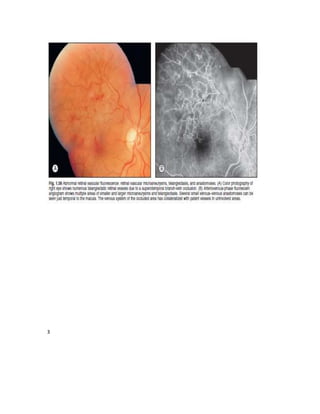
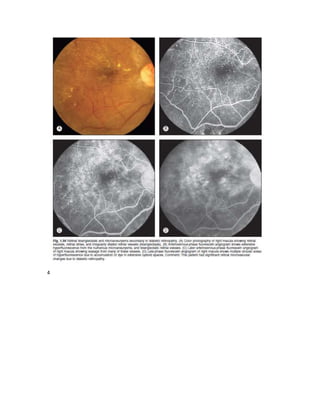
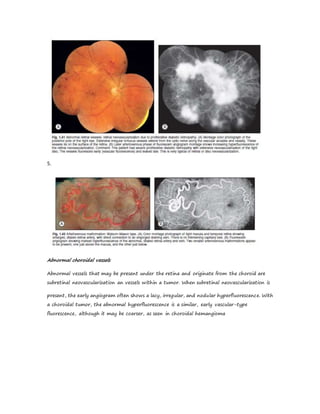
Abnormal retinal and disc vessels
subtle microvascular changes that cannot be appreciated adequately by ophthalmoscopic
examination will be well defined and easily distinguished by fluorescein angiography. These
changes in the retinal vasculature can be classified into six morphologic categories
(1) tortuosity and dilation
(2) telangiectasis
(3) aneurysms
(4) anastomosis
; (5) neovasularisation and (6) tumor vessels
1
2
3
4
5.
Abnormal choroidal vessels
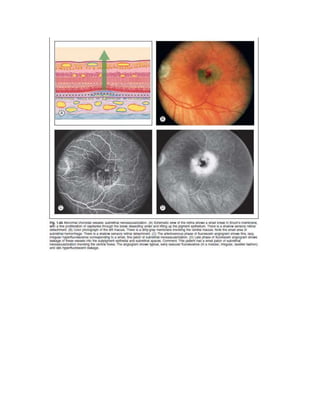
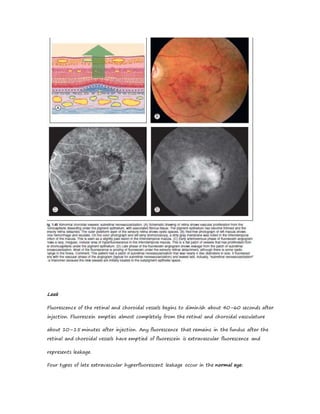
Abnormal vessels that may be present under the retina and originate from the choroid are
subretinal neovascularization an vessels within a tumor. When subretinal neovascularization is
present, the early angiogram often shows a lacy, irregular, and nodular hyperfluorescence. With
a choroidal tumor, the abnormal hyperfluorescence is a similar, early vascular-type
fluorescence, although it may be coarser, as seen in choroidal hemangioma
Leak
Fluorescence of the retinal and choroidal vessels begins to diminish about 40–60 seconds after
injection. Fluorescein empties almost completely from the retinal and choroidal vasculature
about 10–15 minutes after injection. Any fluorescence that remains in the fundus after the
retinal and choroidal vessels have emptied of fluorescein is extravascular fluorescence and
represents leakage.
Four types of late extravascular hyperfluorescent leakage occur in the normal eye:
(1) fluorescence of the disc margins from the surrounding choriocapillaris;
(2) fluorescence of the lamina cribrosa;
(3) fluorescence of the sclera at the disc margin if the retinal pigment epithelium terminates
away from the disc, as in an optic crescent; and
(4) fluorescence of the sclera when the pigment epithelium is lightly pigmented.
These are the only forms of late hyperfluorescence or leakage that can be considered as normal
considered “normal.”
Either or both of the two vascular systems of the fundus can produce abnormal late
hyperfluorescence (leakage) if defects are present in their respective barriers to fluorescein. The
barrier to fluorescein leakage from the retinal vessels is the retinal vascular endothelium. The
barrier to leakage from the choroidal circulation is the pigment epithelium.
1. An abnormality of the retinal vascular endothelium can result in permeability to fluorescein
and leakage of fluorescein into the retinal tissue.
2. Similarly, an abnormality of the pigment epithelium can result in permeability to
fluorescein, and fluorescein will leak from the choroidal tissue through the pigment epithelium.
3.There are two other types of late abnormal fluorescence: one occurs when fluorescein enters
the vitreous, and the other when fluorescein leaks into the optic nerve head.
Vitreous leak
Leakage of fluorescein into the vitreous creates a diffuse, white haze in the late phase of the
fluorescein angiogram. It can be generalized and evenly dispersed, or localized.
Leakage of fluorescein into the vitreous is due to three major causes:
(l) neovascularization growing from the retinal vessels on to the surface of the retina or disc or
into the vitreous cavity;
(2) intraocular inflammation; and
(3) Intraocular tumors.
Vitreous hyperfluorescence secondary to retinal neovascularization is usually localized and
appears as a cotton-ball type of fluorescence surrounding the neovascularization
The vitreous fluorescence secondary to intraocular inflammation is often generalized, giving a
diffuse, white haze to the vitreous because of generalized leakage of fluorescein from the iris and
ciliary body.
The vitreous fluorescence secondary to tumors is most often localized over the tumor.
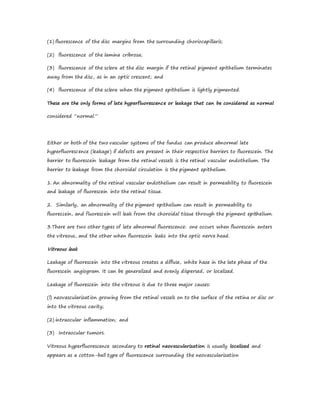
Disc leak
The optic nerve head normally has some fluorescein leakage (late hyperfluorescence) as a result
of staining of the laminacribrosa and the surrounding margins of the disc (from the normally
leaking peripapillary choriocapillaries). The difference between normal and abnormal leakage at
the disc may be subtle.
Papilledema and optic disc edema
In the early phases of the angiogram, dilation of the capillaries on the optic nerve head may be
seen; in the late angiogram, the dilated vessels leak, resulting in a fuzzy fluorescence of the disc
margin.
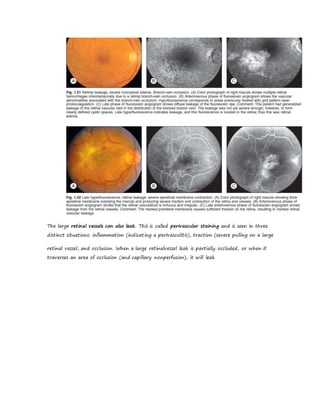
Retinal leak
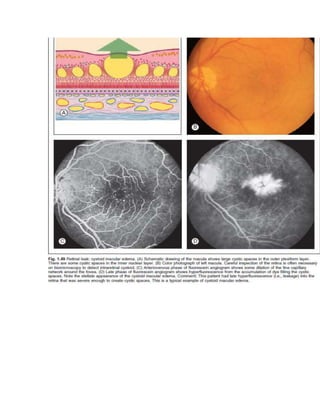
In the late stages of the normal angiogram, the retinal vessels have emptied of fluorescein and
the retina is dark. Any late retinal hyperfluorescence is abnormal and indicates leakage of
retinal vessels.
When the leakage is severe, the extracellular fluid may flow into cystic pockets, and the
angiogram shows fluorescence of the cystic spaces. Fluorescein flows out of the patent
retinal vessels to lie in pools in the cystoid spaces or stains the edematous (noncystic) retinal
tissue. Cystoid retinal edema is apparent as the fluorescein pools in small loculated pockets. In
the macula, cystoid edema takes on a stellate appearance ; elsewhere in the retina, it has a
honeycombed appearance.
When leakage is not pronounced, the cystoid spaces fill slowly and become visible only late in
angiography. When this occurs, the area of cystoid retinal edema may be somewhat
hypofluorescent early in the angiogram because the fluid in these spaces acts as a barrier and
blocks the underlying choroidal fluorescence. When there is heavy fluorescein leakage, the
cystoid spaces fill rapidly, in some cases within a minute after injection.
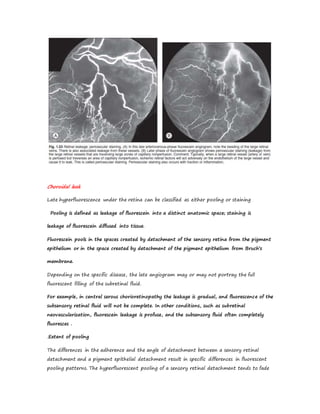
The large retinal vessels can also leak. This is called perivascular staining and is seen in three
distinct situations: inflammation (indicating a perivasculitis), traction (severe pulling on a large
retinal vessel, and occlusion. When a large retinalvessel leak is partially occluded, or when it
traverses an area of occlusion (and capillary nonperfusion), it will leak
Choroidal leak
Late hyperfluorescence under the retina can be classified as either pooling or staining
Pooling is defined as leakage of fluorescein into a distinct anatomic space; staining is
leakage of fluorescein diffused into tissue.
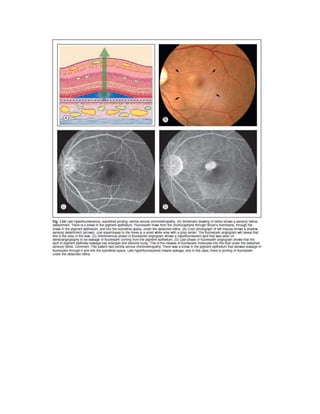
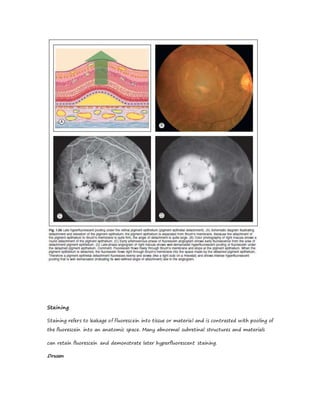
Fluorescein pools in the spaces created by detachment of the sensory retina from the pigment
epithelium or in the space created by detachment of the pigment epithelium from Bruch’s
membrane.
Depending on the specific disease, the late angiogram may or may not portray the full
fluorescent filling of the subretinal fluid.
For example, in central serous chorioretinopathy the leakage is gradual, and fluorescence of the
subsensory retinal fluid will not be complete. In other conditions, such as subretinal
neovascularization, fluorescein leakage is profuse, and the subsensory fluid often completely
fluoresces .
.Extent of pooling
The differences in the adherence and the angle of detachment between a sensory retinal
detachment and a pigment epithelial detachment result in specific differences in fluorescent
pooling patterns. The hyperfluorescent pooling of a sensory retinal detachment tends to fade
gradually toward the site where the sensory retina is attached. This makes fluorescein
angiographic determination of the extent of a sensory retinal detachment difficult.
In contrast, the hyperfluorescent pooling under a pigment epithelial detachment extends to the
edges of the detachment, making the entire detachment and its margins hyperfluorescent
and clearly discernible.
Speed of filling the pooled space
Pooling of fluorescein under a sensory retinal detachment in central serous retinopathy takes
place slowly, since the dye passes through one or more points of leakage in the defective
pigment epithelium . When leakage comes from subretinal neovascularization or a tumor , it is
more rapid and complete. When the pigment epithelium is detached from Bruch’s membrane,
fluorescein passes freely and rapidly through Bruch’s membrane from the choriocapillaris
into the subpigment epithelial space.
In some cases of central serous chorioretinopathy, there is an associated pigment epithelial
detachment, and pooling under each (sensory retinal detachment and the pigment epithelial
detachment) is evident.
Staining
Staining refers to leakage of fluorescein into tissue or material and is contrasted with pooling of
the fluorescein into an anatomic space. Many abnormal subretinal structures and materials
can retain fluorescein and demonstrate later hyperfluorescent staining.
Drusen
Most drusen hyperfluoresce early in the angiogram because choroidal fluorescence is
transmitted through defects in the pigment epithelium overlying the drusen . Fluorescence from
most small drusen diminishes as the dye leaves the choroidal circulation.
However, some larger drusen display later hyperfluorescence or staining . The larger the drusen,
the more likely they will retain fluorescein and staining will occur..
Scar
Scar tissue retains fluorescein and usually demonstrates well demarcated hyperfluorescence
because little, if any, fluid surrounds the scar. The most commonly seen scar tissue is the
disciform scar, which is the endstage of subretinal neovascularization. Scarring is also
seen following numerous other insults to the pigment epithelium and choroid, especially
inflammation
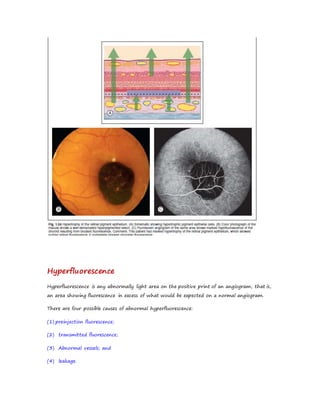
Sclera
In several situations the sclera is visible ophthalmoscopically and exhibits late hyperfluorescent
staining on fluorescein angiography.
Scleral staining is best seen when the retinal pigment epithelium is very pale (as in a blonde
patient) or when or in myopia, the choriocapillaris is usually sufficient to stain the sclera
completely. After the choroidal vessels have emptied of fluorescein in the later phases of
angiography, the large hypofluorescent choroidal vessels appear as dark lines in silhouette
against the stained sclera e
Ffa aios

Ffa aios

  • 1.
    Fluorescein angiography (FA)allows study of the circulation of the retina and choroid in normal and diseased states. Photographs of the retina are taken after intravenous injection of sodium fluorescein. Properties 1. orange-red crystalline hydrocarbon with a molecular weight of 376 daltons 2. diffuses through most of the body flu ids. 3. available as 2- 3 mL of25% concentration or 5 mL of 10% concentration in a sterile aqueous solution. 4. It is eliminated primarily through the liver and kidneys within 24-36 hours via the urine. 5. Eighty percent of the fluorescein is protein-bound, primarily to albumin, and not available for fluorescence; the remaining 20% is unbound and circulates in the vasculature and tissues of the retina and choroid, where it can be visualized. Fluorescence - when a molecule is excited by light of a certain wavelength that raises the molecule to a higher energy state and then allows it to release a photon of light to bring it back to its original state. - To image this fluorescence, special excitation and barrier filters are required. - Sodium fluorescein fluoresces at a wavelength of 520-530 nm (green) after excitation by a light of 465-490 nm (blue). - white light from the camera flash unit is passed through a blue (excitatory) filter, and blue light enters the eye. The blue light, with its wavelength of 465- 490 nm, excites the
  • 2.
    unbound fluorescein moleculescirculating in the retinal and choroidal layers or that have leaked out of the vasculature and stimulates them to emit a longer-wavelength yellow-green light (520-530 nm). - Both the emitted yellow-green fluorescence and some degree of reflected blue light from structures that do not contain fluorescein exit the eye and return to the camera. - A yellow-green (barrier) filter on the camera lens blocks the reflected blue light, permitting only the yellow-green light, which has originated from the fluorescein molecules, into the camera. - The image formed by the emitted fluorescence is recorded on either black-andwhite, high-contrast 35-mm film, videotape, or a digital camera. Techniques Positioning the patient
  • 3.
    Before the patientis seated at the camera, the photographer makes sure that the front lens is free of any dirt or dust. The lens should always be covered by a lens cap when the camera is not in use. The front of the lens should be kept clean using chloroform and a tightly rolled rod of lens tissue. To clean the lens, begin at the center and rotate out to the periphery. Before photography begins, and between shots, the photographer may ask the patient to blink several times. This usually makes the patient more comfortable and also moistens the cornea and keeps it clear. When the pictures are actually being shot, the patient should be instructed to blink as infrequently as possible. Aligning camera and photographing To align the fundus camera properly, the photographer must first assess the “field of the eye.” The camera is equipped with a joystick with which the photographer can adjust the camera laterally and for depth. The camera is also equipped with a knob for vertical adjustment. The photographer finds the red fundus reflex, which is an even, round, sharply defined, pink or red light reflex. If the camera is too close to the eye, a bright, crescentshaped light reflex appears at the edge of the viewing screen or a bright spot appears at its center. If the camera is too far away, a hazy, poorly contrasted photograph results.
  • 4.
    Injecting the fluorescein Thecolor stereoscopic fundus photographs are taken first, before the fluorescein is injected. For injection, we recommend a syringe with a 23-gauge scalp-vein needle . The scalpvein needle has several advantages: it is small enough to enter most visible veins, and an intravenous opening is then available in the event of an emergency. . Whenever an antecubital vein is not visible or accessible, the vein in the back of the hand or radial (thumb) side of the wrist can usually be used for injection. Injecting the fluorescein into a hand or wrist vein increases the circulation time by a few seconds, but this seldom makes any difference. Injection of the fluorescein is coordinated with the photographic process and is done after the first photographs (color fundus and control photographs) have been taken A rapid injection of 2 or 3 seconds delivers a high concentration of fluorescein to the bloodstream for a short time and probably yields somewhat better photographs than does a slower injection. However, the more rapid the injection, the greater the incidence of nausea from a highly concentrated bolus of fluorescein. For this reason a slower injection (4–6 seconds) is preferable; the photographs will still be of good quality
  • 5.
    photographic plan to maximizeefficiency of resources, digital storage of 20 frames per digital proof sheet is typically more than adequate for most clinical scenarios. The first frame of the angiographic series is the color photograph of each eye. Then, a preinjection “control” photograph checks the dual-filter system for autofluorescence and pseudofluorescence. At this point the fluorescein injection is begun. The photographer waits for confirmation of successful venous access and awaits verbal confirmation that infusion is about to begin. Once the injecting clinician starts the infusion of fluorescein, thephotographer begins the initial “injection” image. When the injecting clinician has completed infusion, he or she announces “injection complete” and the photographer takes the “end-ofinjection” image. Then photographs 8 seconds after the beginning of the injection of the dye if the patient is young and 12 seconds after injection for older patients. This is done so that these early photographs will not miss the appearance of fluorescein as it enters the fundus. Then, at intervals of 1.5–2 seconds, approximately six photographs should be taken in succession .If the photographer does not see fluorescein entering and filling the retinal vessels while the six initial-transit photographs are taken, he or she must continue to photograph the fundus until filling takes place and also should check to see why no fluorescein is present.
  • 6.
    After the firstsix initial-transit photographs and approximately 20–30 seconds after injection, with sufficient fluorescein concentration in the eye, the photographer should take a photograph of the fellow eye Late stage photos at 3min, 5min and 10 min of both eyes taken Photographing the periphery Complications A serious complication of the injection is extravasation of the fluorescein under the skin. This can be extremely painful . Necrosis and sloughing of the skin may occur, although this is extremely rare. Superficial phlebitis also has been noted. Toxic neuritis caused by infiltration of extravasated fluorescein along a nerve in the antecubital area can result in considerable pain for up to a few hours. The application of an ice pack at the site of extravasation may help relieve
  • 7.
    pain. For extremelypainful reactions an injection of a local anesthetic at the site of extravasation is effective . Nausea is the most frequent side-effect of fluorescein injection,occurring in about 5% of patients. It is most likely to occur in patients under 50 years of age or when fluorescein is injected rapidly.Premedication with Phenergan 1 hour before and nil per oral for 4 hours before procedure. Vasovagal attacks occur much less frequently during fluorescein angiography than does nausea and are probably caused more by patient anxiety than by the actual injection of fluorescein. It is important to differentiate this from anaphylaxis, in which hypotension, tachycardia, bronchospasm,hives, and itching occur. Retinal vascular anatomy with reference to FA The retina has a dual blood supply. The central retinal artery and retinal circulation serve the inner half of the retina, and the endothelial cell tight junctions provide the inner blood-retina barrier. Normally, neither bound nor unbound fluorescein can pass through this barrier. The choroidal circulationserves the outer half of the retina, and the RPE provides the outer blood- retina barrier. Fluorescein particles that are not bound to protein can pass through the fenestrated walls of the choriocapillaris but do not normally pass through the RPE or zonulae occludentes between adjacent RPE cells to gain access into the subretinal space. Therefore, fluorescein from the choroid cannot enter the neurosensory retina unless the RPE has a defect. Although the fluorescence in the choroid is partially blocked by the pigment in the RPE, it is visible as deep, diffuse background fluorescence Stages ofFA Fluorescein is injected into a peripheral vein and enters the ocular circulation via the ophthalmic artery 8-12 seconds,later, depending on the rate of injection and the patient's age and cardiovascular status. Choroidal flush/transit phase
  • 8.
    The retinal andchoroidal vessels fill during the transitphase, which ranges from 10 to 15 seconds. Choroidal filling is characterized by a patchy choroidal flush, with the lobules often visible. Because the retinal circulation has a longer anatomical course, these vessels fill after the choroidal circulation. Arterial phase The arterial phase of the angiogram occurs after the choroidal phase, with filling of the retinal arteries. Arterio venous phase The arteriovenous phase begins with complete filling of the retinal arteries and capillaries and completes with laminar filling of the retinal veins. This phase, which usually occurs appproximately 1 minute after dye injection, is considered the peak phase of fluorescence, where the most detail is evident in the fovea. Late phase Over the next few minutes, the dye recirculates, with a gradual decline in fluorescence. In the late phases of the angiogram, the choroid, Bruch's membrane, and the sclera stain. The
  • 9.
    larger choroidal vesselsare often seen as hypofluorescent areas against this hyperfluorescent background.
  • 10.
    Abnormalities seenwith FA autofluorescence  hypofluorescence  Hyperfluorescence Hypofluorescence occurs when normal fluorescence is reduced or absent; • vascular filling defect • blocked fluorescence Vascular filling defects occur where the retinal or choroidal vessels do not fill properly, as in nonperfusion of an artery, vein, or capillary in the retina or choroid. These defects produce either a delay or a complete absence in filling of the involved vessels.
  • 12.
    Blocked fluorescence occurswhen the stimulation or visualization of the fluorescein is blocked by fibrous tissue or another barrier, such as pigment or blood, producing an absence of normal retinal or choroidal fluorescence in the area. Blocked fluorescence is most easily differentiated from hypofluorescence due to hypoperfusion by evaluating the ophthalmoscopic view, where a lesion is usually visible that corresponds to the area of blocked fluorescence. If no corresponding area is visib le clini cally, then it is likely an area of vascular filling defect and not blocked fluorescence. By evaluating the level of the blocked fluorescence in relation to the retinal circulation, one can determine how deep the lesion resides. For example, when lesions block the choroidal circulation but retinal vessels are present over this blocking defect, then the lesions are above the choroid and below the retinal vessels.
  • 15.
    Hyperfluorescence Hyperfluorescence is anyabnormally light area on the positive print of an angiogram, that is, an area showing fluorescence in excess of what would be expected on a normal angiogram. There are four possible causes of abnormal hyperfluorescence: (1) preinjection fluorescence; (2) transmitted fluorescence; (3) Abnormal vessels; and (4) leakage.
  • 16.
    Preinjection fluorescence Each angiographicstudy should include one photograph of the fundus taken with the fluorescein filters in place and before fluorescein is injected. This exposure is called the preinjection, or control, fluorescein photograph. In normal situations this photograph is totally dark; it is completely hypofluorescent. When the photograph is not dark, autofluorescence or pseudofluorbescence is present. The conditions that cause autofluorescence occur infrequently, and the filter problems that produce pseudofluorescence have in recent years been minimized by the development of more precisely matched filter systems. Pseudofluorescence occurs when the blue exciter and green barrier filters overlap. The blue filter overlaps into the green range, allowing the passage of green light, or the green barrier filter overlaps into the blue range, allowing the passage of blue light . The overlapping light passes through the system reflects off highly reflective surfaces (light-colored or white structures), and stimulates the film. Autofluorescence is the emission of fluorescent light from ocular structures in the absence of sodium fluorescein. Conditions that cause autofluorescence are optic nerve head drusen and astrocytic hamartoma Transmitted fluorescence (pigment epithelial window defect) This fluorescence is an accentuation of the visibility of normal choroidal fluorescence. Transmitted fluorescence occurs when fluorescence from the choroidal vasculature appears to
  • 17.
    be increased becauseof the absence of pigment in the pigment epithelium, which normally forms a visual barrier to choroidal fluorescence. The major cause of pigment epithelial window defect is atrophy of the pigment epithelium Transmitted fluorescence has the following four basic characteristics: 1. It appears early in angiography, coincidental with choroidal filling. 2. It increases in intensity as dye concentration increases in the choroid. 3. It does not increase in size or shape during the later phases of angiography. 4. It tends to fade and sometimes disappear as the choroid empties of dye at the end of angiography.
  • 19.
    Abnormal Vessels Abnormal retinaland disc vessels subtle microvascular changes that cannot be appreciated adequately by ophthalmoscopic examination will be well defined and easily distinguished by fluorescein angiography. These changes in the retinal vasculature can be classified into six morphologic categories (1) tortuosity and dilation (2) telangiectasis
  • 20.
    (3) aneurysms (4) anastomosis ;(5) neovasularisation and (6) tumor vessels 1 2
  • 21.
  • 22.
  • 23.
    5. Abnormal choroidal vessels Abnormalvessels that may be present under the retina and originate from the choroid are subretinal neovascularization an vessels within a tumor. When subretinal neovascularization is present, the early angiogram often shows a lacy, irregular, and nodular hyperfluorescence. With a choroidal tumor, the abnormal hyperfluorescence is a similar, early vascular-type fluorescence, although it may be coarser, as seen in choroidal hemangioma
  • 25.
    Leak Fluorescence of theretinal and choroidal vessels begins to diminish about 40–60 seconds after injection. Fluorescein empties almost completely from the retinal and choroidal vasculature about 10–15 minutes after injection. Any fluorescence that remains in the fundus after the retinal and choroidal vessels have emptied of fluorescein is extravascular fluorescence and represents leakage. Four types of late extravascular hyperfluorescent leakage occur in the normal eye:
  • 26.
    (1) fluorescence ofthe disc margins from the surrounding choriocapillaris; (2) fluorescence of the lamina cribrosa; (3) fluorescence of the sclera at the disc margin if the retinal pigment epithelium terminates away from the disc, as in an optic crescent; and (4) fluorescence of the sclera when the pigment epithelium is lightly pigmented. These are the only forms of late hyperfluorescence or leakage that can be considered as normal considered “normal.” Either or both of the two vascular systems of the fundus can produce abnormal late hyperfluorescence (leakage) if defects are present in their respective barriers to fluorescein. The barrier to fluorescein leakage from the retinal vessels is the retinal vascular endothelium. The barrier to leakage from the choroidal circulation is the pigment epithelium. 1. An abnormality of the retinal vascular endothelium can result in permeability to fluorescein and leakage of fluorescein into the retinal tissue. 2. Similarly, an abnormality of the pigment epithelium can result in permeability to fluorescein, and fluorescein will leak from the choroidal tissue through the pigment epithelium. 3.There are two other types of late abnormal fluorescence: one occurs when fluorescein enters the vitreous, and the other when fluorescein leaks into the optic nerve head. Vitreous leak Leakage of fluorescein into the vitreous creates a diffuse, white haze in the late phase of the fluorescein angiogram. It can be generalized and evenly dispersed, or localized. Leakage of fluorescein into the vitreous is due to three major causes: (l) neovascularization growing from the retinal vessels on to the surface of the retina or disc or into the vitreous cavity; (2) intraocular inflammation; and (3) Intraocular tumors. Vitreous hyperfluorescence secondary to retinal neovascularization is usually localized and appears as a cotton-ball type of fluorescence surrounding the neovascularization
  • 27.
    The vitreous fluorescencesecondary to intraocular inflammation is often generalized, giving a diffuse, white haze to the vitreous because of generalized leakage of fluorescein from the iris and ciliary body. The vitreous fluorescence secondary to tumors is most often localized over the tumor. Disc leak The optic nerve head normally has some fluorescein leakage (late hyperfluorescence) as a result of staining of the laminacribrosa and the surrounding margins of the disc (from the normally leaking peripapillary choriocapillaries). The difference between normal and abnormal leakage at the disc may be subtle. Papilledema and optic disc edema In the early phases of the angiogram, dilation of the capillaries on the optic nerve head may be seen; in the late angiogram, the dilated vessels leak, resulting in a fuzzy fluorescence of the disc margin. Retinal leak
  • 28.
    In the latestages of the normal angiogram, the retinal vessels have emptied of fluorescein and the retina is dark. Any late retinal hyperfluorescence is abnormal and indicates leakage of retinal vessels. When the leakage is severe, the extracellular fluid may flow into cystic pockets, and the angiogram shows fluorescence of the cystic spaces. Fluorescein flows out of the patent retinal vessels to lie in pools in the cystoid spaces or stains the edematous (noncystic) retinal tissue. Cystoid retinal edema is apparent as the fluorescein pools in small loculated pockets. In the macula, cystoid edema takes on a stellate appearance ; elsewhere in the retina, it has a honeycombed appearance. When leakage is not pronounced, the cystoid spaces fill slowly and become visible only late in angiography. When this occurs, the area of cystoid retinal edema may be somewhat hypofluorescent early in the angiogram because the fluid in these spaces acts as a barrier and blocks the underlying choroidal fluorescence. When there is heavy fluorescein leakage, the cystoid spaces fill rapidly, in some cases within a minute after injection.
  • 30.
    The large retinalvessels can also leak. This is called perivascular staining and is seen in three distinct situations: inflammation (indicating a perivasculitis), traction (severe pulling on a large retinal vessel, and occlusion. When a large retinalvessel leak is partially occluded, or when it traverses an area of occlusion (and capillary nonperfusion), it will leak
  • 31.
    Choroidal leak Late hyperfluorescenceunder the retina can be classified as either pooling or staining Pooling is defined as leakage of fluorescein into a distinct anatomic space; staining is leakage of fluorescein diffused into tissue. Fluorescein pools in the spaces created by detachment of the sensory retina from the pigment epithelium or in the space created by detachment of the pigment epithelium from Bruch’s membrane. Depending on the specific disease, the late angiogram may or may not portray the full fluorescent filling of the subretinal fluid. For example, in central serous chorioretinopathy the leakage is gradual, and fluorescence of the subsensory retinal fluid will not be complete. In other conditions, such as subretinal neovascularization, fluorescein leakage is profuse, and the subsensory fluid often completely fluoresces . .Extent of pooling The differences in the adherence and the angle of detachment between a sensory retinal detachment and a pigment epithelial detachment result in specific differences in fluorescent pooling patterns. The hyperfluorescent pooling of a sensory retinal detachment tends to fade
  • 32.
    gradually toward thesite where the sensory retina is attached. This makes fluorescein angiographic determination of the extent of a sensory retinal detachment difficult. In contrast, the hyperfluorescent pooling under a pigment epithelial detachment extends to the edges of the detachment, making the entire detachment and its margins hyperfluorescent and clearly discernible. Speed of filling the pooled space Pooling of fluorescein under a sensory retinal detachment in central serous retinopathy takes place slowly, since the dye passes through one or more points of leakage in the defective pigment epithelium . When leakage comes from subretinal neovascularization or a tumor , it is more rapid and complete. When the pigment epithelium is detached from Bruch’s membrane, fluorescein passes freely and rapidly through Bruch’s membrane from the choriocapillaris into the subpigment epithelial space. In some cases of central serous chorioretinopathy, there is an associated pigment epithelial detachment, and pooling under each (sensory retinal detachment and the pigment epithelial detachment) is evident.
  • 34.
    Staining Staining refers toleakage of fluorescein into tissue or material and is contrasted with pooling of the fluorescein into an anatomic space. Many abnormal subretinal structures and materials can retain fluorescein and demonstrate later hyperfluorescent staining. Drusen
  • 35.
    Most drusen hyperfluoresceearly in the angiogram because choroidal fluorescence is transmitted through defects in the pigment epithelium overlying the drusen . Fluorescence from most small drusen diminishes as the dye leaves the choroidal circulation. However, some larger drusen display later hyperfluorescence or staining . The larger the drusen, the more likely they will retain fluorescein and staining will occur.. Scar Scar tissue retains fluorescein and usually demonstrates well demarcated hyperfluorescence because little, if any, fluid surrounds the scar. The most commonly seen scar tissue is the disciform scar, which is the endstage of subretinal neovascularization. Scarring is also seen following numerous other insults to the pigment epithelium and choroid, especially inflammation Sclera In several situations the sclera is visible ophthalmoscopically and exhibits late hyperfluorescent staining on fluorescein angiography. Scleral staining is best seen when the retinal pigment epithelium is very pale (as in a blonde patient) or when or in myopia, the choriocapillaris is usually sufficient to stain the sclera completely. After the choroidal vessels have emptied of fluorescein in the later phases of angiography, the large hypofluorescent choroidal vessels appear as dark lines in silhouette
  • 36.