Fetal Pig Dissection
What do you think
humans have in
common with the
pig?
http://www.clipartpanda.com/categories/pig-in-mud-cartoon
https://ferrebeekeeper.files.wordpress.com/2014/03/farmer-clip-art-4.gif
Humans and Pigs may be
closer than you think!
 Both are mammals
 We share common
body systems
 The anatomy of
the pig is close to
that of humans
 The fetal pigs will
tell us more about
our own bodies
and give us a way
to explore!
http://www.fanpop.com/clubs/human-anatomy/images/10358267/title/human-anatomy-photo
http://www.biologycorner.com/pig/fetal_pig02.jpg
SAFETY FIRST!
❖ NEVER point sharp
objects at yourself or
others
❖ Always cut/make
incisions away form
yourself and others
❖ No horseplay in the
lab
❖ Properly mount
specimens to the
dissection pan
❖ Wash hand at the
end of each class
period
❖ Don’t remove any
specimens from the
classroom
❖ Properly dispose of
any materials
❖ Clean up area
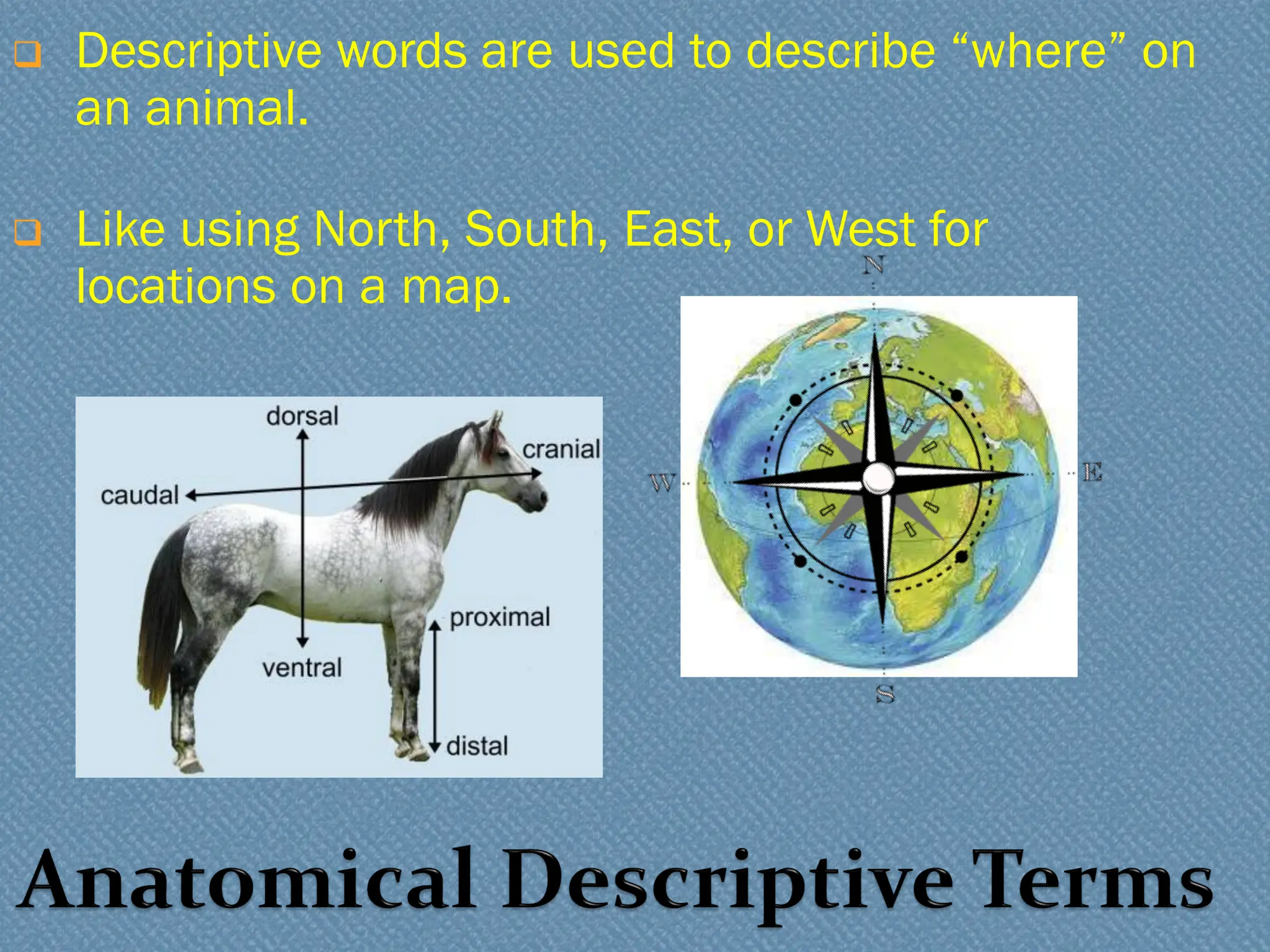
❑ Descriptive words are used to describe “where” on
an animal.
❑ Like using North, South, East, or West for
locations on a map.
 Dorsal -- toward the back
 Ventral -- toward the front/belly
 Separated by the frontal plane
V
 Cranial -- toward the head
 Rostral -- toward the nose/beak
 Caudal -- toward the tail
 Separated by the transverse plane
 Medial – directed toward the
midline (sagittal plane)
 Lateral -- directed away from the
midline (sagittal plane)
Sagittal Plane
 Proximal -- located close to the
sagittal line of the body.
 Distal -- located away from the
sagittal line of the body
External Anatomy
❖ Skin
❖ Nose
❖ Tongue
❖ Eyelids
❖ External Ear
❖ Digits
❖ Umbilical Cord
❖ 2 umbilical arteries
❖ Umbilical vein
❖ Teats
❖ Anus
❖ Identify the Sex
❖ Male – Scrotal Sac (ventral to anus)
and Urogenital Opening
❖ Female – Urogenital opening (ventral
to anus) and genital papilla
DEMO SLIDE BOX 23 Commercial slide. Eye, monkey
Alternative human eye
anterior
chamber
posterior
chamber
vitreous
space
lens
iris
Sclera
Cornea
Sclera
Let’s take a Closer Look!
❖Skin
❖ Skin
❖Umbilical cord
❖Tongue
❖Fetal and Placental membranes
❖Eye
❖Fingertip
Digestive Tract
(Gastrointestinal Tract)
❖ Mouth
❖ Teeth
❖ Tongue
❖ Parotid Gland
❖ Sublingual Gland
❖ Mandibular Gland
❖ Epiglottis
Upper GI
❖ Esophagus
❖ Liver
❖ Stomach
❖ Gallbladder
❖ Pancreas
❖ Spleen
http://www.clker.com/clipart-15593.html
Lower GI
❖ Small intestine
❖ Larger Intestine
❖ Rectum
❖ Anus
Goal: To get nutrients into the body via the breakdown of
food into smaller molecules and to excrete waste
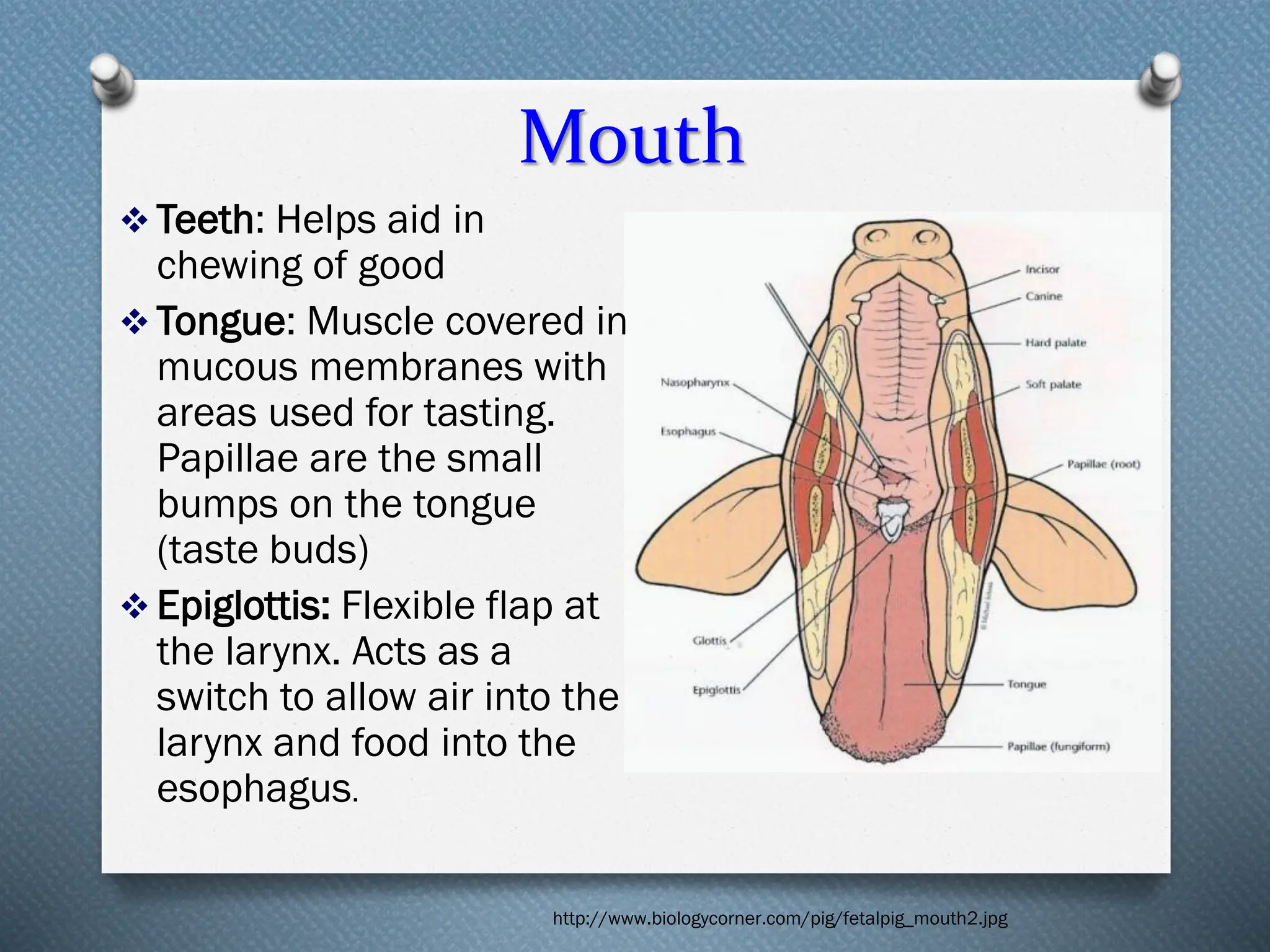
Mouth
❖ Teeth: Helps aid in
chewing of good
❖ Tongue: Muscle covered in
mucous membranes with
areas used for tasting.
Papillae are the small
bumps on the tongue
(taste buds)
❖ Epiglottis: Flexible flap at
the larynx. Acts as a
switch to allow air into the
larynx and food into the
esophagus.
http://www.biologycorner.com/pig/fetalpig_mouth2.jpg
Glands of the Mouth
❖Parotid Gland :
Largest of the salivary
glands located anterior
and inferior to the ear.
❖Sublingual Gland:
One of the salivary
glands; located under
the floor of the mouth.
Mandibular Gland:
One of the salivary
glands inferior to the
mandible.
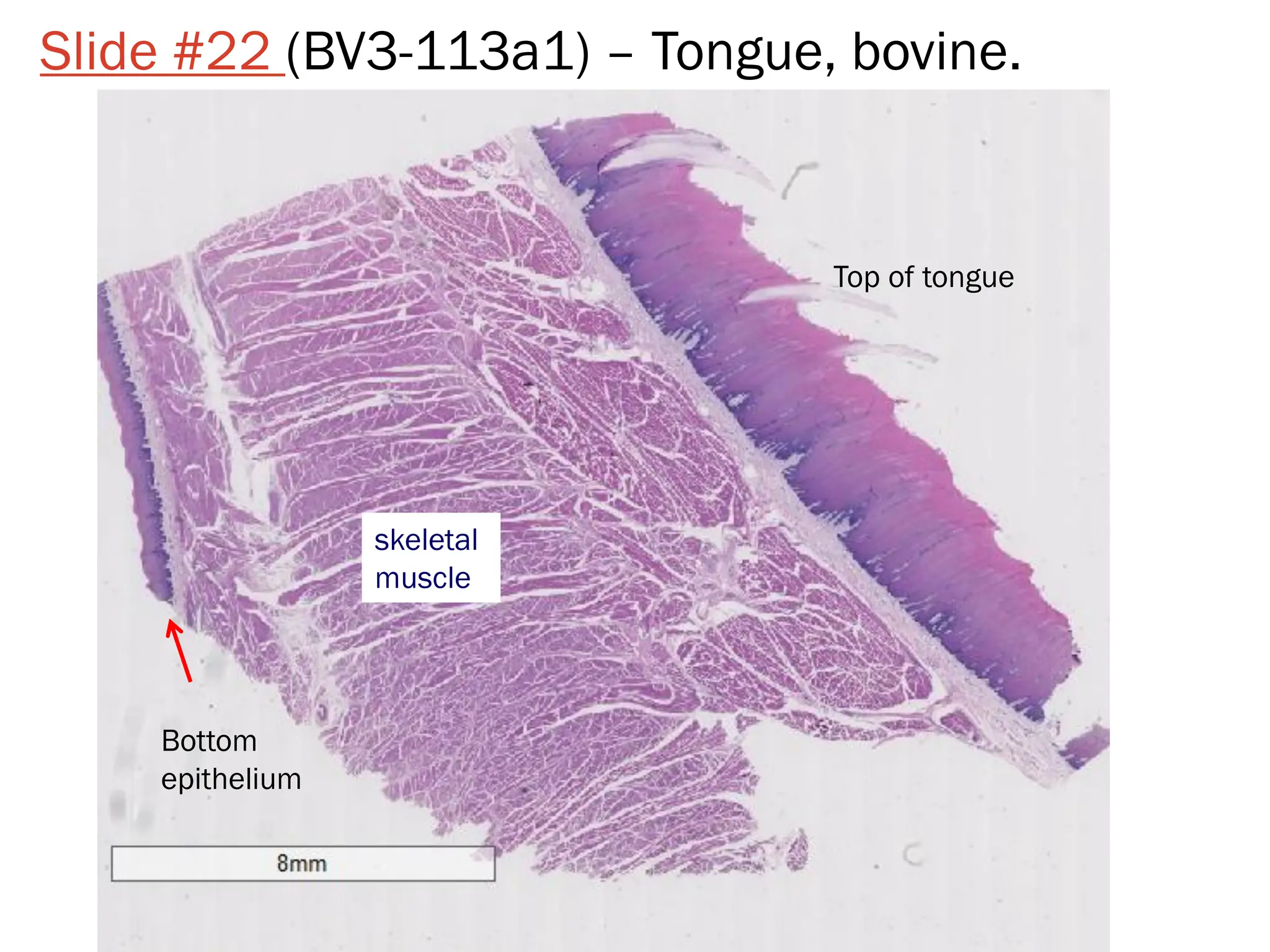
Slide #22 (BV3-113a1) – Tongue, bovine.
skeletal
muscle
Top of tongue
Bottom
epithelium
Demo Slide #186 (SP-1-108). Parotid salivary gland,
sheep
striated duct
interlobular
duct
epithelium
Nerve
bundles
DEMO SLIDE BOX 183 (BV-1-85A)- Mandibular salivary gland, cow.
Striated duct
White fat
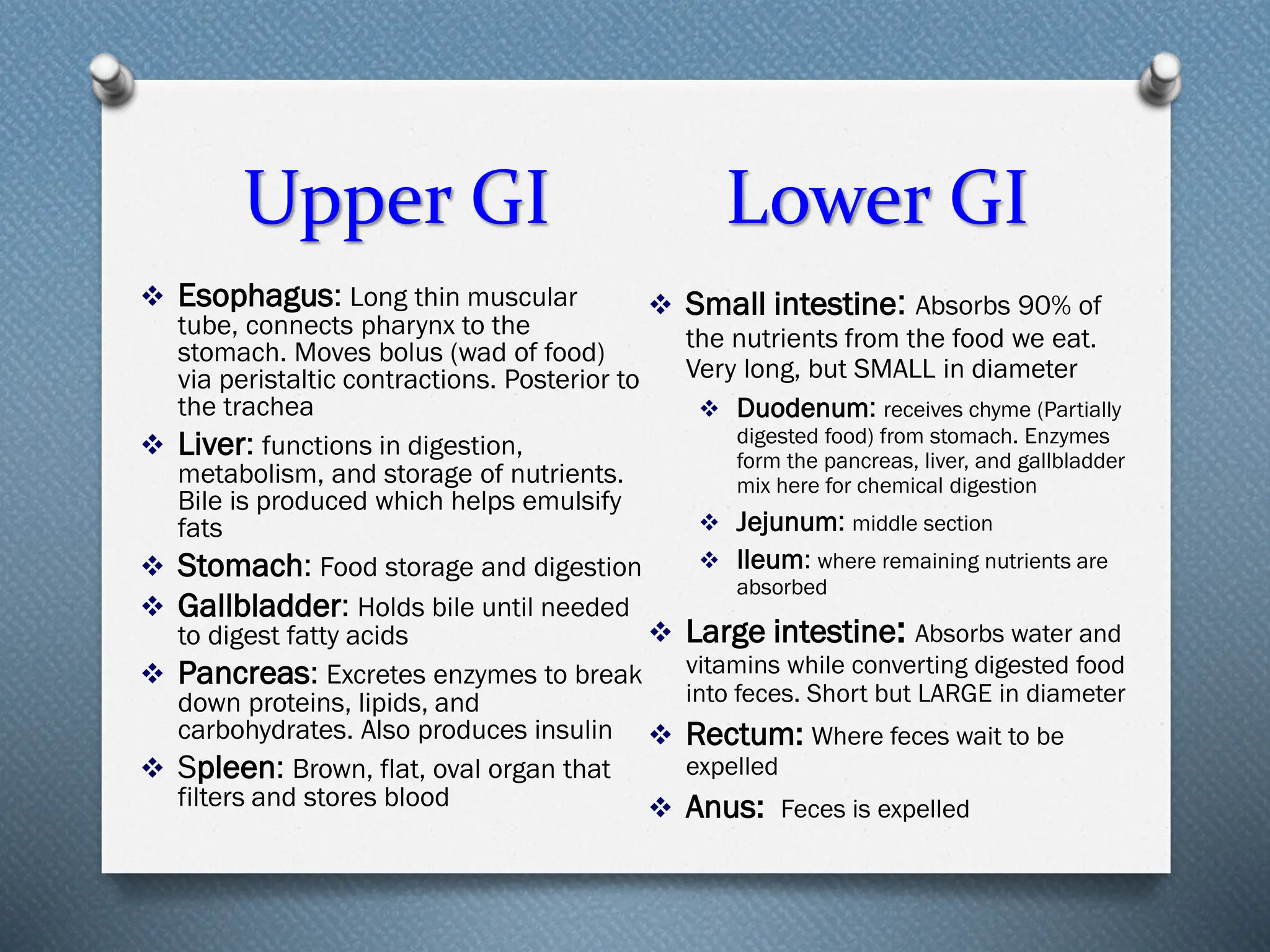
Upper GI Lower GI
❖ Esophagus: Long thin muscular
tube, connects pharynx to the
stomach. Moves bolus (wad of food)
via peristaltic contractions. Posterior to
the trachea
❖ Liver: functions in digestion,
metabolism, and storage of nutrients.
Bile is produced which helps emulsify
fats
❖ Stomach: Food storage and digestion
❖ Gallbladder: Holds bile until needed
to digest fatty acids
❖ Pancreas: Excretes enzymes to break
down proteins, lipids, and
carbohydrates. Also produces insulin
❖ Spleen: Brown, flat, oval organ that
filters and stores blood
❖ Small intestine: Absorbs 90% of
the nutrients from the food we eat.
Very long, but SMALL in diameter
❖ Duodenum: receives chyme (Partially
digested food) from stomach. Enzymes
form the pancreas, liver, and gallbladder
mix here for chemical digestion
❖ Jejunum: middle section
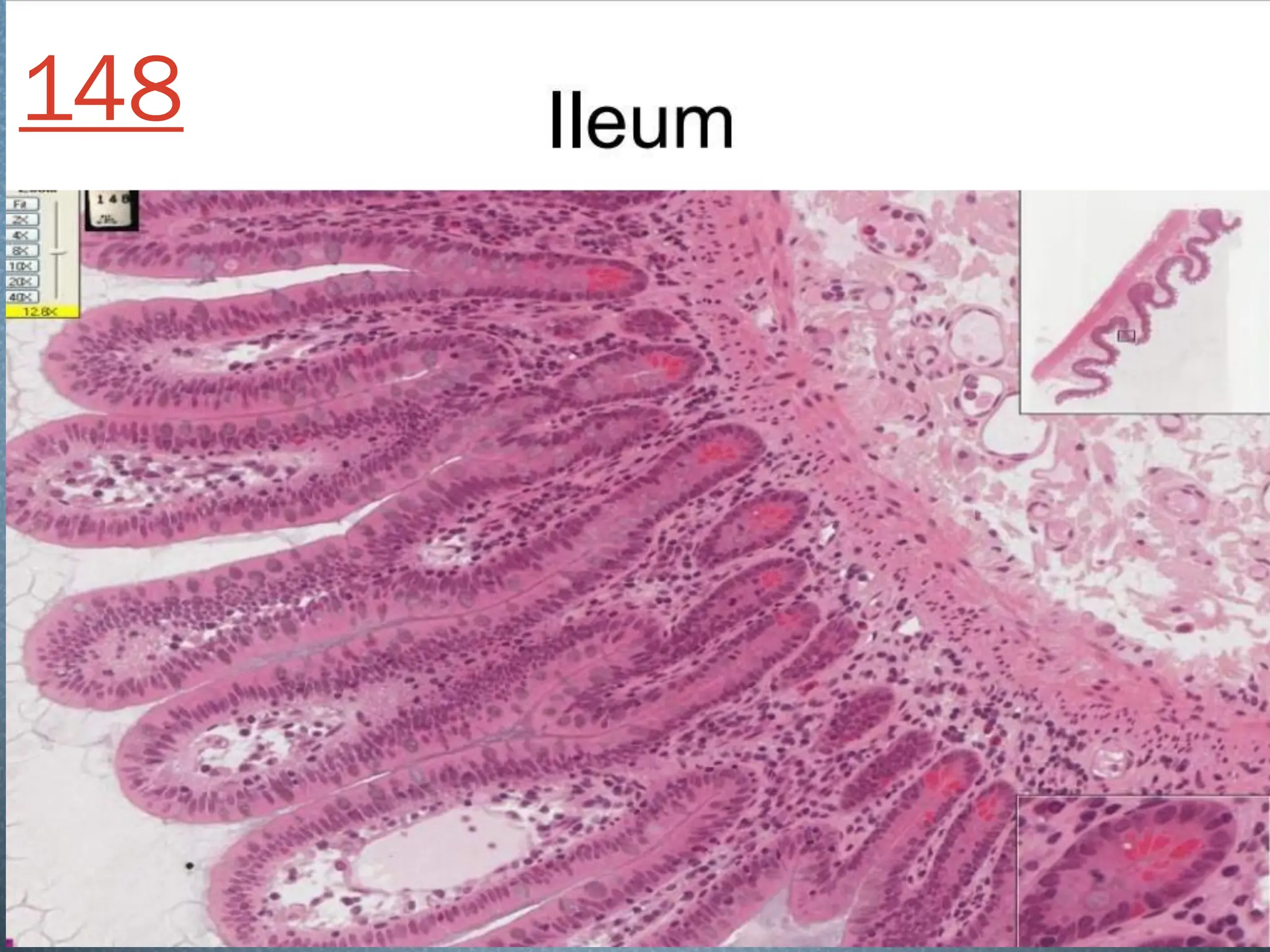
❖ Ileum: where remaining nutrients are
absorbed
❖ Large intestine: Absorbs water and
vitamins while converting digested food
into feces. Short but LARGE in diameter
❖ Rectum: Where feces wait to be
expelled
❖ Anus: Feces is expelled
Larynx
Trachea
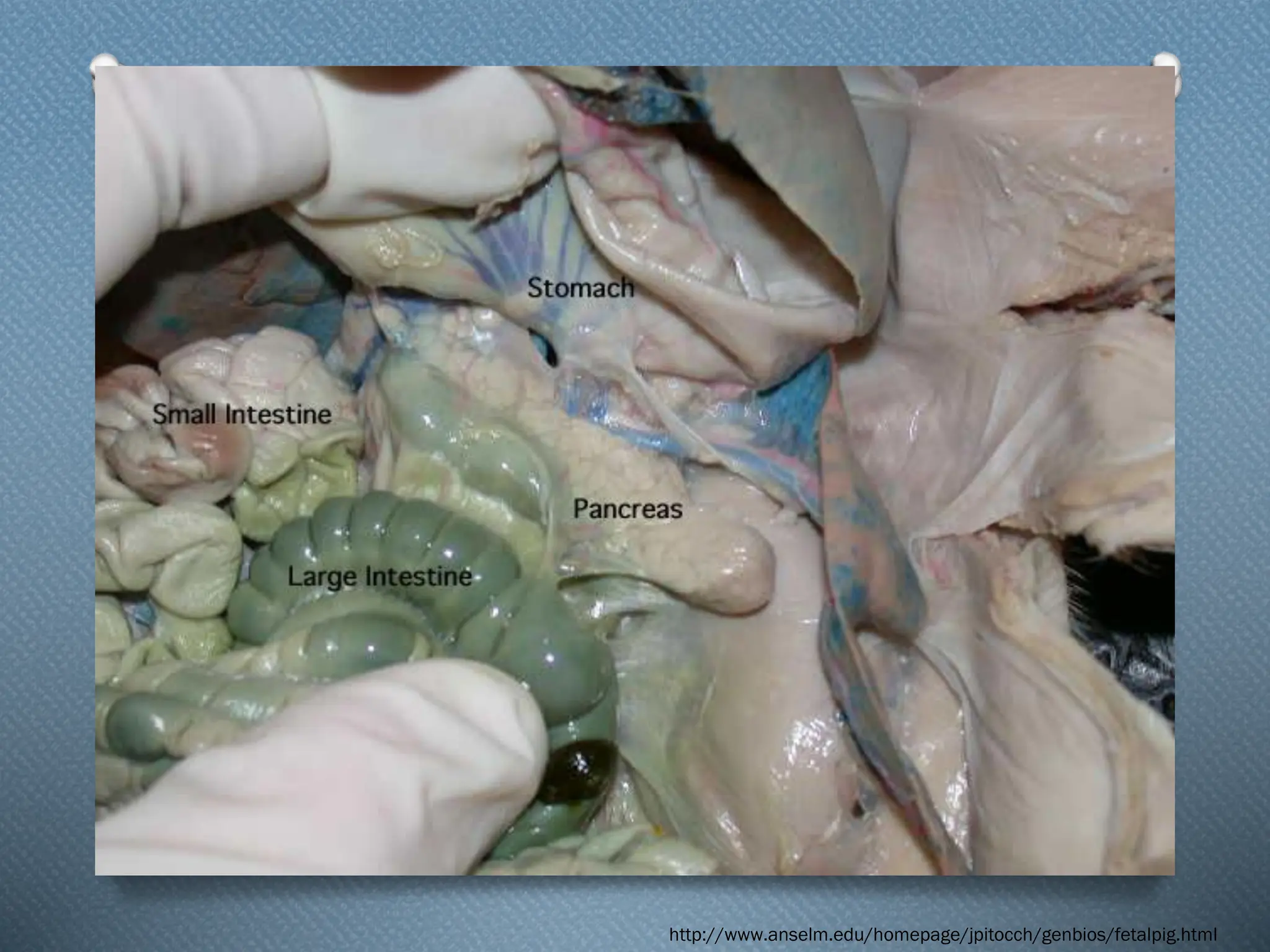
GI TRACT
http://www.anselm.edu/homepage/jpitocch/genbios/fetalpig.html
https://animalplanet.wikispaces.com/Snyder-Crago+Mouth+Anatomy
Slide #71 (Pf5-73/205). Esophagus and trachea,
pig.
mucous membrane
stratified squamous
epithelium
152 Duodenum
Villi Smooth Muscle
Fat
Cells
148
153
Let’s take a Closer Look!
❖ Submandibular gland
❖ Esophagus
❖ Spleen
❖ Liver and Spleen
❖ Bile Duct and portal vein
❖ Gallbladder
❖ Pancreas
❖ Ileum
❖ Duodenum
❖ Liver
Respiratory Tract
Goal: To remove carbon dioxide from the blood and replace it
with oxygen
❖ Works in conjunction with the circulatory system
❖ Organs:
❖ Upper Tract
❖ Nose with nares
❖ Pharynx
❖ Larynx
❖ Lower Tract
❖ Trachea
❖ Lungs which contain the bronchi, bronchioles, and alveoli
❖ Diaphragm
Nose
❖ Air enters the respiratory
system through the paired
nares or nostrils
❖ Two nasal passages:
separated by bone
❖ Used for smell
❖ Hair and mucous
membranes clean out
particles
❖ Carbon dioxide is expired
through the nares
http://www.whitman.edu/academics/courses-of-study/biology/virtual-pig/respiratory-system
Pharynx and Epiglottis
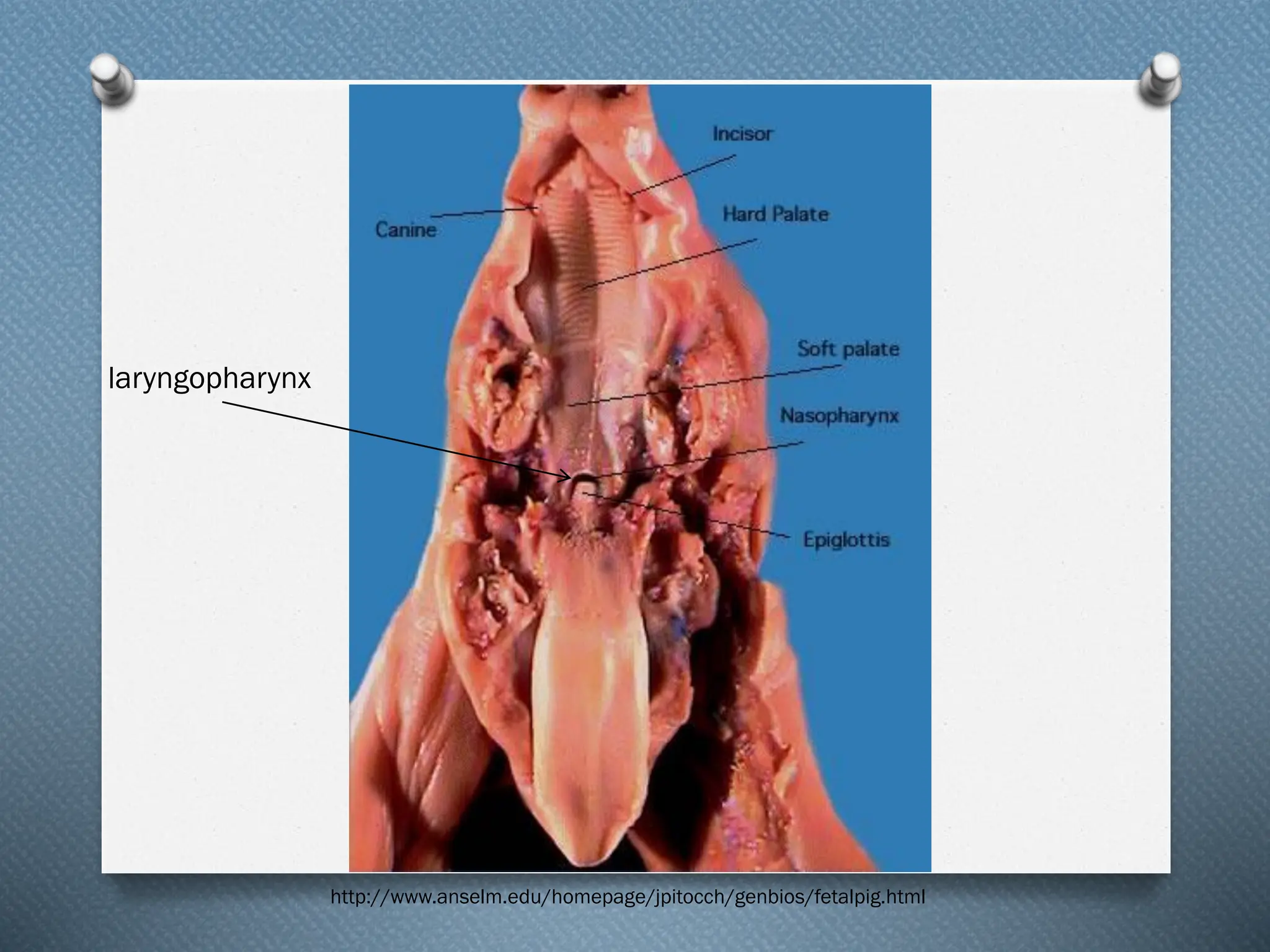
❖ Nasopharynx
❖ Above the soft palate
❖ Leads from the nose to the trachea for breathing
❖ Laryngopharynx
❖ Upper border of the glottis
❖ Helps guide food and air
❖ Epiglottis
❖ Small flap of cartilage
❖ Lies above the pharynx
❖ Allows for air to flow into larynx and trachea
❖ Directs food into the esophagus
http://www.anselm.edu/homepage/jpitocch/genbios/fetalpig.html
laryngopharynx
Larynx
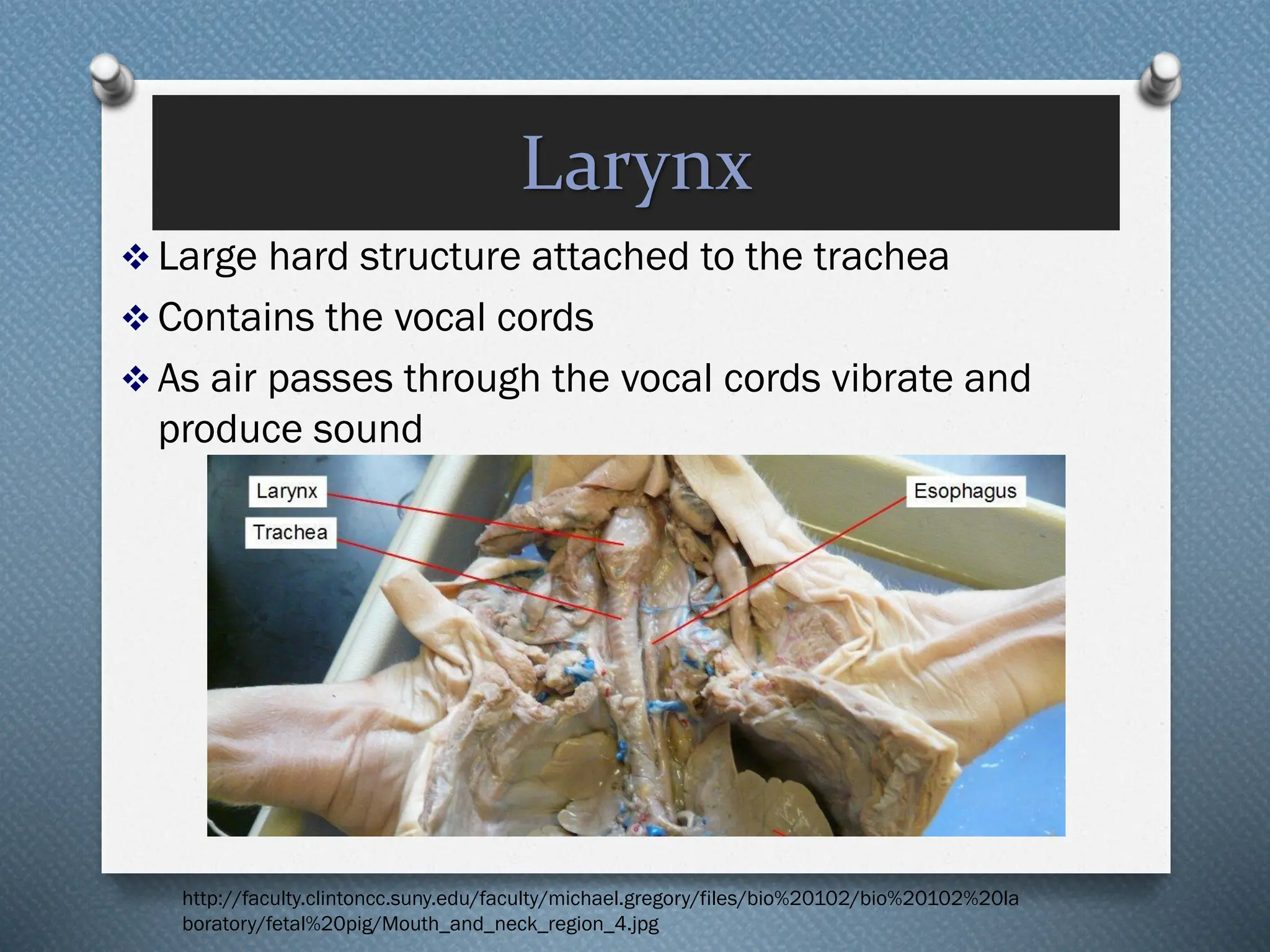
❖ Large hard structure attached to the trachea
❖ Contains the vocal cords
❖ As air passes through the vocal cords vibrate and
produce sound
http://faculty.clintoncc.suny.edu/faculty/michael.gregory/files/bio%20102/bio%20102%20la
boratory/fetal%20pig/Mouth_and_neck_region_4.jpg
Trachea
❖ Windpipe
❖ Connects larynx to lungs
❖ Contains cartilage rings
that prevent trachea
from collapsing
❖ Extends into the thoracic
cavity
❖ Branches into bronchi
❖ Allows air into the lungs
❖ Anterior to the
esophagus
https://www.google.com/search?q=trachea+fetal+pig&espv=2&biw=972&bih=854&source=lnms&tbm=isch&sa=X&ei=qAQ4VKTyO4_o8AHl4oC4Ag&ved=0CAYQ_A
UoAQ#facrc=_&imgdii=ZJMqXEEmRUJLqM%3A%3BLYjzE16FarDrrM%3BZJMqXEEmRUJLqM%3A&imgrc=ZJMqXEEmRUJLqM%253A%3BREGnqwdLFxjyuM%3Bhttp%2
53A%252F%252Fclassconnection.s3.amazonaws.com%252F244%252Fflashcards%252F2198244%252Fjpg%252Fpulmonary_trunk1352727288605.jpg%3Bhttp
DEMO SLIDE BOX 81 – Trachea and elastic artery,
pig.
muscle
“C” shaped rings of hyaline cartilage,
Plasma cells
elastic
artery
companion vein
Lymph node
nerve
Lungs
❖ Branching of the trachea to bronchi to
lungs
❖ Located on either side of the heart
❖ The bronchi divide into bronchioles
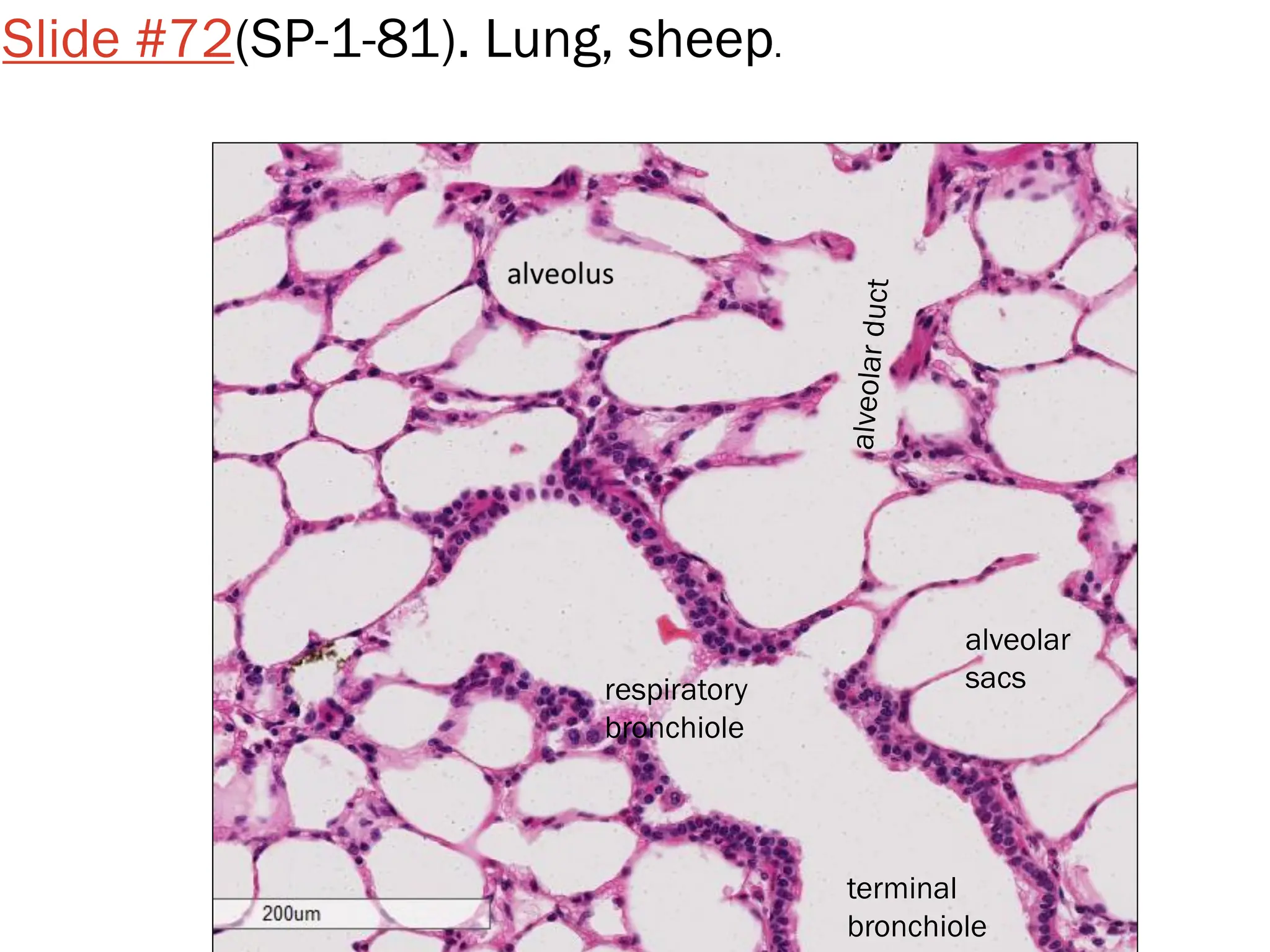
❖ Bronchioles branch into alveolar sacs
❖ Alveolar sacs are bunches of alveoli
❖ Alveoli hold air and tightly bound in
blood vessels; allows for gas exchange
Lungs continued
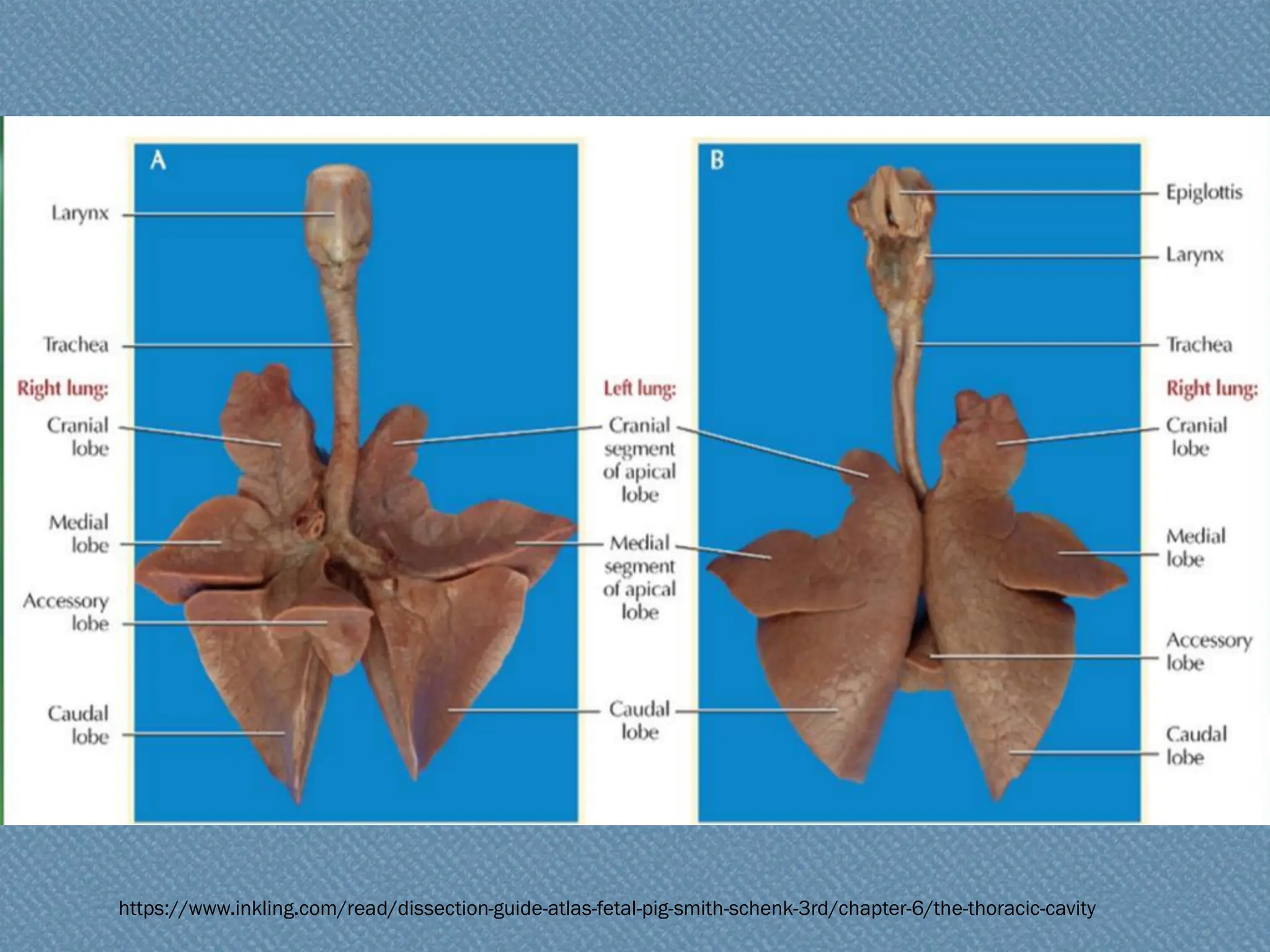
❖ Sectioned into lobes
❖ Right lung is larger (4 lobes)
❖ cranial, medial, caudal, and accessory lobes
❖ Left lung is smaller because of space taken
up by the heart (2 lobes)
❖ apical and caudal lobe
https://www.inkling.com/read/dissection-guide-atlas-fetal-pig-smith-schenk-3rd/chapter-6/the-thoracic-cavity
Slide #72(SP-1-81). Lung, sheep.
smaller intrapulmonary bronchi.
plates of hyaline
cartilage.
artery vein
alveolar sacs
glands
Slide #72(SP-1-81). Lung, sheep.
terminal
bronchiole
alveolar
sacs
respiratory
bronchiole
Diaphragm
❖ Below the lungs
❖ Thin muscular sheet of tissue
❖ Only in mammals
❖ Expands to allow air in (diaphragm contracts)
❖ Compresses to expel air (diaphragm relaxes)
❖ Separates the chest and abdominal cavities
http://faculty.clintoncc.suny.edu/faculty/michael.gregory/files/bio%20102/bio%20102%20laboratory/fetal%20pig/Respiratory_system_5.jpg
https://www.inkling.com/read/dissection-guide-atlas-fetal-pig-smith-schenk-3rd/chapter-6/the-thoracic-cavity
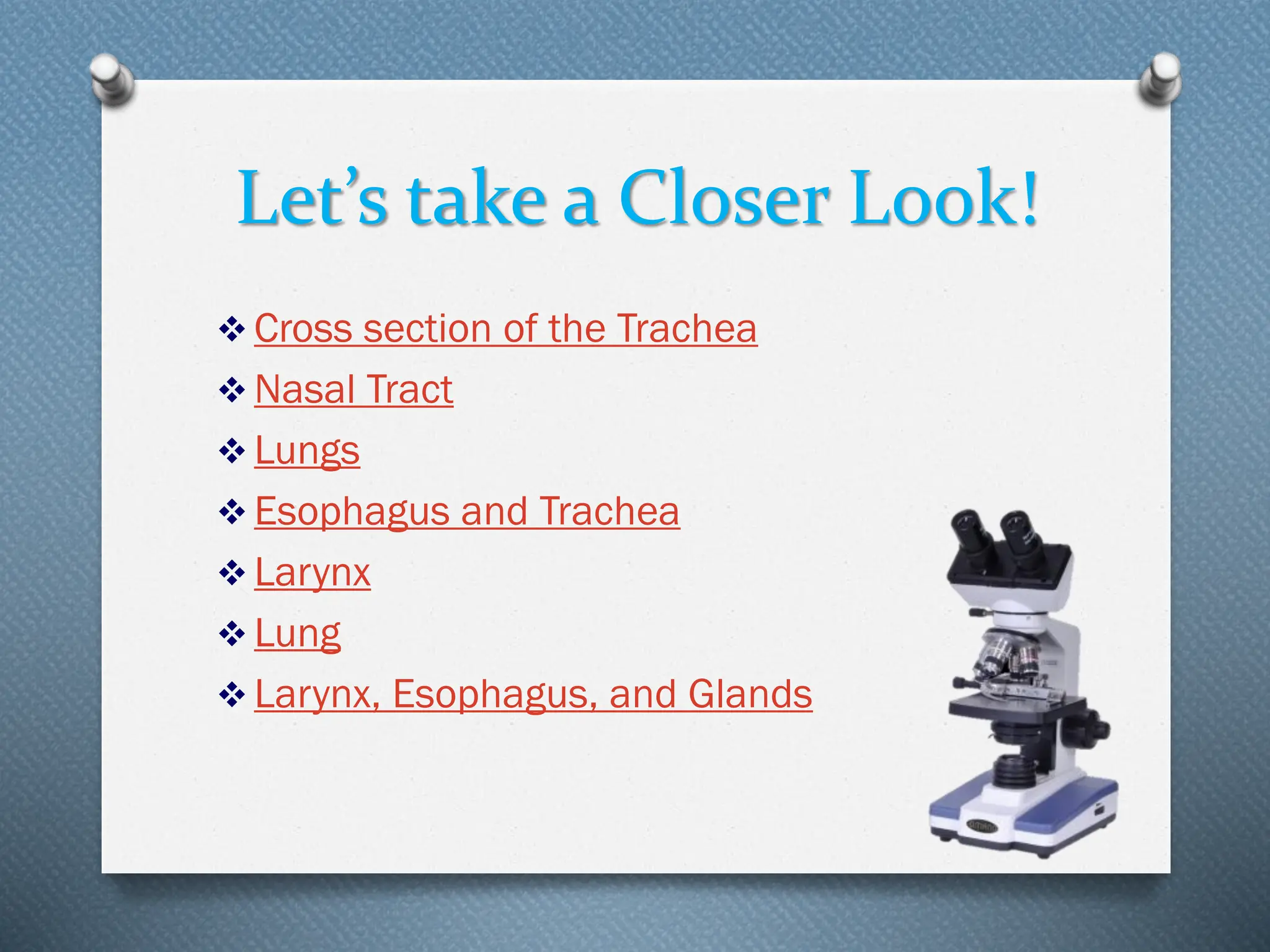
Let’s take a Closer Look!
❖ Cross section of the Trachea
❖ Nasal Tract
❖ Lungs
❖ Esophagus and Trachea
❖ Larynx
❖ Lung
❖ Larynx, Esophagus, and Glands
Circulatory System
Allows blood, nutrients, oxygen and other gases, and
hormones to flow throughout the body
❖ Mammals (including humans)
❖ Double loop system
❖ 4 chambered heart
❖ Organs
❖ Heart
❖ Lungs
❖ Arteries
❖ Veins
http://www.ideacenter.org/contentmgr/showdetails.php/id/1113
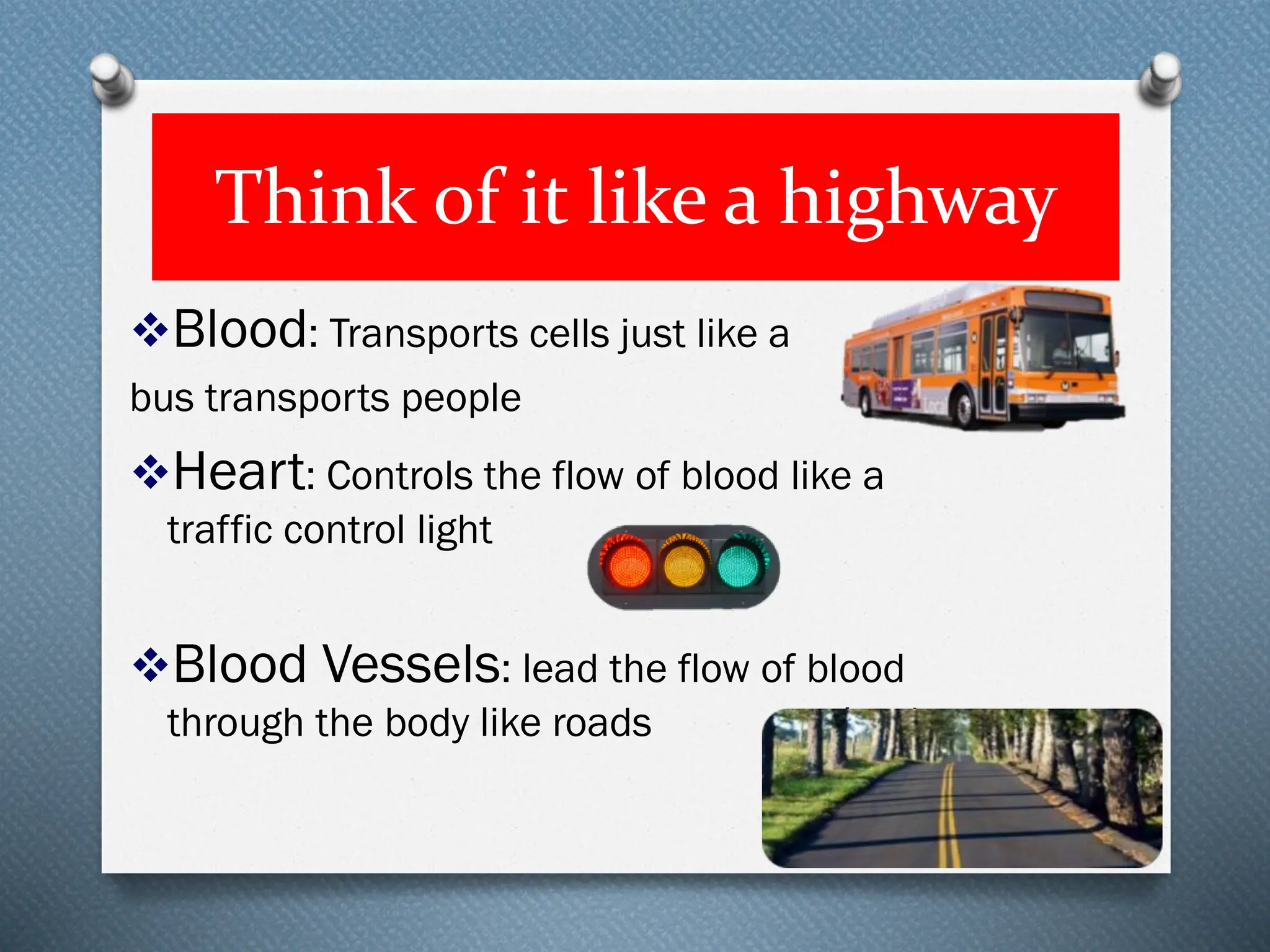
Think of it like a highway
❖Blood: Transports cells just like a
bus transports people
❖Heart: Controls the flow of blood like a
traffic control light
❖Blood Vessels: lead the flow of blood
through the body like roads lead
Heart
❖ Muscle used to pump blood
❖ 4 chambers in mammals
❖ Right Atria
❖ Right Ventricle
❖ Left Atria
❖ Left Ventricle
❖ Atria pump blood to ventricles
❖ Ventricles pump blood out of heart and into circulatory
system
❖ Valves prevent backflow of blood
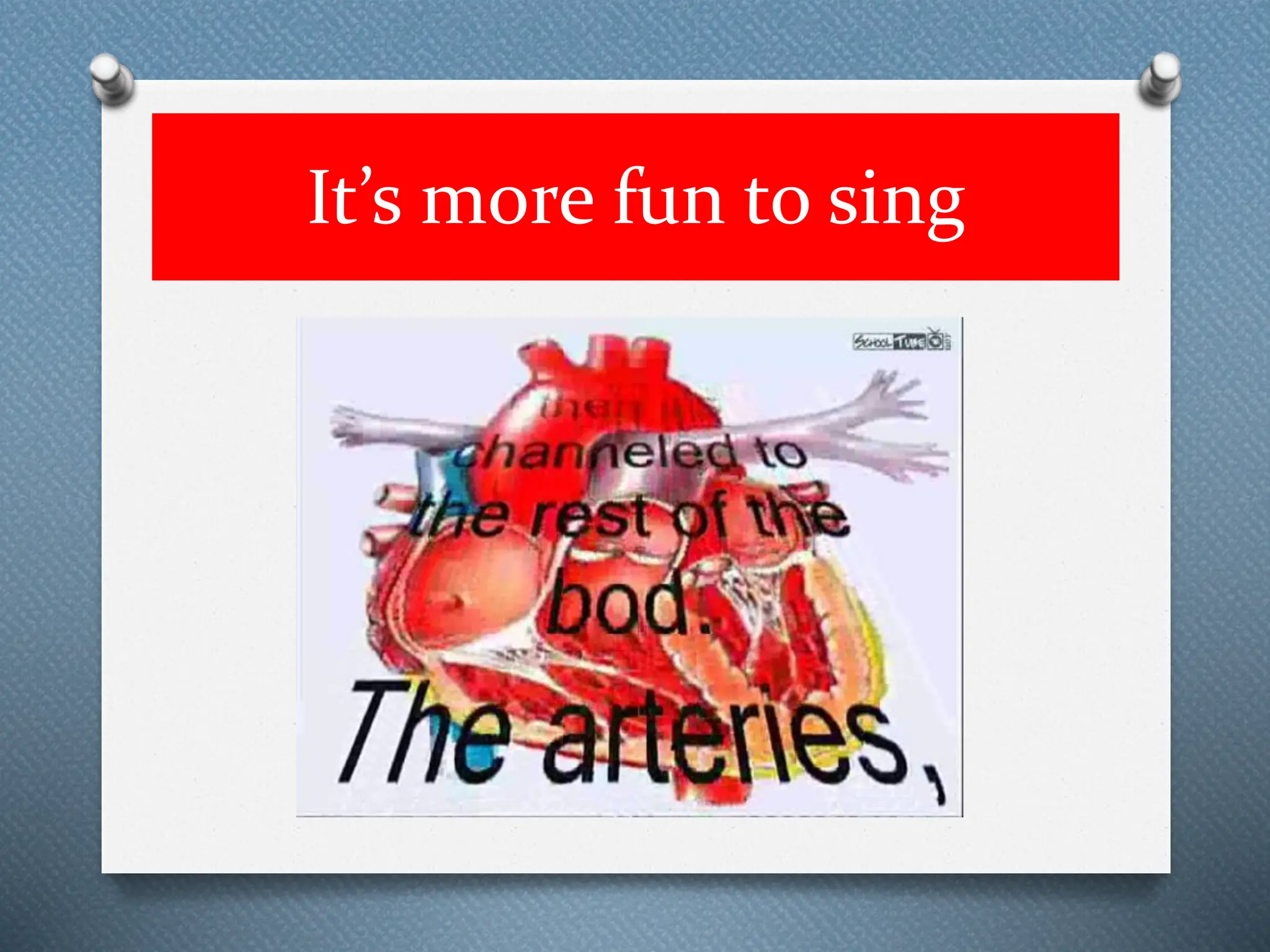
It’s more fun to sing
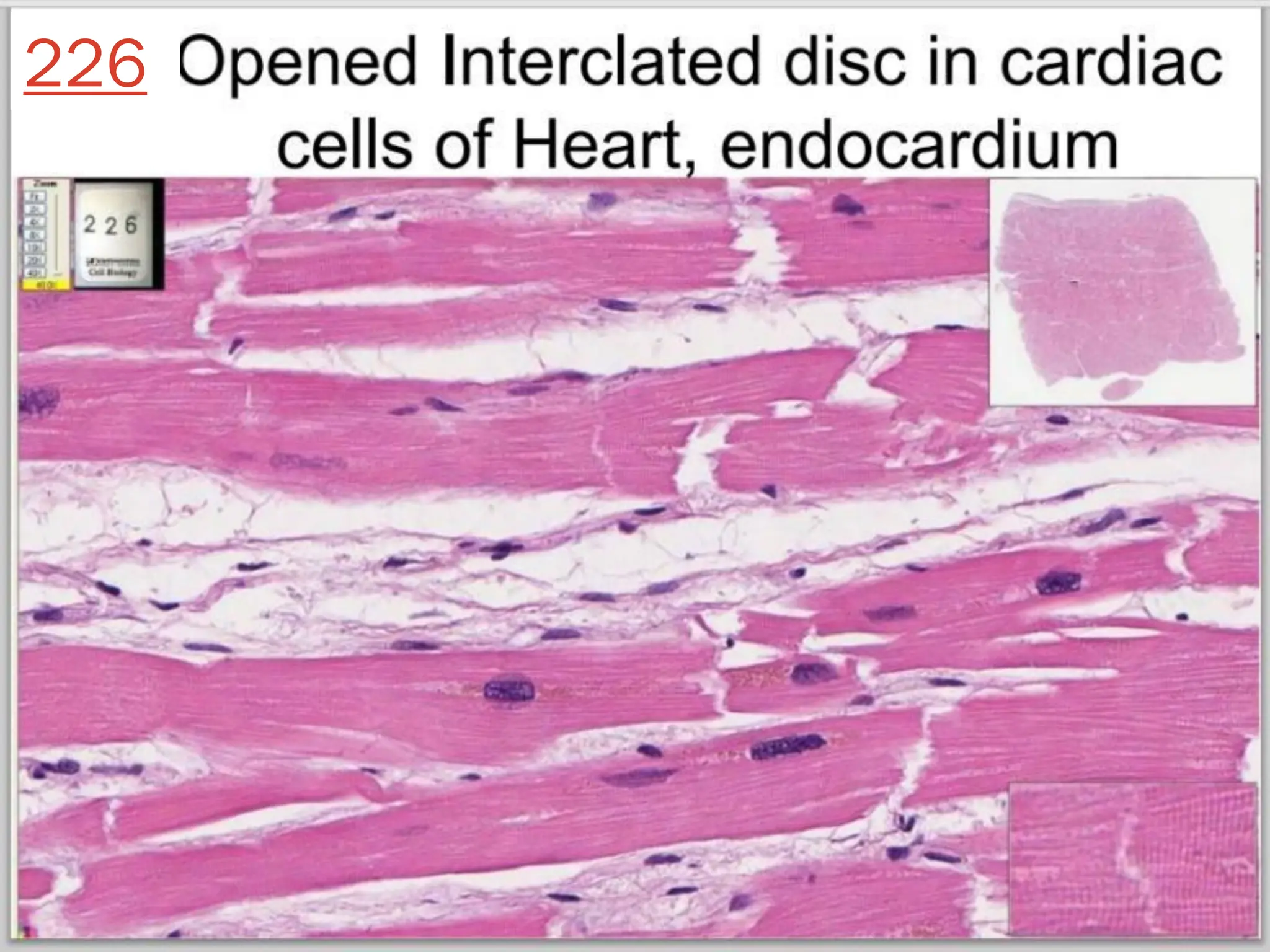
226
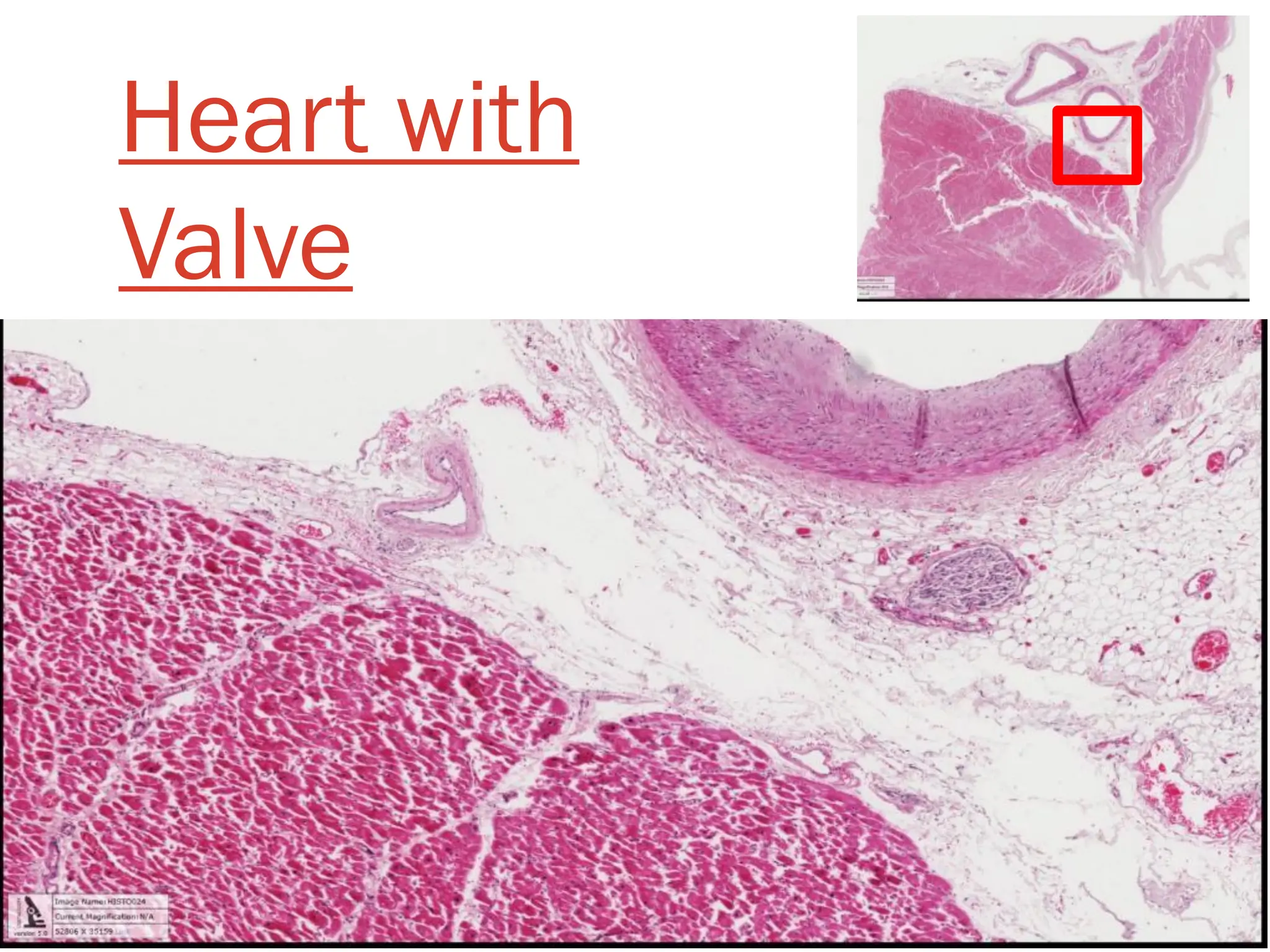
Heart with
Valve
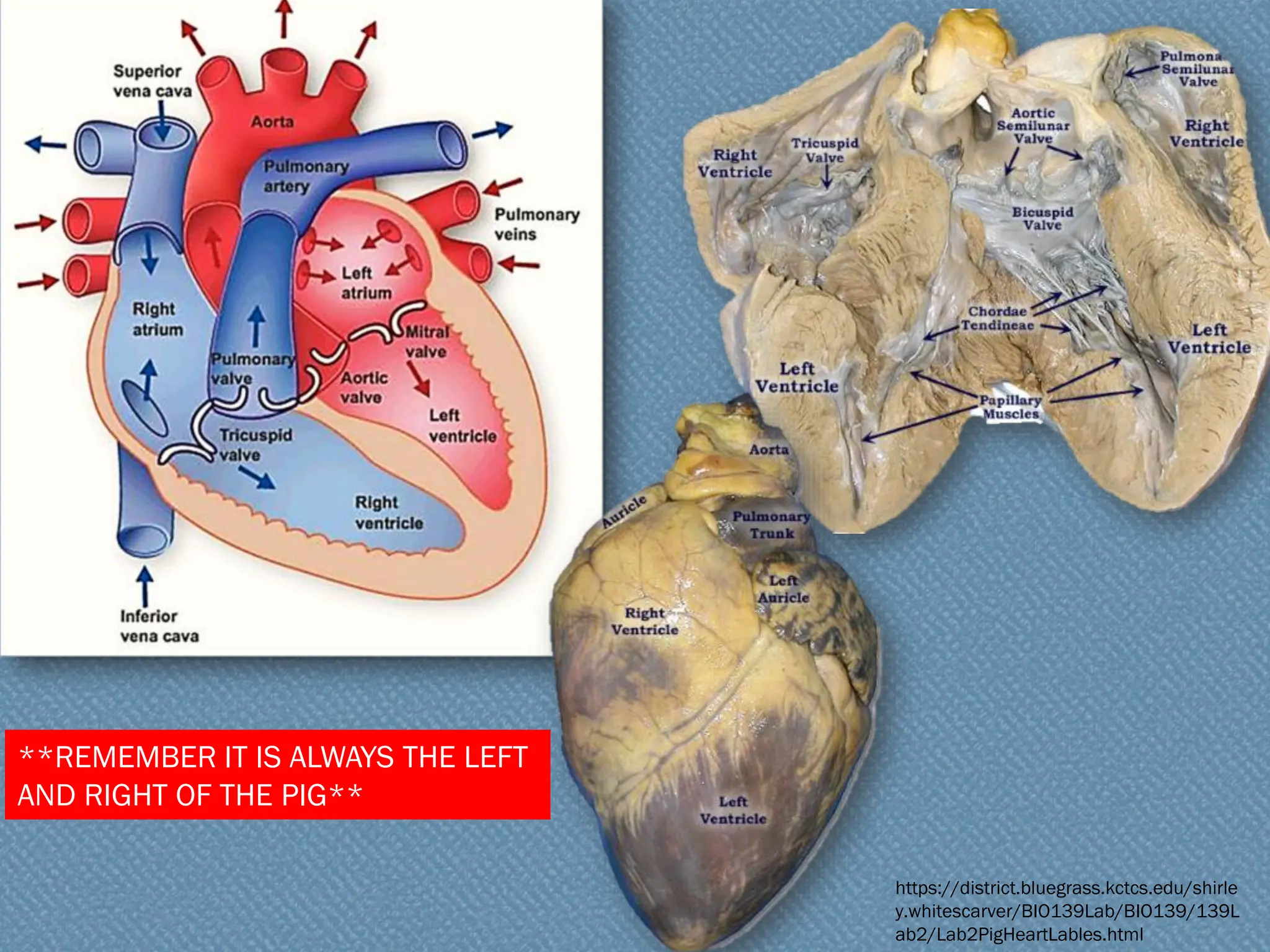
**REMEMBER IT IS ALWAYS THE LEFT
AND RIGHT OF THE PIG**
https://district.bluegrass.kctcs.edu/shirle
y.whitescarver/BIO139Lab/BIO139/139L
ab2/Lab2PigHeartLables.html
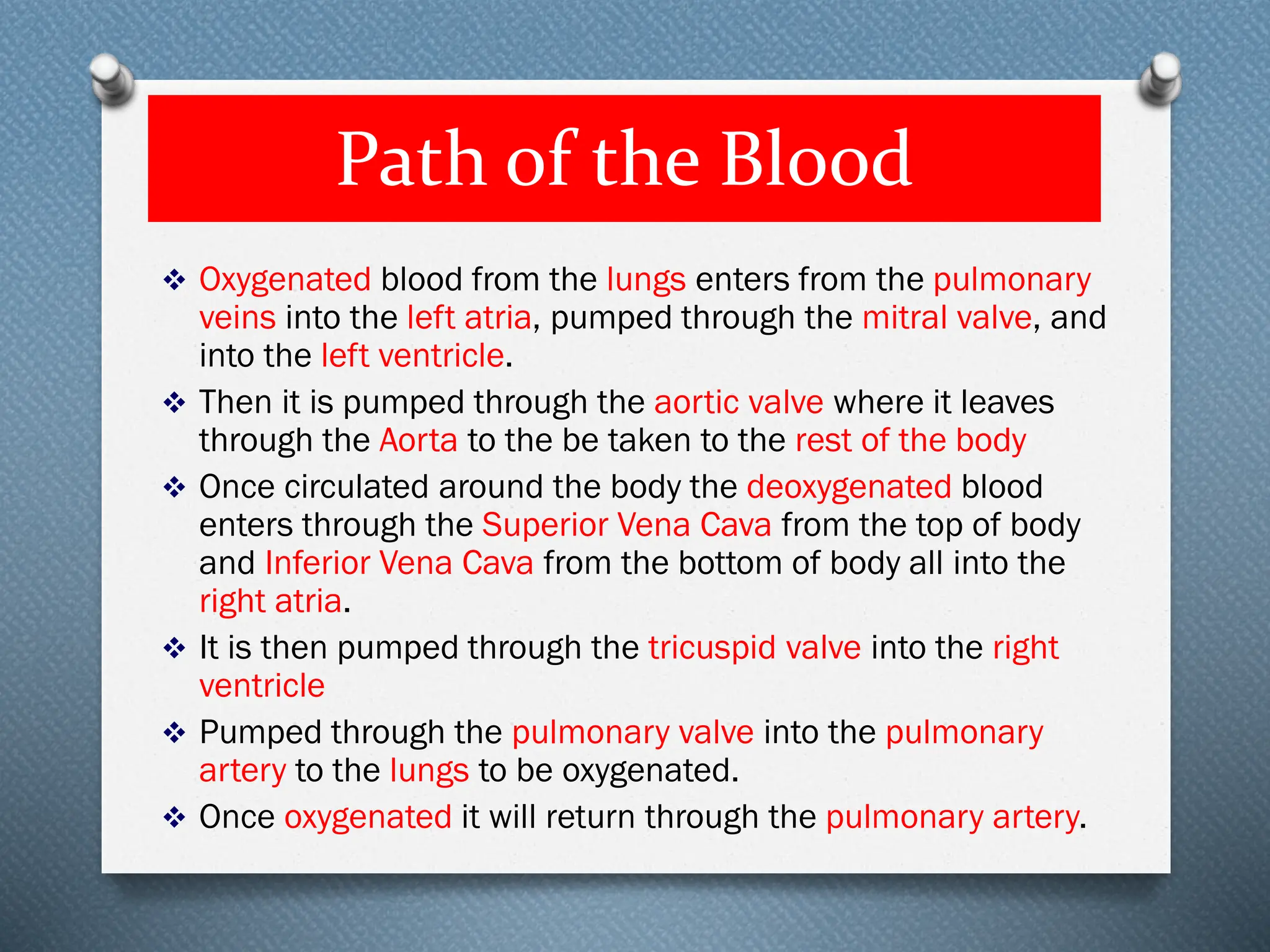
Path of the Blood
❖ Oxygenated blood from the lungs enters from the pulmonary
veins into the left atria, pumped through the mitral valve, and
into the left ventricle.
❖ Then it is pumped through the aortic valve where it leaves
through the Aorta to the be taken to the rest of the body
❖ Once circulated around the body the deoxygenated blood
enters through the Superior Vena Cava from the top of body
and Inferior Vena Cava from the bottom of body all into the
right atria.
❖ It is then pumped through the tricuspid valve into the right
ventricle
❖ Pumped through the pulmonary valve into the pulmonary
artery to the lungs to be oxygenated.
❖ Once oxygenated it will return through the pulmonary artery.
Lungs
❖ Provide oxygen to the blood and remove
carbon dioxide from the blood
❖ Exchange of gases takes place in the
alveolar sacs
http://en.wikipedia.org/wiki/Pulmonary_circulation
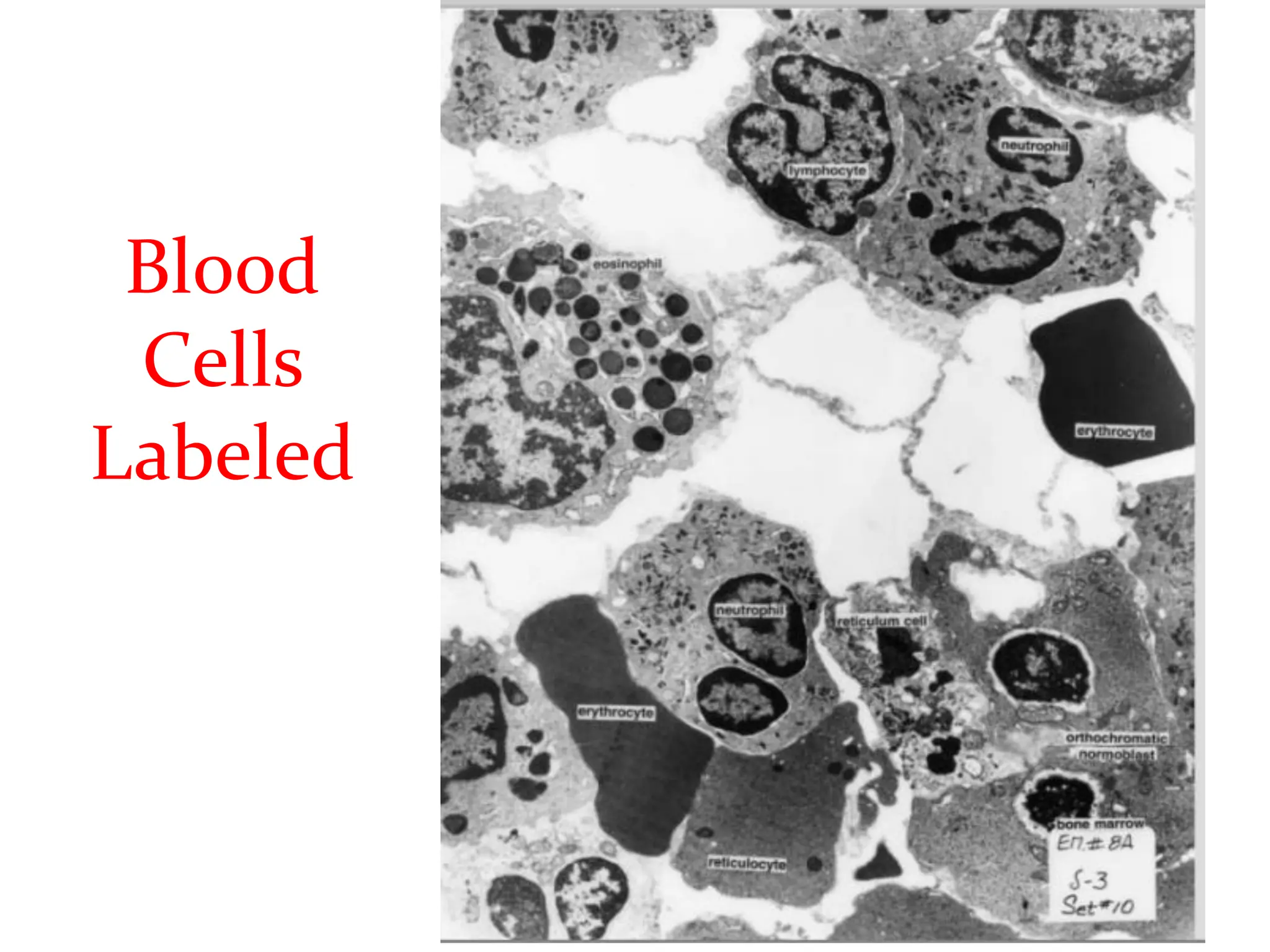
Blood
❖ Liquid that circulates in the blood vessels,
transporting oxygen, carbon dioxide, waste, and
hormones around the body.
❖ Blood contains
❖ (leukocytes)- fight against infections
❖ Red blood cells (erythrocytes) – transport oxygen
❖ Platelets (thrombocytes)- assist in clotting
❖ Plasma- liquid that suspends proteins and the solid
components of blood
White Blood Cells
Blood Vessels
❖Veins- carry blood to the heart
❖Arteries- carry blood away from the heart
❖Capillaries – small pathway that
connects arteries to veins
❖Only one blood cell wide
https://www.studyblue.com/notes/note/n/emt-basic/deck/5473108
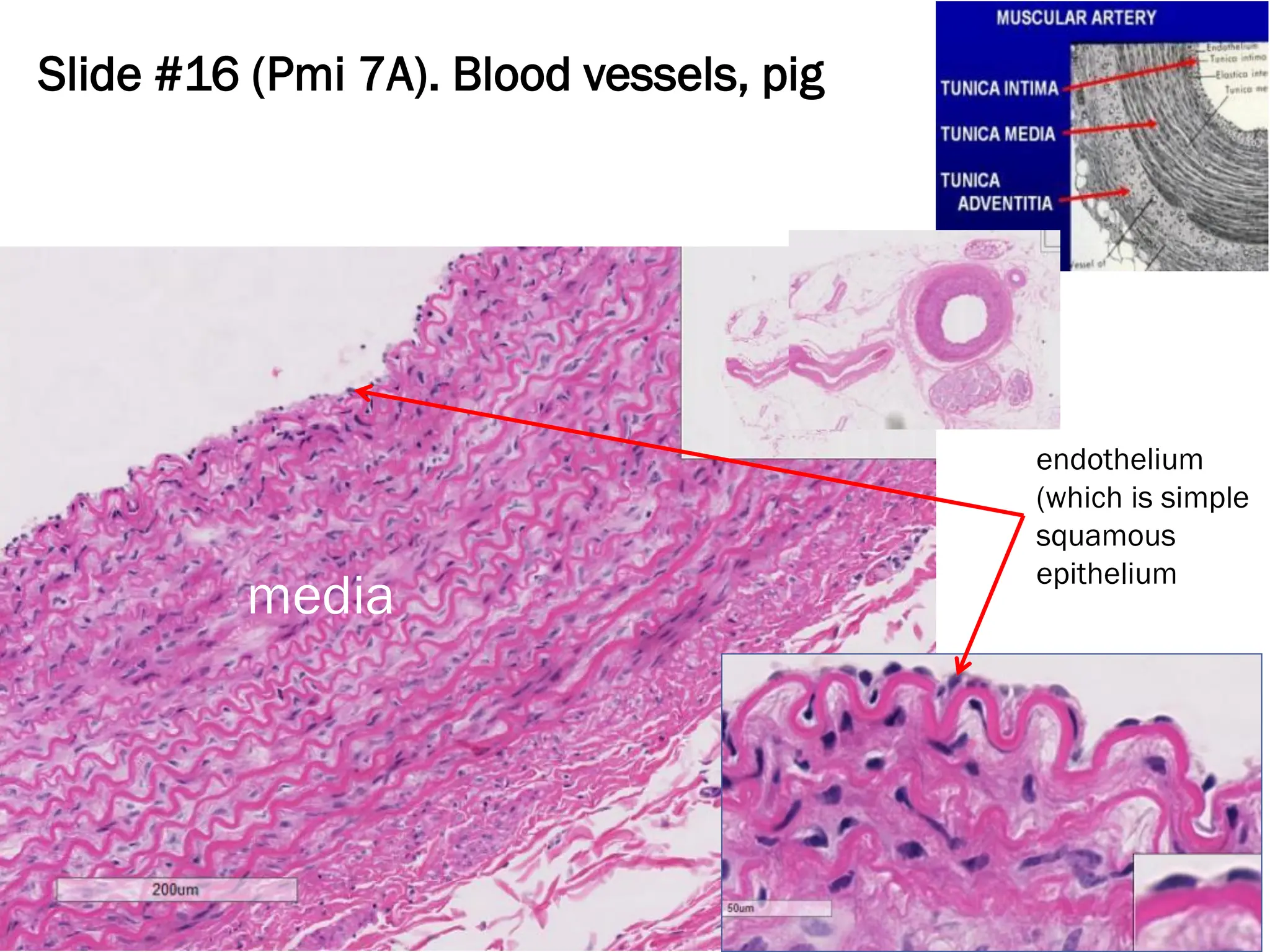
Slide #16 (Pmi 7A). Blood vessels, pig
endothelium
(which is simple
squamous
epithelium
media
Blood
Cells
Labeled
Let’s Take a Closer Look
❖ Peripheral Blood Smear
❖ Red Bone Marrow Smear
❖ Heart, Epicardium
❖ Heart, Endocardium
❖ Blood 1
❖ Blood 2
❖ Blood 3
❖ Bone Marrow
❖ Heart with Valve
❖ Heart Muscle
❖ Heart
http://www.microscope-microscope.org/basic/microscope-images/138-microscopes-lg.jpg
Reproductive System
Expands the population of a certain species
❖ Male and
female reproductive
tracts are different
❖ Males-produce
testosterone and sperm
❖ Females- produce
oocytes
Male Repro Tract
❖Testes – produce sperm
❖Penis - deposits semen into female reproductive tract. Expels
urine from the body.
❖Cremaster muscle –pulls the testes
closer to the body to keep
warm
❖Scrotum -
houses the testes
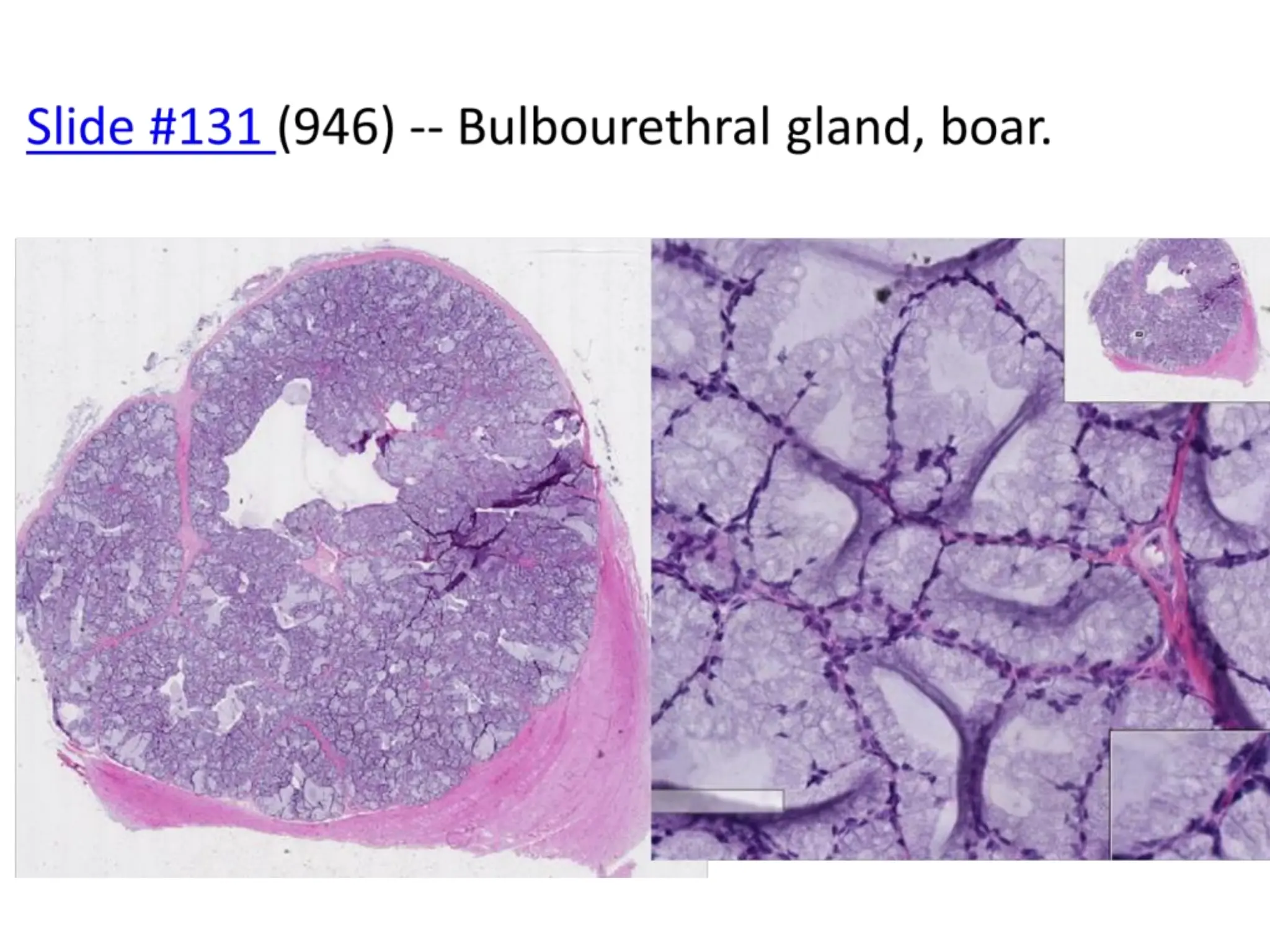
❖Bulbourethral Gland -
gives off seminal
fluid to urethra
❖ Spermatic cord -
contains Vas
deferens,
spermatic artery
and vein, lymphatic
vessels, and leads
to the epididymis
❖ Epididymis- stores
sperm
❖ Seminiferous
tubules – sperm
produced
❖ Vas deferens-
transports sperm to
urethra
❖Urethra – receives seminal secretions form the testes. Drains excretory products from
the bladder
❖Prostate- secretes fluid that carries sperm
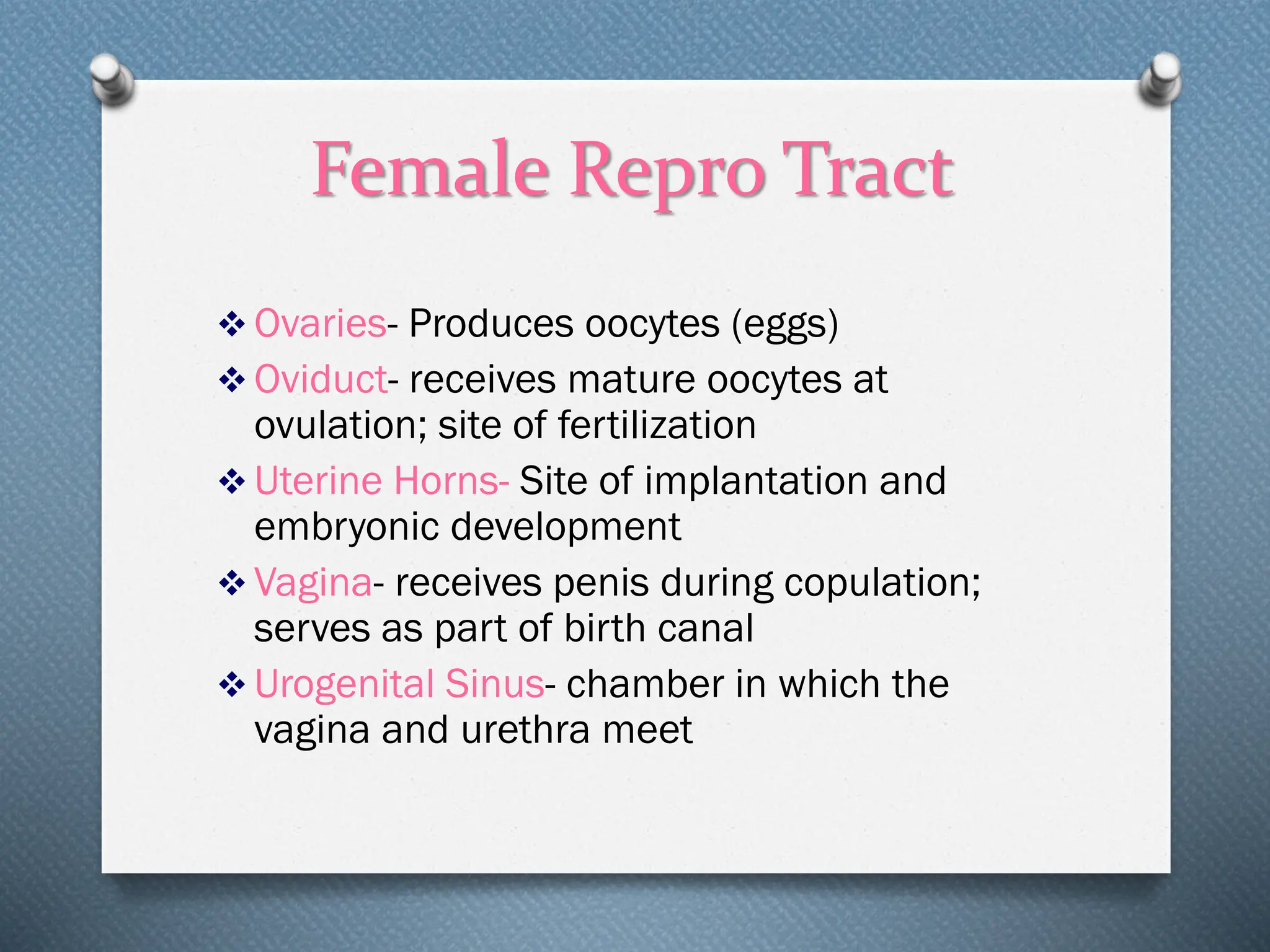
Female Repro Tract
❖ Ovaries- Produces oocytes (eggs)
❖ Oviduct- receives mature oocytes at
ovulation; site of fertilization
❖ Uterine Horns- Site of implantation and
embryonic development
❖ Vagina- receives penis during copulation;
serves as part of birth canal
❖ Urogenital Sinus- chamber in which the
vagina and urethra meet
DEMO SLIDE BOX #208 – Cervix, sow.
complex folds of the luminal surface of the cervix.
Slide #183 (PG-1-84). Mammary gland, sow.
lactiferous duct
ducts
Let’s Take a Closer Look
❖ Ovary 1
❖ Ovary 2
❖ Ovary 3
❖ Uterus
❖ Vagina
❖ Testis
❖ Seminal Vesicle
❖ Prostate
❖ Testis 2
http://nerdbranding.com/product/microscope/
Urinary System
Eliminates wastes from the body, regulates blood
volume and pressure, controls levels of electrolytes
and metabolites, and regulates blood pH
❖ Organs
❖ Adrenal Glands
❖ Kidneys
❖ Ureter
❖ Bladder
❖ Urethra
Adrenal
Gland
Kidney
Ureter
Bladder
http://memorize.com/urinary-system-pig-2/h4nsyh4ns
Urethra
Adrenal Glands
❖ Sit on top of the kidneys
❖ 2 total
❖ 2 Parts
❖ Adrenal Cortex- outer part that
produces hormones vital to life,
such as cortisol (metabolism) and
aldosterone (blood pressure)
❖ Adrenal Medulla- inner part that
produces nonessential hormones,
such as adrenaline (stress)
http://http://blog.lib.umn.edu/clar0841/psychblog/4/
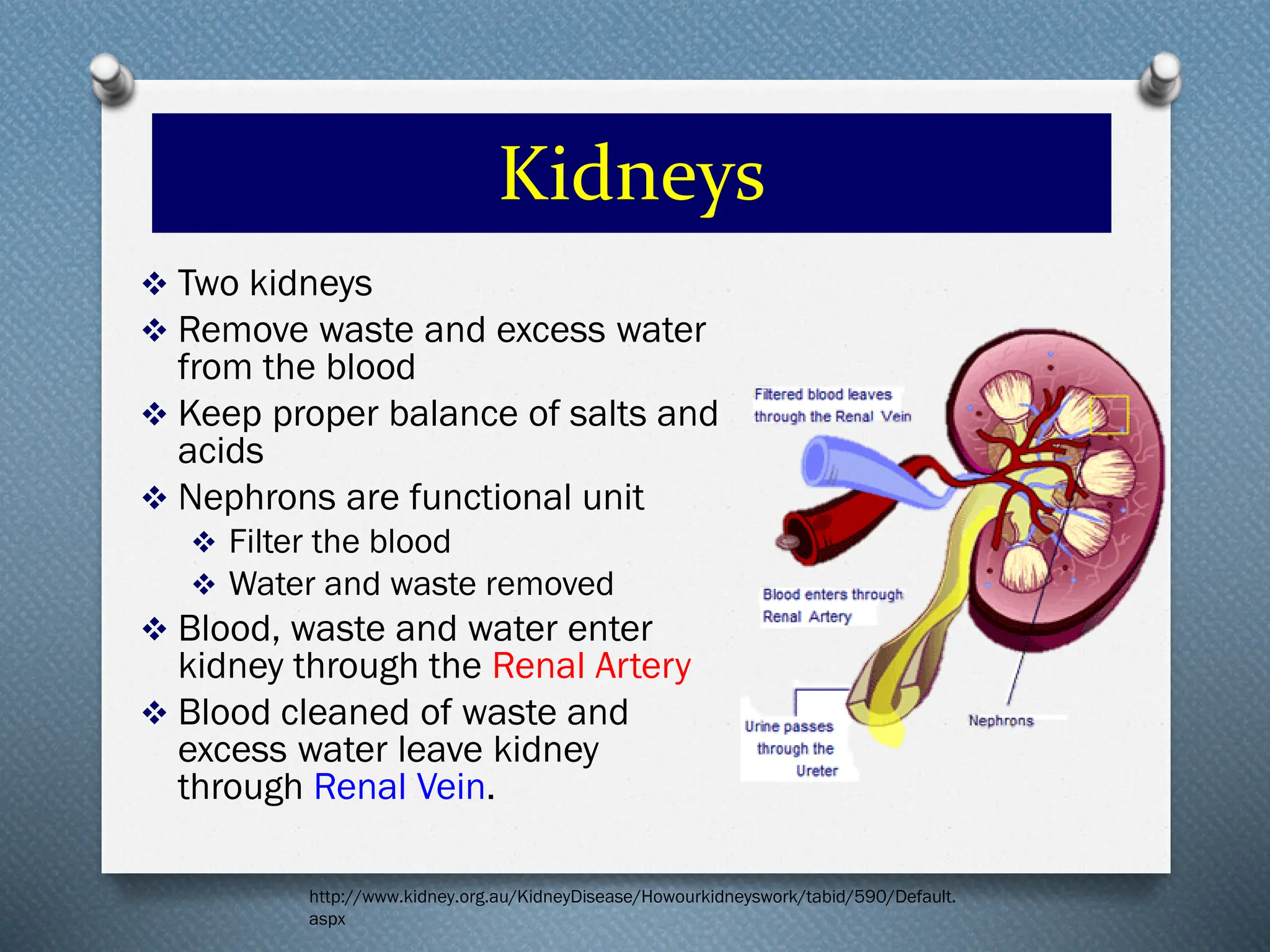
Kidneys
❖ Two kidneys
❖ Remove waste and excess water
from the blood
❖ Keep proper balance of salts and
acids
❖ Nephrons are functional unit
❖ Filter the blood
❖ Water and waste removed
❖ Blood, waste and water enter
kidney through the Renal Artery
❖ Blood cleaned of waste and
excess water leave kidney
through Renal Vein.
http://www.kidney.org.au/KidneyDisease/Howourkidneyswork/tabid/590/Default.
aspx
Kidney
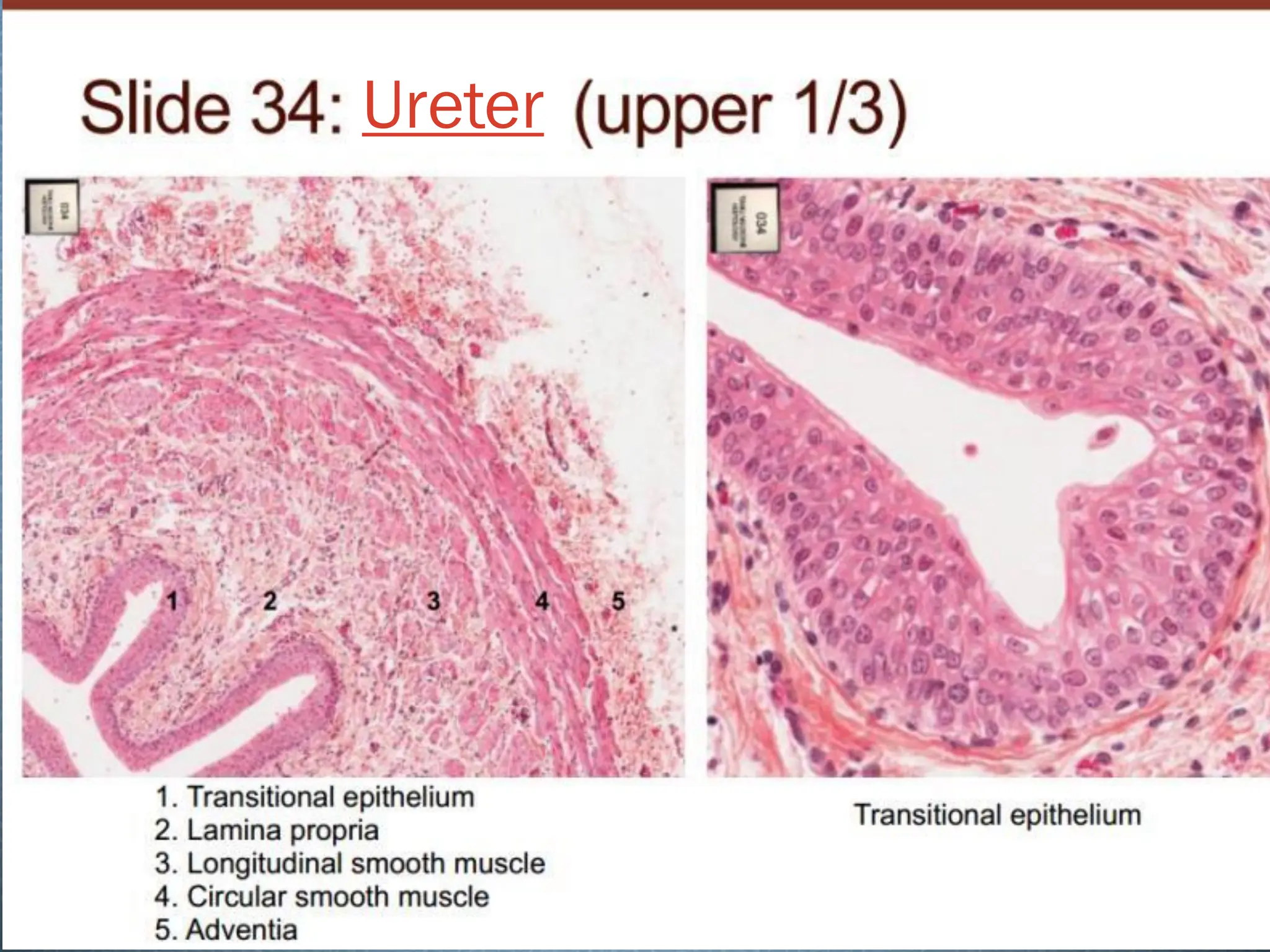
Ureter, Bladder, and Urethra
❖ Ureter
❖ One from each kidney
❖ Carries urine from
kidney to bladder
❖ Strong muscular tube
❖ Bladder
❖ Hollow organ
❖ Expands as it is filled
❖ Urethra
❖ Takes urine from the bladder to be eliminated
Ureter
Urinary Bladder
Let’s Take a Closer Look
❖ Kidney 1
❖ Kidney 2
❖ Ureter
❖ Bladder
❖ Ureter 2
❖ Adrenal gland
❖ Kidney 3
http://www.biologyjunction.com/microscope_lab1.htm
Who would have
thought a pig would
be so closely related
to a human??!!
https://www.google.com/search?q=pig+and+farmer+friend+cartoon&espv=2&bi
w=1197&bih=753&source=lnms&tbm=isch&sa=X&ei=5khRVOqeA4upgwS7n4H
QBw&ved=0CAYQ_AUoAQ#tbm=isch&q=human+in+mud+cartoon&imgdii=_
References
❖ http://peer.tamu.edu/
❖ http://www.whitman.edu/academics/courses-of-study/biology/virtual-pig/respiratory-
system
❖ http://www.thepigsite.com/pighealth/article/9/respiratory-system
❖ http://www.anselm.edu/homepage/jpitocch/genbios/fetalpig.html
❖ http://www.upt.pitt.edu/ntress/Bio1_Lab_Manual_New/fetal_pig_respiratory_intro.ht
m
❖ https://www.inkling.com/read/dissection-guide-atlas-fetal-pig-smith-schenk-
3rd/chapter-6/the-thoracic-cavity
❖ http://faculty.clintoncc.suny.edu/faculty/michael.gregory/files/bio%20102/bio%2010
2%20laboratory/fetal%20pig/Respiratory_system_5.jpg
❖ http://bioserv.fiu.edu/~walterm/human_online/labs/fetal_pig/fetal_pig_anatomy.htm
❖ http://www.shsu.edu/~agr_www/documents/FetalPigDissectionLab_000.pdf
❖ https://www.inkling.com/read/dissection-guide-atlas-fetal-pig-smith-schenk-
3rd/chapter-7/reproductive-system
The End

Fetal Pig Dissection Lab Presentation For HighSchool

  • 1.
  • 2.
    What do youthink humans have in common with the pig? http://www.clipartpanda.com/categories/pig-in-mud-cartoon https://ferrebeekeeper.files.wordpress.com/2014/03/farmer-clip-art-4.gif
  • 3.
    Humans and Pigsmay be closer than you think!  Both are mammals  We share common body systems  The anatomy of the pig is close to that of humans  The fetal pigs will tell us more about our own bodies and give us a way to explore! http://www.fanpop.com/clubs/human-anatomy/images/10358267/title/human-anatomy-photo http://www.biologycorner.com/pig/fetal_pig02.jpg
  • 4.
    SAFETY FIRST! ❖ NEVERpoint sharp objects at yourself or others ❖ Always cut/make incisions away form yourself and others ❖ No horseplay in the lab ❖ Properly mount specimens to the dissection pan ❖ Wash hand at the end of each class period ❖ Don’t remove any specimens from the classroom ❖ Properly dispose of any materials ❖ Clean up area
  • 5.
    ❑ Descriptive wordsare used to describe “where” on an animal. ❑ Like using North, South, East, or West for locations on a map.
  • 6.
     Dorsal --toward the back  Ventral -- toward the front/belly  Separated by the frontal plane V
  • 7.
     Cranial --toward the head  Rostral -- toward the nose/beak  Caudal -- toward the tail  Separated by the transverse plane
  • 8.
     Medial –directed toward the midline (sagittal plane)  Lateral -- directed away from the midline (sagittal plane) Sagittal Plane
  • 9.
     Proximal --located close to the sagittal line of the body.  Distal -- located away from the sagittal line of the body
  • 10.
    External Anatomy ❖ Skin ❖Nose ❖ Tongue ❖ Eyelids ❖ External Ear ❖ Digits ❖ Umbilical Cord ❖ 2 umbilical arteries ❖ Umbilical vein ❖ Teats ❖ Anus ❖ Identify the Sex ❖ Male – Scrotal Sac (ventral to anus) and Urogenital Opening ❖ Female – Urogenital opening (ventral to anus) and genital papilla
  • 11.
    DEMO SLIDE BOX23 Commercial slide. Eye, monkey Alternative human eye anterior chamber posterior chamber vitreous space lens iris Sclera Cornea Sclera
  • 12.
    Let’s take aCloser Look! ❖Skin ❖ Skin ❖Umbilical cord ❖Tongue ❖Fetal and Placental membranes ❖Eye ❖Fingertip
  • 13.
    Digestive Tract (Gastrointestinal Tract) ❖Mouth ❖ Teeth ❖ Tongue ❖ Parotid Gland ❖ Sublingual Gland ❖ Mandibular Gland ❖ Epiglottis Upper GI ❖ Esophagus ❖ Liver ❖ Stomach ❖ Gallbladder ❖ Pancreas ❖ Spleen http://www.clker.com/clipart-15593.html Lower GI ❖ Small intestine ❖ Larger Intestine ❖ Rectum ❖ Anus Goal: To get nutrients into the body via the breakdown of food into smaller molecules and to excrete waste
  • 14.
    Mouth ❖ Teeth: Helpsaid in chewing of good ❖ Tongue: Muscle covered in mucous membranes with areas used for tasting. Papillae are the small bumps on the tongue (taste buds) ❖ Epiglottis: Flexible flap at the larynx. Acts as a switch to allow air into the larynx and food into the esophagus. http://www.biologycorner.com/pig/fetalpig_mouth2.jpg
  • 15.
    Glands of theMouth ❖Parotid Gland : Largest of the salivary glands located anterior and inferior to the ear. ❖Sublingual Gland: One of the salivary glands; located under the floor of the mouth. Mandibular Gland: One of the salivary glands inferior to the mandible.
  • 16.
    Slide #22 (BV3-113a1)– Tongue, bovine. skeletal muscle Top of tongue Bottom epithelium
  • 17.
    Demo Slide #186(SP-1-108). Parotid salivary gland, sheep striated duct interlobular duct epithelium Nerve bundles
  • 18.
    DEMO SLIDE BOX183 (BV-1-85A)- Mandibular salivary gland, cow. Striated duct White fat
  • 19.
    Upper GI LowerGI ❖ Esophagus: Long thin muscular tube, connects pharynx to the stomach. Moves bolus (wad of food) via peristaltic contractions. Posterior to the trachea ❖ Liver: functions in digestion, metabolism, and storage of nutrients. Bile is produced which helps emulsify fats ❖ Stomach: Food storage and digestion ❖ Gallbladder: Holds bile until needed to digest fatty acids ❖ Pancreas: Excretes enzymes to break down proteins, lipids, and carbohydrates. Also produces insulin ❖ Spleen: Brown, flat, oval organ that filters and stores blood ❖ Small intestine: Absorbs 90% of the nutrients from the food we eat. Very long, but SMALL in diameter ❖ Duodenum: receives chyme (Partially digested food) from stomach. Enzymes form the pancreas, liver, and gallbladder mix here for chemical digestion ❖ Jejunum: middle section ❖ Ileum: where remaining nutrients are absorbed ❖ Large intestine: Absorbs water and vitamins while converting digested food into feces. Short but LARGE in diameter ❖ Rectum: Where feces wait to be expelled ❖ Anus: Feces is expelled
  • 20.
  • 21.
  • 22.
  • 23.
    Slide #71 (Pf5-73/205).Esophagus and trachea, pig. mucous membrane stratified squamous epithelium
  • 24.
    152 Duodenum Villi SmoothMuscle Fat Cells
  • 25.
  • 26.
  • 27.
    Let’s take aCloser Look! ❖ Submandibular gland ❖ Esophagus ❖ Spleen ❖ Liver and Spleen ❖ Bile Duct and portal vein ❖ Gallbladder ❖ Pancreas ❖ Ileum ❖ Duodenum ❖ Liver
  • 28.
    Respiratory Tract Goal: Toremove carbon dioxide from the blood and replace it with oxygen ❖ Works in conjunction with the circulatory system ❖ Organs: ❖ Upper Tract ❖ Nose with nares ❖ Pharynx ❖ Larynx ❖ Lower Tract ❖ Trachea ❖ Lungs which contain the bronchi, bronchioles, and alveoli ❖ Diaphragm
  • 29.
    Nose ❖ Air entersthe respiratory system through the paired nares or nostrils ❖ Two nasal passages: separated by bone ❖ Used for smell ❖ Hair and mucous membranes clean out particles ❖ Carbon dioxide is expired through the nares http://www.whitman.edu/academics/courses-of-study/biology/virtual-pig/respiratory-system
  • 30.
    Pharynx and Epiglottis ❖Nasopharynx ❖ Above the soft palate ❖ Leads from the nose to the trachea for breathing ❖ Laryngopharynx ❖ Upper border of the glottis ❖ Helps guide food and air ❖ Epiglottis ❖ Small flap of cartilage ❖ Lies above the pharynx ❖ Allows for air to flow into larynx and trachea ❖ Directs food into the esophagus
  • 31.
  • 32.
    Larynx ❖ Large hardstructure attached to the trachea ❖ Contains the vocal cords ❖ As air passes through the vocal cords vibrate and produce sound http://faculty.clintoncc.suny.edu/faculty/michael.gregory/files/bio%20102/bio%20102%20la boratory/fetal%20pig/Mouth_and_neck_region_4.jpg
  • 33.
    Trachea ❖ Windpipe ❖ Connectslarynx to lungs ❖ Contains cartilage rings that prevent trachea from collapsing ❖ Extends into the thoracic cavity ❖ Branches into bronchi ❖ Allows air into the lungs ❖ Anterior to the esophagus https://www.google.com/search?q=trachea+fetal+pig&espv=2&biw=972&bih=854&source=lnms&tbm=isch&sa=X&ei=qAQ4VKTyO4_o8AHl4oC4Ag&ved=0CAYQ_A UoAQ#facrc=_&imgdii=ZJMqXEEmRUJLqM%3A%3BLYjzE16FarDrrM%3BZJMqXEEmRUJLqM%3A&imgrc=ZJMqXEEmRUJLqM%253A%3BREGnqwdLFxjyuM%3Bhttp%2 53A%252F%252Fclassconnection.s3.amazonaws.com%252F244%252Fflashcards%252F2198244%252Fjpg%252Fpulmonary_trunk1352727288605.jpg%3Bhttp
  • 34.
    DEMO SLIDE BOX81 – Trachea and elastic artery, pig. muscle “C” shaped rings of hyaline cartilage, Plasma cells elastic artery companion vein Lymph node nerve
  • 35.
    Lungs ❖ Branching ofthe trachea to bronchi to lungs ❖ Located on either side of the heart ❖ The bronchi divide into bronchioles ❖ Bronchioles branch into alveolar sacs ❖ Alveolar sacs are bunches of alveoli ❖ Alveoli hold air and tightly bound in blood vessels; allows for gas exchange
  • 36.
    Lungs continued ❖ Sectionedinto lobes ❖ Right lung is larger (4 lobes) ❖ cranial, medial, caudal, and accessory lobes ❖ Left lung is smaller because of space taken up by the heart (2 lobes) ❖ apical and caudal lobe
  • 37.
  • 38.
    Slide #72(SP-1-81). Lung,sheep. smaller intrapulmonary bronchi. plates of hyaline cartilage. artery vein alveolar sacs glands
  • 39.
    Slide #72(SP-1-81). Lung,sheep. terminal bronchiole alveolar sacs respiratory bronchiole
  • 40.
    Diaphragm ❖ Below thelungs ❖ Thin muscular sheet of tissue ❖ Only in mammals ❖ Expands to allow air in (diaphragm contracts) ❖ Compresses to expel air (diaphragm relaxes) ❖ Separates the chest and abdominal cavities http://faculty.clintoncc.suny.edu/faculty/michael.gregory/files/bio%20102/bio%20102%20laboratory/fetal%20pig/Respiratory_system_5.jpg
  • 41.
  • 42.
    Let’s take aCloser Look! ❖ Cross section of the Trachea ❖ Nasal Tract ❖ Lungs ❖ Esophagus and Trachea ❖ Larynx ❖ Lung ❖ Larynx, Esophagus, and Glands
  • 43.
    Circulatory System Allows blood,nutrients, oxygen and other gases, and hormones to flow throughout the body ❖ Mammals (including humans) ❖ Double loop system ❖ 4 chambered heart ❖ Organs ❖ Heart ❖ Lungs ❖ Arteries ❖ Veins http://www.ideacenter.org/contentmgr/showdetails.php/id/1113
  • 44.
    Think of itlike a highway ❖Blood: Transports cells just like a bus transports people ❖Heart: Controls the flow of blood like a traffic control light ❖Blood Vessels: lead the flow of blood through the body like roads lead
  • 45.
    Heart ❖ Muscle usedto pump blood ❖ 4 chambers in mammals ❖ Right Atria ❖ Right Ventricle ❖ Left Atria ❖ Left Ventricle ❖ Atria pump blood to ventricles ❖ Ventricles pump blood out of heart and into circulatory system ❖ Valves prevent backflow of blood
  • 46.
  • 47.
  • 48.
  • 49.
    **REMEMBER IT ISALWAYS THE LEFT AND RIGHT OF THE PIG** https://district.bluegrass.kctcs.edu/shirle y.whitescarver/BIO139Lab/BIO139/139L ab2/Lab2PigHeartLables.html
  • 50.
    Path of theBlood ❖ Oxygenated blood from the lungs enters from the pulmonary veins into the left atria, pumped through the mitral valve, and into the left ventricle. ❖ Then it is pumped through the aortic valve where it leaves through the Aorta to the be taken to the rest of the body ❖ Once circulated around the body the deoxygenated blood enters through the Superior Vena Cava from the top of body and Inferior Vena Cava from the bottom of body all into the right atria. ❖ It is then pumped through the tricuspid valve into the right ventricle ❖ Pumped through the pulmonary valve into the pulmonary artery to the lungs to be oxygenated. ❖ Once oxygenated it will return through the pulmonary artery.
  • 51.
    Lungs ❖ Provide oxygento the blood and remove carbon dioxide from the blood ❖ Exchange of gases takes place in the alveolar sacs http://en.wikipedia.org/wiki/Pulmonary_circulation
  • 52.
    Blood ❖ Liquid thatcirculates in the blood vessels, transporting oxygen, carbon dioxide, waste, and hormones around the body. ❖ Blood contains ❖ (leukocytes)- fight against infections ❖ Red blood cells (erythrocytes) – transport oxygen ❖ Platelets (thrombocytes)- assist in clotting ❖ Plasma- liquid that suspends proteins and the solid components of blood White Blood Cells
  • 53.
    Blood Vessels ❖Veins- carryblood to the heart ❖Arteries- carry blood away from the heart ❖Capillaries – small pathway that connects arteries to veins ❖Only one blood cell wide https://www.studyblue.com/notes/note/n/emt-basic/deck/5473108
  • 54.
    Slide #16 (Pmi7A). Blood vessels, pig endothelium (which is simple squamous epithelium media
  • 55.
  • 56.
    Let’s Take aCloser Look ❖ Peripheral Blood Smear ❖ Red Bone Marrow Smear ❖ Heart, Epicardium ❖ Heart, Endocardium ❖ Blood 1 ❖ Blood 2 ❖ Blood 3 ❖ Bone Marrow ❖ Heart with Valve ❖ Heart Muscle ❖ Heart http://www.microscope-microscope.org/basic/microscope-images/138-microscopes-lg.jpg
  • 57.
    Reproductive System Expands thepopulation of a certain species ❖ Male and female reproductive tracts are different ❖ Males-produce testosterone and sperm ❖ Females- produce oocytes
  • 58.
    Male Repro Tract ❖Testes– produce sperm ❖Penis - deposits semen into female reproductive tract. Expels urine from the body. ❖Cremaster muscle –pulls the testes closer to the body to keep warm ❖Scrotum - houses the testes ❖Bulbourethral Gland - gives off seminal fluid to urethra
  • 59.
    ❖ Spermatic cord- contains Vas deferens, spermatic artery and vein, lymphatic vessels, and leads to the epididymis ❖ Epididymis- stores sperm ❖ Seminiferous tubules – sperm produced ❖ Vas deferens- transports sperm to urethra ❖Urethra – receives seminal secretions form the testes. Drains excretory products from the bladder ❖Prostate- secretes fluid that carries sperm
  • 61.
    Female Repro Tract ❖Ovaries- Produces oocytes (eggs) ❖ Oviduct- receives mature oocytes at ovulation; site of fertilization ❖ Uterine Horns- Site of implantation and embryonic development ❖ Vagina- receives penis during copulation; serves as part of birth canal ❖ Urogenital Sinus- chamber in which the vagina and urethra meet
  • 63.
    DEMO SLIDE BOX#208 – Cervix, sow. complex folds of the luminal surface of the cervix.
  • 64.
    Slide #183 (PG-1-84).Mammary gland, sow. lactiferous duct ducts
  • 65.
    Let’s Take aCloser Look ❖ Ovary 1 ❖ Ovary 2 ❖ Ovary 3 ❖ Uterus ❖ Vagina ❖ Testis ❖ Seminal Vesicle ❖ Prostate ❖ Testis 2 http://nerdbranding.com/product/microscope/
  • 66.
    Urinary System Eliminates wastesfrom the body, regulates blood volume and pressure, controls levels of electrolytes and metabolites, and regulates blood pH ❖ Organs ❖ Adrenal Glands ❖ Kidneys ❖ Ureter ❖ Bladder ❖ Urethra Adrenal Gland Kidney Ureter Bladder http://memorize.com/urinary-system-pig-2/h4nsyh4ns Urethra
  • 67.
    Adrenal Glands ❖ Siton top of the kidneys ❖ 2 total ❖ 2 Parts ❖ Adrenal Cortex- outer part that produces hormones vital to life, such as cortisol (metabolism) and aldosterone (blood pressure) ❖ Adrenal Medulla- inner part that produces nonessential hormones, such as adrenaline (stress) http://http://blog.lib.umn.edu/clar0841/psychblog/4/
  • 68.
    Kidneys ❖ Two kidneys ❖Remove waste and excess water from the blood ❖ Keep proper balance of salts and acids ❖ Nephrons are functional unit ❖ Filter the blood ❖ Water and waste removed ❖ Blood, waste and water enter kidney through the Renal Artery ❖ Blood cleaned of waste and excess water leave kidney through Renal Vein. http://www.kidney.org.au/KidneyDisease/Howourkidneyswork/tabid/590/Default. aspx
  • 69.
  • 70.
    Ureter, Bladder, andUrethra ❖ Ureter ❖ One from each kidney ❖ Carries urine from kidney to bladder ❖ Strong muscular tube ❖ Bladder ❖ Hollow organ ❖ Expands as it is filled ❖ Urethra ❖ Takes urine from the bladder to be eliminated
  • 71.
  • 72.
  • 73.
    Let’s Take aCloser Look ❖ Kidney 1 ❖ Kidney 2 ❖ Ureter ❖ Bladder ❖ Ureter 2 ❖ Adrenal gland ❖ Kidney 3 http://www.biologyjunction.com/microscope_lab1.htm
  • 74.
    Who would have thoughta pig would be so closely related to a human??!! https://www.google.com/search?q=pig+and+farmer+friend+cartoon&espv=2&bi w=1197&bih=753&source=lnms&tbm=isch&sa=X&ei=5khRVOqeA4upgwS7n4H QBw&ved=0CAYQ_AUoAQ#tbm=isch&q=human+in+mud+cartoon&imgdii=_
  • 75.
    References ❖ http://peer.tamu.edu/ ❖ http://www.whitman.edu/academics/courses-of-study/biology/virtual-pig/respiratory- system ❖http://www.thepigsite.com/pighealth/article/9/respiratory-system ❖ http://www.anselm.edu/homepage/jpitocch/genbios/fetalpig.html ❖ http://www.upt.pitt.edu/ntress/Bio1_Lab_Manual_New/fetal_pig_respiratory_intro.ht m ❖ https://www.inkling.com/read/dissection-guide-atlas-fetal-pig-smith-schenk- 3rd/chapter-6/the-thoracic-cavity ❖ http://faculty.clintoncc.suny.edu/faculty/michael.gregory/files/bio%20102/bio%2010 2%20laboratory/fetal%20pig/Respiratory_system_5.jpg ❖ http://bioserv.fiu.edu/~walterm/human_online/labs/fetal_pig/fetal_pig_anatomy.htm ❖ http://www.shsu.edu/~agr_www/documents/FetalPigDissectionLab_000.pdf ❖ https://www.inkling.com/read/dissection-guide-atlas-fetal-pig-smith-schenk- 3rd/chapter-7/reproductive-system
  • 76.