Introduction to Industrial
Fermentation
Processes, Media, Fermenter Design,
Process Variables, and Product Recovery
Introduction to Industrial Fermentation
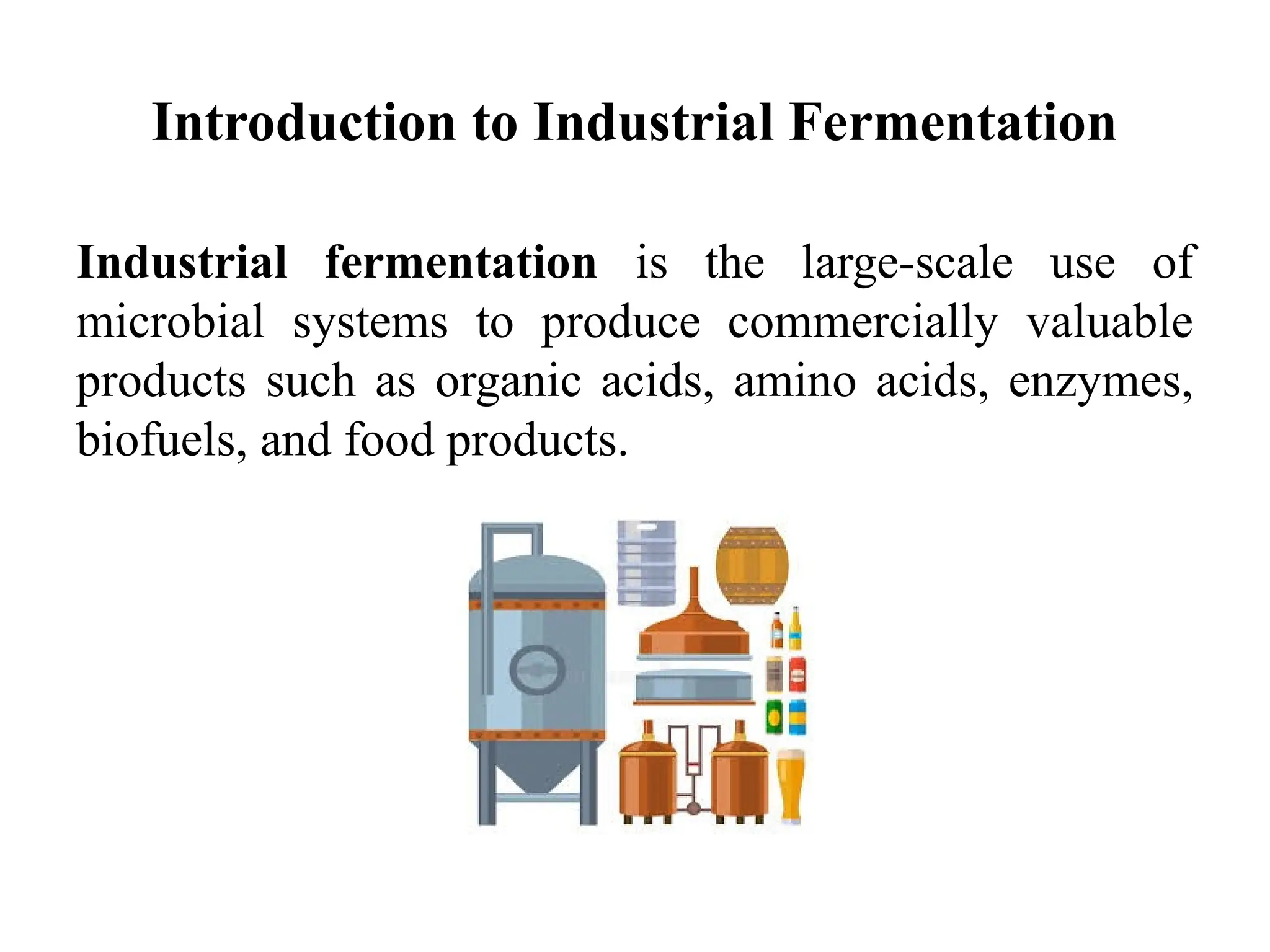
Industrial fermentation is the large-scale use of
microbial systems to produce commercially valuable
products such as organic acids, amino acids, enzymes,
biofuels, and food products.
Historical Evolution
• Traditional Uses: Started with food and beverages,
including bread, beer, and wine production.
• Modern Applications: Now used in pharmaceuticals
(e.g., antibiotics), biodegradable plastics, biofuels,
and biochemical.
Advances in Technology
• Biotechnology and biochemical engineering have
increased the efficiency and yield of fermentation
processes.
• Development of synthetic biology enables precise
control over microbial functions, making it possible
to target specific compounds
Fermentation Types
Aerobic: Requires oxygen, which supports higher
microbial metabolism and growth rates.
Anaerobic: Operates without oxygen, often
resulting in unique metabolites (e.g., alcohol).
Types of Fermentation Processes
• Aerobic Fermentation:
– Mechanism: Oxygen is required for microorganisms to
perform cellular respiration.
– Applications: Production of organic acids (e.g., citric
acid), antibiotics, and enzymes.
• Anaerobic Fermentation:
– Mechanism: Occurs in the absence of oxygen, often
producing different end-products.
– Applications: Ethanol and methane production (used in
brewing and biofuels).
Advancements
• Metabolic Engineering: Alters metabolic pathways
within microorganisms to enhance production of
specific compounds.
• Synthetic Biology: Allows for the creation of
engineered microbes with customized functionalities,
optimizing production efficiency.
Media for Industrial Fermentation
• Role of Fermentation Media:
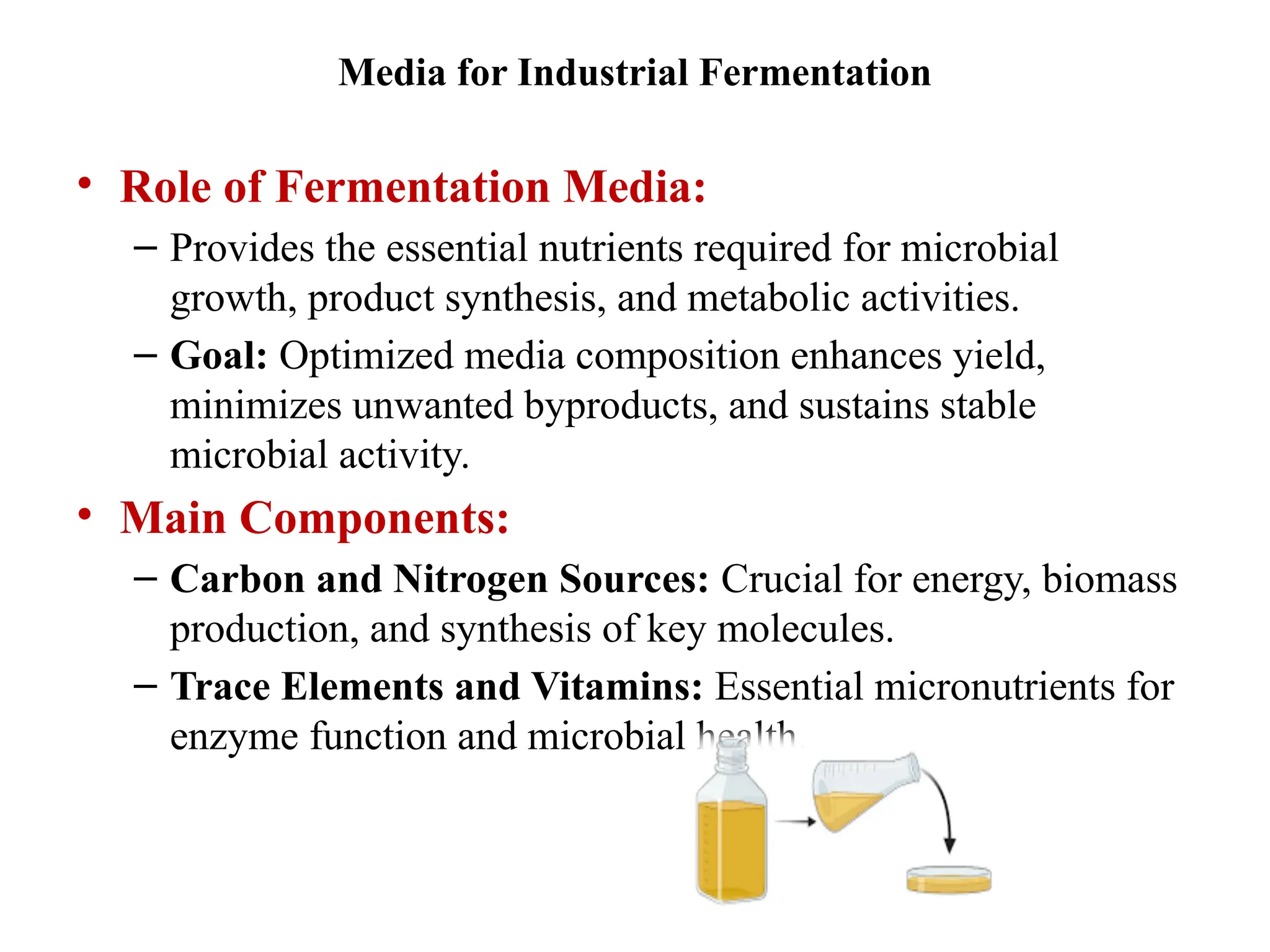
– Provides the essential nutrients required for microbial
growth, product synthesis, and metabolic activities.
– Goal: Optimized media composition enhances yield,
minimizes unwanted byproducts, and sustains stable
microbial activity.
• Main Components:
– Carbon and Nitrogen Sources: Crucial for energy, biomass
production, and synthesis of key molecules.
– Trace Elements and Vitamins: Essential micronutrients for
enzyme function and microbial health.
Role of Carbon and Nitrogen Sources
Carbon Sources:
Glucose: Most widely used due to its ease of
metabolism.
Sucrose and Glycerol: Alternatives based on cost-
effectiveness and product requirements.
Application Example: In citric acid production,
Aspergillus niger uses glucose as a carbon source;
limiting nitrogen encourages citric acid accumulation
over biomass growth.
Conti.
Nitrogen Sources:
Ammonium Salts, Urea, and Nitrates: Used in protein
and nucleotide synthesis.
Application Example: Ammonium sulfate provides
both nitrogen and pH buffering.
Considerations: Proper balance of carbon and nitrogen
is key to maximizing product yield and controlling
metabolic pathways.
Trace Elements and Growth Factors
Trace Elements:
• Magnesium (Mg² ):
⁺ Stabilizes ATP and activates
enzymes.
• Iron (Fe² /Fe³ ):
⁺ ⁺ Critical for electron transport and
metabolic redox reactions.
Growth Factors: Vitamins and other cofactors are
essential for specific metabolic functions
Example Vitamins: Biotin, thiamine, riboflavin.
Importance in Amino Acid Fermentation: Growth
factors play a significant role in optimizing yield for
amino acid production.
Optimizing Media Composition
Media Optimization Strategies:
• Fed-Batch Fermentation: Gradual feeding of
nutrients prevents substrate inhibition, enabling
higher cell density and product yield.
• Waste Utilization: Using cost-effective substrates
like molasses or lignocellulosic biomass to enhance
sustainability.
• Objective: Achieve high productivity while
minimizing costs.
Design and Types of Fermentors
• Fermentor Function: Provides an environment for
controlled microbial growth and product synthesis.
• Types of Fermentors: Choice depends on the
microorganism, process type, and desired product.
1. Stirred-Tank Fermentors (STF): Mechanically
stirred for optimal oxygen transfer.
2. Air-Lift Fermentors: Suitable for low-shear
processes.
3. Packed-Bed & Fluidized-Bed Fermentors: For
immobilized cells and continuous production.
Stirred-Tank Fermentors (STF)
Description: Cylindrical vessel with an internal agitator
for uniform mixing
Applications: Widely used in antibiotics, enzyme, and
organic acid production.
Design Elements:
• Impeller Types: Rushton turbine, marine propeller,
etc., depending on medium viscosity.
• Baffles: Vertical structures that improve mixing
efficiency and prevent vortex formation.
Stirred-Tank Fermentors (STF)
Air-Lift Fermentors
• Mechanism: Uses air bubbles for mixing, reducing
energy consumption and shear stress.
• Applications: Ideal for delicate cells and light-
requiring processes (e.g., algae cultivation).
• Additional Feature: Provides both oxygen and light
distribution for photosynthetic processes.
Air-Lift Fermentors
Packed-Bed and Fluidized-Bed Fermentors
Packed-Bed Fermentors:
• Structure: Solid supports hold immobilized cells,
allowing nutrient flow through the bed.
• Use: Continuous biochemical production without the
need for cell separation.
Fluidized-Bed Fermentors:
• Structure: Fluid dynamics keep particles suspended,
promoting high nutrient transfer.
• Application: Biofilm fermentations or immobilized
cell processes.
Packed-Bed and Fluidized-Bed Fermentors
Process Variables in Fermentation
• Key Variables: Temperature, pH, aeration, and
agitation are critical for optimal microbial growth.
• Importance: Each variable must be controlled for
consistent, high-quality product output and microbial
activity.
Temperature Control
• Role: Temperature influences microbial metabolism
and enzyme activity.
• Optimal Ranges:
• Example: Saccharomyces cerevisiae (yeast) grows
best at 30-35°C for ethanol production.
• Thermophilic Bacteria: Thermus aquaticus used in
high-temperature biofuel production.
• Control Methods: Jacketed vessels or internal heat
exchangers.
pH Control
• Importance: Affects microbial enzyme activity and
product stability.
• Example: Lactic acid production operates best at pH
5-6; citric acid at pH 2-3.
• Control Techniques: Automated acid/base addition,
pH monitoring systems.
Aeration and Oxygen Transfer
• Role in Aerobic Fermentation: Essential for
microbial respiration.
• Factors Affecting Oxygen Transfer: Agitation
speed, sparging, medium viscosity.
• Measurement: kLa (volumetric mass transfer
coefficient) as a metric for oxygen transfer efficiency.
Aeration and Oxygen Transfer
Agitation
• Purpose: Ensures nutrient mixing and prevents
sedimentation.
• Optimization: Balancing mixing efficiency with low
shear stress, especially for delicate cells.
Recovery and Purification of Fermentation Products
• Steps: Recovery, concentration, purification, and
finishing.
• Goal: Achieve high-purity products with minimal
loss.
• Applications: Purification of pharmaceuticals, food-
grade biochemical.
Primary Recovery Methods
Techniques:
• Centrifugation: Separates cells based on density.
• Filtration: Uses micro or ultrafiltration to remove
biomass.
Product Concentration
Techniques:
• Evaporation: Removes water to concentrate product.
• Precipitation: Solvents like ethanol or ammonium
sulfate induce protein or acid precipitation.
Final Purification and Finishing
• Techniques:
• Chromatography: Separates based on charge, size,
or affinity.
• Crystallization: Used for organic acid purification.
• Examples: Purification of enzymes, proteins for
pharmaceuticals.
Conclusion
Key Points: Media optimization, fermentor types,
process variables, and product recovery are essential to
efficient industrial fermentation.
Future Outlook: Industrial fermentation’s evolving
role in sustainable production for food, fuels, and
pharmaceuticals.

Industrial Fermentation: Microbial Magic for Amino Acids, Enzymes, and Biofuels

  • 1.
    Introduction to Industrial Fermentation Processes,Media, Fermenter Design, Process Variables, and Product Recovery
  • 2.
    Introduction to IndustrialFermentation Industrial fermentation is the large-scale use of microbial systems to produce commercially valuable products such as organic acids, amino acids, enzymes, biofuels, and food products.
  • 3.
    Historical Evolution • TraditionalUses: Started with food and beverages, including bread, beer, and wine production. • Modern Applications: Now used in pharmaceuticals (e.g., antibiotics), biodegradable plastics, biofuels, and biochemical.
  • 4.
    Advances in Technology •Biotechnology and biochemical engineering have increased the efficiency and yield of fermentation processes. • Development of synthetic biology enables precise control over microbial functions, making it possible to target specific compounds
  • 5.
    Fermentation Types Aerobic: Requiresoxygen, which supports higher microbial metabolism and growth rates. Anaerobic: Operates without oxygen, often resulting in unique metabolites (e.g., alcohol).
  • 6.
    Types of FermentationProcesses • Aerobic Fermentation: – Mechanism: Oxygen is required for microorganisms to perform cellular respiration. – Applications: Production of organic acids (e.g., citric acid), antibiotics, and enzymes. • Anaerobic Fermentation: – Mechanism: Occurs in the absence of oxygen, often producing different end-products. – Applications: Ethanol and methane production (used in brewing and biofuels).
  • 7.
    Advancements • Metabolic Engineering:Alters metabolic pathways within microorganisms to enhance production of specific compounds. • Synthetic Biology: Allows for the creation of engineered microbes with customized functionalities, optimizing production efficiency.
  • 8.
    Media for IndustrialFermentation • Role of Fermentation Media: – Provides the essential nutrients required for microbial growth, product synthesis, and metabolic activities. – Goal: Optimized media composition enhances yield, minimizes unwanted byproducts, and sustains stable microbial activity. • Main Components: – Carbon and Nitrogen Sources: Crucial for energy, biomass production, and synthesis of key molecules. – Trace Elements and Vitamins: Essential micronutrients for enzyme function and microbial health.
  • 9.
    Role of Carbonand Nitrogen Sources Carbon Sources: Glucose: Most widely used due to its ease of metabolism. Sucrose and Glycerol: Alternatives based on cost- effectiveness and product requirements. Application Example: In citric acid production, Aspergillus niger uses glucose as a carbon source; limiting nitrogen encourages citric acid accumulation over biomass growth.
  • 10.
    Conti. Nitrogen Sources: Ammonium Salts,Urea, and Nitrates: Used in protein and nucleotide synthesis. Application Example: Ammonium sulfate provides both nitrogen and pH buffering. Considerations: Proper balance of carbon and nitrogen is key to maximizing product yield and controlling metabolic pathways.
  • 11.
    Trace Elements andGrowth Factors Trace Elements: • Magnesium (Mg² ): ⁺ Stabilizes ATP and activates enzymes. • Iron (Fe² /Fe³ ): ⁺ ⁺ Critical for electron transport and metabolic redox reactions. Growth Factors: Vitamins and other cofactors are essential for specific metabolic functions Example Vitamins: Biotin, thiamine, riboflavin. Importance in Amino Acid Fermentation: Growth factors play a significant role in optimizing yield for amino acid production.
  • 12.
    Optimizing Media Composition MediaOptimization Strategies: • Fed-Batch Fermentation: Gradual feeding of nutrients prevents substrate inhibition, enabling higher cell density and product yield. • Waste Utilization: Using cost-effective substrates like molasses or lignocellulosic biomass to enhance sustainability. • Objective: Achieve high productivity while minimizing costs.
  • 13.
    Design and Typesof Fermentors • Fermentor Function: Provides an environment for controlled microbial growth and product synthesis. • Types of Fermentors: Choice depends on the microorganism, process type, and desired product. 1. Stirred-Tank Fermentors (STF): Mechanically stirred for optimal oxygen transfer. 2. Air-Lift Fermentors: Suitable for low-shear processes. 3. Packed-Bed & Fluidized-Bed Fermentors: For immobilized cells and continuous production.
  • 14.
    Stirred-Tank Fermentors (STF) Description:Cylindrical vessel with an internal agitator for uniform mixing Applications: Widely used in antibiotics, enzyme, and organic acid production. Design Elements: • Impeller Types: Rushton turbine, marine propeller, etc., depending on medium viscosity. • Baffles: Vertical structures that improve mixing efficiency and prevent vortex formation.
  • 15.
  • 16.
    Air-Lift Fermentors • Mechanism:Uses air bubbles for mixing, reducing energy consumption and shear stress. • Applications: Ideal for delicate cells and light- requiring processes (e.g., algae cultivation). • Additional Feature: Provides both oxygen and light distribution for photosynthetic processes.
  • 17.
  • 18.
    Packed-Bed and Fluidized-BedFermentors Packed-Bed Fermentors: • Structure: Solid supports hold immobilized cells, allowing nutrient flow through the bed. • Use: Continuous biochemical production without the need for cell separation. Fluidized-Bed Fermentors: • Structure: Fluid dynamics keep particles suspended, promoting high nutrient transfer. • Application: Biofilm fermentations or immobilized cell processes.
  • 19.
  • 20.
    Process Variables inFermentation • Key Variables: Temperature, pH, aeration, and agitation are critical for optimal microbial growth. • Importance: Each variable must be controlled for consistent, high-quality product output and microbial activity.
  • 22.
    Temperature Control • Role:Temperature influences microbial metabolism and enzyme activity. • Optimal Ranges: • Example: Saccharomyces cerevisiae (yeast) grows best at 30-35°C for ethanol production. • Thermophilic Bacteria: Thermus aquaticus used in high-temperature biofuel production. • Control Methods: Jacketed vessels or internal heat exchangers.
  • 24.
    pH Control • Importance:Affects microbial enzyme activity and product stability. • Example: Lactic acid production operates best at pH 5-6; citric acid at pH 2-3. • Control Techniques: Automated acid/base addition, pH monitoring systems.
  • 26.
    Aeration and OxygenTransfer • Role in Aerobic Fermentation: Essential for microbial respiration. • Factors Affecting Oxygen Transfer: Agitation speed, sparging, medium viscosity. • Measurement: kLa (volumetric mass transfer coefficient) as a metric for oxygen transfer efficiency.
  • 27.
  • 28.
    Agitation • Purpose: Ensuresnutrient mixing and prevents sedimentation. • Optimization: Balancing mixing efficiency with low shear stress, especially for delicate cells.
  • 29.
    Recovery and Purificationof Fermentation Products • Steps: Recovery, concentration, purification, and finishing. • Goal: Achieve high-purity products with minimal loss. • Applications: Purification of pharmaceuticals, food- grade biochemical.
  • 31.
    Primary Recovery Methods Techniques: •Centrifugation: Separates cells based on density. • Filtration: Uses micro or ultrafiltration to remove biomass.
  • 32.
    Product Concentration Techniques: • Evaporation:Removes water to concentrate product. • Precipitation: Solvents like ethanol or ammonium sulfate induce protein or acid precipitation.
  • 33.
    Final Purification andFinishing • Techniques: • Chromatography: Separates based on charge, size, or affinity. • Crystallization: Used for organic acid purification. • Examples: Purification of enzymes, proteins for pharmaceuticals.
  • 34.
    Conclusion Key Points: Mediaoptimization, fermentor types, process variables, and product recovery are essential to efficient industrial fermentation. Future Outlook: Industrial fermentation’s evolving role in sustainable production for food, fuels, and pharmaceuticals.