Introduc)on to WebVR
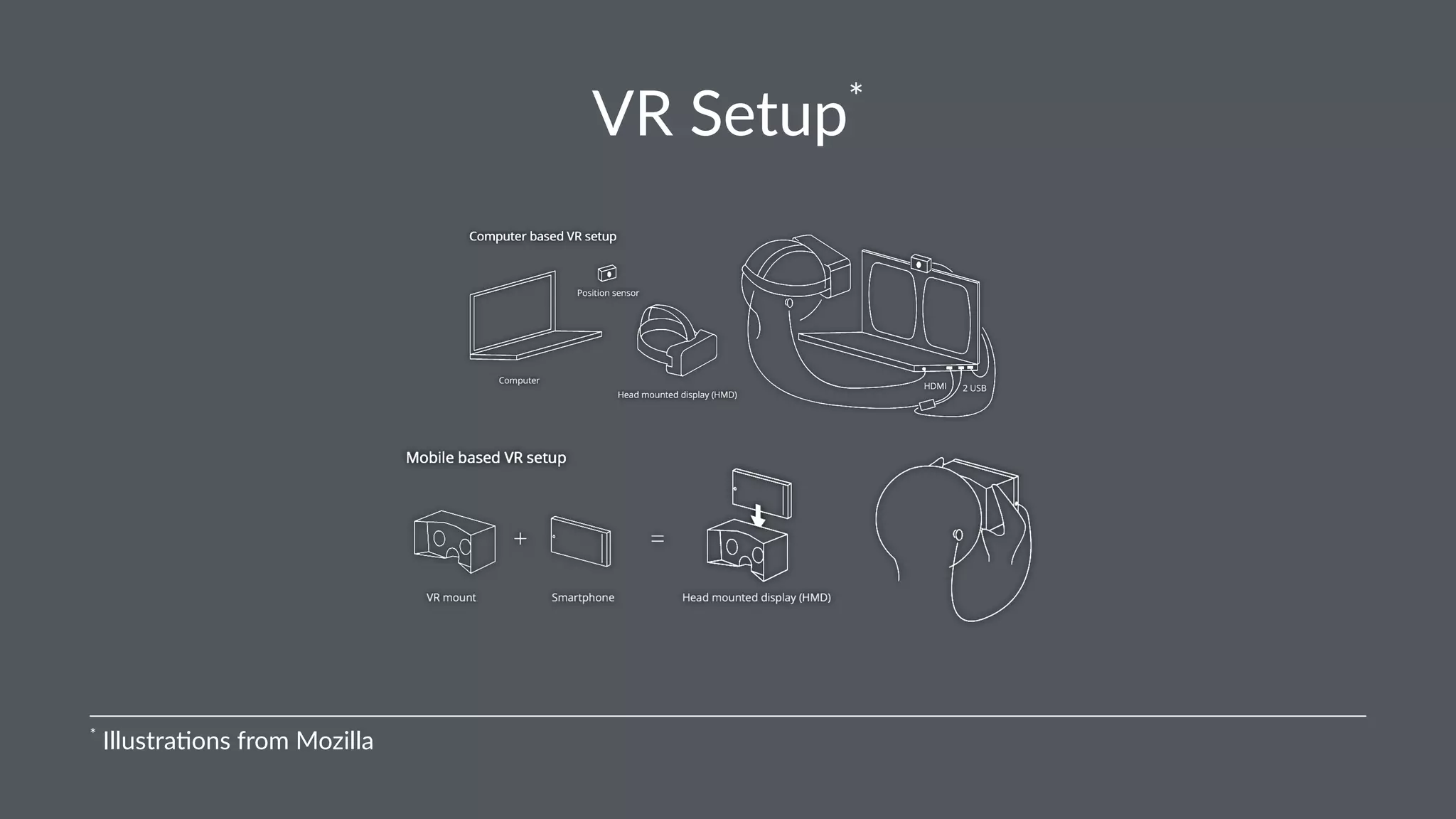
VR Setup*
*
Illustra*ons from Mozilla
VR Experiences
New considera-ons for VR app development
Focus on User Experience
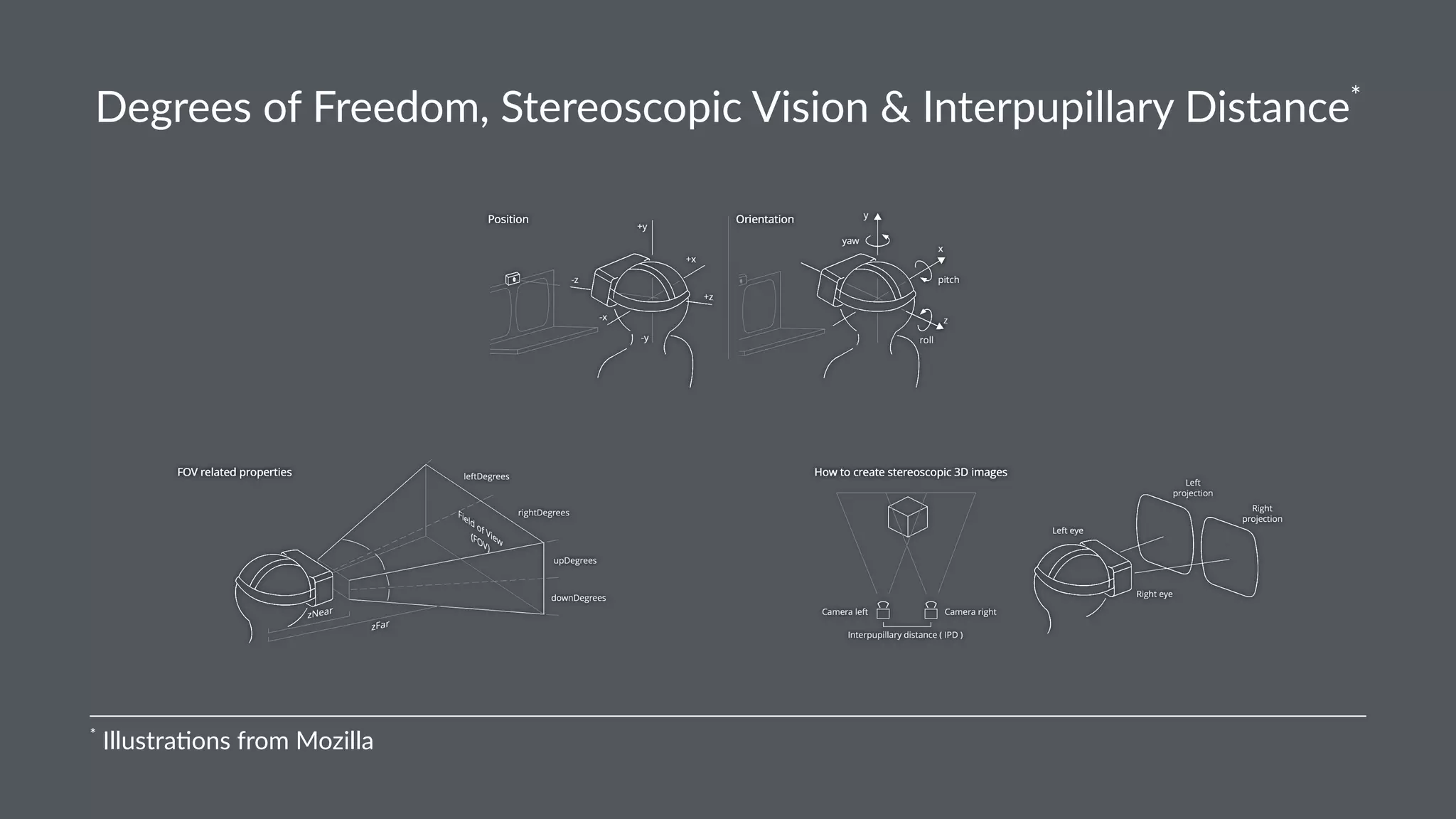
- Stereoscopic vision & interpupillary distance (IPD)
- Head tracking & degrees of freedom (DoF)
- Cone of focus & field of view (FOV)
- 3D posi-onal audio
- Latency & frame rate (frames per second / FPS)
Focus on User Comfort
- Eye strain
- Mo-on sickness
Degrees of Freedom, Stereoscopic Vision & Interpupillary Distance*
*
Illustra*ons from Mozilla
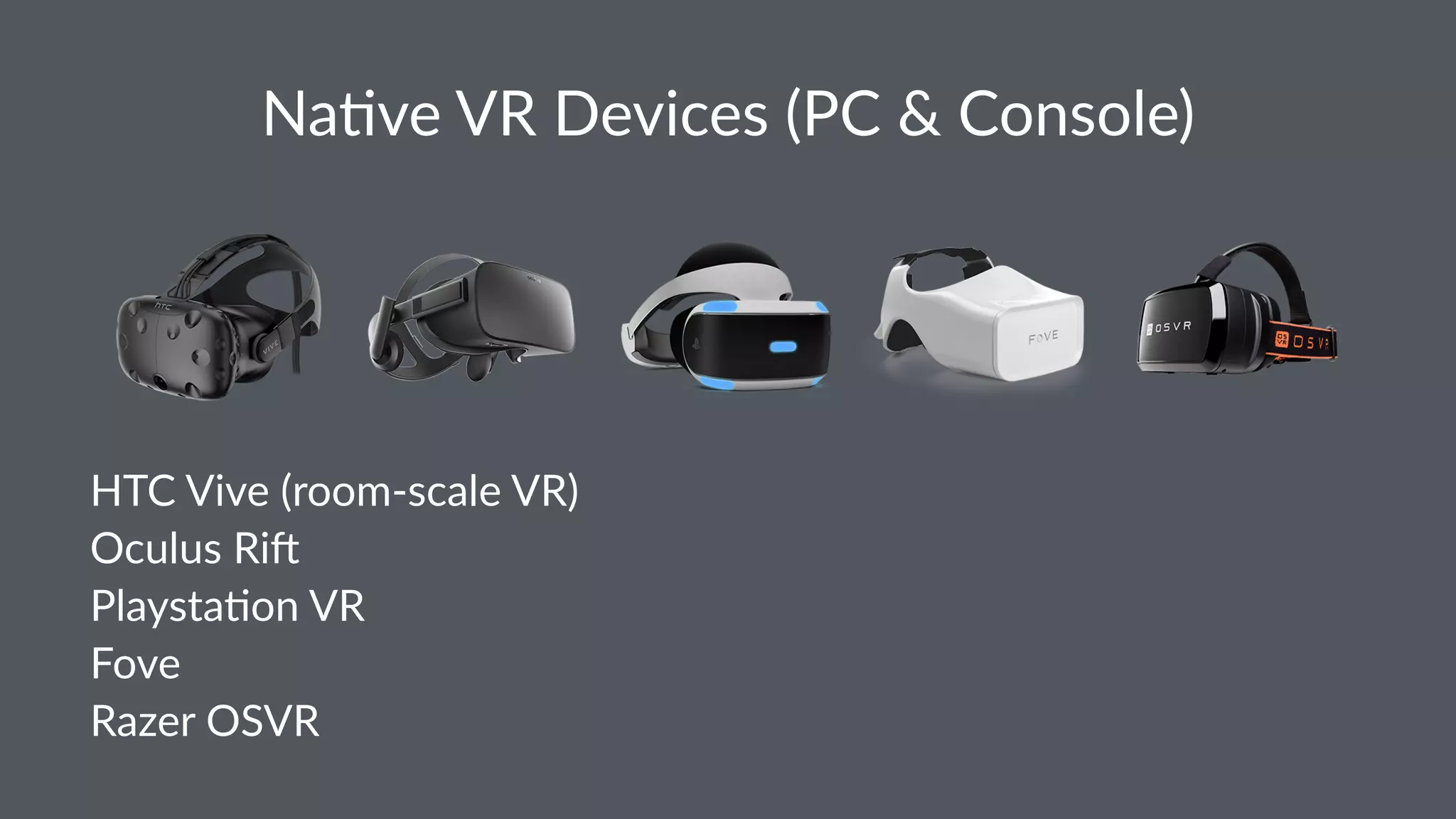
Na#ve VR Devices (PC & Console)
HTC Vive (room-scale VR)
Oculus Ri6
Playsta:on VR
Fove
Razer OSVR
Mobile VR Devices (Smartphone)
Samsung Gear VR
Daydream
Cardboard
Hundreds of third-party headsets
VR Programming
• Unreal Engine (C++)
• Unity (C#)
• Source Engine (C++)
• WebVR (JS)
VR Distribu+on
• SteamVR
• Google Play
• Oculus Store
• The Ri8 Arcade
• V "open alterna>ve" to SteamVR
Why WebVR?
• No app store ecosystem, distribu3on via internet
• Mobile & desktop automa3cally supported
• Uses current tools and libraries for JS
• Easy switch between VR & non-VR mode
• Interfacing with hardware through the browser
Progressive Enhancement by Arturo Paracuellos
Virtual Reality on the Web
A Retrospec+ve 1/2
• 1994 VRML - first a0empt to create an internet-based 3D
language. (Mark Pesce presented the Labyrinth demo he
developed with Tony Parisi and Peter Kennard.)
• VRML2 (1997) - added many features (animaMon) and later was
succeeded by X3D
Problem of VRML: plugin-based technology that only came
preinstalled on IE
Virtual Reality on the Web
A Retrospec+ve 2/2
• 2003 OpenGL ES - cross-language and mul9-pla:orm 3D
graphics API.
Hardware accelerated rendering of 3D objects.
• WebGL 1.0 introduced by Mozilla based on OpenGL ES uses
DOM (canvas element)
• X3D introduced X3DOM
Most popular WebGL
Engines today
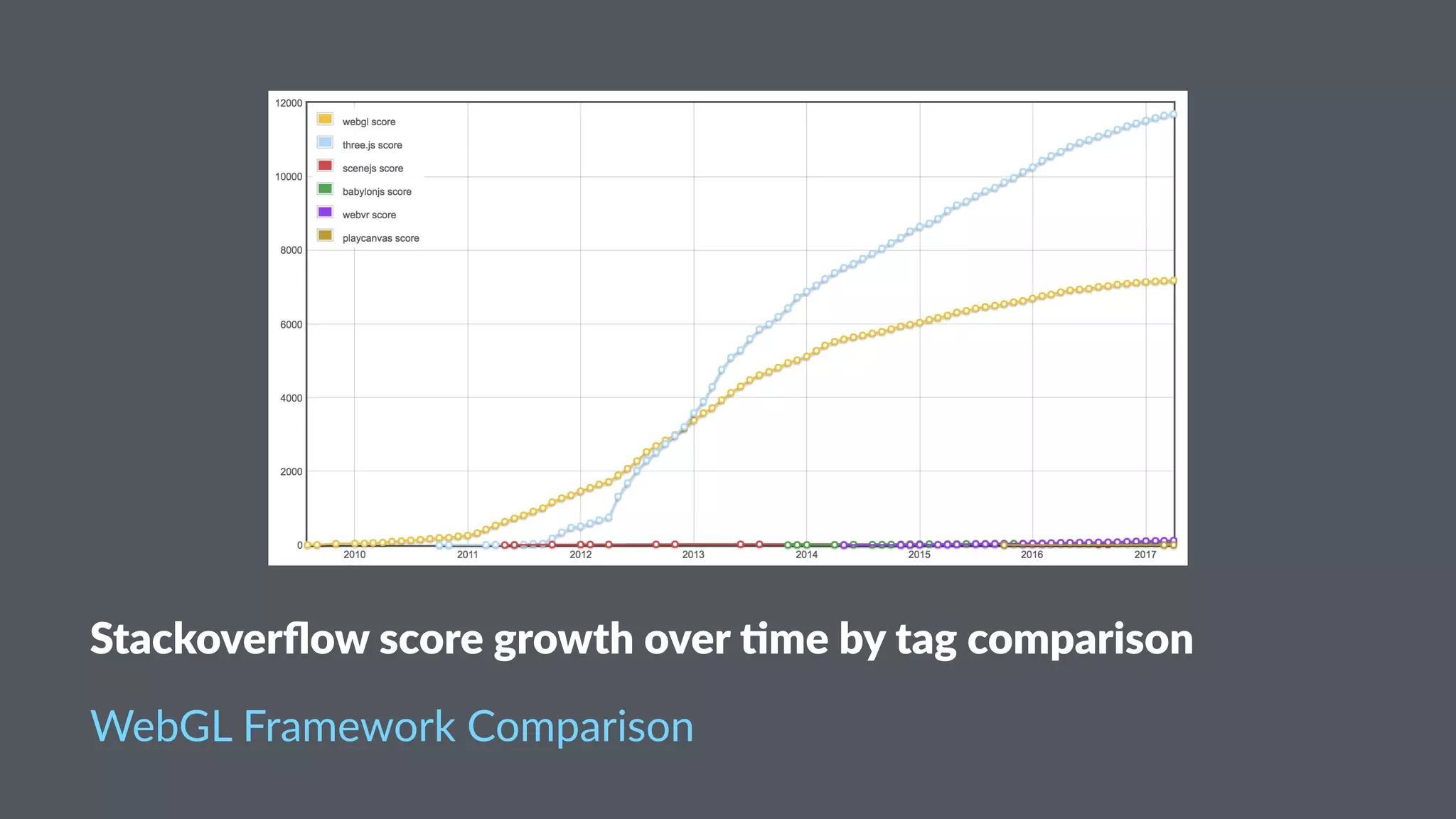
• Three.js by Ricardo Cabello in 2010
• Babylon.js
• PlayCanvas.js
• Goo Engine
• Scene.js
• Turbulenz
Stackoverflow score growth over 0me by tag comparison
WebGL Framework Comparison
What is WebVR?
WebVR is a experimental Javascript API that
provides interfaces to VR hardware to allow
developers to build compelling, comfortable
VR experiences on the web.
WebVR
WebVR v1.1 Editor’s Dra,, 04/05/17
- deviceOrienta-on
- VRDisplay object handles almost everything
- available on mul-ple pla<orms
..soon..
WebVR (2.0) Editor’s Dra,, 04/17/17
- not backwards compa-ble
- device support
- introduc-on of VRDevice & VRSession to replace VRDisplay
- read Explainer doc!
Goals of WebVR
• Detect available virtual reality devices.
• Query the device’s capabili6es.
• Poll the device’s posi6on and orienta6on.
• Display imagery on the device at the appropriate frame rate.
Non-goals of WebVR
• Define how a virtual reality browser would work.
• Take full advantage of augmented reality devices.
• Build “The Metaverse.”
Check out h*ps://webvr.rocks/ for support updates
WebVR Frameworks
• A-Frame by Mozilla
• ReactVR by Facebook
• ForgeJS by GoPro, Inc., great for 360 photo & video content
• Primrose great for collaboraIve VR web apps
• Janus VR VR browser/editor
• Vizor in-browser VR development, SocialVR
• GLAM (GL And Markup) declaraIve language for 3D web
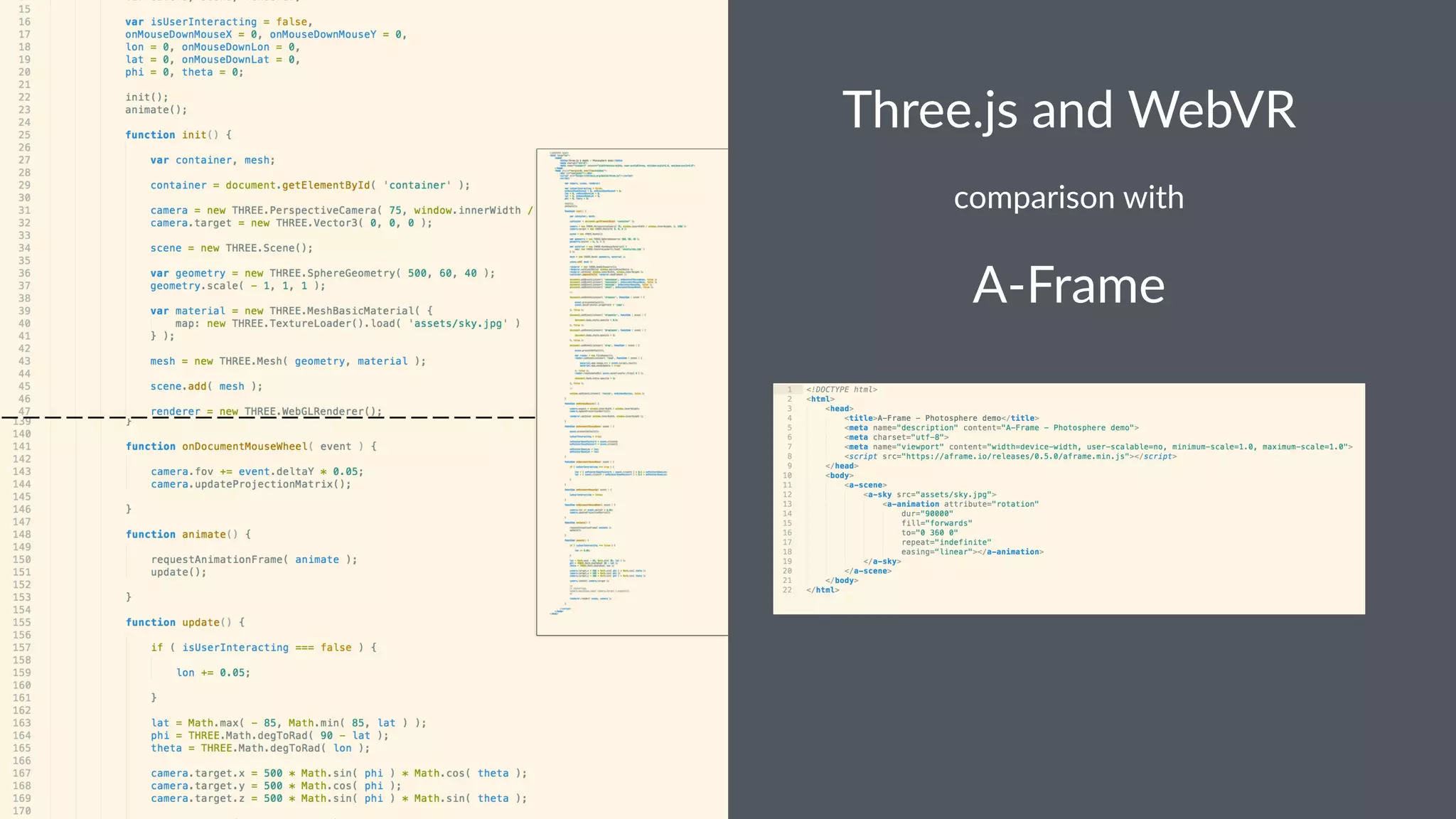
Demo Comparison A & B
Three.js and WebVR
comparison with
A-Frame
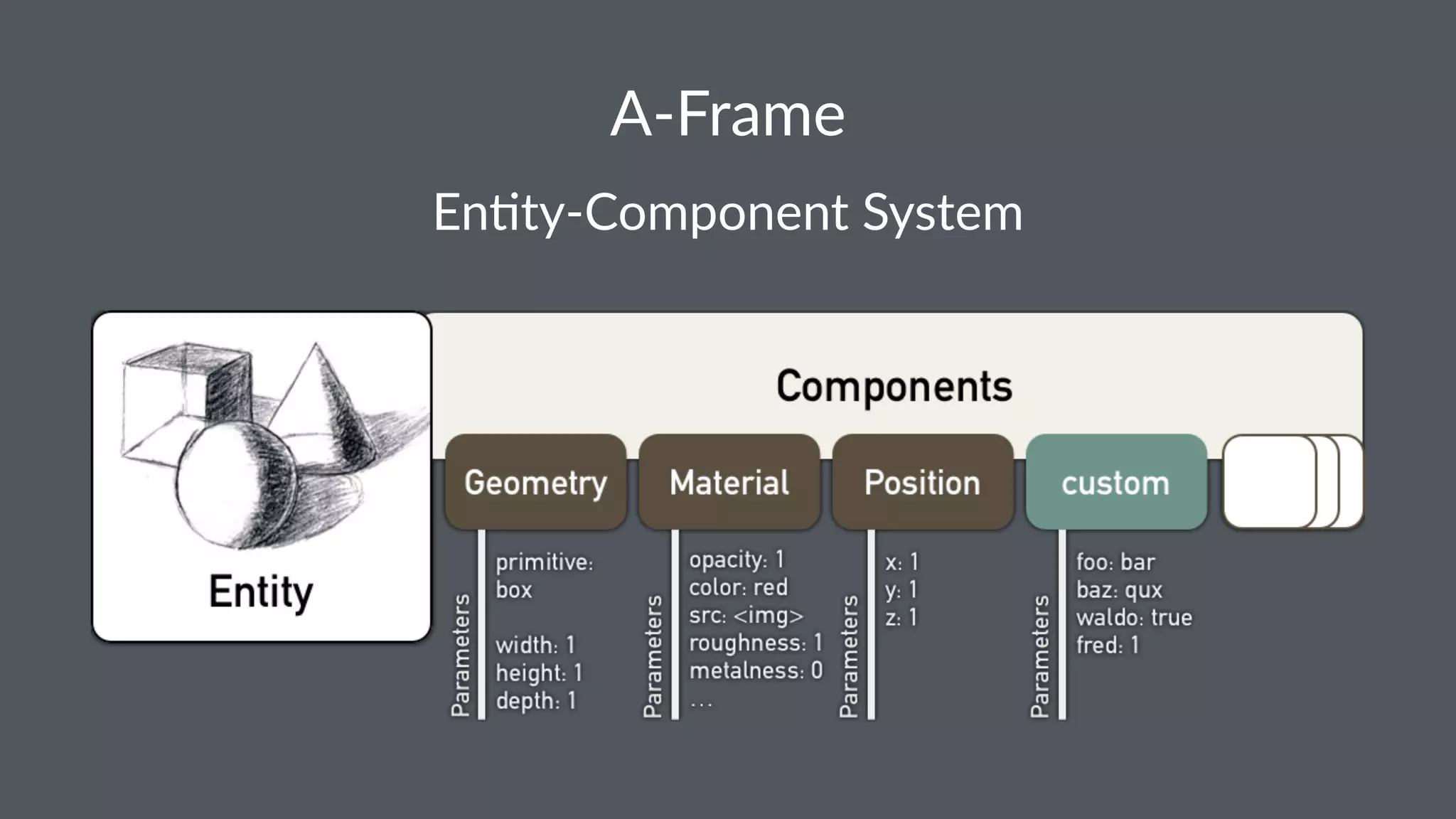
A-Frame
• a 3DML (3D markup language) like X3Dom and GLAM
• DOM-based En>ty-Component System => declara>ve &
extensible (similar to Unity/UE4/PlayCanvas)
The A-Frame Stack:
A-Frame
En#ty-Component System
A-Frame
• En$$es are HTML elements (i.e., <a-entity>)
• Components are HTML a9ributes, set on the en$ty
<body>
<a-scene>
<a-entity geometry="primitive:box" material="color:#c00">
</a-entity>
</a-scene>
</body>
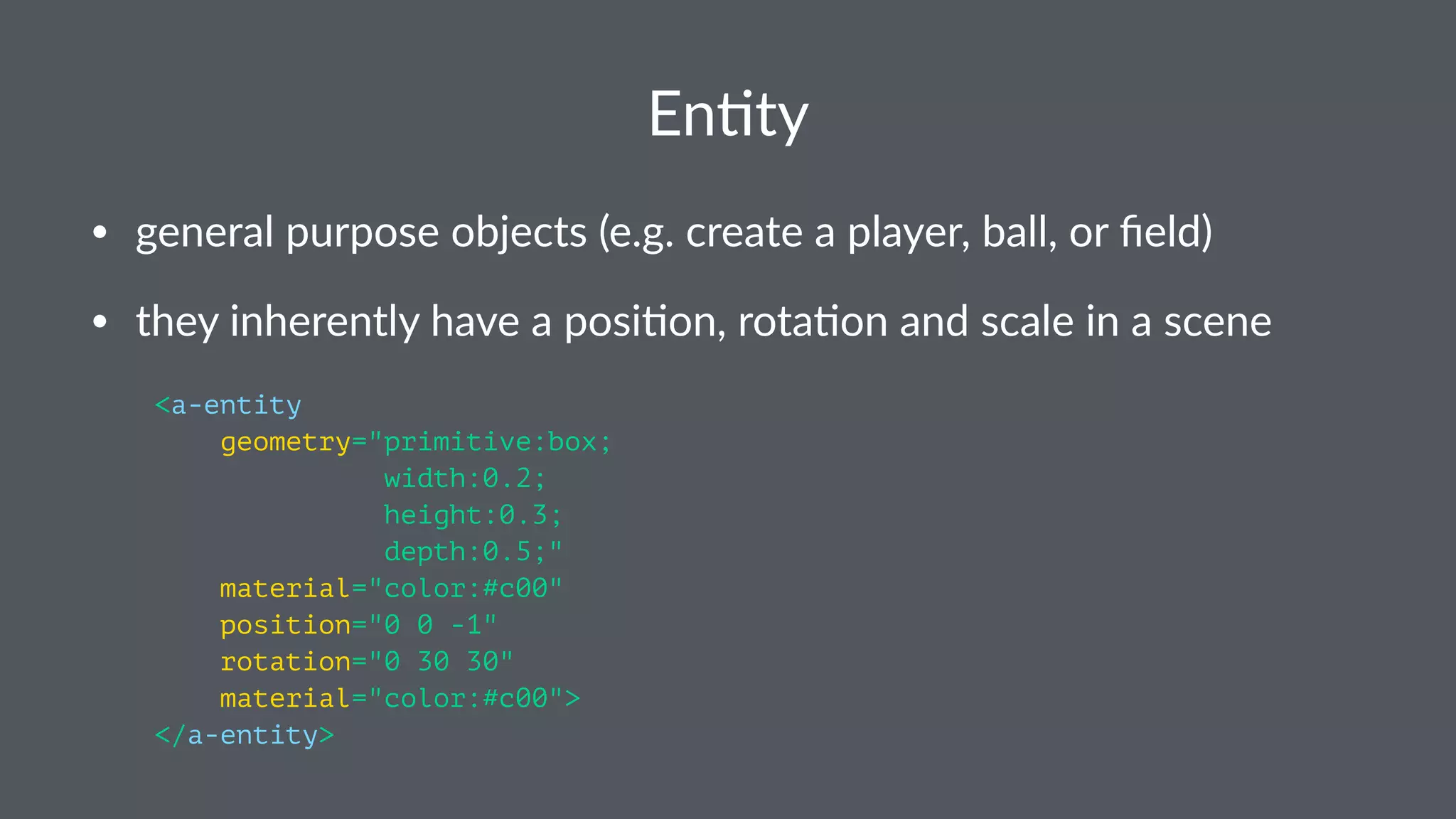
En#ty
• general purpose objects (e.g. create a player, ball, or field)
• they inherently have a posi;on, rota;on and scale in a scene
<a-entity
geometry="primitive:box;
width:0.2;
height:0.3;
depth:0.5;"
material="color:#c00"
position="0 0 -1"
rotation="0 30 30"
material="color:#c00">
</a-entity>
Primi%ves (concise, seman%c building blocks)
<a-entity geometry="primitive:box;
width:0.2;
height:0.3;
depth:0.5;"
material="color:#c00">
</a-entity>
<a-box width="0.2"
height="0.3"
depth="0.5"
material="color:#c00">
</a-box>
Mixins
<a-mixin id="box"
geometry="primitive:box;
width:0.2;
height:0.3;
depth:0.5;"
material="color:#c00">
</a-mixin>
<a-entity mixin="box">
</a-entity>
Custom Components
AFRAME.registerComponent('foo', {
schema: {
bar: {type: 'number'},
baz: {type: 'string'}
},
init: function () {
// Do something when component is plugged in.
},
update: function () {
// Do something when component's data is updated.
}
});
Gaze-Based Control
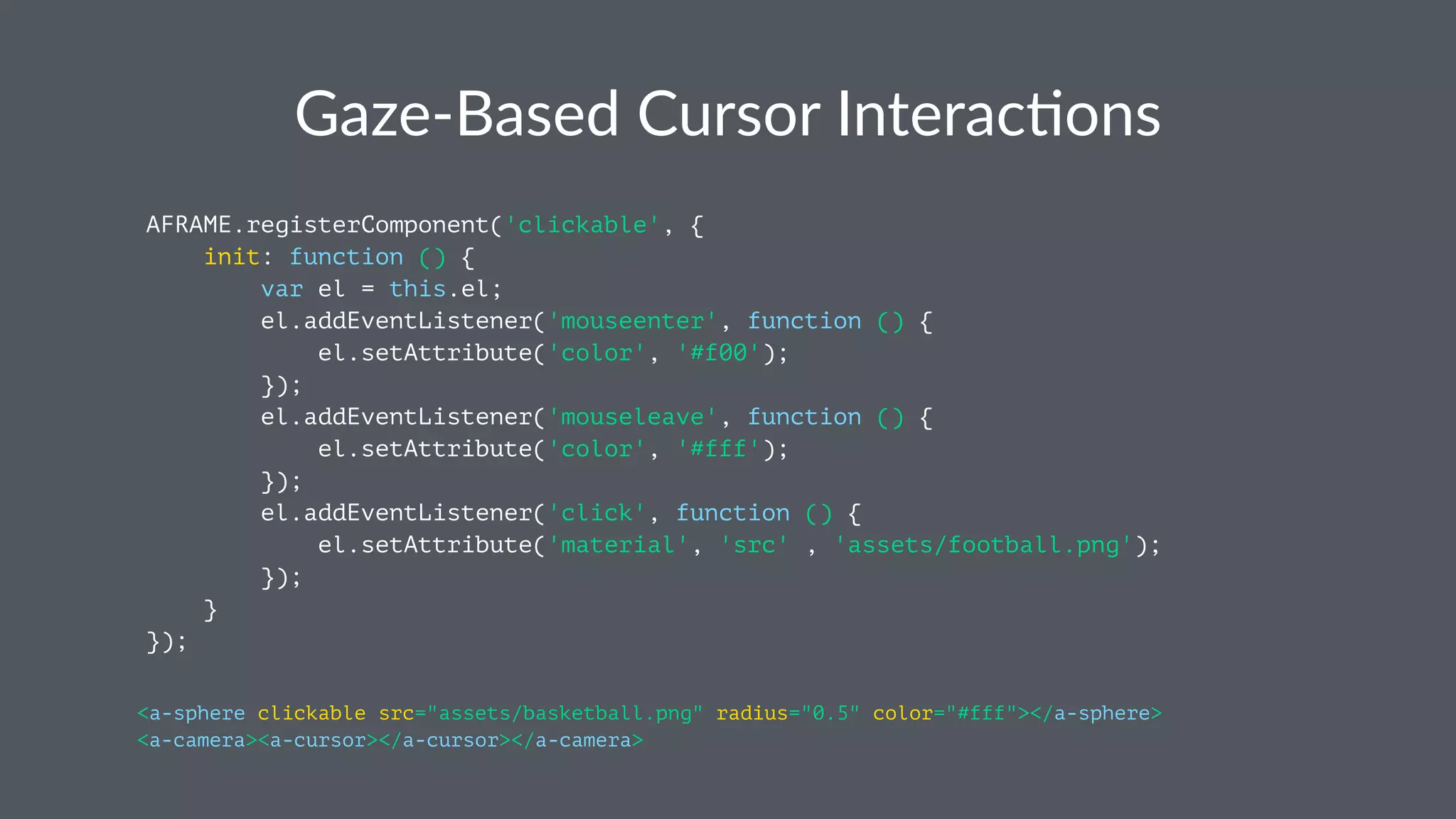
Gaze-Based Cursor Interac2ons
AFRAME.registerComponent('clickable', {
init: function () {
var el = this.el;
el.addEventListener('mouseenter', function () {
el.setAttribute('color', '#f00');
});
el.addEventListener('mouseleave', function () {
el.setAttribute('color', '#fff');
});
el.addEventListener('click', function () {
el.setAttribute('material', 'src' , 'assets/football.png');
});
}
});
<a-sphere clickable src="assets/basketball.png" radius="0.5" color="#fff"></a-sphere>
<a-camera><a-cursor></a-cursor></a-camera>
A-Frame Component Registry
h"ps://aframe.io/docs/0.5.0/
A-Frame Inspector
[control]+[option]+[i]
Create responsibly!
Resources
* A-Frame Slack
* A-Frame Component Registry
* mozvr.com
* VR Gets Real with WebVR
* WebVR API
* The UX of VR
Get In Touch
@rolanddubois
rolanddubois.com
It’s code *me! Here’s what we’re building:
• github.com/rdub80/Ferguson-VR-Hackathon
• XAMPP, MAMP or $ python -m SimpleHTTPServer
• JSBin

Ferguson VR Hackathon - May 6, 2017

  • 1.
  • 2.
  • 3.
    VR Experiences New considera-onsfor VR app development Focus on User Experience - Stereoscopic vision & interpupillary distance (IPD) - Head tracking & degrees of freedom (DoF) - Cone of focus & field of view (FOV) - 3D posi-onal audio - Latency & frame rate (frames per second / FPS) Focus on User Comfort - Eye strain - Mo-on sickness
  • 4.
    Degrees of Freedom,Stereoscopic Vision & Interpupillary Distance* * Illustra*ons from Mozilla
  • 5.
    Na#ve VR Devices(PC & Console) HTC Vive (room-scale VR) Oculus Ri6 Playsta:on VR Fove Razer OSVR
  • 6.
    Mobile VR Devices(Smartphone) Samsung Gear VR Daydream Cardboard Hundreds of third-party headsets
  • 7.
    VR Programming • UnrealEngine (C++) • Unity (C#) • Source Engine (C++) • WebVR (JS)
  • 8.
    VR Distribu+on • SteamVR •Google Play • Oculus Store • The Ri8 Arcade • V "open alterna>ve" to SteamVR
  • 9.
    Why WebVR? • Noapp store ecosystem, distribu3on via internet • Mobile & desktop automa3cally supported • Uses current tools and libraries for JS • Easy switch between VR & non-VR mode • Interfacing with hardware through the browser
  • 10.
    Progressive Enhancement byArturo Paracuellos
  • 11.
    Virtual Reality onthe Web A Retrospec+ve 1/2 • 1994 VRML - first a0empt to create an internet-based 3D language. (Mark Pesce presented the Labyrinth demo he developed with Tony Parisi and Peter Kennard.) • VRML2 (1997) - added many features (animaMon) and later was succeeded by X3D Problem of VRML: plugin-based technology that only came preinstalled on IE
  • 12.
    Virtual Reality onthe Web A Retrospec+ve 2/2 • 2003 OpenGL ES - cross-language and mul9-pla:orm 3D graphics API. Hardware accelerated rendering of 3D objects. • WebGL 1.0 introduced by Mozilla based on OpenGL ES uses DOM (canvas element) • X3D introduced X3DOM
  • 13.
    Most popular WebGL Enginestoday • Three.js by Ricardo Cabello in 2010 • Babylon.js • PlayCanvas.js • Goo Engine • Scene.js • Turbulenz
  • 14.
    Stackoverflow score growthover 0me by tag comparison WebGL Framework Comparison
  • 15.
    What is WebVR? WebVRis a experimental Javascript API that provides interfaces to VR hardware to allow developers to build compelling, comfortable VR experiences on the web.
  • 16.
    WebVR WebVR v1.1 Editor’sDra,, 04/05/17 - deviceOrienta-on - VRDisplay object handles almost everything - available on mul-ple pla<orms ..soon.. WebVR (2.0) Editor’s Dra,, 04/17/17 - not backwards compa-ble - device support - introduc-on of VRDevice & VRSession to replace VRDisplay - read Explainer doc!
  • 17.
    Goals of WebVR •Detect available virtual reality devices. • Query the device’s capabili6es. • Poll the device’s posi6on and orienta6on. • Display imagery on the device at the appropriate frame rate.
  • 18.
    Non-goals of WebVR •Define how a virtual reality browser would work. • Take full advantage of augmented reality devices. • Build “The Metaverse.” Check out h*ps://webvr.rocks/ for support updates
  • 19.
    WebVR Frameworks • A-Frameby Mozilla • ReactVR by Facebook • ForgeJS by GoPro, Inc., great for 360 photo & video content • Primrose great for collaboraIve VR web apps • Janus VR VR browser/editor • Vizor in-browser VR development, SocialVR • GLAM (GL And Markup) declaraIve language for 3D web
  • 20.
  • 21.
  • 22.
    A-Frame • a 3DML(3D markup language) like X3Dom and GLAM • DOM-based En>ty-Component System => declara>ve & extensible (similar to Unity/UE4/PlayCanvas) The A-Frame Stack:
  • 23.
  • 24.
    A-Frame • En$$es areHTML elements (i.e., <a-entity>) • Components are HTML a9ributes, set on the en$ty <body> <a-scene> <a-entity geometry="primitive:box" material="color:#c00"> </a-entity> </a-scene> </body>
  • 25.
    En#ty • general purposeobjects (e.g. create a player, ball, or field) • they inherently have a posi;on, rota;on and scale in a scene <a-entity geometry="primitive:box; width:0.2; height:0.3; depth:0.5;" material="color:#c00" position="0 0 -1" rotation="0 30 30" material="color:#c00"> </a-entity>
  • 26.
    Primi%ves (concise, seman%cbuilding blocks) <a-entity geometry="primitive:box; width:0.2; height:0.3; depth:0.5;" material="color:#c00"> </a-entity> <a-box width="0.2" height="0.3" depth="0.5" material="color:#c00"> </a-box>
  • 27.
  • 28.
    Custom Components AFRAME.registerComponent('foo', { schema:{ bar: {type: 'number'}, baz: {type: 'string'} }, init: function () { // Do something when component is plugged in. }, update: function () { // Do something when component's data is updated. } });
  • 29.
  • 30.
    Gaze-Based Cursor Interac2ons AFRAME.registerComponent('clickable',{ init: function () { var el = this.el; el.addEventListener('mouseenter', function () { el.setAttribute('color', '#f00'); }); el.addEventListener('mouseleave', function () { el.setAttribute('color', '#fff'); }); el.addEventListener('click', function () { el.setAttribute('material', 'src' , 'assets/football.png'); }); } }); <a-sphere clickable src="assets/basketball.png" radius="0.5" color="#fff"></a-sphere> <a-camera><a-cursor></a-cursor></a-camera>
  • 31.
  • 32.
  • 33.
  • 34.
  • 35.
    Resources * A-Frame Slack *A-Frame Component Registry * mozvr.com * VR Gets Real with WebVR * WebVR API * The UX of VR Get In Touch @rolanddubois rolanddubois.com
  • 36.
    It’s code *me!Here’s what we’re building: • github.com/rdub80/Ferguson-VR-Hackathon • XAMPP, MAMP or $ python -m SimpleHTTPServer • JSBin