Valuation
under
FEMA,
1999
C O MPRE HE NSIVE V IE W
24 TH SE PT 2 0 21
FEMA
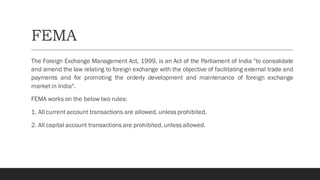
The Foreign Exchange Management Act, 1999, is an Act of the Parliament of India "to consolidate
and amend the law relating to foreign exchange with the objective of facilitating external trade and
payments and for promoting the orderly development and maintenance of foreign exchange
market in India".
FEMA works on the below two rules:
1. All current account transactions are allowed, unless prohibited,
2. All capital account transactions are prohibited, unless allowed.
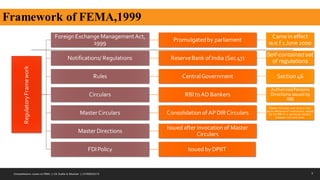
Regulatory
Frame
work
Foreign Exchange ManagementAct,
1999
Promulgatedby parliament
Came in effect
w.e.f 1 June 2000
Notifications/ Regulations ReserveBank of India (Sec47)
Self-contained set
of regulations
Rules CentralGovernment Section 46
Circulars RBItoAD Bankers
AuthorizedPersons
Directionsissued by
RBI
MasterCirculars Consolidation of APDIRCirculars
Master Circulars use to be a one-

point reference of instructions issued
by the RBI on a particular subject
between July and June.
Master Directions
Issued after invocation of Master
Circulars
FDIPolicy Issued by DPIIT
Framework of FEMA,1999
3
Comprehensive course on FEMA || CA. Sudha G. Bhushan || 9769033172
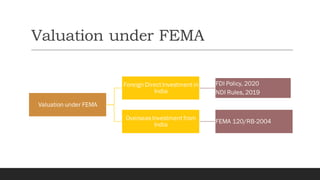
Valuation under FEMA
Foreign Direct Investment in
India
FDI Policy, 2020
NDI Rules, 2019
Overseas Investmentfrom
India FEMA 120/RB-2004
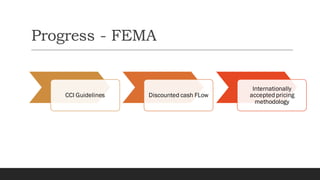
Progress - FEMA
CCI Guidelines Discounted cash FLow
Internationally
accepted pricing
methodology
Foreign
Direct
Investment
FDI
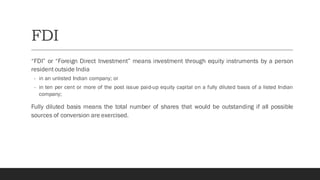
“FDI” or “Foreign Direct Investment” means investment through equity instruments by a person
resident outside India
- in an unlisted Indian company; or
- in ten per cent or more of the post issue paid-up equity capital on a fully diluted basis of a listed Indian
company;
Fully diluted basis means the total number of shares that would be outstanding if all possible
sources of conversion are exercised.
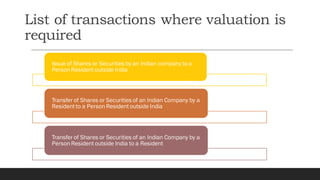
List of transactions where valuation is
required
Issue of Shares or Securities by an Indian company to a
Person Resident outside India
Transfer of Shares or Securities of an Indian Company by a
Resident to a Person Resident outside India
Transfer of Shares or Securities of an Indian Company by a
Person Resident outside India to a Resident
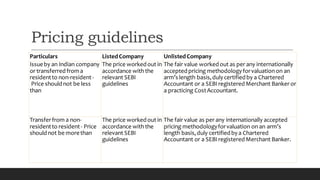
Pricing guidelines
Particulars ListedCompany UnlistedCompany
Issueby an Indian company
or transferredfroma
residentto non-resident-
Price shouldnot be less
than
The price workedout in
accordance with the
relevant SEBI
guidelines
The fair value workedout as per any internationally
acceptedpricing methodologyforvaluation on an
arm’slength basis,dulycertifiedby a Chartered
Accountant or a SEBI registeredMerchant Banker or
a practicing CostAccountant.
Transferfrom a non-
residentto resident- Price
shouldnot be morethan
The price workedout in
accordance with the
relevant SEBI
guidelines
The fair value as per any internationally accepted
pricing methodologyforvaluation on an arm’s
length basis,duly certifiedbya Chartered
Accountant or a SEBI registeredMerchant Banker.
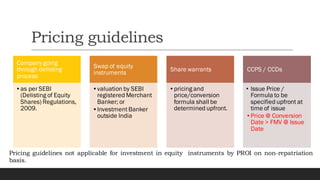
Pricing guidelines
Company going
through delisting
process
•as per SEBI
(Delisting of Equity
Shares) Regulations,
2009.
Swap of equity
instruments
•valuation by SEBI
registered Merchant
Banker; or
•InvestmentBanker
outside India
Share warrants
•pricing and
price/conversion
formula shall be
determined upfront.
CCPS / CCDs
• Issue Price /
Formula to be
specified upfront at
time of issue
•Price @ Conversion
Date > FMV @ Issue
Date
Pricing guidelines not applicable for investment in equity instruments by PROI on non-repatriation
basis.
NDI Rules, 2019: Equity
Instruments
2(k) “equity instruments” means equity shares, convertible debentures, preference shares
and share warrants issued by an Indian company;
Explanation:-
(i) Equity shares issued in accordance with the provisions of the Companies Act, 2013 shall
include equity shares that have been partly paid. “Convertible debentures” means fully,
compulsorily and mandatorily convertible debentures.
Preference shares” means fully, compulsorily and mandatorily convertible preference shares.
Share Warrants are those issued by an Indian company in accordance with the regulations
by the Securities and Exchange Board of India. Equity instruments can contain an optionality
clause subject to a minimum lock-in period of one year or as prescribed for the specific
sector, whichever is higher, but without any option or right to exit at an assured price.
NDI Rules, 2019: Equity Instruments
(ii) Partly paid shares that have been issued to a person resident outside India shall be fully
called-up within twelve months of such issue or as may be specified by the Reserve Bank
from time to time. Twenty- five per cent of the total consideration amount (including share
premium, if any) shall be received upfront.
(iii) In case of share warrants, at least twenty-five per cent of the consideration shall be
received upfront and the balance amount within eighteen months of the issuance of share
warrants.
Special Dispensation
under FEMA
Valuation
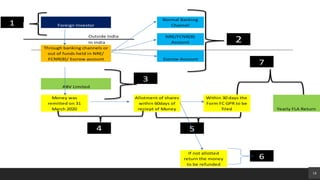
1
Outside India
In India
1
3
7
4 5
Within 30 days the
Form FC GPR to be
filed Yearly FLA Return
If not allotted
return the money
to be refunded
Through banking channels or
out of funds held in NRE/
FCNR(B)/ Escrow account
Foreign Investor
Normal Banking
Channel
Debit to
NRE/FCNR(B)
Account
Escrow Account
Money was
remitted on 31
March 2020
Allotment of shares
within 60days of
reciept of Money
ABV Limited
2
6
14
15
Issuedetails
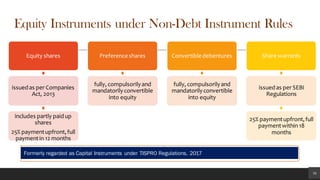
Equity Instruments under Non-Debt Instrument Rules
Equity shares
issuedas per Companies
Act, 2013
includes partly paidup
shares
25% paymentupfront,full
paymentin 12 months
Preferenceshares
fully, compulsorilyand
mandatorilyconvertible
into equity
Convertibledebentures
fully, compulsorilyand
mandatorilyconvertible
into equity
Share warrants
issuedas per SEBI
Regulations
25% paymentupfront,full
paymentwithin 18
months
Formerly regarded as Capital Instruments under TISPRO Regulations, 2017
16
17
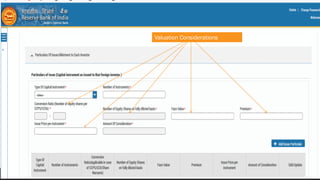
Valuation Considerations
Case 1: PRICING IN CASE OF INVESTMENT BY WAY OF
SUBSCRIPTION TO ITS MEMORANDUM OF ASSOCIATION
It may be noted that where non-residents (including NRIs) are making investments in an Indian company in compliance
with the provisions of the Companies Act, 2013, by way of subscription to its Memorandum of Association, such
investments may be made at face value subject to their eligibility to invest under the FDI scheme and pricing guidelines
neednot be followed.
Case 2
The pricing guidelines will not be applicable for any transfer by way of sale done in accordance with SEBI
Regulations where the pricing is prescribed bySEBI.
A Chartered Accountant’s Certificate to the effect that relevant SEBI Regulations/Guidelines have been
complied with has to be attached to the Form FC-TRS filed with the AD bank. Basically, this gives
exemption to the cases where pricing guidelines could not be met because of compliance of SEBI
Regulations.A.P. (DIR Series) CircularNo. 43 dated 4 November2011.
Case 3: Convertible Instrument
‘Capital’ means equity shares; fully, compulsorily & mandatorily convertible preference shares;
fully, compulsorily& mandatorilyconvertible debenturesand warrants.
Case 3: Convertible Instrument
Convertible Instrument are those instrument which are converted in equity shares after certain
period of time. The number of equity shares for each convertible Instrument are called Conversion
Ratio and price paid for the equity share is called “Conversion Price”.
Further, conversion value of Instrument is equal to Price per Equity Shares * Converted no. of
shares per Instrument.
Conversion ratio
✓ The price/conversion formula of the instrument should be
determined upfront at the time of issue of the instrument.
✓The price at the time of conversion should not in any case be
lower than the fair value worked out, at the time of issuance of
such instruments,in accordance with these Regulations.
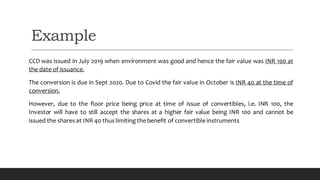
Example
CCD was issued in July 2019 when environment was good and hence the fair value was INR 100 at
the date of issuance.
The conversion is due in Sept 2020. Due to Covid the fair value in October is INR 40 at the time of
conversion.
However, due to the floor price being price at time of issue of convertibles, i.e. INR 100, the
Investor will have to still accept the shares at a higher fair value being INR 100 and cannot be
issued the shares at INR 40 thus limiting the benefit of convertible instruments
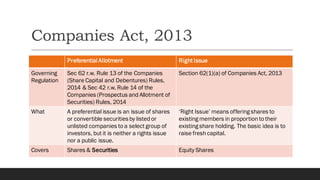
Companies Act, 2013
Preferential Allotment Right Issue
Governing
Regulation
Sec 62 r.w. Rule 13 of the Companies
(Share Capital and Debentures) Rules,
2014 & Sec 42 r.w. Rule 14 of the
Companies (Prospectus and Allotment of
Securities) Rules, 2014
Section 62(1)(a) of Companies Act, 2013
What A preferential issue is an issue of shares
or convertible securitiesby listed or
unlisted companies to a select group of
investors, but it is neither a rights issue
nor a public issue.
‘Right Issue’ means offering shares to
existing members in proportion to their
existing share holding. The basic idea is to
raise fresh capital.
Covers Shares & Securities Equity Shares
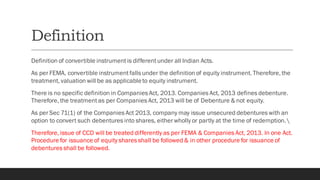
Definition
Definition of convertible instrumentis differentunder all Indian Acts.
As per FEMA, convertible instrumentfalls under the definition of equity instrument. Therefore, the
treatment, valuation will be as applicableto equity instrument.
There is no specific definition in Companies Act, 2013. Companies Act, 2013 defines debenture.
Therefore, the treatmentas per Companies Act, 2013 will be of Debenture & not equity.
As per Sec 71(1) of the Companies Act 2013, company may issue unsecured debentures with an
option to convert such debentures into shares, either wholly or partly at the time of redemption.
Therefore, issue of CCD will be treated differently as per FEMA & Companies Act, 2013. In one Act.
Procedure for issuance of equity shares shall be followed & in other procedure for issuance of
debentures shall be followed.
Valuation under different Act
FEMA:
Particulars ListedCompany UnlistedCompany
Issueby an Indian company
or transferredfroma
residentto non-resident-
Price shouldnot be less
than
The price workedout in
accordance with the
relevant SEBI
guidelines
The fair value workedout as per any internationally
acceptedpricing methodologyforvaluation on an
arm’slength basis,dulycertifiedby a Chartered
Accountant or a SEBI registeredMerchant Banker or
a practicing CostAccountant.
Transferfrom a non-
residentto resident- Price
shouldnot be morethan
The price workedout in
accordance with the
relevant SEBI
guidelines
The fair value as per any internationally accepted
pricing methodologyforvaluation on an arm’s
length basis,duly certifiedbya Chartered
Accountant or a SEBI registeredMerchant Banker.
Case 4: Swap of equity instruments
valuation by SEBI registered Merchant Banker; or Investment Banker outside India
Case 5: Non repatriable basis
The pricing guidelines will not apply for investment in capital
instruments by a person resident outside India on non-repatriation
basis.
Investment on repatriation basis’ means an investment, the sale/
maturity proceeds of which are, net of taxes, eligible to be
repatriated out of India, and the expression ‘Investment on non
repatriation basis’, shall be construed accordingly;
Case 6: Capital instruments with optionality clause
Optionality clauses are allowed in equity shares, fully, compulsorily and mandatorily
convertible debentures and fully, compulsorily and mandatorily convertible preference
shares under FDI scheme
Case 6: Capital instruments with optionality clause
Optionality clauses are allowed in equity shares, fully, compulsorily and mandatorily
convertible debentures and fully, compulsorily and mandatorily convertible preference
shares under FDI scheme, subject to the following conditions:
(a) There is a minimum lock-in period of one year which shall be effective from the date
of allotment of such capital instruments.
(b) After the lock-in period and subject to FDI Policy provisions, if any, the non-resident
investor exercising option/right shall be eligible to exit without any assured return, as
per pricing/valuation guidelines issued under FEMA from time to time.
Other important
things to consider
about consideration
73
32
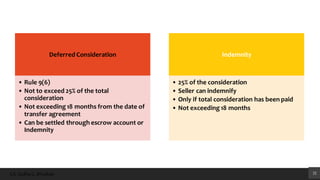
Deferred Consideration
• Rule 9(6)
• Not to exceed 25% of the total
consideration
• Not exceeding 18 months from the date of
transfer agreement
• Can be settled through escrow account or
Indemnity
Indemnity
• 25% of the consideration
• Seller can indemnify
• Only if total consideration has been paid
• Not exceeding 18 months
CA. Sudha G. Bhushan
33
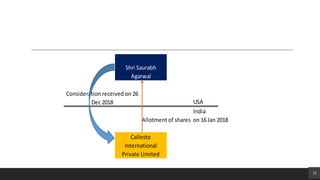
USA
India
Allotment of shares on 16Jan 2018
Shri Saurabh
Agarwal
Callesto
International
Private Limited
Consideration received on 26
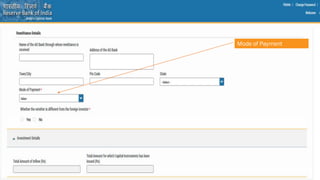
Dec 2018
34
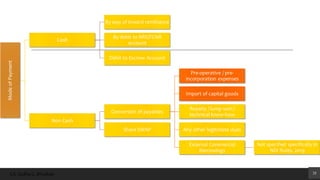
Mode of Payment
Mode
of
Payment
Cash
By way of inward remittance
By debit to NRE/FCNR
account
Debit to Escrow Account
Non Cash
Conversion of payables
Pre-operative / pre-
incorporation expenses
Import of capital goods
Royalty / lump sum /
technical know-how
Any other legitmiate dues
External Commercial
Borrowings
Not specified specifically in
NDI Rules, 2019
Share SWAP
35
CA. Sudha G. Bhushan
Overseas
Direct
Investment
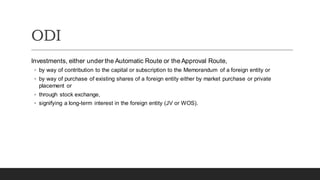
ODI
Investments, either under the Automatic Route or the Approval Route,
◦ by way of contribution to the capital or subscription to the Memorandum of a foreign entity or
◦ by way of purchase of existing shares of a foreign entity either by market purchase or private
placement or
◦ through stock exchange,
◦ signifying a long-term interest in the foreign entity (JV or WOS).
Pricing guidelines
Shares by way of subscription to
MOA
•at face value
•subject to entry route & sectoral
caps.
Ordinary Purchase of Shares
under ODI
In case of partial / full acquisition of an existing foreign Company, where the investmentis more
than USD 5 million, valuation of the shares of the company shall be made by Category I Merchant
Banker registered with SEBI or an InvestmentBanker / Merchant Banker outside India registered
with the appropriateregulatory authority in the host country and,
In all other cases by a Chartered Accountant or a Certified Public Accountant
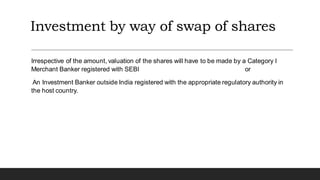
Investment by way of swap of shares
Irrespective of the amount, valuation of the shares will have to be made by a Category I
Merchant Banker registered with SEBI or
An Investment Banker outside India registered with the appropriate regulatory authority in
the host country.
Transfer by way of sale of shares
of a JV / WOS
if the shares are not listed on the stock exchange and the shares are disinvested by a private
arrangement, the share price is not less than the value certified by a Chartered Accountant /
Certified Public Accountant as the fair value of the shares based on the latest audited
financial statements of the JV / WOS;
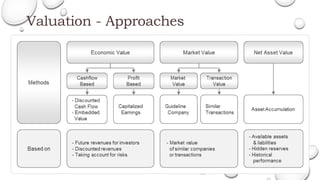
Valuation - Approaches
Convertible
Notes
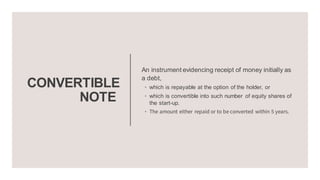
CONVERTIBLE
NOTE
An instrument evidencing receipt of money initially as
a debt,
◦ which is repayable at the option of the holder, or
◦ which is convertible into such number of equity shares of
the start-up.
◦ The amount either repaid or to be converted within 5 years.
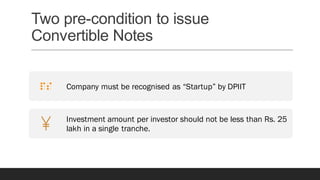
Two pre-condition to issue
Convertible Notes
Company must be recognised as “Startup” by DPIIT
Investment amount per investor should not be less than Rs. 25
lakh in a single tranche.
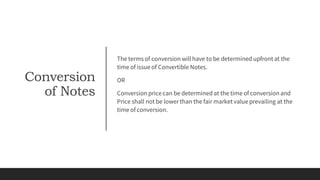
Conversion
of Notes
The terms of conversion will have to be determined upfront at the
time of issue of Convertible Notes.
OR
Conversion price can be determined at the time of conversionand
Price shall not be lower than the fair market value prevailing at the
time of conversion.
Pricing
guidelines-
Convertible
Notes
Unlikeother capitalinstruments,likeEquity
Shares or CCPSor CCD, pricingguidelines need
not to be complied withat the time of issuanceof
a convertiblenote.
Valuation shall be determinedonat the time of:
◦ Conversionofthe convertiblenoteinto equity;
or
◦ In caseof transfer of convertiblenotes from a
non-residenttoa residentor viceversa.
Therefore,thepriceofshares issued upon
conversionor transfer must be at or above fair
marketvalue, determinedbya certified chartered
accountant in practiceor costaccountantin
practiceor MerchantBanker registered withthe
Securities and ExchangeBoard of India.
Taxation of Convertible Notes
At the time of issuance of Convertible Notes:
• ConvertibleNotes being debt initially,there are no tax implication at the time of such issuance.
At the time of conversion of Convertible Note:
• The conversion price of such instruments shall have to be at fair market value. In case if the conversion price is
above the fair market value, then the difference between the conversion price and fair market value may be taxable
in the hands of the company under section 56 (2) (viib) of the Income Tax Act, 1961.
• However, this is exempted in case if the company is registered start-up and has tax exemption approval from
Income Tax department at the time of conversion.
In case if conversion price is lower than fair market value, the difference between the
conversion price and fair market value may be taxable in the hands of holder of convertible
note under section 56 (2) (x) of the Income Tax Act, 1961.
Risk free Rate
The Risk Free Rate
On a risk free investment, the actual return is equal to the expected return. Therefore,there is no
variance around the expected return.
For an investment to be riskfree,then, it has to have
◦ No default risk
◦ No reinvestment risk
It follows then that if asked to estimate a risk free rate:
1. Time horizon matters:Thus, the riskfree ratesin valuation will depend upon when the cash flow is
expected to occur and will vary across time.
2. Currenciesmatter:A risk free rate is currency-specificand can be very different for different
currencies.
3. Not all government securitiesare risk free: Some governments face default risk and the rates on
bonds issued by them will not be risk free
Test 1: A risk-free rate in US dollars!
In valuation, we estimate cash flows forever (or at least for very long time periods). The right risk
free rate to use in valuing a company in US dollars would be
a. A three-month Treasury bill rate (0.09%)
b. A ten-year Treasury bond rate (0.93%)
c. A thirty-year Treasury bond rate (1.4%)
d. A TIPs (inflation-indexed treasury) rate (-1.0%)
e. None of the above
What are we implicitly assuming aboutthe US treasury when we use any of the treasury numbers?
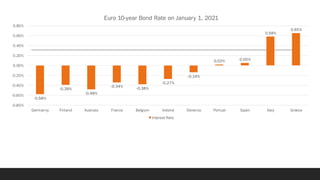
Test 2: A Risk free Rate in Euros ?
-0.58%
-0.39%
-0.48%
-0.34% -0.38%
-0.27%
-0.14%
0.02% 0.05%
0.58%
0.65%
-0.80%
-0.60%
-0.40%
-0.20%
0.00%
0.20%
0.40%
0.60%
0.80%
Germanny Finland Austraia France Belgium Ireland Slovenia Portual Spain Italy Greece
Euro 10-year Bond Rate on January 1, 2021
Interest Rate
Test 3: A
Riskfree
Rate for
Bangladesh
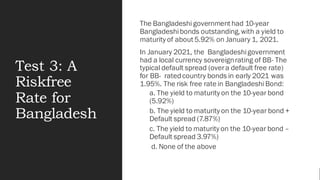
The Bangladeshi government had 10-year
Bangladeshibonds outstanding,with a yield to
maturity of about 5.92% on January 1, 2021.
In January 2021, the Bangladeshigovernment
had a local currency sovereignrating of BB- The
typical default spread (overa default free rate)
for BB- ratedcountry bonds in early 2021 was
1.95%. The risk free rate in Bangladeshi Bond:
a. The yield to maturity on the 10-year bond
(5.92%)
b. The yield to maturity on the 10-year bond +
Default spread (7.87%)
c. The yield to maturity on the 10-year bond –
Default spread 3.97%)
d. None of the above
Sovereign
Default
Spread:
Three paths
to the same
destination…
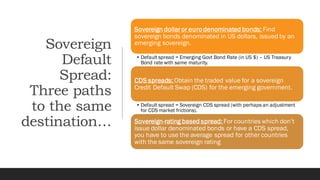
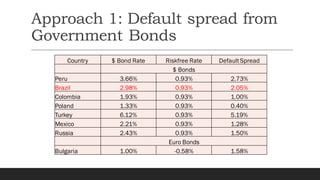
Sovereign dollar or euro denominated bonds: Find
sovereign bonds denominated in US dollars, issued by an
emerging sovereign.
• Default spread = Emerging Govt Bond Rate (in US $) – US Treasury
Bond rate with same maturity.
CDS spreads: Obtain the traded value for a sovereign
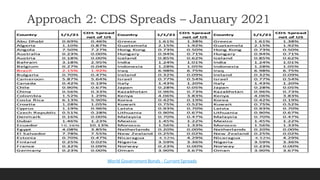
Credit Default Swap (CDS) for the emerging government.
• Default spread = Sovereign CDS spread (with perhaps an adjustment
for CDS market frictions).
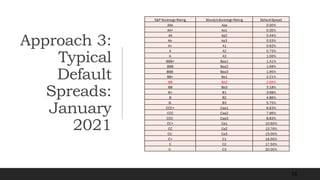
Sovereign-rating based spread: For countries which don’t
issue dollar denominated bonds or have a CDS spread,
you have to use the average spread for other countries
with the same sovereign rating
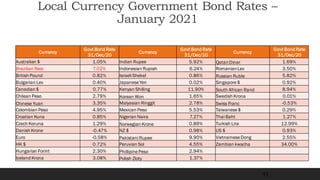
Local Currency Government Bond Rates –
January 2021
55
Currency
Govt Bond Rate
31/Dec/20
Currency
Govt Bond Rate
31/Dec/20
Currency
Govt Bond Rate
31/Dec/20
Australian $ 1.05% Indian Rupee 5.92% Qatari Dinar 1.69%
Brazilian Reai 7.02% Indonesian Rupiah 6.24% RomanianLev 3.50%
British Pound 0.82% Israeli Shekel 0.86% Russian Ruble 5.82%
Bulgarian Lev 0.40% JapaneseYen 0.02% Singapore$ 0.92%
Canadian$ 0.77% Kenyan Shilling 11.90% South African Rand 8.94%
Chilean Peso 2.79% Korean Won 1.65% Swedish Krona 0.01%
Chinese Yuan 3.35% Malyasian Ringgit 2.78% Swiss Franc -0.53%
Colombian Peso 4.95% Mexican Peso 5.53% Taiwanese$ 0.29%
Croatian Kuna 0.85% Nigerian Naira 7.27% Thai Baht 1.27%
Czech Koruna 1.29% Norwegian Krone 0.89% Turkish Lira 12.99%
Danish Krone -0.47% NZ $ 0.98% US $ 0.93%
Euro -0.58% Pakistani Rupee 9.90% VietnameseDong 2.55%
HK $ 0.72% Peruvian Sol 4.55% Zambian kwacha 34.00%
Hungarian Forint 2.30% PhillipinePeso 2.94%
Iceland Krona 3.08% Polish Zloty 1.37%
Approach 1: Default spread from
Government Bonds
Country $ Bond Rate Riskfree Rate DefaultSpread
$ Bonds
Peru 3.66% 0.93% 2.73%
Brazil 2.98% 0.93% 2.05%
Colombia 1.93% 0.93% 1.00%
Poland 1.33% 0.93% 0.40%
Turkey 6.12% 0.93% 5.19%
Mexico 2.21% 0.93% 1.28%
Russia 2.43% 0.93% 1.50%
Euro Bonds
Bulgaria 1.00% -0.58% 1.58%
Approach 2: CDS Spreads – January 2021
World GovernmentBonds - CurrentSpreads
57
Approach 3:
Typical
Default
Spreads:
January
2021
58
S&P SovereignRating Moody'sSovereignRating Default Spread
AAA Aaa 0.00%
AA+ Aa1 0.35%
AA Aa2 0.44%
AA- Aa3 0.53%
A+ A1 0.62%
A A2 0.75%
A- A3 1.06%
BBB+ Baa1 1.41%
BBB Baa2 1.68%
BBB- Baa3 1.95%
BB+ Ba1 2.21%
BB Ba2 2.65%
BB Ba3 3.18%
B+ B1 3.98%
B B2 4.86%
B- B3 5.75%
CCC+ Caa1 6.63%
CCC Caa2 7.96%
CCC- Caa3 8.83%
CC+ Ca1 10.60%
CC Ca2 13.76%
CC- Ca3 15.00%
C+ C1 16.00%
C C2 17.50%
C- C3 20.00%
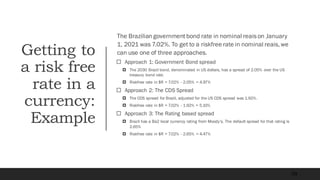
Getting to
a risk free
rate in a
currency:
Example
The Brazilian governmentbond rate in nominal reais on January
1, 2021 was 7.02%. To get to a riskfree rate in nominal reais, we
can use one of three approaches.
 Approach 1: Government Bond spread
 The 2030 Brazil bond, denominated in US dollars, has a spread of 2.05% over the US
treasury bond rate.
 Riskfree rate in $R = 7.02% - 2.05% = 4.97%
 Approach 2: The CDS Spread
 The CDS spread for Brazil, adjusted for the US CDS spread was 1.92%.
 Riskfree rate in $R = 7.02% - 1.92% = 5.10%
 Approach 3: The Rating based spread
 Brazil has a Ba2 local currency rating from Moody’s. The default spread for that rating is
2.65%
 Riskfree rate in $R = 7.02% - 2.65% = 4.47%
59
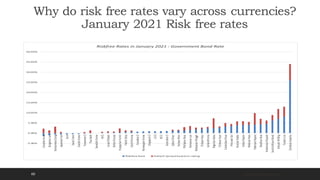
Why do risk free rates vary across currencies?
January 2021 Risk free rates
Aswath Damodaran
60
Don’t have or trust the government bond rate?
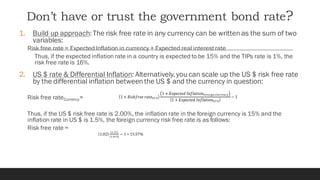
1. Build up approach:The risk free rate in any currency can be writtenas the sum of two
variables:
Risk free rate = Expected Inflation in currency + Expected real interestrate
Thus, if the expected inflation rate in a country is expected to be 15% and the TIPs rate is 1%, the
risk free rate is 16%.
2. US $ rate & Differential Inflation: Alternatively,you can scale up the US $ risk free rate
by the differential inflation betweenthe US $ and the currency in question:
Risk free rateCurrency=
Thus, if the US $ risk free rate is 2.00%, the inflation rate in the foreign currency is 15% and the
inflation rate in US $ is 1.5%, the foreign currency risk free rate is as follows:
Risk free rate =
Estimating an additional country risk
premium: The country default spread
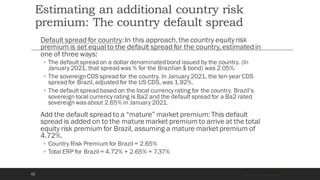
Default spread for country:In this approach,the country equity risk
premium is set equal to the default spread for the country,estimatedin
one of three ways:
◦ The defaultspread on a dollar denominatedbond issued by the country. (In
January 2021, that spread was % for the Brazilian $ bond) was 2.05%.
◦ The sovereignCDS spread for the country. In January 2021, the ten-year CDS
spread for Brazil, adjusted for the US CDS, was 1.92%.
◦ The defaultspread based on the local currency rating for the country. Brazil’s
sovereign local currency rating is Ba2 and the default spread for a Ba2 rated
sovereign was about 2.65% in January 2021.
Add the default spread to a “mature” market premium:This default
spread is added on to the mature market premium to arrive at the total
equity risk premium for Brazil, assuming a mature market premium of
4.72%.
◦ Country Risk Premium for Brazil = 2.65%
◦ Total ERP for Brazil = 4.72% + 2.65% = 7.37%
Aswath Damodaran
62
Q & A
Thankyou !!
Reach out to us at
Sudha@taxpertpro.com
+91 9769033172

Valuation under Foreign Exchange Management Act, 2000

  • 1.
    Valuation under FEMA, 1999 C O MPREHE NSIVE V IE W 24 TH SE PT 2 0 21
  • 2.
    FEMA The Foreign ExchangeManagement Act, 1999, is an Act of the Parliament of India "to consolidate and amend the law relating to foreign exchange with the objective of facilitating external trade and payments and for promoting the orderly development and maintenance of foreign exchange market in India". FEMA works on the below two rules: 1. All current account transactions are allowed, unless prohibited, 2. All capital account transactions are prohibited, unless allowed.
  • 3.
    Regulatory Frame work Foreign Exchange ManagementAct, 1999 Promulgatedbyparliament Came in effect w.e.f 1 June 2000 Notifications/ Regulations ReserveBank of India (Sec47) Self-contained set of regulations Rules CentralGovernment Section 46 Circulars RBItoAD Bankers AuthorizedPersons Directionsissued by RBI MasterCirculars Consolidation of APDIRCirculars Master Circulars use to be a one- point reference of instructions issued by the RBI on a particular subject between July and June. Master Directions Issued after invocation of Master Circulars FDIPolicy Issued by DPIIT Framework of FEMA,1999 3 Comprehensive course on FEMA || CA. Sudha G. Bhushan || 9769033172
  • 4.
    Valuation under FEMA Valuationunder FEMA Foreign Direct Investment in India FDI Policy, 2020 NDI Rules, 2019 Overseas Investmentfrom India FEMA 120/RB-2004
  • 5.
    Progress - FEMA CCIGuidelines Discounted cash FLow Internationally accepted pricing methodology
  • 6.
  • 7.
    FDI “FDI” or “ForeignDirect Investment” means investment through equity instruments by a person resident outside India - in an unlisted Indian company; or - in ten per cent or more of the post issue paid-up equity capital on a fully diluted basis of a listed Indian company; Fully diluted basis means the total number of shares that would be outstanding if all possible sources of conversion are exercised.
  • 8.
    List of transactionswhere valuation is required Issue of Shares or Securities by an Indian company to a Person Resident outside India Transfer of Shares or Securities of an Indian Company by a Resident to a Person Resident outside India Transfer of Shares or Securities of an Indian Company by a Person Resident outside India to a Resident
  • 9.
    Pricing guidelines Particulars ListedCompanyUnlistedCompany Issueby an Indian company or transferredfroma residentto non-resident- Price shouldnot be less than The price workedout in accordance with the relevant SEBI guidelines The fair value workedout as per any internationally acceptedpricing methodologyforvaluation on an arm’slength basis,dulycertifiedby a Chartered Accountant or a SEBI registeredMerchant Banker or a practicing CostAccountant. Transferfrom a non- residentto resident- Price shouldnot be morethan The price workedout in accordance with the relevant SEBI guidelines The fair value as per any internationally accepted pricing methodologyforvaluation on an arm’s length basis,duly certifiedbya Chartered Accountant or a SEBI registeredMerchant Banker.
  • 10.
    Pricing guidelines Company going throughdelisting process •as per SEBI (Delisting of Equity Shares) Regulations, 2009. Swap of equity instruments •valuation by SEBI registered Merchant Banker; or •InvestmentBanker outside India Share warrants •pricing and price/conversion formula shall be determined upfront. CCPS / CCDs • Issue Price / Formula to be specified upfront at time of issue •Price @ Conversion Date > FMV @ Issue Date Pricing guidelines not applicable for investment in equity instruments by PROI on non-repatriation basis.
  • 11.
    NDI Rules, 2019:Equity Instruments 2(k) “equity instruments” means equity shares, convertible debentures, preference shares and share warrants issued by an Indian company; Explanation:- (i) Equity shares issued in accordance with the provisions of the Companies Act, 2013 shall include equity shares that have been partly paid. “Convertible debentures” means fully, compulsorily and mandatorily convertible debentures. Preference shares” means fully, compulsorily and mandatorily convertible preference shares. Share Warrants are those issued by an Indian company in accordance with the regulations by the Securities and Exchange Board of India. Equity instruments can contain an optionality clause subject to a minimum lock-in period of one year or as prescribed for the specific sector, whichever is higher, but without any option or right to exit at an assured price.
  • 12.
    NDI Rules, 2019:Equity Instruments (ii) Partly paid shares that have been issued to a person resident outside India shall be fully called-up within twelve months of such issue or as may be specified by the Reserve Bank from time to time. Twenty- five per cent of the total consideration amount (including share premium, if any) shall be received upfront. (iii) In case of share warrants, at least twenty-five per cent of the consideration shall be received upfront and the balance amount within eighteen months of the issuance of share warrants.
  • 13.
  • 14.
    1 Outside India In India 1 3 7 45 Within 30 days the Form FC GPR to be filed Yearly FLA Return If not allotted return the money to be refunded Through banking channels or out of funds held in NRE/ FCNR(B)/ Escrow account Foreign Investor Normal Banking Channel Debit to NRE/FCNR(B) Account Escrow Account Money was remitted on 31 March 2020 Allotment of shares within 60days of reciept of Money ABV Limited 2 6 14
  • 15.
  • 16.
    Equity Instruments underNon-Debt Instrument Rules Equity shares issuedas per Companies Act, 2013 includes partly paidup shares 25% paymentupfront,full paymentin 12 months Preferenceshares fully, compulsorilyand mandatorilyconvertible into equity Convertibledebentures fully, compulsorilyand mandatorilyconvertible into equity Share warrants issuedas per SEBI Regulations 25% paymentupfront,full paymentwithin 18 months Formerly regarded as Capital Instruments under TISPRO Regulations, 2017 16
  • 17.
  • 18.
    Case 1: PRICINGIN CASE OF INVESTMENT BY WAY OF SUBSCRIPTION TO ITS MEMORANDUM OF ASSOCIATION It may be noted that where non-residents (including NRIs) are making investments in an Indian company in compliance with the provisions of the Companies Act, 2013, by way of subscription to its Memorandum of Association, such investments may be made at face value subject to their eligibility to invest under the FDI scheme and pricing guidelines neednot be followed.
  • 19.
    Case 2 The pricingguidelines will not be applicable for any transfer by way of sale done in accordance with SEBI Regulations where the pricing is prescribed bySEBI. A Chartered Accountant’s Certificate to the effect that relevant SEBI Regulations/Guidelines have been complied with has to be attached to the Form FC-TRS filed with the AD bank. Basically, this gives exemption to the cases where pricing guidelines could not be met because of compliance of SEBI Regulations.A.P. (DIR Series) CircularNo. 43 dated 4 November2011.
  • 20.
    Case 3: ConvertibleInstrument ‘Capital’ means equity shares; fully, compulsorily & mandatorily convertible preference shares; fully, compulsorily& mandatorilyconvertible debenturesand warrants.
  • 21.
    Case 3: ConvertibleInstrument Convertible Instrument are those instrument which are converted in equity shares after certain period of time. The number of equity shares for each convertible Instrument are called Conversion Ratio and price paid for the equity share is called “Conversion Price”. Further, conversion value of Instrument is equal to Price per Equity Shares * Converted no. of shares per Instrument.
  • 22.
    Conversion ratio ✓ Theprice/conversion formula of the instrument should be determined upfront at the time of issue of the instrument. ✓The price at the time of conversion should not in any case be lower than the fair value worked out, at the time of issuance of such instruments,in accordance with these Regulations.
  • 23.
    Example CCD was issuedin July 2019 when environment was good and hence the fair value was INR 100 at the date of issuance. The conversion is due in Sept 2020. Due to Covid the fair value in October is INR 40 at the time of conversion. However, due to the floor price being price at time of issue of convertibles, i.e. INR 100, the Investor will have to still accept the shares at a higher fair value being INR 100 and cannot be issued the shares at INR 40 thus limiting the benefit of convertible instruments
  • 24.
    Companies Act, 2013 PreferentialAllotment Right Issue Governing Regulation Sec 62 r.w. Rule 13 of the Companies (Share Capital and Debentures) Rules, 2014 & Sec 42 r.w. Rule 14 of the Companies (Prospectus and Allotment of Securities) Rules, 2014 Section 62(1)(a) of Companies Act, 2013 What A preferential issue is an issue of shares or convertible securitiesby listed or unlisted companies to a select group of investors, but it is neither a rights issue nor a public issue. ‘Right Issue’ means offering shares to existing members in proportion to their existing share holding. The basic idea is to raise fresh capital. Covers Shares & Securities Equity Shares
  • 25.
    Definition Definition of convertibleinstrumentis differentunder all Indian Acts. As per FEMA, convertible instrumentfalls under the definition of equity instrument. Therefore, the treatment, valuation will be as applicableto equity instrument. There is no specific definition in Companies Act, 2013. Companies Act, 2013 defines debenture. Therefore, the treatmentas per Companies Act, 2013 will be of Debenture & not equity. As per Sec 71(1) of the Companies Act 2013, company may issue unsecured debentures with an option to convert such debentures into shares, either wholly or partly at the time of redemption. Therefore, issue of CCD will be treated differently as per FEMA & Companies Act, 2013. In one Act. Procedure for issuance of equity shares shall be followed & in other procedure for issuance of debentures shall be followed.
  • 26.
    Valuation under differentAct FEMA: Particulars ListedCompany UnlistedCompany Issueby an Indian company or transferredfroma residentto non-resident- Price shouldnot be less than The price workedout in accordance with the relevant SEBI guidelines The fair value workedout as per any internationally acceptedpricing methodologyforvaluation on an arm’slength basis,dulycertifiedby a Chartered Accountant or a SEBI registeredMerchant Banker or a practicing CostAccountant. Transferfrom a non- residentto resident- Price shouldnot be morethan The price workedout in accordance with the relevant SEBI guidelines The fair value as per any internationally accepted pricing methodologyforvaluation on an arm’s length basis,duly certifiedbya Chartered Accountant or a SEBI registeredMerchant Banker.
  • 27.
    Case 4: Swapof equity instruments valuation by SEBI registered Merchant Banker; or Investment Banker outside India
  • 28.
    Case 5: Nonrepatriable basis The pricing guidelines will not apply for investment in capital instruments by a person resident outside India on non-repatriation basis. Investment on repatriation basis’ means an investment, the sale/ maturity proceeds of which are, net of taxes, eligible to be repatriated out of India, and the expression ‘Investment on non repatriation basis’, shall be construed accordingly;
  • 29.
    Case 6: Capitalinstruments with optionality clause Optionality clauses are allowed in equity shares, fully, compulsorily and mandatorily convertible debentures and fully, compulsorily and mandatorily convertible preference shares under FDI scheme
  • 30.
    Case 6: Capitalinstruments with optionality clause Optionality clauses are allowed in equity shares, fully, compulsorily and mandatorily convertible debentures and fully, compulsorily and mandatorily convertible preference shares under FDI scheme, subject to the following conditions: (a) There is a minimum lock-in period of one year which shall be effective from the date of allotment of such capital instruments. (b) After the lock-in period and subject to FDI Policy provisions, if any, the non-resident investor exercising option/right shall be eligible to exit without any assured return, as per pricing/valuation guidelines issued under FEMA from time to time.
  • 31.
    Other important things toconsider about consideration
  • 32.
    73 32 Deferred Consideration • Rule9(6) • Not to exceed 25% of the total consideration • Not exceeding 18 months from the date of transfer agreement • Can be settled through escrow account or Indemnity Indemnity • 25% of the consideration • Seller can indemnify • Only if total consideration has been paid • Not exceeding 18 months CA. Sudha G. Bhushan
  • 33.
    33 USA India Allotment of shareson 16Jan 2018 Shri Saurabh Agarwal Callesto International Private Limited Consideration received on 26 Dec 2018
  • 34.
  • 35.
    Mode of Payment Cash By way ofinward remittance By debit to NRE/FCNR account Debit to Escrow Account Non Cash Conversion of payables Pre-operative / pre- incorporation expenses Import of capital goods Royalty / lump sum / technical know-how Any other legitmiate dues External Commercial Borrowings Not specified specifically in NDI Rules, 2019 Share SWAP 35 CA. Sudha G. Bhushan
  • 36.
  • 37.
    ODI Investments, either underthe Automatic Route or the Approval Route, ◦ by way of contribution to the capital or subscription to the Memorandum of a foreign entity or ◦ by way of purchase of existing shares of a foreign entity either by market purchase or private placement or ◦ through stock exchange, ◦ signifying a long-term interest in the foreign entity (JV or WOS).
  • 38.
    Pricing guidelines Shares byway of subscription to MOA •at face value •subject to entry route & sectoral caps.
  • 39.
    Ordinary Purchase ofShares under ODI In case of partial / full acquisition of an existing foreign Company, where the investmentis more than USD 5 million, valuation of the shares of the company shall be made by Category I Merchant Banker registered with SEBI or an InvestmentBanker / Merchant Banker outside India registered with the appropriateregulatory authority in the host country and, In all other cases by a Chartered Accountant or a Certified Public Accountant
  • 40.
    Investment by wayof swap of shares Irrespective of the amount, valuation of the shares will have to be made by a Category I Merchant Banker registered with SEBI or An Investment Banker outside India registered with the appropriate regulatory authority in the host country.
  • 41.
    Transfer by wayof sale of shares of a JV / WOS if the shares are not listed on the stock exchange and the shares are disinvested by a private arrangement, the share price is not less than the value certified by a Chartered Accountant / Certified Public Accountant as the fair value of the shares based on the latest audited financial statements of the JV / WOS;
  • 42.
  • 43.
  • 44.
    CONVERTIBLE NOTE An instrument evidencingreceipt of money initially as a debt, ◦ which is repayable at the option of the holder, or ◦ which is convertible into such number of equity shares of the start-up. ◦ The amount either repaid or to be converted within 5 years.
  • 45.
    Two pre-condition toissue Convertible Notes Company must be recognised as “Startup” by DPIIT Investment amount per investor should not be less than Rs. 25 lakh in a single tranche.
  • 46.
    Conversion of Notes The termsof conversion will have to be determined upfront at the time of issue of Convertible Notes. OR Conversion price can be determined at the time of conversionand Price shall not be lower than the fair market value prevailing at the time of conversion.
  • 47.
    Pricing guidelines- Convertible Notes Unlikeother capitalinstruments,likeEquity Shares orCCPSor CCD, pricingguidelines need not to be complied withat the time of issuanceof a convertiblenote. Valuation shall be determinedonat the time of: ◦ Conversionofthe convertiblenoteinto equity; or ◦ In caseof transfer of convertiblenotes from a non-residenttoa residentor viceversa. Therefore,thepriceofshares issued upon conversionor transfer must be at or above fair marketvalue, determinedbya certified chartered accountant in practiceor costaccountantin practiceor MerchantBanker registered withthe Securities and ExchangeBoard of India.
  • 48.
    Taxation of ConvertibleNotes At the time of issuance of Convertible Notes: • ConvertibleNotes being debt initially,there are no tax implication at the time of such issuance. At the time of conversion of Convertible Note: • The conversion price of such instruments shall have to be at fair market value. In case if the conversion price is above the fair market value, then the difference between the conversion price and fair market value may be taxable in the hands of the company under section 56 (2) (viib) of the Income Tax Act, 1961. • However, this is exempted in case if the company is registered start-up and has tax exemption approval from Income Tax department at the time of conversion. In case if conversion price is lower than fair market value, the difference between the conversion price and fair market value may be taxable in the hands of holder of convertible note under section 56 (2) (x) of the Income Tax Act, 1961.
  • 49.
  • 50.
    The Risk FreeRate On a risk free investment, the actual return is equal to the expected return. Therefore,there is no variance around the expected return. For an investment to be riskfree,then, it has to have ◦ No default risk ◦ No reinvestment risk It follows then that if asked to estimate a risk free rate: 1. Time horizon matters:Thus, the riskfree ratesin valuation will depend upon when the cash flow is expected to occur and will vary across time. 2. Currenciesmatter:A risk free rate is currency-specificand can be very different for different currencies. 3. Not all government securitiesare risk free: Some governments face default risk and the rates on bonds issued by them will not be risk free
  • 51.
    Test 1: Arisk-free rate in US dollars! In valuation, we estimate cash flows forever (or at least for very long time periods). The right risk free rate to use in valuing a company in US dollars would be a. A three-month Treasury bill rate (0.09%) b. A ten-year Treasury bond rate (0.93%) c. A thirty-year Treasury bond rate (1.4%) d. A TIPs (inflation-indexed treasury) rate (-1.0%) e. None of the above What are we implicitly assuming aboutthe US treasury when we use any of the treasury numbers?
  • 52.
    Test 2: ARisk free Rate in Euros ? -0.58% -0.39% -0.48% -0.34% -0.38% -0.27% -0.14% 0.02% 0.05% 0.58% 0.65% -0.80% -0.60% -0.40% -0.20% 0.00% 0.20% 0.40% 0.60% 0.80% Germanny Finland Austraia France Belgium Ireland Slovenia Portual Spain Italy Greece Euro 10-year Bond Rate on January 1, 2021 Interest Rate
  • 53.
    Test 3: A Riskfree Ratefor Bangladesh The Bangladeshi government had 10-year Bangladeshibonds outstanding,with a yield to maturity of about 5.92% on January 1, 2021. In January 2021, the Bangladeshigovernment had a local currency sovereignrating of BB- The typical default spread (overa default free rate) for BB- ratedcountry bonds in early 2021 was 1.95%. The risk free rate in Bangladeshi Bond: a. The yield to maturity on the 10-year bond (5.92%) b. The yield to maturity on the 10-year bond + Default spread (7.87%) c. The yield to maturity on the 10-year bond – Default spread 3.97%) d. None of the above
  • 54.
    Sovereign Default Spread: Three paths to thesame destination… Sovereign dollar or euro denominated bonds: Find sovereign bonds denominated in US dollars, issued by an emerging sovereign. • Default spread = Emerging Govt Bond Rate (in US $) – US Treasury Bond rate with same maturity. CDS spreads: Obtain the traded value for a sovereign Credit Default Swap (CDS) for the emerging government. • Default spread = Sovereign CDS spread (with perhaps an adjustment for CDS market frictions). Sovereign-rating based spread: For countries which don’t issue dollar denominated bonds or have a CDS spread, you have to use the average spread for other countries with the same sovereign rating
  • 55.
    Local Currency GovernmentBond Rates – January 2021 55 Currency Govt Bond Rate 31/Dec/20 Currency Govt Bond Rate 31/Dec/20 Currency Govt Bond Rate 31/Dec/20 Australian $ 1.05% Indian Rupee 5.92% Qatari Dinar 1.69% Brazilian Reai 7.02% Indonesian Rupiah 6.24% RomanianLev 3.50% British Pound 0.82% Israeli Shekel 0.86% Russian Ruble 5.82% Bulgarian Lev 0.40% JapaneseYen 0.02% Singapore$ 0.92% Canadian$ 0.77% Kenyan Shilling 11.90% South African Rand 8.94% Chilean Peso 2.79% Korean Won 1.65% Swedish Krona 0.01% Chinese Yuan 3.35% Malyasian Ringgit 2.78% Swiss Franc -0.53% Colombian Peso 4.95% Mexican Peso 5.53% Taiwanese$ 0.29% Croatian Kuna 0.85% Nigerian Naira 7.27% Thai Baht 1.27% Czech Koruna 1.29% Norwegian Krone 0.89% Turkish Lira 12.99% Danish Krone -0.47% NZ $ 0.98% US $ 0.93% Euro -0.58% Pakistani Rupee 9.90% VietnameseDong 2.55% HK $ 0.72% Peruvian Sol 4.55% Zambian kwacha 34.00% Hungarian Forint 2.30% PhillipinePeso 2.94% Iceland Krona 3.08% Polish Zloty 1.37%
  • 56.
    Approach 1: Defaultspread from Government Bonds Country $ Bond Rate Riskfree Rate DefaultSpread $ Bonds Peru 3.66% 0.93% 2.73% Brazil 2.98% 0.93% 2.05% Colombia 1.93% 0.93% 1.00% Poland 1.33% 0.93% 0.40% Turkey 6.12% 0.93% 5.19% Mexico 2.21% 0.93% 1.28% Russia 2.43% 0.93% 1.50% Euro Bonds Bulgaria 1.00% -0.58% 1.58%
  • 57.
    Approach 2: CDSSpreads – January 2021 World GovernmentBonds - CurrentSpreads 57
  • 58.
    Approach 3: Typical Default Spreads: January 2021 58 S&P SovereignRatingMoody'sSovereignRating Default Spread AAA Aaa 0.00% AA+ Aa1 0.35% AA Aa2 0.44% AA- Aa3 0.53% A+ A1 0.62% A A2 0.75% A- A3 1.06% BBB+ Baa1 1.41% BBB Baa2 1.68% BBB- Baa3 1.95% BB+ Ba1 2.21% BB Ba2 2.65% BB Ba3 3.18% B+ B1 3.98% B B2 4.86% B- B3 5.75% CCC+ Caa1 6.63% CCC Caa2 7.96% CCC- Caa3 8.83% CC+ Ca1 10.60% CC Ca2 13.76% CC- Ca3 15.00% C+ C1 16.00% C C2 17.50% C- C3 20.00%
  • 59.
    Getting to a riskfree rate in a currency: Example The Brazilian governmentbond rate in nominal reais on January 1, 2021 was 7.02%. To get to a riskfree rate in nominal reais, we can use one of three approaches.  Approach 1: Government Bond spread  The 2030 Brazil bond, denominated in US dollars, has a spread of 2.05% over the US treasury bond rate.  Riskfree rate in $R = 7.02% - 2.05% = 4.97%  Approach 2: The CDS Spread  The CDS spread for Brazil, adjusted for the US CDS spread was 1.92%.  Riskfree rate in $R = 7.02% - 1.92% = 5.10%  Approach 3: The Rating based spread  Brazil has a Ba2 local currency rating from Moody’s. The default spread for that rating is 2.65%  Riskfree rate in $R = 7.02% - 2.65% = 4.47% 59
  • 60.
    Why do riskfree rates vary across currencies? January 2021 Risk free rates Aswath Damodaran 60
  • 61.
    Don’t have ortrust the government bond rate? 1. Build up approach:The risk free rate in any currency can be writtenas the sum of two variables: Risk free rate = Expected Inflation in currency + Expected real interestrate Thus, if the expected inflation rate in a country is expected to be 15% and the TIPs rate is 1%, the risk free rate is 16%. 2. US $ rate & Differential Inflation: Alternatively,you can scale up the US $ risk free rate by the differential inflation betweenthe US $ and the currency in question: Risk free rateCurrency= Thus, if the US $ risk free rate is 2.00%, the inflation rate in the foreign currency is 15% and the inflation rate in US $ is 1.5%, the foreign currency risk free rate is as follows: Risk free rate =
  • 62.
    Estimating an additionalcountry risk premium: The country default spread Default spread for country:In this approach,the country equity risk premium is set equal to the default spread for the country,estimatedin one of three ways: ◦ The defaultspread on a dollar denominatedbond issued by the country. (In January 2021, that spread was % for the Brazilian $ bond) was 2.05%. ◦ The sovereignCDS spread for the country. In January 2021, the ten-year CDS spread for Brazil, adjusted for the US CDS, was 1.92%. ◦ The defaultspread based on the local currency rating for the country. Brazil’s sovereign local currency rating is Ba2 and the default spread for a Ba2 rated sovereign was about 2.65% in January 2021. Add the default spread to a “mature” market premium:This default spread is added on to the mature market premium to arrive at the total equity risk premium for Brazil, assuming a mature market premium of 4.72%. ◦ Country Risk Premium for Brazil = 2.65% ◦ Total ERP for Brazil = 4.72% + 2.65% = 7.37% Aswath Damodaran 62
  • 63.
  • 64.
    Thankyou !! Reach outto us at Sudha@taxpertpro.com +91 9769033172