Due Diligence of Cross Border Transactions
31st August 2019
Institute of Company Secretaries of India
BY CA. Sudha G. Bhushan
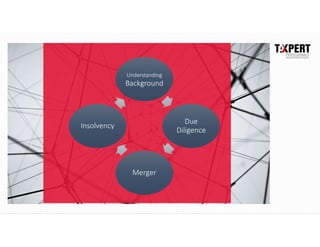
Understanding
Background
Understanding
Background
Due
Diligence
Due
Diligence
MergerMerger
InsolvencyInsolvency
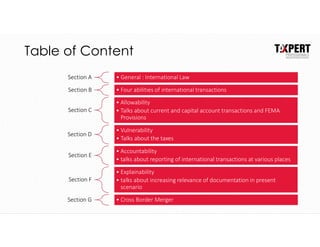
Table of Content
Section A • General : International Law
Section B • Four abilities of international transactions
Section C
• Allowability
• Talks about current and capital account transactions and FEMA
Provisions
Section D
• Vulnerability
• Talks about the taxes
Section E
• Accountability
• talks about reporting of international transactions at various places
Section F
• Explainability
• talks about increasing relevance of documentation in present
scenario
Section G • Cross Border Merger
International Law
8/31/2019 5
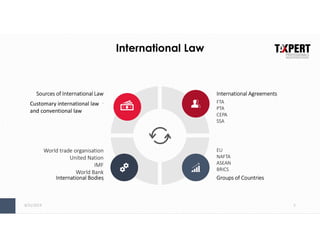
International Law
FTA
PTA
CEPA
SSA
International Agreements
EU
NAFTA
ASEAN
BRICS
Groups of Countries
.
Sources of International Law
World trade organisation
United Nation
IMF
World Bank
.International Bodies
Customary international law
and conventional law
Nuances of Cross Border Transactions
7
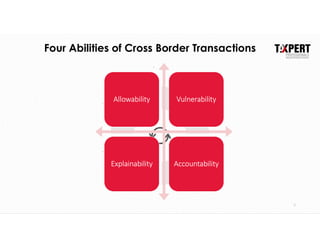
Four Abilities of Cross Border Transactions
.
.
.
Allowability Vulnerability
Explainability Accountability
Allowability
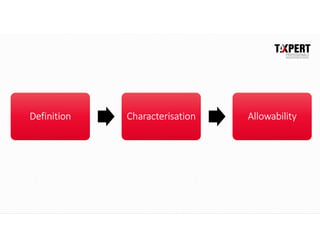
Definition Characterisation Allowability
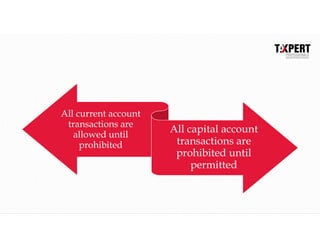
All current account
transactions are
allowed until
prohibited
All capital account
transactions are
prohibited until
permitted
Vulnerability
12
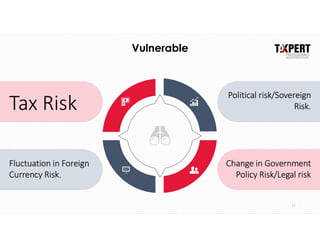
Vulnerable
Tax Risk
Fluctuation in Foreign
Currency Risk.
Political risk/Sovereign
Risk.
Change in Government
Policy Risk/Legal risk
Accountability
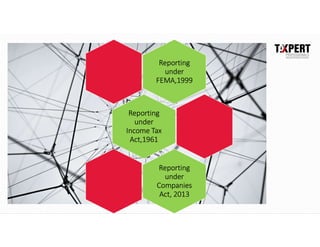
Reporting
under
FEMA,1999
Reporting
under
Income Tax
Act,1961
Reporting
under
Companies
Act, 2013
Explain ability
8/31/2019 16
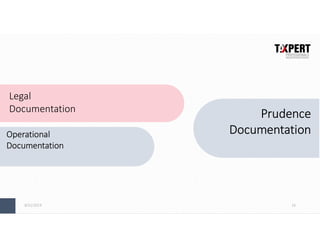
Legal
Documentation
Operational
Documentation
Prudence
Documentation
Cross Border Merger
8/31/2019 18
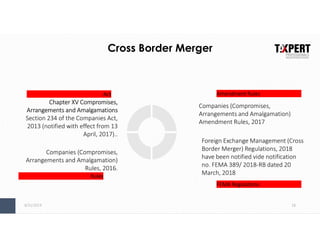
Cross Border Merger
Companies (Compromises,
Arrangements and Amalgamation)
Amendment Rules, 2017
Amendment Rules
Foreign Exchange Management (Cross
Border Merger) Regulations, 2018
have been notified vide notification
no. FEMA 389/ 2018-RB dated 20
March, 2018
FEMA Regulations
Chapter XV Compromises,
Arrangements and Amalgamations
Section 234 of the Companies Act,
2013 (notified with effect from 13
April, 2017)..
Act
Companies (Compromises,
Arrangements and Amalgamation)
Rules, 2016.
Rules
Key definitions under these regulations
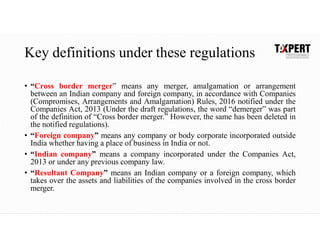
• “Cross border merger” means any merger, amalgamation or arrangement
between an Indian company and foreign company, in accordance with Companies
(Compromises, Arrangements and Amalgamation) Rules, 2016 notified under the
Companies Act, 2013 (Under the draft regulations, the word “demerger” was part
of the definition of “Cross border merger.” However, the same has been deleted in
the notified regulations).
• “Foreign company” means any company or body corporate incorporated outside
India whether having a place of business in India or not.
• “Indian company” means a company incorporated under the Companies Act,
2013 or under any previous company law.
• “Resultant Company” means an Indian company or a foreign company, which
takes over the assets and liabilities of the companies involved in the cross border
merger.
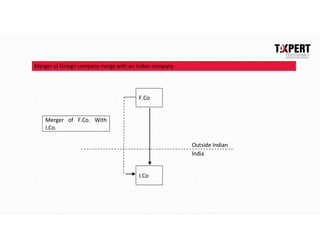
F.Co
Merger of F.Co. With
I.Co.
Outside Indian
India
I.Co
Merger of foreign company merge with an Indian company
Companies Act, 1956
• Section 394(4)(b) of the Companies Act, 1956
states that for the purpose of section 394 of
the Companies act, a ‘transferee company’
can only be a ‘company within the meaning of
this Act’ while a ‘transferor company’ can be
‘any body corporate, whether within the
meaning of the Act or not’. Thus, under sec
394 of the companies Act, 1956, a foreign
company can merge into an Indian company
on satisfying the prescribed conditions & with
the sanction of the High court.
Companies Act, 2013
• On 7th November, 2016 central govt. issued a notification
for enforcement of section 230-233, 235-240, 270-288 etc
w.e.f. 15th Decenber, 2016. MCA vide notification dated
14thDec, 2016 has issued rules i.e. the companies Rules,
2016. These rules will be effective from 15th December,
2016.Consequently, w.e.f. 15.12.2016 all the matters
relating to compromises, Arrangements, & Amalgamations
will be dealt as per provisions of Companies act, 2013 &
the company’s rules, 2016.
• The Reserve Bank of India has issued a notification under
foreign exchange management Regulations,2018 vide
Notification No FEMA.389/2018-RB dated 20 march, 2018
setting out RBI regulations relating to merger,
amalgamation & arrangement b/w Indian companies &
foreign companies
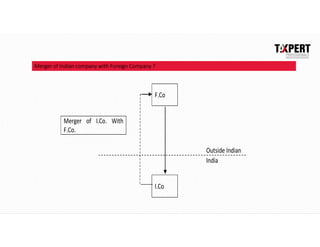
Merger of Indian company with Foreign Company ?
F.Co
Merger of I.Co. With
F.Co.
Outside Indian
India
I.Co
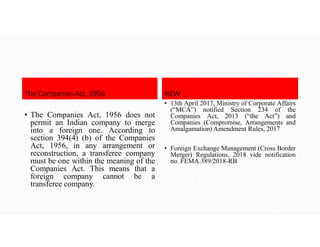
The Companies Act, 1956
• The Companies Act, 1956 does not
permit an Indian company to merge
into a foreign one. According to
section 394(4) (b) of the Companies
Act, 1956, in any arrangement or
reconstruction, a transferee company
must be one within the meaning of the
Companies Act. This means that a
foreign company cannot be a
transferee company.
NEW
• 13th April 2017, Ministry of Corporate Affairs
(“MCA”) notified Section 234 of the
Companies Act, 2013 (“the Act”) and
Companies (Compromise, Arrangements and
Amalgamation) Amendment Rules, 2017
• Foreign Exchange Management (Cross Border
Merger) Regulations, 2018 vide notification
no. FEMA.389/2018-RB
FEMA Provisions
w.r.t Cross Border Merger
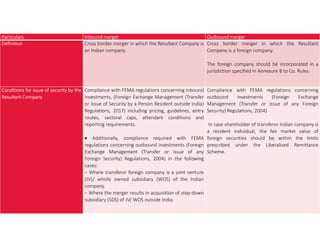
Particulars Inbound merger Outbound merger
Definition Cross border merger in which the Resultant Company is
an Indian company.
Cross border merger in which the Resultant
Company is a foreign company.
The foreign company should be incorporated in a
jurisdiction specified in Annexure B to Co. Rules.
Conditions for issue of security by the
Resultant Company
Compliance with FEMA regulations concerning inbound
investments, (Foreign Exchange Management (Transfer
or Issue of Security by a Person Resident outside India)
Regulations, 2017) including pricing, guidelines, entry
routes, sectoral caps, attendant conditions and
reporting requirements.
 Additionally, compliance required with FEMA
regulations concerning outbound investments (Foreign
Exchange Management (Transfer or issue of any
Foreign Security) Regulations, 2004) in the following
cases:
− Where transferor foreign company is a joint venture
(JV)/ wholly owned subsidiary (WOS) of the Indian
company.
− Where the merger results in acquisition of step-down
subsidiary (SDS) of JV/ WOS outside India.
Compliance with FEMA regulations concerning
outbound investments (Foreign Exchange
Management (Transfer or issue of any Foreign
Security) Regulations, 2004)
In case shareholder of transferor Indian company is
a resident individual, the fair market value of
foreign securities should be within the limits
prescribed under the Liberalised Remittance
Scheme.
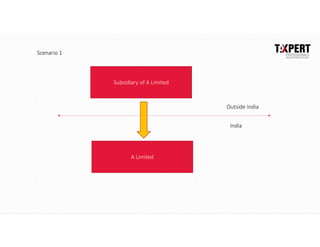
Subsidiary of A Limited
A Limited
Outside India
India
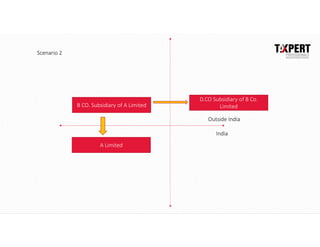
Scenario 1
B CO. Subsidiary of A Limited
A Limited
Outside India
India
D.CO Subsidiary of B Co.
Limited
Scenario 2
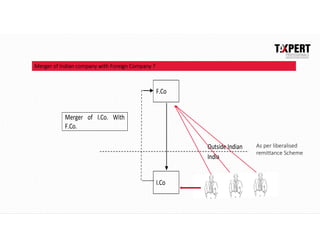
Merger of Indian company with Foreign Company ?
F.Co
Merger of I.Co. With
F.Co.
Outside Indian
India
I.Co
As per liberalised
remittance Scheme
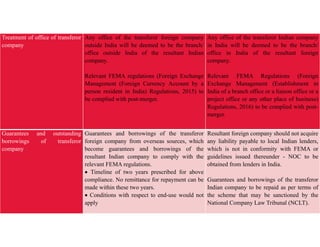
Treatment of office of transferor
company
Any office of the transferor foreign company
outside India will be deemed to be the branch/
office outside India of the resultant Indian
company.
Relevant FEMA regulations (Foreign Exchange
Management (Foreign Currency Account by a
person resident in India) Regulations, 2015) to
be complied with post-merger.
Any office of the transferor Indian company
in India will be deemed to be the branch/
office in India of the resultant foreign
company.
Relevant FEMA Regulations (Foreign
Exchange Management (Establishment in
India of a branch office or a liaison office or a
project office or any other place of business)
Regulations, 2016) to be complied with post-
merger.
Guarantees and outstanding
borrowings of transferor
company
Guarantees and borrowings of the transferor
foreign company from overseas sources, which
become guarantees and borrowings of the
resultant Indian company to comply with the
relevant FEMA regulations.
 Timeline of two years prescribed for above
compliance. No remittance for repayment can be
made within these two years.
 Conditions with respect to end-use would not
apply
Resultant foreign company should not acquire
any liability payable to local Indian lenders,
which is not in conformity with FEMA or
guidelines issued thereunder - NOC to be
obtained from lenders in India.
Guarantees and borrowings of the transferor
Indian company to be repaid as per terms of
the scheme that may be sanctioned by the
National Company Law Tribunal (NCLT).
Merger of Indian company with Foreign Company ?
F.Co
Merger of I.Co. With
F.Co.
Outside Indian
India
I.Co
Indian Company becomes the Branch
office of Foreign Co. ??????
Compliance with Chapter XXII of the
Companies Act, 2013 read with The
Companies (Registration of Foreign
Companies) Rules, 2014 ]
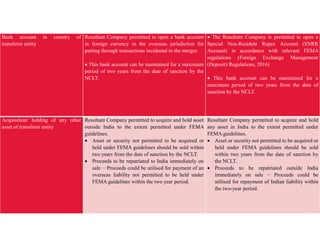
Bank account in country of
transferor entity
Resultant Company permitted to open a bank account
in foreign currency in the overseas jurisdiction for
putting through transactions incidental to the merger.
 This bank account can be maintained for a maximum
period of two years from the date of sanction by the
NCLT.
 The Resultant Company is permitted to open a
Special Non-Resident Rupee Account (SNRR
Account) in accordance with relevant FEMA
regulations (Foreign Exchange Management
(Deposit) Regulations, 2016)
 This bank account can be maintained for a
maximum period of two years from the date of
sanction by the NCLT.
Acquisition/ holding of any other
asset of transferor entity
Resultant Company permitted to acquire and hold asset
outside India to the extent permitted under FEMA
guidelines.
 Asset or security not permitted to be acquired or
held under FEMA guidelines should be sold within
two years from the date of sanction by the NCLT.
 Proceeds to be repatriated to India immediately on
sale − Proceeds could be utilised for payment of an
overseas liability not permitted to be held under
FEMA guidelines within the two year period.
Resultant Company permitted to acquire and hold
any asset in India to the extent permitted under
FEMA guidelines.
 Asset or security not permitted to be acquired or
held under FEMA guidelines should be sold
within two years from the date of sanction by
the NCLT.
 Proceeds to be repatriated outside India
immediately on sale − Proceeds could be
utilised for repayment of Indian liability within
the two-year period.
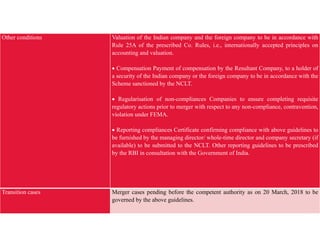
Other conditions Valuation of the Indian company and the foreign company to be in accordance with
Rule 25A of the prescribed Co. Rules, i.e., internationally accepted principles on
accounting and valuation.
 Compensation Payment of compensation by the Resultant Company, to a holder of
a security of the Indian company or the foreign company to be in accordance with the
Scheme sanctioned by the NCLT.
 Regularisation of non-compliances Companies to ensure completing requisite
regulatory actions prior to merger with respect to any non-compliance, contravention,
violation under FEMA.
 Reporting compliances Certificate confirming compliance with above guidelines to
be furnished by the managing director/ whole-time director and company secretary (if
available) to be submitted to the NCLT. Other reporting guidelines to be prescribed
by the RBI in consultation with the Government of India.
Transition cases Merger cases pending before the competent authority as on 20 March, 2018 to be
governed by the above guidelines.
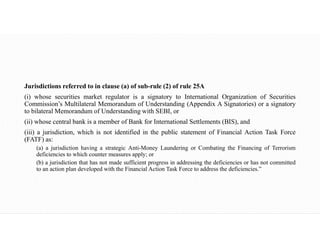
Jurisdictions referred to in clause (a) of sub-rule (2) of rule 25A
(i) whose securities market regulator is a signatory to International Organization of Securities
Commission’s Multilateral Memorandum of Understanding (Appendix A Signatories) or a signatory
to bilateral Memorandum of Understanding with SEBI, or
(ii) whose central bank is a member of Bank for International Settlements (BIS), and
(iii) a jurisdiction, which is not identified in the public statement of Financial Action Task Force
(FATF) as:
(a) a jurisdiction having a strategic Anti-Money Laundering or Combating the Financing of Terrorism
deficiencies to which counter measures apply; or
(b) a jurisdiction that has not made sufficient progress in addressing the deficiencies or has not committed
to an action plan developed with the Financial Action Task Force to address the deficiencies.”
Questions?
Thankyou !!
Sudha@taxpertpro.com

Presentation on Cross Border Mergers

  • 1.
    Due Diligence ofCross Border Transactions 31st August 2019 Institute of Company Secretaries of India BY CA. Sudha G. Bhushan
  • 2.
  • 3.
    Table of Content SectionA • General : International Law Section B • Four abilities of international transactions Section C • Allowability • Talks about current and capital account transactions and FEMA Provisions Section D • Vulnerability • Talks about the taxes Section E • Accountability • talks about reporting of international transactions at various places Section F • Explainability • talks about increasing relevance of documentation in present scenario Section G • Cross Border Merger
  • 4.
  • 5.
    8/31/2019 5 International Law FTA PTA CEPA SSA InternationalAgreements EU NAFTA ASEAN BRICS Groups of Countries . Sources of International Law World trade organisation United Nation IMF World Bank .International Bodies Customary international law and conventional law
  • 6.
    Nuances of CrossBorder Transactions
  • 7.
    7 Four Abilities ofCross Border Transactions . . . Allowability Vulnerability Explainability Accountability
  • 8.
  • 9.
  • 10.
    All current account transactionsare allowed until prohibited All capital account transactions are prohibited until permitted
  • 11.
  • 12.
    12 Vulnerable Tax Risk Fluctuation inForeign Currency Risk. Political risk/Sovereign Risk. Change in Government Policy Risk/Legal risk
  • 13.
  • 14.
  • 15.
  • 16.
  • 17.
  • 18.
    8/31/2019 18 Cross BorderMerger Companies (Compromises, Arrangements and Amalgamation) Amendment Rules, 2017 Amendment Rules Foreign Exchange Management (Cross Border Merger) Regulations, 2018 have been notified vide notification no. FEMA 389/ 2018-RB dated 20 March, 2018 FEMA Regulations Chapter XV Compromises, Arrangements and Amalgamations Section 234 of the Companies Act, 2013 (notified with effect from 13 April, 2017).. Act Companies (Compromises, Arrangements and Amalgamation) Rules, 2016. Rules
  • 19.
    Key definitions underthese regulations • “Cross border merger” means any merger, amalgamation or arrangement between an Indian company and foreign company, in accordance with Companies (Compromises, Arrangements and Amalgamation) Rules, 2016 notified under the Companies Act, 2013 (Under the draft regulations, the word “demerger” was part of the definition of “Cross border merger.” However, the same has been deleted in the notified regulations). • “Foreign company” means any company or body corporate incorporated outside India whether having a place of business in India or not. • “Indian company” means a company incorporated under the Companies Act, 2013 or under any previous company law. • “Resultant Company” means an Indian company or a foreign company, which takes over the assets and liabilities of the companies involved in the cross border merger.
  • 20.
    F.Co Merger of F.Co.With I.Co. Outside Indian India I.Co Merger of foreign company merge with an Indian company
  • 21.
    Companies Act, 1956 •Section 394(4)(b) of the Companies Act, 1956 states that for the purpose of section 394 of the Companies act, a ‘transferee company’ can only be a ‘company within the meaning of this Act’ while a ‘transferor company’ can be ‘any body corporate, whether within the meaning of the Act or not’. Thus, under sec 394 of the companies Act, 1956, a foreign company can merge into an Indian company on satisfying the prescribed conditions & with the sanction of the High court. Companies Act, 2013 • On 7th November, 2016 central govt. issued a notification for enforcement of section 230-233, 235-240, 270-288 etc w.e.f. 15th Decenber, 2016. MCA vide notification dated 14thDec, 2016 has issued rules i.e. the companies Rules, 2016. These rules will be effective from 15th December, 2016.Consequently, w.e.f. 15.12.2016 all the matters relating to compromises, Arrangements, & Amalgamations will be dealt as per provisions of Companies act, 2013 & the company’s rules, 2016. • The Reserve Bank of India has issued a notification under foreign exchange management Regulations,2018 vide Notification No FEMA.389/2018-RB dated 20 march, 2018 setting out RBI regulations relating to merger, amalgamation & arrangement b/w Indian companies & foreign companies
  • 22.
    Merger of Indiancompany with Foreign Company ? F.Co Merger of I.Co. With F.Co. Outside Indian India I.Co
  • 23.
    The Companies Act,1956 • The Companies Act, 1956 does not permit an Indian company to merge into a foreign one. According to section 394(4) (b) of the Companies Act, 1956, in any arrangement or reconstruction, a transferee company must be one within the meaning of the Companies Act. This means that a foreign company cannot be a transferee company. NEW • 13th April 2017, Ministry of Corporate Affairs (“MCA”) notified Section 234 of the Companies Act, 2013 (“the Act”) and Companies (Compromise, Arrangements and Amalgamation) Amendment Rules, 2017 • Foreign Exchange Management (Cross Border Merger) Regulations, 2018 vide notification no. FEMA.389/2018-RB
  • 24.
  • 25.
    Particulars Inbound mergerOutbound merger Definition Cross border merger in which the Resultant Company is an Indian company. Cross border merger in which the Resultant Company is a foreign company. The foreign company should be incorporated in a jurisdiction specified in Annexure B to Co. Rules. Conditions for issue of security by the Resultant Company Compliance with FEMA regulations concerning inbound investments, (Foreign Exchange Management (Transfer or Issue of Security by a Person Resident outside India) Regulations, 2017) including pricing, guidelines, entry routes, sectoral caps, attendant conditions and reporting requirements.  Additionally, compliance required with FEMA regulations concerning outbound investments (Foreign Exchange Management (Transfer or issue of any Foreign Security) Regulations, 2004) in the following cases: − Where transferor foreign company is a joint venture (JV)/ wholly owned subsidiary (WOS) of the Indian company. − Where the merger results in acquisition of step-down subsidiary (SDS) of JV/ WOS outside India. Compliance with FEMA regulations concerning outbound investments (Foreign Exchange Management (Transfer or issue of any Foreign Security) Regulations, 2004) In case shareholder of transferor Indian company is a resident individual, the fair market value of foreign securities should be within the limits prescribed under the Liberalised Remittance Scheme.
  • 26.
    Subsidiary of ALimited A Limited Outside India India Scenario 1
  • 27.
    B CO. Subsidiaryof A Limited A Limited Outside India India D.CO Subsidiary of B Co. Limited Scenario 2
  • 28.
    Merger of Indiancompany with Foreign Company ? F.Co Merger of I.Co. With F.Co. Outside Indian India I.Co As per liberalised remittance Scheme
  • 29.
    Treatment of officeof transferor company Any office of the transferor foreign company outside India will be deemed to be the branch/ office outside India of the resultant Indian company. Relevant FEMA regulations (Foreign Exchange Management (Foreign Currency Account by a person resident in India) Regulations, 2015) to be complied with post-merger. Any office of the transferor Indian company in India will be deemed to be the branch/ office in India of the resultant foreign company. Relevant FEMA Regulations (Foreign Exchange Management (Establishment in India of a branch office or a liaison office or a project office or any other place of business) Regulations, 2016) to be complied with post- merger. Guarantees and outstanding borrowings of transferor company Guarantees and borrowings of the transferor foreign company from overseas sources, which become guarantees and borrowings of the resultant Indian company to comply with the relevant FEMA regulations.  Timeline of two years prescribed for above compliance. No remittance for repayment can be made within these two years.  Conditions with respect to end-use would not apply Resultant foreign company should not acquire any liability payable to local Indian lenders, which is not in conformity with FEMA or guidelines issued thereunder - NOC to be obtained from lenders in India. Guarantees and borrowings of the transferor Indian company to be repaid as per terms of the scheme that may be sanctioned by the National Company Law Tribunal (NCLT).
  • 30.
    Merger of Indiancompany with Foreign Company ? F.Co Merger of I.Co. With F.Co. Outside Indian India I.Co Indian Company becomes the Branch office of Foreign Co. ?????? Compliance with Chapter XXII of the Companies Act, 2013 read with The Companies (Registration of Foreign Companies) Rules, 2014 ]
  • 31.
    Bank account incountry of transferor entity Resultant Company permitted to open a bank account in foreign currency in the overseas jurisdiction for putting through transactions incidental to the merger.  This bank account can be maintained for a maximum period of two years from the date of sanction by the NCLT.  The Resultant Company is permitted to open a Special Non-Resident Rupee Account (SNRR Account) in accordance with relevant FEMA regulations (Foreign Exchange Management (Deposit) Regulations, 2016)  This bank account can be maintained for a maximum period of two years from the date of sanction by the NCLT. Acquisition/ holding of any other asset of transferor entity Resultant Company permitted to acquire and hold asset outside India to the extent permitted under FEMA guidelines.  Asset or security not permitted to be acquired or held under FEMA guidelines should be sold within two years from the date of sanction by the NCLT.  Proceeds to be repatriated to India immediately on sale − Proceeds could be utilised for payment of an overseas liability not permitted to be held under FEMA guidelines within the two year period. Resultant Company permitted to acquire and hold any asset in India to the extent permitted under FEMA guidelines.  Asset or security not permitted to be acquired or held under FEMA guidelines should be sold within two years from the date of sanction by the NCLT.  Proceeds to be repatriated outside India immediately on sale − Proceeds could be utilised for repayment of Indian liability within the two-year period.
  • 32.
    Other conditions Valuationof the Indian company and the foreign company to be in accordance with Rule 25A of the prescribed Co. Rules, i.e., internationally accepted principles on accounting and valuation.  Compensation Payment of compensation by the Resultant Company, to a holder of a security of the Indian company or the foreign company to be in accordance with the Scheme sanctioned by the NCLT.  Regularisation of non-compliances Companies to ensure completing requisite regulatory actions prior to merger with respect to any non-compliance, contravention, violation under FEMA.  Reporting compliances Certificate confirming compliance with above guidelines to be furnished by the managing director/ whole-time director and company secretary (if available) to be submitted to the NCLT. Other reporting guidelines to be prescribed by the RBI in consultation with the Government of India. Transition cases Merger cases pending before the competent authority as on 20 March, 2018 to be governed by the above guidelines.
  • 33.
    Jurisdictions referred toin clause (a) of sub-rule (2) of rule 25A (i) whose securities market regulator is a signatory to International Organization of Securities Commission’s Multilateral Memorandum of Understanding (Appendix A Signatories) or a signatory to bilateral Memorandum of Understanding with SEBI, or (ii) whose central bank is a member of Bank for International Settlements (BIS), and (iii) a jurisdiction, which is not identified in the public statement of Financial Action Task Force (FATF) as: (a) a jurisdiction having a strategic Anti-Money Laundering or Combating the Financing of Terrorism deficiencies to which counter measures apply; or (b) a jurisdiction that has not made sufficient progress in addressing the deficiencies or has not committed to an action plan developed with the Financial Action Task Force to address the deficiencies.”
  • 34.
  • 35.