Page | 3
Oct 2021 newsletter Issue-7, Volume-1
IN THIS ARTICLE WE WILL DISCUSS PRICING OF
INTERNATIONAL TRANSACTION IN ACCORDANCE
WITH INCOME TAX, 1961.
Pricing in International
Transactions with Associated
Enterprises
About the Author
CA Sudha G Bhushan
FCA,FCS, RV & IP (IBBI),
INDEPENDENT WOMEN
DIRECTOR (REGD. WITH
MCA)
E-mail-sudha@taxpertpro.com
Mobile - +91 9769033172
Sudha G. Bhushan is a renowned Finance
Professional and is a Co-Founder of Taxpert
Professionals, a multifaceted consulting company.
She is advisor to Bank of Baroda, NRI and
international operations and Empanelled with HDFC
Bank
1. Introduction
As per section 92 of the Income Tax Act,1961 “Any
income arising from an international transaction shall
be computed having regard to the arm's length
price” Where in an international transaction two or
more associated enterprises enter into a mutual
agreement or arrangement for the allocation or
apportionment of, or any contribution to, any cost or
expense incurred or to be incurred in connection with
a benefit, service or facility provided or to be
provided to any one or more of such enterprises, the
cost or expense allocated or apportioned to, or, as
the case may be, contributed by, any such enterprise
shall be determined having regard to the arm's
length price of such benefit, service or facility, as the
case may be.
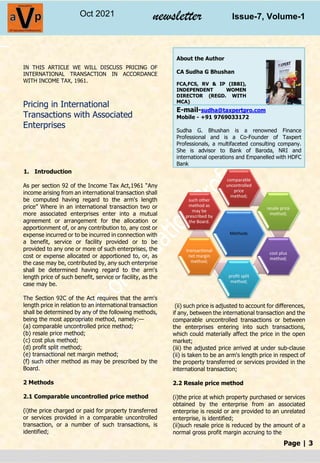
The Section 92C of the Act requires that the arm's
length price in relation to an international transaction
shall be determined by any of the following methods,
being the most appropriate method, namely:—
(a) comparable uncontrolled price method;
(b) resale price method;
(c) cost plus method;
(d) profit split method;
(e) transactional net margin method;
(f) such other method as may be prescribed by the
Board.
2 Methods
2.1 Comparable uncontrolled price method
(i)the price charged or paid for property transferred
or services provided in a comparable uncontrolled
transaction, or a number of such transactions, is
identified;
(ii) such price is adjusted to account for differences,
if any, between the international transaction and the
comparable uncontrolled transactions or between
the enterprises entering into such transactions,
which could materially affect the price in the open
market;
(iii) the adjusted price arrived at under sub-clause
(ii) is taken to be an arm's length price in respect of
the property transferred or services provided in the
international transaction;
2.2 Resale price method
(i)the price at which property purchased or services
obtained by the enterprise from an associated
enterprise is resold or are provided to an unrelated
enterprise, is identified;
(ii)such resale price is reduced by the amount of a
normal gross profit margin accruing to the
Methods
comparable
uncontrolled
price
method;
resale price
method;
cost plus
method;
profit split
method;
transactional
net margin
method;
such other
method as
may be
prescribed by
the Board.
Page | 4
Oct 2021 newsletter Issue-7, Volume-1
Enterprise or to an unrelated enterprise from the
purchase and resale of the same or similar property
or from obtaining and providing the same or similar
services, in a comparable uncontrolled transaction,
or a number of such transactions;
(iii) the price so arrived at is further reduced by the
expenses incurred by the enterprise in connection
with the purchase of property or obtaining of
services;
(iv) the price so arrived at is adjusted to take into
account the functional and other differences,
including differences in accounting practices, if any,
between the international transaction and the
comparable uncontrolled transactions, or between
the enterprises entering into such transactions,
which could materially affect the amount of gross
profit margin in the open market;
(v)the adjusted price arrived at under sub-clause (iv)
is taken to be an arm's length price in respect of the
purchase of the property or obtaining of the services
by the enterprise from the associated enterprise;
2.3 Cost plus method
(i) the direct and indirect costs of production incurred
by the enterprise in respect of property transferred
or services provided to an associated enterprise, are
determined;
(ii) the amount of a normal gross profit mark-up to
such costs (computed according to the same
accounting norms) arising from the transfer or
provision of the same or similar property or services
by the enterprise, or by an unrelated enterprise, in a
comparable uncontrolled transaction, or a number of
such transactions, is determined;
(iii)the normal gross profit mark-up referred to in
sub-clause (ii) is adjusted to take into account the
functional and other differences, if any, between the
international transaction and the comparable
uncontrolled transactions, or between the
enterprises entering into such transactions, which
could materially affect such profit mark-up in the
open market
(iv)the costs referred to in sub-clause (i) are
increased by the adjusted profit mark-up arrived at
under sub-clause (iii);
(v) the sum so arrived at is taken to be an arm's
length price in relation to the supply of the property
or provision of services by the enterprise;
2.4 Profit split method
It may be applicable mainly in international
transactions involving transfer of unique intangibles
or in multiple international transactions which are so
interrelated that they cannot be evaluated
separately for the purpose of determining the arm's
length price of any one transaction, by which-
(i)the combined net profit of the associated
enterprises arising from the international
transaction in which they are engaged, is
determined;
(ii) the relative contribution made by each of the
associated enterprises to the earning of such
combined net profit, is then evaluated on the basis
of the functions performed, assets employed or to
be employed and risks assumed by each enterprise
and on the basis of reliable external market data
which indicates how such contribution would be
evaluated by unrelated enterprises performing
comparable functions in similar circumstances;
(iii) the combined net profit is then split amongst
the enterprises in proportion to their relative
contributions, as evaluated under sub-clause (ii);
(iv) the profit thus apportioned to the assessee is
taken into account to arrive at an arm's length price
in relation to the international transaction:
Provided that the combined net profit referred to in
sub-clause (i) may, in the first instance, be partially
allocated to each enterprise so as to provide it with
a basic return appropriate for the type of
international transaction in which it is engaged, with
reference to market returns achieved for similar
types of transactions by independent enterprises,
and thereafter, the residual net profit remaining
after such allocation may be split amongst the
enterprises in proportion to their relative
contribution in the manner specified under sub-
clauses (ii) and (iii), and in such a case the
aggregate of the net profit allocated to the
enterprise in the first instance together with the
residual net profit apportioned to that enterprise on
the basis of its relative contribution shall be taken
to be the net profit arising to that enterprise from
the international transaction.
2.5 Transactional net margin method
(i)the net profit margin realized by the enterprise
from an international transaction [or a specified
domestic transaction] entered into with an
associated enterprise is computed in relation to
costs incurred or sales effected or assets employed
or to be employed by the enterprise or having
regard to any other relevant base;
(ii) the net profit margin realised by the enterprise
or by an unrelated enterprise from a comparable
uncontrolled transaction or a number of such
transactions is computed having regard to the same
base;
Page | 5
Oct 2021 newsletter Issue-7, Volume-1
(iii) the net profit margin referred to in sub-clause
(ii) arising in comparable uncontrolled transactions is
adjusted to take into account the differences, if any,
between the international transaction and the
comparable uncontrolled transactions, or between
the enterprises entering into such transactions,
which could materially affect the amount of net profit
margin in the open market;
(iv) the net profit margin realised by the enterprise
and referred to in sub-clause (i) is established to be
the same as the net profit margin referred to in sub-
clause (iii);
(v)the net profit margin thus established is then
taken into account to arrive at an arm's length price
in relation to the international transaction.
Any other method
It is any method which takes into account the price
which has been charged or paid, or would have been
charged or paid, for the same or similar uncontrolled
transaction, with or between non-associated
enterprises, under similar circumstances,
considering all the relevant facts.
3.Flexibility in determination of Arm’s Length
Price
Transfer Pricing provisions allows flexibility in
determination of Arm’s Length Price. It permits use
of arithmetic mean/ range (i.e. 35th percentile to
65th percentile).
The Range concept is applicable for all the
transactions including international transactions with
effect from Apr 2014. The range concept is used for
all the methods except the Profit Split Method (PSM)
and the “other method”
There should be a minimum of 6 comparable for
applicability of Range concept. If the number of
comparable less than 6 then arithmetic concepts is
applicable. The arm’s length range is defined as
35th percentile and the 65th percentile of the
dataset arranged in the ascending order.
Rule 10CA of the Income Tax Rules prescribes the
determination of ALP in range concept. The Arm’s
length range will constitute of the values falling
between 35th and the 65th percentile of the
comparable entries that are arranged in the
ascending order.
35th
Percentile = Total no. Of Entries * 35/100 (Lowest
value in the dataset)
65th
Percentile = Total no. Of Entries * 65/100
(Highest value)
If the price as calculated in the 35th Percentile is a
whole number, then the 35th percentile shall be the
arithmetic mean of such value and the value
immediately succeeding in the dataset.
If the value derived from the formula is not a whole
number, then the comparable entry in the next data
place should be considered as the 35th percentile.
The same has to be followed for the 65th percentile
and the 50th percentile (Median).
If the price at which an international transaction or
specified domestic transaction has actually been
undertaken is within the range, the price at which
the international or specified domestic transaction is
undertaken, it is deemed to be the arm’s length
price as per section 92C (1).
The price at which an international transaction or
the specified domestic transaction has actually been
undertaken is outside the arm’s length range
referred in sub-rule (4) of the rule 10 CA, the arm’s
length price shall be taken to be the median of the
dataset.
Conclusion
It is upto the company which method to choose as
far as it is the most appropriate method. As per Rule
10C of Income Tax Rules, 1961, most appropriate
method shall be the method which is best suited to
the facts and circumstances of each particular
international transaction and which provides the
most reliable measure of an arm's length price in
relation to the international transaction.
In selecting the most appropriate method, the
following factors shall be taken into account like the
nature and class of the international transaction, the
class or classes of associated enterprises entering
into the transaction and the functions performed by
them taking into account assets employed or to be
employed and risks assumed by such enterprises,
the availability, coverage and reliability of data
necessary for application of the method, the degree
of comparability existing between the international
transaction and the uncontrolled transaction and
between the enterprises entering into such
transactions, the extent to which reliable and
accurate adjustments can be made to account for
differences, if any, between the international
transaction and the comparable uncontrolled
transaction or between the enterprises entering into
such transactions, the nature, extent and reliability
of assumptions required to be made in application
of a method.

Article on Pricing in International Transaction

  • 1.
    Page | 3 Oct2021 newsletter Issue-7, Volume-1 IN THIS ARTICLE WE WILL DISCUSS PRICING OF INTERNATIONAL TRANSACTION IN ACCORDANCE WITH INCOME TAX, 1961. Pricing in International Transactions with Associated Enterprises About the Author CA Sudha G Bhushan FCA,FCS, RV & IP (IBBI), INDEPENDENT WOMEN DIRECTOR (REGD. WITH MCA) E-mail-sudha@taxpertpro.com Mobile - +91 9769033172 Sudha G. Bhushan is a renowned Finance Professional and is a Co-Founder of Taxpert Professionals, a multifaceted consulting company. She is advisor to Bank of Baroda, NRI and international operations and Empanelled with HDFC Bank 1. Introduction As per section 92 of the Income Tax Act,1961 “Any income arising from an international transaction shall be computed having regard to the arm's length price” Where in an international transaction two or more associated enterprises enter into a mutual agreement or arrangement for the allocation or apportionment of, or any contribution to, any cost or expense incurred or to be incurred in connection with a benefit, service or facility provided or to be provided to any one or more of such enterprises, the cost or expense allocated or apportioned to, or, as the case may be, contributed by, any such enterprise shall be determined having regard to the arm's length price of such benefit, service or facility, as the case may be. The Section 92C of the Act requires that the arm's length price in relation to an international transaction shall be determined by any of the following methods, being the most appropriate method, namely:— (a) comparable uncontrolled price method; (b) resale price method; (c) cost plus method; (d) profit split method; (e) transactional net margin method; (f) such other method as may be prescribed by the Board. 2 Methods 2.1 Comparable uncontrolled price method (i)the price charged or paid for property transferred or services provided in a comparable uncontrolled transaction, or a number of such transactions, is identified; (ii) such price is adjusted to account for differences, if any, between the international transaction and the comparable uncontrolled transactions or between the enterprises entering into such transactions, which could materially affect the price in the open market; (iii) the adjusted price arrived at under sub-clause (ii) is taken to be an arm's length price in respect of the property transferred or services provided in the international transaction; 2.2 Resale price method (i)the price at which property purchased or services obtained by the enterprise from an associated enterprise is resold or are provided to an unrelated enterprise, is identified; (ii)such resale price is reduced by the amount of a normal gross profit margin accruing to the Methods comparable uncontrolled price method; resale price method; cost plus method; profit split method; transactional net margin method; such other method as may be prescribed by the Board.
  • 2.
    Page | 4 Oct2021 newsletter Issue-7, Volume-1 Enterprise or to an unrelated enterprise from the purchase and resale of the same or similar property or from obtaining and providing the same or similar services, in a comparable uncontrolled transaction, or a number of such transactions; (iii) the price so arrived at is further reduced by the expenses incurred by the enterprise in connection with the purchase of property or obtaining of services; (iv) the price so arrived at is adjusted to take into account the functional and other differences, including differences in accounting practices, if any, between the international transaction and the comparable uncontrolled transactions, or between the enterprises entering into such transactions, which could materially affect the amount of gross profit margin in the open market; (v)the adjusted price arrived at under sub-clause (iv) is taken to be an arm's length price in respect of the purchase of the property or obtaining of the services by the enterprise from the associated enterprise; 2.3 Cost plus method (i) the direct and indirect costs of production incurred by the enterprise in respect of property transferred or services provided to an associated enterprise, are determined; (ii) the amount of a normal gross profit mark-up to such costs (computed according to the same accounting norms) arising from the transfer or provision of the same or similar property or services by the enterprise, or by an unrelated enterprise, in a comparable uncontrolled transaction, or a number of such transactions, is determined; (iii)the normal gross profit mark-up referred to in sub-clause (ii) is adjusted to take into account the functional and other differences, if any, between the international transaction and the comparable uncontrolled transactions, or between the enterprises entering into such transactions, which could materially affect such profit mark-up in the open market (iv)the costs referred to in sub-clause (i) are increased by the adjusted profit mark-up arrived at under sub-clause (iii); (v) the sum so arrived at is taken to be an arm's length price in relation to the supply of the property or provision of services by the enterprise; 2.4 Profit split method It may be applicable mainly in international transactions involving transfer of unique intangibles or in multiple international transactions which are so interrelated that they cannot be evaluated separately for the purpose of determining the arm's length price of any one transaction, by which- (i)the combined net profit of the associated enterprises arising from the international transaction in which they are engaged, is determined; (ii) the relative contribution made by each of the associated enterprises to the earning of such combined net profit, is then evaluated on the basis of the functions performed, assets employed or to be employed and risks assumed by each enterprise and on the basis of reliable external market data which indicates how such contribution would be evaluated by unrelated enterprises performing comparable functions in similar circumstances; (iii) the combined net profit is then split amongst the enterprises in proportion to their relative contributions, as evaluated under sub-clause (ii); (iv) the profit thus apportioned to the assessee is taken into account to arrive at an arm's length price in relation to the international transaction: Provided that the combined net profit referred to in sub-clause (i) may, in the first instance, be partially allocated to each enterprise so as to provide it with a basic return appropriate for the type of international transaction in which it is engaged, with reference to market returns achieved for similar types of transactions by independent enterprises, and thereafter, the residual net profit remaining after such allocation may be split amongst the enterprises in proportion to their relative contribution in the manner specified under sub- clauses (ii) and (iii), and in such a case the aggregate of the net profit allocated to the enterprise in the first instance together with the residual net profit apportioned to that enterprise on the basis of its relative contribution shall be taken to be the net profit arising to that enterprise from the international transaction. 2.5 Transactional net margin method (i)the net profit margin realized by the enterprise from an international transaction [or a specified domestic transaction] entered into with an associated enterprise is computed in relation to costs incurred or sales effected or assets employed or to be employed by the enterprise or having regard to any other relevant base; (ii) the net profit margin realised by the enterprise or by an unrelated enterprise from a comparable uncontrolled transaction or a number of such transactions is computed having regard to the same base;
  • 3.
    Page | 5 Oct2021 newsletter Issue-7, Volume-1 (iii) the net profit margin referred to in sub-clause (ii) arising in comparable uncontrolled transactions is adjusted to take into account the differences, if any, between the international transaction and the comparable uncontrolled transactions, or between the enterprises entering into such transactions, which could materially affect the amount of net profit margin in the open market; (iv) the net profit margin realised by the enterprise and referred to in sub-clause (i) is established to be the same as the net profit margin referred to in sub- clause (iii); (v)the net profit margin thus established is then taken into account to arrive at an arm's length price in relation to the international transaction. Any other method It is any method which takes into account the price which has been charged or paid, or would have been charged or paid, for the same or similar uncontrolled transaction, with or between non-associated enterprises, under similar circumstances, considering all the relevant facts. 3.Flexibility in determination of Arm’s Length Price Transfer Pricing provisions allows flexibility in determination of Arm’s Length Price. It permits use of arithmetic mean/ range (i.e. 35th percentile to 65th percentile). The Range concept is applicable for all the transactions including international transactions with effect from Apr 2014. The range concept is used for all the methods except the Profit Split Method (PSM) and the “other method” There should be a minimum of 6 comparable for applicability of Range concept. If the number of comparable less than 6 then arithmetic concepts is applicable. The arm’s length range is defined as 35th percentile and the 65th percentile of the dataset arranged in the ascending order. Rule 10CA of the Income Tax Rules prescribes the determination of ALP in range concept. The Arm’s length range will constitute of the values falling between 35th and the 65th percentile of the comparable entries that are arranged in the ascending order. 35th Percentile = Total no. Of Entries * 35/100 (Lowest value in the dataset) 65th Percentile = Total no. Of Entries * 65/100 (Highest value) If the price as calculated in the 35th Percentile is a whole number, then the 35th percentile shall be the arithmetic mean of such value and the value immediately succeeding in the dataset. If the value derived from the formula is not a whole number, then the comparable entry in the next data place should be considered as the 35th percentile. The same has to be followed for the 65th percentile and the 50th percentile (Median). If the price at which an international transaction or specified domestic transaction has actually been undertaken is within the range, the price at which the international or specified domestic transaction is undertaken, it is deemed to be the arm’s length price as per section 92C (1). The price at which an international transaction or the specified domestic transaction has actually been undertaken is outside the arm’s length range referred in sub-rule (4) of the rule 10 CA, the arm’s length price shall be taken to be the median of the dataset. Conclusion It is upto the company which method to choose as far as it is the most appropriate method. As per Rule 10C of Income Tax Rules, 1961, most appropriate method shall be the method which is best suited to the facts and circumstances of each particular international transaction and which provides the most reliable measure of an arm's length price in relation to the international transaction. In selecting the most appropriate method, the following factors shall be taken into account like the nature and class of the international transaction, the class or classes of associated enterprises entering into the transaction and the functions performed by them taking into account assets employed or to be employed and risks assumed by such enterprises, the availability, coverage and reliability of data necessary for application of the method, the degree of comparability existing between the international transaction and the uncontrolled transaction and between the enterprises entering into such transactions, the extent to which reliable and accurate adjustments can be made to account for differences, if any, between the international transaction and the comparable uncontrolled transaction or between the enterprises entering into such transactions, the nature, extent and reliability of assumptions required to be made in application of a method.