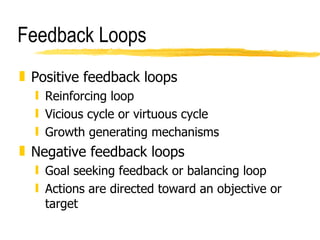
Feedback Loops Positive feedback loops Reinforcing loop Vicious cycle or virtuous cycle Growth generating mechanisms Negative feedback loops Goal seeking feedback or balancing loop Actions are directed toward an objective or target
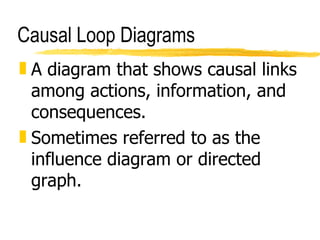
Causal Loop Diagrams A diagram that shows causal links among actions, information, and consequences. Sometimes referred to as the influence diagram or directed graph.
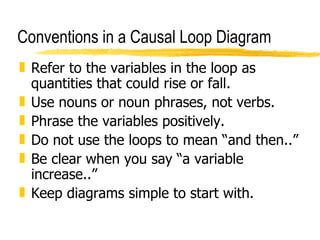
Conventions in a Causal Loop Diagram Refer to the variables in the loop as quantities that could rise or fall. Use nouns or noun phrases, not verbs. Phrase the variables positively. Do not use the loops to mean “and then..” Be clear when you say “a variable increase..” Keep diagrams simple to start with.
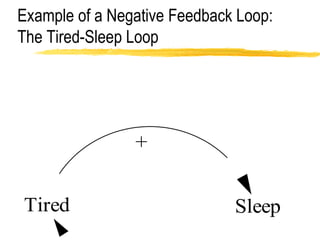
Example of a Negative Feedback Loop: The Tired-Sleep Loop
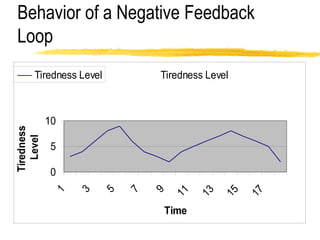
Behavior of a Negative Feedback Loop
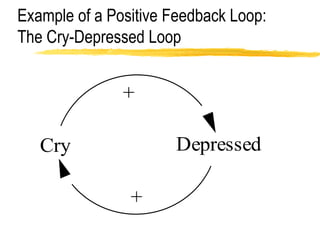
Example of a Positive Feedback Loop: The Cry-Depressed Loop
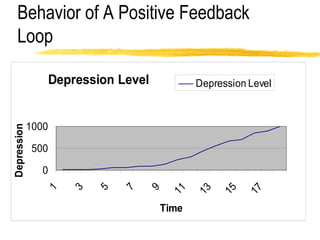
Behavior of A Positive Feedback Loop
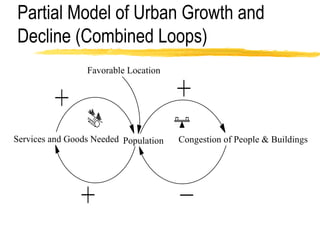
Partial Model of Urban Growth and Decline (Combined Loops) Services and Goods Needed Population Congestion of People & Buildings Favorable Location
Traffic Dynamics (More Complicated Loop)
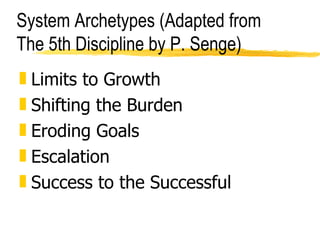
System Archetypes (Adapted from The 5th Discipline by P. Senge) Limits to Growth Shifting the Burden Eroding Goals Escalation Success to the Successful
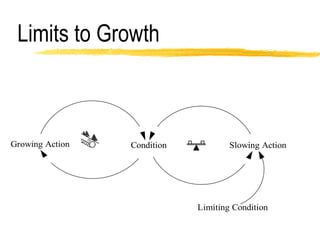
Limits to Growth
Characteristics of Limits to Growth Pattern of behavior Accelerated growth followed by slowing down leading to no more growth or accelerating collapse Management principle Don’t push on the reinforcing loop, remove or weaken the limiting source Examples: growth of a city, learning process, growth of a “young” company
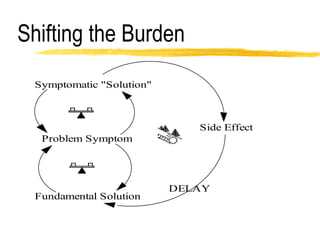
Shifting the Burden
Characteristics of Shifting the Burden Pattern of behavior: Reliance on symptomatic solutions that seems to produce immediate positive results, leading to the avoidance of the fundamental solution. Management principle: Focus on fundamental solution, use symptomatic solution to gain time, not to replace fundamental solution. Examples:credit cards, alcohol/drugs addiction, overtime work, QA inspection
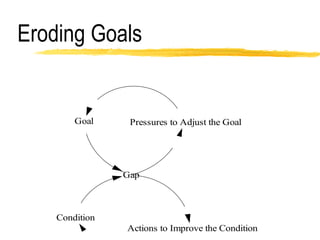
Eroding Goals
Characteristics of Eroding Goals Pattern of Behavior: Relaxing on our Targets, lowering of standards. Management Principle: Hold the Vision. Examples:Lowering of Quality Standards by cutting budgets, Lowering Government Targets to balance deficit, Allowing endangered species to die to push industrialization
Escalation
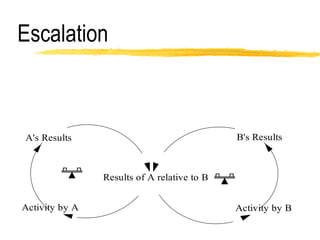
Characteristics of Escalation Pattern of Behavior: Two systems collide each other, where the welfare of one is dependent on the relative advantage over the other. Management Principle: Look for a Win-Win Situation or pursue peaceful actions that would not threaten the other side. Examples:Arms Race, Marriage Problem, Transport Fares, Mindanao Conflict
Success to the Successful
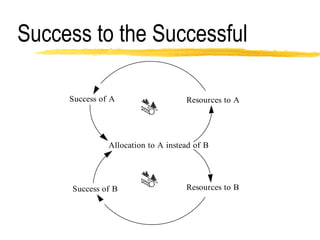
Characteristics of Success to the Successful Pattern of behavior: Two systems compete for a limited resource or support. The more successful system starves the other. Management principle: Break or weaken the coupling between the two system. Balance the achievements of both systems. Examples:work and family life, A slow learner and a fast learner, 2 products with limited funds.
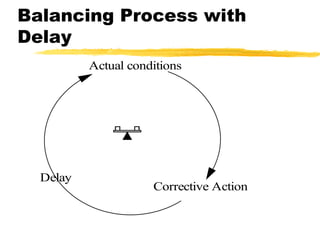
Balancing Process with Delay
Characteristics of Balancing Process with Delay Pattern of behavior The system seems to be on track, but we suddenly overshoot our mark. Management principle Aggressiveness produces instability. Be patient or make the system more responsive. Examples: shower with hot water, cycles in manufacturing, EDSA 2
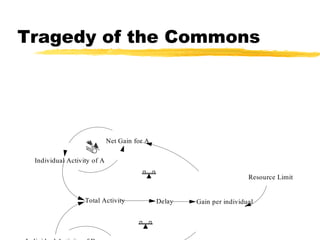
Tragedy of the Commons
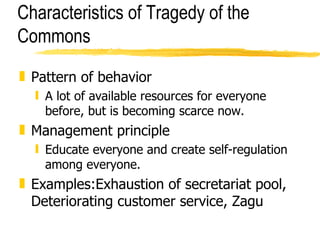
Characteristics of Tragedy of the Commons Pattern of behavior A lot of available resources for everyone before, but is becoming scarce now. Management principle Educate everyone and create self-regulation among everyone. Examples:Exhaustion of secretariat pool, Deteriorating customer service, Zagu
Fixes that Fail
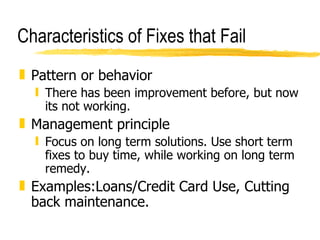
Characteristics of Fixes that Fail Pattern or behavior There has been improvement before, but now its not working. Management principle Focus on long term solutions. Use short term fixes to buy time, while working on long term remedy. Examples:Loans/Credit Card Use, Cutting back maintenance.
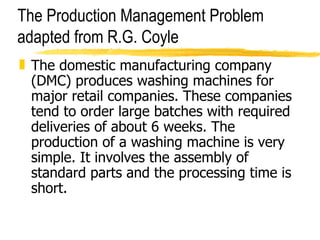
The Production Management Problem adapted from R.G. Coyle The domestic manufacturing company (DMC) produces washing machines for major retail companies. These companies tend to order large batches with required deliveries of about 6 weeks. The production of a washing machine is very simple. It involves the assembly of standard parts and the processing time is short.
The Production Management Problem adapted from R.G. Coyle DMC has never been able to forecast the inflow of new orders. They cope with a very unpredictable order pattern. New orders accumulate into backlog which the company tries to keep down at a target level. The production manager considers two factors in setting the production rate.
The Production Management Problem adapted from R.G. Coyle First, it aims to eliminate discrepancies between actual and target backlog over a period of 4 weeks.The backlog target is to complete the new orders in 6 weeks.
The Production Management Problem adapted from R.G. Coyle Second, to keep up with the current order level, the production rate includes the average order rate to eliminate the discrepancy in the actual backlog and target backlog.
The Production Management Problem adapted from R.G. Coyle The raw material manager tries to keep raw material stock up to a target level, ordering raw materials to eliminate any discrepancies within a period of 4 weeks. The target level is based on smoothing production variations over 4 weeks and aiming to have sufficient stocks to cover 8 weeks of average production.
The Production Management Problem adapted from R.G. Coyle To keep up with the current usage, the order rate is added with the average usage rate of raw materials which would eliminate the discrepancy between the desired stock level and actual stock level.
The Production Management Problem adapted from R.G. Coyle
Summary System dynamics is very relevant to dynamic problems and complements other management science tools. SD deals with the behavior of the system and how it affects its future. This is more relevant to strategic management. SD models come in two forms, the causal loop and a simulation model. SD is very challenging and fun.
Selected References The 5th discipline by P. Senge System dynamics modeling by G. Coyle Http://www.uni-klu.Ac.At/~gossimit/ Links/bookmksd.htm  (SD MEGALINK LIST) Www.vensim.Com Www.pegasuscom.Com Http://sysdyn.mit.edu/road-maps/home.Html

Feedback Loops

  • 1.
    Feedback Loops Positivefeedback loops Reinforcing loop Vicious cycle or virtuous cycle Growth generating mechanisms Negative feedback loops Goal seeking feedback or balancing loop Actions are directed toward an objective or target
  • 2.
    Causal Loop DiagramsA diagram that shows causal links among actions, information, and consequences. Sometimes referred to as the influence diagram or directed graph.
  • 3.
    Conventions in aCausal Loop Diagram Refer to the variables in the loop as quantities that could rise or fall. Use nouns or noun phrases, not verbs. Phrase the variables positively. Do not use the loops to mean “and then..” Be clear when you say “a variable increase..” Keep diagrams simple to start with.
  • 4.
    Example of aNegative Feedback Loop: The Tired-Sleep Loop
  • 5.
    Behavior of aNegative Feedback Loop
  • 6.
    Example of aPositive Feedback Loop: The Cry-Depressed Loop
  • 7.
    Behavior of APositive Feedback Loop
  • 8.
    Partial Model ofUrban Growth and Decline (Combined Loops) Services and Goods Needed Population Congestion of People & Buildings Favorable Location
  • 9.
    Traffic Dynamics (MoreComplicated Loop)
  • 10.
    System Archetypes (Adaptedfrom The 5th Discipline by P. Senge) Limits to Growth Shifting the Burden Eroding Goals Escalation Success to the Successful
  • 11.
  • 12.
    Characteristics of Limitsto Growth Pattern of behavior Accelerated growth followed by slowing down leading to no more growth or accelerating collapse Management principle Don’t push on the reinforcing loop, remove or weaken the limiting source Examples: growth of a city, learning process, growth of a “young” company
  • 13.
  • 14.
    Characteristics of Shiftingthe Burden Pattern of behavior: Reliance on symptomatic solutions that seems to produce immediate positive results, leading to the avoidance of the fundamental solution. Management principle: Focus on fundamental solution, use symptomatic solution to gain time, not to replace fundamental solution. Examples:credit cards, alcohol/drugs addiction, overtime work, QA inspection
  • 15.
  • 16.
    Characteristics of ErodingGoals Pattern of Behavior: Relaxing on our Targets, lowering of standards. Management Principle: Hold the Vision. Examples:Lowering of Quality Standards by cutting budgets, Lowering Government Targets to balance deficit, Allowing endangered species to die to push industrialization
  • 17.
  • 18.
    Characteristics of EscalationPattern of Behavior: Two systems collide each other, where the welfare of one is dependent on the relative advantage over the other. Management Principle: Look for a Win-Win Situation or pursue peaceful actions that would not threaten the other side. Examples:Arms Race, Marriage Problem, Transport Fares, Mindanao Conflict
  • 19.
    Success to theSuccessful
  • 20.
    Characteristics of Successto the Successful Pattern of behavior: Two systems compete for a limited resource or support. The more successful system starves the other. Management principle: Break or weaken the coupling between the two system. Balance the achievements of both systems. Examples:work and family life, A slow learner and a fast learner, 2 products with limited funds.
  • 21.
  • 22.
    Characteristics of BalancingProcess with Delay Pattern of behavior The system seems to be on track, but we suddenly overshoot our mark. Management principle Aggressiveness produces instability. Be patient or make the system more responsive. Examples: shower with hot water, cycles in manufacturing, EDSA 2
  • 23.
  • 24.
    Characteristics of Tragedyof the Commons Pattern of behavior A lot of available resources for everyone before, but is becoming scarce now. Management principle Educate everyone and create self-regulation among everyone. Examples:Exhaustion of secretariat pool, Deteriorating customer service, Zagu
  • 25.
  • 26.
    Characteristics of Fixesthat Fail Pattern or behavior There has been improvement before, but now its not working. Management principle Focus on long term solutions. Use short term fixes to buy time, while working on long term remedy. Examples:Loans/Credit Card Use, Cutting back maintenance.
  • 27.
    The Production ManagementProblem adapted from R.G. Coyle The domestic manufacturing company (DMC) produces washing machines for major retail companies. These companies tend to order large batches with required deliveries of about 6 weeks. The production of a washing machine is very simple. It involves the assembly of standard parts and the processing time is short.
  • 28.
    The Production ManagementProblem adapted from R.G. Coyle DMC has never been able to forecast the inflow of new orders. They cope with a very unpredictable order pattern. New orders accumulate into backlog which the company tries to keep down at a target level. The production manager considers two factors in setting the production rate.
  • 29.
    The Production ManagementProblem adapted from R.G. Coyle First, it aims to eliminate discrepancies between actual and target backlog over a period of 4 weeks.The backlog target is to complete the new orders in 6 weeks.
  • 30.
    The Production ManagementProblem adapted from R.G. Coyle Second, to keep up with the current order level, the production rate includes the average order rate to eliminate the discrepancy in the actual backlog and target backlog.
  • 31.
    The Production ManagementProblem adapted from R.G. Coyle The raw material manager tries to keep raw material stock up to a target level, ordering raw materials to eliminate any discrepancies within a period of 4 weeks. The target level is based on smoothing production variations over 4 weeks and aiming to have sufficient stocks to cover 8 weeks of average production.
  • 32.
    The Production ManagementProblem adapted from R.G. Coyle To keep up with the current usage, the order rate is added with the average usage rate of raw materials which would eliminate the discrepancy between the desired stock level and actual stock level.
  • 33.
    The Production ManagementProblem adapted from R.G. Coyle
  • 34.
    Summary System dynamicsis very relevant to dynamic problems and complements other management science tools. SD deals with the behavior of the system and how it affects its future. This is more relevant to strategic management. SD models come in two forms, the causal loop and a simulation model. SD is very challenging and fun.
  • 35.
    Selected References The5th discipline by P. Senge System dynamics modeling by G. Coyle Http://www.uni-klu.Ac.At/~gossimit/ Links/bookmksd.htm (SD MEGALINK LIST) Www.vensim.Com Www.pegasuscom.Com Http://sysdyn.mit.edu/road-maps/home.Html