Community, Cohesion, and Commitment: Developing and Deploying Open Source Tools in the UVa Online Library EnvironmentJulie Meloni, University of VirginiaMITH Digital Dialogue // 22 Feb 2011jcmeloni@virginia.edu // @jcmeloni
The Hydra ProjectCollaborative effort between University of Virginia, Stanford University, University of Hull, Fedora Commons/DuraSpace, and MediaShelf.Working group created in 2008 to fill a need to develop an end-to-end, flexible, extensible, workflow-driven, Fedora application kit.Technical Framework Community FrameworkNo direct funding of the Hydra Project itself.
Hydra Project Assumption #1no single application can meet the full range of digital asset management needs, but there are shared primitive functions:Depositsimple or multipart objects, singly or in bulkManage object’s content, metadata, and permissionsSearch both full text and fielded search in support of user discovery and administrationBrowseobjects sequentially by collection, attribute, or ad-hoc filteringDelivery of objects for viewing, downloading, and dissemination through user and machine interfaces
Hydra Project ResponseOne body, many heads.Hydra is designed to support tailored applications and workflows for different content types, contexts, and interactions by building from:a common repository infrastructure,flexible, atomic data models, andmodular services and configurable components
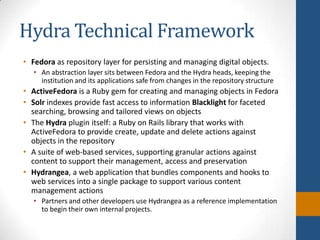
Hydra Technical FrameworkFedoraas repository layer for persisting and managing digital objects. An abstraction layer sits between Fedora and the Hydra heads, keeping the institution and its applications safe from changes in the repository structureActiveFedorais a Ruby gem for creating and managing objects in FedoraSolr indexes provide fast access to information Blacklight for faceted searching, browsing and tailored views on objectsThe Hydra plugin itself: a Ruby on Rails library that works with ActiveFedora to provide create, update and delete actions against objects in the repositoryA suite of web-based services, supporting granular actions against content to support their management, access and preservation Hydrangea, a web application that bundles components and hooks to web services into a single package to support various content management actionsPartners and other developers use Hydrangea as a reference implementation to begin their own internal projects.
Hydra Project Assumption #2no single institution or provider can resource the development or maintenance of a full set of solutions for the same needs.Problems with proprietary software include expense in terms of licensing, hardware, maintenance, potential vendor lock-inProblems with open source software include expense of human resources, and lack of vendor support causes a reliance on internal resources and community that may have different goals than your own.
Hydra Project Response“If you want to go fast, go alone. If you want to go far, go together.”Hydra Steering GroupCollaborative roadmapping, resource allocation and coordination, governance of the technology coreHydra Managers Shape and fund work, commission “heads”, create functional requirements and specifications, UI/UX design, documentation, training, evangelismHydra DevelopersDefine technical architecture, commit code, integration and release, testing, testing, testing.
Hydra Community FrameworkConceived and executed as a collaborative, open source effort from the startAn open architecture, with many contributors to the coreCollaboratively built “solution bundles” that can be adapted and modified to suit local needsHydra heads as reference implementationsUltimate objective of the Hydra Project is to effectively intertwine its technical and community threads of development, producing a community-sourced, sustainable application framework.
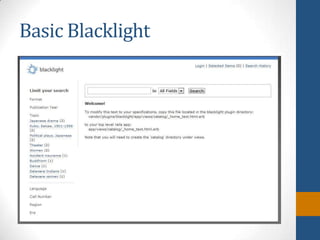
Open Source in PracticeBlacklight is an open source discovery interface that can be used as a front end for a digital repository, or as a single-search interface to aggregate digital content that would otherwise be siloed.Developed originally within the Scholars’ Lab and UVa Library as a skunkworks project; is now an integral part of the Hydra frameworkcustomizable and removable for ultimate flexibilitymany core developers part of the Hydra Project (Bess Sadler, now at Stanford, Bob Haschert at UVa, etc)Continued development by a core group of committers governed by developer norms.
Basic Blacklight
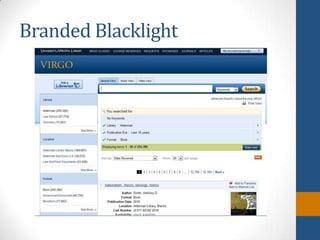
Branded Blacklight
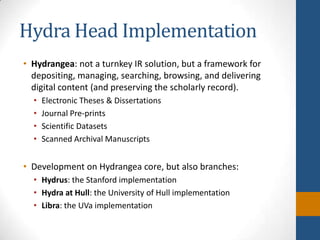
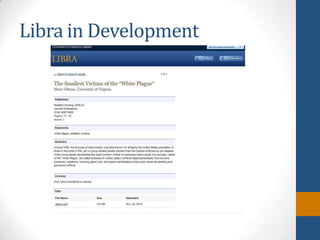
Hydra Head ImplementationHydrangea: not a turnkey IR solution, but a framework for depositing, managing, searching, browsing, and delivering digital content (and preserving the scholarly record).Electronic Theses & DissertationsJournal Pre-printsScientific DatasetsScanned Archival ManuscriptsDevelopment on Hydrangea core, but also branches:Hydrus: the Stanford implementationHydra at Hull: the University of Hull implementationLibra: the UVa implementation
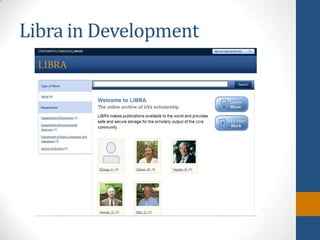
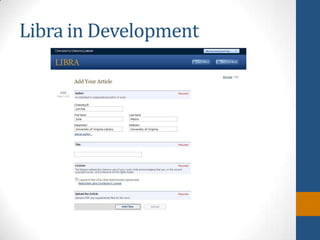
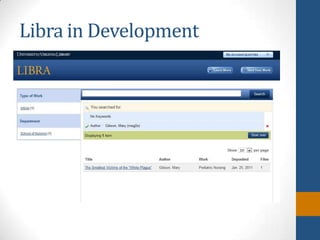
Libra in Development
HYPATIAHYdra Platform for Access to Information in ArchivesA Hydra head that enables processing, arrangement, description and access for born digital archival materials. Built in association with the Mellon AIMS Grant (with UVa, Hull, Stanford & Yale as partners).Functional specifications mapped by content expertsDiscussion within Hydra SteeringResource allocation among partnersDevelopment and continuous integration from the communityWin!
Community, Cohesion, & CommitmentGiven access to a vibrant community of developers and end users, plusA desire to work together when offered workflows and the opportunity to effect change, with a goal of completingProjects and commitments already made, leveraging lessons learned and continuing to move forward, then…all of this runs on love.
Possible Discussion QuestionsSeriously? It runs on love? (Yes, seriously.)Balancing commitments to library applications in production with those in development, plus responsibilities to the communityTeam demographicsSkills required, ongoing training, developer assumptionsMore?

Community, Cohesion, and Commitment

  • 1.
    Community, Cohesion, andCommitment: Developing and Deploying Open Source Tools in the UVa Online Library EnvironmentJulie Meloni, University of VirginiaMITH Digital Dialogue // 22 Feb 2011jcmeloni@virginia.edu // @jcmeloni
  • 2.
    The Hydra ProjectCollaborativeeffort between University of Virginia, Stanford University, University of Hull, Fedora Commons/DuraSpace, and MediaShelf.Working group created in 2008 to fill a need to develop an end-to-end, flexible, extensible, workflow-driven, Fedora application kit.Technical Framework Community FrameworkNo direct funding of the Hydra Project itself.
  • 3.
    Hydra Project Assumption#1no single application can meet the full range of digital asset management needs, but there are shared primitive functions:Depositsimple or multipart objects, singly or in bulkManage object’s content, metadata, and permissionsSearch both full text and fielded search in support of user discovery and administrationBrowseobjects sequentially by collection, attribute, or ad-hoc filteringDelivery of objects for viewing, downloading, and dissemination through user and machine interfaces
  • 4.
    Hydra Project ResponseOnebody, many heads.Hydra is designed to support tailored applications and workflows for different content types, contexts, and interactions by building from:a common repository infrastructure,flexible, atomic data models, andmodular services and configurable components
  • 5.
    Hydra Technical FrameworkFedoraasrepository layer for persisting and managing digital objects. An abstraction layer sits between Fedora and the Hydra heads, keeping the institution and its applications safe from changes in the repository structureActiveFedorais a Ruby gem for creating and managing objects in FedoraSolr indexes provide fast access to information Blacklight for faceted searching, browsing and tailored views on objectsThe Hydra plugin itself: a Ruby on Rails library that works with ActiveFedora to provide create, update and delete actions against objects in the repositoryA suite of web-based services, supporting granular actions against content to support their management, access and preservation Hydrangea, a web application that bundles components and hooks to web services into a single package to support various content management actionsPartners and other developers use Hydrangea as a reference implementation to begin their own internal projects.
  • 6.
    Hydra Project Assumption#2no single institution or provider can resource the development or maintenance of a full set of solutions for the same needs.Problems with proprietary software include expense in terms of licensing, hardware, maintenance, potential vendor lock-inProblems with open source software include expense of human resources, and lack of vendor support causes a reliance on internal resources and community that may have different goals than your own.
  • 7.
    Hydra Project Response“Ifyou want to go fast, go alone. If you want to go far, go together.”Hydra Steering GroupCollaborative roadmapping, resource allocation and coordination, governance of the technology coreHydra Managers Shape and fund work, commission “heads”, create functional requirements and specifications, UI/UX design, documentation, training, evangelismHydra DevelopersDefine technical architecture, commit code, integration and release, testing, testing, testing.
  • 8.
    Hydra Community FrameworkConceivedand executed as a collaborative, open source effort from the startAn open architecture, with many contributors to the coreCollaboratively built “solution bundles” that can be adapted and modified to suit local needsHydra heads as reference implementationsUltimate objective of the Hydra Project is to effectively intertwine its technical and community threads of development, producing a community-sourced, sustainable application framework.
  • 9.
    Open Source inPracticeBlacklight is an open source discovery interface that can be used as a front end for a digital repository, or as a single-search interface to aggregate digital content that would otherwise be siloed.Developed originally within the Scholars’ Lab and UVa Library as a skunkworks project; is now an integral part of the Hydra frameworkcustomizable and removable for ultimate flexibilitymany core developers part of the Hydra Project (Bess Sadler, now at Stanford, Bob Haschert at UVa, etc)Continued development by a core group of committers governed by developer norms.
  • 10.
  • 11.
  • 12.
    Hydra Head ImplementationHydrangea:not a turnkey IR solution, but a framework for depositing, managing, searching, browsing, and delivering digital content (and preserving the scholarly record).Electronic Theses & DissertationsJournal Pre-printsScientific DatasetsScanned Archival ManuscriptsDevelopment on Hydrangea core, but also branches:Hydrus: the Stanford implementationHydra at Hull: the University of Hull implementationLibra: the UVa implementation
  • 13.
  • 14.
  • 15.
  • 16.
  • 17.
    HYPATIAHYdra Platform forAccess to Information in ArchivesA Hydra head that enables processing, arrangement, description and access for born digital archival materials. Built in association with the Mellon AIMS Grant (with UVa, Hull, Stanford & Yale as partners).Functional specifications mapped by content expertsDiscussion within Hydra SteeringResource allocation among partnersDevelopment and continuous integration from the communityWin!
  • 18.
    Community, Cohesion, &CommitmentGiven access to a vibrant community of developers and end users, plusA desire to work together when offered workflows and the opportunity to effect change, with a goal of completingProjects and commitments already made, leveraging lessons learned and continuing to move forward, then…all of this runs on love.
  • 19.
    Possible Discussion QuestionsSeriously?It runs on love? (Yes, seriously.)Balancing commitments to library applications in production with those in development, plus responsibilities to the communityTeam demographicsSkills required, ongoing training, developer assumptionsMore?