OMICS Group 
OMICS Group International through its Open Access Initiative is committed to make 
genuine and reliable contributions to the scientific community. OMICS Group hosts 
over 400 leading-edge peer reviewed Open Access Journals and organizes over 300 
International Conferences annually all over the world. OMICS Publishing Group 
journals have over 3 million readers and the fame and success of the same can be 
attributed to the strong editorial board which contains over 30000 eminent 
personalities that ensure a rapid, quality and quick review process. OMICS Group 
signed an agreement with more than 1000 International Societies to make healthcare 
information Open Access. 
Contact us at: contact.omics@omicsonline.org
OMICS Journals are welcoming Submissions 
OMICS Group welcomes submissions that are original 
and technically so as to serve both the developing world 
and developed countries in the best possible way. 
OMICS Journals are poised in excellence by publishing 
high quality research. OMICS Group follows an Editorial 
Manager® System peer review process and boasts of a 
strong and active editorial board. 
Editors and reviewers are experts in their field and 
provide anonymous, unbiased and detailed reviews of all 
submissions. 
The journal gives the options of multiple language 
translations for all the articles and all archived articles 
are available in HTML, XML, PDF and audio formats. 
Also, all the published articles are archived in 
repositories and indexing services like DOAJ, CAS, 
Google Scholar, Scientific Commons, Index Copernicus, 
EBSCO, HINARI and GALE. 
For more details please visit our website: 
http://omicsonline.org/Submitmanuscript.php
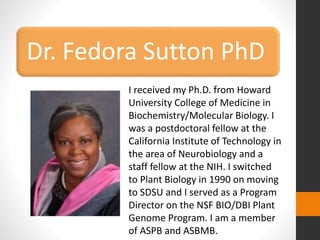
Dr. Fedora Sutton PhD 
I received my Ph.D. from Howard 
University College of Medicine in 
Biochemistry/Molecular Biology. I 
was a postdoctoral fellow at the 
California Institute of Technology in 
the area of Neurobiology and a 
staff fellow at the NIH. I switched 
to Plant Biology in 1990 on moving 
to SDSU and I served as a Program 
Director on the NSF BIO/DBI Plant 
Genome Program. I am a member 
of ASPB and ASBMB.
Biography 
After 24 years at South Dakota State University, I have retired. 
I am now VP of Research at MYOBiofuels LLC. and Adjunct 
Professor at South Dakota State University. 
Research interests 
• Understanding the role of G-protein coupled receptors (GPCR) 
in animals cells as they respond to plant metabolites and 
growth hormones. 
• Deciphering signal transduction pathways that modulate 
genome silencing, gene expression and protein turnover in 
plant and algal cells.
G-protein coupled receptors(GPCR) 
Identification of plant ligands that control GPCR signal transduction 
pathways in animal tissues such as brain and pancreas. 
Techniques: Yeast 2 hybrid screens, Xenopus oocyte expression, 
standard molecular biology techniques including 
In vitro transcription and microinjections
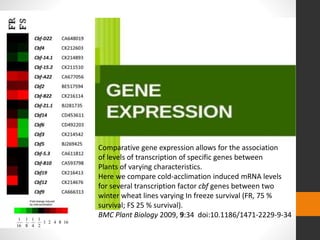
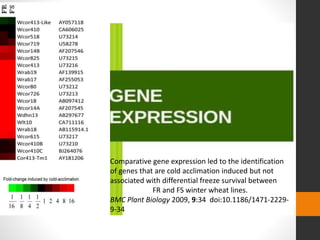
Comparative gene expression allows for the association 
of levels of transcription of specific genes between 
Plants of varying characteristics. 
Here we compare cold-acclimation induced mRNA levels 
for several transcription factor cbf genes between two 
winter wheat lines varying In freeze survival (FR, 75 % 
survival; FS 25 % survival). 
BMC Plant Biology 2009, 9:34 doi:10.1186/1471-2229-9-34
Comparative gene expression led to the identification 
of genes that are cold acclimation induced but not 
associated with differential freeze survival between 
FR and FS winter wheat lines. 
BMC Plant Biology 2009, 9:34 doi:10.1186/1471-2229- 
9-34
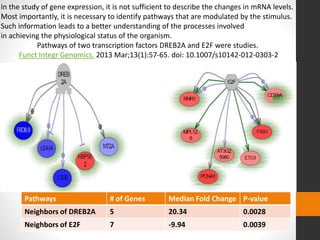
In the study of gene expression, it is not sufficient to describe the changes in mRNA levels. 
Most importantly, it is necessary to identify pathways that are modulated by the stimulus. 
Such information leads to a better understanding of the processes involved 
in achieving the physiological status of the organism. 
Pathways of two transcription factors DREB2A and E2F were studies. 
Funct Integr Genomics. 2013 Mar;13(1):57-65. doi: 10.1007/s10142-012-0303-2 
Pathways # of Genes Median Fold Change P-value 
Neighbors of DREB2A 5 20.34 0.0028 
Neighbors of E2F 7 -9.94 0.0039
Proteomics 
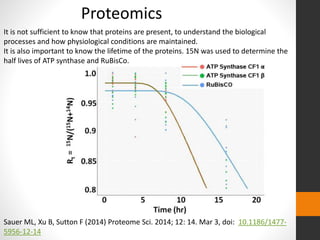
It is not sufficient to know that proteins are present, to understand the biological 
processes and how physiological conditions are maintained. 
It is also important to know the lifetime of the proteins. 15N was used to determine the 
half lives of ATP synthase and RuBisCo. 
Sauer ML, Xu B, Sutton F (2014) Proteome Sci. 2014; 12: 14. Mar 3, doi: 10.1186/1477- 
5956-12-14
Synchronization of pathways 
Preparing an organism to withstand abiotic stress is about the 
synchronization of the pathways to achieve: 
1. an optimal or near optimal tissue water content 
2. Cessation of cell proliferation (quiescence). 
In winter wheat, this involves synchronization of the E2F and 
DREB2A pathways. 
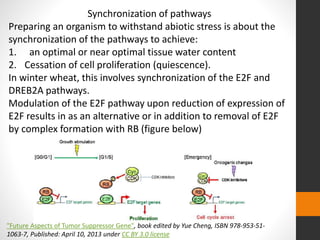
Modulation of the E2F pathway upon reduction of expression of 
E2F results in as an alternative or in addition to removal of E2F 
by complex formation with RB (figure below) 
"Future Aspects of Tumor Suppressor Gene", book edited by Yue Cheng, ISBN 978-953-51- 
1063-7, Published: April 10, 2013 under CC BY 3.0 license
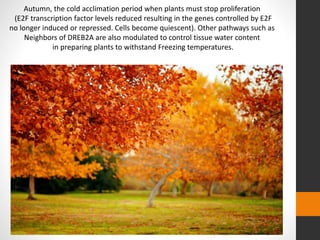
Autumn, the cold acclimation period when plants must stop proliferation 
(E2F transcription factor levels reduced resulting in the genes controlled by E2F 
no longer induced or repressed. Cells become quiescent). Other pathways such as 
Neighbors of DREB2A are also modulated to control tissue water content 
in preparing plants to withstand Freezing temperatures.
Approved by 
Dr. Fedora Sutton PhD.
• 6th World Congress on 
OMICS Group 
Conference 
Biotechnology 
November 30-December 02, 2015 HICC-Hyderabad, India 
• www.biotechnologycongress.com
OMICS Group Open Access Membership 
OMICS publishing Group Open Access Membership 
enables academic and research institutions, funders 
and corporations to actively encourage open access in 
scholarly communication and the dissemination of 
research published by their authors. 
For more details and benefits, click on the link below: 
http://omicsonline.org/membership.php

Fedora sutton g-protein coupled receptors

  • 1.
    OMICS Group OMICSGroup International through its Open Access Initiative is committed to make genuine and reliable contributions to the scientific community. OMICS Group hosts over 400 leading-edge peer reviewed Open Access Journals and organizes over 300 International Conferences annually all over the world. OMICS Publishing Group journals have over 3 million readers and the fame and success of the same can be attributed to the strong editorial board which contains over 30000 eminent personalities that ensure a rapid, quality and quick review process. OMICS Group signed an agreement with more than 1000 International Societies to make healthcare information Open Access. Contact us at: contact.omics@omicsonline.org
  • 2.
    OMICS Journals arewelcoming Submissions OMICS Group welcomes submissions that are original and technically so as to serve both the developing world and developed countries in the best possible way. OMICS Journals are poised in excellence by publishing high quality research. OMICS Group follows an Editorial Manager® System peer review process and boasts of a strong and active editorial board. Editors and reviewers are experts in their field and provide anonymous, unbiased and detailed reviews of all submissions. The journal gives the options of multiple language translations for all the articles and all archived articles are available in HTML, XML, PDF and audio formats. Also, all the published articles are archived in repositories and indexing services like DOAJ, CAS, Google Scholar, Scientific Commons, Index Copernicus, EBSCO, HINARI and GALE. For more details please visit our website: http://omicsonline.org/Submitmanuscript.php
  • 3.
    Dr. Fedora SuttonPhD I received my Ph.D. from Howard University College of Medicine in Biochemistry/Molecular Biology. I was a postdoctoral fellow at the California Institute of Technology in the area of Neurobiology and a staff fellow at the NIH. I switched to Plant Biology in 1990 on moving to SDSU and I served as a Program Director on the NSF BIO/DBI Plant Genome Program. I am a member of ASPB and ASBMB.
  • 4.
    Biography After 24years at South Dakota State University, I have retired. I am now VP of Research at MYOBiofuels LLC. and Adjunct Professor at South Dakota State University. Research interests • Understanding the role of G-protein coupled receptors (GPCR) in animals cells as they respond to plant metabolites and growth hormones. • Deciphering signal transduction pathways that modulate genome silencing, gene expression and protein turnover in plant and algal cells.
  • 5.
    G-protein coupled receptors(GPCR) Identification of plant ligands that control GPCR signal transduction pathways in animal tissues such as brain and pancreas. Techniques: Yeast 2 hybrid screens, Xenopus oocyte expression, standard molecular biology techniques including In vitro transcription and microinjections
  • 6.
    Comparative gene expressionallows for the association of levels of transcription of specific genes between Plants of varying characteristics. Here we compare cold-acclimation induced mRNA levels for several transcription factor cbf genes between two winter wheat lines varying In freeze survival (FR, 75 % survival; FS 25 % survival). BMC Plant Biology 2009, 9:34 doi:10.1186/1471-2229-9-34
  • 7.
    Comparative gene expressionled to the identification of genes that are cold acclimation induced but not associated with differential freeze survival between FR and FS winter wheat lines. BMC Plant Biology 2009, 9:34 doi:10.1186/1471-2229- 9-34
  • 8.
    In the studyof gene expression, it is not sufficient to describe the changes in mRNA levels. Most importantly, it is necessary to identify pathways that are modulated by the stimulus. Such information leads to a better understanding of the processes involved in achieving the physiological status of the organism. Pathways of two transcription factors DREB2A and E2F were studies. Funct Integr Genomics. 2013 Mar;13(1):57-65. doi: 10.1007/s10142-012-0303-2 Pathways # of Genes Median Fold Change P-value Neighbors of DREB2A 5 20.34 0.0028 Neighbors of E2F 7 -9.94 0.0039
  • 9.
    Proteomics It isnot sufficient to know that proteins are present, to understand the biological processes and how physiological conditions are maintained. It is also important to know the lifetime of the proteins. 15N was used to determine the half lives of ATP synthase and RuBisCo. Sauer ML, Xu B, Sutton F (2014) Proteome Sci. 2014; 12: 14. Mar 3, doi: 10.1186/1477- 5956-12-14
  • 10.
    Synchronization of pathways Preparing an organism to withstand abiotic stress is about the synchronization of the pathways to achieve: 1. an optimal or near optimal tissue water content 2. Cessation of cell proliferation (quiescence). In winter wheat, this involves synchronization of the E2F and DREB2A pathways. Modulation of the E2F pathway upon reduction of expression of E2F results in as an alternative or in addition to removal of E2F by complex formation with RB (figure below) "Future Aspects of Tumor Suppressor Gene", book edited by Yue Cheng, ISBN 978-953-51- 1063-7, Published: April 10, 2013 under CC BY 3.0 license
  • 11.
    Autumn, the coldacclimation period when plants must stop proliferation (E2F transcription factor levels reduced resulting in the genes controlled by E2F no longer induced or repressed. Cells become quiescent). Other pathways such as Neighbors of DREB2A are also modulated to control tissue water content in preparing plants to withstand Freezing temperatures.
  • 12.
    Approved by Dr.Fedora Sutton PhD.
  • 13.
    • 6th WorldCongress on OMICS Group Conference Biotechnology November 30-December 02, 2015 HICC-Hyderabad, India • www.biotechnologycongress.com
  • 14.
    OMICS Group OpenAccess Membership OMICS publishing Group Open Access Membership enables academic and research institutions, funders and corporations to actively encourage open access in scholarly communication and the dissemination of research published by their authors. For more details and benefits, click on the link below: http://omicsonline.org/membership.php