A91700218003
It is my privilege to express my deep sense of
gratitude to my guide, Dr.Chittabrata Mal, Faculty
of Amity Institute of Biotechnology, Amity University
Kolkata for his valuable guidance & support at each
and every stage of my project work.
I express my sincere thanks to Dr.Swatilekha Ghosh,
for her efficient supervision, help and support during
the course.
Last but not the least;
I would like to offer special thanks to my friends for
immense help and support throughout the work.
Gene expression analysis involves the determination of
the pattern of genes expressed at the level of genetic
transcription, under specific circumstances or in a
specific cell. The measurement of gene expression is a
critical tool employed across drug discovery, life
science research and the optimization of bio
production. Various structural properties, functional
importance, phylogeny and expression pattern of all
Stress Proteins were determined using various
bioinformatics tools. Most of the proteins are stable in the
cellular environment with a prominent expression in the
extracellular region and plasma membrane. Structurally,
these proteins are similar but functionally they are
diverse with novel enzymatic activities of oxalate
decarboxylase, lyase, peroxidase, and oxidoreductase.
1. Introduction
2. Materials and methods
3. Results
4. Conclusion
5. References
INTRODUCTION
•WHAT IS PLANT
STRESS
Plant stress is a state where a plant is
growing in non-ideal growth conditions
and has increased demands put on it.
Plant stress refers to any unfavourable
condition or substance that affects a
plant’s metabolism, reproduction, root
development, or growth. Plant stress
can come in different forms and
durations. Some plant stressors are
naturally occurring, like drought or
wind, while others may be the result of
human activity, like over irrigation or
root disturbance.
ITS CAUSES
Plant stress is caused by a variety of
factors, some of which are obvious (like
natural disasters), while others occur on
a micro scale in the soil. Recent natural
disasters represent one type of plant
stress factors, called abiotic factors,
which usually occur above ground. A
second type of plant stress factors are
called biotic factors, which mostly occur
underground, and can cause plant stress
through pathogens and pests.
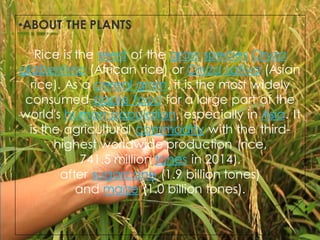
•ABOUT THE PLANTS
Rice is the seed of the grass species Oryza
glaberrima (African rice) or Oryza sativa (Asian
rice). As a cereal grain, it is the most widely
consumed staple food for a large part of the
world's human population, especially in Asia. It
is the agricultural commodity with the third-
highest worldwide production (rice,
741.5 million tones in 2014),
after sugarcane (1.9 billion tones)
and maize (1.0 billion tones).
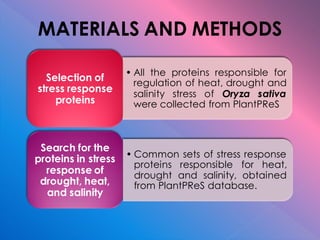
MATERIALS AND METHODS
• All the proteins responsible for
regulation of heat, drought and
salinity stress of Oryza sativa
were collected from PlantPReS
Selection of
stress response
proteins
• Common sets of stress response
proteins responsible for heat,
drought and salinity, obtained
from PlantPReS database.
Search for the
proteins in stress
response of
drought, heat,
and salinity
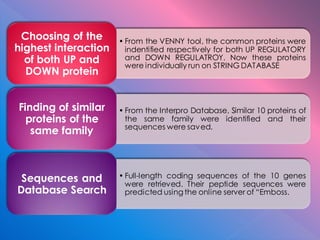
• From the VENNY tool, the common proteins were
indentified respectively for both UP REGULATORY
and DOWN REGULATROY. Now these proteins
were individually run on STRING DATABASE
Choosing of the
highest interaction
of both UP and
DOWN protein
• From the Interpro Database, Similar 10 proteins of
the same family were identified and their
sequences were saved.
Finding of similar
proteins of the
same family
• Full-length coding sequences of the 10 genes
were retrieved. Their peptide sequences were
predicted using the online server of “Emboss.
Sequences and
Database Search
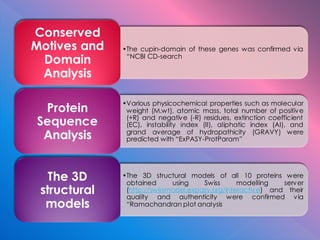
•The cupin-domain of these genes was confirmed via
“NCBI CD-search
Conserved
Motives and
Domain
Analysis
•Various physicochemical properties such as molecular
weight (M.wt), atomic mass, total number of positive
(+R) and negative (-R) residues, extinction coefficient
(EC), instability index (II), aliphatic index (AI), and
grand average of hydropathicity (GRAVY) were
predicted with “ExPASY-ProtParam”
Protein
Sequence
Analysis
•The 3D structural models of all 10 proteins were
obtained using Swiss modelling server
(http://swissmodel.expasy.org/interactive) and their
quality and authenticity were confirmed via
“Ramachandran plot analysis
The 3D
structural
models
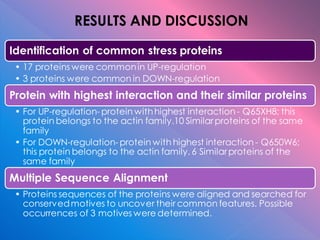
RESULTS AND DISCUSSION
Identification of common stress proteins
• 17 proteins were commonin UP-regulation
• 3 proteins were common in DOWN-regulation
Protein with highest interaction and their similar proteins
• For UP-regulation-protein withhighest interaction- Q65XH8; this
protein belongs to the actin family.10 Similarproteins of the same
family
• For DOWN-regulation-protein with highest interaction - Q650W6;
this protein belongs to the actin family. 6 Similarproteins of the
same family
Multiple Sequence Alignment
• Proteins sequences of the proteins were aligned and searched for
conservedmotives to uncover their common features. Possible
occurrences of 3 motives were determined.
Physicochemical Properties
• Various physicochemical properties of the protein
exhibited significant variations
Functional analysis
• A detailed picture of the proteins enzymatic activities
and their corresponding roles in various plant processes
were taken. Functional analysis with STRING predicted
that all proteins play important role in plant defence by
offering a broad-spectrum disease resistance.
3D Structural Analysis
• The best model was selected based on its Global
model quality estimation (GMQE) and Q mean (Z-
score) estimation scores in which high value indicates
the higher reliability of the resu
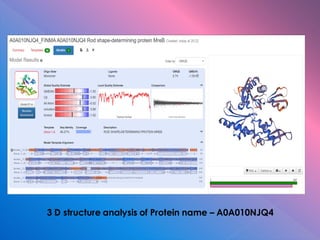
3 D structure analysis of Protein name – A0A010NJQ4
The study revealed that the proteins seem similar in structure but
functionally they are much more diverse. Genes located on the
same CHR possess similar physiochemical properties, subcellular
localization, functional properties, expression pattern and close
phylogenetic relationship confirming their origin through
duplication. Functionally, the proteins are interlinked with each
other or with the genes of other families to cope with various
stresses. This analysis can help to identify the molecular basis of
phenotypic differences and select gene expression targets for in-
depth study. Plant gene expression, in response to stress cues, is
tightly controlled by transcriptional regulators. Posttranslational
modifications are a key mechanism to control the activities of
transcription factors (TFs). The regulation of gene expression in
plants, as in other higher eukaryotes, is a subject of daunting
complexity. Nevertheless, even a partial understanding of
how plant genes work, in conjunction with the methods
of molecular biology and plant tissue culture, opens the door to a
dazzling array of techniques for manipulating various aspects of
the phenotypes of plants.
1. Gene expression in plant
https://www.sciencedirect.com/topics/biochemistry-genetics-and-
molecular-biology/gene-expression-in-plant
2.Plant genes for abiotic stress
https://www.intechopen.com/books/abiotic-stress-in-plants-mechanisms-
and-adaptations/plant-genes-for-abiotic-stress
3.Plant stress. What causes it –how to reduce it
https://www.coolplanet.com/blog/plant-stress-what-causes-plant-stress-
and-how-to-reduce-it
4.Introduction to plant stress
https://link.springer.com/chapter/10.1007/978-3-319-59379-1_1
5.Water Stress in Plants: Causes, Effects and Responses
https://www.researchgate.net/publication/221921924_Water_Stress_in_Pla
nts_Causes_Effects_and_Responses
6.Response of plants to water stress
https://www.ncbi.nlm.nih.gov/pmc/articles/PMC3952189/
REFERENCES
Rice stress related gene expression analysis

Rice stress related gene expression analysis

  • 1.
  • 2.
    It is myprivilege to express my deep sense of gratitude to my guide, Dr.Chittabrata Mal, Faculty of Amity Institute of Biotechnology, Amity University Kolkata for his valuable guidance & support at each and every stage of my project work. I express my sincere thanks to Dr.Swatilekha Ghosh, for her efficient supervision, help and support during the course. Last but not the least; I would like to offer special thanks to my friends for immense help and support throughout the work.
  • 3.
    Gene expression analysisinvolves the determination of the pattern of genes expressed at the level of genetic transcription, under specific circumstances or in a specific cell. The measurement of gene expression is a critical tool employed across drug discovery, life science research and the optimization of bio production. Various structural properties, functional importance, phylogeny and expression pattern of all Stress Proteins were determined using various bioinformatics tools. Most of the proteins are stable in the cellular environment with a prominent expression in the extracellular region and plasma membrane. Structurally, these proteins are similar but functionally they are diverse with novel enzymatic activities of oxalate decarboxylase, lyase, peroxidase, and oxidoreductase.
  • 4.
    1. Introduction 2. Materialsand methods 3. Results 4. Conclusion 5. References
  • 5.
    INTRODUCTION •WHAT IS PLANT STRESS Plantstress is a state where a plant is growing in non-ideal growth conditions and has increased demands put on it. Plant stress refers to any unfavourable condition or substance that affects a plant’s metabolism, reproduction, root development, or growth. Plant stress can come in different forms and durations. Some plant stressors are naturally occurring, like drought or wind, while others may be the result of human activity, like over irrigation or root disturbance. ITS CAUSES Plant stress is caused by a variety of factors, some of which are obvious (like natural disasters), while others occur on a micro scale in the soil. Recent natural disasters represent one type of plant stress factors, called abiotic factors, which usually occur above ground. A second type of plant stress factors are called biotic factors, which mostly occur underground, and can cause plant stress through pathogens and pests.
  • 6.
    •ABOUT THE PLANTS Riceis the seed of the grass species Oryza glaberrima (African rice) or Oryza sativa (Asian rice). As a cereal grain, it is the most widely consumed staple food for a large part of the world's human population, especially in Asia. It is the agricultural commodity with the third- highest worldwide production (rice, 741.5 million tones in 2014), after sugarcane (1.9 billion tones) and maize (1.0 billion tones).
  • 7.
    MATERIALS AND METHODS •All the proteins responsible for regulation of heat, drought and salinity stress of Oryza sativa were collected from PlantPReS Selection of stress response proteins • Common sets of stress response proteins responsible for heat, drought and salinity, obtained from PlantPReS database. Search for the proteins in stress response of drought, heat, and salinity
  • 8.
    • From theVENNY tool, the common proteins were indentified respectively for both UP REGULATORY and DOWN REGULATROY. Now these proteins were individually run on STRING DATABASE Choosing of the highest interaction of both UP and DOWN protein • From the Interpro Database, Similar 10 proteins of the same family were identified and their sequences were saved. Finding of similar proteins of the same family • Full-length coding sequences of the 10 genes were retrieved. Their peptide sequences were predicted using the online server of “Emboss. Sequences and Database Search
  • 9.
    •The cupin-domain ofthese genes was confirmed via “NCBI CD-search Conserved Motives and Domain Analysis •Various physicochemical properties such as molecular weight (M.wt), atomic mass, total number of positive (+R) and negative (-R) residues, extinction coefficient (EC), instability index (II), aliphatic index (AI), and grand average of hydropathicity (GRAVY) were predicted with “ExPASY-ProtParam” Protein Sequence Analysis •The 3D structural models of all 10 proteins were obtained using Swiss modelling server (http://swissmodel.expasy.org/interactive) and their quality and authenticity were confirmed via “Ramachandran plot analysis The 3D structural models
  • 10.
    RESULTS AND DISCUSSION Identificationof common stress proteins • 17 proteins were commonin UP-regulation • 3 proteins were common in DOWN-regulation Protein with highest interaction and their similar proteins • For UP-regulation-protein withhighest interaction- Q65XH8; this protein belongs to the actin family.10 Similarproteins of the same family • For DOWN-regulation-protein with highest interaction - Q650W6; this protein belongs to the actin family. 6 Similarproteins of the same family Multiple Sequence Alignment • Proteins sequences of the proteins were aligned and searched for conservedmotives to uncover their common features. Possible occurrences of 3 motives were determined.
  • 11.
    Physicochemical Properties • Variousphysicochemical properties of the protein exhibited significant variations Functional analysis • A detailed picture of the proteins enzymatic activities and their corresponding roles in various plant processes were taken. Functional analysis with STRING predicted that all proteins play important role in plant defence by offering a broad-spectrum disease resistance. 3D Structural Analysis • The best model was selected based on its Global model quality estimation (GMQE) and Q mean (Z- score) estimation scores in which high value indicates the higher reliability of the resu
  • 12.
    3 D structureanalysis of Protein name – A0A010NJQ4
  • 13.
    The study revealedthat the proteins seem similar in structure but functionally they are much more diverse. Genes located on the same CHR possess similar physiochemical properties, subcellular localization, functional properties, expression pattern and close phylogenetic relationship confirming their origin through duplication. Functionally, the proteins are interlinked with each other or with the genes of other families to cope with various stresses. This analysis can help to identify the molecular basis of phenotypic differences and select gene expression targets for in- depth study. Plant gene expression, in response to stress cues, is tightly controlled by transcriptional regulators. Posttranslational modifications are a key mechanism to control the activities of transcription factors (TFs). The regulation of gene expression in plants, as in other higher eukaryotes, is a subject of daunting complexity. Nevertheless, even a partial understanding of how plant genes work, in conjunction with the methods of molecular biology and plant tissue culture, opens the door to a dazzling array of techniques for manipulating various aspects of the phenotypes of plants.
  • 14.
    1. Gene expressionin plant https://www.sciencedirect.com/topics/biochemistry-genetics-and- molecular-biology/gene-expression-in-plant 2.Plant genes for abiotic stress https://www.intechopen.com/books/abiotic-stress-in-plants-mechanisms- and-adaptations/plant-genes-for-abiotic-stress 3.Plant stress. What causes it –how to reduce it https://www.coolplanet.com/blog/plant-stress-what-causes-plant-stress- and-how-to-reduce-it 4.Introduction to plant stress https://link.springer.com/chapter/10.1007/978-3-319-59379-1_1 5.Water Stress in Plants: Causes, Effects and Responses https://www.researchgate.net/publication/221921924_Water_Stress_in_Pla nts_Causes_Effects_and_Responses 6.Response of plants to water stress https://www.ncbi.nlm.nih.gov/pmc/articles/PMC3952189/ REFERENCES