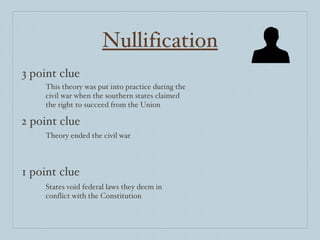
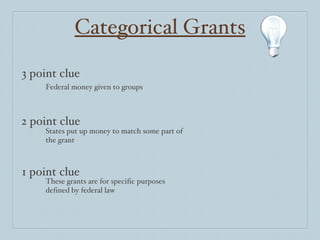
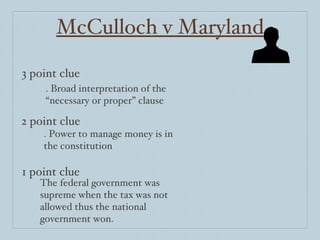
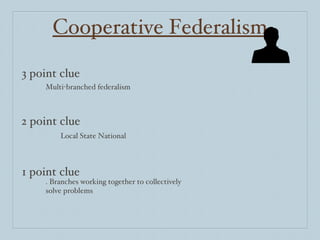
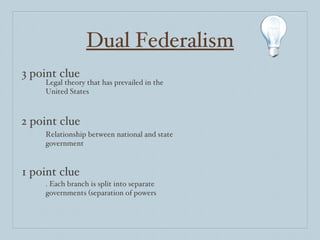
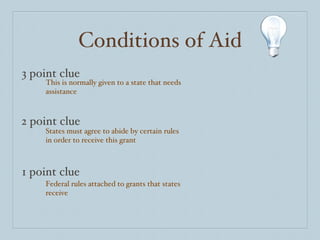
Federalism refers to the evolving relationship between U.S. state governments and the federal government, with sovereignty distributed between at least two levels so that each level has authority over some issues. The theory was tested during the Civil War when southern states claimed the right to secede from the Union. Grants from the federal government provide funds to states and local governments for specific purposes, but also impose requirements on how the funds are used. Cooperative federalism involves branches of government working together to solve problems, while dual federalism maintains a separation between national and state authority.