A. I would have stopped before the
experiment started.
B. I would have stopped after the mild
shocks.
C. I would have stopped after the medium
strength shocks.
D. I would have stopped before the XXX
shocks.
E. I would have continued to the end.
According to “Her
Point Is,” what
makes a good
summary?
To integrate a paraphrase properly within a
paragraph, a good writer usually has
(1) At least one sentence to introduce the
paraphrase,
(2) the paraphrase itself, and
(3) at least one sentence to comment on the
paraphrase.
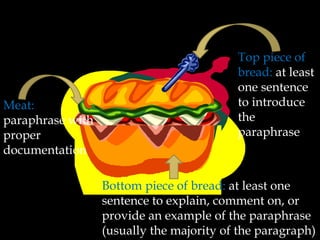
Top piece of
bread: at least
one sentence
to introduce
the
paraphrase
Meat:
paraphrase with
proper
documentation
Bottom piece of bread: at least one
sentence to explain, comment on, or
provide an example of the paraphrase
(usually the majority of the paragraph)
Begin with a topic sentence that gives
the reader a sense of what the single
main idea of the paragraph will be.
This sentence should be one of the
“supporting reasons” for your thesis
statement. It should have opinion!
This is the part of your paragraph
where you support your topic
sentence by including a specific point
taken from the “proof text” (the essay,
article, book, everyday life, etc. you are
writing about or analyzing). The
evidence is a paraphrase or quotation.
You want to explain your topic sentence and
its connection to the evidence. You want to

include your analysis here. Why did you
include the quotation or paraphrase? What
do you want to say about it? You should
include specific examples to illustrate your
points (these examples should come from
you, not the source), but be sure to show
how your examples connect to your
statement (topic sentence). This section
should comprise the majority of the
paragraph.
Statement:
I used to believe that if a particular subject
was difficult for me that I was just not
gifted with intelligence in that area; now
that I am moving toward a growth mindset,
I understand that my knowledge in
anything is dependent on the amount of
effort I put into learning.
Evidence:
According to Carol Dweck, students with a
fixed mindset believe that people are
naturally smart in certain subjects whereas
those with a growth mindset understand
that they are capable of understanding
anything with the right amount of effort.
Explanation:
I tell people that I am bad at math, but I am working on
changing that attitude to a more realistic self-view. I earned
average grades in my high school math classes, but the
concepts did not come easily to me. In my college algebra class,
I watched as other students breezed through tests and quizzes
and I felt like I was struggling to pass. Instead of realizing that
I needed to put more work into the class, I put the
responsibility on others. I decided the teacher was boring. I
imagined that the other students just understood the material
right away. I began to miss class and skip assignments. Of
course, my actions resulted in a failing grade. At the time, I
was quick to shift the blame to other people and circumstances,
but the truth was that I was making excuses rather than trying
because I did not want to try and fail. Doing so would affirm
my biggest fear: I was dumb. I have come to realize that I truly
earned the F, not because of my lack of natural math skills, but
because of my own lack of effort.
I used to believe that if a particular subject was difficult for me that
I was just not gifted with intelligence in that area; now that I am
moving toward a growth mindset, I understand that my knowledge
in anything is dependent on the amount of effort I put into learning.
According to Carol Dweck, students with a fixed mindset believe that
people are naturally smart in certain subjects whereas those with a
growth mindset understand that they are capable of understanding
anything with the right amount of effort. I tell people that I am bad at
math, but I am working on changing that attitude to a more realistic
self-view. I earned average grades in my high school math classes,
but the concepts did not come easily to me. In my college algebra
class, I watched as other students breezed through tests and quizzes
and I felt like I was struggling to pass. Instead of realizing that I
needed to put more work into the class, I put the responsibility on
others. I decided the teacher was boring. I imagined that the other
students just understood the material right away. I began to miss
class and skip assignments. Of course, my actions resulted in a failing
grade. At the time, I was quick to shift the blame to other people and
circumstances, but the truth was that I was making excuses rather
than trying because I did not want to try and fail. Doing so would
affirm my biggest fear: I was dumb. I have come to realize that I truly
earned the F, not because of my lack of natural math skills, but
because of my own lack of effort.
You have five minutes to discuss each question as a
group. You will be tested on your discussion, so make
it count!
 Was Slater’s second-person rendition of the
experiment powerful for you? Why or why not?
 Why do you think 65 percent of the participants were
willing to go all the way to the XXX level?
 Milgram was demonstrating how “any normal
person can become a killer if he finds himself in a
place where killing is called for” (Slater 45). Do you
agree or disagree with Milgram. Why?
 Slater is honest that she would not have disobeyed
had she been a subject. Does this admission help or
hurt the chapter?
 What does Milgram’s experiment mean?
 Dictionary.com definition
 Not sane; not of sound mind; mentally deranged
 Of, pertaining to, or characteristic of a person who is
mentally deranged
 Utterly senseless
 Are these definitions helpful?
 Dictionary.com definition
 Free from mental derangement; having a sound,
healthy mind
 Having or showing reason, sound judgment, or good
sense
 Sound; healthy
 What questions does that give you?
A. “Her Point Is”
B. “Obscura”
C. Socratic Smackdown
D. SEE Paragraphs
E. Defining Sanity
A. Summarizing
B. Paraphrasing
C. Discussing
D. SEE Paragraphs
E. Essay #1
Due Thursday, February 5 at 11:55 p.m.:
 Post to the weekly discussion on Moodle
Due Sunday, February 8 at 11:55 p.m.:
 Submit your rough draft of Essay #1
 Respond to at least two students in the Moodle discussion
Due Monday, February 9 at 11:55 p.m.:
 Watch the EP video lessons “How to Determine the Best Audience or
Readers for an Essay” and “What Is MLA Format?” and take the
respective quizzes (due Tuesday at 1:40 p.m. on Moodle)
 One discussion question for “On Being Sane in Insane Places” (to
Turnitin)
Due Tuesday, February 10 at the beginning of class:
 Read “As He Himself Puts It” (Chapter 3 of They Say/I Say) and come to
class prepared to discuss
 Read “On Being Sane in Insane Places” (Chapter 3 of Opening Skinner’s
Box) and come to class prepared to discuss
 A copy of your discussion question
 Study pictures and names for Tuesday’s quiz
Due Tuesday, February 10 at 11:55 p.m.:
 Peer reviews of Essay #1 through Turnitin

February 3 (101A)

  • 1.
    A. I wouldhave stopped before the experiment started. B. I would have stopped after the mild shocks. C. I would have stopped after the medium strength shocks. D. I would have stopped before the XXX shocks. E. I would have continued to the end.
  • 5.
    According to “Her PointIs,” what makes a good summary?
  • 8.
    To integrate aparaphrase properly within a paragraph, a good writer usually has (1) At least one sentence to introduce the paraphrase, (2) the paraphrase itself, and (3) at least one sentence to comment on the paraphrase.
  • 9.
    Top piece of bread:at least one sentence to introduce the paraphrase Meat: paraphrase with proper documentation Bottom piece of bread: at least one sentence to explain, comment on, or provide an example of the paraphrase (usually the majority of the paragraph)
  • 11.
    Begin with atopic sentence that gives the reader a sense of what the single main idea of the paragraph will be. This sentence should be one of the “supporting reasons” for your thesis statement. It should have opinion!
  • 12.
    This is thepart of your paragraph where you support your topic sentence by including a specific point taken from the “proof text” (the essay, article, book, everyday life, etc. you are writing about or analyzing). The evidence is a paraphrase or quotation.
  • 13.
    You want toexplain your topic sentence and its connection to the evidence. You want to include your analysis here. Why did you include the quotation or paraphrase? What do you want to say about it? You should include specific examples to illustrate your points (these examples should come from you, not the source), but be sure to show how your examples connect to your statement (topic sentence). This section should comprise the majority of the paragraph.

  • 14.
    Statement: I used tobelieve that if a particular subject was difficult for me that I was just not gifted with intelligence in that area; now that I am moving toward a growth mindset, I understand that my knowledge in anything is dependent on the amount of effort I put into learning.
  • 15.
    Evidence: According to CarolDweck, students with a fixed mindset believe that people are naturally smart in certain subjects whereas those with a growth mindset understand that they are capable of understanding anything with the right amount of effort.
  • 16.
    Explanation: I tell peoplethat I am bad at math, but I am working on changing that attitude to a more realistic self-view. I earned average grades in my high school math classes, but the concepts did not come easily to me. In my college algebra class, I watched as other students breezed through tests and quizzes and I felt like I was struggling to pass. Instead of realizing that I needed to put more work into the class, I put the responsibility on others. I decided the teacher was boring. I imagined that the other students just understood the material right away. I began to miss class and skip assignments. Of course, my actions resulted in a failing grade. At the time, I was quick to shift the blame to other people and circumstances, but the truth was that I was making excuses rather than trying because I did not want to try and fail. Doing so would affirm my biggest fear: I was dumb. I have come to realize that I truly earned the F, not because of my lack of natural math skills, but because of my own lack of effort.
  • 17.
    I used tobelieve that if a particular subject was difficult for me that I was just not gifted with intelligence in that area; now that I am moving toward a growth mindset, I understand that my knowledge in anything is dependent on the amount of effort I put into learning. According to Carol Dweck, students with a fixed mindset believe that people are naturally smart in certain subjects whereas those with a growth mindset understand that they are capable of understanding anything with the right amount of effort. I tell people that I am bad at math, but I am working on changing that attitude to a more realistic self-view. I earned average grades in my high school math classes, but the concepts did not come easily to me. In my college algebra class, I watched as other students breezed through tests and quizzes and I felt like I was struggling to pass. Instead of realizing that I needed to put more work into the class, I put the responsibility on others. I decided the teacher was boring. I imagined that the other students just understood the material right away. I began to miss class and skip assignments. Of course, my actions resulted in a failing grade. At the time, I was quick to shift the blame to other people and circumstances, but the truth was that I was making excuses rather than trying because I did not want to try and fail. Doing so would affirm my biggest fear: I was dumb. I have come to realize that I truly earned the F, not because of my lack of natural math skills, but because of my own lack of effort.
  • 19.
    You have fiveminutes to discuss each question as a group. You will be tested on your discussion, so make it count!  Was Slater’s second-person rendition of the experiment powerful for you? Why or why not?  Why do you think 65 percent of the participants were willing to go all the way to the XXX level?  Milgram was demonstrating how “any normal person can become a killer if he finds himself in a place where killing is called for” (Slater 45). Do you agree or disagree with Milgram. Why?  Slater is honest that she would not have disobeyed had she been a subject. Does this admission help or hurt the chapter?  What does Milgram’s experiment mean?
  • 23.
     Dictionary.com definition Not sane; not of sound mind; mentally deranged  Of, pertaining to, or characteristic of a person who is mentally deranged  Utterly senseless  Are these definitions helpful?
  • 24.
     Dictionary.com definition Free from mental derangement; having a sound, healthy mind  Having or showing reason, sound judgment, or good sense  Sound; healthy  What questions does that give you?
  • 28.
    A. “Her PointIs” B. “Obscura” C. Socratic Smackdown D. SEE Paragraphs E. Defining Sanity
  • 29.
    A. Summarizing B. Paraphrasing C.Discussing D. SEE Paragraphs E. Essay #1
  • 30.
    Due Thursday, February5 at 11:55 p.m.:  Post to the weekly discussion on Moodle Due Sunday, February 8 at 11:55 p.m.:  Submit your rough draft of Essay #1  Respond to at least two students in the Moodle discussion Due Monday, February 9 at 11:55 p.m.:  Watch the EP video lessons “How to Determine the Best Audience or Readers for an Essay” and “What Is MLA Format?” and take the respective quizzes (due Tuesday at 1:40 p.m. on Moodle)  One discussion question for “On Being Sane in Insane Places” (to Turnitin) Due Tuesday, February 10 at the beginning of class:  Read “As He Himself Puts It” (Chapter 3 of They Say/I Say) and come to class prepared to discuss  Read “On Being Sane in Insane Places” (Chapter 3 of Opening Skinner’s Box) and come to class prepared to discuss  A copy of your discussion question  Study pictures and names for Tuesday’s quiz Due Tuesday, February 10 at 11:55 p.m.:  Peer reviews of Essay #1 through Turnitin