     Michelle
                 
      Edit 654 OL
Prof: TSAMASIROS
   key Points:

    o Technology offers education cost effective ways to
      improve learning outcomes for students

    o Teachers must embrace technology
      “innovation, prompt implementation, regular
      evaluation, and continuous improvement.”

    o The need for leaders throughout our education
      system to understand the role of technology and that
      it is the core of all we do
   To develop an education system that will:

    o Increase access to education all over the US


    o Foster ICT Skills
        • Prepare students for success in the competitive global
          economy
        • Promote lifelong learning strategies

    o To provide a vision to states, districts, and other stakeholders
       as to how to improve American education

    o To present a model of 21st century learning powered by
       technology
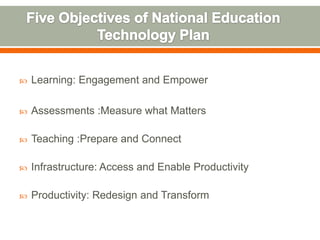
   Learning: Engagement and Empower

   Assessments :Measure what Matters

   Teaching :Prepare and Connect

   Infrastructure: Access and Enable Productivity

   Productivity: Redesign and Transform
   GOAL:

    All learners will have engaging and empowering learning
    experiences that prepare them to be
    active, creative, knowledgeable, and ethical participants in
    our globally networked society.”
   Determine how students learn e.g.
    blogs, collaboration, etc.

   Emphasis should be placed on
    personalized, differentiated and individualized learning

   Ensure students have 21st Century Skills

   Universal Design for Learning Framework
   GOAL:

    Our education system will leverage the power of
    technology to measure what matter and use assessment
    information for continuous improvement.”
   "I'm calling on our nation's governors and state
    education chiefs to develop standards and assessments
    that don't simply measure whether students can fill in a
    bubble on a test, but whether they possess 21st century
    skills like problem-solving and critical thinking and
    entrepreneurship and creativity."

        —President Barack Obama,
        Address to the Hispanic Chamber of Commerce, March 10, 2009
   Embedded assessments i.e. simulations, collaboration
    environments, virtual worlds, games and cognitive tutors

   Technology based assessments that combined cognitive
    research and theory

   Feedback about student learning to improve
    achievement and instructional practices.

   Tools and training—that can help manage the
    assessment process, analyze relevant information

   Adaptive Assessment- Facilitates Differentiated Learning
   Why use Technology Based Assessments?

       • Enable us to assess how well students
         communicate for a variety of purposes and in a
         variety of ways, including in virtual environments

       • We can use them to assess what students learn
         outside school walls and hours as well as inside.

       • It supports measuring performance that cannot be
         assessed with conventional testing formats

       • Helps improve learning and assessments
   What impact does Technology have on
    Assessments?

    o Technology Speeds Development and Testing of New
      Assessments

    o Technology Enables Broader Involvement in Providing Feedback


    o Technology Could Reduce Test Taking for Accountability Only (it
      is possible to reduce the number of external assessments
      needed to audit the education system’s quality.

    o Technology allows assessments using Universal Design for
      Learning principles that make assessments more
      accessible, effective, and valid for students with disability and
      English language capability.
   GOAL:

“Professional educators will be supported individually and
in teams by technology that connects them to
data, content, resources, expertise, and learning
experiences that can empower and inspire them to provide
more effective teaching for all learners.”
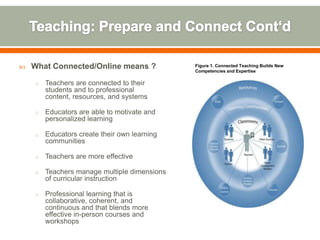
   What Connected/Online means ?             Figure 1. Connected Teaching Builds New
                                              Competencies and Expertise

    o   Teachers are connected to their
        students and to professional
        content, resources, and systems

    o   Educators are able to motivate and
        personalized learning

    o   Educators create their own learning
        communities

    o   Teachers are more effective

    o   Teachers manage multiple dimensions
        of curricular instruction

    o   Professional learning that is
        collaborative, coherent, and
        continuous and that blends more
        effective in-person courses and
        workshops
   GOAL:

“All students and educators will have access to a
comprehensive infrastructure for learning when and where
they need it.”
   24/7 Access to data from multiple sources while ensuring
    appropriate levels of security and privacy

   Broadband Everywhere

   Multiple Access Points- adequate wireless connectivity

   E-Rate provisions and CIPA requirements (filters)

   Supported - the development and use of open educational
    resources to promote innovative and creative opportunities

   Human Talent and Scaling Expertise
   GOAL

      “The education system at all levels will redesign
      processes and structures to take advantage of the
      power of technology to improve learning outcomes
      while making more efficient use of time, money, and
      staff.”
   Cost Efficiency and Cost Savings Strategies - states
    and districts should adopt common cost-accounting
    standards for benchmarking and analyzing costs

   Process redesigns that takes advantage of the impact
    and power of technology for improving performance and
    increasing productivity.
   How can Technology support the reorganization?

    o By enabling more flexible student-centered
      scheduling

    o By facilitating the implementation of competency-
      based approach to education. (students earn credit
      for graduation by demonstrating their competence
      with respect to the standards stipulated by their
      school districts)
How do we achieve our goal of leading the
world in education?
   Provide Competitive grants to schools and non profit
    organizations for innovations to improve k-12 education

   Transfer current technology innovations from
    consumer, business and entertainment sectors to
    education

   Support education Research and Developmental that is
    occurring at the National Science Foundation
   What is the Purpose of The National Center for Research and Digital
    Technologies?

    o Promote transparency and Private and Public collaboration with the
       best industry minds

    o Interoperability Standards

    o Identify key research and development challenges

    o Identify Key emerging Trends

    o individual project share developments, progress, best practices, and
       outcomes with each other

    o Show the feasibility of innovative tools, content, and pedagogies that
       leverage knowledge, information, and technology advances at the
   National Education Technology Plan 2010

    o http://www.ed.gov/sites/default/files/netp2010.pdf
   “Knowing how to use technology and knowing how to
    use it for teaching are extremely different skills.”
        ~ Barry Fishman is an Associate Professor of Learning
       Technologies in the University of Michigan School of Education
        and School of Information

NETP

  • 1.
    Michelle  Edit 654 OL Prof: TSAMASIROS
  • 2.
    key Points: o Technology offers education cost effective ways to improve learning outcomes for students o Teachers must embrace technology “innovation, prompt implementation, regular evaluation, and continuous improvement.” o The need for leaders throughout our education system to understand the role of technology and that it is the core of all we do
  • 3.
    To develop an education system that will: o Increase access to education all over the US o Foster ICT Skills • Prepare students for success in the competitive global economy • Promote lifelong learning strategies o To provide a vision to states, districts, and other stakeholders as to how to improve American education o To present a model of 21st century learning powered by technology
  • 4.
    Learning: Engagement and Empower  Assessments :Measure what Matters  Teaching :Prepare and Connect  Infrastructure: Access and Enable Productivity  Productivity: Redesign and Transform
  • 5.
    GOAL: All learners will have engaging and empowering learning experiences that prepare them to be active, creative, knowledgeable, and ethical participants in our globally networked society.”
  • 6.
    Determine how students learn e.g. blogs, collaboration, etc.  Emphasis should be placed on personalized, differentiated and individualized learning  Ensure students have 21st Century Skills  Universal Design for Learning Framework
  • 7.
    GOAL: Our education system will leverage the power of technology to measure what matter and use assessment information for continuous improvement.”
  • 8.
    "I'm calling on our nation's governors and state education chiefs to develop standards and assessments that don't simply measure whether students can fill in a bubble on a test, but whether they possess 21st century skills like problem-solving and critical thinking and entrepreneurship and creativity." —President Barack Obama, Address to the Hispanic Chamber of Commerce, March 10, 2009
  • 9.
    Embedded assessments i.e. simulations, collaboration environments, virtual worlds, games and cognitive tutors  Technology based assessments that combined cognitive research and theory  Feedback about student learning to improve achievement and instructional practices.  Tools and training—that can help manage the assessment process, analyze relevant information  Adaptive Assessment- Facilitates Differentiated Learning
  • 10.
    Why use Technology Based Assessments? • Enable us to assess how well students communicate for a variety of purposes and in a variety of ways, including in virtual environments • We can use them to assess what students learn outside school walls and hours as well as inside. • It supports measuring performance that cannot be assessed with conventional testing formats • Helps improve learning and assessments
  • 11.
    What impact does Technology have on Assessments? o Technology Speeds Development and Testing of New Assessments o Technology Enables Broader Involvement in Providing Feedback o Technology Could Reduce Test Taking for Accountability Only (it is possible to reduce the number of external assessments needed to audit the education system’s quality. o Technology allows assessments using Universal Design for Learning principles that make assessments more accessible, effective, and valid for students with disability and English language capability.
  • 12.
    GOAL: “Professional educators will be supported individually and in teams by technology that connects them to data, content, resources, expertise, and learning experiences that can empower and inspire them to provide more effective teaching for all learners.”
  • 13.
    What Connected/Online means ? Figure 1. Connected Teaching Builds New Competencies and Expertise o Teachers are connected to their students and to professional content, resources, and systems o Educators are able to motivate and personalized learning o Educators create their own learning communities o Teachers are more effective o Teachers manage multiple dimensions of curricular instruction o Professional learning that is collaborative, coherent, and continuous and that blends more effective in-person courses and workshops
  • 14.
    GOAL: “All students and educators will have access to a comprehensive infrastructure for learning when and where they need it.”
  • 15.
    24/7 Access to data from multiple sources while ensuring appropriate levels of security and privacy  Broadband Everywhere  Multiple Access Points- adequate wireless connectivity  E-Rate provisions and CIPA requirements (filters)  Supported - the development and use of open educational resources to promote innovative and creative opportunities  Human Talent and Scaling Expertise
  • 16.
    GOAL “The education system at all levels will redesign processes and structures to take advantage of the power of technology to improve learning outcomes while making more efficient use of time, money, and staff.”
  • 17.
    Cost Efficiency and Cost Savings Strategies - states and districts should adopt common cost-accounting standards for benchmarking and analyzing costs  Process redesigns that takes advantage of the impact and power of technology for improving performance and increasing productivity.
  • 18.
    How can Technology support the reorganization? o By enabling more flexible student-centered scheduling o By facilitating the implementation of competency- based approach to education. (students earn credit for graduation by demonstrating their competence with respect to the standards stipulated by their school districts)
  • 19.
    How do weachieve our goal of leading the world in education?  Provide Competitive grants to schools and non profit organizations for innovations to improve k-12 education  Transfer current technology innovations from consumer, business and entertainment sectors to education  Support education Research and Developmental that is occurring at the National Science Foundation
  • 20.
    What is the Purpose of The National Center for Research and Digital Technologies? o Promote transparency and Private and Public collaboration with the best industry minds o Interoperability Standards o Identify key research and development challenges o Identify Key emerging Trends o individual project share developments, progress, best practices, and outcomes with each other o Show the feasibility of innovative tools, content, and pedagogies that leverage knowledge, information, and technology advances at the
  • 21.
    National Education Technology Plan 2010 o http://www.ed.gov/sites/default/files/netp2010.pdf
  • 22.
    “Knowing how to use technology and knowing how to use it for teaching are extremely different skills.” ~ Barry Fishman is an Associate Professor of Learning Technologies in the University of Michigan School of Education and School of Information