Measuring Semantic Similarity and Relatedness in the Biomedical Domain : Methods and Applications  Ted Pedersen, Ph.D.  Department of Computer Science University of Minnesota, Duluth [email_address] http://www.d.umn.edu/~tpederse February 21, 2012
Acknowledgments This work on semantic similarity and relatedness has been supported by a National Science Foundation CAREER award (2001 – 2007, #0092784, PI Pedersen) and by the National Library of Medicine, National Institutes of Health (2008 – present, 1R01LM009623-01A2, PI Pakhomov)
The contents of this talk are solely my responsibility and do not necessarily represent the official views of the National Science Foundation or the National Institutes of Health.
Topics Semantic similarity vs. semantic relatedness
How to measure similarity  With ontologies and corpora How to measure relatedness With definitions and corpora Applications?  Word Sense Disambiguation
Sentiment Classification
What are we measuring? Concept pairs Assign a numeric value that quantifies how similar or related two concepts are Not words Must know concept underlying a word form
Cold may be  temperature  or  illness Concept Mapping
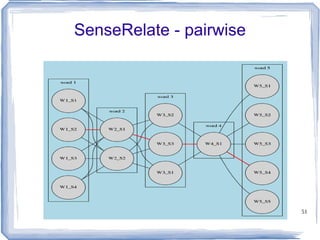
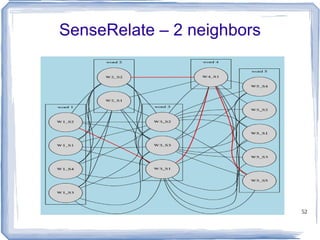
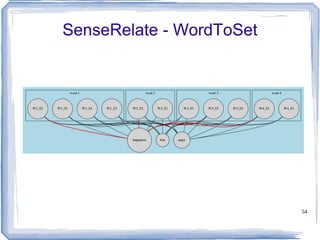
Word Sense Disambiguation But, WSD can be done using semantic similarity! SenseRelate, later in the talk
Why? Being able to organize concepts by their similarity or relatedness to each other is a fundamental operation in the human mind, and in many problems in Natural Language Processing and Artificial Intelligence
If we know a lot about X, and if we know Y is similar to X, then a lot of what we know about X may apply to Y Use X to explain or categorize Y
GOOD NEWS!  Free Open Source Software! WordNet::Similarity  http://wn-similarity.sourceforge.net
General English
Widely used (+550 citations) UMLS::Similarity http://umls-similarity.sourceforge.net
Unified Medical Language System
Spun off from WordNet::Similarity But has added a whole lot!
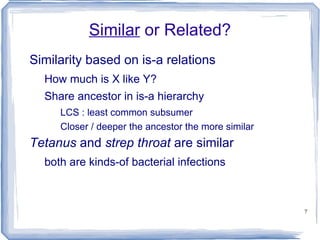
Similar  or Related? Similarity based on is-a relations How much is X like Y?
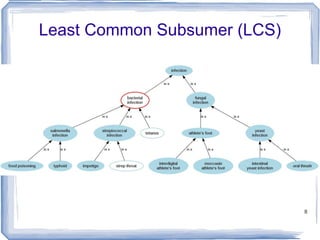
Share ancestor in is-a hierarchy  LCS : least common subsumer
Closer / deeper the ancestor the more similar Tetanus  and  strep throat  are similar both are kinds-of bacterial infections
Least Common Subsumer (LCS)
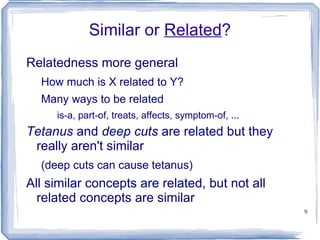
Similar or  Related ? Relatedness more general How much is X related to Y?
Many ways to be related is-a, part-of, treats, affects, symptom-of, ... Tetanus  and  deep cuts  are related but they really aren't similar (deep cuts can cause tetanus)  All similar concepts are related, but not all related concepts are similar
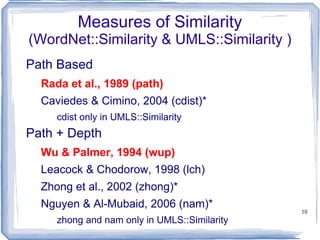
Measures of Similarity (WordNet::Similarity & UMLS::Similarity ) Path Based Rada et al., 1989 (path)
Caviedes & Cimino, 2004 (cdist)* cdist only in UMLS::Similarity Path + Depth  Wu & Palmer, 1994 (wup)
Leacock & Chodorow, 1998 (lch) Zhong et al., 2002 (zhong)* Nguyen & Al-Mubaid, 2006 (nam)* zhong and nam only in UMLS::Similarity
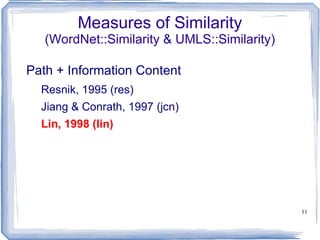
Measures of Similarity (WordNet::Similarity & UMLS::Similarity) Path + Information Content Resnik, 1995 (res)
Jiang & Conrath, 1997 (jcn)
Lin, 1998 (lin)
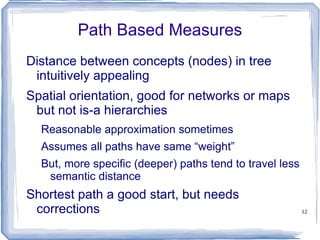
Path Based Measures Distance between concepts (nodes) in tree intuitively appealing
Spatial orientation, good for networks or maps but not is-a hierarchies Reasonable approximation sometimes
Assumes all paths have same “weight”
But, more specific (deeper) paths tend to travel less semantic distance Shortest path a good start, but needs corrections
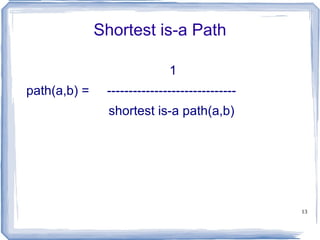
Shortest is-a Path 1 path(a,b) =  ------------------------------
shortest is-a path(a,b)
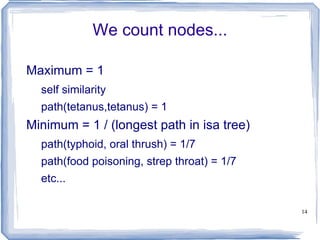
We count nodes... Maximum = 1  self similarity
path(tetanus,tetanus) = 1 Minimum = 1 / (longest path in isa tree) path(typhoid, oral thrush) = 1/7
path(food poisoning, strep throat) = 1/7
etc...
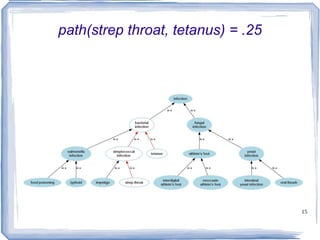
path(strep throat, tetanus) = .25
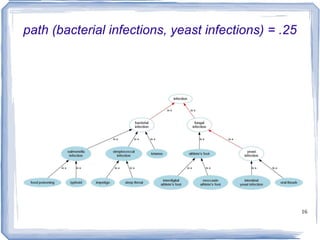
path (bacterial infections, yeast infections) = .25
? Are  bacterial infections  and  yeast infections  similar to the same degree as are  tetanus  and  strep throat  ?
The path measure says “yes, they are.”
Path + Depth Path only doesn't account for specificity
Deeper concepts more specific
Paths between deeper concepts travel less semantic distance
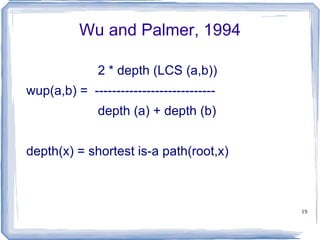
Wu and Palmer, 1994 2 * depth (LCS (a,b)) wup(a,b) =  ----------------------------
depth (a) + depth (b)
depth(x) = shortest is-a path(root,x)
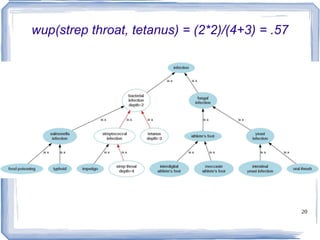
wup(strep throat, tetanus) = (2*2)/(4+3) = .57
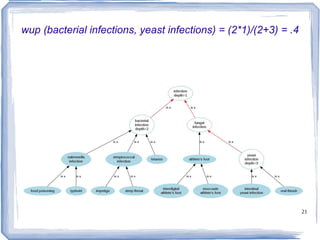
wup (bacterial infections, yeast infections) = (2*1)/(2+3) = .4
? Wu and Palmer say that  strep throat  and  tetanus  (.57) are more similar than are  bacterial infections  and  yeast infections  (.4)
Path says that  strep throat  and  tetanus  (.25) are equally similar as are  bacterial infections  and  yeast infections  (.25)
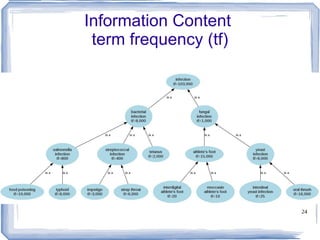
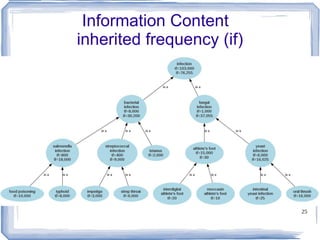
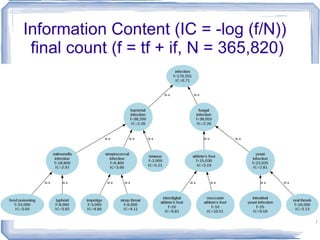
Information Content ic(concept) = -log p(concept) [Resnik 1995] Need to count concepts
Term frequency +Inherited frequency
p(concept) = tf + if / N Depth shows specificity but not frequency
Low frequency concepts often much more specific than high frequency ones
Information Content  term frequency (tf)
Information Content  inherited frequency (if)
Information Content (IC = -log (f/N))  final count (f = tf + if, N = 365,820)
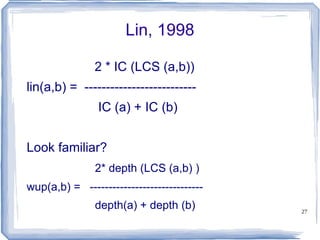
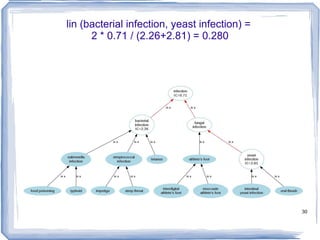
Lin, 1998 2 * IC (LCS (a,b)) lin(a,b) =  --------------------------
IC (a) + IC (b)
Look familiar?
2* depth (LCS (a,b) )
wup(a,b) =  ------------------------------
depth(a) + depth (b)
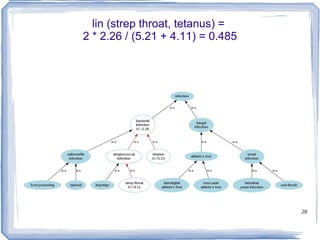
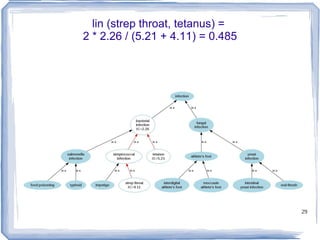
lin (strep throat, tetanus) =  2 * 2.26 / (5.21 + 4.11) = 0.485
lin (bacterial infection, yeast infection) =  2 * 0.71 / (2.26+2.81) = 0.280
? Lin says that  strep throat  and  tetanus  (.49) are more similar than are  bacterial infection  and  yeast infection  (.28)
Wu and Palmer say that  strep throat  and  tetanus  (.57) are more similar than are  bacterial infection  and  yeast infection  (.4)

Feb20 mayo-webinar-21feb2012