http://www.itsmsolutions.com/newsletters/DITYvol5iss44.htmVol. 5.44 • November 4, 2009Janet
Kuhn

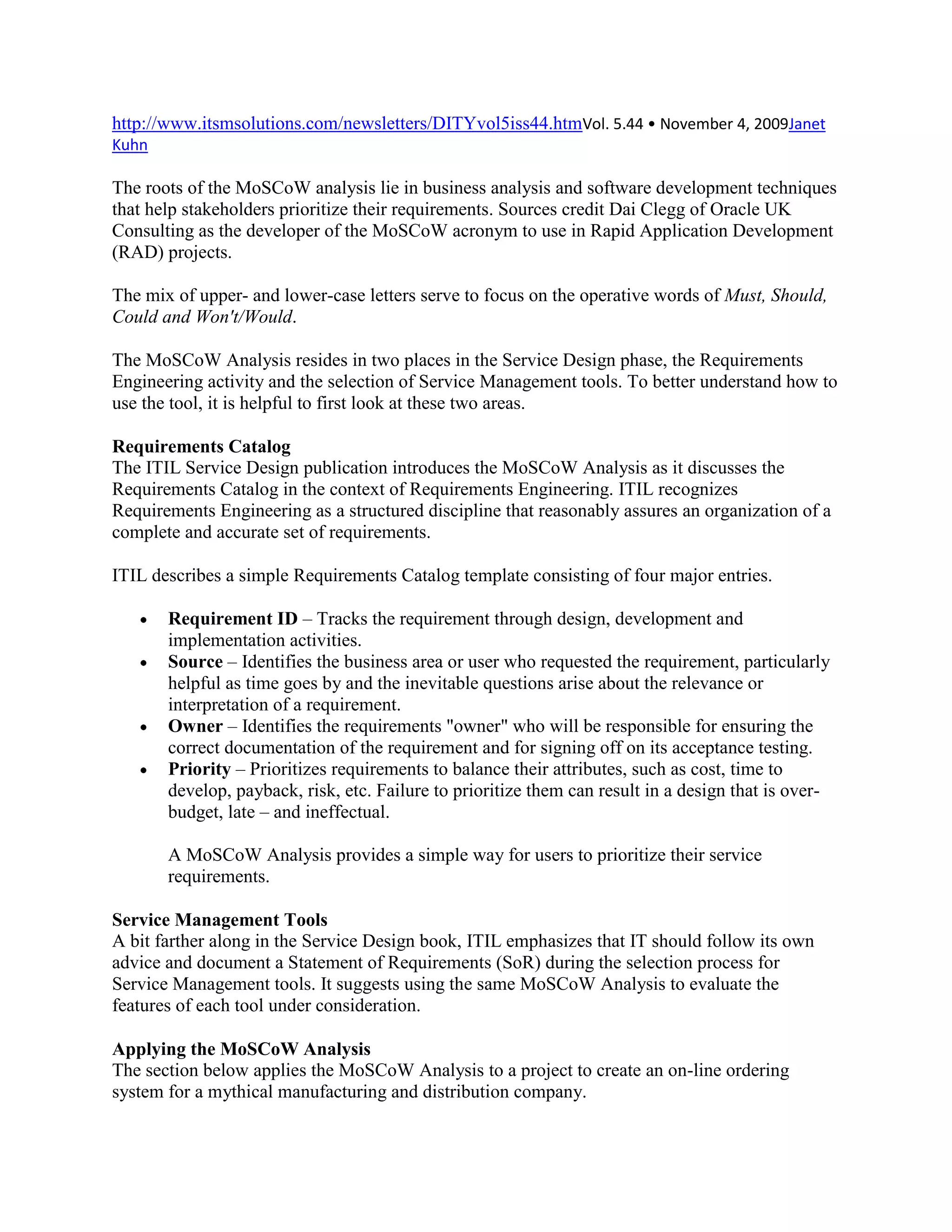
The roots of the MoSCoW analysis lie in business analysis and software development techniques
that help stakeholders prioritize their requirements. Sources credit Dai Clegg of Oracle UK
Consulting as the developer of the MoSCoW acronym to use in Rapid Application Development
(RAD) projects.

The mix of upper- and lower-case letters serve to focus on the operative words of Must, Should,
Could and Won't/Would.

The MoSCoW Analysis resides in two places in the Service Design phase, the Requirements
Engineering activity and the selection of Service Management tools. To better understand how to
use the tool, it is helpful to first look at these two areas.

Requirements Catalog
The ITIL Service Design publication introduces the MoSCoW Analysis as it discusses the
Requirements Catalog in the context of Requirements Engineering. ITIL recognizes
Requirements Engineering as a structured discipline that reasonably assures an organization of a
complete and accurate set of requirements.

ITIL describes a simple Requirements Catalog template consisting of four major entries.

       Requirement ID – Tracks the requirement through design, development and
       implementation activities.
       Source – Identifies the business area or user who requested the requirement, particularly
       helpful as time goes by and the inevitable questions arise about the relevance or
       interpretation of a requirement.
       Owner – Identifies the requirements "owner" who will be responsible for ensuring the
       correct documentation of the requirement and for signing off on its acceptance testing.
       Priority – Prioritizes requirements to balance their attributes, such as cost, time to
       develop, payback, risk, etc. Failure to prioritize them can result in a design that is over-
       budget, late – and ineffectual.

       A MoSCoW Analysis provides a simple way for users to prioritize their service
       requirements.

Service Management Tools
A bit farther along in the Service Design book, ITIL emphasizes that IT should follow its own
advice and document a Statement of Requirements (SoR) during the selection process for
Service Management tools. It suggests using the same MoSCoW Analysis to evaluate the
features of each tool under consideration.

Applying the MoSCoW Analysis
The section below applies the MoSCoW Analysis to a project to create an on-line ordering
system for a mythical manufacturing and distribution company.
MUST HAVE – This is a key requirement without which the service has no value.

       Web site hosting services
       Ability to securely accept credit card transactions
       Online shopping cart
       Customer database accessible to customer service representatives
       Customer service support during U.S. business hours
       Technical support (full support during U.S. business hours; skeleton support other times)
       Interfaces to inventory control and shipping systems
       Performance monitoring and reporting

SHOULD HAVE – This is an important requirement that must be delivered, but if time is short,
could be delayed for a future delivery. The service still has value without these features.

       Ability to accept other forms of payment than standard credit cards
       Integration of customer database into Service Desk system
       7 x 24 customer service support
       7 x 24 full technical support
       Customer coupons for special discounts
       Load balancing during busy times

COULD HAVE – This requirement would be useful to have if it does not cost too much or take
too long to develop, but it is not central to the service.

       Cross-sell capability
       Customer database marketing reporting

WON'T HAVE/WOULD LIKE (or want) TO HAVE NEXT TIME – This requirement is not
needed now, but will be needed in the future, where it may be upgraded to a MUST HAVE.

       "Live Chat" customer service capability
       Proactive customer contact related to warranty issues
       Ability for authorized business users to update product information without IT assistance
       Ability for authorized business users to create discount coupons without IT assistance
       Customer product reviews on website


Summary
No matter whether your planning is done with a sophisticated tool or on the conference room
whiteboard, the need to categorize and prioritize requirements is key to an on-time, cost-effective
service delivery that meets the user's requirements for creating value.
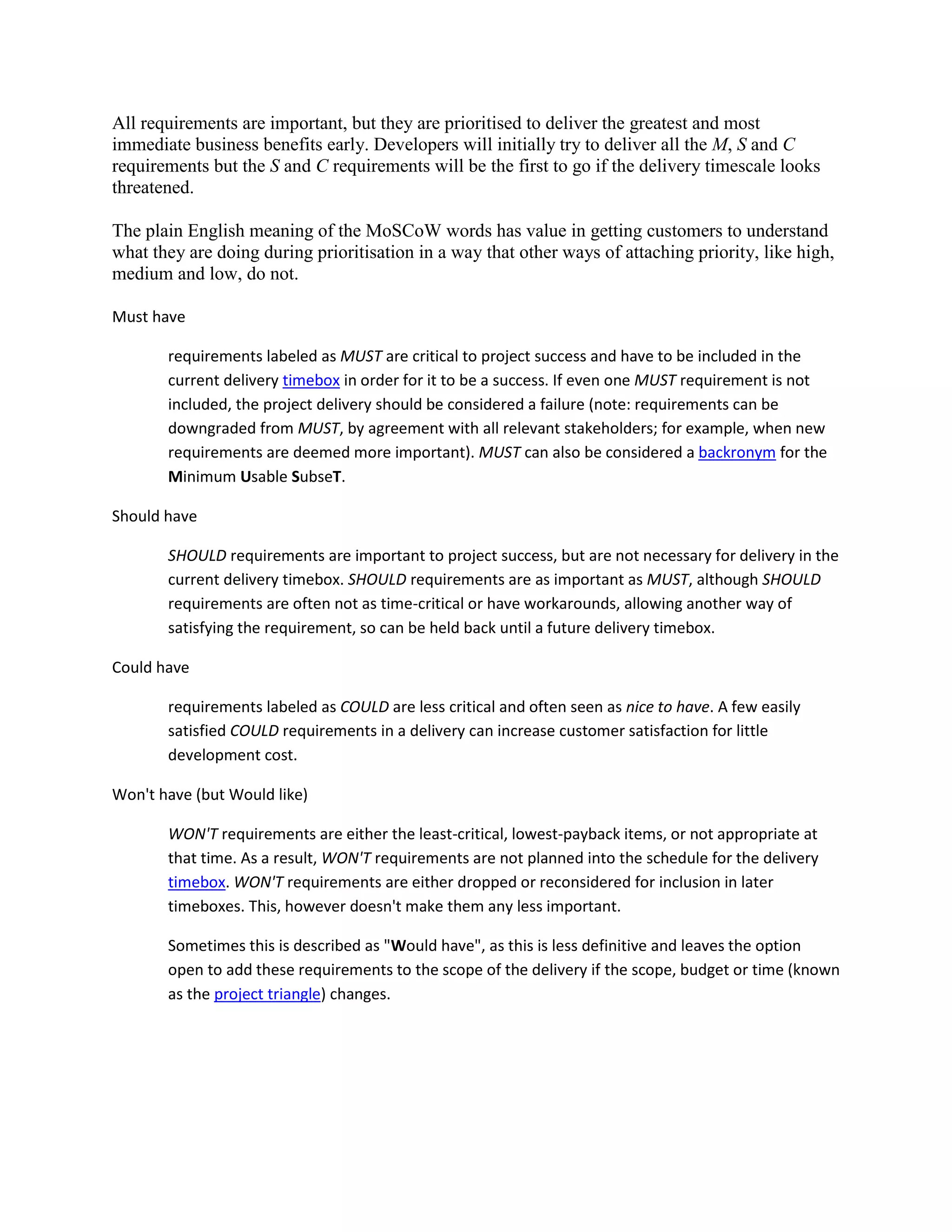
All requirements are important, but they are prioritised to deliver the greatest and most
immediate business benefits early. Developers will initially try to deliver all the M, S and C
requirements but the S and C requirements will be the first to go if the delivery timescale looks
threatened.

The plain English meaning of the MoSCoW words has value in getting customers to understand
what they are doing during prioritisation in a way that other ways of attaching priority, like high,
medium and low, do not.

Must have

       requirements labeled as MUST are critical to project success and have to be included in the
       current delivery timebox in order for it to be a success. If even one MUST requirement is not
       included, the project delivery should be considered a failure (note: requirements can be
       downgraded from MUST, by agreement with all relevant stakeholders; for example, when new
       requirements are deemed more important). MUST can also be considered a backronym for the
       Minimum Usable SubseT.

Should have

       SHOULD requirements are important to project success, but are not necessary for delivery in the
       current delivery timebox. SHOULD requirements are as important as MUST, although SHOULD
       requirements are often not as time-critical or have workarounds, allowing another way of
       satisfying the requirement, so can be held back until a future delivery timebox.

Could have

       requirements labeled as COULD are less critical and often seen as nice to have. A few easily
       satisfied COULD requirements in a delivery can increase customer satisfaction for little
       development cost.

Won't have (but Would like)

       WON'T requirements are either the least-critical, lowest-payback items, or not appropriate at
       that time. As a result, WON'T requirements are not planned into the schedule for the delivery
       timebox. WON'T requirements are either dropped or reconsidered for inclusion in later
       timeboxes. This, however doesn't make them any less important.

       Sometimes this is described as "Would have", as this is less definitive and leaves the option
       open to add these requirements to the scope of the delivery if the scope, budget or time (known
       as the project triangle) changes.

Moscow

  • 1.
    http://www.itsmsolutions.com/newsletters/DITYvol5iss44.htmVol. 5.44 •November 4, 2009Janet Kuhn The roots of the MoSCoW analysis lie in business analysis and software development techniques that help stakeholders prioritize their requirements. Sources credit Dai Clegg of Oracle UK Consulting as the developer of the MoSCoW acronym to use in Rapid Application Development (RAD) projects. The mix of upper- and lower-case letters serve to focus on the operative words of Must, Should, Could and Won't/Would. The MoSCoW Analysis resides in two places in the Service Design phase, the Requirements Engineering activity and the selection of Service Management tools. To better understand how to use the tool, it is helpful to first look at these two areas. Requirements Catalog The ITIL Service Design publication introduces the MoSCoW Analysis as it discusses the Requirements Catalog in the context of Requirements Engineering. ITIL recognizes Requirements Engineering as a structured discipline that reasonably assures an organization of a complete and accurate set of requirements. ITIL describes a simple Requirements Catalog template consisting of four major entries. Requirement ID – Tracks the requirement through design, development and implementation activities. Source – Identifies the business area or user who requested the requirement, particularly helpful as time goes by and the inevitable questions arise about the relevance or interpretation of a requirement. Owner – Identifies the requirements "owner" who will be responsible for ensuring the correct documentation of the requirement and for signing off on its acceptance testing. Priority – Prioritizes requirements to balance their attributes, such as cost, time to develop, payback, risk, etc. Failure to prioritize them can result in a design that is over- budget, late – and ineffectual. A MoSCoW Analysis provides a simple way for users to prioritize their service requirements. Service Management Tools A bit farther along in the Service Design book, ITIL emphasizes that IT should follow its own advice and document a Statement of Requirements (SoR) during the selection process for Service Management tools. It suggests using the same MoSCoW Analysis to evaluate the features of each tool under consideration. Applying the MoSCoW Analysis The section below applies the MoSCoW Analysis to a project to create an on-line ordering system for a mythical manufacturing and distribution company.
  • 2.
    MUST HAVE –This is a key requirement without which the service has no value. Web site hosting services Ability to securely accept credit card transactions Online shopping cart Customer database accessible to customer service representatives Customer service support during U.S. business hours Technical support (full support during U.S. business hours; skeleton support other times) Interfaces to inventory control and shipping systems Performance monitoring and reporting SHOULD HAVE – This is an important requirement that must be delivered, but if time is short, could be delayed for a future delivery. The service still has value without these features. Ability to accept other forms of payment than standard credit cards Integration of customer database into Service Desk system 7 x 24 customer service support 7 x 24 full technical support Customer coupons for special discounts Load balancing during busy times COULD HAVE – This requirement would be useful to have if it does not cost too much or take too long to develop, but it is not central to the service. Cross-sell capability Customer database marketing reporting WON'T HAVE/WOULD LIKE (or want) TO HAVE NEXT TIME – This requirement is not needed now, but will be needed in the future, where it may be upgraded to a MUST HAVE. "Live Chat" customer service capability Proactive customer contact related to warranty issues Ability for authorized business users to update product information without IT assistance Ability for authorized business users to create discount coupons without IT assistance Customer product reviews on website Summary No matter whether your planning is done with a sophisticated tool or on the conference room whiteboard, the need to categorize and prioritize requirements is key to an on-time, cost-effective service delivery that meets the user's requirements for creating value.
  • 3.
    All requirements areimportant, but they are prioritised to deliver the greatest and most immediate business benefits early. Developers will initially try to deliver all the M, S and C requirements but the S and C requirements will be the first to go if the delivery timescale looks threatened. The plain English meaning of the MoSCoW words has value in getting customers to understand what they are doing during prioritisation in a way that other ways of attaching priority, like high, medium and low, do not. Must have requirements labeled as MUST are critical to project success and have to be included in the current delivery timebox in order for it to be a success. If even one MUST requirement is not included, the project delivery should be considered a failure (note: requirements can be downgraded from MUST, by agreement with all relevant stakeholders; for example, when new requirements are deemed more important). MUST can also be considered a backronym for the Minimum Usable SubseT. Should have SHOULD requirements are important to project success, but are not necessary for delivery in the current delivery timebox. SHOULD requirements are as important as MUST, although SHOULD requirements are often not as time-critical or have workarounds, allowing another way of satisfying the requirement, so can be held back until a future delivery timebox. Could have requirements labeled as COULD are less critical and often seen as nice to have. A few easily satisfied COULD requirements in a delivery can increase customer satisfaction for little development cost. Won't have (but Would like) WON'T requirements are either the least-critical, lowest-payback items, or not appropriate at that time. As a result, WON'T requirements are not planned into the schedule for the delivery timebox. WON'T requirements are either dropped or reconsidered for inclusion in later timeboxes. This, however doesn't make them any less important. Sometimes this is described as "Would have", as this is less definitive and leaves the option open to add these requirements to the scope of the delivery if the scope, budget or time (known as the project triangle) changes.