Download free for 30 days
Sign in
Upload
Language (EN)
Support
Business
Mobile
Social Media
Marketing
Technology
Art & Photos
Career
Design
Education
Presentations & Public Speaking
Government & Nonprofit
Healthcare
Internet
Law
Leadership & Management
Automotive
Engineering
Software
Recruiting & HR
Retail
Sales
Services
Science
Small Business & Entrepreneurship
Food
Environment
Economy & Finance
Data & Analytics
Investor Relations
Sports
Spiritual
News & Politics
Travel
Self Improvement
Real Estate
Entertainment & Humor
Health & Medicine
Devices & Hardware
Lifestyle
Change Language
Language
English
Español
Português
Français
Deutsche
Cancel
Save
EN
Uploaded by
chandioasghar1984
PPT, PDF
0 views
Ch01-Introduction Databases and Database Users.ppt
Introduction to database management system
Education
◦
Read more
0
Save
Share
Embed
Embed presentation
Download
Download to read offline
1
/ 30
2
/ 30
3
/ 30
4
/ 30
5
/ 30
6
/ 30
7
/ 30
8
/ 30
9
/ 30
10
/ 30
11
/ 30
12
/ 30
13
/ 30
14
/ 30
15
/ 30
16
/ 30
17
/ 30
18
/ 30
19
/ 30
20
/ 30
21
/ 30
22
/ 30
23
/ 30
24
/ 30
25
/ 30
26
/ 30
27
/ 30
28
/ 30
29
/ 30
30
/ 30
More Related Content
PPT
Chapter01
by
Reham Maher El-Safarini
PPT
introduction to database systems Chapter01.ppt
by
KelemAlebachew
PPT
chapter 01 introduction to Database.ppt
by
NuurAxmed2
PPT
Introduction to Database management system and characteristics
by
ShrutiArora343479
PPT
Ch01 database-conceptsppt4207
by
Burhan Chaudhry
PDF
1 introduction databases and database users
by
Kumar
PPT
cse3330-spring14-Ch1.ppt
by
redmont2
PDF
Introduction: Databases and Database Users
by
sontumax
Chapter01
by
Reham Maher El-Safarini
introduction to database systems Chapter01.ppt
by
KelemAlebachew
chapter 01 introduction to Database.ppt
by
NuurAxmed2
Introduction to Database management system and characteristics
by
ShrutiArora343479
Ch01 database-conceptsppt4207
by
Burhan Chaudhry
1 introduction databases and database users
by
Kumar
cse3330-spring14-Ch1.ppt
by
redmont2
Introduction: Databases and Database Users
by
sontumax
Similar to Ch01-Introduction Databases and Database Users.ppt
PPT
Chapter01 (3).ppt
by
abhilashbachu5
PDF
Basic to Advance DBMS BOOK for School and Graduate Student
by
Akhilpandey36
PPT
Chapter01.ppt
by
AdilAlpkocak1
PPT
Chapter01.ppt
by
KivSoreangsey1
PPT
Chapter01 database system in computer.ppt
by
ubaidullah75790
PPT
Foundation of database systems -Database Systems.ppt
by
ABDUKHASHEBA
PPT
Chapter01.ppt
by
ssuser7584721
PDF
Chapter01.pdf
by
SATHYANARAYANAKB
PPT
L01- Databases & Database Users ppt for DBMS
by
cxalbxer
PPT
Lecture_1_Introduction to DBMS, Database and Normalization by Zach Whinsky
by
crazygamez2468
PPTX
DBMS Introduction: Database Users and Databases
by
FuckOff458583
PPT
Chapter01.ppt
by
RashmiAcharya27
PPT
Chapter01.ppt
by
WaleedMaqsood4
PDF
Chapter 1 data base system erd engineer .pdf
by
hendmohamed98
PPT
Ena ch01
by
rereelshahed
PPT
Ena ch01
by
rereelshahed
PPT
Chapter01
by
sasa_eldoby
PDF
dbms combine with sql for engineering .pdf
by
dubeyabhinav442
PPTX
Introduction to Database and database users.pptx
by
HajarMeseehYaseen
PPT
FDS (Sixth Edition) | C1 | Databases and Database Users
by
Harsh Verdhan Raj
Chapter01 (3).ppt
by
abhilashbachu5
Basic to Advance DBMS BOOK for School and Graduate Student
by
Akhilpandey36
Chapter01.ppt
by
AdilAlpkocak1
Chapter01.ppt
by
KivSoreangsey1
Chapter01 database system in computer.ppt
by
ubaidullah75790
Foundation of database systems -Database Systems.ppt
by
ABDUKHASHEBA
Chapter01.ppt
by
ssuser7584721
Chapter01.pdf
by
SATHYANARAYANAKB
L01- Databases & Database Users ppt for DBMS
by
cxalbxer
Lecture_1_Introduction to DBMS, Database and Normalization by Zach Whinsky
by
crazygamez2468
DBMS Introduction: Database Users and Databases
by
FuckOff458583
Chapter01.ppt
by
RashmiAcharya27
Chapter01.ppt
by
WaleedMaqsood4
Chapter 1 data base system erd engineer .pdf
by
hendmohamed98
Ena ch01
by
rereelshahed
Ena ch01
by
rereelshahed
Chapter01
by
sasa_eldoby
dbms combine with sql for engineering .pdf
by
dubeyabhinav442
Introduction to Database and database users.pptx
by
HajarMeseehYaseen
FDS (Sixth Edition) | C1 | Databases and Database Users
by
Harsh Verdhan Raj
Recently uploaded
PPTX
Appreciations - Jan 26 01.pptxkjkjkkjkjkjkj
by
preetheshparmar
PPTX
Mohan - "A man of silence and authority"
by
nidhibachauhan46
PPTX
Drugs modulating serotonergic system.pptx
by
Norman Arockiaraj G
PPTX
That long silence - Novel by Shashi Deshapande
by
sanjanavaghela65
PDF
Sharad Bisen_Irrigation Systems and Methods in Horticultural Crops.pdf
by
bisensharad
PPTX
Reimagining Academic Library Services through Artificial Intelligence: A Case...
by
Don Bosco College, Itanagar
PDF
Darwinism: Theory of Natural Selection and Origin of Species
by
IPGDCWA,NAMPALLY
PPTX
Appreciations - Jan 26 01.pptxkkkmmkmkmkmkm
by
preetheshparmar
PPTX
PREVENTIVE PEDIATRICS.pptx
by
BANDITA PATRA
PPTX
West Hatch High School - GCSE Art Presentation
by
WestHatch
PPTX
West Hatch High School -- GCSE Geography
by
WestHatch
PPTX
West Hatch High School - GCSE Media Studies
by
WestHatch
PDF
Bishan_Singh_Presentation - Toba tek Singh
by
gopalsinhchauhan9313
PPTX
How Physician Assistants in the USA Earn CME Credits Online.pptx
by
CME4Life
PPTX
Definition of communication skills and it's process.
by
purvrajsinhsarvaiya0
PPTX
Biological source, chemical constituents, and therapeutic efficacy of the fol...
by
Sai Meer College of Pharmacy
PPTX
Toba Tek Singh - Visualising Partition through Manto's Lens
by
miraljoshi48
PDF
Risks and opportunities of artificial intelligence in education: A critical view
by
Yannis
PDF
West Hatch High School - GCSE Media Specification
by
WestHatch
PDF
Lamarckism: Theory of Evolution, Principles, Examples, Objections and Neo-Lam...
by
IPGDCWA,NAMPALLY
Appreciations - Jan 26 01.pptxkjkjkkjkjkjkj
by
preetheshparmar
Mohan - "A man of silence and authority"
by
nidhibachauhan46
Drugs modulating serotonergic system.pptx
by
Norman Arockiaraj G
That long silence - Novel by Shashi Deshapande
by
sanjanavaghela65
Sharad Bisen_Irrigation Systems and Methods in Horticultural Crops.pdf
by
bisensharad
Reimagining Academic Library Services through Artificial Intelligence: A Case...
by
Don Bosco College, Itanagar
Darwinism: Theory of Natural Selection and Origin of Species
by
IPGDCWA,NAMPALLY
Appreciations - Jan 26 01.pptxkkkmmkmkmkmkm
by
preetheshparmar
PREVENTIVE PEDIATRICS.pptx
by
BANDITA PATRA
West Hatch High School - GCSE Art Presentation
by
WestHatch
West Hatch High School -- GCSE Geography
by
WestHatch
West Hatch High School - GCSE Media Studies
by
WestHatch
Bishan_Singh_Presentation - Toba tek Singh
by
gopalsinhchauhan9313
How Physician Assistants in the USA Earn CME Credits Online.pptx
by
CME4Life
Definition of communication skills and it's process.
by
purvrajsinhsarvaiya0
Biological source, chemical constituents, and therapeutic efficacy of the fol...
by
Sai Meer College of Pharmacy
Toba Tek Singh - Visualising Partition through Manto's Lens
by
miraljoshi48
Risks and opportunities of artificial intelligence in education: A critical view
by
Yannis
West Hatch High School - GCSE Media Specification
by
WestHatch
Lamarckism: Theory of Evolution, Principles, Examples, Objections and Neo-Lam...
by
IPGDCWA,NAMPALLY
Ch01-Introduction Databases and Database Users.ppt
1.
Slide 1- 1 Copyright
© 2007 Ramez Elmasri and Shamkant B. Navathe
2.
Copyright © 2007
Ramez Elmasri and Shamkant B. Navathe Chapter 1 Introduction: Databases and Database Users
3.
Slide 1- 3 Copyright
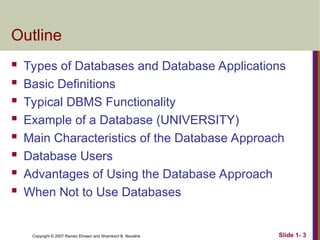
© 2007 Ramez Elmasri and Shamkant B. Navathe Outline Types of Databases and Database Applications Basic Definitions Typical DBMS Functionality Example of a Database (UNIVERSITY) Main Characteristics of the Database Approach Database Users Advantages of Using the Database Approach When Not to Use Databases
4.
Slide 1- 4 Copyright
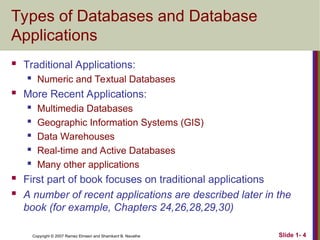
© 2007 Ramez Elmasri and Shamkant B. Navathe Types of Databases and Database Applications Traditional Applications: Numeric and Textual Databases More Recent Applications: Multimedia Databases Geographic Information Systems (GIS) Data Warehouses Real-time and Active Databases Many other applications First part of book focuses on traditional applications A number of recent applications are described later in the book (for example, Chapters 24,26,28,29,30)
5.
Slide 1- 5 Copyright
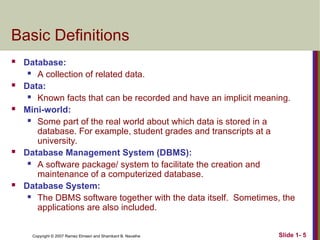
© 2007 Ramez Elmasri and Shamkant B. Navathe Basic Definitions Database: A collection of related data. Data: Known facts that can be recorded and have an implicit meaning. Mini-world: Some part of the real world about which data is stored in a database. For example, student grades and transcripts at a university. Database Management System (DBMS): A software package/ system to facilitate the creation and maintenance of a computerized database. Database System: The DBMS software together with the data itself. Sometimes, the applications are also included.
6.
Slide 1- 6 Copyright
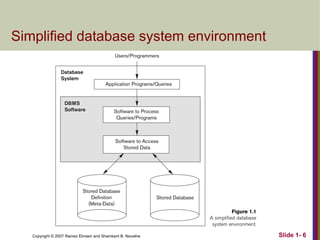
© 2007 Ramez Elmasri and Shamkant B. Navathe Simplified database system environment
7.
Slide 1- 7 Copyright
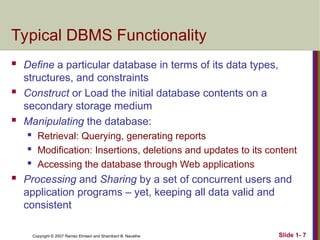
© 2007 Ramez Elmasri and Shamkant B. Navathe Typical DBMS Functionality Define a particular database in terms of its data types, structures, and constraints Construct or Load the initial database contents on a secondary storage medium Manipulating the database: Retrieval: Querying, generating reports Modification: Insertions, deletions and updates to its content Accessing the database through Web applications Processing and Sharing by a set of concurrent users and application programs – yet, keeping all data valid and consistent
8.
Slide 1- 8 Copyright
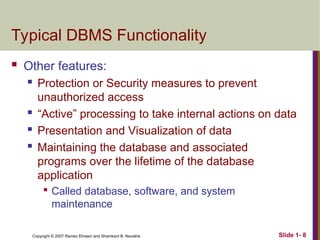
© 2007 Ramez Elmasri and Shamkant B. Navathe Typical DBMS Functionality Other features: Protection or Security measures to prevent unauthorized access “Active” processing to take internal actions on data Presentation and Visualization of data Maintaining the database and associated programs over the lifetime of the database application Called database, software, and system maintenance
9.
Slide 1- 9 Copyright
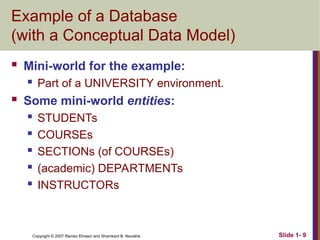
© 2007 Ramez Elmasri and Shamkant B. Navathe Example of a Database (with a Conceptual Data Model) Mini-world for the example: Part of a UNIVERSITY environment. Some mini-world entities: STUDENTs COURSEs SECTIONs (of COURSEs) (academic) DEPARTMENTs INSTRUCTORs
10.
Slide 1- 10 Copyright
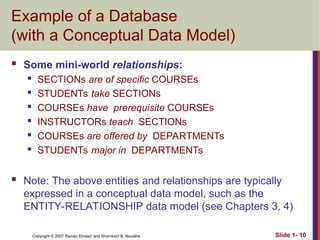
© 2007 Ramez Elmasri and Shamkant B. Navathe Example of a Database (with a Conceptual Data Model) Some mini-world relationships: SECTIONs are of specific COURSEs STUDENTs take SECTIONs COURSEs have prerequisite COURSEs INSTRUCTORs teach SECTIONs COURSEs are offered by DEPARTMENTs STUDENTs major in DEPARTMENTs Note: The above entities and relationships are typically expressed in a conceptual data model, such as the ENTITY-RELATIONSHIP data model (see Chapters 3, 4)
11.
Slide 1- 11 Copyright
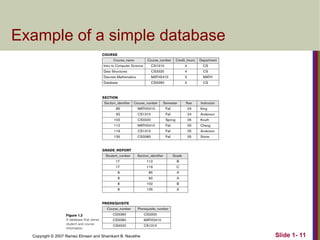
© 2007 Ramez Elmasri and Shamkant B. Navathe Example of a simple database
12.
Slide 1- 12 Copyright
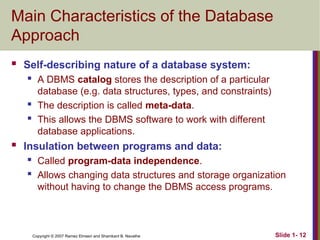
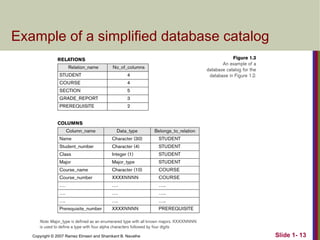
© 2007 Ramez Elmasri and Shamkant B. Navathe Main Characteristics of the Database Approach Self-describing nature of a database system: A DBMS catalog stores the description of a particular database (e.g. data structures, types, and constraints) The description is called meta-data. This allows the DBMS software to work with different database applications. Insulation between programs and data: Called program-data independence. Allows changing data structures and storage organization without having to change the DBMS access programs.
13.
Slide 1- 13 Copyright
© 2007 Ramez Elmasri and Shamkant B. Navathe Example of a simplified database catalog
14.
Slide 1- 14 Copyright
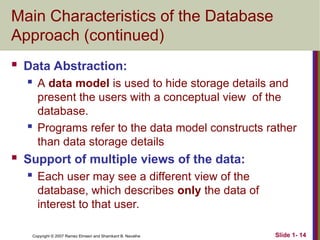
© 2007 Ramez Elmasri and Shamkant B. Navathe Main Characteristics of the Database Approach (continued) Data Abstraction: A data model is used to hide storage details and present the users with a conceptual view of the database. Programs refer to the data model constructs rather than data storage details Support of multiple views of the data: Each user may see a different view of the database, which describes only the data of interest to that user.
15.
Slide 1- 15 Copyright
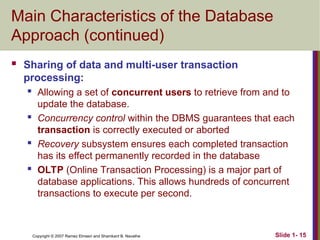
© 2007 Ramez Elmasri and Shamkant B. Navathe Main Characteristics of the Database Approach (continued) Sharing of data and multi-user transaction processing: Allowing a set of concurrent users to retrieve from and to update the database. Concurrency control within the DBMS guarantees that each transaction is correctly executed or aborted Recovery subsystem ensures each completed transaction has its effect permanently recorded in the database OLTP (Online Transaction Processing) is a major part of database applications. This allows hundreds of concurrent transactions to execute per second.
16.
Slide 1- 16 Copyright
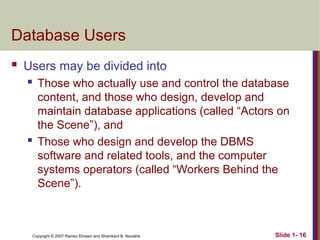
© 2007 Ramez Elmasri and Shamkant B. Navathe Database Users Users may be divided into Those who actually use and control the database content, and those who design, develop and maintain database applications (called “Actors on the Scene”), and Those who design and develop the DBMS software and related tools, and the computer systems operators (called “Workers Behind the Scene”).
17.
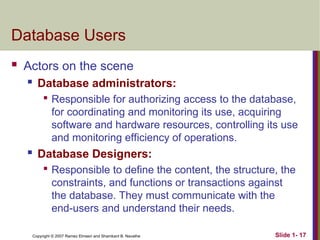
Slide 1- 17 Copyright
© 2007 Ramez Elmasri and Shamkant B. Navathe Database Users Actors on the scene Database administrators: Responsible for authorizing access to the database, for coordinating and monitoring its use, acquiring software and hardware resources, controlling its use and monitoring efficiency of operations. Database Designers: Responsible to define the content, the structure, the constraints, and functions or transactions against the database. They must communicate with the end-users and understand their needs.
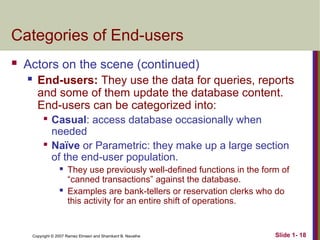
18.
Slide 1- 18 Copyright
© 2007 Ramez Elmasri and Shamkant B. Navathe Categories of End-users Actors on the scene (continued) End-users: They use the data for queries, reports and some of them update the database content. End-users can be categorized into: Casual: access database occasionally when needed Naïve or Parametric: they make up a large section of the end-user population. They use previously well-defined functions in the form of “canned transactions” against the database. Examples are bank-tellers or reservation clerks who do this activity for an entire shift of operations.
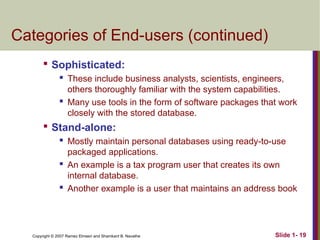
19.
Slide 1- 19 Copyright
© 2007 Ramez Elmasri and Shamkant B. Navathe Categories of End-users (continued) Sophisticated: These include business analysts, scientists, engineers, others thoroughly familiar with the system capabilities. Many use tools in the form of software packages that work closely with the stored database. Stand-alone: Mostly maintain personal databases using ready-to-use packaged applications. An example is a tax program user that creates its own internal database. Another example is a user that maintains an address book
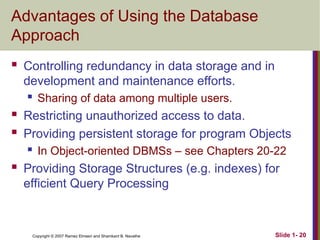
20.
Slide 1- 20 Copyright
© 2007 Ramez Elmasri and Shamkant B. Navathe Advantages of Using the Database Approach Controlling redundancy in data storage and in development and maintenance efforts. Sharing of data among multiple users. Restricting unauthorized access to data. Providing persistent storage for program Objects In Object-oriented DBMSs – see Chapters 20-22 Providing Storage Structures (e.g. indexes) for efficient Query Processing
21.
Slide 1- 21 Copyright
© 2007 Ramez Elmasri and Shamkant B. Navathe Advantages of Using the Database Approach (continued) Providing backup and recovery services. Providing multiple interfaces to different classes of users. Representing complex relationships among data. Enforcing integrity constraints on the database. Drawing inferences and actions from the stored data using deductive and active rules
22.
Slide 1- 22 Copyright
© 2007 Ramez Elmasri and Shamkant B. Navathe Additional Implications of Using the Database Approach Potential for enforcing standards: This is very crucial for the success of database applications in large organizations. Standards refer to data item names, display formats, screens, report structures, meta-data (description of data), Web page layouts, etc. Reduced application development time: Incremental time to add each new application is reduced.
23.
Slide 1- 23 Copyright
© 2007 Ramez Elmasri and Shamkant B. Navathe Additional Implications of Using the Database Approach (continued) Flexibility to change data structures: Database structure may evolve as new requirements are defined. Availability of current information: Extremely important for on-line transaction systems such as airline, hotel, car reservations. Economies of scale: Wasteful overlap of resources and personnel can be avoided by consolidating data and applications across departments.
24.
Slide 1- 24 Copyright
© 2007 Ramez Elmasri and Shamkant B. Navathe Historical Development of Database Technology Early Database Applications: The Hierarchical and Network Models were introduced in mid 1960s and dominated during the seventies. A bulk of the worldwide database processing still occurs using these models, particularly, the hierarchical model. Relational Model based Systems: Relational model was originally introduced in 1970, was heavily researched and experimented within IBM Research and several universities. Relational DBMS Products emerged in the early 1980s.
25.
Slide 1- 25 Copyright
© 2007 Ramez Elmasri and Shamkant B. Navathe Historical Development of Database Technology (continued) Object-oriented and emerging applications: Object-Oriented Database Management Systems (OODBMSs) were introduced in late 1980s and early 1990s to cater to the need of complex data processing in CAD and other applications. Their use has not taken off much. Many relational DBMSs have incorporated object database concepts, leading to a new category called object-relational DBMSs (ORDBMSs) Extended relational systems add further capabilities (e.g. for multimedia data, XML, and other data types)
26.
Slide 1- 26 Copyright
© 2007 Ramez Elmasri and Shamkant B. Navathe Historical Development of Database Technology (continued) Data on the Web and E-commerce Applications: Web contains data in HTML (Hypertext markup language) with links among pages. This has given rise to a new set of applications and E-commerce is using new standards like XML (eXtended Markup Language). (see Ch. 27). Script programming languages such as PHP and JavaScript allow generation of dynamic Web pages that are partially generated from a database (see Ch. 26). Also allow database updates through Web pages
27.
Slide 1- 27 Copyright
© 2007 Ramez Elmasri and Shamkant B. Navathe Extending Database Capabilities New functionality is being added to DBMSs in the following areas: Scientific Applications XML (eXtensible Markup Language) Image Storage and Management Audio and Video Data Management Data Warehousing and Data Mining Spatial Data Management Time Series and Historical Data Management The above gives rise to new research and development in incorporating new data types, complex data structures, new operations and storage and indexing schemes in database systems.
28.
Slide 1- 28 Copyright
© 2007 Ramez Elmasri and Shamkant B. Navathe When not to use a DBMS Main inhibitors (costs) of using a DBMS: High initial investment and possible need for additional hardware. Overhead for providing generality, security, concurrency control, recovery, and integrity functions. When a DBMS may be unnecessary: If the database and applications are simple, well defined, and not expected to change. If there are stringent real-time requirements that may not be met because of DBMS overhead. If access to data by multiple users is not required.
29.
Slide 1- 29 Copyright
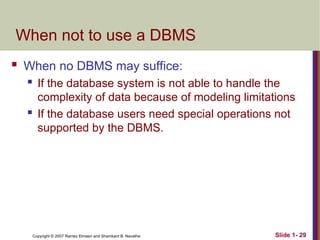
© 2007 Ramez Elmasri and Shamkant B. Navathe When not to use a DBMS When no DBMS may suffice: If the database system is not able to handle the complexity of data because of modeling limitations If the database users need special operations not supported by the DBMS.
30.
Slide 1- 30 Copyright
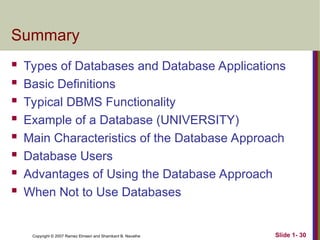
© 2007 Ramez Elmasri and Shamkant B. Navathe Summary Types of Databases and Database Applications Basic Definitions Typical DBMS Functionality Example of a Database (UNIVERSITY) Main Characteristics of the Database Approach Database Users Advantages of Using the Database Approach When Not to Use Databases
Download