Journal of Economic Literature
Vol. XXXVII (Decmber 1999), pp. 1569–1614

                                                                  Morduch:ofThe Microfinance (December 1999)
                                                                      Journal Economic Literature, Vol. XXXVII Promise


               The Microfinance Promise
                                   Jonathan Morduch1


              1. Introduction                          increasingly fractured, offering a fragile
                                                       foundation on which to build.
A     BOUT ONE billion people globally
      live in households with per capita in-
comes of under one dollar per day. The
                                                          Amid the dispiriting news, excite-
                                                       ment is building about a set of unusual
                                                       financial institutions prospering in dis-
policymakers and practitioners who have                tant corners of the world—especially
been trying to improve the lives of that               Bolivia, Bangladesh, and Indonesia. The
billion face an uphill battle. Reports of              hope is that much poverty can be allevi-
bureaucratic sprawl and unchecked cor-                 ated—and that economic and social
ruption abound. And many now believe                   structures can be transformed funda-
that government assistance to the poor                 mentally—by providing financial ser-
often creates dependency and disincen-                 vices to low-income households. These
tives that make matters worse, not bet-                institutions, united under the banner of
ter. Moreover, despite decades of aid,                 microfinance, share a commitment to
communities and families appear to be                  serving clients that have been excluded
  1 Princeton University. JMorduch@Princeton.
                                                       from the formal banking sector. Almost
Edu. I have benefited from comments from               all of the borrowers do so to finance
Harold Alderman, Anne Case, Jonathan Conning,          self-employment activities, and many
Peter Fidler, Karla Hoff, Margaret Madajewicz,         start by taking loans as small as $75, re-
John Pencavel, Mark Schreiner, Jay Rosengard,
J.D. von Pischke, and three anonymous referees. I      paid over several months or a year. Only
have also benefited from discussions with Abhijit      a few programs require borrowers to
Banerjee, David Cutler, Don Johnston, Albert           put up collateral, enabling would-be en-
Park, Mark Pitt, Marguerite Robinson, Scott
Rozelle, Michael Woolcock, and seminar partici-        trepreneurs with few assets to escape
pants at Brown University, HIID, and the Ohio          positions as poorly paid wage laborers
State University. Aimee Chin and Milissa Day pro-      or farmers.
vided excellent research assistance. Part of the re-
search was funded by the Harvard Institute for            Some of the programs serve just a
International Development, and I appreciate the        handful of borrowers while others serve
support of Jeffrey Sachs and David Bloom. I also       millions. In the past two decades, a di-
appreciate the hospitality of the Bank Rakyat In-
donesia in Jakarta in August 1996 and of Grameen,      verse assortment of new programs has
BRAC, and ASA staff in Bangladesh in the sum-          been set up in Africa, Asia, Latin Amer-
mer of 1997. The paper was largely completed           ica, Canada, and roughly 300 U.S. sites
during a year as a National Fellow at the Hoover
Institution, Stanford University. The revision         from New York to San Diego (The Econo-
was completed with support from the Mac-               mist 1997). Globally, there are now
Arthur Foundation. An earlier version of the pa-       about 8 to 10 million households served
per was circulated under the title “The Microfi-
nance Revolution.” The paper reflects my views         by microfinance programs, and some
only.                                                  practitioners are pushing to expand to
                                                   1569
1570        Journal of Economic Literature, Vol. XXXVII (December 1999)

100 million poor households by 2005.                  furniture maker in Northern California.
As James Wolfensohn, the president of                 The story continues:
the World Bank, has been quick to                      From ancient slums and impoverished vil-
point out, helping 100 million house-                  lages in the developing world to the tired in-
holds means that as many as 500–600                    ner cities and frayed suburbs of America’s
million poor people could benefit. In-                 economic fringes, these and millions of other
creasing activity in the United States                 women are all part of a revolution. Some
                                                       might call it a capitalist revolution . . . As
can be expected as banks turn to mi-                   little as $25 or $50 in the developing world,
crofinance encouraged by new teeth                     perhaps $500 or $5000 in the United States,
added to the Community Reinvestment                    these microloans make huge differences in
Act of 1977 (Timothy O’Brien 1998).                    people’s lives . . . Many Third World bank-
   The programs point to innovations                   ers are finding that lending to the poor is not
                                                       just a good thing to do but is also profitable.
like “group-lending” contracts and new                 (Brill 1999)
attitudes about subsidies as the keys to
their successes. Group-lending con-                      Advocates who lean left highlight the
tracts effectively make a borrower’s                  “bottom-up” aspects, attention to com-
neighbors co-signers to loans, mitigat-               munity, focus on women, and, most im-
ing problems created by informational                 portantly, the aim to help the under-
asymmetries between lender and bor-                   served. It is no coincidence that the rise
rower. Neighbors now have incentives                  of microfinance parallels the rise of non-
to monitor each other and to exclude                  governmental organizations (NGOs) in
risky borrowers from participation, pro-              policy circles and the newfound attention
moting repayments even in the absence                 to “social capital” by academics (e.g.,
of collateral requirements. The con-                  Robert Putnam 1993). Those who lean
tracts have caught the attention of eco-              right highlight the prospect of alleviat-
nomic theorists, and they have brought                ing poverty while providing incentives
global recognition to the group-lending               to work, the nongovernmental leadership,
model of Bangladesh’s Grameen Bank. 2                 the use of mechanisms disciplined by
   The lack of public discord is striking.            market forces, and the general suspicion
Microfinance appears to offer a “win-                 of ongoing subsidization.
win” solution, where both financial in-                  There are good reasons for excite-
stitutions and poor clients profit. The               ment about the promise of microfi-
first installment of a recent five-part se-           nance, especially given the political
ries in the San Francisco Examiner, for               context, but there are also good reasons
example, begins with stories about four               for caution. Alleviating poverty through
women helped by microfinance: a tex-                  banking is an old idea with a checkered
tile distributor in Ahmedabad, India; a               past. Poverty alleviation through the
street vendor in Cairo, Egypt; an artist              provision of subsidized credit was a cen-
in Albuquerque, New Mexico; and a                     terpiece of many countries’ develop-
   2 Recent theoretical studies of microfinance in-
                                                      ment strategies from the early 1950s
clude Joseph Stiglitz 1990; Hal Varian 1990; Timo-    through the 1980s, but these experi-
thy Besley and Stephen Coate 1995; Abhijit            ences were nearly all disasters. Loan re-
Banerjee, Besley, and Timothy Guinnane 1992;          payment rates often dropped well below
Maitreesh Ghatak 1998; Mansoora Rashid and
Robert Townsend 1993; Beatriz Armendariz de           50 percent; costs of subsidies ballooned;
Aghion and Morduch 1998; Armendariz and Chris-        and much credit was diverted to the po-
tian Gollier 1997; Margaret Madajewicz 1998;          litically powerful, away from the in-
Aliou Diagne 1998; Bruce Wydick 1999; Jonathan
Conning 1997; Edward S. Prescott 1997; and Loïc       tended recipients (Dale Adams, Douglas
Sadoulet 1997.                                        Graham, and J. D. von Pischke 1984).
Morduch: The Microfinance Promise                        1571

   What is new? Although very few pro-       through soft terms on loans from do-
grams require collateral, the major new      nors. Moreover, the programs that are
programs report loan repayment rates         breaking even financially are not those
that are in almost all cases above 95        celebrated for serving the poorest cli-
percent. The programs have also proven       ents. A recent survey shows that even
able to reach poor individuals, particu-     poverty-focused programs with a “com-
larly women, that have been difficult to     mitment” to achieving financial sustain-
reach through alternative approaches.        ability cover only about 70 percent of
Nowhere is this more striking than in        their full costs (MicroBanking Bulletin
Bangladesh, a predominantly Muslim           1998). While many hope that weak fi-
country traditionally viewed as cultur-      nancial performances will improve over
ally conservative and male-dominated.        time, even established poverty-focused
The programs there together serve            programs like the Grameen Bank would
close to five million borrowers, the vast    have trouble making ends meet without
majority of whom are women, and, in          ongoing subsidies.
addition to providing loans, some of the        The continuing dependence on subsi-
programs also offer education on health      dies has given donors a strong voice,
issues, gender roles, and legal rights.      but, ironically, they have used it to
The new programs also break from the         preach against ongoing subsidization.
past by eschewing heavy government in-       The fear of repeating past mistakes has
volvement and by paying close attention      pushed donors to argue that subsidiza-
to the incentives that drive efficient       tion should be used only to cover start-
performance.                                 up costs. But if money spent to support
   But things are happening fast—and         microfinance helps to meet social objec-
getting much faster. In 1997, a high         tives in ways not possible through alter-
profile consortium of policymakers,          native programs like workfare or direct
charitable foundations, and practitioners    food aid, why not continue subsidizing
started a drive to raise over $20 billion    microfinance? Would the world be bet-
for microfinance start-ups in the next ten   ter off if programs like the Grameen
years (Microcredit Summit Report 1997).      Bank were forced to shut their doors?
Most of those funds are being mobi-             Answering the questions requires
lized and channeled to new, untested         studies of social impacts and informa-
institutions, and existing resources are     tion on client profiles by income and
being reallocated from traditional pov-      occupation. Those arguing from the
erty alleviation programs to microfi-        anti-subsidy (“win-win”) position have
nance. With donor funding pouring in,        shown little interest in collecting these
practitioners have limited incentives to     data, however. One defense is that, as-
step back and question exactly how and       suming that the “win-win” position is
where monies will be best spent.             correct (i.e., that raising real interest
   The evidence described below, how-        rates to levels approaching 40 percent
ever, suggests that the greatest promise     per year will not seriously undermine
of microfinance is so far unmet, and the     the depth of outreach), financial viabil-
boldest claims do not withstand close        ity should be sufficient to show social
scrutiny. High repayment rates have          impact. But the assertion is strong, and
seldom translated into profits as adver-     the broader argument packs little punch
tised. As Section 4 shows, most pro-         without evidence to back it up.
grams continue to be subsidized di-             Poverty-focused programs counter
rectly through grants and indirectly         that shifting all costs onto clients would
1572      Journal of Economic Literature, Vol. XXXVII (December 1999)

likely undermine social objectives, but      by practitioners and researchers who
by the same token there is not yet di-       are moving beyond the terms of early
rect evidence on this either. Anecdotes      conversations (e.g., Gary Woller, Chris-
abound about dramatic social and eco-        topher Dunford, and Warner Wood-
nomic impacts, but there have been few       worth 1999). The promise of microfi-
impact evaluations with carefully cho-       nance was founded on innovation: new
sen treatment and control groups (or         management structures, new contracts,
with control groups of any sort), and        and new attitudes. The leading pro-
those that exist yield a mixed picture of    grams came about by trial and error.
impacts. Nor has there been much solid       Once the mechanisms worked reason-
empirical work on the sensitivity of         ably well, standardization and replica-
credit demand to the interest rate, nor      tion became top priorities, with contin-
on the extent to which subsidized pro-       ued innovation only around the edges.
grams generate externalities for non-        As a result, most programs are not opti-
borrowers. Part of the problem is that       mally designed nor necessarily offering
the programs themselves also have little     the most desirable financial products.
incentive to complete impact studies.        While the group-lending contract is the
Data collection efforts can be costly and    most celebrated innovation in microfi-
distracting, and results threaten to un-     nance, all programs use a variety of
dermine the rhetorical strength of the       other innovations that may well be as
anecdotal evidence.                          important, especially various forms of
   The indirect evidence at least lends      dynamic incentives and repayment
support to those wary of the anti-sub-       schedules. In this sense, economic the-
sidy argument. Without better data, av-      ory on microfinance (which focuses
erage loan size is typically used to proxy   nearly exclusively on group contracts) is
for poverty levels (under the assump-        also ahead of the evidence. A portion of
tion that only poorer households will be     donor money would be well spent quan-
willing to take the smallest loans). The     tifying the roles of these overlapping
typical borrower from financially self-      mechanisms and supporting efforts to
sufficient programs has a loan balance       determine less expensive combinations
of around $430—with loan sizes often         of mechanisms to serve poor clients in
much higher (MicroBanking Bulletin           varying contexts. New management
1998). In low-income countries, bor-         structures, like the stripped-down struc-
rowers at that level tend to be among        ture of Bangladesh’s Association for So-
the “better off” poor or are even slightly   cial Advancement, may allow sharp cost-
above the poverty line. Expanding fi-        cutting. New products, like the flexible
nancial services in this way can foster      savings plan of Bangladesh’s SafeSave,
economic efficiency—and, perhaps,            may provide an alternative route to fi-
economic growth along the lines of           nancial sustainability while helping poor
Valerie Bencivenga and Bruce D. Smith        households. The enduring lesson of mi-
(1991)—but it will do little directly to     crofinance is that mechanisms matter:
affect the vast majority of poor house-      the full promise of microfinance can
holds. In contrast, Section 4.1 shows        only be realized by returning to the
that the typical client from (subsidized)    early commitments to experimentation,
programs focused sharply on poverty al-      innovation, and evaluation.
leviation has a loan balance close to just      The next section describes leading
$100.                                        programs. Section 3 considers theoret-
   Important next steps are being taken      ical perspectives. Section 4 turns to
Morduch: The Microfinance Promise                               1573

financial sustainability, and Section 5     failures appeared to confirm suspicions
takes up issues surrounding the costs and   that poor households are neither credit-
benefits of subsidization. Section 6 de-    worthy nor able to save much. More-
scribes econometric evaluations of im-      over, subsidized credit was often di-
pacts, and Section 7 turns from credit      verted to politically-favored non-poor
to saving. The final section concludes      households (Adams and von Pischke
with consideration of microfinance          1992). Despite good intentions, many
in the broader context of economic          programs proved costly and did little to
development.                                help the intended beneficiaries.
                                               The experience of Bangladesh’s Gra-
          2. New Approaches                 meen Bank turned this around, and now
                                            a broad range of financial institutions
   Received wisdom has long been that       offer alternative microfinance models
lending to poor households is doomed        with varying philosophies and target
to failure: costs are too high, risks are   groups. Other pioneers described below
too great, savings propensities are too     include BancoSol of Bolivia, the Bank
low, and few households have much to        Rakyat Indonesia, the Bank Kredit Deas
put up as collateral. Not long ago, the     of Indonesia, and the village banks
norm was heavily subsidized credit pro-     started by the Foundation for Interna-
vided by government banks with repay-       tional Community Assistance (FINCA).
ment rates of 70–80 percent at best. In     The programs below were chosen with
Bangladesh, for example, loans targeted     an eye to illustrating the diversity of
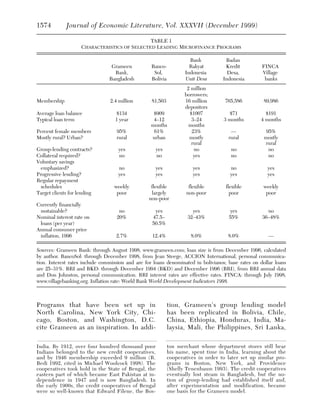
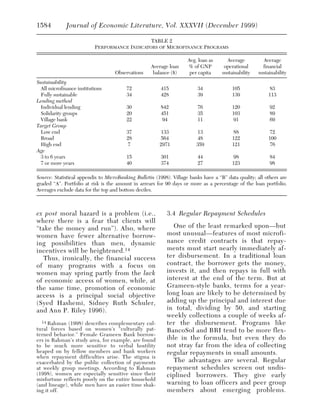
to poor households by traditional banks     mechanisms in use, and Table 1 high-
had repayment rates of 51.6 percent in      lights particular mechanisms. The func-
1980. By 1988–89, a year of bad flood-      tioning of the mechanisms is described
ing, the repayment rate had fallen to       further in Section 3. 3
18.8 percent (M. A. Khalily and Richard
Meyer 1993). Similarly, by 1986 repay-      2.1 The Grameen Bank, Bangladesh
ment rates sank to 41 percent for subsi-       The idea for the Grameen Bank did
dized credit delivered as part of India’s   not come down from the academy, nor
high-profile Integrated Rural Develop-      from ideas that started in high-income
ment Program (Robert Pulley 1989).          countries and then spread broadly. 4
These programs offered heavily subsi-
                                               3 Sections 4.1 and 5.1 describe summary statis-
dized credit on the premise that poor
                                            tics on a broad variety of programs. See also Maria
households cannot afford to borrow at       Otero and Elisabeth Rhyne (1994); MicroBanking
high interest rates.                        Bulletin (1998); Ernst Brugger and Sarath Rajapa-
   But the costs quickly mounted and        tirana (1995); David Hulme and Paul Mosley
                                            (1996); and Elaine Edgcomb, Joyce Klein, and
the programs soon bogged down gov-          Peggy Clark (1996).
ernment budgets, giving little incentive       4 Part of the inspiration came from observing

for banks to expand. Moreover, many         credit cooperatives in Bangladesh, and, interest-
                                            ingly, these had European roots. The late nine-
bank managers were forced to reduce         teenth century in Europe saw the blossoming of
interest rates on deposits in order to      credit cooperatives designed to help low-income
compensate for the low rates on loans.      households save and get credit. The cooperatives
                                            started by Frederick Raiffeisen grew to serve 1.4
In equilibrium, little in the way of sav-   million in Germany by 1910, with replications in
ings was collected, little credit was de-   Ireland and northern Italy (Guinnane 1994 and
livered, and default rates accelerated as   1997; Aidan Hollis and Arthur Sweetman 1997). In
                                            the 1880s the government of Madras in South In-
borrowers began to perceive that the        dia, then under British rule, looked to the German
banks would not last long. The repeated     experiences for solutions in addressing poverty in
1574          Journal of Economic Literature, Vol. XXXVII (December 1999)

                                              TABLE 1
                    CHARACTERISTICS OF SELECTED LEADING MICROFINANCE PROGRAMS

                                                                      Bank           Badan
                                 Grameen           Banco-             Rakyat         Kredit         FINCA
                                  Bank,             Sol,            Indonesia         Desa,         Village
                                Bangladesh         Bolivia          Unit Desa       Indonesia        banks
                                                                     2 million
                                                                    borrowers;
Membership                      2.4 million        81,503           16 million       765,586         89,986
                                                                    depositors
Average loan balance               $134            $909               $1007           $71             $191
Typical loan term                  1 year          4–12                3–24         3 months        4 months
                                                  months              months
Percent female members             95%             61%                 23%             —              95%
Mostly rural? Urban?               rural          urban               mostly          rural          mostly
                                                                       rural                         rural
Group-lending contracts?            yes              yes                no             no              no
Collateral required?                no               no                 yes            no              no
Voluntary savings
  emphasized?                       no               yes               yes             no              yes
Progressive lending?                yes              yes               yes             yes             yes
Regular repayment
  schedules                       weekly           flexible           flexible       flexible        weekly
Target clients for lending         poor            largely           non-poor          poor           poor
                                                  non-poor
Currently financially
 sustainable?                       no              yes                yes              yes            no
Nominal interest rate on           20%             47.5–             32–43%            55%           36–48%
 loans (per year)                                  50.5%
Annual consumer price
 inflation, 1996                   2.7%            12.4%               8.0%           8.0%             —

Sources: Grameen Bank: through August 1998, www.grameen.com; loan size is from December 1996, calculated
by author. BancoSol: through December 1998, from Jean Steege, ACCION International, personal communica-
tion. Interest rates include commission and are for loans denominated in bolivianos; base rates on dollar loans
are 25–31%. BRI and BKD: through December 1994 (BKD) and December 1996 (BRI), from BRI annual data
and Don Johnston, personal communication. BRI interest rates are effective rates. FINCA: through July 1998,
www.villagebanking.org. Inflation rate: World Bank World Development Indicators 1998.


Programs that have been set up in                            tion, Grameen’s group lending model
North Carolina, New York City, Chi-                          has been replicated in Bolivia, Chile,
cago, Boston, and Washington, D.C.                           China, Ethiopia, Honduras, India, Ma-
cite Grameen as an inspiration. In addi-                     laysia, Mali, the Philippines, Sri Lanka,

India. By 1912, over four hundred thousand poor              ton merchant whose department stores still bear
Indians belonged to the new credit cooperatives,             his name, spent time in India, learning about the
and by 1946 membership exceeded 9 million (R.                cooperatives in order to later set up similar pro-
Bedi 1992, cited in Michael Woolcock 1998). The              grams in Boston, New York, and Providence
cooperatives took hold in the State of Bengal, the           (Shelly Tenenbaum 1993). The credit cooperatives
eastern part of which became East Pakistan at in-            eventually lost steam in Bangladesh, but the no-
dependence in 1947 and is now Bangladesh. In                 tion of group-lending had established itself and,
the early 1900s, the credit cooperatives of Bengal           after experimentation and modification, became
were so well-known that Edward Filene, the Bos-              one basis for the Grameen model.
Morduch: The Microfinance Promise                                  1575

Tanzania, Thailand, the U.S., and Viet-             rely on informal insurance relationships
nam. When Bill Clinton was still gover-             and threats, ranging from social isola-
nor, it was Muhammad Yunus, founder                 tion to physical retribution, that facili-
of the Grameen Bank (and a Vander-                  tate borrowing for households lacking
bilt-trained economist), who was called             collateral (Besley and Coate 1995). The
on to help set up the Good Faith Fund               programs thus combine the scale advan-
in Arkansas, one of the early microfi-              tages of a standard bank with mecha-
nance organizations in the U.S. As                  nisms long used in traditional, group-
Yunus (1995) describes the beginning:               based modes of informal finance, such
                                                    as rotating savings and credit associa-
 Bangladesh had a terrible famine in 1974. I
                                                    tions (Besley, Coate, and Glenn Loury
 was teaching economics in a Bangladesh uni-
 versity at that time. You can guess how diffi-     1993). 5
 cult it is to teach the elegant theories of eco-      The Grameen Bank now has over two
 nomics when people are dying of hunger all         million borrowers, 95 percent of whom
 around you. Those theories appeared like           are women, receiving loans that total
 cruel jokes. I became a drop-out from formal
                                                    $30–40 million per month. Reported re-
 economics. I wanted to learn economics
 from the poor in the village next door to the      cent repayment rates average 97–98
 university campus.                                 percent, but as Section 4.2 describes,
                                                    relevant rates average about 92 percent
   Yunus found that most villagers were             and have been substantially lower in
unable to obtain credit at reasonable               recent years.
rates, so he began by lending them                     Most loans are for one year with a
money from his own pocket, allowing                 nominal interest rate of 20 percent
the villagers to buy materials for proj-            (roughly a 15–16 percent real rate).
ects like weaving bamboo stools and                 Calculations described in Section 4.2
making pots (New York Times 1997).                  suggest, however, that Grameen would
Ten years later, Yunus had set up the               have had to charge a nominal rate of
bank, drawing on lessons from informal              around 32 percent in order to become
financial institutions to lend exclusively          fully financially sustainable (holding the
to groups of poor households. Common                current cost structure constant). The
loan uses include rice processing,                  management argues that such an in-
livestock raising, and traditional crafts.          crease would undermine the bank’s so-
   The groups form voluntarily, and,                cial mission (Shahidur Khandker 1998),
while loans are made to individuals, all
in the group are held responsible for                 5 In a rotating savings and credit association, a
loan repayment. The groups consist of               group of participants puts contributions into a pot
five borrowers each, with lending first             that is given to a single member. This is repeated
                                                    over time until each member has had a turn, with
to two, then to the next two, and then              order determined by list, lottery, or auction. Most
to the fifth. These groups of five meet             microfinance contracts build on the use of groups
together weekly with seven other                    but mobilize capital from outside the area.
                                                    ROSCA participants are often women, and in the
groups, so that bank staff meet with                U.S. involvement is active in new immigrant com-
forty clients at a time. According to the           munities, including among Koreans, Vietnamese,
rules, if one member ever defaults, all             Mexicans, Salvadorans, Guatemalans, Trinidadi-
                                                    ans, Jamaicans, Barbadans, and Ethiopians. In-
in the group are denied subsequent                  volvement had been active earlier in the century
loans. The contracts take advantage of              among Japanese and Chinese Americans, but it
local information and the “social assets”           is not common now (Light and Pham 1998).
                                                    Rutherford (1998) and Armendariz and Morduch
that are at the heart of local enforce-             (1998) describe links of ROSCAs and microfinance
ment mechanisms. Those mechanisms                   mechanisms.
1576        Journal of Economic Literature, Vol. XXXVII (December 1999)

but there is little solid evidence that              loans are denominated in dollars, how-
speaks to the issue.                                 ever, and these loans cost clients 24–30
  Grameen figures prominently as an                  percent per year, with a 1 percent fee
early innovator in microfinance and has              up front.
been particularly well studied. Assess-                 Fourth, as a result of these rates, the
ments of its financial performance are               bank does not rely on subsidies, mak-
described below in Section 4.2, of its               ing a respectable return on lending.
costs and benefits in Section 5.1, and               BancoSol reports returns on equity of
of its social and economic impacts in                nearly 30 percent at the end of 1998
Section 6.3.                                         and returns on assets of about 4.5 per-
                                                     cent, figures that are impressive relative
2.2 BancoSol, Bolivia                                to Wall Street investments—although
                                                     adjustments for risk will alter the pic-
   Banco Solidario (BancoSol) of urban               ture. Fifth, repayment schedules are
Bolivia also lends to groups but differs             flexible, allowing some borrowers to
in many ways from Grameen. 6 First, its              make weekly repayments and others to
focus is sharply on banking, not on so-              do so only monthly. Sixth, loan dura-
cial service. Second, loans are made to              tions are also flexible. At the end of
all group members simultaneously, and                1998, about 10 percent had durations
the “solidarity groups” can be formed of             between one and four months, 24 per-
three to seven members. The bank,                    cent had durations of four to seven
though, is constantly evolving, and it               months, 23 percent had durations of
has started lending to individuals as                seven to ten months, 19 percent had
well. By the end of 1998, 92 percent of              durations of ten to thirteen months,
the portfolio was in loans made to soli-             and the balance stretched toward two
darity groups and 98 percent of clients              years.
were in solidarity groups, but it is likely             Seventh, borrowers are better off
that those ratios will fall over time. By            than in Bangladesh and loans are larger,
the end of 1998, 28 percent of the port-             with average loan balances exceeding
folio had some kind of guarantee beyond              $900, roughly nine times larger than for
just a solidarity group.                             Grameen (although first loans may start
   Third, interest rates are relatively              as low as $100). Thus while BancoSol
high. While 1998 inflation was below 5               serves poor clients, a recent study finds
percent, loans denominated in bolivi-                that typical clients are among the “rich-
anos were made at an annual base rate                est of the poor” and are clustered just
of 48 percent, plus a 2.5 percent com-               above the poverty line (where poverty
mission charged up front. Clients with               is based on access to a set of basic
solid performance records are offered                needs like shelter and education; Sergio
loans at 45 percent per year, but this is            Navajas et al. 1998). Partly this may be
still steep relative to Grameen (but not             due to the “maturation” of clients from
relative to the typical moneylender,                 poor borrowers into less poor borrow-
who may charge as much as 10 percent                 ers, but the profile of clients also looks
per month). About 70–80 percent of                   very different from that of the ma-
                                                     ture clients of typical South Asian
  6 The financial information is from Jean Steege,   programs.
ACCION International, personal communication,           The stress on the financial side has
January 1999. Claudio Gonzalez-Vega et al. (1997)
provide more detail on BancoSol. Further infor-      made BancoSol one of the key forces
mation can also be found at http://www.accion.org.   in the Bolivian banking system. The
Morduch: The Microfinance Promise                                1577

institution   started    as    an    NGO     32.3 percent in New Mexico.7 ACCION’s
(PRODEM) in 1987, became a bank in           other affiliates, including six in the United
1992, and, by the end of 1998, served        States, have not, however, achieved fi-
81,503 low-income clients. That scale        nancial sustainability. The largest im-
gives it about 40 percent of borrowers       pediments for U.S. programs appear to
in the entire Bolivian banking system.       be a mixed record of repayment, and
   Part of the success is due to impres-     usury laws that prevent microfinance in-
sive repayment performance, although         stitutions from charging interest rates
difficulties are beginning to emerge.        that cover costs (Pham 1996).
Unlike most other microfinance institu-
                                             2.3 Rakyat Indonesia
tions, BancoSol reports overdues using
conservative standards: if a loan repay-        Like BancoSol, the Bank Rakyat In-
ment is overdue for one day, the entire      donesia unit desa system is financially
unpaid balance is considered at risk         self-sufficient and also lends to “better
(even when the planned payment was           off” poor and nonpoor households, with
only scheduled to be a partial repay-        average loan sizes of $1007 during
ment). By these standards, 2.03 percent      1996. Unlike BancoSol and Grameen,
of the portfolio was at risk at the end of   however, BRI does not use a group
1997. But by the end of 1998, the frac-      lending mechanism. And, unlike nearly
tion increased to 4.89 percent, a trend      all other programs, the bank requires
that parallels a general weakening           individual borrowers to put up collat-
throughout the Bolivian banking system       eral, so the very poorest borrowers are
and which may signal the negative            excluded, but operations remain small-
effects of increasing competition.           scale and “collateral” is often defined
BancoSol’s successes have spawned            loosely, allowing staff some discretion to
competition from NGOs, new nonbank           increase loan size for reliable borrowers
financial institutions, and even formal      who may not be able to fully back loans
banks with new loan windows for low-         with assets. Even in the wake of the re-
income clients. The effect has been a        cent financial crisis in Indonesia, repay-
rapid increase in credit supply, and a       ment rates for BRI were 97.8 percent in
weakening of repayment incentives that       March 1998 (Paul McGuire 1998).
may foreshadow problems to come                 The bank has centered on achieving
elsewhere (see Section 3.3).                 cost reductions by setting up a network
   Still, BancoSol stands as a financial       7 Data are from ACCION (1997) and hold as of
success, and the model has been repli-       December 1996. Five of the six U.S. affiliates have
cated—profitably—by nine of the eigh-        only been operating since 1994, and the group as a
teen other Latin American affiliates of      whole serves only 1,695 clients (but with capital
                                             secured for expansion). A range of microfinance
ACCION International, an NGO based           institutions operate in the U.S. Among the oldest
in Somerville, Massachusetts. ACCION         and best-established are Chicago’s South Shore
also serves over one thousand clients in     Bank and Boston’s Working Capital. The Cal-
                                             Meadow Foundation has recently provided fund-
the U.S., spread over the six programs.      ing for several microfinance programs in Canada.
Average loan sizes range from $1366 in       Microfinance participation in the U.S. is heavily
New Mexico to $3883 in Chicago, and          minority-based, with a high ethnic concentration.
                                             For example, 90 percent of the urban clients of
overall nearly 40 percent of the clients     Boston’s Working Capital are minorities (and 66
are female. As of December 1996, pay-        percent are female). Loans start at $500. Clients
ments past due by at least thirty days       tend to be better educated and have more job ex-
                                             perience than average welfare recipients, and just
averaged 15.5 percent but ranged as          29 percent of Working Capital’s borrowers were
high as 21.2 percent in New York and         below the poverty line (Working Capital 1997).
1578      Journal of Economic Literature, Vol. XXXVII (December 1999)

of branches and posts (with an average        of 1994, the BKDs generated profits of
of five staff members each) and now           $4.73 million on $30 million of net loans
serves about 2 million borrowers and 16       outstanding to 765,586 borrowers. 8
million depositors. (The importance of           Like Grameen-style programs, the
savings to BRI is highlighted below in        BKDs lend to the poorest households,
Section 7.) Loan officers get to know         and scale is small, with an emphasis on
clients over time, starting borrowers off     petty traders and an average loan size of
with small loans and increasing loan          $71 in 1994. The term of loans is gener-
size conditional on repayment perfor-         ally 10–12 weeks with weekly repay-
mance. Annualized interest rates are 34       ment and interest of 10 percent on the
percent in general and 24 percent if          principal. Christen et al. (1995) calcu-
loans are paid with no delay (roughly 25      late that this translates to a 55 percent
percent and 15 percent in real terms—         nominal annual rate and a 46 percent
before the recent financial crisis).          real rate in 1993. Loan losses in 1994
   Like BancoSol, BRI also does not see       were just under 4 percent of loans
itself as a social service organization,      outstanding (Johnston 1996).
and it does not provide clients with             Also as in most microfinance programs,
training or guidance—it aims to earn a        loans do not require collateral. The in-
profit and sees microfinance as good          novation of the BKDs is to allocate
business (Marguerite Robinson 1992).          funds through village-level management
Indeed, in 1995, the unit desa program        commissions led by village heads. This
of the Bank Rakyat Indonesia earned           works in Indonesia since there is a clear
$175 million in profits on their loans to     system of authority that stretches from
low-income households. More striking,         Jakarta down to the villages. The BKDs
the program’s repayment rates—and             piggy-back on this structure, and the
profits—on loans to poor households           management commissions thus build in
have exceeded the performance of loans        many of the advantages of group lend-
made to corporate clients by other parts      ing (most importantly, exploiting local
of the bank. A recent calculation sug-        information and enforcement mecha-
gests that if the BRI unit desa program       nisms) while retaining an individual-
did not have to cross-subsidize the rest      lending approach. The commissions are
of the bank, they could have broken           able to exclude the worst credit risks
even in 1995 while charging a nominal         but appear to be relatively democratic
interest rate of just 17.5 percent per        in their allocations. Through the late
year on loans (around a 7 percent real        1990s, most BKDs have had excess
rate; Jacob Yaron, McDonald Benjamin,         capital for lending and hold balances in
and Stephanie Charitonenko 1998).             BRI accounts. The BKDs are now su-
                                              pervised by BRI, and successful BKD
2.4 Kredit Desa, Indonesia
                                              borrowers can graduate naturally to
  The Bank Kredit Desa system                 larger-scale lending from BRI units.
(BKDs) in rural Indonesia, a sister insti-
tution to BRI, is much less well-known.       2.5 Village Banks
The program dates back to 1929, al-
though much of the capital was wiped            Prospects for replicating the BKDs
out by the hyper-inflation of the middle      outside of Indonesia are limited, how-
1960s (Don Johnston 1996). Like BRI,          ever. A more promising, exportable
loans are made to individuals and the           8 Figures are calculated from Johnston (1996)
operation is financially viable. At the end   and data provided by BRI in August 1996.
Morduch: The Microfinance Promise                              1579

village-based structure is provided by      mulation have limited those aspirations
the network of village banks started in     (Candace Nelson et al. 1995).
the mid-1980s in Latin America by              Like the Indonesian BKDs, the vil-
John Hatch and his associates at the        lage banks successfully harness local in-
Foundation for International Commu-         formation and peer pressure without us-
nity Assistance (FINCA). The village        ing small groups along BancoSol or
banking model has now been replicated       Grameen lines. And, as with the BKDs,
in over 3000 sites in 25 countries by       sustainability is an aim, with nominal in-
NGOs like CARE, Catholic Relief Ser-        terest rates as high as 4 percent per
vices, Freedom from Hunger, and Save        month. Most village banks, however,
the Children. FINCA programs alone          still require substantial subsidies to
serve nearly 90,000 clients in countries    cover capital costs. Section 4.1 shows
as diverse as Peru, Haiti, Malawi,          evidence that village banks as a group
Uganda, and Kyrgyzstan, as well as in       cover just 70 percent of total costs on
Maryland, Virginia, and Washington,         average. Partly, this is because many vil-
D.C.                                        lage banks have been set up in areas
   The NGOs help set up village finan-      that are particularly difficult to serve
cial institutions in partnership with lo-   (e.g., rural Mali and Burkina Faso), and
cal groups, allowing substantial local      the focus has been on outreach rather
autonomy over loan decisions and man-       than scale. Worldwide, the number of
agement. Freedom from Hunger, for           clients is measured in the tens of thou-
example, then facilitates a relationship    sands, rather than the millions served
between the village banks and local com-    by the Grameen Bank and BRI.
mercial banks with the aim to create
sustainable institutional structures.              3. Microfinance Mechanisms
   The village banks tend to serve a
                                               The five programs above highlight
poor, predominantly female clientele
                                            the diversity of approaches spawned by
similar to that served by the Grameen
                                            the common idea of lending to low-
Bank. In the standard model, the spon-
                                            income households. Group lending has
soring agency makes an initial loan to
                                            taken most of the spotlight, and the
the village bank and its 30–50 members.
                                            idea has had immediate appeal for eco-
Loans are then made to members, start-
                                            nomic theorists and for policymakers
ing at around $50 with a four month
                                            with a vision of building programs
term, with subsequent loan sizes tied to
                                            around households’ “social” assets, even
the amount that members have on de-
                                            when physical assets are few. But its
posit with the bank (they must typically
                                            role has been exaggerated: group lend-
have saved at least 20 percent of the
                                            ing is not the only mechanism that dif-
loan value). The initial loan from the
                                            ferentiates microfinance contracts from
sponsoring agency is kept in an “exter-
                                            standard loan contracts. 9 The programs
nal account,” and interest income is
                                            described above also use dynamic in-
used to cover costs. The deposits of
                                            centives, regular repayment schedules,
members are held in an “internal ac-
                                            and collateral substitutes to help main-
count” that can be drawn down as de-
                                            tain high repayment rates. Lending to
positors need. The original aim was to
build up internal accounts so that exter-     9 Ghatak and Guinnane (1999) provide an excel-

nal funding could be withdrawn within       lent review of group-lending contracts. Monica
                                            Huppi and Gershon Feder (1990) provide an early
three years, but in practice growing        perspective. Armendariz and Morduch (1998) de-
credit demands and slow savings accu-       scribe the functioning of alternative mechanisms.
1580        Journal of Economic Literature, Vol. XXXVII (December 1999)

women can also be a benefit from a                 each type in the population, but it is
financial perspective.                             unable to determine which specific in-
   As shown in Table 1, just two of the            vestors are of which type. Investors,
five use explicit group-lending con-               though, have perfect information about
tracts, but all lend in increasing                 each other.
amounts over time (“progressive” lend-                Both types want to invest in a project
ing), offer terms that are substantially           with an uncertain outcome that requires
better than alternative credit sources,            one unit of capital. If they choose not to
and cut off borrowers in default. Most             undertake the project, they can earn
also require weekly or semi-weekly re-             wage income m. The risky investors have
payments, beginning soon after loan re-            a probability of success p r and net re-
ceipt. While we lack good evidence on              turn R r. The safe investors have a prob-
the relative importance of these mecha-            ability of success p s and net return R s.
nisms, there is increasing anecdotal evi-          When either type fails, the return is zero.
dence on limits to group lending per se            Returns are statistically independent.
(e.g., the village studies from Bangla-               Risky types are less likely to be suc-
desh in Aminur Rahman 1998; Imran                  cessful (pr < ps), but they have higher re-
Matin 1997; Woolcock 1999; Sanae Ito               turns when they succeed. For simplic-
1998; and Pankaj Jain 1996). This sec-             ity, assume that the expected net
tion highlights what is known (or ought            returns are equal for both safe and risky
                                                                         __
to be known) about the diversity of                types: prRr = psRs ≡ R. The projects of
technologies that underlie repayment               both types are socially profitable in that
rates and screening mechanisms.                    expected returns net of the cost of capi-
                                                   tal, ρ, exceed earnings from wage labor:
                                                   _
                                                   _
3.1 Peer Selection                                 R − ρ > m.
                                                      Neither type has assets to put up as
  Group lending has many advantages,               collateral, so the investors pay the bank
beginning with mitigation of problems              nothing if the projects fail. To break
created by adverse selection. The key is           even, the bank must set the interest
that group-lending schemes provide in-             rate high enough to cover its per-loan
centives for similar types to group to-            capital cost, ρ. If both types borrow, the
gether. Ghatak (1999) shows how this               equilibrium interest rate under compe-
sorting process can be instrumental in                                                   –
                                                   tition will then be set so that rp = ρ,
improving repayment rates, allowing for            where p  – is the average probability of
lower interest rates, and raising social           success in the population. Since the
welfare. His insight is that a group-              bank can’t distinguish between borrow-
lending contract provides a way to price           ers, all investors will face interest rate,
discriminate that is impossible with an            r. As a result, safe types have lower ex-
individual-lending contract. 10                    pected returns than risky types—since
                                                   _
                                                   _         _
                                                             _
  To see this, imagine two types of po-            R − rps < R − rpr —and the safe types will
tential investors. Both types are risk             enter the market only if their expected
neutral, but one type is “risky” and the           net return exceeds their fallback posi-
                                                         __
other is “safe”; the risky type fails more         tion: R − rps > m. If the safe types enter,
often than the safe type, but the risky            the risky types will too.
types have higher returns when success-               But the safe types will stay out of the
                                                                __
ful. The bank knows the fraction of                market if R − rps < m, and only risky
  10 Armendariz and Gollier (1997) also describe   types might be left in the market. In
this mechanism in parallel work.                   that case, the equilibrium interest rate
Morduch: The Microfinance Promise                                   1581

will rise so that rpr = ρ. Risky types drive           pected net gain from joining with a safe
out the safe. The risky types lose the                 type is as much as pr(ps − pr)c∗. But since
implicit cross-subsidization by the safe               pr < ps, the expected gains to risky types
types, while the safe types lose access to             are always smaller than the expected
capital. This second-best scenario is in-              losses to safe types. Thus, there is no
efficient since only the risky types bor-              mutually beneficial way for risky and
row, even though the safe types also                   safe types to group together. Group
have socially valuable projects.                       lending thus leads to assortative match-
   Can a group-lending scheme improve                  ing: all types group with like types
on this outcome? If it does, it must                   (Gary Becker 1991). 12
bring the safe types back into the mar-                    How does this affect the functioning
ket. For simplicity, consider groups of                of the credit market? Ghatak (1999)
two people, with each group formed                     demonstrates that the group-lending
voluntarily. Individuals invest indepen-               contract provides a way to charge dif-
dently, but the contract is written to                 ferent effective fees to risky and safe
create joint liability. Imagine a contract             types—even though all groups face ex-
such that each borrower pays nothing if                actly the same contract with exactly the
her project fails, and an amount r∗ if                 same nominal charges, r∗ and c∗. The
her project is successful. In addition,                result arises because risky types will be
the successful borrower pays a joint-                  teamed with other risky types, while
liability payment c∗ if the other mem-                 safe types team with safe types. Risky
ber of the group fails. 11 The expected                types then receive expected net returns
                                                           __
net return of a safe_type teamed with a
                       _                               of R − pr(r∗ + (1 − pr)c∗), while safe types
risky type is then R − ps(r∗ + (1 − pr)c∗),            receive expected net returns of
                                                       _
                                                       _
with similar calculations for exclusively              R − ps(r∗ + (1 − ps)c∗). Thus, a successful
safe and exclusively risky groups.                     risky type is more likely to have to pay
   Will the groups be homogeneous or                   the joint-liability payment c∗ than a
mixed? Since safe types are always pre-                successful safe type. If r∗ and c∗ are set
ferred as partners (since their prob-                  appropriately, the group-lending con-
ability of failure is lower), the question             tract can provide an effective way to
becomes: will the risky types be willing               price discriminate that is impossible
to make a large enough transfer to the                 under the standard second-best indi-
safe types such that both risky and safe               vidual-lending contract. If p s = 0.9 and
types do better together? By comparing                 p r = 0.8, for example, the safer types
expected returns under alternative sce-                can expect to pay less than the riskier
narios, we can calculate that a safe type              types as long as the joint liability
will require a transfer of at least                    payment is set so that c∗ > 1.4r∗.
ps(ps − pr)c∗ to agree to form a partner-                  Efficiency gains result if the difference
ship with a risky type. Will risky types               is large enough to induce the safe types
be willing to pay that much? Their ex-                 back into the market. When this hap-
                                                       pens, average repayment rates rise, and
   11 In typical contracts, group members are re-      the bank can afford to maintain a lower
sponsible for helping to pay off the loan in diffi-    interest rate r∗ while not losing money.
culty, rather than having to pay a fixed penalty for
a group member’s default. While clients lack col-
lateral, they are assumed to have a large enough          12 Ghatak (1998) extends the results to groups
income flow to cover these costs if needed. In         larger than 2, a continuum of types, and prefer-
practice this may impose a constraint on loan size     ences against risk. See also Varian (1990) and Ar-
since individuals may have increasing difficulty       mendariz and Gollier (1997) on related issues of
paying c∗ + r∗ when loan sizes grow large.             efficiency and sorting.
1582       Journal of Economic Literature, Vol. XXXVII (December 1999)

3.2 Peer Monitoring                                 How can a group-lending contract
                                                improve matters? The key is that it can
   Group lending may also provide               create a mechanism that gives borrow-
benefits by inducing borrowers not to           ers an incentive to choose the safe ac-
take risks that undermine the bank’s            tivity. Again consider groups of two bor-
profitability (Stiglitz 1990; Besley and        rowers and group-lending contracts like
Coate 1995). This can be seen by                those in Section 3.1 above. The borrow-
slightly modifying the framework in             ers in each group have the ability to
Section 3.1 to consider moral hazard.           enforce contracts between each other,
Instead, consider identical risk averse         and they jointly decide which types
borrowers with utility functions u(x).          of activities to undertake. Now their
   Each borrower may do either risky or         problem is to choose between both do-
safe activities, and each activity again        ing the safe activity, yielding each bor-
requires the same capital cost. The             rower expected utility of p2u(Rs − r∗) +
                                                                                 s
bank, as above, has imperfect informa-          ps(1 − ps)u(Rs − r∗ − c∗), or doing the
tion about borrowers—in particular,             risky activity with expected utility
here it cannot tell whether the borrow-         p2u(Rr − r∗) + pr(1 − pr)u(Rr − r∗ − c∗). If
                                                  r
ers have done the safe or risky activity.       the joint-liability payment c∗ is set high
Moral hazard is thus a prime concern.           enough, borrowers will always choose to
When projects fail, borrowers have a re-        do the safe activity (Stiglitz 1990).
turn of zero, and a borrower’s utility              This is good for the bank, but it sad-
level when projects fail is normalized to       dles borrowers with extra risk. The
zero as well.                                   bank, though, knows borrowers will now
   We start with the standard individual-       do the safe activity, and it earns extra
lending contract. Borrowers either have         income from the joint-liability pay-
expected utility psu(Rs − r) or pru(Rr − r),    ments. The bank can thus afford to
depending on whether they do the safe           lower the interest rate to offset the
or risky activity. If everyone did the          burden.
safe activity, the bank could charge an             Thus, through exploiting the ability
interest rate of r = ρ/p s and break even.      of neighbors to enforce contracts and
But, since the bank cannot see which            monitor each other—even when the
activity is chosen (and thus cannot con-        bank can do neither—the group-lending
tract on it), borrowers may fare better         contract again offers a way to lower
doing the risky activity and getting ex-        equilibrium interest rates, raise expected
pected utility E[U sr] = pru(Rr − ρ/ps). The    utility, and raise expected repayment
bank then loses money. Thus, the bank           rates.
raises interest rates to r = ρ/p r. Now the
                                                3.3 Dynamic Incentives
borrower gets expected utility of
E[U rr] = pru(Rr − ρ/pr), and she is clearly       A third mechanism for securing high
worse off than with a lower interest            repayment rates with high monitoring
rate. In fact, if the borrower could            costs involves exploiting dynamic incen-
somehow commit to doing the safe ac-            tives (Besley 1995, p. 2187). Programs
tivity, she could be better off—with ex-        typically begin by lending just small
pected utility E[U ss] = psu(Rs − ρ/ps). Thus   amounts and then increasing loan size
the borrower prefers E[U sr] to E[U ss] to      upon satisfactory repayment. The re-
E[U rr], but the information problem            peated nature of the interactions—and
and inability to commit means that she          the credible threat to cut off any future
always gets the worst outcome, E[U rr].         lending when loans are not repaid—can
Morduch: The Microfinance Promise                          1583

be exploited to overcome information                    Relying on dynamic incentives also
problems and improve efficiency,                     runs into problems common to all finite
whether lending is group-based or                    repeated games. If the lending relation-
individual-based. 13                                 ship has a clear end, borrowers have in-
   Incentives are enhanced further if                centives to default in the final period.
borrowers can anticipate a stream of in-             Anticipating that, the lender will not
creasingly larger loans. (Hulme and                  lend in the final period, giving borrow-
Mosley 1996 term this “progressive                   ers incentives to default in the penulti-
lending,” and the ACCION network                     mate period—and so forth until the en-
calls it “step lending.”) As above, keep-            tire mechanism unravels. Thus, unless
ing interest rates relatively low is criti-          there is substantial uncertainty about
cal, since the advantage of microfinance             the end date—or if “graduation” from one
programs lies in their offering services             program to the next is well-established
at rates that are more attractive than               (ad infinitum), dynamic incentives have
competitors’ rates. Thus, the Bank Rak-              limited scope on their own.
yat Indonesia (BRI) and BancoSol                        One quite different advantage of pro-
charge high rates, but they keep levels              gressive lending is the ability to test
well below rates that moneylenders                   borrowers with small loans at the start.
traditionally charge.                                This feature allows lenders to develop
   However, competition will diminish                relationships with clients over time and
the power of the dynamic incentives                  to screen out the worst prospects before
against moral hazard—a problem that                  expanding loan scale (Parikshit Ghosh
both the Bank Rakyat Indonesia and                   and Debraj Ray 1997).
BancoSol are starting to feel as other                  Dynamic incentives can also help to
commercial banks see the potential                   explain advantages found in lending to
profitability of their model. In practice,           women. Credit programs like those of
though, real competition has yet to be               the Grameen Bank and the Bangladesh
felt by most microfinance institutions               Rural Advancement Committee (BRAC)
(perhaps because so few are actually                 did not begin with a focus on women.
turning a profit). As competition grows,             In 1980–83, women made up 39 percent
the need for a centralized credit rating             and 34 percent of their respective mem-
agency will also grow.                               berships, but by 1991–92, BRAC’s
   Dynamic incentives will also work                 membership was 74 percent female and
better in areas with relatively low mo-              Grameen’s was 94 percent female (Anne
bility. In urban areas, for example,                 Marie Goetz and Rina Sen Gupta 1995).
where households come and go, it may                 As Table 2 shows, many other programs
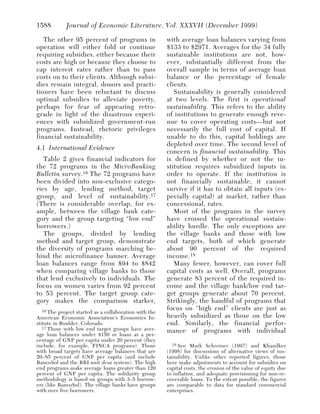
not be easy to catch defaulters who                  also focus on lending to women, and it
move across town and start borrowing                 appears to confer financial advantages
again with a clean slate at a different              on the programs. At Grameen, for ex-
branch or program. BRI has faced                     ample, 15.3 percent of male borrowers
greater trouble securing repayments in               were “struggling” in 1991 (i.e., missing
their urban programs than in their rural             some payments before the final due
ones, which may be due to greater                    date) while this was true for just 1.3
urban mobility.                                      percent of women (Khandker, Baqui
                                                     Khalily, and Zahed Kahn 1995).
  13 See the general theoretical treatment in Bol-      The decision to focus on women has
ton and Scharfstein (1990) and the application to
microfinance contracts in Armendariz and Mor-        some obvious advantages. The lower
duch (1998).                                         mobility of women may be a plus where
1584          Journal of Economic Literature, Vol. XXXVII (December 1999)

                                              TABLE 2
                          PERFORMANCE INDICATORS OF MICROFINANCE PROGRAMS

                                                                     Avg. loan as      Average          Average
                                                    Average loan     % of GNP         operational       financial
                                    Observations     balance ($)      per capita     sustainability   sustainability
Sustainability
 All microfinance institutions           72              415              34              105              83
 Fully sustainable                       34              428              39              139              113
Lending method
 Individual lending                      30              842             76               120              92
 Solidarity groups                       20              451             35               103              89
 Village bank                            22               94             11                91              69
Target Group
 Low end                                 37              133              13               88               72
 Broad                                   28              564              48              122              100
 High end                                7              2971             359              121               76
Age
 3 to 6 years                            15              301              44               98              84
 7 or more years                         40              374              27              123              98

Source: Statistical appendix to MicroBanking Bulletin (1998). Village banks have a “B” data quality; all others are
graded “A”. Portfolio at risk is the amount in arrears for 90 days or more as a percentage of the loan portfolio.
Averages exclude data for the top and bottom deciles.


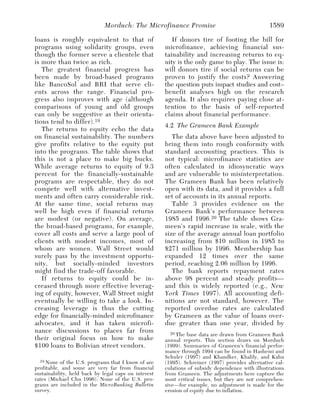
ex post moral hazard is a problem (i.e.,                   3.4 Regular Repayment Schedules
where there is a fear that clients will
“take the money and run”). Also, where                        One of the least remarked upon—but
women have fewer alternative borrow-                       most unusual—features of most microfi-
ing possibilities than men, dynamic                        nance credit contracts is that repay-
incentives will be heightened. 14                          ments must start nearly immediately af-
   Thus, ironically, the financial success                 ter disbursement. In a traditional loan
of many programs with a focus on                           contract, the borrower gets the money,
women may spring partly from the lack                      invests it, and then repays in full with
of economic access of women, while, at                     interest at the end of the term. But at
the same time, promotion of economic                       Grameen-style banks, terms for a year-
access is a principal social objective                     long loan are likely to be determined by
(Syed Hashemi, Sidney Ruth Schuler,                        adding up the principal and interest due
and Ann P. Riley 1996).                                    in total, dividing by 50, and starting
                                                           weekly collections a couple of weeks af-
  14 Rahman   (1998) describes complementary cul-          ter the disbursement. Programs like
tural forces based on women’s “culturally pat-             BancoSol and BRI tend to be more flex-
terned behavior.” Female Grameen Bank borrow-
ers in Rahman’s study area, for example, are found         ible in the formula, but even they do
to be much more sensitive to verbal hostility              not stray far from the idea of collecting
heaped on by fellow members and bank workers               regular repayments in small amounts.
when repayment difficulties arise. The stigma is
exacerbated by the public collection of payments              The advantages are several. Regular
at weekly group meetings. According to Rahman              repayment schedules screen out undis-
(1998), women are especially sensitive since their         ciplined borrowers. They give early
misfortune reflects poorly on the entire household
(and lineage), while men have an easier time shak-         warning to loan officers and peer group
ing it off.                                                members about emerging problems.
Morduch: The Microfinance Promise                                    1585

                                                TABLE 2 (Cont.)


                                     Avg. return        Avg. percent of      Avg. percent    Avg. number of
                                      on equity         portfolio at risk   female clients   active borrowers
Sustainability
 All microfinance institutions          –8.5                  3.3                65              9,035
 Fully sustainable                       9.3                  2.6                61              12,926
Lending method
 Individual lending                     –5.0                  3.1                53              15,226
 Solidarity groups                       –3.0                 4.1                49               7,252
 Village bank                           –17.4                 2.8                92               7,833
Target Group
 Low end                                –16.2                 3.8                74              7,953
 Broad                                   1.2                  3.0                60              12,282
 High end                               –6.2                  1.9                34              1,891
Age
 3 to 6 years                           –6.8                  2.2                71               9,921
 7 or more years                        –2.4                  4.1                63              16,557


And they allow the bank to get hold of                    3.5 Collateral Substitutes
cash flows before they are consumed or
otherwise diverted, a point developed                        While few programs require collat-
by Stuart Rutherford (1998).                              eral, many have substitutes. For exam-
   More striking, because the repayment                   ple, programs following the Grameen
process begins before investments bear                    model require that borrowers contrib-
fruit, weekly repayments necessitate                      ute to an “emergency fund” in the
that the household has an additional in-                  amount of 0.5 percent of every unit bor-
come source on which to rely. Thus, in-                   rowed (beyond a given scale). The
sisting on weekly repayments means                        emergency fund provides insurance in
that the bank is effectively lending                      cases of default, death, disability, etc.,
partly against the household’s steady,                    in amounts proportional to the length of
diversified income stream, not just the                   membership. An additional 5 percent of
risky project. This confers advantages                    the loan is taken out as a “group tax”
for the bank and for diversified house-                   that goes into a group fund account. Up
holds. But it means that microfinance                     to half of the fund can be used by group
has yet to make real inroads in areas fo-                 members (with unanimous consent).
cused sharply on highly seasonal occu-                    Typically, it is disbursed among the
pations like agricultural cultivation.                    group as zero-interest loans with fixed
Seasonality thus poses one of the largest                 terms. Until October 1995, Grameen
challenges to the spread of microfi-                      Bank members could not withdraw
nance in areas centered on rainfed                        these funds from the bank, even upon
agriculture, areas that include some of                   leaving. These “forced savings” can now
the poorest regions of South Asia and                     be withdrawn upon leaving, but only af-
Africa.                                                   ter the banks have taken out what they
1586      Journal of Economic Literature, Vol. XXXVII (December 1999)

are owed. Thus, in effect, the funds          borrowers in growing businesses and
serve as a form of partial collateral.        those that outstrip the pace of their
   The Bank Rakyat Indonesia’s unit           peers (Madajewicz 1997; Woolcock
desa program is one of the few pro-           1998)? Are weekly meetings particularly
grams to require collateral explicitly. Its   costly (for both borrowers and bank
advocates, however, emphasize instead         staff) in areas of low population density
the role of dynamic incentives in gener-      and at busy agricultural seasons? Do so-
ating repayments (Richard Patten and          cial programs enhance economic perfor-
Jay Rosengard 1991; Robinson 1992). It        mance? When default occurs, do bank
is impossible, though, to determine eas-      staff follow the letter of the law and cut
ily which incentive mechanism is most         off good clients with the misfortune to
important in driving repayment rates.         be in groups with unlucky neighbors?
While bank officials point out that col-      Or is renegotiation common (Hashemi
lateral is almost never collected, this       and Sidney Schuler 1997; Matin 1997;
does not signal its lack of importance as     Armendariz and Morduch 1998)?
an incentive device. If the threat of col-       Most of the theoretical propositions
lection is believable, there should be        are supported with anecdotes from par-
few instances when collateral is actually     ticular programs, but they have not
collected.                                    been established as empirical regulari-
   BancoSol also stresses the role of         ties. Better research is needed to sharpen
solidarity groups in assuring repay-          both the growing body of microfinance
ments, but as its clients have prospered      theory and ongoing policy dialogues.
at varying rates, lending approaches             Empirical understandings of microfi-
have diversified as well. As noted in         nance will also be aided by studies that
Section 2.2, by the end of 1998, 28 per-      quantify the roles of the various mecha-
cent of its portfolio had some kind of        nisms in driving microfinance perfor-
guarantee beyond the solidarity group.        mance. The difficulty in these inquiries is
                                              that most programs use the same lend-
3.6 Empirical Research Agenda
                                              ing model in all branches. Thus, there is
   Do the mechanisms above function as        no variation off of which to estimate the
advertised? Is there evidence of assorta-     efficacy of particular mechanisms. Well-
tive matching through group lending as        designed experiments would help (e.g.,
postulated by Ghatak (1999)? Are fu-          individual-lending contracts to some of
ture loan terms predicted by lagged           the sample, group-lending contracts to
performance, as suggested by the the-         others; weekly repayments for some,
ory of dynamic incentives? Extending          monthly or quarterly schedules for others).
the theory further, does the group-lend-         Lacking well-designed experiments, a
ing contract heighten default prob-           collection of studies instead presents
abilities for the entire group when some      regressions in which repayment rates
members run into difficulties, as pre-        are explained by proxies for forces be-
dicted by Besley and Coate (1995)?            hind particular mechanisms. The vari-
Does group lending lead to excessive          ation thus arises from features of the
monitoring and excessive pressure to          economic environment that affect the
undertake “safe” projects rather than         efficacy of particular program features:
riskier and more lucrative projects           How good are information flows? How
(Banerjee, Besley, and Guinnane               competitive are credit markets? How
1992)? Is the group-lending structure         strong are informal enforcement mech-
less flexible than individual lending for     anisms? The variation in answers to
Morduch: The Microfinance Promise                             1587

these questions allows econometric esti-      opposite in considering other Bangla-
mation, but the evidence is indirect and      desh banks (including Grameen). Both
subject to multiple interpretations since     drop-out rates and repayment rates in-
the strength of information flows, mar-       crease in better-developed villages.
kets, and enforcement mechanisms is           This may be a product of improved li-
unlikely to matter only through the           quidity and better business opportuni-
form of credit contract. In addition, se-     ties in better-off villages, but it might
lection biases of the sort raised in Sec-     also reflect selection bias.
tion 6.1 are likely to apply. Still, some        These bits of evidence show that
results are provocative.                      group lending is a varied enterprise and
   For example, Wydick (1999) reports         that there is much to microfinance be-
on a survey of an ACCION Interna-             yond group lending. Narrowing the gap
tional affiliate in western Guatemala         between theory and evidence will be an
tailored to elicit information about          important step toward improving and
groups. He finds that improvements in         evaluating programs.
repayment rates are associated with
variables that proxy for the ability to             4. Profitability and Financial
monitor and enforce group relation-                         Sustainability
ships, such as knowledge of the weekly
sales of fellow group members. He                Microfinance discussions pay surpris-
finds little impact, though, of social ties   ingly little attention to particular mech-
per se: friends do not make more reli-        anisms relative to how much attention
able group members than others. In fact,      is paid to purely financial matters. Ac-
members are sometimes softer on their         cordingly, this section considers fi-
friends, worsening average repayment          nances, and social issues are taken up
rates.                                        again in Section 5.
   Mark Wenner (1995) investigates re-           How well in the end have microfi-
payment rates in 25 village banks in          nance programs met their financial
Costa Rica affiliated with FINCA. He          promise? A recent survey finds 34 prof-
finds active screening that successfully      itable programs among a group of 72
excludes the worst credit risks, working      with a “commitment” to financial sus-
in a more straightforward way than in         tainability     (MicroBanking      Bulletin
the simple model of peer selection in         1998). This does not imply, however,
Section 3.1 above. He also finds that         that half of all programs worldwide are
delinquency rates are higher in better        self-sufficient. The hundreds of pro-
off towns. This lends support to the the-     grams outside the base 72 continue to
ory of dynamic incentives: where bor-         depend on the generosity of donors
rowers have better alternatives, they are     (e.g., Grameen Bank and most of its
likely to value the programs less, and        replicators do not make the list of 72,
this drives up default rates.                 although BancoSol and BRI do). Some
   The result is echoed by Manohar            experts estimate that no more than 1
Sharma and Manfred Zeller (1996) in their     percent of NGO programs worldwide
study of three programs in Bangladesh         are currently financially sustainable—
(but not Grameen). They find that re-         and perhaps another 5 percent of NGO
payment rates are higher in remote            programs will ever cross the hurdle. 15
communities—i.e., those with fewer al-          15 The figures are based on an informal poll
ternative credit programs. Khandker et        taken by Richard Rosenberg at a microfinance
al. (1995, Table 7.2), however, find the      conference (personal communication, Nov. 1998).
1588         Journal of Economic Literature, Vol. XXXVII (December 1999)

   The other 95 percent of programs in                  with average loan balances varying from
operation will either fold or continue                  $133 to $2971. Averages for the 34 fully
requiring subsidies, either because their               sustainable institutions are not, how-
costs are high or because they choose to                ever, substantially different from the
cap interest rates rather than to pass                  overall sample in terms of average loan
costs on to their clients. Although subsi-              balance or the percentage of female
dies remain integral, donors and practi-                clients.
tioners have been reluctant to discuss                     Sustainability is generally considered
optimal subsidies to alleviate poverty,                 at two levels. The first is operational
perhaps for fear of appearing retro-                    sustainability. This refers to the ability
grade in light of the disastrous experi-                of institutions to generate enough reve-
ences with subsidized government-run                    nue to cover operating costs—but not
programs. Instead, rhetoric privileges                  necessarily the full cost of capital. If
financial sustainability.                               unable to do this, capital holdings are
                                                        depleted over time. The second level of
4.1 International Evidence
                                                        concern is financial sustainability. This
   Table 2 gives financial indicators for               is defined by whether or not the in-
the 72 programs in the MicroBanking                     stitution requires subsidized inputs in
Bulletin survey. 16 The 72 programs have                order to operate. If the institution is
been divided into non-exclusive catego-                 not financially sustainable, it cannot
ries by age, lending method, target                     survive if it has to obtain all inputs (es-
group, and level of sustainability. 17                  pecially capital) at market, rather than
(There is considerable overlap, for ex-                 concessional, rates.
ample, between the village bank cate-                      Most of the programs in the survey
gory and the group targeting “low end”                  have crossed the operational sustain-
borrowers.)                                             ability hurdle. The only exceptions are
   The groups, divided by lending                       the village banks and those with low
method and target group, demonstrate                    end targets, both of which generate
the diversity of programs marching be-                  about 90 percent of the required
hind the microfinance banner. Average                   income. 18
loan balances range from $94 to $842                       Many fewer, however, can cover full
when comparing village banks to those                   capital costs as well. Overall, programs
that lend exclusively to individuals. The               generate 83 percent of the required in-
focus on women varies from 92 percent                   come and the village bank/low end tar-
to 53 percent. The target group cate-                   get groups generate about 70 percent.
gory makes the comparison starker,                      Strikingly, the handful of programs that
   16 The project started as a collaboration with the
                                                        focus on “high end” clients are just as
American Economic Association’s Economics In-           heavily subsidized as those on the low
stitute in Boulder, Colorado.                           end. Similarly, the financial perfor-
   17 Those with low end target groups have aver-
                                                        mance of programs with individual
age loan balances under $150 or loans as a per-
centage of GNP per capita under 20 percent (they
include, for example, FINCA programs). Those               18 See Mark Schreiner (1997) and Khandker
with broad targets have average balances that are       (1998) for discussions of alternative views of sus-
20–85 percent of GNP per capita (and include            tainability. Unlike other reported figures, those
BancoSol and the BRI unit desa system). The high        here make adjustments to account for subsidies on
end programs make average loans greater than 120        capital costs, the erosion of the value of equity due
percent of GNP per capita. The solidarity group         to inflation, and adequate provisioning for non-re-
methodology is based on groups with 3–5 borrow-         coverable loans. To the extent possible, the figures
ers (like BancoSol). The village banks have groups      are comparable to data for standard commercial
with over five borrowers.                               enterprises.
Morduch: The Microfinance Promise                                   1589

loans is roughly equivalent to that of                   If donors tire of footing the bill for
programs using solidarity groups, even                microfinance, achieving financial sus-
though the former serve a clientele that              tainability and increasing returns to eq-
is more than twice as rich.                           uity is the only game to play. The issue is:
   The greatest financial progress has                will donors tire if social returns can be
been made by broad-based programs                     proven to justify the costs? Answering
like BancoSol and BRI that serve cli-                 the question puts impact studies and cost–
ents across the range. Financial pro-                 benefit analyses high on the research
gress also improves with age (although                agenda. It also requires paying close at-
comparisons of young and old groups                   tention to the basis of self-reported
can only be suggestive as their orienta-              claims about financial performance.
tions tend to differ). 19
                                                      4.2 The Grameen Bank Example
   The returns to equity echo the data
on financial sustainability. The numbers                 The data above have been adjusted to
give profits relative to the equity put               bring them into rough conformity with
into the programs. The table shows that               standard accounting practices. This is
this is not a place to make big bucks.                not typical: microfinance statistics are
While average returns to equity of 9.3                often calculated in idiosyncratic ways
percent for the financially-sustainable               and are vulnerable to misinterpretation.
programs are respectable, they do not                 The Grameen Bank has been relatively
compete well with alternative invest-                 open with its data, and it provides a full
ments and often carry considerable risk.              set of accounts in its annual reports.
At the same time, social returns may                     Table 3 provides evidence on the
well be high even if financial returns                Grameen Bank’s performance between
are modest (or negative). On average,                 1985 and 1996. 20 The table shows Gra-
the broad-based programs, for example,                meen’s rapid increase in scale, with the
cover all costs and serve a large pool of             size of the average annual loan portfolio
clients with modest incomes, most of                  increasing from $10 million in 1985 to
whom are women. Wall Street would                     $271 million by 1996. Membership has
surely pass by the investment opportu-                expanded 12 times over the same
nity, but socially-minded investors                   period, reaching 2.06 million by 1996.
might find the trade-off favorable.                      The bank reports repayment rates
   If returns to equity could be in-                  above 98 percent and steady profits—
creased through more effective leverag-               and this is widely reported (e.g., New
ing of equity, however, Wall Street might             York Times 1997). All accounting defi-
eventually be willing to take a look. In-             nitions are not standard, however. The
creasing leverage is thus the cutting                 reported overdue rates are calculated
edge for financially-minded microfinance              by Grameen as the value of loans over-
advocates, and it has taken microfi-                  due greater than one year, divided by
nance discussions to places far from                     20 The base data are drawn from Grameen Bank
their original focus on how to make                   annual reports. This section draws on Morduch
$100 loans to Bolivian street vendors.                (1999). Summaries of Grameen’s financial perfor-
                                                      mance through 1994 can be found in Hashemi and
                                                      Schuler (1997) and Khandker, Khalily, and Kahn
  19 None of the U.S. programs that I know of are     (1995). Schreiner (1997) provides alternative cal-
profitable, and some are very far from financial      culations of subsidy dependence with illustrations
sustainability, held back by legal caps on interest   from Grameen. The adjustments here capture the
rates (Michael Chu 1996). None of the U.S. pro-       most critical issues, but they are not comprehen-
grams are included in the MicroBanking Bulletin       sive—for example, no adjustment is made for the
survey.                                               erosion of equity due to inflation.
1590         Journal of Economic Literature, Vol. XXXVII (December 1999)

                                                TABLE 3
                             GRAMEEN BANK: SELECTED FINANCIAL INDICATORS
                                      (Millions of 1996 U.S. dollars)

                                                                                                  1985–
                                                                                                  1996
                                         1985        1990        1992        1994        1996    average
Size
  Average annual loans outstanding       10.0        58.3        83.8        211.5       271.3    108
  Members (thousands)                    172         870        1,424        2,013       2,060   1,101
Overdues rates (%)
  Reported overdues rate                 2.8         3.3          2.5        0.8         13.9     1.6A
  Adjusted overdues rate                 3.8         6.2          1.9        15.0         —       7.8A
Profits
  Reported profits                       0.02        0.09       –0.15         0.56        0.46    1.5B
  Adjusted profits                      –0.33       –1.51       –3.06        –0.93       –2.28   –17.8B
Subsidies
  Direct grants                          0.0         2.3          1.7         2.0         2.1     16.4B
  Value of access to soft loans          1.1         7.0          5.8         9.0        12.7     80.5B
  Value of access to equity              0.0         0.4          2.7         8.0         8.8     47.3B
    Subsidy per 100 units outstanding    11          21           16           7           9       11
Interest rates (%)
  Average nominal on-lending rate        16.8        11.1        15.8        16.7        15.9     15.9
  Average real on-lending rate            5.9         3.0        11.6        13.1        10.1     10.1
  Benchmark cost of capital              15.0        15.0        13.5         9.4        10.3     11.3
  Average nominal cost of capital         7.9         2.2         2.1         5.5         3.4      3.7
  Subsidy dependence index                80         263         106          45          65       74
  Avg. nominal “break-even” rate         30.2        40.2        32.6        24.2        26.2     25.7

Source: Morduch (1999) based on data from various years of the Grameen Bank Annual Report.
Notes: A: average for 1985–94, weighted by portfolio size. B: Sum for 1985–96.


the current portfolio. A problem is that                it is high enough to start creating finan-
the current portfolio tends to be much                  cial difficulties. More dramatically, the
larger than the portfolio that existed                  bank reported an overdue rate of 0.8
when the overdue loans were first                       percent in 1994, while at the same time
made. With the portfolio expanding 27                   I estimate that 15 percent of the loans
times between 1985 and 1996, reported                   made that year were unrecovered.
default rates are considerably lower                       Similarly, reported profits differ con-
than standard calculation of arrears                    siderably from adjusted profits in Table
(which instead immediately captures                     3. The main adjustment is to make ade-
the share of the portfolio “at risk”). The              quate provision for loan losses. Until re-
adjusted rates replace the denominator                  cently, the bank had been slow to write
with the size of the portfolio at the time              off losses, and the adjusted rates ensure
that the loans were made.                               that in each year the bank writes off a
   Doing so can make a big difference:                  modest 3.5 percent of its portfolio (still,
overall, overdues averaged 7.8 percent                  considerably less than the 7.8 percent
between 1985 and 1996, rather than the                  average overdue rate). The result is
reported 1.6 percent. The rate is still                 losses of nearly $18 million between
impressive relative to the performance                  1985 and 1996, rather than the bank’s
of government development banks, but                    reported $1.5 million in profits.
Morduch: The Microfinance Promise                       1591

   Grants from donors are considered          While borrowers would not be happy, it
part of income in the profit calcula-         is not obvious that they would defect.
tions. If the bank had to rely only on        Clients of the Bangladesh Rural Ad-
income from lending and investments,          vancement Committee, a Grameen
it would have instead suffered losses of      competitor with a similar client base,
$34 million between 1985 and 1996.            are already paying 30 percent nominal
   The bulk of the bank’s subsidies en-       base interest rates, for example.
ter through soft loans, however. Gra-            Alternatively,    radically  stripping
meen paid an average of 3.7 percent on        down administrative costs would pro-
borrowed capital (a –1.7 percent real         vide breathing room. In the early 1990s
rate). Had it not had access to conces-       salary and personnel costs accounted
sional rates, it would have had to pay        for half of Grameen’s total costs, while
considerably more. Here, an alternative       interest costs were held below 25 per-
benchmark capital cost measure is ap-         cent. Decreasing wages has been impos-
proximated as the Bangladesh deposit          sible since they are linked to govern-
rate from IMF International Financial         ment wage scales, so the emphasis has
Statistics (1996) plus a 3 percent adjust-    had to be on increasing efficiency. By
ment for transactions costs. The differ-      1996, salary and personnel costs were
ence in rates yields a total value of ac-     roughly equal to interest costs (Mor-
cess to soft loans of $80.5 million           duch 1999). Training costs have also
between 1985 and 1996. An additional          been high. One study found that in
implicit subsidy of $47.3 million was re-     1991, 54 percent of female trainees and
ceived by Grameen through access to           30 percent of male trainees dropped out
equity which was used to generate             before taking up first positions with
returns below opportunity costs.              Grameen—and much of Grameen’s di-
   Although subsidies have increased          rect grants are funneled to supporting
over time in absolute quantities, the         training efforts (Khandker, Khalily, and
bank’s scale has grown even more              Kahn 1995).
quickly. As a result, the annual subsidy         The Association for Social Advance-
per dollar outstanding has fallen sub-        ment (ASA), another large microfinance
stantially, leveling off at about ten cents   presence in Bangladesh, demonstrates a
on the dollar.                                more radical approach to cost control.
   The subsidy dependence index sum-          They have streamlined record keeping
marizes the subsidy data by yielding an       and simplified operations so that, for
estimate of the percentage increase in        example, only one loan type is offered—
the interest rate required in order for       versus Grameen’s choice of general
the bank to operate without subsidies of      loans, housing loans, collective loans,
any kind (Yaron 1992). The result for         seasonal loans, and, more recently,
1985–96 indicates that in the early           lease/loan arrangements. ASA thus feels
1990s Grameen would have had to in-           comfortable hiring staff with fewer for-
crease nominal interest rates on its gen-     mal qualifications than Grameen, and
eral loan product from 20 percent to          staff retention is aided. ASA has also
above 50 percent. Overall, the average        eliminated mid-level branch offices and
break-even rate is 32 percent (the aver-      has centered nearly exclusively on the
age on-lending rate is lower than 20          larger groups of forty village members,
percent since about one quarter of the        rather than the five-member subgroups.
portfolio is comprised of housing loans          The Grameen Bank’s current path, pur-
offered at 8 percent interest per year).      suing cross-subsidization and alternative
1592      Journal of Economic Literature, Vol. XXXVII (December 1999)

income generation projects (including        careful cost-benefit studies to date. But
an internet provision service and other      the fact is that subsidies are an ongoing
for-profit spin-offs) is appealing in the    reality: some “infants” are getting old.
medium term, but it has its own perils:      Moreover, many of the worries about
the bank’s mission risks getting diluted,    problems associated with subsidies can
and profitable sectors are vulnerable to     likely be overcome. 21
competition over time.                          It is true that donors can be fickle,
  Grameen’s self-reported successes          but governments will remain committed
have been exaggerated, but even if the       to poverty alleviation well after interna-
bank is not the economic miracle that        tional agencies have moved on to the
many have claimed, it is not obvious         next Big Idea. If subsidized microfi-
that its failure to reach financial self-    nance proves to deliver more bang for
sufficiency is in itself a problem. As       the buck than other social investments,
long as benefits sufficiently exceed         should subsidies be turned down?
costs and donors remain committed to            Scale certainly matters, but often a
the cause, Grameen could hold up as a        small well-targeted program may do
wise social investment.                      more to alleviate measured poverty than
                                             a large, poorly-targeted program. Con-
5. Costs and Benefits of Credit Subsidies    sider this example from Morduch
                                             (2000). Assume that the typical client in
   Nearly all programs espouse financial     a subsidized program has an income of,
sustainability as a key principle. At the    say, 50 percent of the poverty line,
same time, nearly all programs rely on       while the typical client of a sustainable
subsidies of one sort or another. These      (high interest rate) program has an in-
subsidies are typically viewed as tem-       come of 90 percent of the poverty line.
porary aids that help programs over-         To clarify the comparison, assume that
come start-up costs, not as ongoing pro-     the net impacts on income per borrower
gram features. It is the familiar “infant    are identical for the programs (after
industry” argument for protection.           repaying loans with interest).
   The anti-subsidy stance springs from         Minimizing poverty as measured by
a series of worries. First, donors can be    the commonly-used “squared poverty
fickle, and programs that aim to exist       gap” of James Foster, Joel Greer, and
into the future feel the need for inde-      Erik Thorbecke (1984), for example,
pendence. Second, donor budgets are          suggests that raising the poorer bor-
limited, restricting the scale of opera-     rower’s income by one dollar has five
tions to the size of the dole. Self-suffi-   times greater impact than doing the
cient programs, on the other hand, can       same for the less poor borrower. If the
expand to meet demand. Third, subsi-         sustainable program has 63,000 clients
dized programs run the risk of becom-        (roughly the size of Bolivia’s BancoSol
ing inefficient without hard bottom          in the early 1990s), the subsidized pro-
lines. Fourth, in the past subsidies have    gram would need to reach just 12,600
ended up in the wrong hands, rather          clients to have an equivalent impact. The
than helping poor households.
   The view that subsidies should just be      21 This section draws heavily on Morduch
temporary has meant that calculating         (2000). Adams, Graham, and von Pischke (1982)
the costs and benefits of subsidies has      present a well-argued alternative perspective.
                                             Schreiner (1997) presents a framework for consid-
not been an important part of microfi-       ering cost-effectiveness applied to BancoSol and
nance practice, and there have been no       the Grameen Bank.
Morduch: The Microfinance Promise                                 1593

comparison is too simple, but it amply       tios of 3.53 and 2.59 for borrowing from
illustrates how social weights and depth     BRAC by women and men, respectively.
of outreach can outweigh concerns with          These calculations provide an impor-
scale.                                       tant first-cut at taking costs and bene-
   The third issue, the danger of slip-      fits seriously. They suggest that invest-
ping into inefficiency, has been demon-      ing in microfinance is not a universal
strated many times over by large public      winner, but some programs beat alter-
banks in low-income countries. But the       natives. Like all quick calculations,
key to efficiency is the maintenance of      though, they rest on a series of simplifi-
hard budget constraints, not necessarily     cations. Most immediately, only mea-
profits. Several donors already use strict   surable benefits can be considered, thus
and explicit performance targets when        excluding much-discussed social im-
lending to microfinance institutions,        pacts like “gender empowerment.”
conditioning future tranches on perfor-      Other limits hinge on how the measur-
mances to date. The lessons can be ap-       able impacts are quantified. For exam-
plied more widely and used to promote        ple, the 0.91 ratio for lending to women
efficiency and improve targeting in a        by Grameen draws on an estimated 18
broader range of subsidized programs.        cent increase in household consumption
                                             for every additional dollar borrowed by
5.1 Simple Cost–Benefit Ratios
                                             women from Grameen (Pitt and Khand-
   How should costs and benefits be          ker 1998). The estimate is a marginal
compared? A simple gauge can be              impact of an additional dollar lent, but
formed by dividing the value of subsi-       the average impact is more appropriate
dies by a measure of benefits accruing       here since the entire program is being
to borrowers. For example, Khandker          evaluated, not just the expansion of
(1998) reports a cost–benefit ratio of       scale. 22 If average benefits were used
0.91 with respect to improvements in         instead and if marginal returns diminish
household consumption via borrowing          with amounts borrowed, the cost–bene-
by women from the Grameen Bank.              fit ratio will be overstated. Supporting
This means that it costs society 91 cents    the Grameen Bank will then yield a
for every dollar of benefit to clients. A    greater impact than $1 benefit for each
similar calculation leads to a cost–bene-    $0.91 spent. On the other hand, if there
fit ratio of 1.48 for borrowing by men.      are large fixed costs in production tech-
The ratio is higher, since lending to        nologies, marginal returns may well be
men appears to have a smaller impact         higher than average returns, weakening
on household consumption (Mark Pitt          support for Grameen. There is evidence
and Khandker 1998), but Khandker             to suggest that this may be the case: as
stresses that even the ratio for male        discussed further in Section 6.3, aver-
borrowers compares favorably to alter-       age impacts estimated with the same
native poverty alleviation programs in       data are close to zero (Morduch 1998b).
Bangladesh, like the World Food Pro-            Putting aside the average-marginal
gramme’s Food-for-Work scheme (cost–
benefit ratio = 1.71) and CARE’s simi-          22 The econometric structure required for iden-
                                             tification in fact rests on the assumption that mar-
lar program (cost–benefit ratio = 2.62).     ginal and average impacts are equated (see Sec-
The microfinance programs of the             tion 6.3 below), although Pitt and Khandker
Bangladesh Rural Advancement Com-            interpret the impacts as marginal. Average impacts
                                             estimated with more limited econometric struc-
mittee (BRAC) compare less favorably,        ture turn out to look very different (Morduch
however. Khandker (1998) reports ra-         1998).
1594      Journal of Economic Literature, Vol. XXXVII (December 1999)

distinction, simple cost–benefit ratios      making explicit social valuations and
fail to capture dynamics. Imagine that       evaluating the sensitivity of impacts and
borrowing allows a client to purchase a      credit demand to the rate of subsidy.
sewing machine. Owning the machine              The assertion that borrowers desire
(and being able to set up a small-scale      access to credit, not subsidized credit,
tailoring business) creates benefits into    implies that this hypothetical example
the future, and using impacts on cur-        misses another aspect that militates
rent household consumption does not          against subsidies. The example assumes
capture the full value of borrowing          that the subsidized program reaches
since cost is a stock variable, while        much poorer clients, but if it is true
benefit is a flow. In principle, costs       that credit demand by poor borrowers is
should be compared to the present            not very sensitive to the interest rate,
value of the flow of future impacts, not     the profile of borrowers should be simi-
the current impact, and doing so will        lar at subsidized and non-subsidized
lower cost–benefit ratios.                   programs. Pushing for financial sustain-
   Perhaps the most difficult problem—       ability should not limit the depth of
and the one most relevant from the van-      outreach by much, and the case for
tage of the current debate into microfi-     subsidization weakens considerably.
nance—is that simple cost–benefit               Anecdotal evidence for this claim,
calculations fail to provide insight about   however, tends to rely on either partial
the relevant counterfactual scenario.        analytics (e.g., application of the princi-
Cost–benefit ratios might be improved        ple of declining marginal returns to
(or worsened) by reducing subsidies          capital when all else is not held con-
slightly, and the simple cost–benefit ra-    stant) or incomplete views of demand
tios provide no sense of the optimality      conditions (e.g., seeing demand at high
of such a move. Thus, while it might be      interest rates but overlooking the pool
that a dollar used to subsidize an exist-    of potential borrowers that are discour-
ing microfinance program helps poor          aged by high costs). Some argue that in-
households more than other uses, it          terest costs are a small fraction of over-
might also be that the microfinance          all production costs, so households can
program would ultimately help more           absorb high interest rates. But, all the
poor people if it was not subsidized (or     same, net profits could remain sensitive
if it was subsidized at a much lower         to interest rates.
level). This kind of argument has been          Practitioners in Bangladesh tend to
put forward often by observers skeptical     believe that the elasticity of credit de-
of subsidies (e.g., CGAP 1996).              mand with respect to the interest rate is
   Again consider the hypothetical com-      high, and accordingly they keep interest
parison above of a sustainable program       rates relatively low (below 25 percent
with 63,000 clients versus a subsidized      real). Practitioners in Latin America
program with just 12,600. If society         tend to believe that the elasticity is low,
judged that one dollar in the hands of a     and they set interest rates as high as
poor borrower is worth just ten times        needed (approaching 60 percent real).
the value of a dollar to a less poor bor-    Both could be correct in their contexts,
rower (rather than 5 times the value as      but serious empirical work is lacking.
assumed above), the larger (nonsubsi-           The issue relates to a broader con-
dized) program will now do more to im-       cern with impacts on non-borrowers.
prove social welfare than the one with       Specifically, why is it assumed that a
subsidies. Resolving the issues requires     choice must be made between program
Morduch: The Microfinance Promise                                 1595

types? Why can’t different types of pro-   tion that are needed to put numbers
grams coexist? More generally, how will    on the ideas under debate. The start-
the existence of a subsidized program      ing point is a social welfare function
affect the profitability of both formal    W = W(w1,w 2, … , w N ), which is assumed
and informal institutions operating        to be additively separable and indexed
nearby?                                    over the entire population i = 1,2, ..., N;
   Theorists have made progress here,      social weights are given by α i , and w i is
although solid empirical evidence re-      a measure of the lifetime welfare of
mains scant. Karla Hoff and Stiglitz       household i: 23
(1998) and Pinaki Bose (1998), for ex-                             N
ample, illustrate cases in which the en-                     W = ∑αiw i.
try of a subsidized program worsens the                           i=1
terms and availability of loans offered
                                                The total amount borrowed from all
by moneylenders in the informal sector.
                                           sources is L i , and the borrower’s aver-
The negative impacts occur because the
                                           age return per unit is δ i, where returns
subsidized programs reduce optimal
                                           are both pecuniary and non-pecuniary.
scale and siphon off the best borrowers,
                                           Borrowers pay an average interest rate
leaving the non-subsidized lenders with
                                           r i , depending on the sources of loans.
a riskier pool of clients and higher en-
                                           Those who borrow only from the subsi-
forcement costs than before. Sanjay Jain
                                           dized source pay an interest rate r i = r.
(1999) similarly considers the case in
                                           The net return from borrowing is thus
which clients might borrow simultane-
                                           y i = L i (δ i – r i), and I assume that house-
ously from both formal and informal
                                           hold welfare is derived from base in-
sources but where the scale advantages
                                           come Y plus income from borrowing:
of the formal sector outweigh the infor-
                                           w i = w(Y + y i). The change in social
mational advantages of local money-
                                           welfare for a small decrease in subsidi-
lenders. The three papers give examples
                                           zation (i.e., a small increase in r) is
of cases in which the clients of subsi-
                                           thus:
dized programs do well but at the
expense of borrowers (and lenders)                 N
                                           dW         dw i dri  dLi
elsewhere. However, the papers also            = ∑α i                (δi − ri) +
describe the possibility of favorable       dr        dyi dr  dri
                                                               
                                                 i=1
counter-examples in which everyone                                           dδi     
benefits. In this line, Maria Floro, and                                   Li dri − 1  .
                                                                                     
Ray (1997) and Gabriel Fuentes (1996)
provide cases in which increasing for-
                                              23 To see the key issues most easily, I ignore the
mal sector credit may eventually per-
                                           heterogeneity in capital and non-credit services
colate down to the informal sector,        like savings. In thinking about the place of subsi-
increasing credit availability there as    dized microfinance institutions more generally, we
well. Unfortunately, for now policy-       would also want to consider impacts on the funda-
                                           mental economic and social structures in rural vil-
makers have little to go on beyond         lages: the role microfinance can play in empower-
a handful of small-scale case studies      ing women, in encouraging better health practices,
and these theoretical examples and         in promoting education, in reducing vulnerability,
                                           and in encouraging community cohesion. It is here
counterexamples.                           that many microfinance programs may make the
                                           greatest impacts, but it is also the set of impacts
5.2 Empirical Research Agenda              that are hardest to measure. The focus is on im-
                                           pacts on poverty rather than purely efficiency—al-
  The issues above can be put together     though there may be pure efficiency-based justifi-
formally to show the kinds of informa-     cations for intervention (Besley 1994).
1596       Journal of Economic Literature, Vol. XXXVII (December 1999)

   The equation illustrates points of con-      itable technologies? Will it reduce equi-
tention and priorities for empirical re-        librium credit demand and thus limit
search. The first issue, moving from the        scale economies (and thus reduce aver-
left, is the need to make explicit social       age returns)? Do better-off households
judgements about the distribution of so-        have projects with higher returns than
cial weights α i, and this will hinge on        poorer households? Household surveys
knowledge of the baseline welfare levels        with disaggregated production data can
of all households—a critical determinant        be used to address these questions
of how income affects welfare, dw i/dy i. A     through estimates of profit functions,
starting point is documentation of the          again with an eye to the responsiveness
baseline income levels and demographic          to capital availability and capital costs.
characteristics of both participants and non-      Debates about microfinance subsidi-
participants, a task possibly made easier       zation have often been stymied by dif-
by linking surveys of participants with         ferences of opinion about the levels of
existing randomized household surveys.          these parameters. Those who oppose
   The term dr i /dr reflects externalities     subsidization tend to assume a relatively
associated with the impact of subsidized        flat distribution of social weights α i, low
interest rates on interest rates in other       sensitivity of credit demand to interest
sectors, as well as the degree to which         rates dL i/dr i , positive impacts of inter-
clients of subsidized programs get a            est rates on returns dδ i/dr i , very low re-
break on average capital costs. Both            turns to investments by poorer house-
supply and demand factors are reflected         holds, and negative externalities of
in the sensitivity of equilibrium credit        subsidized credit programs on other
to interest rates, dL i/dr i. The sort of       lenders: dr i /dr < 0. Those who support
supply-side spillovers that drive dr i/dr       subsidization, on the other hand, tend
are at play here, as well as the sensitiv-      to put much greater social weight on
ity of credit demand to the interest            consumption by the poor, assume highly
rate—will reducing subsidies make               sensitive credit demand to interest
credit too costly for borrowers? The            rates, low impacts or perhaps negative
supply-side issues could be evaluated           impacts of interest rates on returns,
with household surveys that have infor-         moderately high (but not extremely
mation on the availability and terms of         high) returns to investments by poor
credit; for example, it would be natural        households, and small or beneficial
to gauge spillover effects by matching          spillovers onto other lenders.
those surveys to information on the tim-           Despite the lack of evidence, experi-
ing and scope of new microfinance pro-          enced practitioners on both sides of the
grams. Those same household surveys             debate hold their views strongly. Dis-
could also be used to measure the sensi-        cussion about the role of microfinance
tivity of credit demand to interest rates.      in development thus remains stale-
Selection problems are notorious in             mated early in the game, with assertions
these kinds of studies, but instrumental        checked by counter-assertions and no
variables like inherited assets have been       immediate route to resolution. Fortu-
shown to have potential.                        nately, apart from the social judge-
   Finally, the term dδ i/dr i reflects the     ments, these are all issues that can be
interaction of average returns, produc-         resolved by fairly straightforward em-
tion technologies, risk, and capital            pirical studies. It is the peculiar circum-
costs. Will increased interest rates push       stance of the microfinance policy con-
borrowers toward riskier but more prof-         text—with donors eager to spend on
Morduch: The Microfinance Promise                        1597

new programs and ample funds avail-            made for microfinance were made for
able for subsidization—that has pre-           publicly-funded job training programs
vented further progress in getting to          and for Head Start in the U.S.—that
the roots of these most basic issues.          they could ultimately pay for them-
                                               selves while generating fundamental
    6. Social and Economic Impacts             changes in the lives of poor households.
                                               And they too received enthusiastic bi-
   In principle, self-employment activi-       partisan support from the outset. Head
ties started due to microfinance partici-      Start, which aims to help 3–5 year-old
pation can affect households in many           children with disadvantaged back-
ways (if, indeed, that is what house-          grounds get an extra leg up on early
holds actually do with loans). First,          education, has proved to be a success in
there should be an income effect, push-        general. For African-American chil-
ing up consumption levels and, holding         dren, however, it has been largely inef-
all else the same, increasing the de-          fective, with average impacts rapidly di-
mand for children, children’s education,       minishing over time (Janet Currie and
and leisure. But there will also be ef-        Duncan Thomas 1995). Publicly-funded
fects on the value of time, yielding a va-     job training has also had real successes,
riety of counterbalancing effects. With        especially when programs center on
increased female employment, having            teaching basic job skills. However, more
more children becomes costlier, push-          intensive programs have been expensive
ing fertility rates downward. The need         and seldom justify their costs (Robert
to have children help at home (to com-         Lalonde 1995). These mixed reports do
pensate for extra work taken on by par-        not overshadow the argument that both
ents) could decrease schooling levels,         programs have played important roles
and, most obviously, leisure may fall if       for many beneficiaries, but they suggest
opportunity costs are sufficiently in-         that marginal dollars would have been
creased. On top of these forces, many          more effectively used by alternative
programs directly advocate family plan-        programs.
ning and stress the importance of                 As noted above, microfinance pro-
schooling, so participation may also           grams have yet to receive that kind of
bring shifts in attitudes, as well as shifts   scrutiny. Visits to areas served by mi-
in the relative bargaining positions of        crofinance programs show what cannot
husbands and wives. Thus, while con-           be seen in books of accounts—earnings
sumption and income levels ought to in-        from microfinance participation are
crease, it is not clear a priori what will     funding new houses, further education
happen to fertility, children’s education,     for children, new savings accounts, and
and leisure.                                   new businesses. But are these changes
   Moreover, the extent of net impacts         more remarkable than those occurring
depends on the opportunities open to           elsewhere?
households in the absence of microfi-             Simple measures can be deceiving.
nance. Households that do not partici-         For example, a recent survey shows that
pate in microfinance programs may              57 percent of the school-age sons of
have access to a wide range of informal        Grameen Bank borrowers are enrolled
financial mechanisms and other services        in school—versus 30 percent of the sons
provided by NGOs and government                of eligible households that do not bor-
social programs.                               row. The difference is sharp, but does
   Not long ago, similar claims to those       Grameen attract households with greater
1598        Journal of Economic Literature, Vol. XXXVII (December 1999)

propensities for education, or is this dif-           cover costs. 25 More recently, evalu-
ference a result of the program? A dif-               ations have included simple measures of
ferent view of the data is obtained by                outreach—the number of borrowers be-
pooling information on all children in                low official poverty lines, the gender of
villages served by the Grameen Bank.                  borrowers, and the average size of loans
Taken together, the average enrollment                and savings accounts (e.g., MicroBank-
rate for sons from a random sample of                 ing Bulletin 1998; Robert Peck Christen
all eligible households is 46 percent                 et al. 1995).
(combining those that borrow and those                   But nothing is ever truly simple.
that do not). But the fraction is 48                  When money is fungible within the
percent in a random sample of compa-                  household and fungible between differ-
rable households in control villages                  ent activities and assets, the net impact
without program access. Assuming that                 on women and saving cannot be gauged
control and treatment groups are                      without taking into account realloca-
comparable, the Grameen education                     tions between men and women and be-
advantage disappears. 24                              tween multiple forms of saving and in-
   Unfortunately, there are few reliable              vestment. For example, although 95
estimates of the net impacts of pro-                  percent of Grameen borrowers are fe-
grams. The failures which dot the mi-                 male, Goetz and Sen Gupta (1995) find
crofinance landscape are also frequently              that in just 37 percent of cases do fe-
overlooked, overshadowed by the impres-               male borrowers from Grameen Bank re-
sive claims that arise from successful                tain significant control over loan use
programs.                                             (Hashemi, Schuler, and Riley 1996,
   Why the lack of sound statistical evalu-           however, find control is retained in 63
ations? First, many donors and practitio-             percent of cases). Addressing these is-
ners argue that as long as programs cover             sues—as well as selection bias—requires
costs and appear to serve poor house-                 evaluations with carefully constructed
holds, serious evaluations are a waste of             control and treatment groups.
time and money—a diversion from run-
                                                      6.1 Selection
ning the programs themselves. But as
the simple education example above                       Microfinance programs can boast that
demonstrates, quick looks can mislead.                their mechanisms ensure that borrowers
Moreover, almost no programs are cov-                 are more entrepreneurial, better con-
ering costs. Second, sound evaluations                nected, more dedicated, and less risky
pose difficult statistical issues.                    than non-participants. This success in
   Many evaluations, not surprisingly,                screening applicants makes addressing
stress the banking side. As above, the                selection biases due to non-random par-
evaluations generally measure perfor-                 ticipation that much more important.
mance by on-time repayment rates and                  Would borrowers have done just as well
the ability to generate revenues which                without the programs?
                                                         The biases can be large. In evaluating
   24 Comparisons are from Morduch (1998) and         the Grameen Bank, Signe-Mary McKer-
are restricted to households with less than half an   nan (1996, p. 31) finds that not control-
acre. The Grameen advantage remains elusive
even after controlling for child-specific, house-     ling for selection bias can lead to over-
hold-specific, and village-specific variables. Pitt   estimation of the effect of participation
and Khandker (1998a), however, find some posi-
tive effects on male schooling using a structural       25 See, e.g., Richard Patten and Donald
econometric model to estimate parameters with         Snodgrass (1987), Yaron (1992), Bruce Bolnick
the same data set.                                    (1988), and Mahabub Hossain (1988).
Morduch: The Microfinance Promise                                   1599

on profits by as much as 100 percent. This        proach has been popular because data
is a testament to the great success that the      collection is simple, with recall data
Grameen Bank has had in identifying               often used in the absence of a baseline
and targeting good clients. It also means         survey, and because it promises to con-
that every dollar lent by Grameen may             trol for both non-random participation
be responsible for as little as half of the       and non-random program placement.
profits reported by their clients.                Even so, it is subject to potential biases
   Selection bias may also go in the op-          due to time-varying unobservables
posite direction. Many microfinance in-           (James Heckman and Jeffrey Smith
stitutions target women and poor house-           1995). 27
holds. Pitt and Khandker (1998a), for                The best known examples are the
example, find that poorer households              studies collected in the Hulme and
are more likely to be Grameen borrow-             Mosley (1996) volumes. The studies of-
ers than their neighbors, conditional on          fer before-after comparisons, as well as
village of residence and other observ-            comparisons between participants and
able characteristics. In cross-sectional          control groups (where the control
studies, this outreach can lead to a              groups are often households that have
downward bias on the estimated effect of          been selected for program participation
credit on earnings. At the extreme, the           but that have yet to begin borrowing).
effective targeting of poor households               Two results are striking. Comparison
can yield the impression that participa-          of the second and final columns of Ta-
tion in the program makes clients poorer.         ble 4 shows that programs that have
Addressing the selection bias reveals             achieved higher levels of financial sus-
how participation increases earnings.             tainability make larger net impacts on
   The second important source of bias            changes in their borrowers’ incomes. (It
is non-random program placement.                  is not incidental that those programs
Many programs are set up specifically             tend to cater to wealthier households.)
to serve the under-served. Thus, they             Table 4 orders the programs in the
are located where there has long been             study by their degree of subsidy depen-
weak financial service. This may lead to          dence, ranging from –9 percent (full
apparent negative impacts relative to             profitability) to 1884 percent (dire fi-
control areas. Alternatively, the pro-            nancial straits). The ranking is nearly
grams may set up where there is good              identical to that based on the ratio of
complementary infrastructure (von Pis-            participant-control comparisons of in-
chke 1991, pp. 305–306), biasing esti-            come changes, ranging from 544 per-
mates upward. The size and signs of the           cent to 117 percent (a negligible net
biases are likely to change as programs           impact). Their second result is that,
expand over time into new areas.                  even within given programs, wealthier
   A natural response has been to ex-             households benefit more than poorer
ploit variation over time by collecting           households.
information on borrowers before and af-              These results combine to suggest that
ter program participation. 26 The ap-             microfinance programs targeted to poor
                                                    27 The  reliability of methods based on differ-
  26 Microfinance  evaluations based on before-   ences is reduced as the time periods get closer
after comparisons include Eric Nelson and Bol-    together, reducing temporal variation. Differenc-
nick (1986), Barbara MkNelly and Chatree          ing noisy data can also exacerbate measurement
Watetip (1993), Craig Churchill (1995), Richard   error; in the “classical” case this leads to attenu-
Vengroff and Lucy Greevey (1994), and J. R.       ation bias. Noisy recall may thus bias downward
Macinko et al. (1997)                             coefficients which show program impacts.
1600         Journal of Economic Literature, Vol. XXXVII (December 1999)

                                          TABLE 4
    IMPACT AND FINANCIAL PERFORMANCE INDICATORS FOR SELECTED MICROFINANCE PROGRAMS, 1992

                                  Number of         1988–92 Subsidy                            Average loan
                                  borrowers           dependence         Percent female        size for case
         Program                    (1992)               index               clients            studies ($)
BRI unit desa, Indonesia          2,400,000                –9                   24                  600
BKK, Indonesia                     499,000                 32                   55                  38
Two RRBs, India                     25,000                106                    9                   99
BancoSol, Bolivia                   45,000                135                   74                  322
TRDEP, Bangladesh                   25,000                199                   38                   —
KREP Juhudi, Kenya                  2,400                217                    51                  72
Nine PTCCSs, Sri Lanka             700,000                226                   50                   50
SACA, Malawi                       400,000                398                   28                   70
BRAC, Bangladesh                   650,000                408                   75                   —
Mudzi Foundation, Malawi              223                1884                   82                  57
KIE-ISP, Kenya                       1,700                 —                    23                   —

Source: Data are from Hulme and Mosely (1996), volume 1, tables 3.3, 3.7, 4.1, and 5.1. The final four columns
pertain to case studies. Abbreviations—BancoSol: Banco Solidario. BRI: Bank Rakyat Indonesia. BRAC:
Bangladesh Rural Advancement Committee. BKK: Badan Kredit Kecamatan. PTCCS: Primary Thrift and Credit
Cooperative Society. RRB: Regional rural banks. KREP: Kenya Rural Enterprise Programme. KIE-ISP: Kenya
Industrial Estates-Informal Sector Programme. SACA: Smallholder Agricultural Credit Administration. The subsidy
dependence index gives the percentage increase in the interest rate required if the program is to exist without
subsidies; negative numbers indicate profitability without subsidies (Yaron 1992).


households may offer only limited bene-                  as much as 40 percent even where the
fits. The results have been used to but-                 (ostensibly) identical series is presented
tress arguments that pursuing full finan-                in more than one table (e.g., increases
cial sustainability is the surest way to                 in family income in their tables 4.1 and
deliver the most bang for the buck—                      4.2 or a similar series in tables 4.1, 4.3,
and that poorer households should be                     and 8.1). Even if the calculations were
served by other interventions than                       consistent, sample sizes are small for
credit.                                                  some of the most important studies.
   But observers have too quickly                        The distribution of impacts in Mosley’s
pointed to the apparent dichotomy. The                   (1996) BancoSol study, for example,
unresolved empirical issue is whether                    rests on evidence on just 24 borrowers.
there is often an important group in the                 In addition, the quality of control
middle—neither the destitute nor petty                   groups is inconsistent. For example, the
entrepreneurs able to pay high interest                  Indonesian studies draw on a control
rates. Is the typical middle-rung bor-                   group with fewer women and less access
rower at the Grameen Bank the norm                       to formal financial services than the
or the exception?                                        overall borrower group (p. 55). Table 4
   Given the sharpness of the results,                   shows that the average control group in-
the Hulme-Mosley studies deserve to                      come for BRI is 40 percent lower than
be read carefully. Unfortunately, doing                  for the borrower group—and the Banco-
so yields as many questions as answers.                  Sol control group has income one third
Corners were cut in the rush to get the                  the level of the borrower group. Even if
volumes out, and substantial inconsis-                   the income levels started closer to-
tencies slipped by. Key results vary by                  gether, one is left to wonder why some
Morduch: The Microfinance Promise                                  1601

                                            TABLE 4 (Cont.)


                             1992 family          1992 family     Average annual      As ratio of
                              income—              income—         % change in      control group
        Program             borrowers ($)         controls ($)   borrower income   percent change
BRI unit desa, Indonesia        1722                 1074             20.7              544
BKK, Indonesia                   702                  570              5.2              216
Two RRBs, India                 505                  496              46.0              191
BancoSol, Bolivia               3028                 1121             28.1              193
TRDEP, Bangladesh               1138                  816             38.7              126
KREP Juhudi, Kenya              1756                 1307              1.5              133
Nine PTCCSs, Sri Lanka          1301                  981             15.6              157
SACA, Malawi                     830                  276              2.8              175
BRAC, Bangladesh                 517                  552             19.8              143
Mudzi Foundation, Malawi        665                  669              1.4               117
KIE-ISP, Kenya                  2807                 1759              0.5              125


households were already borrowing but                that a production-side variable that
the control groups had yet to receive                explains credit use does not also help
loans. Selection bias associated with                explain expenditure-related outcomes
fixed characteristics will be eliminated             independently.
through the differencing procedure, but                 The interest rate is a potential identi-
selection bias associated with growth                fying variable, but since achieving uni-
prospects remains. The Hulme-Mosley                  formity across branches is a common
hypotheses are provocative, but policy               goal of microfinance programs, interest
decisions should wait for more careful               rates are unlikely to vary within a given
studies.                                             program area—and estimation is impos-
                                                     sible without some variation. Even if in-
6.2 The Search for Instruments
                                                     terest rates vary, it is likely that the
   More careful work would be helped                 variation will at least partly reflect un-
by the availability of instrumental vari-            observed attributes of the borrower, un-
ables. The search for convincing instru-             dermining their use as instruments (Pitt
mental variables for credit has yielded              and Khandker 1998a).
little, however. The problem is com-                    Other likely identifying variables are
pounded since variables that may be un-              those which affect the supply of credit
related in more developed economies—                 but not demand. Zeller et al. (1996, p.
such as the structure of production and              60), suggest community-level variables,
consumption—may be integrally linked                 proxies for “social capital,” lender char-
due to non-separabilities driven by im-              acteristics, and program eligibility re-
perfect and incomplete markets (Mor-                 quirements. The first two suggestions
duch 1995). It then becomes less likely              work as long as the community-level
1602      Journal of Economic Literature, Vol. XXXVII (December 1999)

variables and social capital do not di-       questions requires technical sophistica-
rectly affect profitability, investment,      tion and a series of identifying assump-
etc. This is a high hurdle for social         tions tied to the structure of the econo-
capital to pass.                              metric models. The basic insight is
   Lender characteristics have appeal.        simple, however. The fact that program
Like community-level variables, though,       rules restrict participation to house-
they will be wiped out when using vil-        holds owning a half acre of land or less
lage-level fixed-effects methods if there     suggests a source of variation to exploit
is no variation in program access within      for identification. A natural first cut at
a village. When there is within-village       evaluation would be a straightforward
variation in program access, however,         comparison of outcomes of households
rules determining eligibility can be the      clustered just below the cut-off line to
basis of an identification strategy, a tack   those just above, a standard application of
taken by Pitt and Khandker (1998a,b).         regression discontinuity design (Donald
The approach is considered in greater         Campbell 1969).
detail below.                                    Pitt, Khandker, and their associates
                                              skip that step, however, and take two
6.3 Exploiting a Quasi-Experiment:
                                              steps ahead. First, rather than using
    An Example
                                              just the simple eligibility rule for identi-
   The Hulme-Mosley (1996) studies            fication, their instruments are effec-
and similar small-scale evaluations build     tively a series of household charac-
on simple methods with small samples.         teristics interacted with an indicator
In contrast, a series of recent papers on     variable for whether each household
programs in Bangladesh exploit a sam-         both lives in a program village and is
ple of 1800 households and carefully          deemed eligible to borrow. Identifica-
considered econometric approaches             tion thus comes from differences in the
(Pitt and Khandker 1998a,b; Pitt et al.       way that age, education, etc. affect out-
1999; McKernan 1996; Morduch 1998).           comes for the sample as a whole versus
The programs include the Grameen              their effects for the eligible subsample
Bank, Bangladesh Rural Advancement            with program access. Any differences
Committee (BRAC), and the Bangla-             are assigned to program participation.
desh Rural Development Board (BRDB).          Identification thus rests with the as-
All use a Grameen-style lending model         sumption that there are not important
and nominally restrict access to house-       non-linearities in the ways that age,
holds holding under half an acre of           education, and the other variables
land.                                         influence outcomes of interest. 28
   The Bangladesh survey includes                Pitt and Khandker (1998a) take one
samples from villages with no access to       additional step, exploring the impact
programs, and the approach exploits           by gender and by each of the three
program rules that bar wealthier house-
holds from participating. These two fea-        28 Pitt and Khandker (1998a) explain outcomes
tures form the core of the quasi-experi-      using a linear functional form for the right hand
ment, offering two types of control           side variables, with the exception of land holdings
                                              and program credit which are in logs. The left
groups. The main constraint is restric-       hand side consumption and labor supply variables
tion to cross-sectional information on        are in logs. Pitt and Khandker demonstrate that
outcomes.                                     their results are robust to allowing flexibility in the
                                              specification for the land holdings variable but do
   The range of questions asked in these      not show results with flexible treatments of other
studies is ambitious, and answering the       variables.
Morduch: The Microfinance Promise                         1603

programs. Concern with gender is moti-       fixed effects, thus sweeping out any
vated by the observation that women          unobserved village-level heterogeneity
tend to be more reliable borrowers than      (estimating with fixed effects without
men (section 3.3 above) and that             soaking up most of the program impact
women may allocate resources differ-         is made possible by the fact that a frac-
ently from their spouses (Geoffrey           tion of residents in each village is ineli-
Wood and Iffath Sharif 1997; Goetz and       gible to borrow from the programs—
Sen Gupta 1995). The question is im-         and by the assumption that spillovers
portant both for improving program im-       are small). However, the fixed effects
pact and for helping better understand       do not control for features of peer
household behavior more generally.           networks—or other relevant charac-
   A more complicated selection prob-        teristics—that are specific just to target
lem emerges now since participation in       households in program villages. The vil-
the program entails not just a choice        lage-level fixed effects will only control
about whether a member of the house-         for those unobservables that affect all
hold should participate but also specifi-    households in a village identically (and
cally who in the household should par-       linearly). Non-random program place-
ticipate. Pitt and Khandker exploit the      ment thus remains an issue if, as is
fact that credit groups are never mixed      plausible, the functionally landless are
by gender (by regulation), and not all       noticeably different from their wealth-
villages have groups of both genders.        ier neighbors (noticeable to bank staff
Thus, men in villages with no male           but not the econometrician), and if the
groups will not be eligible to borrow;       programs take this into account when
likewise for women. In the 87 villages       deciding where to locate.
surveyed, 10 have no female groups and          The final structural detail stems from
22 have no male groups (and 40 have          the use of a first stage Tobit to explain
both, leaving 15 villages with no            credit demand. The Tobit requires that
groups). Identification now comes from       second stage impacts must be assumed
comparing how the roles of age, educa-       to be homogeneous across borrowers, a
tion, etc. for men with access to male       common assumption in the evaluation
groups compare to their roles for men        literature, but one that researchers are
without access; likewise for the charac-     keen to relax (Joshua Angrist, Guido
teristics of women with and without          Imbens, and Donald Rubin 1996). It
access.                                      also implies, for example, that marginal
   Of course, the fact that a man is in a    and average impacts are equated. The
village with no male groups may say          assumption poses difficulties if the dis-
something about the unobserved quali-        tribution of returns is anything like that
ties of the men and the strength of their    for BancoSol borrowers, where staff
peer networks in that village. If, for ex-   predict that in any given cohort roughly
ample, the men are poor credit risks,        25 percent show spectacular gains to
the evaluation will overstate the pure       borrowing, 60–65 percent stay about the
impact on men who do participate.            same, and 10–15 percent go bankrupt
Similarly, if having a strong peer group     (Mosley 1996).
increases impacts directly, the estimates       Entertaining these assumptions, how-
will reflect the role of peer groups in      ever, offers the chance to estimate im-
addition to the role of the program.         portant quantities like gender-specific
   Pitt and Khandker partly address the      marginal impacts that would otherwise
problem by estimating with village-level     be impossible. The structure cleverly
1604        Journal of Economic Literature, Vol. XXXVII (December 1999)

exploits the eligibility rules that bar               household consumption increases by 18
lending to households owning over half                taka for every 100 taka lent to a woman.
an acre of land. Coupled with the often-              The increase is just 11 taka for every
cited observation that land markets are               100 taka lent to a man. Lending to
very thin in South Asia, there is the ba-             women has little effect on labor supply,
sis for an instrument that is plausibly               but men take more leisure—explaining
exogenous and that is associated with                 part of the shortfall in consumption in-
a sharp discontinuity in treatments,                  creases. Conversely, non-land assets in-
providing a substantial advantage over                crease substantially when borrowing is
previous studies.                                     by women, but not by men. Results on
   These identifying assumptions do not               schooling are mixed. Schooling of boys
hold up in the data, however. Most                    is increased whether men or women
critically, leakages are evident when                 borrow. When women borrow from
looking more closely at what the pro-                 Grameen, schooling of girls also in-
grams do, rather than just at what they               creases, but it does not do so when
say. Hassan Zaman (1997), for example,                women borrow from the other pro-
finds that 28 percent of borrowers from               grams. This may suggest that girls are
BRAC are above the half acre cut-off,                 called upon to help take care of work
and I find a similar number for Gra-                  that their mothers had done prior to
meen (30 percent) using the data col-                 borrowing.
lected by Pitt and Khandker (Morduch                     Pitt and Khandker (1998a) interpret
1998). The discrepancies are not minor:               their finding that loans to women have
average land holdings are 1.5 acres for               higher marginal impacts than loans to
those households that borrow from                     men as an indication of a lack of fungi-
Grameen but are over the half acre line               bility of capital and income within the
and some borrowers hold over five                     household. But since loans to males are
acres. Consequently, nonparametric re-                larger on average, in principle the pat-
gression yields no obvious discontinuity              terns of impacts on consumption can
in the probability of borrowing for                   also be explained by the standard theory
households across the relevant range of               of declining marginal returns to capital.30
landholdings. Contrary to the evidence                   Using a similar methodology, Pitt et
for India, the data also show consider-               al. (1999) find that Grameen participa-
able activity in the land market, with                tion by women had no effect on contra-
nearly one eighth of borrowers making                 ceptive use and a slight positive effect
purchases during their tenure with the                on fertility. Participation by men, how-
programs. 29                                          ever, reduced fertility and moderately
   The results, putting aside the ques-               increased contraceptive use. The mixed
tions about identification, are striking.             findings should perhaps not be surpris-
Pitt and Khandker (1998a) estimate that               ing, given the treatment-control set-up.
                                                      Bangladesh underwent a broad fertility
  29 Inchoosing control groups, the survey strictly   decline in the 1970s and 1980s, so con-
follows the half-acre cut-off rule. But the Gra-      trol villages were also in the process of
meen Bank’s eligibility requirement is in fact half
an acre of land or total net assets under the value     30 When   calculated conditional on borrowing
of one acre of single cropped, non-irrigated land     positive amounts, males borrow slightly more on
(Hatch and Frederick 1998). Some households           average from Grameen (15,797 taka versus 14,128
with over half an acre may still qualify under the    taka). For BRAC, males cumulatively borrowed
second criterion, but mistargeting is so extensive    5,842 taka versus 4,711 taka for women, and for
that considerable leakage remains even under the      BRDB, males borrowed 6020 taka versus 4118
expanded definition.                                  taka for women (Morduch 1998).
Morduch: The Microfinance Promise                                 1605

reducing family size (Monica Das Gupta      80 percent. Taking the two results to-
and D. Narayana 1996). Hashemi,             gether, she argues that the provision of
Schuler, and Riley (1997) find positive     credit alone explains roughly half of the
effects of program participation on con-    average increases in self-employment
traceptive use in a sample of 1300          profits brought by Grameen.
women, but they do not control for             Identification here is complicated by
nonrandom program placement.                the fact that both microfinance partici-
   Pitt and Khandker (1998b) extend the     pation and capital use are endogenous.
framework to consider impacts on sea-       The quasi-experiment is used to iden-
sonality, taking advantage of data on la-   tify program participation, and the in-
bor supply and consumption following        struments for capital are the numbers
the three main rice seasons. Microfi-       of land-owning relatives of potential
nance borrowing is shown to improve         borrowers. The latter instruments are
the ability to smooth consumption           motivated by the suggestion that having
across seasons, and entry into the pro-     more land-owning relatives is likely as-
grams is partly driven by insurance         sociated with having greater access to
concerns.                                   interhousehold transfers, a common
   McKernan (1996) builds on the Pitt       credit substitute. However, the instru-
and Khandker research to investigate        ments prove invalid if, as is likely, prof-
non-credit impacts of the microfinance      its are affected directly by the business
programs in Bangladesh. The question        connections, implicit insurance, and
is important since the programs put         family responsibilities associated with
considerable energy into vocational         the size and characteristics of one’s
training and education about health and     extended family. 31
social issues. Beyond these direct “so-        As a result of questions raised about
cial development programs,” participa-      the identifying assumptions, I take an-
tion can also provide borrowers with        other look at the data, focusing instead
discipline, a sense of empowerment,         on simple comparisons across treatment
and shared information. Focusing just       and control villages, controlling as well
on credit misses these potentially          for household- and village-level charac-
important program aspects.                  teristics and not making distinctions by
   McKernan investigates these aspects      gender (Morduch 1998). The results
by estimating the determinants of self-     differ considerably from the Pitt–
employment profits while controlling        Khandker studies. After limiting sam-
for capital, other inputs, and a dummy      ples just to comparable households, I find
variable for microfinance participation.    no increase in consumption or educa-
The dummy variable indicates that par-      tion (and a slight increase in labor sup-
ticipation in Grameen Bank is associ-       ply) when using the data to measure the
ated with a 126 percent increase in self-   impact of program access. For example,
employment profits beyond the direct        households with access to Grameen
impact of the capital. Thus, on average     have per capita consumption levels that
households more than double their self-
                                               31 Under the maintained assumptions, Mada-
employment earnings (bearing in mind,
                                            jewicz (1997) finds that when disaggregating capi-
though, that self-employment activities     tal types, the “non-credit impact” loses statistical
start at a low base and are for most        significance, suggesting that the impact could re-
households a minor share of total in-       flect roles of specific types of capital use (in this
                                            case, greater use of working capital by program
come). McKernan also finds that non-        participants), rather than factors like education or
credit impacts alone raise profits by 50–   “empowerment.”
1606      Journal of Economic Literature, Vol. XXXVII (December 1999)

are 7 percent below those of compara-         even poor households are eager to save
ble control groups, a finding that is ro-     if given appealing interest rates, a con-
bust to controlling for village-level un-     veniently located facility, and flexible
observables (although the latter result       accounts—with bankers in Indonesia
is not significantly different from zero).    and South Asia finding that convenience
The weak findings are consistent with         generally trumps interest rates.
the presence of a rich variety of alterna-       A recent study of the expansion of ru-
tive institutions available to non-partici-   ral banking in Mexico shows this possi-
pants: the programs may make impor-           bility clearly. Fernando Aportela (1998)
tant absolute differences in the lives of     measures the impact on savings rates of
participants, even if they have made          the expansion of Pahnal, a Mexican sav-
negligible relative differences.              ings institute targeted to low-income
   But like Pitt and Khandker (1998b), I      clients. Pahnal expanded rapidly in the
find some signs of consumption smooth-        end of 1993, setting up branches in post
ing across seasons, a result that can be      offices, a model that follows the postal
traced to increased smoothing of labor        savings programs of Japan and Ger-
across seasons. Taken together, the evi-      many. Pahnal also introduced simpler
dence is decidedly mixed. Pitt and            savings instruments with much lower
Khandker have set out an important re-        minimum balances and lower fees than
search agenda and have demonstrated           were offered by earlier programs. Ex-
the sensitivity of results to methodologi-    ploiting the fact that Pahnal’s expansion
cal assumptions. But my results show          was not uniform across regions,
that the quasi-experiment turns out to        Aportela uses a differences-in-differ-
be much less clean than it appeared at        ences framework to estimate impacts,
first, and that using village-level fixed     finding that expansion of program avail-
effects is not a panacea for addressing       ability pushed up savings rates by al-
bias due to non-random program place-         most five percentage points—and by al-
ment. Substantively, the results suggest      most seven percentage points for some
that benefits from risk reduction may         of the poorest households.
be as important (or more important)              But how much is new savings and
than direct impacts on average levels of      how much is reallocations from other
consumption. More generally, the              assets (and from under mattresses)? If
mixed results show that much more             portfolio reallocations are substantial,
work is required to establish the case        net benefits to depositors may be
for strong microfinance benefits in this      smaller than it appears at first. Aportela
context.                                      (1998) finds little evidence for crowding
                                              out of other savings instruments, how-
               7. Savings                     ever, suggesting that much of the
                                              increase is due to new saving.
  One additional means for promoting             From an institutional viewpoint, in-
household welfare is the development          corporating savings mobilization in mi-
of facilities for safe but liquid savings     crofinance programs makes sense for a
deposits. Early microfinance programs         variety of reasons (Robinson 1995).
were not effective in mobilizing savings      First, it can provide a relatively inex-
and showed little interest in doing so.       pensive source of capital for re-lending.
Partly, it was thought that poor house-       Second, today’s depositors may be to-
holds were too poor to save. But recent       morrow’s borrowers, so a savings pro-
microfinance experience shows that            gram creates a natural client pool.
Morduch: The Microfinance Promise                             1607

Third, building up savings may offer im-                 By 1988, over four million poor
portant advantages to low-income house-               households were saving through the
holds directly: households can build up               program, and by December 1996, over
assets to use as collateral, they can                 sixteen million had deposits. Deposit
build up a reserve to reduce consump-                 sizes are small, with average balances in
tion volatility over time, and they may               1996 of $184, suggesting that the aver-
be able to self-finance investments rather            age depositor is considerably less well
than always turning to creditors. On                  off than the average borrower (with an
the other hand, handling lots of small                average loan balance over $1000). This
deposit accounts can be prohibitively                 represents over $3 billion in savings and
expensive. 32                                         gives BRI a relatively cheap source of
   Grameen and BancoSol are just start-               funds for relending while providing
ing to mobilize savings more aggres-                  households with means to build up as-
sively, but BRI has made it a major part              sets and better smooth consumption. As
of their program in Indonesia. A turn-                above, the question is open, though, as
ing point in Indonesia was introduction               to how much is new savings. (Of course,
of the SIMPEDES saving program in                     even if the increased savings rates were
1986. Before SIMPEDES, households                     due only to simple portfolio realloca-
had to save in accounts run by Bank In-               tions, there could still be substantial ef-
donesia that limited withdrawals to                   ficiency benefits from promoting the
twice a month but which offered rea-                  scale of intermediation and enhancing
sonable interest rates—households re-                 flexibility for depositors.)
ceived 15 percent on deposits and paid                   Like many programs, Grameen did
12 percent on loans! SIMPEDES offers                  not focus on mobilizing voluntary sav-
unlimited withdrawals, and this has                   ings until recently. The bank now pro-
turned out to be a boon to risk-averse                vides opportunities for voluntary sav-
depositors. The bank has also success-                ings, but total deposits remain small. In
fully implemented a lottery, such that                contrast, SafeSave, an innovative new
chances for prizes increase with the                  program in Bangladesh, has made vol-
amount on deposit (Mexico’s Pahnal has                untary saving the core of its program.
also had success with a savings-based                 Staff solicit savings from members on a
lottery, a system that echoes Britain’s               daily basis with the aim to help house-
long-running lottery-based premium                    holds convert their ability to save in
bonds). These two features have made                  regular but small amounts into a useful
the SIMPEDES program very popular,                    lump of money, much as is achieved
even if interest rates are zero for small             (less flexibly) through participation in
deposits, 0.75 percent monthly for me-                informal rotating savings and credit as-
dium deposits, and 1.125 percent                      sociations (Rutherford 1998). In fact,
monthly for larger deposits (over about               the program was founded in part by Ra-
$100) with inflation knocking out much                beya Islam, a housewife in Dhaka who
of the interest for poorer households                 had long experience running ROSCAs.
(Patten and Rosengard 1991, p. 71).                   By the end of 1998, SafeSave had over
  32 In
                                                      2000 clients, and it appears to have
         the U.S., however, banks find that servic-
ing a $500 deposit balance can cost as much as $7     good prospects for becoming financially
per month. Costs, though, may be lowered sub-         sustainable, although it remains small
stantially through encouraging emerging technolo-     and subsidized for now (SafeSave 1998).
gies like electronic “smart cards” that are used in
automatic teller machines (that might possibly be        Part of the reason that subsidized pro-
trucked from site to site).                           grams have not been more aggressive in
1608      Journal of Economic Literature, Vol. XXXVII (December 1999)

mobilizing savings rests with interest       thus generated. Under earlier subsi-
rate spreads. Part of the trap that many     dized credit schemes, everyone lost out
early programs fell into involved banks      through savings mobilization. By imple-
charging interest rates r on loans and       menting the proposed scheme, how-
paying depositors a rate d, which was        ever, clients, microfinance programs,
less than r to avoid further losses. Since   and donors can share benefits from
r was kept artificially low in the name of   savings mobilization.
welfare maximization, d was often kept          Promoting saving will not always
even lower, and incentives for saving were   benefit clients, however. Most impor-
diminished. The spread (r – d) has thus      tant, rapid inflation can quickly erode
been the focus of those interested in        the holdings of poor households (while
savings mobilization. Increasing lending     benefiting those holding debt). How-
rates is clearly helpful here.               ever, even if individual households find
   But this is not the appropriate spread    it impossible to adequately protect
to maximize if capital is subsidized and     themselves, the bank can invest in ap-
the objective is to enhance welfare in a     propriate foreign currencies and assets
cost-effective manner. A more appro-         to create a hedge. While I know of no
priate spread to watch is m − (d + a),       microfinance institution that has yet
where m is the rate at which donors ob-      done so, there is no reason not to in
tain funds and a reflects the per unit       principle.
administrative costs of managing and            There may also be practical con-
mobilizing savings deposits. Thus, m         straints. Only tightly-regulated institu-
gives the donor’s opportunity cost of        tions should be entrusted to hold sav-
raising funds and (d + a) gives the pro-     ings, but this would exclude most
gram’s opportunity costs. For example,       microfinance programs (except, for ex-
in the mid-1990’s the Grameen Bank           ample, for BRI, BancoSol, and Gra-
obtained funds from the Bangladesh           meen, which are chartered banks).
Bank at just 5–6 percent while alterna-      Large, traditional commercial banks
tive sources of funds would have cost        may also have cost advantages in han-
12–15 percent. If Grameen could have         dling deposits. One answer is that fully-
mobilized savings at a cost below the        chartered savings banks could operate
Bangladesh Bank’s opportunity cost of        independently but alongside NGOs en-
funds, the social cost of subsidization      gaged in lending. The savings banks
could have been reduced.                     should have fully independent accounts
   Savings mobilization at deposit rates     and funds, and the savings that are col-
above lending rates can reduce the           lected should in no way be tied to lend-
costs of programs, rather than add to        ing operations. However, a contractual
them—if donors reward microfinance           link to exploit the rebate opportunity
programs for generating funds at costs       above could still be used to reduce costs
lower than they face. One way to do this     of subsidization on the lending side.
is to split the difference between do-          Both the rebate proposal and the sav-
nors and programs of (m − c) − (d + a)       ings bank/microcredit partnership idea
per dollar of savings mobilized and re-      need further thought before implemen-
lent (where c is the concessional inter-     tation. But both ideas appear sound in
est rate that subsidized microfinance        principle and suggest that there may be
programs pay for capital)—and to re-         creative ways around roadblocks.
duce concessional lending by donors by          The evidence on savings raises an im-
one dollar for each dollar of lending        portant question for economists. Poor
Morduch: The Microfinance Promise                       1609

households often appear to be con-          strong leadership and special legal ac-
strained in their ability to borrow (Mor-   commodations. Elsewhere, it has taken
duch 1995). This is puzzling, though—       persistent prodding by donors and mi-
as long as households are not too           crofinance advocates. Demonstration
impatient, they should be able to save      effects and subsidized experimentation
their way out of borrowing constraints      have also been integral.
(Angus Deaton 1992, section 6.2). The          The microfinance movement has also
new institutions can provide a way to do    lifted the profile of NGOs. While gov-
so.                                         ernment failures become increasingly
                                            evident, NGOs have had the energy,
             8. Conclusions                 dedication, and financial resources to
                                            pursue required legislative changes and
   The microfinance movement has            institutional experimentation. Increas-
made inroads around the world. In the       ingly, NGOs can be expected to take
process, poor households are being          over social tasks once the exclusive do-
given hope and the possibility to im-       main of state ministries, and interna-
prove their lives through their own la-     tional organizations like the World
bor. But the “win-win” rhetoric promis-     Bank are adapting accordingly.
ing poverty alleviation with profits has       This is all new, but some received
moved far ahead of the evidence, and        wisdom holds. Most important, all else
even the most fundamental claims            the same it remains far more costly to
remain unsubstantiated.                     lend small amounts of money to many
   Even if the current enthusiasms ebb,     people than to lend large amounts to a
the movement has demonstrated the           few. As a result, the programs are
importance of thinking creatively about     highly cost-sensitive, and most rely on
mechanism design, and it is forcing         subsidies. Initiating a serious discussion
economists to rethink much received         about next steps necessitates first facing
wisdom about the nature of poverty,         up to the exaggerated claims for finan-
markets, and institutional innovation. In   cial performance that have characterized
the end, this may prove to be the most      some leaders in the movement.
important legacy of the movement.              If the movement plans not to aban-
   In particular, the movement has          don the promise of substantial poverty
shown that, despite high transactions       alleviation through finance, it must
costs and no collateral, in some cases it   make hard choices. One avenue is to
is possible to lend profitably to low-in-   take another hard look at management
come households. The experiences have       structures and mechanism design in or-
shown as well that many relatively poor     der to lower costs while maintaining
households can save in quantity when        outreach. Doing so will be far from sim-
given attractive saving vehicles; this      ple, and it is hard to imagine substantial
suggests that one way to address the        progress without a second major wave
borrowing constraints faced by poor         of innovation. Donors can contribute by
households may be to address saving         encouraging further experimentation
constraints instead of addressing just      and evaluation, rather than just replica-
the credit side. But the experiences        tion and adherence to a narrow set
have also confirmed how difficult it is     of “best practices” based on existing
to create new institutions, even those      programs.
that are ultimately profitable. In Bo-         The other path is to reopen the
livia, Bangladesh, and Indonesia it took    conversation on ways that ongoing
1610      Journal of Economic Literature, Vol. XXXVII (December 1999)

subsidies can benefit both clients and       increasing overall levels of economic
institutions. The movement has shown         growth and employment generation.
some successes in coupling efficient op-     Microfinance may be able to help some
erations with subsidized resources, and      households take advantage of those pro-
these lessons can be expanded. Some          cesses, but nothing so far suggests that
observers speculate that if subsidies are    it will ever drive them.
pulled and costs cannot be reduced, as          Still, by forging ahead in the face of
many as 95 percent of current programs       skepticism, microfinance programs now
will eventually have to close shop. The      provide promise for millions of house-
remaining 5 percent will be drawn from       holds. Even critics have been inspired
among the larger programs, and they          by this success. The time is right for as-
will help fill gaps in financial markets.    sessing next steps with candor—and
But, extrapolating from current experi-      better evidence.
ence, the typical clients of these finan-
                                                               REFERENCES
cially sustainable programs will be less
poor than those in the typical program       ACCION International. 1997. Credit Lines 3:1
                                               (An Update of the ACCION U.S. Network),
focused sharply on poverty alleviation.        March.
   No one argues seriously that finance-     Adams, Dale and J.D. von Pischke. 1992. “Mi-
based programs will be the answer for          croenterprise Credit Programs: Déja Vu,”
                                               World Devel., 20:10, pp. 1463–70.
truly destitute households, but the          Adams, Dale; Douglas Graham, and J.D. von Pi-
promise remains that microfinance may          schke. 1984. Undermining Rural Development
be an important aid for households that        with Cheap Credit. Boulder, CO: Westview
                                               Press.
are not destitute but still remain consid-   Angrist, Joshua; Guido Imbens, and Donald Ru-
erably below poverty lines. The tension        bin. 1996. “Identification of Causal Effects Us-
is that the scale of lending to this group     ing Instrumental Variables,” J. Amer. Stat. As-
                                               soc., 91:34, pp. 444–56.
is not likely to permit the scale econo-     Aportela, Fernando. 1998. “Effects of Financial
mies available to programs focused on          Access on Savings by Low-Income People,”
households just above poverty lines.           MIT Econ. Dept., draft.
                                             Armendariz de Aghion, Beatriz and Christian Gol-
Subsidizing may yield greater social           lier. 1997. “Peer Group Formation in an Ad-
benefits than costs here, and Section 5        verse Selection Model,” Econ. Dept., U. Col-
outlines a framework for integrating           lege, London, draft.
                                             Armendariz de Aghion, Beatriz and Jonathan Mor-
competing arguments.                           duch. 1998. “Microfinance Beyond Group
   This prospect is exciting, especially       Lending,” Harvard and Princeton, draft.
given the dearth of appealing alterna-       Banerjee, Abhijit; Timothy Besley, and Timothy
                                               Guinnane. 1994. “Thy Neighbor’s Keeper: The
tives, but the promise of microfinance         Design of a Credit Cooperative with Theory
should be kept in context. Even in the         and a Test,” Quart. J. Econ., 109:2, pp. 491–
best of circumstances, credit from mi-         515.
                                             Becker, Gary. 1981. A Treatise on the Family.
crofinance programs helps fund self-           Cambridge: Harvard U. Press.
employment activities that most often        Bedi, R. 1992. Theory, History, and Practice of
supplement income for borrowers                Cooperation. Meerut (U.P., India): R. Lall
                                               Book Depot.
rather than drive fundamental shifts in      Bencivenga, Valerie and Bruce D. Smith. 1991.
employment patterns. It rarely gener-          “Financial Intermediation and Endogenous
ates new jobs for others, and success          Growth,” Rev. Econ. Stud., 58:2, pp. 195–209.
                                             Besley, Timothy. 1994. “How Do Market Failures
has been especially limited in regions         Justify Interventions in Rural Credit Markets?”
with highly seasonal income patterns           World Bank Res. Observer, 9:1, pp. 22–47.
and low population densities. The best       ——— . 1995. “Savings, Credit, and Insurance,” in
                                               Handbook of Development Economics, vol. 3A.
evidence to date suggests that making a        T.N. Srinivasan and Jere Behrman, eds. Am-
real dent in poverty rates will require        sterdam: Elsevier. pp. 2125–207.
Morduch: The Microfinance Promise                                   1611
Besley, Timothy and Stephen Coate. 1995. “Group      Edgcomb, Elaine; Joyce Klein, and Peggy Clark.
  Lending, Repayment Incentives, and Social            1996. The Practice of Microenterprise in the
  Collateral,” J. Devel. Econ., 46.                    U.S.: Strategies, Costs, and Effectiveness. Wash-
Besley, Timothy; Stephen Coate, and Glenn              ington, DC: The Aspen Institute.
  Loury. 1993. “The Economics of Rotating Sav-       Edgcomb, Elaine and Laura Barton. 1998. “Social
  ings and Credit Associations,” Amer. Econ.           Intermediation and Microfinance: A Literature
  Rev., 83:4, pp. 792–810.                             Review,” Microenterprise Best Practices report,
Bolnick, Bruce R.. 1988. “Evaluating Loan Collec-      USAID/Development Alternatives, Inc., Aug.
  tion Performance: An Indonesian Example,”            [www.mip.org].
  World Devel., 16, pp. 501–10.                      The Economist. 1997. “Microlending: From San-
Bolton, Patrick and David Sharfstein. 1990. “A         dals to Suits,” Feb. 1, p. 75.
  Theory of Predation Based on Agency Problems       Floro, Maria and Debraj Ray. 1997. “Vertical
  in Financial Contracting,” Amer. Econ. Rev., 80,     Links Between Formal and Informal Financial
  pp. 93–106.                                          Institutions,” Rev. Devel. Econ. 1:1.
Bose, Pinaki. 1998. “Formal-Informal Sector In-      Foster, James; Joel Greer, and Erik Thorbecke.
  teraction in Rural Credit Markets,” J. Devel.        1984. “A Class of Decomposable Poverty Mea-
  Econ., 56, pp. 256–80.                               sures,” Econometrica, 52:3, pp. 761–66.
Brill, Betsy. 1999. “A Little Credit, A Huge Suc-    Fuentes, Gabriel. 1996. “The Use of Village
  cess,” San Francisco Examiner, May 2.                Agents in Rural Credit Delivery,” J. Devel.
Brugger, Ernst and Sarath Rajapatirana, eds. 1995.     Stud., 33:2, pp. 188–209.
  New Perspectives on Financing Small Business in    Fugelsang, Andreas and Dale Chandler, with Daya
  Developing Countries. San Francisco: ICS Press.      Akuretiyagama. 1993. Participation as Pro-
Burtless, Gary. 1995. “The Case for Randomized         cess—Process as Growth: What We Can Learn
  Field Trials in Economic and Policy Research,”       from Grameen Bank, Bangladesh. Dhaka: Gra-
  J. Econ. Perspect., 9:2, pp. 63–84.                  meen Trust.
Campbell, Donald T. 1969. “Reforms as Experi-        Ghatak, Maitreesh. 1999. “Group Lending, Local
  ments,” Amer. Psychologist, 24, pp. 409–29.          Information and Peer Selection,” J. Devel.
Chu, Michael. 1996. “The Numbers Begin to Add          Econ., forthcoming.
  Up for Microcredit; Poor Entrepreneurs Find        Ghatak, Maitreesh and Timothy Guinnane. 1999.
  Doors Opening,” WorldPaper, April.                   “The Economics of Lending with Joint Liability:
Churchill, Craig F. 1995. “The Impact of Credit        Theory and Practice,” J. Devel. Econ., forth-
  on Informal Sector Enterprises in South Africa:      coming.
  A Study of Get Ahead Foundation’s Stokvel          Ghosh, Parikshit and Debraj Ray. 1996. “Coopera-
  Lending Programme.” Clark U. MA Thesis,              tion in Community Interaction without Infor-
  Worcester MA.                                        mation Flows,” Rev. Econ. Stud., 63, pp. 491–
Christen, Robert Peck; Elizabeth Rhyne, Robert         519.
  Vogel, and C. McKean. 1995. “Maximizing the        ——— . 1997. “Information and Repeated Interac-
  Outreach of Microenterprise Finance: The             tion: Application to Informal Credit Markets,”
  Emerging Lessons of Successful Programs,”            Texas A&M and Boston U., draft.
  USAID Program and Operations Assessment            Goetz, Anne Marie and Rina Sen Gupta. 1996.
  Report No. 10, Washington, DC                        “Who Takes the Credit? Gender, Power, and
Conning, Jonathan. 1997. “Joint Liability, Peer        Control over Loan Use in Rural Credit Pro-
  Monitoring, and the Creation of Social Collat-       grams in Bangladesh,” World Devel. 24:1, pp.
  eral,” Econ Dept., Williams College, draft.          45–63.
Consultative Group to Assist the Poorest [CGAP].     Gonzalez-Vega, Claudio; Mark Schreiner, Richard
  1996. “Microcredit Interest Rates,” Occasional       Meyer, Jorge Rodriguez-Meza, and Sergio
  Paper No. 1, Washington, DC, August.                 Navajas. 1997. “BancoSol: The Challenge of
Currie, Janet and Duncan Thomas. 1995. “Does           Growth for Microfinance,” in Microfinance for
  Head Start Make a Difference?” Amer. Econ.           the Poor? Hartmut Schneider, ed. Paris:
  Rev., 85:3, pp. 341–64.                              OECD.
Das Gupta, Monica and D. Narayana. 1996.             Grameen Bank (various years), Annual Report.
  “Bangladesh’s Fertility Decline from a Regional      Dhaka: Grameen Bank.
  Perspective,” Harvard Center for Population        Guinnane, Timothy. 1994. “A Failed Institutional
  and Development Studies WP 96.03.                    Transplant: Raiffeisen’s Credit Cooperatives in
Deaton, Angus. 1992. Understanding Consump-            Ireland, 1894–1914,” Explor. Econ. Hist. 31, pp.
  tion. Oxford: Clarendon Press.                       38–61.
Diagne, Aliou. 1998. “Default Incentives, Peer       ——— . 1997. “Cooperatives as Information Ma-
  Pressure, and Equilibrium Outcomes in Group-         chines: German Rural Credit Cooperatives,
  Based Lending Programs,” IFPRI FCND                  1883–1914,” Econ. Dept., Yale U., draft.
  Working Paper.                                     Gurgand, Marc; Glenn Pederson, and Jacob
Durham, Brad. 1996. “A Movement May Face a             Yaron. 1994. “Outreach and Sustainability of Six
  Battle for its Soul; Microcredit Plays for High      Rural Finance Institutions in Sub-Saharan Af-
  Stakes with the World Bank,” WorldPaper,             rica.” Washington, DC, World Bank Discuss.
  April.                                               Paper 248.
1612        Journal of Economic Literature, Vol. XXXVII (December 1999)
Hashemi, Syed M. and Sidney Schuler. 1997a.           Light, Ivan and Michelle Pham. 1998. “Micro-
   “Sustainable Banking with the Poor: A Case           credit Credit and Informal Credit in the United
   Study of the Grameen Bank,” WP #10, JSI Re-          States: New Strategies for Economic Develop-
   search and Training Institute, Washington, DC        ment,” J. Devel. Entrepreneurship, 3:1.
——— . 1997b. “The Influence of Women’s                Macinko, J.; R. Rodriguez-Garcia, B. Schwethelm,
   Changing Roles and Status in Bangladesh’s Fer-       and Stephen Smith. 1997. “Village Banking, In-
   tility Transition: Evidence from a Study of          come Generation and Maternal and Child
   Credit Programs and Contraceptive Use,”              Health: Design and Evaluation of a Social Sci-
   World Devel., 25:4, pp. 563–75.                      ence Experiment in Ecuador and Honduras,”
Hatch, John and Laura Frederick. 1998. “Poverty         George Washington U., draft.
   Assessment by Microfinance Institutions: A Re-     Madajewicz, Margaret. 1997. “Capital for the
   view of Current Practice,” Microenterprise Best      Poor: The Role of Monitoring,” Harvard U.
   Practices report, USAID/Development Alterna-         Econ. Dept, draft.
   tives, Inc., Aug. [www.mip.org].                   Matin, Imran. 1997. “Repayment Performance of
Heckman, James J. and Jeffrey A. Smith. 1995.           Grameen Bank Borrowers: the ‘Unzipped’
   “Assessing the Case for Social Experiments,” J.      State,” Savings and Devel. 4.
   Econ. Perspect. 9:2, pp. 85–110.                   McGuire, Paul. 1998. “The Asian Financial Cri-
Hoff, Karla and Joseph Stiglitz. 1998. “Money-          sis—Some Implications for Microfinance,” Mi-
   lenders and bankers: price-increasing subsidies      crobanking Bulletin, Boulder, CO: Economics
   in a monopolistically competitive market,” J.        Institute.
   Devel. Econ. 55, pp. 485–518.                      McKernan, Signe-Mary. 1996. “The Impact of Mi-
Hollis, Aidan and Arthur Sweetman. 1997. “Micro-        cro-Credit Programs on Self-Employment Prof-
   credit: What Can We Learn from the Past?”            its: Do Non-Credit Program Aspects Matter,”
   Econ. Depts., U. Calgary and U. Victoria, draft.     Brown U. (draft).
Hossain, Mahabub. 1988. “Credit for Alleviation       MicroBanking Bulletin. 1998. Boulder, CO: Eco-
   of Rural Poverty: The Grameen Bank in Bangla-        nomics Institute.
   desh,” Int. Food Policy Research Institute Res.    Microcredit Summit Report. 1997. Washington,
   Report 65, Washington, DC.                           DC: RESULTS Educational Fund.
Hulme, David and Paul Mosley, eds. 1996. Fi-          MkNelly, Barbara and Chatree Watetip. 1993.
   nance Against Poverty. London: Routledge.            “Impact Evaluation of Freedom from Hunger’s
Huppi, Monica and Gershon Feder. 1990. “The             Credit with Education Program in Thailand,”
   Role of Groups and Credit Cooperatives in Ru-        Freedom From Hunger Foundation. Davis,
   ral Lending,” World Bank Research Obs. 5:2,          CA.
   pp. 187–204.                                       Moffit, Robert. 1991. “Program Evaluation with
International Monetary Fund. 1996. Intl. Finan-         Nonexperimental Data,” Evaluation Rev. 15:3,
   cial Stat. Yearbook XLIX. Washington, DC:            June, pp. 291–314.
   IMF.                                               Morduch, Jonathan. 1995. “Income Smoothing
Ito, Sanae. 1998. “The Grameen Bank and Peer            and Consumption Smoothing,” J. Econ. Per-
   Monitoring: A Sociological Perspective,” paper       spect. 9:3, pp. 103–14.
   presented at the Workshop on Recent Research       ——— . 1998. “Does Microfinance Really Help the
   on Microfinance, U. Sussex, 13 February, 1998.       Poor? Evidence from Flagship Programs in
Jain, Pankaj. 1996. “Managing Credit for Rural          Bangladesh,” Hoover Institution, Stanford U.,
   Poor: Lessons from the Grameen Bank,” World          July, draft.
   Devel. 24:1, pp. 78–89.                            ——— . 1999. “The Role of Subsidies in Microfi-
Jain, Sanjay. 1999. “The Interaction of Formal and      nance: Evidence from the Grameen Bank,” J.
   Informal Credit Markets in Developing Coun-          Devel. Econ., Oct.
   tries: Symbiosis versus Crowding Out,” J. Devel.   ——— . 2000. “The Microfinance Schism,” World
   Econ., 59:2, pp. 419–44.                             Devel., forthcoming.
Johnston, Don. 1996. “Notes on Bank Kredit            Mosley, Paul. 1996. “Metamorphosis from NGO to
   Desa,” Bank Rakyat Indonesia/Harvard Insti-          Commercial Bank: the Case of BancoSol in Bo-
   tute for Int. Development (Jakarta).                 livia,” chapter 10 in Finance Against Poverty.
Khalily, M.A. and R. Meyer. 1993. “The Political        David Hulme and Paul Mosley, eds. London:
   Economy of Loan Recovery,” Saving and Devel.         Routledge.
   17:1, pp. 23–38.                                   Navajas, Sergio; Mark Schreiner, Richard Meyer,
Khandker, Shahidur. 1998. Fighting Poverty with         Carlos Gonzalez-Vega, and Jorge Rodriguez-
   Microcredit: Experience in Bangladesh. New           Meza. 1998. “Microcredit and the Poorest of
   York: Oxford U. Press for the World Bank.            the Poor: Theory and Evidence from Bolivia,”
Khandker, Shahidur R., Baqui Khalily, and Zahed         Dept. Agricultural, Environmental, and Devel-
   Kahn. 1995. Grameen Bank: Performance and            opment Econ., Ohio State U., draft.
   Sustainability, World Bank Discuss. Paper 306,     Nelson Eric R. and Bolnick Bruce R. 1986. “Sur-
   Washington DC.                                       vey Methods for Assessing Small Credit Pro-
Lalonde, Robert. 1995. “The Promise of Public           grams Evaluating the Economic Impact of
   Sector-Sponsored Training Programs,” J. Econ.        KIK/KMKP Credits.” J. Devel. Stud.
   Perspect. 9:2, pp. 149–68.                         Nelson, Candace; Barbara MkNelly, Kathleen
Morduch: The Microfinance Promise                                   1613
   Stack, and Lawrence Yanovitch. 1995. Village       Rutherford, Stuart. 1995. ASA: The Biography of
   Banking: The State of the Practice. New York:         an NGO. Dhaka: Association for Social Ad-
   Small Enterprise Education and Promotion              vancement.
   (SEEP) Network.                                    ——— . 1998. The Poor and Their Money, draft
The New York Times. 1997. “Micro-loans for the           manuscript.
   Very Poor,” (editorial), February 16.              Sadoulet, Loïc. 1997. “The Role of Mutual Insur-
O’Brien, Timothy. 1998. “For Banks, A Big Nudge          ance in Group Lending,” Department of Eco-
   to do More: Communities Fear Lending Drop-            nomics, Princeton U., manuscript.
   Off,” New York Times, July 5, pp. D1, D9.          SafeSave Cooperative, Ltd. 1998. 31st October
Otero, Maria and Elisabeth Rhyne. 1994. The New          1998 Update. Dhaka: SafeSave.
   World of Microenterprise Finance. West Hart-       Schreiner, Mark. 1997. A Framework For the
   ford, CT: Kumarian Press.                             Analysis of the Performance and Sustainability
Patten, Richard and Jay Rosengard. 1991. Progress        of Subsidized Microfinance Organizations with
   with Profits: The Development of Rural Banking        Application to BancoSol of Bolivia and Gra-
   in Indonesia. San Francisco: ICS Press.               meen Bank of Bangladesh. Unpublished Ph.D.
Patten, Richard H. and Donald R. Snodgrass.              Dissertation, The Ohio State U..
   1987. “Monitoring and Evaluating Kupedes           Schuler, Sidney Ruth; Syed M. Hashemi, and Ann
   (General Rural Credit) in Indonesia,” HIID            P. Riley. 1996. “Rural Credit Programs and
   Development Discuss. Paper 249, Harvard U.            Women’s Empowerment in Bangladesh,” World
Pham, Alex. 1996. “Profile: Michael Chu; A Man           Devel., 24:4, pp. 635–53.
   of Principles—and Principals,” Boston Globe,       Sharma, Manohar and Manfred Zeller. 1996. “Re-
   July 21, pp. D1, D5.                                  payment Performance in Group-Based Credit
Pitt, Mark and Shahidur Kandker. 1998a. “The             Programs in Bangladesh: An Empirical Analy-
   Impact of Group-Based Credit Programs on              sis,” FCND Discuss. Paper 15, Int. Food Policy
   Poor Households in Bangladesh: Does the Gen-          Research Institute, Washington, D.C.
   der of Participants Matter?” J. Polit. Econ.       Stiglitz, Joseph. 1990. “Peer Monitoring and
   106:5, pp. 958–996.                                   Credit Markets,” World Bank Econ. Rev. 4:3,
——— . 1998b. “Credit Programs for the Poor and           pp. 351–66.
   Seasonality in Rural Bangladesh,” Brown U. and     Stiglitz, Joseph and Andrew Weiss. 1981. “Credit
   World Bank, draft.                                    Rationing in Markets with Imperfect Informa-
Pitt, Mark; Shahidur Khandker, Signe-Mary                tion,” Amer. Econ. Rev. 71:3, pp. 393–419.
   McKernan, and M. Abdul Latif. 1999. “Credit        Tenenbaum, Shelly. 1993. A Credit to Their Com-
   Programs for the Poor and Reproductive Behav-         munity: Jewish Loan Societies in the United
   ior in Low Income Countries: Are the Reported         States, 1880–1945. Detroit: Wayne State U.
   Causal Relationships the Result of Heterogene-        Press.
   ity Bias?” Demography, Feb.                        Varian, Hal. 1990. “Monitoring Agents with Other
Prescott, Edward S. 1997.”Group Lending and Fi-          Agents,” J. Instit. Theoretical Econ., 146, pp.
   nancial Intermediation: An Example,” Fed. Re-         153–74.
   serve Bank of Richmond Econ. Quart. 83:4,          Vengroff, Richard and Lucy Greevey. 1994.
   Fall, pp. 23–48.                                      “Evaluation of Project Impact: ACEP Compo-
Pulley, Robert. 1989. “Making the Poor Credit-           nent of the Community Enterprise Develop-
   worthy: A Case Study of the Integrated Rural          ment Project,” Report to USAID/Dakar. U.
   Development Program in India,” World Bank             Connecticut: Storrs.
   Discuss. Paper 58, Washington, DC                  von Pishke, J.D. 1991. Finance At The Frontier:
Putnam, Robert. 1993. Making Democracy Work.             Debt Capacity and The Role of Credit in the
   Princeton, NJ: Princeton U. Press.                    Private Economy, Washington, DC: The World
Rahman, Aminur. 1998. “Microcredit Initiatives           Bank, EDI Development Studies.
   for Equitable and Sustainable Development:         Wenner, Mark D. 1995. “Group Credit: A Means
   Who Pays?” World Devel. 26:12.                        to Improve Information Transger and Loan Re-
Rashid, Mansoora and Robert M. Townsend. 1993.           payment Performance,” J. Devel. Stud. 32:2, pp.
   “Targeting Credit and Insurance: Efficiency,          264–81.
   Mechanism Design, and Program Evaluation,”         Woller, Gary; Christopher Dunford, and Warner
   The World Bank and U. Chicago, draft.                 Woodworth. 1999. “Where to Microfinance?”
Robinson, Marguerite. 1992. “Rural Financial In-         Int. J. Econ. Devel. Forthcoming.
   termediation: Lessons from Indonesia, Part         Wood, Geoffrey and Iffath Sharif, eds. 1997. Who
   One. The Bank Rakyat Indonesia: Rural Bank-           Needs Credit? Poverty and Finance in Bangla-
   ing, 1970–91,” Harvard Institute for Int. Devel-      desh. Dhaka: U. Press Ltd.
   opment Discuss. Paper 434.                         Woolcock, Michael. 1998. “Social Theory, Devel-
——— . 1995. “Indonesia: The Role of Savings in           opment Policy, and Poverty Alleviation: A Com-
   Developing Sustainable Commercial Financing           parative-Historical Analysis of Group-Based
   of Small and Micro Enterprises,” in New Per-          Banking in Developing Economies,” unpub-
   spectives on Financing Small Business in Devel-       lished Ph.D. Dissertation, Dept. Sociology,
   oping Countries. Ernst A. Brugger and Sarath          Brown U.
   Rajapatirana, eds. San Francisco: ICS Press.       Woolcock, Michael. 1999. “Learning from Failures
1614        Journal of Economic Literature, Vol. XXXVII (December 1999)
  in Microfinance: What Unsuccessful Cases Tell     Yunus, Muhammad. 1995. Testimony before the
  Us About How Group-Based Programs Work,”            House [of Representatives of the U.S.] Com-
  Amer. J. Econ. Sociology, forthcoming.              mittee on Int. Relations, Fed. News Service,
Working Capital. 1997. “Information Packet,”          June 27.
  Winter/Spring Materials, Cambridge, MA.           Zaman, Hassan. 1997. “Micro-Credit Programmes:
Wydick, W. Bruce. 1999. “Can Social Cohesion Be       Who Participates and What Does it Matter?”
  Harnessed to Repair Market Failures? Evi-           Who Needs Credit? Poverty and Finance in
  dence from Group Lending in Guatemala,”             Bangladesh. Geoffrey Wood and Iffath Sharif,
  Econ. J., 109:457, pp. 463–75.                      eds. Dhaka: U. Press Ltd.
Yaron, Jacob. 1992. “Successful Rural Finance In-   Zeller, Manfred; Akhter Ahmed, Suresh Babu, Su-
  stitutions,” World Bank Discuss. Paper 150,         miter Broca, Aliou Diagne, and Manohar
  Washington, DC.                                     Sharma. 1996. “Rural Financial Policies for
Yaron, Jacob; McDonald Benjamin, and Stephanie        Food Security for the Poor: Methodologies for
  Charitonenko. 1998. “Promoting Efficient Rural      a Multicountry Research Project,” Int. Food
  Financial Intermediation,” World Bank Res.          Policy Research Inst., FCND Discuss. Paper
  Observer, Aug.                                      11.

Microfinance promise

  • 1.
    Journal of EconomicLiterature Vol. XXXVII (Decmber 1999), pp. 1569–1614 Morduch:ofThe Microfinance (December 1999) Journal Economic Literature, Vol. XXXVII Promise The Microfinance Promise Jonathan Morduch1 1. Introduction increasingly fractured, offering a fragile foundation on which to build. A BOUT ONE billion people globally live in households with per capita in- comes of under one dollar per day. The Amid the dispiriting news, excite- ment is building about a set of unusual financial institutions prospering in dis- policymakers and practitioners who have tant corners of the world—especially been trying to improve the lives of that Bolivia, Bangladesh, and Indonesia. The billion face an uphill battle. Reports of hope is that much poverty can be allevi- bureaucratic sprawl and unchecked cor- ated—and that economic and social ruption abound. And many now believe structures can be transformed funda- that government assistance to the poor mentally—by providing financial ser- often creates dependency and disincen- vices to low-income households. These tives that make matters worse, not bet- institutions, united under the banner of ter. Moreover, despite decades of aid, microfinance, share a commitment to communities and families appear to be serving clients that have been excluded 1 Princeton University. JMorduch@Princeton. from the formal banking sector. Almost Edu. I have benefited from comments from all of the borrowers do so to finance Harold Alderman, Anne Case, Jonathan Conning, self-employment activities, and many Peter Fidler, Karla Hoff, Margaret Madajewicz, start by taking loans as small as $75, re- John Pencavel, Mark Schreiner, Jay Rosengard, J.D. von Pischke, and three anonymous referees. I paid over several months or a year. Only have also benefited from discussions with Abhijit a few programs require borrowers to Banerjee, David Cutler, Don Johnston, Albert put up collateral, enabling would-be en- Park, Mark Pitt, Marguerite Robinson, Scott Rozelle, Michael Woolcock, and seminar partici- trepreneurs with few assets to escape pants at Brown University, HIID, and the Ohio positions as poorly paid wage laborers State University. Aimee Chin and Milissa Day pro- or farmers. vided excellent research assistance. Part of the re- search was funded by the Harvard Institute for Some of the programs serve just a International Development, and I appreciate the handful of borrowers while others serve support of Jeffrey Sachs and David Bloom. I also millions. In the past two decades, a di- appreciate the hospitality of the Bank Rakyat In- donesia in Jakarta in August 1996 and of Grameen, verse assortment of new programs has BRAC, and ASA staff in Bangladesh in the sum- been set up in Africa, Asia, Latin Amer- mer of 1997. The paper was largely completed ica, Canada, and roughly 300 U.S. sites during a year as a National Fellow at the Hoover Institution, Stanford University. The revision from New York to San Diego (The Econo- was completed with support from the Mac- mist 1997). Globally, there are now Arthur Foundation. An earlier version of the pa- about 8 to 10 million households served per was circulated under the title “The Microfi- nance Revolution.” The paper reflects my views by microfinance programs, and some only. practitioners are pushing to expand to 1569
  • 2.
    1570 Journal of Economic Literature, Vol. XXXVII (December 1999) 100 million poor households by 2005. furniture maker in Northern California. As James Wolfensohn, the president of The story continues: the World Bank, has been quick to From ancient slums and impoverished vil- point out, helping 100 million house- lages in the developing world to the tired in- holds means that as many as 500–600 ner cities and frayed suburbs of America’s million poor people could benefit. In- economic fringes, these and millions of other creasing activity in the United States women are all part of a revolution. Some might call it a capitalist revolution . . . As can be expected as banks turn to mi- little as $25 or $50 in the developing world, crofinance encouraged by new teeth perhaps $500 or $5000 in the United States, added to the Community Reinvestment these microloans make huge differences in Act of 1977 (Timothy O’Brien 1998). people’s lives . . . Many Third World bank- The programs point to innovations ers are finding that lending to the poor is not just a good thing to do but is also profitable. like “group-lending” contracts and new (Brill 1999) attitudes about subsidies as the keys to their successes. Group-lending con- Advocates who lean left highlight the tracts effectively make a borrower’s “bottom-up” aspects, attention to com- neighbors co-signers to loans, mitigat- munity, focus on women, and, most im- ing problems created by informational portantly, the aim to help the under- asymmetries between lender and bor- served. It is no coincidence that the rise rower. Neighbors now have incentives of microfinance parallels the rise of non- to monitor each other and to exclude governmental organizations (NGOs) in risky borrowers from participation, pro- policy circles and the newfound attention moting repayments even in the absence to “social capital” by academics (e.g., of collateral requirements. The con- Robert Putnam 1993). Those who lean tracts have caught the attention of eco- right highlight the prospect of alleviat- nomic theorists, and they have brought ing poverty while providing incentives global recognition to the group-lending to work, the nongovernmental leadership, model of Bangladesh’s Grameen Bank. 2 the use of mechanisms disciplined by The lack of public discord is striking. market forces, and the general suspicion Microfinance appears to offer a “win- of ongoing subsidization. win” solution, where both financial in- There are good reasons for excite- stitutions and poor clients profit. The ment about the promise of microfi- first installment of a recent five-part se- nance, especially given the political ries in the San Francisco Examiner, for context, but there are also good reasons example, begins with stories about four for caution. Alleviating poverty through women helped by microfinance: a tex- banking is an old idea with a checkered tile distributor in Ahmedabad, India; a past. Poverty alleviation through the street vendor in Cairo, Egypt; an artist provision of subsidized credit was a cen- in Albuquerque, New Mexico; and a terpiece of many countries’ develop- 2 Recent theoretical studies of microfinance in- ment strategies from the early 1950s clude Joseph Stiglitz 1990; Hal Varian 1990; Timo- through the 1980s, but these experi- thy Besley and Stephen Coate 1995; Abhijit ences were nearly all disasters. Loan re- Banerjee, Besley, and Timothy Guinnane 1992; payment rates often dropped well below Maitreesh Ghatak 1998; Mansoora Rashid and Robert Townsend 1993; Beatriz Armendariz de 50 percent; costs of subsidies ballooned; Aghion and Morduch 1998; Armendariz and Chris- and much credit was diverted to the po- tian Gollier 1997; Margaret Madajewicz 1998; litically powerful, away from the in- Aliou Diagne 1998; Bruce Wydick 1999; Jonathan Conning 1997; Edward S. Prescott 1997; and Loïc tended recipients (Dale Adams, Douglas Sadoulet 1997. Graham, and J. D. von Pischke 1984).
  • 3.
    Morduch: The MicrofinancePromise 1571 What is new? Although very few pro- through soft terms on loans from do- grams require collateral, the major new nors. Moreover, the programs that are programs report loan repayment rates breaking even financially are not those that are in almost all cases above 95 celebrated for serving the poorest cli- percent. The programs have also proven ents. A recent survey shows that even able to reach poor individuals, particu- poverty-focused programs with a “com- larly women, that have been difficult to mitment” to achieving financial sustain- reach through alternative approaches. ability cover only about 70 percent of Nowhere is this more striking than in their full costs (MicroBanking Bulletin Bangladesh, a predominantly Muslim 1998). While many hope that weak fi- country traditionally viewed as cultur- nancial performances will improve over ally conservative and male-dominated. time, even established poverty-focused The programs there together serve programs like the Grameen Bank would close to five million borrowers, the vast have trouble making ends meet without majority of whom are women, and, in ongoing subsidies. addition to providing loans, some of the The continuing dependence on subsi- programs also offer education on health dies has given donors a strong voice, issues, gender roles, and legal rights. but, ironically, they have used it to The new programs also break from the preach against ongoing subsidization. past by eschewing heavy government in- The fear of repeating past mistakes has volvement and by paying close attention pushed donors to argue that subsidiza- to the incentives that drive efficient tion should be used only to cover start- performance. up costs. But if money spent to support But things are happening fast—and microfinance helps to meet social objec- getting much faster. In 1997, a high tives in ways not possible through alter- profile consortium of policymakers, native programs like workfare or direct charitable foundations, and practitioners food aid, why not continue subsidizing started a drive to raise over $20 billion microfinance? Would the world be bet- for microfinance start-ups in the next ten ter off if programs like the Grameen years (Microcredit Summit Report 1997). Bank were forced to shut their doors? Most of those funds are being mobi- Answering the questions requires lized and channeled to new, untested studies of social impacts and informa- institutions, and existing resources are tion on client profiles by income and being reallocated from traditional pov- occupation. Those arguing from the erty alleviation programs to microfi- anti-subsidy (“win-win”) position have nance. With donor funding pouring in, shown little interest in collecting these practitioners have limited incentives to data, however. One defense is that, as- step back and question exactly how and suming that the “win-win” position is where monies will be best spent. correct (i.e., that raising real interest The evidence described below, how- rates to levels approaching 40 percent ever, suggests that the greatest promise per year will not seriously undermine of microfinance is so far unmet, and the the depth of outreach), financial viabil- boldest claims do not withstand close ity should be sufficient to show social scrutiny. High repayment rates have impact. But the assertion is strong, and seldom translated into profits as adver- the broader argument packs little punch tised. As Section 4 shows, most pro- without evidence to back it up. grams continue to be subsidized di- Poverty-focused programs counter rectly through grants and indirectly that shifting all costs onto clients would
  • 4.
    1572 Journal of Economic Literature, Vol. XXXVII (December 1999) likely undermine social objectives, but by practitioners and researchers who by the same token there is not yet di- are moving beyond the terms of early rect evidence on this either. Anecdotes conversations (e.g., Gary Woller, Chris- abound about dramatic social and eco- topher Dunford, and Warner Wood- nomic impacts, but there have been few worth 1999). The promise of microfi- impact evaluations with carefully cho- nance was founded on innovation: new sen treatment and control groups (or management structures, new contracts, with control groups of any sort), and and new attitudes. The leading pro- those that exist yield a mixed picture of grams came about by trial and error. impacts. Nor has there been much solid Once the mechanisms worked reason- empirical work on the sensitivity of ably well, standardization and replica- credit demand to the interest rate, nor tion became top priorities, with contin- on the extent to which subsidized pro- ued innovation only around the edges. grams generate externalities for non- As a result, most programs are not opti- borrowers. Part of the problem is that mally designed nor necessarily offering the programs themselves also have little the most desirable financial products. incentive to complete impact studies. While the group-lending contract is the Data collection efforts can be costly and most celebrated innovation in microfi- distracting, and results threaten to un- nance, all programs use a variety of dermine the rhetorical strength of the other innovations that may well be as anecdotal evidence. important, especially various forms of The indirect evidence at least lends dynamic incentives and repayment support to those wary of the anti-sub- schedules. In this sense, economic the- sidy argument. Without better data, av- ory on microfinance (which focuses erage loan size is typically used to proxy nearly exclusively on group contracts) is for poverty levels (under the assump- also ahead of the evidence. A portion of tion that only poorer households will be donor money would be well spent quan- willing to take the smallest loans). The tifying the roles of these overlapping typical borrower from financially self- mechanisms and supporting efforts to sufficient programs has a loan balance determine less expensive combinations of around $430—with loan sizes often of mechanisms to serve poor clients in much higher (MicroBanking Bulletin varying contexts. New management 1998). In low-income countries, bor- structures, like the stripped-down struc- rowers at that level tend to be among ture of Bangladesh’s Association for So- the “better off” poor or are even slightly cial Advancement, may allow sharp cost- above the poverty line. Expanding fi- cutting. New products, like the flexible nancial services in this way can foster savings plan of Bangladesh’s SafeSave, economic efficiency—and, perhaps, may provide an alternative route to fi- economic growth along the lines of nancial sustainability while helping poor Valerie Bencivenga and Bruce D. Smith households. The enduring lesson of mi- (1991)—but it will do little directly to crofinance is that mechanisms matter: affect the vast majority of poor house- the full promise of microfinance can holds. In contrast, Section 4.1 shows only be realized by returning to the that the typical client from (subsidized) early commitments to experimentation, programs focused sharply on poverty al- innovation, and evaluation. leviation has a loan balance close to just The next section describes leading $100. programs. Section 3 considers theoret- Important next steps are being taken ical perspectives. Section 4 turns to
  • 5.
    Morduch: The MicrofinancePromise 1573 financial sustainability, and Section 5 failures appeared to confirm suspicions takes up issues surrounding the costs and that poor households are neither credit- benefits of subsidization. Section 6 de- worthy nor able to save much. More- scribes econometric evaluations of im- over, subsidized credit was often di- pacts, and Section 7 turns from credit verted to politically-favored non-poor to saving. The final section concludes households (Adams and von Pischke with consideration of microfinance 1992). Despite good intentions, many in the broader context of economic programs proved costly and did little to development. help the intended beneficiaries. The experience of Bangladesh’s Gra- 2. New Approaches meen Bank turned this around, and now a broad range of financial institutions Received wisdom has long been that offer alternative microfinance models lending to poor households is doomed with varying philosophies and target to failure: costs are too high, risks are groups. Other pioneers described below too great, savings propensities are too include BancoSol of Bolivia, the Bank low, and few households have much to Rakyat Indonesia, the Bank Kredit Deas put up as collateral. Not long ago, the of Indonesia, and the village banks norm was heavily subsidized credit pro- started by the Foundation for Interna- vided by government banks with repay- tional Community Assistance (FINCA). ment rates of 70–80 percent at best. In The programs below were chosen with Bangladesh, for example, loans targeted an eye to illustrating the diversity of to poor households by traditional banks mechanisms in use, and Table 1 high- had repayment rates of 51.6 percent in lights particular mechanisms. The func- 1980. By 1988–89, a year of bad flood- tioning of the mechanisms is described ing, the repayment rate had fallen to further in Section 3. 3 18.8 percent (M. A. Khalily and Richard Meyer 1993). Similarly, by 1986 repay- 2.1 The Grameen Bank, Bangladesh ment rates sank to 41 percent for subsi- The idea for the Grameen Bank did dized credit delivered as part of India’s not come down from the academy, nor high-profile Integrated Rural Develop- from ideas that started in high-income ment Program (Robert Pulley 1989). countries and then spread broadly. 4 These programs offered heavily subsi- 3 Sections 4.1 and 5.1 describe summary statis- dized credit on the premise that poor tics on a broad variety of programs. See also Maria households cannot afford to borrow at Otero and Elisabeth Rhyne (1994); MicroBanking high interest rates. Bulletin (1998); Ernst Brugger and Sarath Rajapa- But the costs quickly mounted and tirana (1995); David Hulme and Paul Mosley (1996); and Elaine Edgcomb, Joyce Klein, and the programs soon bogged down gov- Peggy Clark (1996). ernment budgets, giving little incentive 4 Part of the inspiration came from observing for banks to expand. Moreover, many credit cooperatives in Bangladesh, and, interest- ingly, these had European roots. The late nine- bank managers were forced to reduce teenth century in Europe saw the blossoming of interest rates on deposits in order to credit cooperatives designed to help low-income compensate for the low rates on loans. households save and get credit. The cooperatives started by Frederick Raiffeisen grew to serve 1.4 In equilibrium, little in the way of sav- million in Germany by 1910, with replications in ings was collected, little credit was de- Ireland and northern Italy (Guinnane 1994 and livered, and default rates accelerated as 1997; Aidan Hollis and Arthur Sweetman 1997). In the 1880s the government of Madras in South In- borrowers began to perceive that the dia, then under British rule, looked to the German banks would not last long. The repeated experiences for solutions in addressing poverty in
  • 6.
    1574 Journal of Economic Literature, Vol. XXXVII (December 1999) TABLE 1 CHARACTERISTICS OF SELECTED LEADING MICROFINANCE PROGRAMS Bank Badan Grameen Banco- Rakyat Kredit FINCA Bank, Sol, Indonesia Desa, Village Bangladesh Bolivia Unit Desa Indonesia banks 2 million borrowers; Membership 2.4 million 81,503 16 million 765,586 89,986 depositors Average loan balance $134 $909 $1007 $71 $191 Typical loan term 1 year 4–12 3–24 3 months 4 months months months Percent female members 95% 61% 23% — 95% Mostly rural? Urban? rural urban mostly rural mostly rural rural Group-lending contracts? yes yes no no no Collateral required? no no yes no no Voluntary savings emphasized? no yes yes no yes Progressive lending? yes yes yes yes yes Regular repayment schedules weekly flexible flexible flexible weekly Target clients for lending poor largely non-poor poor poor non-poor Currently financially sustainable? no yes yes yes no Nominal interest rate on 20% 47.5– 32–43% 55% 36–48% loans (per year) 50.5% Annual consumer price inflation, 1996 2.7% 12.4% 8.0% 8.0% — Sources: Grameen Bank: through August 1998, www.grameen.com; loan size is from December 1996, calculated by author. BancoSol: through December 1998, from Jean Steege, ACCION International, personal communica- tion. Interest rates include commission and are for loans denominated in bolivianos; base rates on dollar loans are 25–31%. BRI and BKD: through December 1994 (BKD) and December 1996 (BRI), from BRI annual data and Don Johnston, personal communication. BRI interest rates are effective rates. FINCA: through July 1998, www.villagebanking.org. Inflation rate: World Bank World Development Indicators 1998. Programs that have been set up in tion, Grameen’s group lending model North Carolina, New York City, Chi- has been replicated in Bolivia, Chile, cago, Boston, and Washington, D.C. China, Ethiopia, Honduras, India, Ma- cite Grameen as an inspiration. In addi- laysia, Mali, the Philippines, Sri Lanka, India. By 1912, over four hundred thousand poor ton merchant whose department stores still bear Indians belonged to the new credit cooperatives, his name, spent time in India, learning about the and by 1946 membership exceeded 9 million (R. cooperatives in order to later set up similar pro- Bedi 1992, cited in Michael Woolcock 1998). The grams in Boston, New York, and Providence cooperatives took hold in the State of Bengal, the (Shelly Tenenbaum 1993). The credit cooperatives eastern part of which became East Pakistan at in- eventually lost steam in Bangladesh, but the no- dependence in 1947 and is now Bangladesh. In tion of group-lending had established itself and, the early 1900s, the credit cooperatives of Bengal after experimentation and modification, became were so well-known that Edward Filene, the Bos- one basis for the Grameen model.
  • 7.
    Morduch: The MicrofinancePromise 1575 Tanzania, Thailand, the U.S., and Viet- rely on informal insurance relationships nam. When Bill Clinton was still gover- and threats, ranging from social isola- nor, it was Muhammad Yunus, founder tion to physical retribution, that facili- of the Grameen Bank (and a Vander- tate borrowing for households lacking bilt-trained economist), who was called collateral (Besley and Coate 1995). The on to help set up the Good Faith Fund programs thus combine the scale advan- in Arkansas, one of the early microfi- tages of a standard bank with mecha- nance organizations in the U.S. As nisms long used in traditional, group- Yunus (1995) describes the beginning: based modes of informal finance, such as rotating savings and credit associa- Bangladesh had a terrible famine in 1974. I tions (Besley, Coate, and Glenn Loury was teaching economics in a Bangladesh uni- versity at that time. You can guess how diffi- 1993). 5 cult it is to teach the elegant theories of eco- The Grameen Bank now has over two nomics when people are dying of hunger all million borrowers, 95 percent of whom around you. Those theories appeared like are women, receiving loans that total cruel jokes. I became a drop-out from formal $30–40 million per month. Reported re- economics. I wanted to learn economics from the poor in the village next door to the cent repayment rates average 97–98 university campus. percent, but as Section 4.2 describes, relevant rates average about 92 percent Yunus found that most villagers were and have been substantially lower in unable to obtain credit at reasonable recent years. rates, so he began by lending them Most loans are for one year with a money from his own pocket, allowing nominal interest rate of 20 percent the villagers to buy materials for proj- (roughly a 15–16 percent real rate). ects like weaving bamboo stools and Calculations described in Section 4.2 making pots (New York Times 1997). suggest, however, that Grameen would Ten years later, Yunus had set up the have had to charge a nominal rate of bank, drawing on lessons from informal around 32 percent in order to become financial institutions to lend exclusively fully financially sustainable (holding the to groups of poor households. Common current cost structure constant). The loan uses include rice processing, management argues that such an in- livestock raising, and traditional crafts. crease would undermine the bank’s so- The groups form voluntarily, and, cial mission (Shahidur Khandker 1998), while loans are made to individuals, all in the group are held responsible for 5 In a rotating savings and credit association, a loan repayment. The groups consist of group of participants puts contributions into a pot five borrowers each, with lending first that is given to a single member. This is repeated over time until each member has had a turn, with to two, then to the next two, and then order determined by list, lottery, or auction. Most to the fifth. These groups of five meet microfinance contracts build on the use of groups together weekly with seven other but mobilize capital from outside the area. ROSCA participants are often women, and in the groups, so that bank staff meet with U.S. involvement is active in new immigrant com- forty clients at a time. According to the munities, including among Koreans, Vietnamese, rules, if one member ever defaults, all Mexicans, Salvadorans, Guatemalans, Trinidadi- ans, Jamaicans, Barbadans, and Ethiopians. In- in the group are denied subsequent volvement had been active earlier in the century loans. The contracts take advantage of among Japanese and Chinese Americans, but it local information and the “social assets” is not common now (Light and Pham 1998). Rutherford (1998) and Armendariz and Morduch that are at the heart of local enforce- (1998) describe links of ROSCAs and microfinance ment mechanisms. Those mechanisms mechanisms.
  • 8.
    1576 Journal of Economic Literature, Vol. XXXVII (December 1999) but there is little solid evidence that loans are denominated in dollars, how- speaks to the issue. ever, and these loans cost clients 24–30 Grameen figures prominently as an percent per year, with a 1 percent fee early innovator in microfinance and has up front. been particularly well studied. Assess- Fourth, as a result of these rates, the ments of its financial performance are bank does not rely on subsidies, mak- described below in Section 4.2, of its ing a respectable return on lending. costs and benefits in Section 5.1, and BancoSol reports returns on equity of of its social and economic impacts in nearly 30 percent at the end of 1998 Section 6.3. and returns on assets of about 4.5 per- cent, figures that are impressive relative 2.2 BancoSol, Bolivia to Wall Street investments—although adjustments for risk will alter the pic- Banco Solidario (BancoSol) of urban ture. Fifth, repayment schedules are Bolivia also lends to groups but differs flexible, allowing some borrowers to in many ways from Grameen. 6 First, its make weekly repayments and others to focus is sharply on banking, not on so- do so only monthly. Sixth, loan dura- cial service. Second, loans are made to tions are also flexible. At the end of all group members simultaneously, and 1998, about 10 percent had durations the “solidarity groups” can be formed of between one and four months, 24 per- three to seven members. The bank, cent had durations of four to seven though, is constantly evolving, and it months, 23 percent had durations of has started lending to individuals as seven to ten months, 19 percent had well. By the end of 1998, 92 percent of durations of ten to thirteen months, the portfolio was in loans made to soli- and the balance stretched toward two darity groups and 98 percent of clients years. were in solidarity groups, but it is likely Seventh, borrowers are better off that those ratios will fall over time. By than in Bangladesh and loans are larger, the end of 1998, 28 percent of the port- with average loan balances exceeding folio had some kind of guarantee beyond $900, roughly nine times larger than for just a solidarity group. Grameen (although first loans may start Third, interest rates are relatively as low as $100). Thus while BancoSol high. While 1998 inflation was below 5 serves poor clients, a recent study finds percent, loans denominated in bolivi- that typical clients are among the “rich- anos were made at an annual base rate est of the poor” and are clustered just of 48 percent, plus a 2.5 percent com- above the poverty line (where poverty mission charged up front. Clients with is based on access to a set of basic solid performance records are offered needs like shelter and education; Sergio loans at 45 percent per year, but this is Navajas et al. 1998). Partly this may be still steep relative to Grameen (but not due to the “maturation” of clients from relative to the typical moneylender, poor borrowers into less poor borrow- who may charge as much as 10 percent ers, but the profile of clients also looks per month). About 70–80 percent of very different from that of the ma- ture clients of typical South Asian 6 The financial information is from Jean Steege, programs. ACCION International, personal communication, The stress on the financial side has January 1999. Claudio Gonzalez-Vega et al. (1997) provide more detail on BancoSol. Further infor- made BancoSol one of the key forces mation can also be found at http://www.accion.org. in the Bolivian banking system. The
  • 9.
    Morduch: The MicrofinancePromise 1577 institution started as an NGO 32.3 percent in New Mexico.7 ACCION’s (PRODEM) in 1987, became a bank in other affiliates, including six in the United 1992, and, by the end of 1998, served States, have not, however, achieved fi- 81,503 low-income clients. That scale nancial sustainability. The largest im- gives it about 40 percent of borrowers pediments for U.S. programs appear to in the entire Bolivian banking system. be a mixed record of repayment, and Part of the success is due to impres- usury laws that prevent microfinance in- sive repayment performance, although stitutions from charging interest rates difficulties are beginning to emerge. that cover costs (Pham 1996). Unlike most other microfinance institu- 2.3 Rakyat Indonesia tions, BancoSol reports overdues using conservative standards: if a loan repay- Like BancoSol, the Bank Rakyat In- ment is overdue for one day, the entire donesia unit desa system is financially unpaid balance is considered at risk self-sufficient and also lends to “better (even when the planned payment was off” poor and nonpoor households, with only scheduled to be a partial repay- average loan sizes of $1007 during ment). By these standards, 2.03 percent 1996. Unlike BancoSol and Grameen, of the portfolio was at risk at the end of however, BRI does not use a group 1997. But by the end of 1998, the frac- lending mechanism. And, unlike nearly tion increased to 4.89 percent, a trend all other programs, the bank requires that parallels a general weakening individual borrowers to put up collat- throughout the Bolivian banking system eral, so the very poorest borrowers are and which may signal the negative excluded, but operations remain small- effects of increasing competition. scale and “collateral” is often defined BancoSol’s successes have spawned loosely, allowing staff some discretion to competition from NGOs, new nonbank increase loan size for reliable borrowers financial institutions, and even formal who may not be able to fully back loans banks with new loan windows for low- with assets. Even in the wake of the re- income clients. The effect has been a cent financial crisis in Indonesia, repay- rapid increase in credit supply, and a ment rates for BRI were 97.8 percent in weakening of repayment incentives that March 1998 (Paul McGuire 1998). may foreshadow problems to come The bank has centered on achieving elsewhere (see Section 3.3). cost reductions by setting up a network Still, BancoSol stands as a financial 7 Data are from ACCION (1997) and hold as of success, and the model has been repli- December 1996. Five of the six U.S. affiliates have cated—profitably—by nine of the eigh- only been operating since 1994, and the group as a teen other Latin American affiliates of whole serves only 1,695 clients (but with capital secured for expansion). A range of microfinance ACCION International, an NGO based institutions operate in the U.S. Among the oldest in Somerville, Massachusetts. ACCION and best-established are Chicago’s South Shore also serves over one thousand clients in Bank and Boston’s Working Capital. The Cal- Meadow Foundation has recently provided fund- the U.S., spread over the six programs. ing for several microfinance programs in Canada. Average loan sizes range from $1366 in Microfinance participation in the U.S. is heavily New Mexico to $3883 in Chicago, and minority-based, with a high ethnic concentration. For example, 90 percent of the urban clients of overall nearly 40 percent of the clients Boston’s Working Capital are minorities (and 66 are female. As of December 1996, pay- percent are female). Loans start at $500. Clients ments past due by at least thirty days tend to be better educated and have more job ex- perience than average welfare recipients, and just averaged 15.5 percent but ranged as 29 percent of Working Capital’s borrowers were high as 21.2 percent in New York and below the poverty line (Working Capital 1997).
  • 10.
    1578 Journal of Economic Literature, Vol. XXXVII (December 1999) of branches and posts (with an average of 1994, the BKDs generated profits of of five staff members each) and now $4.73 million on $30 million of net loans serves about 2 million borrowers and 16 outstanding to 765,586 borrowers. 8 million depositors. (The importance of Like Grameen-style programs, the savings to BRI is highlighted below in BKDs lend to the poorest households, Section 7.) Loan officers get to know and scale is small, with an emphasis on clients over time, starting borrowers off petty traders and an average loan size of with small loans and increasing loan $71 in 1994. The term of loans is gener- size conditional on repayment perfor- ally 10–12 weeks with weekly repay- mance. Annualized interest rates are 34 ment and interest of 10 percent on the percent in general and 24 percent if principal. Christen et al. (1995) calcu- loans are paid with no delay (roughly 25 late that this translates to a 55 percent percent and 15 percent in real terms— nominal annual rate and a 46 percent before the recent financial crisis). real rate in 1993. Loan losses in 1994 Like BancoSol, BRI also does not see were just under 4 percent of loans itself as a social service organization, outstanding (Johnston 1996). and it does not provide clients with Also as in most microfinance programs, training or guidance—it aims to earn a loans do not require collateral. The in- profit and sees microfinance as good novation of the BKDs is to allocate business (Marguerite Robinson 1992). funds through village-level management Indeed, in 1995, the unit desa program commissions led by village heads. This of the Bank Rakyat Indonesia earned works in Indonesia since there is a clear $175 million in profits on their loans to system of authority that stretches from low-income households. More striking, Jakarta down to the villages. The BKDs the program’s repayment rates—and piggy-back on this structure, and the profits—on loans to poor households management commissions thus build in have exceeded the performance of loans many of the advantages of group lend- made to corporate clients by other parts ing (most importantly, exploiting local of the bank. A recent calculation sug- information and enforcement mecha- gests that if the BRI unit desa program nisms) while retaining an individual- did not have to cross-subsidize the rest lending approach. The commissions are of the bank, they could have broken able to exclude the worst credit risks even in 1995 while charging a nominal but appear to be relatively democratic interest rate of just 17.5 percent per in their allocations. Through the late year on loans (around a 7 percent real 1990s, most BKDs have had excess rate; Jacob Yaron, McDonald Benjamin, capital for lending and hold balances in and Stephanie Charitonenko 1998). BRI accounts. The BKDs are now su- pervised by BRI, and successful BKD 2.4 Kredit Desa, Indonesia borrowers can graduate naturally to The Bank Kredit Desa system larger-scale lending from BRI units. (BKDs) in rural Indonesia, a sister insti- tution to BRI, is much less well-known. 2.5 Village Banks The program dates back to 1929, al- though much of the capital was wiped Prospects for replicating the BKDs out by the hyper-inflation of the middle outside of Indonesia are limited, how- 1960s (Don Johnston 1996). Like BRI, ever. A more promising, exportable loans are made to individuals and the 8 Figures are calculated from Johnston (1996) operation is financially viable. At the end and data provided by BRI in August 1996.
  • 11.
    Morduch: The MicrofinancePromise 1579 village-based structure is provided by mulation have limited those aspirations the network of village banks started in (Candace Nelson et al. 1995). the mid-1980s in Latin America by Like the Indonesian BKDs, the vil- John Hatch and his associates at the lage banks successfully harness local in- Foundation for International Commu- formation and peer pressure without us- nity Assistance (FINCA). The village ing small groups along BancoSol or banking model has now been replicated Grameen lines. And, as with the BKDs, in over 3000 sites in 25 countries by sustainability is an aim, with nominal in- NGOs like CARE, Catholic Relief Ser- terest rates as high as 4 percent per vices, Freedom from Hunger, and Save month. Most village banks, however, the Children. FINCA programs alone still require substantial subsidies to serve nearly 90,000 clients in countries cover capital costs. Section 4.1 shows as diverse as Peru, Haiti, Malawi, evidence that village banks as a group Uganda, and Kyrgyzstan, as well as in cover just 70 percent of total costs on Maryland, Virginia, and Washington, average. Partly, this is because many vil- D.C. lage banks have been set up in areas The NGOs help set up village finan- that are particularly difficult to serve cial institutions in partnership with lo- (e.g., rural Mali and Burkina Faso), and cal groups, allowing substantial local the focus has been on outreach rather autonomy over loan decisions and man- than scale. Worldwide, the number of agement. Freedom from Hunger, for clients is measured in the tens of thou- example, then facilitates a relationship sands, rather than the millions served between the village banks and local com- by the Grameen Bank and BRI. mercial banks with the aim to create sustainable institutional structures. 3. Microfinance Mechanisms The village banks tend to serve a The five programs above highlight poor, predominantly female clientele the diversity of approaches spawned by similar to that served by the Grameen the common idea of lending to low- Bank. In the standard model, the spon- income households. Group lending has soring agency makes an initial loan to taken most of the spotlight, and the the village bank and its 30–50 members. idea has had immediate appeal for eco- Loans are then made to members, start- nomic theorists and for policymakers ing at around $50 with a four month with a vision of building programs term, with subsequent loan sizes tied to around households’ “social” assets, even the amount that members have on de- when physical assets are few. But its posit with the bank (they must typically role has been exaggerated: group lend- have saved at least 20 percent of the ing is not the only mechanism that dif- loan value). The initial loan from the ferentiates microfinance contracts from sponsoring agency is kept in an “exter- standard loan contracts. 9 The programs nal account,” and interest income is described above also use dynamic in- used to cover costs. The deposits of centives, regular repayment schedules, members are held in an “internal ac- and collateral substitutes to help main- count” that can be drawn down as de- tain high repayment rates. Lending to positors need. The original aim was to build up internal accounts so that exter- 9 Ghatak and Guinnane (1999) provide an excel- nal funding could be withdrawn within lent review of group-lending contracts. Monica Huppi and Gershon Feder (1990) provide an early three years, but in practice growing perspective. Armendariz and Morduch (1998) de- credit demands and slow savings accu- scribe the functioning of alternative mechanisms.
  • 12.
    1580 Journal of Economic Literature, Vol. XXXVII (December 1999) women can also be a benefit from a each type in the population, but it is financial perspective. unable to determine which specific in- As shown in Table 1, just two of the vestors are of which type. Investors, five use explicit group-lending con- though, have perfect information about tracts, but all lend in increasing each other. amounts over time (“progressive” lend- Both types want to invest in a project ing), offer terms that are substantially with an uncertain outcome that requires better than alternative credit sources, one unit of capital. If they choose not to and cut off borrowers in default. Most undertake the project, they can earn also require weekly or semi-weekly re- wage income m. The risky investors have payments, beginning soon after loan re- a probability of success p r and net re- ceipt. While we lack good evidence on turn R r. The safe investors have a prob- the relative importance of these mecha- ability of success p s and net return R s. nisms, there is increasing anecdotal evi- When either type fails, the return is zero. dence on limits to group lending per se Returns are statistically independent. (e.g., the village studies from Bangla- Risky types are less likely to be suc- desh in Aminur Rahman 1998; Imran cessful (pr < ps), but they have higher re- Matin 1997; Woolcock 1999; Sanae Ito turns when they succeed. For simplic- 1998; and Pankaj Jain 1996). This sec- ity, assume that the expected net tion highlights what is known (or ought returns are equal for both safe and risky __ to be known) about the diversity of types: prRr = psRs ≡ R. The projects of technologies that underlie repayment both types are socially profitable in that rates and screening mechanisms. expected returns net of the cost of capi- tal, ρ, exceed earnings from wage labor: _ _ 3.1 Peer Selection R − ρ > m. Neither type has assets to put up as Group lending has many advantages, collateral, so the investors pay the bank beginning with mitigation of problems nothing if the projects fail. To break created by adverse selection. The key is even, the bank must set the interest that group-lending schemes provide in- rate high enough to cover its per-loan centives for similar types to group to- capital cost, ρ. If both types borrow, the gether. Ghatak (1999) shows how this equilibrium interest rate under compe- sorting process can be instrumental in – tition will then be set so that rp = ρ, improving repayment rates, allowing for where p – is the average probability of lower interest rates, and raising social success in the population. Since the welfare. His insight is that a group- bank can’t distinguish between borrow- lending contract provides a way to price ers, all investors will face interest rate, discriminate that is impossible with an r. As a result, safe types have lower ex- individual-lending contract. 10 pected returns than risky types—since _ _ _ _ To see this, imagine two types of po- R − rps < R − rpr —and the safe types will tential investors. Both types are risk enter the market only if their expected neutral, but one type is “risky” and the net return exceeds their fallback posi- __ other is “safe”; the risky type fails more tion: R − rps > m. If the safe types enter, often than the safe type, but the risky the risky types will too. types have higher returns when success- But the safe types will stay out of the __ ful. The bank knows the fraction of market if R − rps < m, and only risky 10 Armendariz and Gollier (1997) also describe types might be left in the market. In this mechanism in parallel work. that case, the equilibrium interest rate
  • 13.
    Morduch: The MicrofinancePromise 1581 will rise so that rpr = ρ. Risky types drive pected net gain from joining with a safe out the safe. The risky types lose the type is as much as pr(ps − pr)c∗. But since implicit cross-subsidization by the safe pr < ps, the expected gains to risky types types, while the safe types lose access to are always smaller than the expected capital. This second-best scenario is in- losses to safe types. Thus, there is no efficient since only the risky types bor- mutually beneficial way for risky and row, even though the safe types also safe types to group together. Group have socially valuable projects. lending thus leads to assortative match- Can a group-lending scheme improve ing: all types group with like types on this outcome? If it does, it must (Gary Becker 1991). 12 bring the safe types back into the mar- How does this affect the functioning ket. For simplicity, consider groups of of the credit market? Ghatak (1999) two people, with each group formed demonstrates that the group-lending voluntarily. Individuals invest indepen- contract provides a way to charge dif- dently, but the contract is written to ferent effective fees to risky and safe create joint liability. Imagine a contract types—even though all groups face ex- such that each borrower pays nothing if actly the same contract with exactly the her project fails, and an amount r∗ if same nominal charges, r∗ and c∗. The her project is successful. In addition, result arises because risky types will be the successful borrower pays a joint- teamed with other risky types, while liability payment c∗ if the other mem- safe types team with safe types. Risky ber of the group fails. 11 The expected types then receive expected net returns __ net return of a safe_type teamed with a _ of R − pr(r∗ + (1 − pr)c∗), while safe types risky type is then R − ps(r∗ + (1 − pr)c∗), receive expected net returns of _ _ with similar calculations for exclusively R − ps(r∗ + (1 − ps)c∗). Thus, a successful safe and exclusively risky groups. risky type is more likely to have to pay Will the groups be homogeneous or the joint-liability payment c∗ than a mixed? Since safe types are always pre- successful safe type. If r∗ and c∗ are set ferred as partners (since their prob- appropriately, the group-lending con- ability of failure is lower), the question tract can provide an effective way to becomes: will the risky types be willing price discriminate that is impossible to make a large enough transfer to the under the standard second-best indi- safe types such that both risky and safe vidual-lending contract. If p s = 0.9 and types do better together? By comparing p r = 0.8, for example, the safer types expected returns under alternative sce- can expect to pay less than the riskier narios, we can calculate that a safe type types as long as the joint liability will require a transfer of at least payment is set so that c∗ > 1.4r∗. ps(ps − pr)c∗ to agree to form a partner- Efficiency gains result if the difference ship with a risky type. Will risky types is large enough to induce the safe types be willing to pay that much? Their ex- back into the market. When this hap- pens, average repayment rates rise, and 11 In typical contracts, group members are re- the bank can afford to maintain a lower sponsible for helping to pay off the loan in diffi- interest rate r∗ while not losing money. culty, rather than having to pay a fixed penalty for a group member’s default. While clients lack col- lateral, they are assumed to have a large enough 12 Ghatak (1998) extends the results to groups income flow to cover these costs if needed. In larger than 2, a continuum of types, and prefer- practice this may impose a constraint on loan size ences against risk. See also Varian (1990) and Ar- since individuals may have increasing difficulty mendariz and Gollier (1997) on related issues of paying c∗ + r∗ when loan sizes grow large. efficiency and sorting.
  • 14.
    1582 Journal of Economic Literature, Vol. XXXVII (December 1999) 3.2 Peer Monitoring How can a group-lending contract improve matters? The key is that it can Group lending may also provide create a mechanism that gives borrow- benefits by inducing borrowers not to ers an incentive to choose the safe ac- take risks that undermine the bank’s tivity. Again consider groups of two bor- profitability (Stiglitz 1990; Besley and rowers and group-lending contracts like Coate 1995). This can be seen by those in Section 3.1 above. The borrow- slightly modifying the framework in ers in each group have the ability to Section 3.1 to consider moral hazard. enforce contracts between each other, Instead, consider identical risk averse and they jointly decide which types borrowers with utility functions u(x). of activities to undertake. Now their Each borrower may do either risky or problem is to choose between both do- safe activities, and each activity again ing the safe activity, yielding each bor- requires the same capital cost. The rower expected utility of p2u(Rs − r∗) + s bank, as above, has imperfect informa- ps(1 − ps)u(Rs − r∗ − c∗), or doing the tion about borrowers—in particular, risky activity with expected utility here it cannot tell whether the borrow- p2u(Rr − r∗) + pr(1 − pr)u(Rr − r∗ − c∗). If r ers have done the safe or risky activity. the joint-liability payment c∗ is set high Moral hazard is thus a prime concern. enough, borrowers will always choose to When projects fail, borrowers have a re- do the safe activity (Stiglitz 1990). turn of zero, and a borrower’s utility This is good for the bank, but it sad- level when projects fail is normalized to dles borrowers with extra risk. The zero as well. bank, though, knows borrowers will now We start with the standard individual- do the safe activity, and it earns extra lending contract. Borrowers either have income from the joint-liability pay- expected utility psu(Rs − r) or pru(Rr − r), ments. The bank can thus afford to depending on whether they do the safe lower the interest rate to offset the or risky activity. If everyone did the burden. safe activity, the bank could charge an Thus, through exploiting the ability interest rate of r = ρ/p s and break even. of neighbors to enforce contracts and But, since the bank cannot see which monitor each other—even when the activity is chosen (and thus cannot con- bank can do neither—the group-lending tract on it), borrowers may fare better contract again offers a way to lower doing the risky activity and getting ex- equilibrium interest rates, raise expected pected utility E[U sr] = pru(Rr − ρ/ps). The utility, and raise expected repayment bank then loses money. Thus, the bank rates. raises interest rates to r = ρ/p r. Now the 3.3 Dynamic Incentives borrower gets expected utility of E[U rr] = pru(Rr − ρ/pr), and she is clearly A third mechanism for securing high worse off than with a lower interest repayment rates with high monitoring rate. In fact, if the borrower could costs involves exploiting dynamic incen- somehow commit to doing the safe ac- tives (Besley 1995, p. 2187). Programs tivity, she could be better off—with ex- typically begin by lending just small pected utility E[U ss] = psu(Rs − ρ/ps). Thus amounts and then increasing loan size the borrower prefers E[U sr] to E[U ss] to upon satisfactory repayment. The re- E[U rr], but the information problem peated nature of the interactions—and and inability to commit means that she the credible threat to cut off any future always gets the worst outcome, E[U rr]. lending when loans are not repaid—can
  • 15.
    Morduch: The MicrofinancePromise 1583 be exploited to overcome information Relying on dynamic incentives also problems and improve efficiency, runs into problems common to all finite whether lending is group-based or repeated games. If the lending relation- individual-based. 13 ship has a clear end, borrowers have in- Incentives are enhanced further if centives to default in the final period. borrowers can anticipate a stream of in- Anticipating that, the lender will not creasingly larger loans. (Hulme and lend in the final period, giving borrow- Mosley 1996 term this “progressive ers incentives to default in the penulti- lending,” and the ACCION network mate period—and so forth until the en- calls it “step lending.”) As above, keep- tire mechanism unravels. Thus, unless ing interest rates relatively low is criti- there is substantial uncertainty about cal, since the advantage of microfinance the end date—or if “graduation” from one programs lies in their offering services program to the next is well-established at rates that are more attractive than (ad infinitum), dynamic incentives have competitors’ rates. Thus, the Bank Rak- limited scope on their own. yat Indonesia (BRI) and BancoSol One quite different advantage of pro- charge high rates, but they keep levels gressive lending is the ability to test well below rates that moneylenders borrowers with small loans at the start. traditionally charge. This feature allows lenders to develop However, competition will diminish relationships with clients over time and the power of the dynamic incentives to screen out the worst prospects before against moral hazard—a problem that expanding loan scale (Parikshit Ghosh both the Bank Rakyat Indonesia and and Debraj Ray 1997). BancoSol are starting to feel as other Dynamic incentives can also help to commercial banks see the potential explain advantages found in lending to profitability of their model. In practice, women. Credit programs like those of though, real competition has yet to be the Grameen Bank and the Bangladesh felt by most microfinance institutions Rural Advancement Committee (BRAC) (perhaps because so few are actually did not begin with a focus on women. turning a profit). As competition grows, In 1980–83, women made up 39 percent the need for a centralized credit rating and 34 percent of their respective mem- agency will also grow. berships, but by 1991–92, BRAC’s Dynamic incentives will also work membership was 74 percent female and better in areas with relatively low mo- Grameen’s was 94 percent female (Anne bility. In urban areas, for example, Marie Goetz and Rina Sen Gupta 1995). where households come and go, it may As Table 2 shows, many other programs not be easy to catch defaulters who also focus on lending to women, and it move across town and start borrowing appears to confer financial advantages again with a clean slate at a different on the programs. At Grameen, for ex- branch or program. BRI has faced ample, 15.3 percent of male borrowers greater trouble securing repayments in were “struggling” in 1991 (i.e., missing their urban programs than in their rural some payments before the final due ones, which may be due to greater date) while this was true for just 1.3 urban mobility. percent of women (Khandker, Baqui Khalily, and Zahed Kahn 1995). 13 See the general theoretical treatment in Bol- The decision to focus on women has ton and Scharfstein (1990) and the application to microfinance contracts in Armendariz and Mor- some obvious advantages. The lower duch (1998). mobility of women may be a plus where
  • 16.
    1584 Journal of Economic Literature, Vol. XXXVII (December 1999) TABLE 2 PERFORMANCE INDICATORS OF MICROFINANCE PROGRAMS Avg. loan as Average Average Average loan % of GNP operational financial Observations balance ($) per capita sustainability sustainability Sustainability All microfinance institutions 72 415 34 105 83 Fully sustainable 34 428 39 139 113 Lending method Individual lending 30 842 76 120 92 Solidarity groups 20 451 35 103 89 Village bank 22 94 11 91 69 Target Group Low end 37 133 13 88 72 Broad 28 564 48 122 100 High end 7 2971 359 121 76 Age 3 to 6 years 15 301 44 98 84 7 or more years 40 374 27 123 98 Source: Statistical appendix to MicroBanking Bulletin (1998). Village banks have a “B” data quality; all others are graded “A”. Portfolio at risk is the amount in arrears for 90 days or more as a percentage of the loan portfolio. Averages exclude data for the top and bottom deciles. ex post moral hazard is a problem (i.e., 3.4 Regular Repayment Schedules where there is a fear that clients will “take the money and run”). Also, where One of the least remarked upon—but women have fewer alternative borrow- most unusual—features of most microfi- ing possibilities than men, dynamic nance credit contracts is that repay- incentives will be heightened. 14 ments must start nearly immediately af- Thus, ironically, the financial success ter disbursement. In a traditional loan of many programs with a focus on contract, the borrower gets the money, women may spring partly from the lack invests it, and then repays in full with of economic access of women, while, at interest at the end of the term. But at the same time, promotion of economic Grameen-style banks, terms for a year- access is a principal social objective long loan are likely to be determined by (Syed Hashemi, Sidney Ruth Schuler, adding up the principal and interest due and Ann P. Riley 1996). in total, dividing by 50, and starting weekly collections a couple of weeks af- 14 Rahman (1998) describes complementary cul- ter the disbursement. Programs like tural forces based on women’s “culturally pat- BancoSol and BRI tend to be more flex- terned behavior.” Female Grameen Bank borrow- ers in Rahman’s study area, for example, are found ible in the formula, but even they do to be much more sensitive to verbal hostility not stray far from the idea of collecting heaped on by fellow members and bank workers regular repayments in small amounts. when repayment difficulties arise. The stigma is exacerbated by the public collection of payments The advantages are several. Regular at weekly group meetings. According to Rahman repayment schedules screen out undis- (1998), women are especially sensitive since their ciplined borrowers. They give early misfortune reflects poorly on the entire household (and lineage), while men have an easier time shak- warning to loan officers and peer group ing it off. members about emerging problems.
  • 17.
    Morduch: The MicrofinancePromise 1585 TABLE 2 (Cont.) Avg. return Avg. percent of Avg. percent Avg. number of on equity portfolio at risk female clients active borrowers Sustainability All microfinance institutions –8.5 3.3 65 9,035 Fully sustainable 9.3 2.6 61 12,926 Lending method Individual lending –5.0 3.1 53 15,226 Solidarity groups –3.0 4.1 49 7,252 Village bank –17.4 2.8 92 7,833 Target Group Low end –16.2 3.8 74 7,953 Broad 1.2 3.0 60 12,282 High end –6.2 1.9 34 1,891 Age 3 to 6 years –6.8 2.2 71 9,921 7 or more years –2.4 4.1 63 16,557 And they allow the bank to get hold of 3.5 Collateral Substitutes cash flows before they are consumed or otherwise diverted, a point developed While few programs require collat- by Stuart Rutherford (1998). eral, many have substitutes. For exam- More striking, because the repayment ple, programs following the Grameen process begins before investments bear model require that borrowers contrib- fruit, weekly repayments necessitate ute to an “emergency fund” in the that the household has an additional in- amount of 0.5 percent of every unit bor- come source on which to rely. Thus, in- rowed (beyond a given scale). The sisting on weekly repayments means emergency fund provides insurance in that the bank is effectively lending cases of default, death, disability, etc., partly against the household’s steady, in amounts proportional to the length of diversified income stream, not just the membership. An additional 5 percent of risky project. This confers advantages the loan is taken out as a “group tax” for the bank and for diversified house- that goes into a group fund account. Up holds. But it means that microfinance to half of the fund can be used by group has yet to make real inroads in areas fo- members (with unanimous consent). cused sharply on highly seasonal occu- Typically, it is disbursed among the pations like agricultural cultivation. group as zero-interest loans with fixed Seasonality thus poses one of the largest terms. Until October 1995, Grameen challenges to the spread of microfi- Bank members could not withdraw nance in areas centered on rainfed these funds from the bank, even upon agriculture, areas that include some of leaving. These “forced savings” can now the poorest regions of South Asia and be withdrawn upon leaving, but only af- Africa. ter the banks have taken out what they
  • 18.
    1586 Journal of Economic Literature, Vol. XXXVII (December 1999) are owed. Thus, in effect, the funds borrowers in growing businesses and serve as a form of partial collateral. those that outstrip the pace of their The Bank Rakyat Indonesia’s unit peers (Madajewicz 1997; Woolcock desa program is one of the few pro- 1998)? Are weekly meetings particularly grams to require collateral explicitly. Its costly (for both borrowers and bank advocates, however, emphasize instead staff) in areas of low population density the role of dynamic incentives in gener- and at busy agricultural seasons? Do so- ating repayments (Richard Patten and cial programs enhance economic perfor- Jay Rosengard 1991; Robinson 1992). It mance? When default occurs, do bank is impossible, though, to determine eas- staff follow the letter of the law and cut ily which incentive mechanism is most off good clients with the misfortune to important in driving repayment rates. be in groups with unlucky neighbors? While bank officials point out that col- Or is renegotiation common (Hashemi lateral is almost never collected, this and Sidney Schuler 1997; Matin 1997; does not signal its lack of importance as Armendariz and Morduch 1998)? an incentive device. If the threat of col- Most of the theoretical propositions lection is believable, there should be are supported with anecdotes from par- few instances when collateral is actually ticular programs, but they have not collected. been established as empirical regulari- BancoSol also stresses the role of ties. Better research is needed to sharpen solidarity groups in assuring repay- both the growing body of microfinance ments, but as its clients have prospered theory and ongoing policy dialogues. at varying rates, lending approaches Empirical understandings of microfi- have diversified as well. As noted in nance will also be aided by studies that Section 2.2, by the end of 1998, 28 per- quantify the roles of the various mecha- cent of its portfolio had some kind of nisms in driving microfinance perfor- guarantee beyond the solidarity group. mance. The difficulty in these inquiries is that most programs use the same lend- 3.6 Empirical Research Agenda ing model in all branches. Thus, there is Do the mechanisms above function as no variation off of which to estimate the advertised? Is there evidence of assorta- efficacy of particular mechanisms. Well- tive matching through group lending as designed experiments would help (e.g., postulated by Ghatak (1999)? Are fu- individual-lending contracts to some of ture loan terms predicted by lagged the sample, group-lending contracts to performance, as suggested by the the- others; weekly repayments for some, ory of dynamic incentives? Extending monthly or quarterly schedules for others). the theory further, does the group-lend- Lacking well-designed experiments, a ing contract heighten default prob- collection of studies instead presents abilities for the entire group when some regressions in which repayment rates members run into difficulties, as pre- are explained by proxies for forces be- dicted by Besley and Coate (1995)? hind particular mechanisms. The vari- Does group lending lead to excessive ation thus arises from features of the monitoring and excessive pressure to economic environment that affect the undertake “safe” projects rather than efficacy of particular program features: riskier and more lucrative projects How good are information flows? How (Banerjee, Besley, and Guinnane competitive are credit markets? How 1992)? Is the group-lending structure strong are informal enforcement mech- less flexible than individual lending for anisms? The variation in answers to
  • 19.
    Morduch: The MicrofinancePromise 1587 these questions allows econometric esti- opposite in considering other Bangla- mation, but the evidence is indirect and desh banks (including Grameen). Both subject to multiple interpretations since drop-out rates and repayment rates in- the strength of information flows, mar- crease in better-developed villages. kets, and enforcement mechanisms is This may be a product of improved li- unlikely to matter only through the quidity and better business opportuni- form of credit contract. In addition, se- ties in better-off villages, but it might lection biases of the sort raised in Sec- also reflect selection bias. tion 6.1 are likely to apply. Still, some These bits of evidence show that results are provocative. group lending is a varied enterprise and For example, Wydick (1999) reports that there is much to microfinance be- on a survey of an ACCION Interna- yond group lending. Narrowing the gap tional affiliate in western Guatemala between theory and evidence will be an tailored to elicit information about important step toward improving and groups. He finds that improvements in evaluating programs. repayment rates are associated with variables that proxy for the ability to 4. Profitability and Financial monitor and enforce group relation- Sustainability ships, such as knowledge of the weekly sales of fellow group members. He Microfinance discussions pay surpris- finds little impact, though, of social ties ingly little attention to particular mech- per se: friends do not make more reli- anisms relative to how much attention able group members than others. In fact, is paid to purely financial matters. Ac- members are sometimes softer on their cordingly, this section considers fi- friends, worsening average repayment nances, and social issues are taken up rates. again in Section 5. Mark Wenner (1995) investigates re- How well in the end have microfi- payment rates in 25 village banks in nance programs met their financial Costa Rica affiliated with FINCA. He promise? A recent survey finds 34 prof- finds active screening that successfully itable programs among a group of 72 excludes the worst credit risks, working with a “commitment” to financial sus- in a more straightforward way than in tainability (MicroBanking Bulletin the simple model of peer selection in 1998). This does not imply, however, Section 3.1 above. He also finds that that half of all programs worldwide are delinquency rates are higher in better self-sufficient. The hundreds of pro- off towns. This lends support to the the- grams outside the base 72 continue to ory of dynamic incentives: where bor- depend on the generosity of donors rowers have better alternatives, they are (e.g., Grameen Bank and most of its likely to value the programs less, and replicators do not make the list of 72, this drives up default rates. although BancoSol and BRI do). Some The result is echoed by Manohar experts estimate that no more than 1 Sharma and Manfred Zeller (1996) in their percent of NGO programs worldwide study of three programs in Bangladesh are currently financially sustainable— (but not Grameen). They find that re- and perhaps another 5 percent of NGO payment rates are higher in remote programs will ever cross the hurdle. 15 communities—i.e., those with fewer al- 15 The figures are based on an informal poll ternative credit programs. Khandker et taken by Richard Rosenberg at a microfinance al. (1995, Table 7.2), however, find the conference (personal communication, Nov. 1998).
  • 20.
    1588 Journal of Economic Literature, Vol. XXXVII (December 1999) The other 95 percent of programs in with average loan balances varying from operation will either fold or continue $133 to $2971. Averages for the 34 fully requiring subsidies, either because their sustainable institutions are not, how- costs are high or because they choose to ever, substantially different from the cap interest rates rather than to pass overall sample in terms of average loan costs on to their clients. Although subsi- balance or the percentage of female dies remain integral, donors and practi- clients. tioners have been reluctant to discuss Sustainability is generally considered optimal subsidies to alleviate poverty, at two levels. The first is operational perhaps for fear of appearing retro- sustainability. This refers to the ability grade in light of the disastrous experi- of institutions to generate enough reve- ences with subsidized government-run nue to cover operating costs—but not programs. Instead, rhetoric privileges necessarily the full cost of capital. If financial sustainability. unable to do this, capital holdings are depleted over time. The second level of 4.1 International Evidence concern is financial sustainability. This Table 2 gives financial indicators for is defined by whether or not the in- the 72 programs in the MicroBanking stitution requires subsidized inputs in Bulletin survey. 16 The 72 programs have order to operate. If the institution is been divided into non-exclusive catego- not financially sustainable, it cannot ries by age, lending method, target survive if it has to obtain all inputs (es- group, and level of sustainability. 17 pecially capital) at market, rather than (There is considerable overlap, for ex- concessional, rates. ample, between the village bank cate- Most of the programs in the survey gory and the group targeting “low end” have crossed the operational sustain- borrowers.) ability hurdle. The only exceptions are The groups, divided by lending the village banks and those with low method and target group, demonstrate end targets, both of which generate the diversity of programs marching be- about 90 percent of the required hind the microfinance banner. Average income. 18 loan balances range from $94 to $842 Many fewer, however, can cover full when comparing village banks to those capital costs as well. Overall, programs that lend exclusively to individuals. The generate 83 percent of the required in- focus on women varies from 92 percent come and the village bank/low end tar- to 53 percent. The target group cate- get groups generate about 70 percent. gory makes the comparison starker, Strikingly, the handful of programs that 16 The project started as a collaboration with the focus on “high end” clients are just as American Economic Association’s Economics In- heavily subsidized as those on the low stitute in Boulder, Colorado. end. Similarly, the financial perfor- 17 Those with low end target groups have aver- mance of programs with individual age loan balances under $150 or loans as a per- centage of GNP per capita under 20 percent (they include, for example, FINCA programs). Those 18 See Mark Schreiner (1997) and Khandker with broad targets have average balances that are (1998) for discussions of alternative views of sus- 20–85 percent of GNP per capita (and include tainability. Unlike other reported figures, those BancoSol and the BRI unit desa system). The high here make adjustments to account for subsidies on end programs make average loans greater than 120 capital costs, the erosion of the value of equity due percent of GNP per capita. The solidarity group to inflation, and adequate provisioning for non-re- methodology is based on groups with 3–5 borrow- coverable loans. To the extent possible, the figures ers (like BancoSol). The village banks have groups are comparable to data for standard commercial with over five borrowers. enterprises.
  • 21.
    Morduch: The MicrofinancePromise 1589 loans is roughly equivalent to that of If donors tire of footing the bill for programs using solidarity groups, even microfinance, achieving financial sus- though the former serve a clientele that tainability and increasing returns to eq- is more than twice as rich. uity is the only game to play. The issue is: The greatest financial progress has will donors tire if social returns can be been made by broad-based programs proven to justify the costs? Answering like BancoSol and BRI that serve cli- the question puts impact studies and cost– ents across the range. Financial pro- benefit analyses high on the research gress also improves with age (although agenda. It also requires paying close at- comparisons of young and old groups tention to the basis of self-reported can only be suggestive as their orienta- claims about financial performance. tions tend to differ). 19 4.2 The Grameen Bank Example The returns to equity echo the data on financial sustainability. The numbers The data above have been adjusted to give profits relative to the equity put bring them into rough conformity with into the programs. The table shows that standard accounting practices. This is this is not a place to make big bucks. not typical: microfinance statistics are While average returns to equity of 9.3 often calculated in idiosyncratic ways percent for the financially-sustainable and are vulnerable to misinterpretation. programs are respectable, they do not The Grameen Bank has been relatively compete well with alternative invest- open with its data, and it provides a full ments and often carry considerable risk. set of accounts in its annual reports. At the same time, social returns may Table 3 provides evidence on the well be high even if financial returns Grameen Bank’s performance between are modest (or negative). On average, 1985 and 1996. 20 The table shows Gra- the broad-based programs, for example, meen’s rapid increase in scale, with the cover all costs and serve a large pool of size of the average annual loan portfolio clients with modest incomes, most of increasing from $10 million in 1985 to whom are women. Wall Street would $271 million by 1996. Membership has surely pass by the investment opportu- expanded 12 times over the same nity, but socially-minded investors period, reaching 2.06 million by 1996. might find the trade-off favorable. The bank reports repayment rates If returns to equity could be in- above 98 percent and steady profits— creased through more effective leverag- and this is widely reported (e.g., New ing of equity, however, Wall Street might York Times 1997). All accounting defi- eventually be willing to take a look. In- nitions are not standard, however. The creasing leverage is thus the cutting reported overdue rates are calculated edge for financially-minded microfinance by Grameen as the value of loans over- advocates, and it has taken microfi- due greater than one year, divided by nance discussions to places far from 20 The base data are drawn from Grameen Bank their original focus on how to make annual reports. This section draws on Morduch $100 loans to Bolivian street vendors. (1999). Summaries of Grameen’s financial perfor- mance through 1994 can be found in Hashemi and Schuler (1997) and Khandker, Khalily, and Kahn 19 None of the U.S. programs that I know of are (1995). Schreiner (1997) provides alternative cal- profitable, and some are very far from financial culations of subsidy dependence with illustrations sustainability, held back by legal caps on interest from Grameen. The adjustments here capture the rates (Michael Chu 1996). None of the U.S. pro- most critical issues, but they are not comprehen- grams are included in the MicroBanking Bulletin sive—for example, no adjustment is made for the survey. erosion of equity due to inflation.
  • 22.
    1590 Journal of Economic Literature, Vol. XXXVII (December 1999) TABLE 3 GRAMEEN BANK: SELECTED FINANCIAL INDICATORS (Millions of 1996 U.S. dollars) 1985– 1996 1985 1990 1992 1994 1996 average Size Average annual loans outstanding 10.0 58.3 83.8 211.5 271.3 108 Members (thousands) 172 870 1,424 2,013 2,060 1,101 Overdues rates (%) Reported overdues rate 2.8 3.3 2.5 0.8 13.9 1.6A Adjusted overdues rate 3.8 6.2 1.9 15.0 — 7.8A Profits Reported profits 0.02 0.09 –0.15 0.56 0.46 1.5B Adjusted profits –0.33 –1.51 –3.06 –0.93 –2.28 –17.8B Subsidies Direct grants 0.0 2.3 1.7 2.0 2.1 16.4B Value of access to soft loans 1.1 7.0 5.8 9.0 12.7 80.5B Value of access to equity 0.0 0.4 2.7 8.0 8.8 47.3B Subsidy per 100 units outstanding 11 21 16 7 9 11 Interest rates (%) Average nominal on-lending rate 16.8 11.1 15.8 16.7 15.9 15.9 Average real on-lending rate 5.9 3.0 11.6 13.1 10.1 10.1 Benchmark cost of capital 15.0 15.0 13.5 9.4 10.3 11.3 Average nominal cost of capital 7.9 2.2 2.1 5.5 3.4 3.7 Subsidy dependence index 80 263 106 45 65 74 Avg. nominal “break-even” rate 30.2 40.2 32.6 24.2 26.2 25.7 Source: Morduch (1999) based on data from various years of the Grameen Bank Annual Report. Notes: A: average for 1985–94, weighted by portfolio size. B: Sum for 1985–96. the current portfolio. A problem is that it is high enough to start creating finan- the current portfolio tends to be much cial difficulties. More dramatically, the larger than the portfolio that existed bank reported an overdue rate of 0.8 when the overdue loans were first percent in 1994, while at the same time made. With the portfolio expanding 27 I estimate that 15 percent of the loans times between 1985 and 1996, reported made that year were unrecovered. default rates are considerably lower Similarly, reported profits differ con- than standard calculation of arrears siderably from adjusted profits in Table (which instead immediately captures 3. The main adjustment is to make ade- the share of the portfolio “at risk”). The quate provision for loan losses. Until re- adjusted rates replace the denominator cently, the bank had been slow to write with the size of the portfolio at the time off losses, and the adjusted rates ensure that the loans were made. that in each year the bank writes off a Doing so can make a big difference: modest 3.5 percent of its portfolio (still, overall, overdues averaged 7.8 percent considerably less than the 7.8 percent between 1985 and 1996, rather than the average overdue rate). The result is reported 1.6 percent. The rate is still losses of nearly $18 million between impressive relative to the performance 1985 and 1996, rather than the bank’s of government development banks, but reported $1.5 million in profits.
  • 23.
    Morduch: The MicrofinancePromise 1591 Grants from donors are considered While borrowers would not be happy, it part of income in the profit calcula- is not obvious that they would defect. tions. If the bank had to rely only on Clients of the Bangladesh Rural Ad- income from lending and investments, vancement Committee, a Grameen it would have instead suffered losses of competitor with a similar client base, $34 million between 1985 and 1996. are already paying 30 percent nominal The bulk of the bank’s subsidies en- base interest rates, for example. ter through soft loans, however. Gra- Alternatively, radically stripping meen paid an average of 3.7 percent on down administrative costs would pro- borrowed capital (a –1.7 percent real vide breathing room. In the early 1990s rate). Had it not had access to conces- salary and personnel costs accounted sional rates, it would have had to pay for half of Grameen’s total costs, while considerably more. Here, an alternative interest costs were held below 25 per- benchmark capital cost measure is ap- cent. Decreasing wages has been impos- proximated as the Bangladesh deposit sible since they are linked to govern- rate from IMF International Financial ment wage scales, so the emphasis has Statistics (1996) plus a 3 percent adjust- had to be on increasing efficiency. By ment for transactions costs. The differ- 1996, salary and personnel costs were ence in rates yields a total value of ac- roughly equal to interest costs (Mor- cess to soft loans of $80.5 million duch 1999). Training costs have also between 1985 and 1996. An additional been high. One study found that in implicit subsidy of $47.3 million was re- 1991, 54 percent of female trainees and ceived by Grameen through access to 30 percent of male trainees dropped out equity which was used to generate before taking up first positions with returns below opportunity costs. Grameen—and much of Grameen’s di- Although subsidies have increased rect grants are funneled to supporting over time in absolute quantities, the training efforts (Khandker, Khalily, and bank’s scale has grown even more Kahn 1995). quickly. As a result, the annual subsidy The Association for Social Advance- per dollar outstanding has fallen sub- ment (ASA), another large microfinance stantially, leveling off at about ten cents presence in Bangladesh, demonstrates a on the dollar. more radical approach to cost control. The subsidy dependence index sum- They have streamlined record keeping marizes the subsidy data by yielding an and simplified operations so that, for estimate of the percentage increase in example, only one loan type is offered— the interest rate required in order for versus Grameen’s choice of general the bank to operate without subsidies of loans, housing loans, collective loans, any kind (Yaron 1992). The result for seasonal loans, and, more recently, 1985–96 indicates that in the early lease/loan arrangements. ASA thus feels 1990s Grameen would have had to in- comfortable hiring staff with fewer for- crease nominal interest rates on its gen- mal qualifications than Grameen, and eral loan product from 20 percent to staff retention is aided. ASA has also above 50 percent. Overall, the average eliminated mid-level branch offices and break-even rate is 32 percent (the aver- has centered nearly exclusively on the age on-lending rate is lower than 20 larger groups of forty village members, percent since about one quarter of the rather than the five-member subgroups. portfolio is comprised of housing loans The Grameen Bank’s current path, pur- offered at 8 percent interest per year). suing cross-subsidization and alternative
  • 24.
    1592 Journal of Economic Literature, Vol. XXXVII (December 1999) income generation projects (including careful cost-benefit studies to date. But an internet provision service and other the fact is that subsidies are an ongoing for-profit spin-offs) is appealing in the reality: some “infants” are getting old. medium term, but it has its own perils: Moreover, many of the worries about the bank’s mission risks getting diluted, problems associated with subsidies can and profitable sectors are vulnerable to likely be overcome. 21 competition over time. It is true that donors can be fickle, Grameen’s self-reported successes but governments will remain committed have been exaggerated, but even if the to poverty alleviation well after interna- bank is not the economic miracle that tional agencies have moved on to the many have claimed, it is not obvious next Big Idea. If subsidized microfi- that its failure to reach financial self- nance proves to deliver more bang for sufficiency is in itself a problem. As the buck than other social investments, long as benefits sufficiently exceed should subsidies be turned down? costs and donors remain committed to Scale certainly matters, but often a the cause, Grameen could hold up as a small well-targeted program may do wise social investment. more to alleviate measured poverty than a large, poorly-targeted program. Con- 5. Costs and Benefits of Credit Subsidies sider this example from Morduch (2000). Assume that the typical client in Nearly all programs espouse financial a subsidized program has an income of, sustainability as a key principle. At the say, 50 percent of the poverty line, same time, nearly all programs rely on while the typical client of a sustainable subsidies of one sort or another. These (high interest rate) program has an in- subsidies are typically viewed as tem- come of 90 percent of the poverty line. porary aids that help programs over- To clarify the comparison, assume that come start-up costs, not as ongoing pro- the net impacts on income per borrower gram features. It is the familiar “infant are identical for the programs (after industry” argument for protection. repaying loans with interest). The anti-subsidy stance springs from Minimizing poverty as measured by a series of worries. First, donors can be the commonly-used “squared poverty fickle, and programs that aim to exist gap” of James Foster, Joel Greer, and into the future feel the need for inde- Erik Thorbecke (1984), for example, pendence. Second, donor budgets are suggests that raising the poorer bor- limited, restricting the scale of opera- rower’s income by one dollar has five tions to the size of the dole. Self-suffi- times greater impact than doing the cient programs, on the other hand, can same for the less poor borrower. If the expand to meet demand. Third, subsi- sustainable program has 63,000 clients dized programs run the risk of becom- (roughly the size of Bolivia’s BancoSol ing inefficient without hard bottom in the early 1990s), the subsidized pro- lines. Fourth, in the past subsidies have gram would need to reach just 12,600 ended up in the wrong hands, rather clients to have an equivalent impact. The than helping poor households. The view that subsidies should just be 21 This section draws heavily on Morduch temporary has meant that calculating (2000). Adams, Graham, and von Pischke (1982) the costs and benefits of subsidies has present a well-argued alternative perspective. Schreiner (1997) presents a framework for consid- not been an important part of microfi- ering cost-effectiveness applied to BancoSol and nance practice, and there have been no the Grameen Bank.
  • 25.
    Morduch: The MicrofinancePromise 1593 comparison is too simple, but it amply tios of 3.53 and 2.59 for borrowing from illustrates how social weights and depth BRAC by women and men, respectively. of outreach can outweigh concerns with These calculations provide an impor- scale. tant first-cut at taking costs and bene- The third issue, the danger of slip- fits seriously. They suggest that invest- ping into inefficiency, has been demon- ing in microfinance is not a universal strated many times over by large public winner, but some programs beat alter- banks in low-income countries. But the natives. Like all quick calculations, key to efficiency is the maintenance of though, they rest on a series of simplifi- hard budget constraints, not necessarily cations. Most immediately, only mea- profits. Several donors already use strict surable benefits can be considered, thus and explicit performance targets when excluding much-discussed social im- lending to microfinance institutions, pacts like “gender empowerment.” conditioning future tranches on perfor- Other limits hinge on how the measur- mances to date. The lessons can be ap- able impacts are quantified. For exam- plied more widely and used to promote ple, the 0.91 ratio for lending to women efficiency and improve targeting in a by Grameen draws on an estimated 18 broader range of subsidized programs. cent increase in household consumption for every additional dollar borrowed by 5.1 Simple Cost–Benefit Ratios women from Grameen (Pitt and Khand- How should costs and benefits be ker 1998). The estimate is a marginal compared? A simple gauge can be impact of an additional dollar lent, but formed by dividing the value of subsi- the average impact is more appropriate dies by a measure of benefits accruing here since the entire program is being to borrowers. For example, Khandker evaluated, not just the expansion of (1998) reports a cost–benefit ratio of scale. 22 If average benefits were used 0.91 with respect to improvements in instead and if marginal returns diminish household consumption via borrowing with amounts borrowed, the cost–bene- by women from the Grameen Bank. fit ratio will be overstated. Supporting This means that it costs society 91 cents the Grameen Bank will then yield a for every dollar of benefit to clients. A greater impact than $1 benefit for each similar calculation leads to a cost–bene- $0.91 spent. On the other hand, if there fit ratio of 1.48 for borrowing by men. are large fixed costs in production tech- The ratio is higher, since lending to nologies, marginal returns may well be men appears to have a smaller impact higher than average returns, weakening on household consumption (Mark Pitt support for Grameen. There is evidence and Khandker 1998), but Khandker to suggest that this may be the case: as stresses that even the ratio for male discussed further in Section 6.3, aver- borrowers compares favorably to alter- age impacts estimated with the same native poverty alleviation programs in data are close to zero (Morduch 1998b). Bangladesh, like the World Food Pro- Putting aside the average-marginal gramme’s Food-for-Work scheme (cost– benefit ratio = 1.71) and CARE’s simi- 22 The econometric structure required for iden- tification in fact rests on the assumption that mar- lar program (cost–benefit ratio = 2.62). ginal and average impacts are equated (see Sec- The microfinance programs of the tion 6.3 below), although Pitt and Khandker Bangladesh Rural Advancement Com- interpret the impacts as marginal. Average impacts estimated with more limited econometric struc- mittee (BRAC) compare less favorably, ture turn out to look very different (Morduch however. Khandker (1998) reports ra- 1998).
  • 26.
    1594 Journal of Economic Literature, Vol. XXXVII (December 1999) distinction, simple cost–benefit ratios making explicit social valuations and fail to capture dynamics. Imagine that evaluating the sensitivity of impacts and borrowing allows a client to purchase a credit demand to the rate of subsidy. sewing machine. Owning the machine The assertion that borrowers desire (and being able to set up a small-scale access to credit, not subsidized credit, tailoring business) creates benefits into implies that this hypothetical example the future, and using impacts on cur- misses another aspect that militates rent household consumption does not against subsidies. The example assumes capture the full value of borrowing that the subsidized program reaches since cost is a stock variable, while much poorer clients, but if it is true benefit is a flow. In principle, costs that credit demand by poor borrowers is should be compared to the present not very sensitive to the interest rate, value of the flow of future impacts, not the profile of borrowers should be simi- the current impact, and doing so will lar at subsidized and non-subsidized lower cost–benefit ratios. programs. Pushing for financial sustain- Perhaps the most difficult problem— ability should not limit the depth of and the one most relevant from the van- outreach by much, and the case for tage of the current debate into microfi- subsidization weakens considerably. nance—is that simple cost–benefit Anecdotal evidence for this claim, calculations fail to provide insight about however, tends to rely on either partial the relevant counterfactual scenario. analytics (e.g., application of the princi- Cost–benefit ratios might be improved ple of declining marginal returns to (or worsened) by reducing subsidies capital when all else is not held con- slightly, and the simple cost–benefit ra- stant) or incomplete views of demand tios provide no sense of the optimality conditions (e.g., seeing demand at high of such a move. Thus, while it might be interest rates but overlooking the pool that a dollar used to subsidize an exist- of potential borrowers that are discour- ing microfinance program helps poor aged by high costs). Some argue that in- households more than other uses, it terest costs are a small fraction of over- might also be that the microfinance all production costs, so households can program would ultimately help more absorb high interest rates. But, all the poor people if it was not subsidized (or same, net profits could remain sensitive if it was subsidized at a much lower to interest rates. level). This kind of argument has been Practitioners in Bangladesh tend to put forward often by observers skeptical believe that the elasticity of credit de- of subsidies (e.g., CGAP 1996). mand with respect to the interest rate is Again consider the hypothetical com- high, and accordingly they keep interest parison above of a sustainable program rates relatively low (below 25 percent with 63,000 clients versus a subsidized real). Practitioners in Latin America program with just 12,600. If society tend to believe that the elasticity is low, judged that one dollar in the hands of a and they set interest rates as high as poor borrower is worth just ten times needed (approaching 60 percent real). the value of a dollar to a less poor bor- Both could be correct in their contexts, rower (rather than 5 times the value as but serious empirical work is lacking. assumed above), the larger (nonsubsi- The issue relates to a broader con- dized) program will now do more to im- cern with impacts on non-borrowers. prove social welfare than the one with Specifically, why is it assumed that a subsidies. Resolving the issues requires choice must be made between program
  • 27.
    Morduch: The MicrofinancePromise 1595 types? Why can’t different types of pro- tion that are needed to put numbers grams coexist? More generally, how will on the ideas under debate. The start- the existence of a subsidized program ing point is a social welfare function affect the profitability of both formal W = W(w1,w 2, … , w N ), which is assumed and informal institutions operating to be additively separable and indexed nearby? over the entire population i = 1,2, ..., N; Theorists have made progress here, social weights are given by α i , and w i is although solid empirical evidence re- a measure of the lifetime welfare of mains scant. Karla Hoff and Stiglitz household i: 23 (1998) and Pinaki Bose (1998), for ex- N ample, illustrate cases in which the en- W = ∑αiw i. try of a subsidized program worsens the i=1 terms and availability of loans offered The total amount borrowed from all by moneylenders in the informal sector. sources is L i , and the borrower’s aver- The negative impacts occur because the age return per unit is δ i, where returns subsidized programs reduce optimal are both pecuniary and non-pecuniary. scale and siphon off the best borrowers, Borrowers pay an average interest rate leaving the non-subsidized lenders with r i , depending on the sources of loans. a riskier pool of clients and higher en- Those who borrow only from the subsi- forcement costs than before. Sanjay Jain dized source pay an interest rate r i = r. (1999) similarly considers the case in The net return from borrowing is thus which clients might borrow simultane- y i = L i (δ i – r i), and I assume that house- ously from both formal and informal hold welfare is derived from base in- sources but where the scale advantages come Y plus income from borrowing: of the formal sector outweigh the infor- w i = w(Y + y i). The change in social mational advantages of local money- welfare for a small decrease in subsidi- lenders. The three papers give examples zation (i.e., a small increase in r) is of cases in which the clients of subsi- thus: dized programs do well but at the expense of borrowers (and lenders) N dW dw i dri  dLi elsewhere. However, the papers also = ∑α i (δi − ri) + describe the possibility of favorable dr dyi dr  dri  i=1 counter-examples in which everyone   dδi  benefits. In this line, Maria Floro, and Li dri − 1  .    Ray (1997) and Gabriel Fuentes (1996) provide cases in which increasing for- 23 To see the key issues most easily, I ignore the mal sector credit may eventually per- heterogeneity in capital and non-credit services colate down to the informal sector, like savings. In thinking about the place of subsi- increasing credit availability there as dized microfinance institutions more generally, we well. Unfortunately, for now policy- would also want to consider impacts on the funda- mental economic and social structures in rural vil- makers have little to go on beyond lages: the role microfinance can play in empower- a handful of small-scale case studies ing women, in encouraging better health practices, and these theoretical examples and in promoting education, in reducing vulnerability, and in encouraging community cohesion. It is here counterexamples. that many microfinance programs may make the greatest impacts, but it is also the set of impacts 5.2 Empirical Research Agenda that are hardest to measure. The focus is on im- pacts on poverty rather than purely efficiency—al- The issues above can be put together though there may be pure efficiency-based justifi- formally to show the kinds of informa- cations for intervention (Besley 1994).
  • 28.
    1596 Journal of Economic Literature, Vol. XXXVII (December 1999) The equation illustrates points of con- itable technologies? Will it reduce equi- tention and priorities for empirical re- librium credit demand and thus limit search. The first issue, moving from the scale economies (and thus reduce aver- left, is the need to make explicit social age returns)? Do better-off households judgements about the distribution of so- have projects with higher returns than cial weights α i, and this will hinge on poorer households? Household surveys knowledge of the baseline welfare levels with disaggregated production data can of all households—a critical determinant be used to address these questions of how income affects welfare, dw i/dy i. A through estimates of profit functions, starting point is documentation of the again with an eye to the responsiveness baseline income levels and demographic to capital availability and capital costs. characteristics of both participants and non- Debates about microfinance subsidi- participants, a task possibly made easier zation have often been stymied by dif- by linking surveys of participants with ferences of opinion about the levels of existing randomized household surveys. these parameters. Those who oppose The term dr i /dr reflects externalities subsidization tend to assume a relatively associated with the impact of subsidized flat distribution of social weights α i, low interest rates on interest rates in other sensitivity of credit demand to interest sectors, as well as the degree to which rates dL i/dr i , positive impacts of inter- clients of subsidized programs get a est rates on returns dδ i/dr i , very low re- break on average capital costs. Both turns to investments by poorer house- supply and demand factors are reflected holds, and negative externalities of in the sensitivity of equilibrium credit subsidized credit programs on other to interest rates, dL i/dr i. The sort of lenders: dr i /dr < 0. Those who support supply-side spillovers that drive dr i/dr subsidization, on the other hand, tend are at play here, as well as the sensitiv- to put much greater social weight on ity of credit demand to the interest consumption by the poor, assume highly rate—will reducing subsidies make sensitive credit demand to interest credit too costly for borrowers? The rates, low impacts or perhaps negative supply-side issues could be evaluated impacts of interest rates on returns, with household surveys that have infor- moderately high (but not extremely mation on the availability and terms of high) returns to investments by poor credit; for example, it would be natural households, and small or beneficial to gauge spillover effects by matching spillovers onto other lenders. those surveys to information on the tim- Despite the lack of evidence, experi- ing and scope of new microfinance pro- enced practitioners on both sides of the grams. Those same household surveys debate hold their views strongly. Dis- could also be used to measure the sensi- cussion about the role of microfinance tivity of credit demand to interest rates. in development thus remains stale- Selection problems are notorious in mated early in the game, with assertions these kinds of studies, but instrumental checked by counter-assertions and no variables like inherited assets have been immediate route to resolution. Fortu- shown to have potential. nately, apart from the social judge- Finally, the term dδ i/dr i reflects the ments, these are all issues that can be interaction of average returns, produc- resolved by fairly straightforward em- tion technologies, risk, and capital pirical studies. It is the peculiar circum- costs. Will increased interest rates push stance of the microfinance policy con- borrowers toward riskier but more prof- text—with donors eager to spend on
  • 29.
    Morduch: The MicrofinancePromise 1597 new programs and ample funds avail- made for microfinance were made for able for subsidization—that has pre- publicly-funded job training programs vented further progress in getting to and for Head Start in the U.S.—that the roots of these most basic issues. they could ultimately pay for them- selves while generating fundamental 6. Social and Economic Impacts changes in the lives of poor households. And they too received enthusiastic bi- In principle, self-employment activi- partisan support from the outset. Head ties started due to microfinance partici- Start, which aims to help 3–5 year-old pation can affect households in many children with disadvantaged back- ways (if, indeed, that is what house- grounds get an extra leg up on early holds actually do with loans). First, education, has proved to be a success in there should be an income effect, push- general. For African-American chil- ing up consumption levels and, holding dren, however, it has been largely inef- all else the same, increasing the de- fective, with average impacts rapidly di- mand for children, children’s education, minishing over time (Janet Currie and and leisure. But there will also be ef- Duncan Thomas 1995). Publicly-funded fects on the value of time, yielding a va- job training has also had real successes, riety of counterbalancing effects. With especially when programs center on increased female employment, having teaching basic job skills. However, more more children becomes costlier, push- intensive programs have been expensive ing fertility rates downward. The need and seldom justify their costs (Robert to have children help at home (to com- Lalonde 1995). These mixed reports do pensate for extra work taken on by par- not overshadow the argument that both ents) could decrease schooling levels, programs have played important roles and, most obviously, leisure may fall if for many beneficiaries, but they suggest opportunity costs are sufficiently in- that marginal dollars would have been creased. On top of these forces, many more effectively used by alternative programs directly advocate family plan- programs. ning and stress the importance of As noted above, microfinance pro- schooling, so participation may also grams have yet to receive that kind of bring shifts in attitudes, as well as shifts scrutiny. Visits to areas served by mi- in the relative bargaining positions of crofinance programs show what cannot husbands and wives. Thus, while con- be seen in books of accounts—earnings sumption and income levels ought to in- from microfinance participation are crease, it is not clear a priori what will funding new houses, further education happen to fertility, children’s education, for children, new savings accounts, and and leisure. new businesses. But are these changes Moreover, the extent of net impacts more remarkable than those occurring depends on the opportunities open to elsewhere? households in the absence of microfi- Simple measures can be deceiving. nance. Households that do not partici- For example, a recent survey shows that pate in microfinance programs may 57 percent of the school-age sons of have access to a wide range of informal Grameen Bank borrowers are enrolled financial mechanisms and other services in school—versus 30 percent of the sons provided by NGOs and government of eligible households that do not bor- social programs. row. The difference is sharp, but does Not long ago, similar claims to those Grameen attract households with greater
  • 30.
    1598 Journal of Economic Literature, Vol. XXXVII (December 1999) propensities for education, or is this dif- cover costs. 25 More recently, evalu- ference a result of the program? A dif- ations have included simple measures of ferent view of the data is obtained by outreach—the number of borrowers be- pooling information on all children in low official poverty lines, the gender of villages served by the Grameen Bank. borrowers, and the average size of loans Taken together, the average enrollment and savings accounts (e.g., MicroBank- rate for sons from a random sample of ing Bulletin 1998; Robert Peck Christen all eligible households is 46 percent et al. 1995). (combining those that borrow and those But nothing is ever truly simple. that do not). But the fraction is 48 When money is fungible within the percent in a random sample of compa- household and fungible between differ- rable households in control villages ent activities and assets, the net impact without program access. Assuming that on women and saving cannot be gauged control and treatment groups are without taking into account realloca- comparable, the Grameen education tions between men and women and be- advantage disappears. 24 tween multiple forms of saving and in- Unfortunately, there are few reliable vestment. For example, although 95 estimates of the net impacts of pro- percent of Grameen borrowers are fe- grams. The failures which dot the mi- male, Goetz and Sen Gupta (1995) find crofinance landscape are also frequently that in just 37 percent of cases do fe- overlooked, overshadowed by the impres- male borrowers from Grameen Bank re- sive claims that arise from successful tain significant control over loan use programs. (Hashemi, Schuler, and Riley 1996, Why the lack of sound statistical evalu- however, find control is retained in 63 ations? First, many donors and practitio- percent of cases). Addressing these is- ners argue that as long as programs cover sues—as well as selection bias—requires costs and appear to serve poor house- evaluations with carefully constructed holds, serious evaluations are a waste of control and treatment groups. time and money—a diversion from run- 6.1 Selection ning the programs themselves. But as the simple education example above Microfinance programs can boast that demonstrates, quick looks can mislead. their mechanisms ensure that borrowers Moreover, almost no programs are cov- are more entrepreneurial, better con- ering costs. Second, sound evaluations nected, more dedicated, and less risky pose difficult statistical issues. than non-participants. This success in Many evaluations, not surprisingly, screening applicants makes addressing stress the banking side. As above, the selection biases due to non-random par- evaluations generally measure perfor- ticipation that much more important. mance by on-time repayment rates and Would borrowers have done just as well the ability to generate revenues which without the programs? The biases can be large. In evaluating 24 Comparisons are from Morduch (1998) and the Grameen Bank, Signe-Mary McKer- are restricted to households with less than half an nan (1996, p. 31) finds that not control- acre. The Grameen advantage remains elusive even after controlling for child-specific, house- ling for selection bias can lead to over- hold-specific, and village-specific variables. Pitt estimation of the effect of participation and Khandker (1998a), however, find some posi- tive effects on male schooling using a structural 25 See, e.g., Richard Patten and Donald econometric model to estimate parameters with Snodgrass (1987), Yaron (1992), Bruce Bolnick the same data set. (1988), and Mahabub Hossain (1988).
  • 31.
    Morduch: The MicrofinancePromise 1599 on profits by as much as 100 percent. This proach has been popular because data is a testament to the great success that the collection is simple, with recall data Grameen Bank has had in identifying often used in the absence of a baseline and targeting good clients. It also means survey, and because it promises to con- that every dollar lent by Grameen may trol for both non-random participation be responsible for as little as half of the and non-random program placement. profits reported by their clients. Even so, it is subject to potential biases Selection bias may also go in the op- due to time-varying unobservables posite direction. Many microfinance in- (James Heckman and Jeffrey Smith stitutions target women and poor house- 1995). 27 holds. Pitt and Khandker (1998a), for The best known examples are the example, find that poorer households studies collected in the Hulme and are more likely to be Grameen borrow- Mosley (1996) volumes. The studies of- ers than their neighbors, conditional on fer before-after comparisons, as well as village of residence and other observ- comparisons between participants and able characteristics. In cross-sectional control groups (where the control studies, this outreach can lead to a groups are often households that have downward bias on the estimated effect of been selected for program participation credit on earnings. At the extreme, the but that have yet to begin borrowing). effective targeting of poor households Two results are striking. Comparison can yield the impression that participa- of the second and final columns of Ta- tion in the program makes clients poorer. ble 4 shows that programs that have Addressing the selection bias reveals achieved higher levels of financial sus- how participation increases earnings. tainability make larger net impacts on The second important source of bias changes in their borrowers’ incomes. (It is non-random program placement. is not incidental that those programs Many programs are set up specifically tend to cater to wealthier households.) to serve the under-served. Thus, they Table 4 orders the programs in the are located where there has long been study by their degree of subsidy depen- weak financial service. This may lead to dence, ranging from –9 percent (full apparent negative impacts relative to profitability) to 1884 percent (dire fi- control areas. Alternatively, the pro- nancial straits). The ranking is nearly grams may set up where there is good identical to that based on the ratio of complementary infrastructure (von Pis- participant-control comparisons of in- chke 1991, pp. 305–306), biasing esti- come changes, ranging from 544 per- mates upward. The size and signs of the cent to 117 percent (a negligible net biases are likely to change as programs impact). Their second result is that, expand over time into new areas. even within given programs, wealthier A natural response has been to ex- households benefit more than poorer ploit variation over time by collecting households. information on borrowers before and af- These results combine to suggest that ter program participation. 26 The ap- microfinance programs targeted to poor 27 The reliability of methods based on differ- 26 Microfinance evaluations based on before- ences is reduced as the time periods get closer after comparisons include Eric Nelson and Bol- together, reducing temporal variation. Differenc- nick (1986), Barbara MkNelly and Chatree ing noisy data can also exacerbate measurement Watetip (1993), Craig Churchill (1995), Richard error; in the “classical” case this leads to attenu- Vengroff and Lucy Greevey (1994), and J. R. ation bias. Noisy recall may thus bias downward Macinko et al. (1997) coefficients which show program impacts.
  • 32.
    1600 Journal of Economic Literature, Vol. XXXVII (December 1999) TABLE 4 IMPACT AND FINANCIAL PERFORMANCE INDICATORS FOR SELECTED MICROFINANCE PROGRAMS, 1992 Number of 1988–92 Subsidy Average loan borrowers dependence Percent female size for case Program (1992) index clients studies ($) BRI unit desa, Indonesia 2,400,000 –9 24 600 BKK, Indonesia 499,000 32 55 38 Two RRBs, India 25,000 106 9 99 BancoSol, Bolivia 45,000 135 74 322 TRDEP, Bangladesh 25,000 199 38 — KREP Juhudi, Kenya 2,400 217 51 72 Nine PTCCSs, Sri Lanka 700,000 226 50 50 SACA, Malawi 400,000 398 28 70 BRAC, Bangladesh 650,000 408 75 — Mudzi Foundation, Malawi 223 1884 82 57 KIE-ISP, Kenya 1,700 — 23 — Source: Data are from Hulme and Mosely (1996), volume 1, tables 3.3, 3.7, 4.1, and 5.1. The final four columns pertain to case studies. Abbreviations—BancoSol: Banco Solidario. BRI: Bank Rakyat Indonesia. BRAC: Bangladesh Rural Advancement Committee. BKK: Badan Kredit Kecamatan. PTCCS: Primary Thrift and Credit Cooperative Society. RRB: Regional rural banks. KREP: Kenya Rural Enterprise Programme. KIE-ISP: Kenya Industrial Estates-Informal Sector Programme. SACA: Smallholder Agricultural Credit Administration. The subsidy dependence index gives the percentage increase in the interest rate required if the program is to exist without subsidies; negative numbers indicate profitability without subsidies (Yaron 1992). households may offer only limited bene- as much as 40 percent even where the fits. The results have been used to but- (ostensibly) identical series is presented tress arguments that pursuing full finan- in more than one table (e.g., increases cial sustainability is the surest way to in family income in their tables 4.1 and deliver the most bang for the buck— 4.2 or a similar series in tables 4.1, 4.3, and that poorer households should be and 8.1). Even if the calculations were served by other interventions than consistent, sample sizes are small for credit. some of the most important studies. But observers have too quickly The distribution of impacts in Mosley’s pointed to the apparent dichotomy. The (1996) BancoSol study, for example, unresolved empirical issue is whether rests on evidence on just 24 borrowers. there is often an important group in the In addition, the quality of control middle—neither the destitute nor petty groups is inconsistent. For example, the entrepreneurs able to pay high interest Indonesian studies draw on a control rates. Is the typical middle-rung bor- group with fewer women and less access rower at the Grameen Bank the norm to formal financial services than the or the exception? overall borrower group (p. 55). Table 4 Given the sharpness of the results, shows that the average control group in- the Hulme-Mosley studies deserve to come for BRI is 40 percent lower than be read carefully. Unfortunately, doing for the borrower group—and the Banco- so yields as many questions as answers. Sol control group has income one third Corners were cut in the rush to get the the level of the borrower group. Even if volumes out, and substantial inconsis- the income levels started closer to- tencies slipped by. Key results vary by gether, one is left to wonder why some
  • 33.
    Morduch: The MicrofinancePromise 1601 TABLE 4 (Cont.) 1992 family 1992 family Average annual As ratio of income— income— % change in control group Program borrowers ($) controls ($) borrower income percent change BRI unit desa, Indonesia 1722 1074 20.7 544 BKK, Indonesia 702 570 5.2 216 Two RRBs, India 505 496 46.0 191 BancoSol, Bolivia 3028 1121 28.1 193 TRDEP, Bangladesh 1138 816 38.7 126 KREP Juhudi, Kenya 1756 1307 1.5 133 Nine PTCCSs, Sri Lanka 1301 981 15.6 157 SACA, Malawi 830 276 2.8 175 BRAC, Bangladesh 517 552 19.8 143 Mudzi Foundation, Malawi 665 669 1.4 117 KIE-ISP, Kenya 2807 1759 0.5 125 households were already borrowing but that a production-side variable that the control groups had yet to receive explains credit use does not also help loans. Selection bias associated with explain expenditure-related outcomes fixed characteristics will be eliminated independently. through the differencing procedure, but The interest rate is a potential identi- selection bias associated with growth fying variable, but since achieving uni- prospects remains. The Hulme-Mosley formity across branches is a common hypotheses are provocative, but policy goal of microfinance programs, interest decisions should wait for more careful rates are unlikely to vary within a given studies. program area—and estimation is impos- sible without some variation. Even if in- 6.2 The Search for Instruments terest rates vary, it is likely that the More careful work would be helped variation will at least partly reflect un- by the availability of instrumental vari- observed attributes of the borrower, un- ables. The search for convincing instru- dermining their use as instruments (Pitt mental variables for credit has yielded and Khandker 1998a). little, however. The problem is com- Other likely identifying variables are pounded since variables that may be un- those which affect the supply of credit related in more developed economies— but not demand. Zeller et al. (1996, p. such as the structure of production and 60), suggest community-level variables, consumption—may be integrally linked proxies for “social capital,” lender char- due to non-separabilities driven by im- acteristics, and program eligibility re- perfect and incomplete markets (Mor- quirements. The first two suggestions duch 1995). It then becomes less likely work as long as the community-level
  • 34.
    1602 Journal of Economic Literature, Vol. XXXVII (December 1999) variables and social capital do not di- questions requires technical sophistica- rectly affect profitability, investment, tion and a series of identifying assump- etc. This is a high hurdle for social tions tied to the structure of the econo- capital to pass. metric models. The basic insight is Lender characteristics have appeal. simple, however. The fact that program Like community-level variables, though, rules restrict participation to house- they will be wiped out when using vil- holds owning a half acre of land or less lage-level fixed-effects methods if there suggests a source of variation to exploit is no variation in program access within for identification. A natural first cut at a village. When there is within-village evaluation would be a straightforward variation in program access, however, comparison of outcomes of households rules determining eligibility can be the clustered just below the cut-off line to basis of an identification strategy, a tack those just above, a standard application of taken by Pitt and Khandker (1998a,b). regression discontinuity design (Donald The approach is considered in greater Campbell 1969). detail below. Pitt, Khandker, and their associates skip that step, however, and take two 6.3 Exploiting a Quasi-Experiment: steps ahead. First, rather than using An Example just the simple eligibility rule for identi- The Hulme-Mosley (1996) studies fication, their instruments are effec- and similar small-scale evaluations build tively a series of household charac- on simple methods with small samples. teristics interacted with an indicator In contrast, a series of recent papers on variable for whether each household programs in Bangladesh exploit a sam- both lives in a program village and is ple of 1800 households and carefully deemed eligible to borrow. Identifica- considered econometric approaches tion thus comes from differences in the (Pitt and Khandker 1998a,b; Pitt et al. way that age, education, etc. affect out- 1999; McKernan 1996; Morduch 1998). comes for the sample as a whole versus The programs include the Grameen their effects for the eligible subsample Bank, Bangladesh Rural Advancement with program access. Any differences Committee (BRAC), and the Bangla- are assigned to program participation. desh Rural Development Board (BRDB). Identification thus rests with the as- All use a Grameen-style lending model sumption that there are not important and nominally restrict access to house- non-linearities in the ways that age, holds holding under half an acre of education, and the other variables land. influence outcomes of interest. 28 The Bangladesh survey includes Pitt and Khandker (1998a) take one samples from villages with no access to additional step, exploring the impact programs, and the approach exploits by gender and by each of the three program rules that bar wealthier house- holds from participating. These two fea- 28 Pitt and Khandker (1998a) explain outcomes tures form the core of the quasi-experi- using a linear functional form for the right hand ment, offering two types of control side variables, with the exception of land holdings and program credit which are in logs. The left groups. The main constraint is restric- hand side consumption and labor supply variables tion to cross-sectional information on are in logs. Pitt and Khandker demonstrate that outcomes. their results are robust to allowing flexibility in the specification for the land holdings variable but do The range of questions asked in these not show results with flexible treatments of other studies is ambitious, and answering the variables.
  • 35.
    Morduch: The MicrofinancePromise 1603 programs. Concern with gender is moti- fixed effects, thus sweeping out any vated by the observation that women unobserved village-level heterogeneity tend to be more reliable borrowers than (estimating with fixed effects without men (section 3.3 above) and that soaking up most of the program impact women may allocate resources differ- is made possible by the fact that a frac- ently from their spouses (Geoffrey tion of residents in each village is ineli- Wood and Iffath Sharif 1997; Goetz and gible to borrow from the programs— Sen Gupta 1995). The question is im- and by the assumption that spillovers portant both for improving program im- are small). However, the fixed effects pact and for helping better understand do not control for features of peer household behavior more generally. networks—or other relevant charac- A more complicated selection prob- teristics—that are specific just to target lem emerges now since participation in households in program villages. The vil- the program entails not just a choice lage-level fixed effects will only control about whether a member of the house- for those unobservables that affect all hold should participate but also specifi- households in a village identically (and cally who in the household should par- linearly). Non-random program place- ticipate. Pitt and Khandker exploit the ment thus remains an issue if, as is fact that credit groups are never mixed plausible, the functionally landless are by gender (by regulation), and not all noticeably different from their wealth- villages have groups of both genders. ier neighbors (noticeable to bank staff Thus, men in villages with no male but not the econometrician), and if the groups will not be eligible to borrow; programs take this into account when likewise for women. In the 87 villages deciding where to locate. surveyed, 10 have no female groups and The final structural detail stems from 22 have no male groups (and 40 have the use of a first stage Tobit to explain both, leaving 15 villages with no credit demand. The Tobit requires that groups). Identification now comes from second stage impacts must be assumed comparing how the roles of age, educa- to be homogeneous across borrowers, a tion, etc. for men with access to male common assumption in the evaluation groups compare to their roles for men literature, but one that researchers are without access; likewise for the charac- keen to relax (Joshua Angrist, Guido teristics of women with and without Imbens, and Donald Rubin 1996). It access. also implies, for example, that marginal Of course, the fact that a man is in a and average impacts are equated. The village with no male groups may say assumption poses difficulties if the dis- something about the unobserved quali- tribution of returns is anything like that ties of the men and the strength of their for BancoSol borrowers, where staff peer networks in that village. If, for ex- predict that in any given cohort roughly ample, the men are poor credit risks, 25 percent show spectacular gains to the evaluation will overstate the pure borrowing, 60–65 percent stay about the impact on men who do participate. same, and 10–15 percent go bankrupt Similarly, if having a strong peer group (Mosley 1996). increases impacts directly, the estimates Entertaining these assumptions, how- will reflect the role of peer groups in ever, offers the chance to estimate im- addition to the role of the program. portant quantities like gender-specific Pitt and Khandker partly address the marginal impacts that would otherwise problem by estimating with village-level be impossible. The structure cleverly
  • 36.
    1604 Journal of Economic Literature, Vol. XXXVII (December 1999) exploits the eligibility rules that bar household consumption increases by 18 lending to households owning over half taka for every 100 taka lent to a woman. an acre of land. Coupled with the often- The increase is just 11 taka for every cited observation that land markets are 100 taka lent to a man. Lending to very thin in South Asia, there is the ba- women has little effect on labor supply, sis for an instrument that is plausibly but men take more leisure—explaining exogenous and that is associated with part of the shortfall in consumption in- a sharp discontinuity in treatments, creases. Conversely, non-land assets in- providing a substantial advantage over crease substantially when borrowing is previous studies. by women, but not by men. Results on These identifying assumptions do not schooling are mixed. Schooling of boys hold up in the data, however. Most is increased whether men or women critically, leakages are evident when borrow. When women borrow from looking more closely at what the pro- Grameen, schooling of girls also in- grams do, rather than just at what they creases, but it does not do so when say. Hassan Zaman (1997), for example, women borrow from the other pro- finds that 28 percent of borrowers from grams. This may suggest that girls are BRAC are above the half acre cut-off, called upon to help take care of work and I find a similar number for Gra- that their mothers had done prior to meen (30 percent) using the data col- borrowing. lected by Pitt and Khandker (Morduch Pitt and Khandker (1998a) interpret 1998). The discrepancies are not minor: their finding that loans to women have average land holdings are 1.5 acres for higher marginal impacts than loans to those households that borrow from men as an indication of a lack of fungi- Grameen but are over the half acre line bility of capital and income within the and some borrowers hold over five household. But since loans to males are acres. Consequently, nonparametric re- larger on average, in principle the pat- gression yields no obvious discontinuity terns of impacts on consumption can in the probability of borrowing for also be explained by the standard theory households across the relevant range of of declining marginal returns to capital.30 landholdings. Contrary to the evidence Using a similar methodology, Pitt et for India, the data also show consider- al. (1999) find that Grameen participa- able activity in the land market, with tion by women had no effect on contra- nearly one eighth of borrowers making ceptive use and a slight positive effect purchases during their tenure with the on fertility. Participation by men, how- programs. 29 ever, reduced fertility and moderately The results, putting aside the ques- increased contraceptive use. The mixed tions about identification, are striking. findings should perhaps not be surpris- Pitt and Khandker (1998a) estimate that ing, given the treatment-control set-up. Bangladesh underwent a broad fertility 29 Inchoosing control groups, the survey strictly decline in the 1970s and 1980s, so con- follows the half-acre cut-off rule. But the Gra- trol villages were also in the process of meen Bank’s eligibility requirement is in fact half an acre of land or total net assets under the value 30 When calculated conditional on borrowing of one acre of single cropped, non-irrigated land positive amounts, males borrow slightly more on (Hatch and Frederick 1998). Some households average from Grameen (15,797 taka versus 14,128 with over half an acre may still qualify under the taka). For BRAC, males cumulatively borrowed second criterion, but mistargeting is so extensive 5,842 taka versus 4,711 taka for women, and for that considerable leakage remains even under the BRDB, males borrowed 6020 taka versus 4118 expanded definition. taka for women (Morduch 1998).
  • 37.
    Morduch: The MicrofinancePromise 1605 reducing family size (Monica Das Gupta 80 percent. Taking the two results to- and D. Narayana 1996). Hashemi, gether, she argues that the provision of Schuler, and Riley (1997) find positive credit alone explains roughly half of the effects of program participation on con- average increases in self-employment traceptive use in a sample of 1300 profits brought by Grameen. women, but they do not control for Identification here is complicated by nonrandom program placement. the fact that both microfinance partici- Pitt and Khandker (1998b) extend the pation and capital use are endogenous. framework to consider impacts on sea- The quasi-experiment is used to iden- sonality, taking advantage of data on la- tify program participation, and the in- bor supply and consumption following struments for capital are the numbers the three main rice seasons. Microfi- of land-owning relatives of potential nance borrowing is shown to improve borrowers. The latter instruments are the ability to smooth consumption motivated by the suggestion that having across seasons, and entry into the pro- more land-owning relatives is likely as- grams is partly driven by insurance sociated with having greater access to concerns. interhousehold transfers, a common McKernan (1996) builds on the Pitt credit substitute. However, the instru- and Khandker research to investigate ments prove invalid if, as is likely, prof- non-credit impacts of the microfinance its are affected directly by the business programs in Bangladesh. The question connections, implicit insurance, and is important since the programs put family responsibilities associated with considerable energy into vocational the size and characteristics of one’s training and education about health and extended family. 31 social issues. Beyond these direct “so- As a result of questions raised about cial development programs,” participa- the identifying assumptions, I take an- tion can also provide borrowers with other look at the data, focusing instead discipline, a sense of empowerment, on simple comparisons across treatment and shared information. Focusing just and control villages, controlling as well on credit misses these potentially for household- and village-level charac- important program aspects. teristics and not making distinctions by McKernan investigates these aspects gender (Morduch 1998). The results by estimating the determinants of self- differ considerably from the Pitt– employment profits while controlling Khandker studies. After limiting sam- for capital, other inputs, and a dummy ples just to comparable households, I find variable for microfinance participation. no increase in consumption or educa- The dummy variable indicates that par- tion (and a slight increase in labor sup- ticipation in Grameen Bank is associ- ply) when using the data to measure the ated with a 126 percent increase in self- impact of program access. For example, employment profits beyond the direct households with access to Grameen impact of the capital. Thus, on average have per capita consumption levels that households more than double their self- 31 Under the maintained assumptions, Mada- employment earnings (bearing in mind, jewicz (1997) finds that when disaggregating capi- though, that self-employment activities tal types, the “non-credit impact” loses statistical start at a low base and are for most significance, suggesting that the impact could re- households a minor share of total in- flect roles of specific types of capital use (in this case, greater use of working capital by program come). McKernan also finds that non- participants), rather than factors like education or credit impacts alone raise profits by 50– “empowerment.”
  • 38.
    1606 Journal of Economic Literature, Vol. XXXVII (December 1999) are 7 percent below those of compara- even poor households are eager to save ble control groups, a finding that is ro- if given appealing interest rates, a con- bust to controlling for village-level un- veniently located facility, and flexible observables (although the latter result accounts—with bankers in Indonesia is not significantly different from zero). and South Asia finding that convenience The weak findings are consistent with generally trumps interest rates. the presence of a rich variety of alterna- A recent study of the expansion of ru- tive institutions available to non-partici- ral banking in Mexico shows this possi- pants: the programs may make impor- bility clearly. Fernando Aportela (1998) tant absolute differences in the lives of measures the impact on savings rates of participants, even if they have made the expansion of Pahnal, a Mexican sav- negligible relative differences. ings institute targeted to low-income But like Pitt and Khandker (1998b), I clients. Pahnal expanded rapidly in the find some signs of consumption smooth- end of 1993, setting up branches in post ing across seasons, a result that can be offices, a model that follows the postal traced to increased smoothing of labor savings programs of Japan and Ger- across seasons. Taken together, the evi- many. Pahnal also introduced simpler dence is decidedly mixed. Pitt and savings instruments with much lower Khandker have set out an important re- minimum balances and lower fees than search agenda and have demonstrated were offered by earlier programs. Ex- the sensitivity of results to methodologi- ploiting the fact that Pahnal’s expansion cal assumptions. But my results show was not uniform across regions, that the quasi-experiment turns out to Aportela uses a differences-in-differ- be much less clean than it appeared at ences framework to estimate impacts, first, and that using village-level fixed finding that expansion of program avail- effects is not a panacea for addressing ability pushed up savings rates by al- bias due to non-random program place- most five percentage points—and by al- ment. Substantively, the results suggest most seven percentage points for some that benefits from risk reduction may of the poorest households. be as important (or more important) But how much is new savings and than direct impacts on average levels of how much is reallocations from other consumption. More generally, the assets (and from under mattresses)? If mixed results show that much more portfolio reallocations are substantial, work is required to establish the case net benefits to depositors may be for strong microfinance benefits in this smaller than it appears at first. Aportela context. (1998) finds little evidence for crowding out of other savings instruments, how- 7. Savings ever, suggesting that much of the increase is due to new saving. One additional means for promoting From an institutional viewpoint, in- household welfare is the development corporating savings mobilization in mi- of facilities for safe but liquid savings crofinance programs makes sense for a deposits. Early microfinance programs variety of reasons (Robinson 1995). were not effective in mobilizing savings First, it can provide a relatively inex- and showed little interest in doing so. pensive source of capital for re-lending. Partly, it was thought that poor house- Second, today’s depositors may be to- holds were too poor to save. But recent morrow’s borrowers, so a savings pro- microfinance experience shows that gram creates a natural client pool.
  • 39.
    Morduch: The MicrofinancePromise 1607 Third, building up savings may offer im- By 1988, over four million poor portant advantages to low-income house- households were saving through the holds directly: households can build up program, and by December 1996, over assets to use as collateral, they can sixteen million had deposits. Deposit build up a reserve to reduce consump- sizes are small, with average balances in tion volatility over time, and they may 1996 of $184, suggesting that the aver- be able to self-finance investments rather age depositor is considerably less well than always turning to creditors. On off than the average borrower (with an the other hand, handling lots of small average loan balance over $1000). This deposit accounts can be prohibitively represents over $3 billion in savings and expensive. 32 gives BRI a relatively cheap source of Grameen and BancoSol are just start- funds for relending while providing ing to mobilize savings more aggres- households with means to build up as- sively, but BRI has made it a major part sets and better smooth consumption. As of their program in Indonesia. A turn- above, the question is open, though, as ing point in Indonesia was introduction to how much is new savings. (Of course, of the SIMPEDES saving program in even if the increased savings rates were 1986. Before SIMPEDES, households due only to simple portfolio realloca- had to save in accounts run by Bank In- tions, there could still be substantial ef- donesia that limited withdrawals to ficiency benefits from promoting the twice a month but which offered rea- scale of intermediation and enhancing sonable interest rates—households re- flexibility for depositors.) ceived 15 percent on deposits and paid Like many programs, Grameen did 12 percent on loans! SIMPEDES offers not focus on mobilizing voluntary sav- unlimited withdrawals, and this has ings until recently. The bank now pro- turned out to be a boon to risk-averse vides opportunities for voluntary sav- depositors. The bank has also success- ings, but total deposits remain small. In fully implemented a lottery, such that contrast, SafeSave, an innovative new chances for prizes increase with the program in Bangladesh, has made vol- amount on deposit (Mexico’s Pahnal has untary saving the core of its program. also had success with a savings-based Staff solicit savings from members on a lottery, a system that echoes Britain’s daily basis with the aim to help house- long-running lottery-based premium holds convert their ability to save in bonds). These two features have made regular but small amounts into a useful the SIMPEDES program very popular, lump of money, much as is achieved even if interest rates are zero for small (less flexibly) through participation in deposits, 0.75 percent monthly for me- informal rotating savings and credit as- dium deposits, and 1.125 percent sociations (Rutherford 1998). In fact, monthly for larger deposits (over about the program was founded in part by Ra- $100) with inflation knocking out much beya Islam, a housewife in Dhaka who of the interest for poorer households had long experience running ROSCAs. (Patten and Rosengard 1991, p. 71). By the end of 1998, SafeSave had over 32 In 2000 clients, and it appears to have the U.S., however, banks find that servic- ing a $500 deposit balance can cost as much as $7 good prospects for becoming financially per month. Costs, though, may be lowered sub- sustainable, although it remains small stantially through encouraging emerging technolo- and subsidized for now (SafeSave 1998). gies like electronic “smart cards” that are used in automatic teller machines (that might possibly be Part of the reason that subsidized pro- trucked from site to site). grams have not been more aggressive in
  • 40.
    1608 Journal of Economic Literature, Vol. XXXVII (December 1999) mobilizing savings rests with interest thus generated. Under earlier subsi- rate spreads. Part of the trap that many dized credit schemes, everyone lost out early programs fell into involved banks through savings mobilization. By imple- charging interest rates r on loans and menting the proposed scheme, how- paying depositors a rate d, which was ever, clients, microfinance programs, less than r to avoid further losses. Since and donors can share benefits from r was kept artificially low in the name of savings mobilization. welfare maximization, d was often kept Promoting saving will not always even lower, and incentives for saving were benefit clients, however. Most impor- diminished. The spread (r – d) has thus tant, rapid inflation can quickly erode been the focus of those interested in the holdings of poor households (while savings mobilization. Increasing lending benefiting those holding debt). How- rates is clearly helpful here. ever, even if individual households find But this is not the appropriate spread it impossible to adequately protect to maximize if capital is subsidized and themselves, the bank can invest in ap- the objective is to enhance welfare in a propriate foreign currencies and assets cost-effective manner. A more appro- to create a hedge. While I know of no priate spread to watch is m − (d + a), microfinance institution that has yet where m is the rate at which donors ob- done so, there is no reason not to in tain funds and a reflects the per unit principle. administrative costs of managing and There may also be practical con- mobilizing savings deposits. Thus, m straints. Only tightly-regulated institu- gives the donor’s opportunity cost of tions should be entrusted to hold sav- raising funds and (d + a) gives the pro- ings, but this would exclude most gram’s opportunity costs. For example, microfinance programs (except, for ex- in the mid-1990’s the Grameen Bank ample, for BRI, BancoSol, and Gra- obtained funds from the Bangladesh meen, which are chartered banks). Bank at just 5–6 percent while alterna- Large, traditional commercial banks tive sources of funds would have cost may also have cost advantages in han- 12–15 percent. If Grameen could have dling deposits. One answer is that fully- mobilized savings at a cost below the chartered savings banks could operate Bangladesh Bank’s opportunity cost of independently but alongside NGOs en- funds, the social cost of subsidization gaged in lending. The savings banks could have been reduced. should have fully independent accounts Savings mobilization at deposit rates and funds, and the savings that are col- above lending rates can reduce the lected should in no way be tied to lend- costs of programs, rather than add to ing operations. However, a contractual them—if donors reward microfinance link to exploit the rebate opportunity programs for generating funds at costs above could still be used to reduce costs lower than they face. One way to do this of subsidization on the lending side. is to split the difference between do- Both the rebate proposal and the sav- nors and programs of (m − c) − (d + a) ings bank/microcredit partnership idea per dollar of savings mobilized and re- need further thought before implemen- lent (where c is the concessional inter- tation. But both ideas appear sound in est rate that subsidized microfinance principle and suggest that there may be programs pay for capital)—and to re- creative ways around roadblocks. duce concessional lending by donors by The evidence on savings raises an im- one dollar for each dollar of lending portant question for economists. Poor
  • 41.
    Morduch: The MicrofinancePromise 1609 households often appear to be con- strong leadership and special legal ac- strained in their ability to borrow (Mor- commodations. Elsewhere, it has taken duch 1995). This is puzzling, though— persistent prodding by donors and mi- as long as households are not too crofinance advocates. Demonstration impatient, they should be able to save effects and subsidized experimentation their way out of borrowing constraints have also been integral. (Angus Deaton 1992, section 6.2). The The microfinance movement has also new institutions can provide a way to do lifted the profile of NGOs. While gov- so. ernment failures become increasingly evident, NGOs have had the energy, 8. Conclusions dedication, and financial resources to pursue required legislative changes and The microfinance movement has institutional experimentation. Increas- made inroads around the world. In the ingly, NGOs can be expected to take process, poor households are being over social tasks once the exclusive do- given hope and the possibility to im- main of state ministries, and interna- prove their lives through their own la- tional organizations like the World bor. But the “win-win” rhetoric promis- Bank are adapting accordingly. ing poverty alleviation with profits has This is all new, but some received moved far ahead of the evidence, and wisdom holds. Most important, all else even the most fundamental claims the same it remains far more costly to remain unsubstantiated. lend small amounts of money to many Even if the current enthusiasms ebb, people than to lend large amounts to a the movement has demonstrated the few. As a result, the programs are importance of thinking creatively about highly cost-sensitive, and most rely on mechanism design, and it is forcing subsidies. Initiating a serious discussion economists to rethink much received about next steps necessitates first facing wisdom about the nature of poverty, up to the exaggerated claims for finan- markets, and institutional innovation. In cial performance that have characterized the end, this may prove to be the most some leaders in the movement. important legacy of the movement. If the movement plans not to aban- In particular, the movement has don the promise of substantial poverty shown that, despite high transactions alleviation through finance, it must costs and no collateral, in some cases it make hard choices. One avenue is to is possible to lend profitably to low-in- take another hard look at management come households. The experiences have structures and mechanism design in or- shown as well that many relatively poor der to lower costs while maintaining households can save in quantity when outreach. Doing so will be far from sim- given attractive saving vehicles; this ple, and it is hard to imagine substantial suggests that one way to address the progress without a second major wave borrowing constraints faced by poor of innovation. Donors can contribute by households may be to address saving encouraging further experimentation constraints instead of addressing just and evaluation, rather than just replica- the credit side. But the experiences tion and adherence to a narrow set have also confirmed how difficult it is of “best practices” based on existing to create new institutions, even those programs. that are ultimately profitable. In Bo- The other path is to reopen the livia, Bangladesh, and Indonesia it took conversation on ways that ongoing
  • 42.
    1610 Journal of Economic Literature, Vol. XXXVII (December 1999) subsidies can benefit both clients and increasing overall levels of economic institutions. The movement has shown growth and employment generation. some successes in coupling efficient op- Microfinance may be able to help some erations with subsidized resources, and households take advantage of those pro- these lessons can be expanded. Some cesses, but nothing so far suggests that observers speculate that if subsidies are it will ever drive them. pulled and costs cannot be reduced, as Still, by forging ahead in the face of many as 95 percent of current programs skepticism, microfinance programs now will eventually have to close shop. The provide promise for millions of house- remaining 5 percent will be drawn from holds. Even critics have been inspired among the larger programs, and they by this success. The time is right for as- will help fill gaps in financial markets. sessing next steps with candor—and But, extrapolating from current experi- better evidence. ence, the typical clients of these finan- REFERENCES cially sustainable programs will be less poor than those in the typical program ACCION International. 1997. Credit Lines 3:1 (An Update of the ACCION U.S. Network), focused sharply on poverty alleviation. March. No one argues seriously that finance- Adams, Dale and J.D. von Pischke. 1992. “Mi- based programs will be the answer for croenterprise Credit Programs: Déja Vu,” World Devel., 20:10, pp. 1463–70. truly destitute households, but the Adams, Dale; Douglas Graham, and J.D. von Pi- promise remains that microfinance may schke. 1984. Undermining Rural Development be an important aid for households that with Cheap Credit. Boulder, CO: Westview Press. are not destitute but still remain consid- Angrist, Joshua; Guido Imbens, and Donald Ru- erably below poverty lines. The tension bin. 1996. “Identification of Causal Effects Us- is that the scale of lending to this group ing Instrumental Variables,” J. Amer. Stat. As- soc., 91:34, pp. 444–56. is not likely to permit the scale econo- Aportela, Fernando. 1998. “Effects of Financial mies available to programs focused on Access on Savings by Low-Income People,” households just above poverty lines. MIT Econ. Dept., draft. Armendariz de Aghion, Beatriz and Christian Gol- Subsidizing may yield greater social lier. 1997. “Peer Group Formation in an Ad- benefits than costs here, and Section 5 verse Selection Model,” Econ. Dept., U. Col- outlines a framework for integrating lege, London, draft. Armendariz de Aghion, Beatriz and Jonathan Mor- competing arguments. duch. 1998. “Microfinance Beyond Group This prospect is exciting, especially Lending,” Harvard and Princeton, draft. given the dearth of appealing alterna- Banerjee, Abhijit; Timothy Besley, and Timothy Guinnane. 1994. “Thy Neighbor’s Keeper: The tives, but the promise of microfinance Design of a Credit Cooperative with Theory should be kept in context. Even in the and a Test,” Quart. J. Econ., 109:2, pp. 491– best of circumstances, credit from mi- 515. Becker, Gary. 1981. A Treatise on the Family. crofinance programs helps fund self- Cambridge: Harvard U. Press. employment activities that most often Bedi, R. 1992. Theory, History, and Practice of supplement income for borrowers Cooperation. Meerut (U.P., India): R. Lall Book Depot. rather than drive fundamental shifts in Bencivenga, Valerie and Bruce D. Smith. 1991. employment patterns. It rarely gener- “Financial Intermediation and Endogenous ates new jobs for others, and success Growth,” Rev. Econ. Stud., 58:2, pp. 195–209. Besley, Timothy. 1994. “How Do Market Failures has been especially limited in regions Justify Interventions in Rural Credit Markets?” with highly seasonal income patterns World Bank Res. Observer, 9:1, pp. 22–47. and low population densities. The best ——— . 1995. “Savings, Credit, and Insurance,” in Handbook of Development Economics, vol. 3A. evidence to date suggests that making a T.N. Srinivasan and Jere Behrman, eds. Am- real dent in poverty rates will require sterdam: Elsevier. pp. 2125–207.
  • 43.
    Morduch: The MicrofinancePromise 1611 Besley, Timothy and Stephen Coate. 1995. “Group Edgcomb, Elaine; Joyce Klein, and Peggy Clark. Lending, Repayment Incentives, and Social 1996. The Practice of Microenterprise in the Collateral,” J. Devel. Econ., 46. U.S.: Strategies, Costs, and Effectiveness. Wash- Besley, Timothy; Stephen Coate, and Glenn ington, DC: The Aspen Institute. Loury. 1993. “The Economics of Rotating Sav- Edgcomb, Elaine and Laura Barton. 1998. “Social ings and Credit Associations,” Amer. Econ. Intermediation and Microfinance: A Literature Rev., 83:4, pp. 792–810. Review,” Microenterprise Best Practices report, Bolnick, Bruce R.. 1988. “Evaluating Loan Collec- USAID/Development Alternatives, Inc., Aug. tion Performance: An Indonesian Example,” [www.mip.org]. World Devel., 16, pp. 501–10. The Economist. 1997. “Microlending: From San- Bolton, Patrick and David Sharfstein. 1990. “A dals to Suits,” Feb. 1, p. 75. Theory of Predation Based on Agency Problems Floro, Maria and Debraj Ray. 1997. “Vertical in Financial Contracting,” Amer. Econ. Rev., 80, Links Between Formal and Informal Financial pp. 93–106. Institutions,” Rev. Devel. Econ. 1:1. Bose, Pinaki. 1998. “Formal-Informal Sector In- Foster, James; Joel Greer, and Erik Thorbecke. teraction in Rural Credit Markets,” J. Devel. 1984. “A Class of Decomposable Poverty Mea- Econ., 56, pp. 256–80. sures,” Econometrica, 52:3, pp. 761–66. Brill, Betsy. 1999. “A Little Credit, A Huge Suc- Fuentes, Gabriel. 1996. “The Use of Village cess,” San Francisco Examiner, May 2. Agents in Rural Credit Delivery,” J. Devel. Brugger, Ernst and Sarath Rajapatirana, eds. 1995. Stud., 33:2, pp. 188–209. New Perspectives on Financing Small Business in Fugelsang, Andreas and Dale Chandler, with Daya Developing Countries. San Francisco: ICS Press. Akuretiyagama. 1993. Participation as Pro- Burtless, Gary. 1995. “The Case for Randomized cess—Process as Growth: What We Can Learn Field Trials in Economic and Policy Research,” from Grameen Bank, Bangladesh. Dhaka: Gra- J. Econ. Perspect., 9:2, pp. 63–84. meen Trust. Campbell, Donald T. 1969. “Reforms as Experi- Ghatak, Maitreesh. 1999. “Group Lending, Local ments,” Amer. Psychologist, 24, pp. 409–29. Information and Peer Selection,” J. Devel. Chu, Michael. 1996. “The Numbers Begin to Add Econ., forthcoming. Up for Microcredit; Poor Entrepreneurs Find Ghatak, Maitreesh and Timothy Guinnane. 1999. Doors Opening,” WorldPaper, April. “The Economics of Lending with Joint Liability: Churchill, Craig F. 1995. “The Impact of Credit Theory and Practice,” J. Devel. Econ., forth- on Informal Sector Enterprises in South Africa: coming. A Study of Get Ahead Foundation’s Stokvel Ghosh, Parikshit and Debraj Ray. 1996. “Coopera- Lending Programme.” Clark U. MA Thesis, tion in Community Interaction without Infor- Worcester MA. mation Flows,” Rev. Econ. Stud., 63, pp. 491– Christen, Robert Peck; Elizabeth Rhyne, Robert 519. Vogel, and C. McKean. 1995. “Maximizing the ——— . 1997. “Information and Repeated Interac- Outreach of Microenterprise Finance: The tion: Application to Informal Credit Markets,” Emerging Lessons of Successful Programs,” Texas A&M and Boston U., draft. USAID Program and Operations Assessment Goetz, Anne Marie and Rina Sen Gupta. 1996. Report No. 10, Washington, DC “Who Takes the Credit? Gender, Power, and Conning, Jonathan. 1997. “Joint Liability, Peer Control over Loan Use in Rural Credit Pro- Monitoring, and the Creation of Social Collat- grams in Bangladesh,” World Devel. 24:1, pp. eral,” Econ Dept., Williams College, draft. 45–63. Consultative Group to Assist the Poorest [CGAP]. Gonzalez-Vega, Claudio; Mark Schreiner, Richard 1996. “Microcredit Interest Rates,” Occasional Meyer, Jorge Rodriguez-Meza, and Sergio Paper No. 1, Washington, DC, August. Navajas. 1997. “BancoSol: The Challenge of Currie, Janet and Duncan Thomas. 1995. “Does Growth for Microfinance,” in Microfinance for Head Start Make a Difference?” Amer. Econ. the Poor? Hartmut Schneider, ed. Paris: Rev., 85:3, pp. 341–64. OECD. Das Gupta, Monica and D. Narayana. 1996. Grameen Bank (various years), Annual Report. “Bangladesh’s Fertility Decline from a Regional Dhaka: Grameen Bank. Perspective,” Harvard Center for Population Guinnane, Timothy. 1994. “A Failed Institutional and Development Studies WP 96.03. Transplant: Raiffeisen’s Credit Cooperatives in Deaton, Angus. 1992. Understanding Consump- Ireland, 1894–1914,” Explor. Econ. Hist. 31, pp. tion. Oxford: Clarendon Press. 38–61. Diagne, Aliou. 1998. “Default Incentives, Peer ——— . 1997. “Cooperatives as Information Ma- Pressure, and Equilibrium Outcomes in Group- chines: German Rural Credit Cooperatives, Based Lending Programs,” IFPRI FCND 1883–1914,” Econ. Dept., Yale U., draft. Working Paper. Gurgand, Marc; Glenn Pederson, and Jacob Durham, Brad. 1996. “A Movement May Face a Yaron. 1994. “Outreach and Sustainability of Six Battle for its Soul; Microcredit Plays for High Rural Finance Institutions in Sub-Saharan Af- Stakes with the World Bank,” WorldPaper, rica.” Washington, DC, World Bank Discuss. April. Paper 248.
  • 44.
    1612 Journal of Economic Literature, Vol. XXXVII (December 1999) Hashemi, Syed M. and Sidney Schuler. 1997a. Light, Ivan and Michelle Pham. 1998. “Micro- “Sustainable Banking with the Poor: A Case credit Credit and Informal Credit in the United Study of the Grameen Bank,” WP #10, JSI Re- States: New Strategies for Economic Develop- search and Training Institute, Washington, DC ment,” J. Devel. Entrepreneurship, 3:1. ——— . 1997b. “The Influence of Women’s Macinko, J.; R. Rodriguez-Garcia, B. Schwethelm, Changing Roles and Status in Bangladesh’s Fer- and Stephen Smith. 1997. “Village Banking, In- tility Transition: Evidence from a Study of come Generation and Maternal and Child Credit Programs and Contraceptive Use,” Health: Design and Evaluation of a Social Sci- World Devel., 25:4, pp. 563–75. ence Experiment in Ecuador and Honduras,” Hatch, John and Laura Frederick. 1998. “Poverty George Washington U., draft. Assessment by Microfinance Institutions: A Re- Madajewicz, Margaret. 1997. “Capital for the view of Current Practice,” Microenterprise Best Poor: The Role of Monitoring,” Harvard U. Practices report, USAID/Development Alterna- Econ. Dept, draft. tives, Inc., Aug. [www.mip.org]. Matin, Imran. 1997. “Repayment Performance of Heckman, James J. and Jeffrey A. Smith. 1995. Grameen Bank Borrowers: the ‘Unzipped’ “Assessing the Case for Social Experiments,” J. State,” Savings and Devel. 4. Econ. Perspect. 9:2, pp. 85–110. McGuire, Paul. 1998. “The Asian Financial Cri- Hoff, Karla and Joseph Stiglitz. 1998. “Money- sis—Some Implications for Microfinance,” Mi- lenders and bankers: price-increasing subsidies crobanking Bulletin, Boulder, CO: Economics in a monopolistically competitive market,” J. Institute. Devel. Econ. 55, pp. 485–518. McKernan, Signe-Mary. 1996. “The Impact of Mi- Hollis, Aidan and Arthur Sweetman. 1997. “Micro- cro-Credit Programs on Self-Employment Prof- credit: What Can We Learn from the Past?” its: Do Non-Credit Program Aspects Matter,” Econ. Depts., U. Calgary and U. Victoria, draft. Brown U. (draft). Hossain, Mahabub. 1988. “Credit for Alleviation MicroBanking Bulletin. 1998. Boulder, CO: Eco- of Rural Poverty: The Grameen Bank in Bangla- nomics Institute. desh,” Int. Food Policy Research Institute Res. Microcredit Summit Report. 1997. Washington, Report 65, Washington, DC. DC: RESULTS Educational Fund. Hulme, David and Paul Mosley, eds. 1996. Fi- MkNelly, Barbara and Chatree Watetip. 1993. nance Against Poverty. London: Routledge. “Impact Evaluation of Freedom from Hunger’s Huppi, Monica and Gershon Feder. 1990. “The Credit with Education Program in Thailand,” Role of Groups and Credit Cooperatives in Ru- Freedom From Hunger Foundation. Davis, ral Lending,” World Bank Research Obs. 5:2, CA. pp. 187–204. Moffit, Robert. 1991. “Program Evaluation with International Monetary Fund. 1996. Intl. Finan- Nonexperimental Data,” Evaluation Rev. 15:3, cial Stat. Yearbook XLIX. Washington, DC: June, pp. 291–314. IMF. Morduch, Jonathan. 1995. “Income Smoothing Ito, Sanae. 1998. “The Grameen Bank and Peer and Consumption Smoothing,” J. Econ. Per- Monitoring: A Sociological Perspective,” paper spect. 9:3, pp. 103–14. presented at the Workshop on Recent Research ——— . 1998. “Does Microfinance Really Help the on Microfinance, U. Sussex, 13 February, 1998. Poor? Evidence from Flagship Programs in Jain, Pankaj. 1996. “Managing Credit for Rural Bangladesh,” Hoover Institution, Stanford U., Poor: Lessons from the Grameen Bank,” World July, draft. Devel. 24:1, pp. 78–89. ——— . 1999. “The Role of Subsidies in Microfi- Jain, Sanjay. 1999. “The Interaction of Formal and nance: Evidence from the Grameen Bank,” J. Informal Credit Markets in Developing Coun- Devel. Econ., Oct. tries: Symbiosis versus Crowding Out,” J. Devel. ——— . 2000. “The Microfinance Schism,” World Econ., 59:2, pp. 419–44. Devel., forthcoming. Johnston, Don. 1996. “Notes on Bank Kredit Mosley, Paul. 1996. “Metamorphosis from NGO to Desa,” Bank Rakyat Indonesia/Harvard Insti- Commercial Bank: the Case of BancoSol in Bo- tute for Int. Development (Jakarta). livia,” chapter 10 in Finance Against Poverty. Khalily, M.A. and R. Meyer. 1993. “The Political David Hulme and Paul Mosley, eds. London: Economy of Loan Recovery,” Saving and Devel. Routledge. 17:1, pp. 23–38. Navajas, Sergio; Mark Schreiner, Richard Meyer, Khandker, Shahidur. 1998. Fighting Poverty with Carlos Gonzalez-Vega, and Jorge Rodriguez- Microcredit: Experience in Bangladesh. New Meza. 1998. “Microcredit and the Poorest of York: Oxford U. Press for the World Bank. the Poor: Theory and Evidence from Bolivia,” Khandker, Shahidur R., Baqui Khalily, and Zahed Dept. Agricultural, Environmental, and Devel- Kahn. 1995. Grameen Bank: Performance and opment Econ., Ohio State U., draft. Sustainability, World Bank Discuss. Paper 306, Nelson Eric R. and Bolnick Bruce R. 1986. “Sur- Washington DC. vey Methods for Assessing Small Credit Pro- Lalonde, Robert. 1995. “The Promise of Public grams Evaluating the Economic Impact of Sector-Sponsored Training Programs,” J. Econ. KIK/KMKP Credits.” J. Devel. Stud. Perspect. 9:2, pp. 149–68. Nelson, Candace; Barbara MkNelly, Kathleen
  • 45.
    Morduch: The MicrofinancePromise 1613 Stack, and Lawrence Yanovitch. 1995. Village Rutherford, Stuart. 1995. ASA: The Biography of Banking: The State of the Practice. New York: an NGO. Dhaka: Association for Social Ad- Small Enterprise Education and Promotion vancement. (SEEP) Network. ——— . 1998. The Poor and Their Money, draft The New York Times. 1997. “Micro-loans for the manuscript. Very Poor,” (editorial), February 16. Sadoulet, Loïc. 1997. “The Role of Mutual Insur- O’Brien, Timothy. 1998. “For Banks, A Big Nudge ance in Group Lending,” Department of Eco- to do More: Communities Fear Lending Drop- nomics, Princeton U., manuscript. Off,” New York Times, July 5, pp. D1, D9. SafeSave Cooperative, Ltd. 1998. 31st October Otero, Maria and Elisabeth Rhyne. 1994. The New 1998 Update. Dhaka: SafeSave. World of Microenterprise Finance. West Hart- Schreiner, Mark. 1997. A Framework For the ford, CT: Kumarian Press. Analysis of the Performance and Sustainability Patten, Richard and Jay Rosengard. 1991. Progress of Subsidized Microfinance Organizations with with Profits: The Development of Rural Banking Application to BancoSol of Bolivia and Gra- in Indonesia. San Francisco: ICS Press. meen Bank of Bangladesh. Unpublished Ph.D. Patten, Richard H. and Donald R. Snodgrass. Dissertation, The Ohio State U.. 1987. “Monitoring and Evaluating Kupedes Schuler, Sidney Ruth; Syed M. Hashemi, and Ann (General Rural Credit) in Indonesia,” HIID P. Riley. 1996. “Rural Credit Programs and Development Discuss. Paper 249, Harvard U. Women’s Empowerment in Bangladesh,” World Pham, Alex. 1996. “Profile: Michael Chu; A Man Devel., 24:4, pp. 635–53. of Principles—and Principals,” Boston Globe, Sharma, Manohar and Manfred Zeller. 1996. “Re- July 21, pp. D1, D5. payment Performance in Group-Based Credit Pitt, Mark and Shahidur Kandker. 1998a. “The Programs in Bangladesh: An Empirical Analy- Impact of Group-Based Credit Programs on sis,” FCND Discuss. Paper 15, Int. Food Policy Poor Households in Bangladesh: Does the Gen- Research Institute, Washington, D.C. der of Participants Matter?” J. Polit. Econ. Stiglitz, Joseph. 1990. “Peer Monitoring and 106:5, pp. 958–996. Credit Markets,” World Bank Econ. Rev. 4:3, ——— . 1998b. “Credit Programs for the Poor and pp. 351–66. Seasonality in Rural Bangladesh,” Brown U. and Stiglitz, Joseph and Andrew Weiss. 1981. “Credit World Bank, draft. Rationing in Markets with Imperfect Informa- Pitt, Mark; Shahidur Khandker, Signe-Mary tion,” Amer. Econ. Rev. 71:3, pp. 393–419. McKernan, and M. Abdul Latif. 1999. “Credit Tenenbaum, Shelly. 1993. A Credit to Their Com- Programs for the Poor and Reproductive Behav- munity: Jewish Loan Societies in the United ior in Low Income Countries: Are the Reported States, 1880–1945. Detroit: Wayne State U. Causal Relationships the Result of Heterogene- Press. ity Bias?” Demography, Feb. Varian, Hal. 1990. “Monitoring Agents with Other Prescott, Edward S. 1997.”Group Lending and Fi- Agents,” J. Instit. Theoretical Econ., 146, pp. nancial Intermediation: An Example,” Fed. Re- 153–74. serve Bank of Richmond Econ. Quart. 83:4, Vengroff, Richard and Lucy Greevey. 1994. Fall, pp. 23–48. “Evaluation of Project Impact: ACEP Compo- Pulley, Robert. 1989. “Making the Poor Credit- nent of the Community Enterprise Develop- worthy: A Case Study of the Integrated Rural ment Project,” Report to USAID/Dakar. U. Development Program in India,” World Bank Connecticut: Storrs. Discuss. Paper 58, Washington, DC von Pishke, J.D. 1991. Finance At The Frontier: Putnam, Robert. 1993. Making Democracy Work. Debt Capacity and The Role of Credit in the Princeton, NJ: Princeton U. Press. Private Economy, Washington, DC: The World Rahman, Aminur. 1998. “Microcredit Initiatives Bank, EDI Development Studies. for Equitable and Sustainable Development: Wenner, Mark D. 1995. “Group Credit: A Means Who Pays?” World Devel. 26:12. to Improve Information Transger and Loan Re- Rashid, Mansoora and Robert M. Townsend. 1993. payment Performance,” J. Devel. Stud. 32:2, pp. “Targeting Credit and Insurance: Efficiency, 264–81. Mechanism Design, and Program Evaluation,” Woller, Gary; Christopher Dunford, and Warner The World Bank and U. Chicago, draft. Woodworth. 1999. “Where to Microfinance?” Robinson, Marguerite. 1992. “Rural Financial In- Int. J. Econ. Devel. Forthcoming. termediation: Lessons from Indonesia, Part Wood, Geoffrey and Iffath Sharif, eds. 1997. Who One. The Bank Rakyat Indonesia: Rural Bank- Needs Credit? Poverty and Finance in Bangla- ing, 1970–91,” Harvard Institute for Int. Devel- desh. Dhaka: U. Press Ltd. opment Discuss. Paper 434. Woolcock, Michael. 1998. “Social Theory, Devel- ——— . 1995. “Indonesia: The Role of Savings in opment Policy, and Poverty Alleviation: A Com- Developing Sustainable Commercial Financing parative-Historical Analysis of Group-Based of Small and Micro Enterprises,” in New Per- Banking in Developing Economies,” unpub- spectives on Financing Small Business in Devel- lished Ph.D. Dissertation, Dept. Sociology, oping Countries. Ernst A. Brugger and Sarath Brown U. Rajapatirana, eds. San Francisco: ICS Press. Woolcock, Michael. 1999. “Learning from Failures
  • 46.
    1614 Journal of Economic Literature, Vol. XXXVII (December 1999) in Microfinance: What Unsuccessful Cases Tell Yunus, Muhammad. 1995. Testimony before the Us About How Group-Based Programs Work,” House [of Representatives of the U.S.] Com- Amer. J. Econ. Sociology, forthcoming. mittee on Int. Relations, Fed. News Service, Working Capital. 1997. “Information Packet,” June 27. Winter/Spring Materials, Cambridge, MA. Zaman, Hassan. 1997. “Micro-Credit Programmes: Wydick, W. Bruce. 1999. “Can Social Cohesion Be Who Participates and What Does it Matter?” Harnessed to Repair Market Failures? Evi- Who Needs Credit? Poverty and Finance in dence from Group Lending in Guatemala,” Bangladesh. Geoffrey Wood and Iffath Sharif, Econ. J., 109:457, pp. 463–75. eds. Dhaka: U. Press Ltd. Yaron, Jacob. 1992. “Successful Rural Finance In- Zeller, Manfred; Akhter Ahmed, Suresh Babu, Su- stitutions,” World Bank Discuss. Paper 150, miter Broca, Aliou Diagne, and Manohar Washington, DC. Sharma. 1996. “Rural Financial Policies for Yaron, Jacob; McDonald Benjamin, and Stephanie Food Security for the Poor: Methodologies for Charitonenko. 1998. “Promoting Efficient Rural a Multicountry Research Project,” Int. Food Financial Intermediation,” World Bank Res. Policy Research Inst., FCND Discuss. Paper Observer, Aug. 11.