FDI is a direct investment into production or
business in a country by an individual or company
in another country, either by buying a company in the
target country or by expanding operations of an
existing business in that country. Foreign direct
investment is in contrast to portfolio investment which
is a passive investment in the securities of another
country such as stocks and bonds.
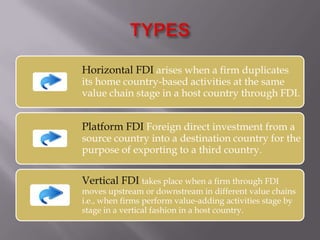
Horizontal FDI arises when a firm duplicates
its home country-based activities at the same
value chain stage in a host country through FDI.
Platform FDI Foreign direct investment from a
source country into a destination country for the
purpose of exporting to a third country.
Vertical FDI takes place when a firm through FDI
moves upstream or downstream in different value chains
i.e., when firms perform value-adding activities stage by
stage in a vertical fashion in a host country.
• Inflow of equipment and technology
• Competitive advantage & innovation
• Financial resources for expansion
• Employment generation
• Contribution to exports
Advantages
• Crowding of local industry.
• Conflicts of laws
• Effect on natural environment
• Loss of control
• Effect on local culture
The foreign direct investor may acquire voting power of an enterprise in an economy
through any of the following methods:
 by acquiring shares in an associated enterprise
 through a merger or an acquisition of an unrelated enterprise
 participating in an equity joint venture with another investor or
enterprise
 by incorporating a wholly owned subsidiary or company
anywhere
 Low corporate tax and individual income tax rates
 Tax holidays
 Other types of tax concessions
 Preferential tariffs
 Special economic zones
 Epz – export processing zones
 Bonded warehouses
 Maquiladoras
 Investment financial subsidies
 Soft loan or loan guarantees
 Free land or land subsidies
 Relocation & expatriation
 Infrastructure subsidies
 R&d support
 Derogation from regulations (usually for very large projects)
 Profitability: Attract where return on investment is
higher
 Costs of production: Encouraged by lower costs of
production like raw materials, labor .
 Economic Conditions: Market
potential, infrastructure, size of population, income
level etc
 Government policies: Policies like foreign
investment, foreign
collaboration, remittances, profits, taxation, foreign
exchange control, tariffs etc.
 Political factors: Political stability, nature of important
political parties and relations with other countries.
• We are the second highest producer of fruits and
vegetables in the world but still we are not able to utilize
is properly because of inadequate infrastructure
facilities.
• It will reduce pre-harvest wastage/losses and thus help
control food inflation.
• It will create 1.5 million more jobs in 5 years. Apart
from the huge number of indirect employment.
• It will increase competition which is always beneficial
for the customer.
• It will remove the middleman from the equation. It will
reduce costs which in turn will reduce prices.
• At least 10% of shares of Co; needed to qualify
as FDI.
• Mauritius has been the largest direct investor
in India.(US$20 billion)
• The United States is the second largest investor
in India.(US$6 billion)
• U.S is the worlds largest recipient of FDI.
By vishal rana
Contact-
Email- vishalrana2690@gmail.com
Twitter- @vishalrana2690
Facebook- www.facebook.com/vishal.rana.rana.vishal

FDI - foreign direct investment

  • 1.
    FDI is adirect investment into production or business in a country by an individual or company in another country, either by buying a company in the target country or by expanding operations of an existing business in that country. Foreign direct investment is in contrast to portfolio investment which is a passive investment in the securities of another country such as stocks and bonds.
  • 2.
    Horizontal FDI ariseswhen a firm duplicates its home country-based activities at the same value chain stage in a host country through FDI. Platform FDI Foreign direct investment from a source country into a destination country for the purpose of exporting to a third country. Vertical FDI takes place when a firm through FDI moves upstream or downstream in different value chains i.e., when firms perform value-adding activities stage by stage in a vertical fashion in a host country.
  • 3.
    • Inflow ofequipment and technology • Competitive advantage & innovation • Financial resources for expansion • Employment generation • Contribution to exports Advantages
  • 4.
    • Crowding oflocal industry. • Conflicts of laws • Effect on natural environment • Loss of control • Effect on local culture
  • 5.
    The foreign directinvestor may acquire voting power of an enterprise in an economy through any of the following methods:  by acquiring shares in an associated enterprise  through a merger or an acquisition of an unrelated enterprise  participating in an equity joint venture with another investor or enterprise  by incorporating a wholly owned subsidiary or company anywhere
  • 6.
     Low corporatetax and individual income tax rates  Tax holidays  Other types of tax concessions  Preferential tariffs  Special economic zones  Epz – export processing zones  Bonded warehouses  Maquiladoras  Investment financial subsidies  Soft loan or loan guarantees  Free land or land subsidies  Relocation & expatriation  Infrastructure subsidies  R&d support  Derogation from regulations (usually for very large projects)
  • 7.
     Profitability: Attractwhere return on investment is higher  Costs of production: Encouraged by lower costs of production like raw materials, labor .  Economic Conditions: Market potential, infrastructure, size of population, income level etc  Government policies: Policies like foreign investment, foreign collaboration, remittances, profits, taxation, foreign exchange control, tariffs etc.  Political factors: Political stability, nature of important political parties and relations with other countries.
  • 8.
    • We arethe second highest producer of fruits and vegetables in the world but still we are not able to utilize is properly because of inadequate infrastructure facilities. • It will reduce pre-harvest wastage/losses and thus help control food inflation. • It will create 1.5 million more jobs in 5 years. Apart from the huge number of indirect employment. • It will increase competition which is always beneficial for the customer. • It will remove the middleman from the equation. It will reduce costs which in turn will reduce prices.
  • 9.
    • At least10% of shares of Co; needed to qualify as FDI. • Mauritius has been the largest direct investor in India.(US$20 billion) • The United States is the second largest investor in India.(US$6 billion) • U.S is the worlds largest recipient of FDI.
  • 10.
    By vishal rana Contact- Email-vishalrana2690@gmail.com Twitter- @vishalrana2690 Facebook- www.facebook.com/vishal.rana.rana.vishal