A Case Study
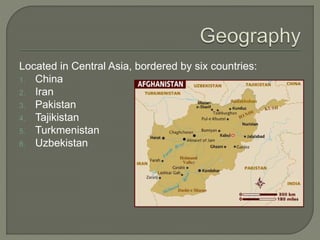
Located in Central Asia, bordered by six countries: 
1. China 
2. Iran 
3. Pakistan 
4. Tajikistan 
5. Turkmenistan 
6. Uzbekistan
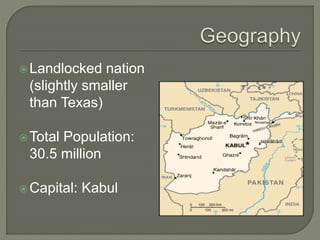
Landlocked nation 
(slightly smaller 
than Texas) 
Total Population: 
30.5 million 
Capital: Kabul
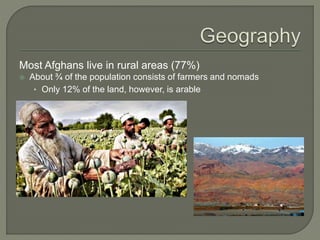
Most Afghans live in rural areas (77%) 
 About ¾ of the population consists of farmers and nomads 
• Only 12% of the land, however, is arable
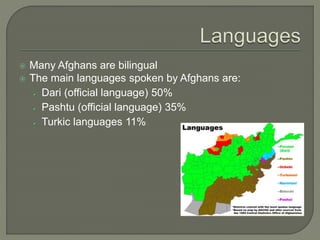
 Many Afghans are bilingual 
 The main languages spoken by Afghans are: 
Dari (official language) 50% 
Pashtu (official language) 35% 
Turkic languages 11%
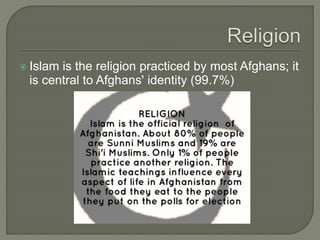
 Islam is the religion practiced by most Afghans; it 
is central to Afghans' identity (99.7%)
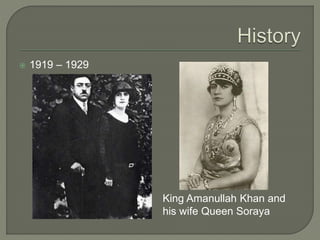
King Amanullah Khan and 
his wife Queen Soraya 
 1919 – 1929
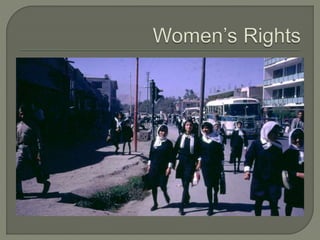
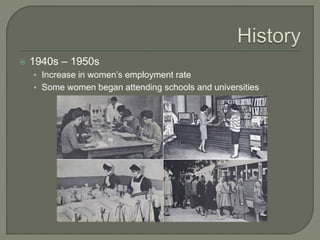
 1940s – 1950s 
• Increase in women’s employment rate 
• Some women began attending schools and universities
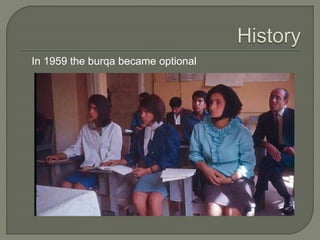
In 1959 the burqa became optional
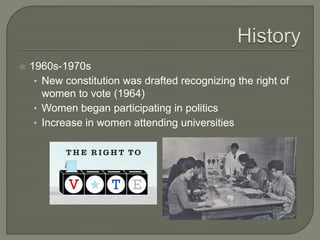
 1960s-1970s 
• New constitution was drafted recognizing the right of 
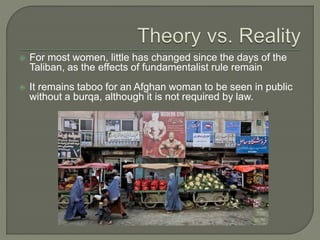
women to vote (1964) 
• Women began participating in politics 
• Increase in women attending universities
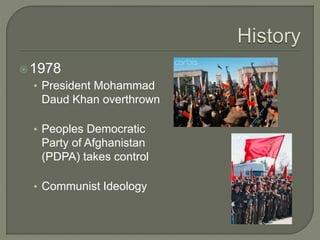
1978 
• President Mohammad 
Daud Khan overthrown 
• Peoples Democratic 
Party of Afghanistan 
(PDPA) takes control 
• Communist Ideology
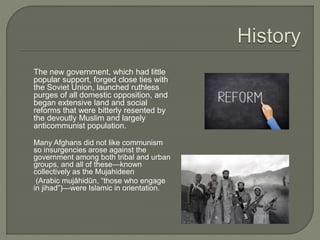
The new government, which had little 
popular support, forged close ties with 
the Soviet Union, launched ruthless 
purges of all domestic opposition, and 
began extensive land and social 
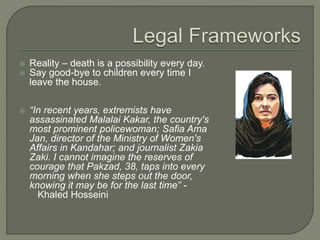
reforms that were bitterly resented by 
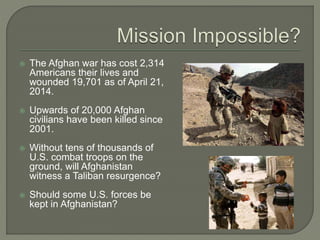
the devoutly Muslim and largely 
anticommunist population. 
Many Afghans did not like communism 
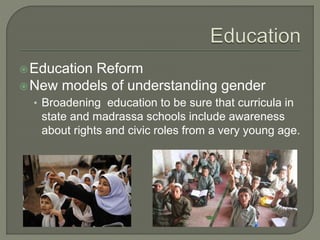
so insurgencies arose against the 
government among both tribal and urban 
groups, and all of these—known 
collectively as the Mujahideen 
(Arabic mujāhidūn, “those who engage 
in jihad”)—were Islamic in orientation.
1979-1992 
• Soviet Union invades Afghanistan 
with hope of spreading communism 
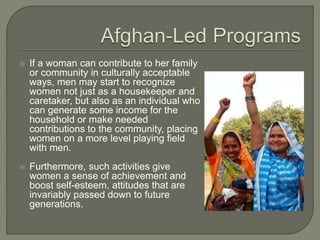
(1979) 
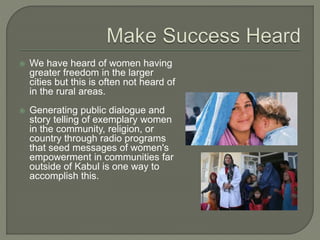
 Upon taking power, the Soviet Communist 
government introduced a program of 
reforms designed to: 
• Abolish feudal power in the 
countryside, 
• Guarantee freedom of religion 
• Guarantee equal rights for women and 
ethnic minorities 
• Improve literacy rate of men and 
women of Afghanistan 
• Improve healthcare in rural areas
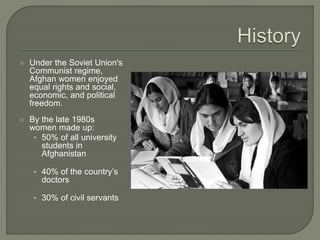
 Under the Soviet Union's 
Communist regime, 
Afghan women enjoyed 
equal rights and social, 
economic, and political 
freedom. 
 By the late 1980s 
women made up: 
• 50% of all university 
students in 
Afghanistan 
• 40% of the country’s 
doctors 
• 30% of civil servants
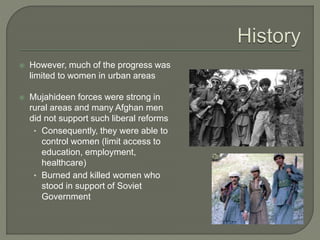
 However, much of the progress was 
limited to women in urban areas 
 Mujahideen forces were strong in 
rural areas and many Afghan men 
did not support such liberal reforms 
• Consequently, they were able to 
control women (limit access to 
education, employment, 
healthcare) 
• Burned and killed women who 
stood in support of Soviet 
Government
1989-1992 
• Mujahideen forces received funds from USA, 
Saudi Arabia and Pakistan to overthrow Soviet 
Union. As a result, forces grew even stronger. 
• In 1989 Soviet Union withdrew, but civil war 
erupted among factions of guerilla fighters 
known as ‘Mujahideen’ 
• In 1992 the Communist regime fell and 
Mujahideen Government took control.
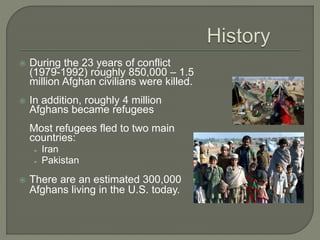
 During the 23 years of conflict 
(1979-1992) roughly 850,000 – 1.5 
million Afghan civilians were killed. 
 In addition, roughly 4 million 
Afghans became refugees 
Most refugees fled to two main 
countries: 
➢ Iran 
➢ Pakistan 
 There are an estimated 300,000 
Afghans living in the U.S. today.
1992-1996 
 When the Mujahideen took power in 1992, they forced all 
women to follow the Islamic dress code, including wearing 
veils. 
 Women’s movement was restricted; consequently 
employment and education for women declined; access to 
medical care was limited. 
 During the bloody four-year civil war, women often were 
kidnapped, raped and killed by men from other ethnicities.
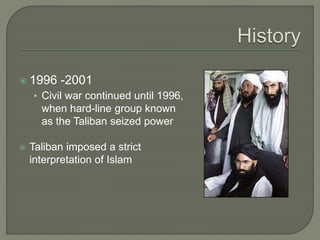
 1996 -2001 
• Civil war continued until 1996, 
when hard-line group known 
as the Taliban seized power 
 Taliban imposed a strict 
interpretation of Islam
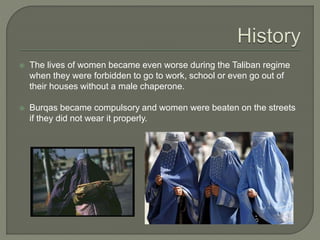
 The lives of women became even worse during the Taliban regime 
when they were forbidden to go to work, school or even go out of 
their houses without a male chaperone. 
 Burqas became compulsory and women were beaten on the streets 
if they did not wear it properly.
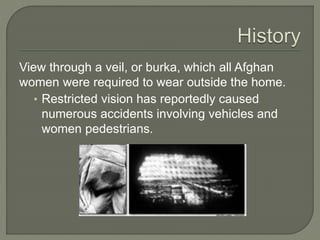
View through a veil, or burka, which all Afghan 
women were required to wear outside the home. 
• Restricted vision has reportedly caused 
numerous accidents involving vehicles and 
women pedestrians.
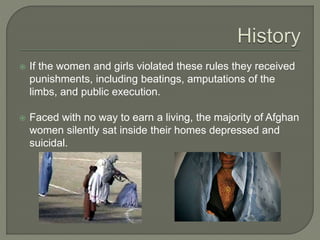
 If the women and girls violated these rules they received 
punishments, including beatings, amputations of the 
limbs, and public execution. 
 Faced with no way to earn a living, the majority of Afghan 
women silently sat inside their homes depressed and 
suicidal.
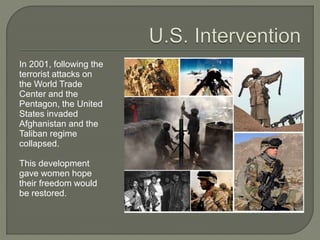
In 2001, following the 
terrorist attacks on 
the World Trade 
Center and the 
Pentagon, the United 
States invaded 
Afghanistan and the 
Taliban regime 
collapsed. 
This development 
gave women hope 
their freedom would 
be restored.
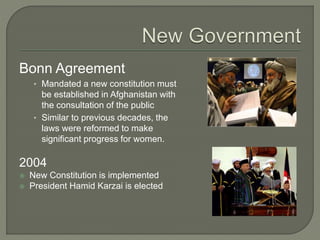
Bonn Agreement 
• Mandated a new constitution must 
be established in Afghanistan with 
the consultation of the public 
• Similar to previous decades, the 
laws were reformed to make 
significant progress for women. 
2004 
 New Constitution is implemented 
 President Hamid Karzai is elected
 Article 22 states, “The citizens of Afghanistan 
– whether man or woman—have equal rights 
and duties before the law.” 
 Article 44 states, “The state shall devise and 
implement effective programs for balancing 
and promoting of education for women, 
improving of education of nomads and 
elimination of illiteracy in the country.”
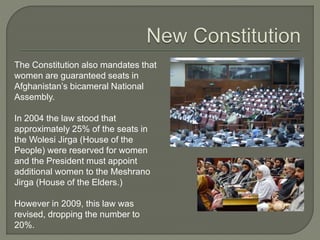
The Constitution also mandates that 
women are guaranteed seats in 
Afghanistan’s bicameral National 
Assembly. 
In 2004 the law stood that 
approximately 25% of the seats in 
the Wolesi Jirga (House of the 
People) were reserved for women 
and the President must appoint 
additional women to the Meshrano 
Jirga (House of the Elders.) 
However in 2009, this law was 
revised, dropping the number to 
20%.
International Law 
 The Constitution obliges the government "to create a 
prosperous and progressive society based on social 
justice," and to "protect human rights," expressly 
requiring the state to "abide by the U.N. charter, 
international treaties, international conventions that 
Afghanistan has signed, and the Universal 
Declaration of Human Rights."
Afghanistan is a party to the following 
human rights treaties and covenants: 
• ICCPR –1983 
• ICESCR – 1983 
• Convention Against Torture-1987 
• Convention of the Rights of the Child- 2003 
• CEDAW- 2003 
• International Convention of the Elimination of all 
Forms of Racial Discrimination Against Women- 
2003
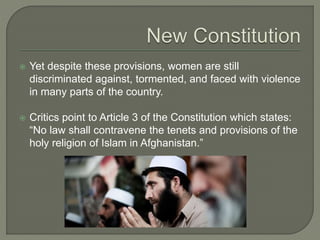
 Yet despite these provisions, women are still 
discriminated against, tormented, and faced with violence 
in many parts of the country. 
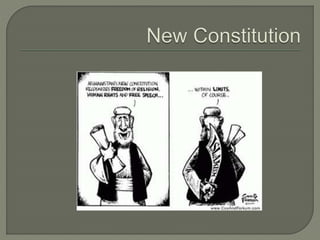
 Critics point to Article 3 of the Constitution which states: 
“No law shall contravene the tenets and provisions of the 
holy religion of Islam in Afghanistan.”
 http://vimeo.com/60319802 (2013)
 For most women, little has changed since the days of the 
Taliban, as the effects of fundamentalist rule remain 
 It remains taboo for an Afghan woman to be seen in public 
without a burqa, although it is not required by law.
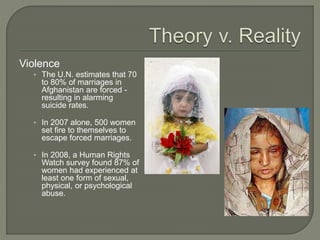
Violence 
• The U.N. estimates that 70 
to 80% of marriages in 
Afghanistan are forced - 
resulting in alarming 
suicide rates. 
• In 2007 alone, 500 women 
set fire to themselves to 
escape forced marriages. 
• In 2008, a Human Rights 
Watch survey found 87% of 
women had experienced at 
least one form of sexual, 
physical, or psychological 
abuse.
The Afghan government recently changed the legal age for 
marriage for girls from 16 to 17. 
• Men who want to marry girls under 17 are not entitled to 
obtain a marriage certificate, although many men simply 
do not bother with officially registering their marriages. 
• However, it seems that fewer girls are getting married. 
Self-immolation (setting oneself on fire) has decreased from 
350 cases per year in Herat province to 70 cases per year after 
a government education campaign.
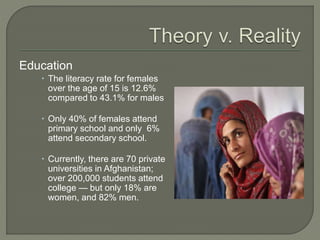
Education 
 The literacy rate for females 
over the age of 15 is 12.6% 
compared to 43.1% for males 
 Only 40% of females attend 
primary school and only 6% 
attend secondary school. 
 Currently, there are 70 private 
universities in Afghanistan; 
over 200,000 students attend 
college — but only 18% are 
women, and 82% men.
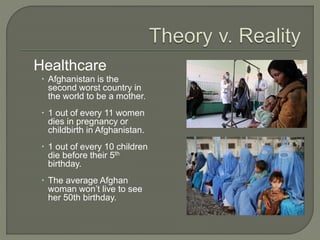
Healthcare 
 Afghanistan is the 
second worst country in 
the world to be a mother. 
 1 out of every 11 women 
dies in pregnancy or 
childbirth in Afghanistan. 
 1 out of every 10 children 
die before their 5th 
birthday. 
 The average Afghan 
woman won’t live to see 
her 50th birthday.
Employment 
• Women can be employed, but only if their male 
relatives permit it.
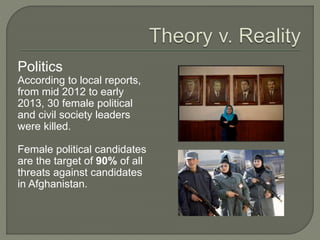
Politics 
According to local reports, 
from mid 2012 to early 
2013, 30 female political 
and civil society leaders 
were killed. 
Female political candidates 
are the target of 90% of all 
threats against candidates 
in Afghanistan.
Prisoners of Tradition (2013) 
• http://youtu.be/W0Q9n4gmJrY?t=50s
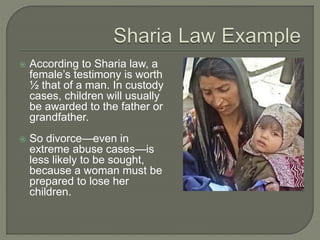
 According to Sharia law, a 
female’s testimony is worth 
½ that of a man. In custody 
cases, children will usually 
be awarded to the father or 
grandfather. 
 So divorce—even in 
extreme abuse cases—is 
less likely to be sought, 
because a woman must be 
prepared to lose her 
children.
Problems 
Mistrust of judicial system 
• Corrupt, disconnected 
Judges are not educated in Afghan law 
• Base decisions on personal interpretation of Islam 
(Sharia law) 
Afghans are unaware of the correct law 
• Misinformed 
• Do not know about laws due to the lack of 
education/numerous regime changes
Afghan Law or Islamic Law? 
• http://youtu.be/W0Q9n4gmJrY?t=3m30s 
• Background: Sohelia is in prison for refusing to 
marry an older man that her father had chosen for 
her. She ran away and married her lover and was 
sentenced to prison for 6 years.
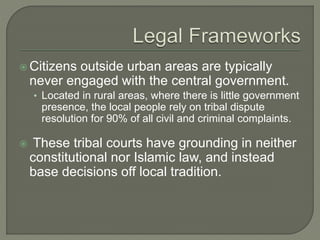
Citizens outside urban areas are typically 
never engaged with the central government. 
• Located in rural areas, where there is little government 
presence, the local people rely on tribal dispute 
resolution for 90% of all civil and criminal complaints. 
 These tribal courts have grounding in neither 
constitutional nor Islamic law, and instead 
base decisions off local tradition.
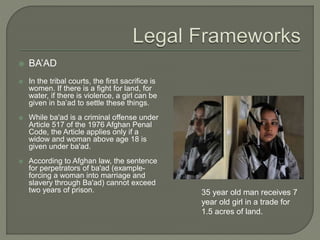
 BA’AD 
 In the tribal courts, the first sacrifice is 
women. If there is a fight for land, for 
water, if there is violence, a girl can be 
given in ba’ad to settle these things. 
 While ba'ad is a criminal offense under 
Article 517 of the 1976 Afghan Penal 
Code, the Article applies only if a 
widow and woman above age 18 is 
given under ba'ad. 
 According to Afghan law, the sentence 
for perpetrators of ba'ad (example-forcing 
a woman into marriage and 
slavery through Ba'ad) cannot exceed 
two years of prison. 35 year old man receives 7 
year old girl in a trade for 
1.5 acres of land.
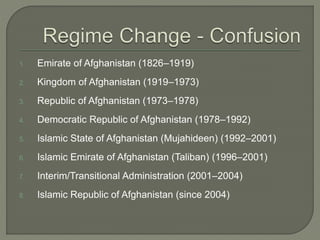
1. Emirate of Afghanistan (1826–1919) 
2. Kingdom of Afghanistan (1919–1973) 
3. Republic of Afghanistan (1973–1978) 
4. Democratic Republic of Afghanistan (1978–1992) 
5. Islamic State of Afghanistan (Mujahideen) (1992–2001) 
6. Islamic Emirate of Afghanistan (Taliban) (1996–2001) 
7. Interim/Transitional Administration (2001–2004) 
8. Islamic Republic of Afghanistan (since 2004)
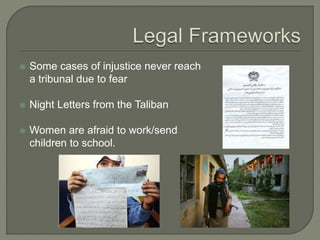
 Some cases of injustice never reach 
a tribunal due to fear 
 Night Letters from the Taliban 
 Women are afraid to work/send 
children to school.
 Reality – death is a possibility every day. 
 Say good-bye to children every time I 
leave the house. 
 “In recent years, extremists have 
assassinated Malalai Kakar, the country's 
most prominent policewoman; Safia Ama 
Jan, director of the Ministry of Women's 
Affairs in Kandahar; and journalist Zakia 
Zaki. I cannot imagine the reserves of 
courage that Pakzad, 38, taps into every 
morning when she steps out the door, 
knowing it may be for the last time” - 
Khaled Hosseini
 The Afghan war has cost 2,314 
Americans their lives and 
wounded 19,701 as of April 21, 
2014. 
 Upwards of 20,000 Afghan 
civilians have been killed since 
2001. 
 Without tens of thousands of 
U.S. combat troops on the 
ground, will Afghanistan 
witness a Taliban resurgence? 
 Should some U.S. forces be 
kept in Afghanistan?
 Obama in May of 2014- ““We have to recognize 
Afghanistan will not be a perfect place, and it is not 
America’s responsibility to make it one,” he said. “The 
future of Afghanistan must be decided by Afghans.”
Suggestions for future success 
• Education Reform 
• Access to Legal Recourse 
• Political Participation
Education Reform 
New models of understanding gender 
• Broadening education to be sure that curricula in 
state and madrassa schools include awareness 
about rights and civic roles from a very young age.
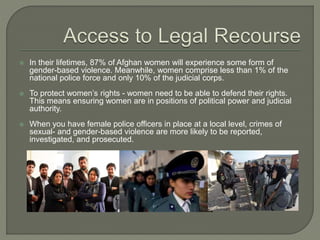
 In their lifetimes, 87% of Afghan women will experience some form of 
gender-based violence. Meanwhile, women comprise less than 1% of the 
national police force and only 10% of the judicial corps. 
 To protect women’s rights - women need to be able to defend their rights. 
This means ensuring women are in positions of political power and judicial 
authority. 
 When you have female police officers in place at a local level, crimes of 
sexual- and gender-based violence are more likely to be reported, 
investigated, and prosecuted.
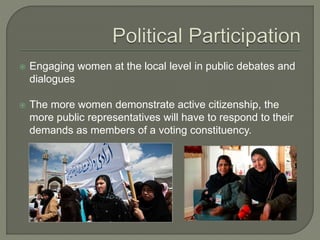
 Engaging women at the local level in public debates and 
dialogues 
 The more women demonstrate active citizenship, the 
more public representatives will have to respond to their 
demands as members of a voting constituency.
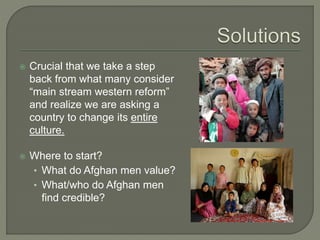
 Crucial that we take a step 
back from what many consider 
“main stream western reform” 
and realize we are asking a 
country to change its entire 
culture. 
 Where to start? 
• What do Afghan men value? 
• What/who do Afghan men 
find credible?
 Those who use ‘culture’ or ‘religion’ to justify acts of violence 
against women usually do so on the grounds that their 
interpretation represents the one ‘true’ or ‘authentic’ vision, 
while simultaneously marginalizing alternatives. 
 Discrimination and violence against women is thus rooted in 
the domineering, and patriarchal interpretation and not the 
inherent nature of that religion or culture itself. 
 Accordingly, it is crucial to demystify the concepts of ‘culture’ 
and ‘religion’, exposing the vested interests of those who 
claim to represent ‘authenticity’, and bring to light alternative 
visions in order to protect women’s human rights.
 Islamic law is viewed as more credible at the 
community level and as more progressive 
with regards to women’s rights than most 
customary norms and practices. 
 Greater assessment of how Islamic legal 
literacy, scholarship, and dialogue might help 
protect women’s rights in the coming difficult 
period is crucial to increasing the acceptance 
of these rights and therefore their 
sustainability.
 “The majority of Afghan men I have spoken to 
about this do not oppose the idea of their 
wife, sister, or daughter working outside the 
home or pursuing further education; rather, 
their opposition to it in practice comes from a 
fear of how others in their community or 
extended family may judge them. Breaking a 
cultural taboo sparks a plague of gossip that 
has the potential to destroy a family's 
reputation, particularly when it concerns the 
integrity of women, who represent a family's 
honor.” – Reporter in Afghanistan
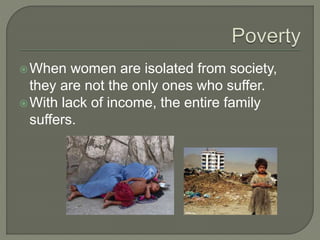
When women are isolated from society, 
they are not the only ones who suffer. 
With lack of income, the entire family 
suffers.
 If a woman can contribute to her family 
or community in culturally acceptable 
ways, men may start to recognize 
women not just as a housekeeper and 
caretaker, but also as an individual who 
can generate some income for the 
household or make needed 
contributions to the community, placing 
women on a more level playing field 
with men. 
 Furthermore, such activities give 
women a sense of achievement and 
boost self-esteem, attitudes that are 
invariably passed down to future 
generations.
 We have heard of women having 
greater freedom in the larger 
cities but this is often not heard of 
in the rural areas. 
 Generating public dialogue and 
story telling of exemplary women 
in the community, religion, or 
country through radio programs 
that seed messages of women's 
empowerment in communities far 
outside of Kabul is one way to 
accomplish this.
 http://vimeo.com/90779690

Women in Afghanistan

  • 1.
  • 2.
    Located in CentralAsia, bordered by six countries: 1. China 2. Iran 3. Pakistan 4. Tajikistan 5. Turkmenistan 6. Uzbekistan
  • 3.
    Landlocked nation (slightlysmaller than Texas) Total Population: 30.5 million Capital: Kabul
  • 4.
    Most Afghans livein rural areas (77%)  About ¾ of the population consists of farmers and nomads • Only 12% of the land, however, is arable
  • 5.
     Many Afghansare bilingual  The main languages spoken by Afghans are: Dari (official language) 50% Pashtu (official language) 35% Turkic languages 11%
  • 6.
     Islam isthe religion practiced by most Afghans; it is central to Afghans' identity (99.7%)
  • 8.
    King Amanullah Khanand his wife Queen Soraya  1919 – 1929
  • 9.
     1940s –1950s • Increase in women’s employment rate • Some women began attending schools and universities
  • 10.
    In 1959 theburqa became optional
  • 11.
     1960s-1970s •New constitution was drafted recognizing the right of women to vote (1964) • Women began participating in politics • Increase in women attending universities
  • 12.
    1978 • PresidentMohammad Daud Khan overthrown • Peoples Democratic Party of Afghanistan (PDPA) takes control • Communist Ideology
  • 13.
    The new government,which had little popular support, forged close ties with the Soviet Union, launched ruthless purges of all domestic opposition, and began extensive land and social reforms that were bitterly resented by the devoutly Muslim and largely anticommunist population. Many Afghans did not like communism so insurgencies arose against the government among both tribal and urban groups, and all of these—known collectively as the Mujahideen (Arabic mujāhidūn, “those who engage in jihad”)—were Islamic in orientation.
  • 14.
    1979-1992 • SovietUnion invades Afghanistan with hope of spreading communism (1979)  Upon taking power, the Soviet Communist government introduced a program of reforms designed to: • Abolish feudal power in the countryside, • Guarantee freedom of religion • Guarantee equal rights for women and ethnic minorities • Improve literacy rate of men and women of Afghanistan • Improve healthcare in rural areas
  • 15.
     Under theSoviet Union's Communist regime, Afghan women enjoyed equal rights and social, economic, and political freedom.  By the late 1980s women made up: • 50% of all university students in Afghanistan • 40% of the country’s doctors • 30% of civil servants
  • 16.
     However, muchof the progress was limited to women in urban areas  Mujahideen forces were strong in rural areas and many Afghan men did not support such liberal reforms • Consequently, they were able to control women (limit access to education, employment, healthcare) • Burned and killed women who stood in support of Soviet Government
  • 17.
    1989-1992 • Mujahideenforces received funds from USA, Saudi Arabia and Pakistan to overthrow Soviet Union. As a result, forces grew even stronger. • In 1989 Soviet Union withdrew, but civil war erupted among factions of guerilla fighters known as ‘Mujahideen’ • In 1992 the Communist regime fell and Mujahideen Government took control.
  • 18.
     During the23 years of conflict (1979-1992) roughly 850,000 – 1.5 million Afghan civilians were killed.  In addition, roughly 4 million Afghans became refugees Most refugees fled to two main countries: ➢ Iran ➢ Pakistan  There are an estimated 300,000 Afghans living in the U.S. today.
  • 19.
    1992-1996  Whenthe Mujahideen took power in 1992, they forced all women to follow the Islamic dress code, including wearing veils.  Women’s movement was restricted; consequently employment and education for women declined; access to medical care was limited.  During the bloody four-year civil war, women often were kidnapped, raped and killed by men from other ethnicities.
  • 20.
     1996 -2001 • Civil war continued until 1996, when hard-line group known as the Taliban seized power  Taliban imposed a strict interpretation of Islam
  • 21.
     The livesof women became even worse during the Taliban regime when they were forbidden to go to work, school or even go out of their houses without a male chaperone.  Burqas became compulsory and women were beaten on the streets if they did not wear it properly.
  • 22.
    View through aveil, or burka, which all Afghan women were required to wear outside the home. • Restricted vision has reportedly caused numerous accidents involving vehicles and women pedestrians.
  • 23.
     If thewomen and girls violated these rules they received punishments, including beatings, amputations of the limbs, and public execution.  Faced with no way to earn a living, the majority of Afghan women silently sat inside their homes depressed and suicidal.
  • 24.
    In 2001, followingthe terrorist attacks on the World Trade Center and the Pentagon, the United States invaded Afghanistan and the Taliban regime collapsed. This development gave women hope their freedom would be restored.
  • 25.
    Bonn Agreement •Mandated a new constitution must be established in Afghanistan with the consultation of the public • Similar to previous decades, the laws were reformed to make significant progress for women. 2004  New Constitution is implemented  President Hamid Karzai is elected
  • 26.
     Article 22states, “The citizens of Afghanistan – whether man or woman—have equal rights and duties before the law.”  Article 44 states, “The state shall devise and implement effective programs for balancing and promoting of education for women, improving of education of nomads and elimination of illiteracy in the country.”
  • 27.
    The Constitution alsomandates that women are guaranteed seats in Afghanistan’s bicameral National Assembly. In 2004 the law stood that approximately 25% of the seats in the Wolesi Jirga (House of the People) were reserved for women and the President must appoint additional women to the Meshrano Jirga (House of the Elders.) However in 2009, this law was revised, dropping the number to 20%.
  • 28.
    International Law The Constitution obliges the government "to create a prosperous and progressive society based on social justice," and to "protect human rights," expressly requiring the state to "abide by the U.N. charter, international treaties, international conventions that Afghanistan has signed, and the Universal Declaration of Human Rights."
  • 29.
    Afghanistan is aparty to the following human rights treaties and covenants: • ICCPR –1983 • ICESCR – 1983 • Convention Against Torture-1987 • Convention of the Rights of the Child- 2003 • CEDAW- 2003 • International Convention of the Elimination of all Forms of Racial Discrimination Against Women- 2003
  • 30.
     Yet despitethese provisions, women are still discriminated against, tormented, and faced with violence in many parts of the country.  Critics point to Article 3 of the Constitution which states: “No law shall contravene the tenets and provisions of the holy religion of Islam in Afghanistan.”
  • 32.
  • 33.
     For mostwomen, little has changed since the days of the Taliban, as the effects of fundamentalist rule remain  It remains taboo for an Afghan woman to be seen in public without a burqa, although it is not required by law.
  • 34.
    Violence • TheU.N. estimates that 70 to 80% of marriages in Afghanistan are forced - resulting in alarming suicide rates. • In 2007 alone, 500 women set fire to themselves to escape forced marriages. • In 2008, a Human Rights Watch survey found 87% of women had experienced at least one form of sexual, physical, or psychological abuse.
  • 35.
    The Afghan governmentrecently changed the legal age for marriage for girls from 16 to 17. • Men who want to marry girls under 17 are not entitled to obtain a marriage certificate, although many men simply do not bother with officially registering their marriages. • However, it seems that fewer girls are getting married. Self-immolation (setting oneself on fire) has decreased from 350 cases per year in Herat province to 70 cases per year after a government education campaign.
  • 36.
    Education  Theliteracy rate for females over the age of 15 is 12.6% compared to 43.1% for males  Only 40% of females attend primary school and only 6% attend secondary school.  Currently, there are 70 private universities in Afghanistan; over 200,000 students attend college — but only 18% are women, and 82% men.
  • 37.
    Healthcare  Afghanistanis the second worst country in the world to be a mother.  1 out of every 11 women dies in pregnancy or childbirth in Afghanistan.  1 out of every 10 children die before their 5th birthday.  The average Afghan woman won’t live to see her 50th birthday.
  • 38.
    Employment • Womencan be employed, but only if their male relatives permit it.
  • 39.
    Politics According tolocal reports, from mid 2012 to early 2013, 30 female political and civil society leaders were killed. Female political candidates are the target of 90% of all threats against candidates in Afghanistan.
  • 40.
    Prisoners of Tradition(2013) • http://youtu.be/W0Q9n4gmJrY?t=50s
  • 41.
     According toSharia law, a female’s testimony is worth ½ that of a man. In custody cases, children will usually be awarded to the father or grandfather.  So divorce—even in extreme abuse cases—is less likely to be sought, because a woman must be prepared to lose her children.
  • 42.
    Problems Mistrust ofjudicial system • Corrupt, disconnected Judges are not educated in Afghan law • Base decisions on personal interpretation of Islam (Sharia law) Afghans are unaware of the correct law • Misinformed • Do not know about laws due to the lack of education/numerous regime changes
  • 43.
    Afghan Law orIslamic Law? • http://youtu.be/W0Q9n4gmJrY?t=3m30s • Background: Sohelia is in prison for refusing to marry an older man that her father had chosen for her. She ran away and married her lover and was sentenced to prison for 6 years.
  • 44.
    Citizens outside urbanareas are typically never engaged with the central government. • Located in rural areas, where there is little government presence, the local people rely on tribal dispute resolution for 90% of all civil and criminal complaints.  These tribal courts have grounding in neither constitutional nor Islamic law, and instead base decisions off local tradition.
  • 45.
     BA’AD In the tribal courts, the first sacrifice is women. If there is a fight for land, for water, if there is violence, a girl can be given in ba’ad to settle these things.  While ba'ad is a criminal offense under Article 517 of the 1976 Afghan Penal Code, the Article applies only if a widow and woman above age 18 is given under ba'ad.  According to Afghan law, the sentence for perpetrators of ba'ad (example-forcing a woman into marriage and slavery through Ba'ad) cannot exceed two years of prison. 35 year old man receives 7 year old girl in a trade for 1.5 acres of land.
  • 46.
    1. Emirate ofAfghanistan (1826–1919) 2. Kingdom of Afghanistan (1919–1973) 3. Republic of Afghanistan (1973–1978) 4. Democratic Republic of Afghanistan (1978–1992) 5. Islamic State of Afghanistan (Mujahideen) (1992–2001) 6. Islamic Emirate of Afghanistan (Taliban) (1996–2001) 7. Interim/Transitional Administration (2001–2004) 8. Islamic Republic of Afghanistan (since 2004)
  • 47.
     Some casesof injustice never reach a tribunal due to fear  Night Letters from the Taliban  Women are afraid to work/send children to school.
  • 48.
     Reality –death is a possibility every day.  Say good-bye to children every time I leave the house.  “In recent years, extremists have assassinated Malalai Kakar, the country's most prominent policewoman; Safia Ama Jan, director of the Ministry of Women's Affairs in Kandahar; and journalist Zakia Zaki. I cannot imagine the reserves of courage that Pakzad, 38, taps into every morning when she steps out the door, knowing it may be for the last time” - Khaled Hosseini
  • 49.
     The Afghanwar has cost 2,314 Americans their lives and wounded 19,701 as of April 21, 2014.  Upwards of 20,000 Afghan civilians have been killed since 2001.  Without tens of thousands of U.S. combat troops on the ground, will Afghanistan witness a Taliban resurgence?  Should some U.S. forces be kept in Afghanistan?
  • 50.
     Obama inMay of 2014- ““We have to recognize Afghanistan will not be a perfect place, and it is not America’s responsibility to make it one,” he said. “The future of Afghanistan must be decided by Afghans.”
  • 51.
    Suggestions for futuresuccess • Education Reform • Access to Legal Recourse • Political Participation
  • 52.
    Education Reform Newmodels of understanding gender • Broadening education to be sure that curricula in state and madrassa schools include awareness about rights and civic roles from a very young age.
  • 53.
     In theirlifetimes, 87% of Afghan women will experience some form of gender-based violence. Meanwhile, women comprise less than 1% of the national police force and only 10% of the judicial corps.  To protect women’s rights - women need to be able to defend their rights. This means ensuring women are in positions of political power and judicial authority.  When you have female police officers in place at a local level, crimes of sexual- and gender-based violence are more likely to be reported, investigated, and prosecuted.
  • 54.
     Engaging womenat the local level in public debates and dialogues  The more women demonstrate active citizenship, the more public representatives will have to respond to their demands as members of a voting constituency.
  • 56.
     Crucial thatwe take a step back from what many consider “main stream western reform” and realize we are asking a country to change its entire culture.  Where to start? • What do Afghan men value? • What/who do Afghan men find credible?
  • 57.
     Those whouse ‘culture’ or ‘religion’ to justify acts of violence against women usually do so on the grounds that their interpretation represents the one ‘true’ or ‘authentic’ vision, while simultaneously marginalizing alternatives.  Discrimination and violence against women is thus rooted in the domineering, and patriarchal interpretation and not the inherent nature of that religion or culture itself.  Accordingly, it is crucial to demystify the concepts of ‘culture’ and ‘religion’, exposing the vested interests of those who claim to represent ‘authenticity’, and bring to light alternative visions in order to protect women’s human rights.
  • 58.
     Islamic lawis viewed as more credible at the community level and as more progressive with regards to women’s rights than most customary norms and practices.  Greater assessment of how Islamic legal literacy, scholarship, and dialogue might help protect women’s rights in the coming difficult period is crucial to increasing the acceptance of these rights and therefore their sustainability.
  • 59.
     “The majorityof Afghan men I have spoken to about this do not oppose the idea of their wife, sister, or daughter working outside the home or pursuing further education; rather, their opposition to it in practice comes from a fear of how others in their community or extended family may judge them. Breaking a cultural taboo sparks a plague of gossip that has the potential to destroy a family's reputation, particularly when it concerns the integrity of women, who represent a family's honor.” – Reporter in Afghanistan
  • 60.
    When women areisolated from society, they are not the only ones who suffer. With lack of income, the entire family suffers.
  • 61.
     If awoman can contribute to her family or community in culturally acceptable ways, men may start to recognize women not just as a housekeeper and caretaker, but also as an individual who can generate some income for the household or make needed contributions to the community, placing women on a more level playing field with men.  Furthermore, such activities give women a sense of achievement and boost self-esteem, attitudes that are invariably passed down to future generations.
  • 62.
     We haveheard of women having greater freedom in the larger cities but this is often not heard of in the rural areas.  Generating public dialogue and story telling of exemplary women in the community, religion, or country through radio programs that seed messages of women's empowerment in communities far outside of Kabul is one way to accomplish this.
  • 63.

Editor's Notes

  • #4 Landlocked Country: Making the export of goods difficult and expensive Climate: Cold winters and hot summers Terrain: rugged mountains and plains
  • #7 80% Sunni Muslim 19% Shi’I Muslim 1% practice other religion
  • #8 Anyone have a guess when this photo was taken? 1960s Unknown to many, myself included, Afghan women once enjoyed very similar freedoms to that of U.S. women
  • #9 In the early 1900s, under the rule of King Amanullah Khan, child marriages were banned and universal education for boys and girls was encouraged. Queen Soraya, was his wife- was an Afghan woman who appeared without a veil in public bringing change in the lives of other women. She also established the first magazine for women.
  • #10 Sake of time – skipping naming the different kings-- but just note there was a change. Regardless under the new king, the government continued to advance human rights. Increase in employment rate + school
  • #11 Another photo of women in school Note in 1959 the burqa became optional
  • #13 In 1983 - A republic was attempted to be formed. a form of government in which power resides in the people,[1] and the government is ruled by elected leaders run according to law, rather than inherited or appointed (such as through inheritance or divine mandate). In April 1978 Afghanistan’s centrist government, headed by Pres. Mohammad Daud Khan, was overthrown by left-wing military officers led by Nur Mohammad Taraki. Power was thereafter shared by two a Marxist-Leninist political groups, known as the Peoples Democratic Party of Afghanistan, who had close ties with the Soviet Union. In 1978, a communist group known as the People's Democratic Party of Afghanistan (PDPA), launched a revolt overthrowing and killing then-President Mohammed Daoud Khan. The PDPA, composed of young, recently urbanized, detribalized people, sought to transform the entire country of Afghanistan into a modern socialist state. While the PDPA attempted to reform marriage laws, women's health laws, and encouraged education for women throughout Afghanistan, the reforms were accompanied by brutal violence, killing anyone the regime considered as potential opponents. Consequently, scores of innocent men and women, including leaders of religious groups and professionals of every kind, were murdered. This repression sparked uprisings throughout the country and mutinies within the Afghan army threatened to destabilize the regime. In 1979 the Soviet Union invaded Afghanistan to replace the existing communist government. Under the Soviet Union's Communist regime from 1979 to 1992, Afghan women enjoyed equal rights and social, economic, and political freedom. While women held a greater number of business, law enforcement, and Parliament positions than ever before, the brutal violence accompanying such reforms between the Communist regime and citizens of Afghanistan who opposed such reforms continued.
  • #14 While the PDPA attempted to reform marriage laws, women's health laws, and encouraged education for women throughout Afghanistan, the reforms were accompanied by brutal violence, killing anyone the regime considered as potential opponents. Consequently, scores of innocent men and women, including leaders of religious groups and professionals of every kind, were murdered. This repression sparked uprisings throughout the country and mutinies within the Afghan army threatened to destabilize the regime. The Muslims living in Afghanistan were extremely conservative and religious, thus opposed Marxist teachings. Secondly, when the socialist government was set up in Afghanistan in 1978, social reforms were issued that directed conflicted with Muslim culture. For example, women, who in Islamic teachings are inferior to men, were given equal rights as men. Dress and the education system were also "westernized" causing upset in the conservative Muslims.
  • #15   In 1979 the Soviet Union invaded Afghanistan to replace the existing communist government.   Under the Soviet Union's Communist regime from 1979 to 1992, Afghan women enjoyed equal rights and social, economic, and political freedom. While women held a greater number of business, law enforcement, and Parliament positions than ever before, the brutal violence accompanying such reforms between the Communist regime and citizens of Afghanistan who opposed such reforms continued.
  • #16 Tduring this time Women studied agriculture, engineering and business at the city’s university. Women drove cars, traveled and went on dates. Fifty percent of university students were women.
  • #17 Able to control
  • #19 850,000 – 1.5 million civillian deaths
  • #20 In some parts of Afghanistan, the mujahedeen killed unveiled women during the Communist regime.
  • #21  Taliban- whose name means 'students of religion' in the language of the Pathan tribe.
  • #22 The lives of women became even worse during the Taliban regime when they were forbidden to go to work, school or even go out of their houses without a male chaperone. Burqas became compulsory and women were beaten on the streets if they did not wear it properly or wore attractive clothes under the burqa. White was also forbidden because it was the color of the Taliban’s flag. Women who wore white shoes or high heels were lashed by the Taliban because white or high-heeled shoes were considered attractive to men. Women were forced to stay home and the men were told to paint the windows at the house so that other men could not see the women inside.
  • #23 Women were instructed to cloak themselves in the burqa from head to toe.
  • #24 Photo- public execution which we watched earlier in class Photo 2- woman who burned herself, attempting to commit suicide because she was so unhappy
  • #25  Al-Qaeda, a terrorist network operating within Afghanistan and other places, did Many Afghans expressed their solidarity with the people of the U.S. after Sept. 11 After September 11, the U.S. invaded Afghanistan and toppled the Taliban for sheltering Osama bin Laden U.S. and NATO forces remain in Afghanistan today
  • #26 In December 2001, Afghan representatives met with U.S. allies in Bonn, Germany, to create a plan for governing the country post-Taliban. The plan, known as the Bonn Agreement, or officially referred to as the Agreement on Provisional Arrangements in Afghanistan Pending the Re-Establishment of Permanent Government Institutions, established a framework for transformation and stabilization of the Afghan political system. Part of the Bonn Agreement Mandated new constitution – with both men and women contributing to the process
  • #27 Implemented in 2004 – here are a few provisions – demonstrating progress for women’s rights. Since the fall of the Taliban, the new government with the support of the international community has provided some help to Afghans intent on improving the status of women in Afghanistan. The Afghan government has signed many national and international treaties in this regard. According to the Afghan constitution, Afghan men and women have equal rights. Moreover, the Afghan government signed CEDAW (International Convention on the Elimination of All Forms of Discrimination Against Women). There are women in the cabinet, police force, media, parliament and other governmental sectors. Women also have the chance to run their own NGOs as well as work with international agencies. There is also a Ministry for Women’s Affairs to monitor other ministries’ plans and policies to make sure women are included in all plans and programs. Women are no longer imprisoned in their homes so they can go to school, study abroad, and work outside the home. However, all these developments are limited to women in the cities. Eighty-five percent of Afghan women live in rural areas so they have benefited little from these programs.
  • #28 Note* in 2009 --- this number was reduced to 20%.
  • #30 Example treaties that Afghanistan has ratified
  • #31 Thus, in a society where religion is the supreme law of the land, a woman’s freedom is dependent on who is interpreting the word of Islam.
  • #33 Start at 1:44 …. Not at a priority--- Then pause when it says she is going to visit.. Start again at 3:48 -so you can see we have these laws in theory, but reality is very different. End when it says to escape violence
  • #34 It remains taboo for an Afghan woman to be seen in public without a burqa, although it is not required by law.
  • #35 Young bride photo - About 16 percent of Afghan children are married under the age of 15, according to recent data from UNICEF. And there is evidence that the poverty of recent years is pushing down the marriage age further in some areas. In an unhappy forced marriage, the man can take a woman he loves as a second wife, according to both Islamic and Afghan culture. But the girls are trapped. Some commit suicide — in Kapisa province, just north of Kabul, an 18-year-old girl shot and killed herself because her family would not break off her three-year engagement to a drug addict, Afghanistan's Pajhwok News Agency reported in August. Some girls are bartered into marriage to repay debt or resolve a dispute. And widespread poverty still compels many parents to get their daughters married to avoid the cost of caring for them. Older, wealthier husbands will pay a larger bride-price for a girl.
  • #37 Girls are often the most marginalized and vulnerable. Women and girls are still largely uneducated and confined to their homes, with few prospects for gainful employment. Attacks on civilian women and children as they go to work or school have continued. Many Afghan families will only permit their daughters to attend all-girls schools close to home and few such schools exist. Other families believe it is unnecessary for girls to be educated. Schools for girls have been burned down, hundreds of teachers educating girls have been threatened or killed, and girls and have been physically harmed while attending or walking to or from school.
  • #38 Though the rate is still high, improvements in access to clean water, electricity and sanitation, as well as better educated mothers, have helped the save the lives of thousands of Afghan women.   Most of this is lack of healthcare facilities, woman not being able to see a male doctor, woman not being able to leave the house, lack of electricity, sanitation, many live in poverty.
  • #40 http://www.telegraph.co.uk/news/worldnews/asia/afghanistan/10311676/Afghanistans-most-senior-female-police-officer-dies-after-attack-by-gunmen.html *as I noted previously – government reduced number of seats in parliament for women *also
  • #41 Start at 56 seconds The film was created last year (2013) When they show babies- this is where to stop 2:02 pause – note – judge will give consideration to Afghan law and Sharia law (also known as Islamic Law)
  • #42 Women’s legal standing is limited. Read slides
  • #43 Mistrust of judicial system – people in parliament are not connected to those in rural areas, have seen the government change so many times, rural areas think it is against the Islamic religion. Judges are not educated – as you saw in the video – some will base it off shaira law while others will consider Afghan law. There is no rule of law for the country. Many judges, even some sitting on the supreme court never went to law school. They were trained in _____. Varying interpretations depending on where you live. Most likely judge appointed because of political connection. These leaves Afghans unaware of the correct law – they are not educated / confused
  • #44 Start at 3:30 End at 4:36 < less than 1/3 of adults are literate Note how he said “once she marries the guy I want for her, she can get out.”
  • #45 Continuing the subject of lack of enforcement… Citizens outside urban areas are typically never engaged with the central government. Located in rural areas, where there is little government presence, the local people rely on tribal dispute resolution for 90% of all civil and criminal complaints. These tribal courts have grounding in neither constitutional nor Islamic law, and instead base decisions off local tradition.
  • #46 One such tradition is known as Ba’ad. First sacrifice is women  she is used to settle things. Cannot exceed 2 years of prison… but critics note regime changes (see next slide) Photo – 35 year old man receives 7 year old girl. Muslim Drug Addict Trades His 5-Year-old Daughter for 1.5 Acres of Land
  • #47 Not punished because of confusion…. Critics note however, that the applicable law is difficult for Afghans to determine because of the numerous regime changes, new constitutions, and basic laws since 1964. Accordingly, many Afghans have little or no understanding of their rights under the Afghan Constitution or Islamic law, and as such many perpetrators of human rights violations go unpunished. Photo – 35 year old man receives 7 year old girl. Muslim Drug Addict Trades His 5-Year-old Daughter for 1.5 Acres of Land Emirate of Afghanistan (1826–1919) Kingdom of Afghanistan (1919–1973) Republic of Afghanistan (1973–1978) Democratic Republic of Afghanistan (1978–1992) Islamic State of Afghanistan (1992–2001) Islamic Emirate of Afghanistan (1996–2001) Interim/Transitional Administration (2001–2004) Islamic Republic of Afghanistan (since 2004)
  • #48 Finally, it is important to note that some cases of injustice are never brought to any court, whether a victim resides in an urban or rural area due to fear. Despite the Taliban regime collapsing in 2001, groups of Taliban insurgents are still very prominent in Afghanistan. One intimidation method the Taliban uses to influence the people of Afghanistan is to send out night letters. A night letter is a warning delivered under a gate or nailed to a door in the dead of night. Often times, it is sent to a house or a school, threatening the receiver if she continues to work or send her daughter to school, she will be killed, her child’s school will be bombed or her home will be burned to the ground. Consequently, rather than report the letter, women will stop working and keep their children at home. These stories are seldom heard, but it's not because they are rare. The victims are often too terrified to report such attacks to the authorities, or have little hope that anything will be done if they do. “They can expect little or no protection from their government, which seems more willing to provide patronage to senior insurgents who switch sides than assist women at grave risk.” When high-profile women are assassinated, their cases are not given the priority they deserve and their killers are rarely brought to justice. While men who run afoul of the Taliban are also attacked, the situation for women is much worse.
  • #50 Today, the Afghanistan War, one of the longest in U.S. history, is winding down, leaving open a host of questions.
  • #53 Any time we are talking about a change in cultural norms and ensuring that there is really a radical shift in the way that entire communities (including government officials) view women, we need to think about building new models of understanding gender.   That means broadening education to be sure that curricula in state and madrassa schools include awareness about rights and civic roles from a very young age.   We've seen many positive changes in statutory and constitutional protections for women in Afghanistan in the last 12 years. The biggest challenge now is not necessarily technical or purely legalistic.
  • #54 In their lifetimes, 87 percent of Afghan women will experience some form of gender-based violence. Meanwhile, women comprise less than 1 one percent of the national police force and only 10 percent of the judicial corps. To ensure equality under the law, legal recourse must be made available to women. “In a country as sex-segregated as Afghanistan, you have to be thinking about how to get women into these positions—those that preside over the execution of justice,” said Barsa. When you have female police officers in place at a local level, crimes of sexual- and gender-based violence are more likely to be reported, investigated, and prosecuted. Najiba Taj (front left), a former juvenile court judge, became Afghanistan's first female criminal defense lawyer when she joined ILF-Afghanistan in 2003
  • #55 The most important way to protect women’s rights under the next administration is to ensure Afghan women are positioned to defend those rights. This means ensuring women are in positions of political power and judicial authority, but it also means engaging women at the local level in the public debates and dialogues that will define the future of the Afghan state—not least of which is a potential political settlement with the Taliban. The more women demonstrate active citizenship, the more public representatives will have to respond to their demands as members of a voting constituency.
  • #56 The Afghan government is deeply mistrusted, viewed as lacking legitimacy and as a puppet of Western actors. Laws and programs associated with it are often reflexively opposed. That women have certain rights under Afghan law is therefore no longer considered a persuasive argument. It is unclear whether the 2014 presidential elections and the new administration that follows will reverse this mistrust.
  • #59 Afghan legal aid and women’s rights organizations have increasingly looked to an Islamic legal framework to promote women’s rights. Interpreting Islam to promote women’s rights – will lead to greater acceptance and sustainability.
  • #60 So if we are successful in interpreting Islam to promote women’s rights – it is likely that men will follow. It is not that Afghan men are inherently against women – it is what their culture tells them to do.
  • #62 Afghan-led programs that provide micro-finance assistance and vocational trainings to women and men in rural areas is one potential way to begin changing attitudes Example – rural areas, vocational training
  • #64 Start at 2:43 – time permitting If not start at 3:45 (talks about how they blame it on religion – but women have a future)