HONDURAS AND NIGERIA
Federal Republic of Nigeria
 Federal constitutional Republic
 Thirty-six states
 Federal CapitalTerritory,Abuja.
 The country is located in West Africa and
shares land borders with the Republic
of Benin in the west, Chad and Cameroon in
the east, and Niger in the north.
 Official language: English
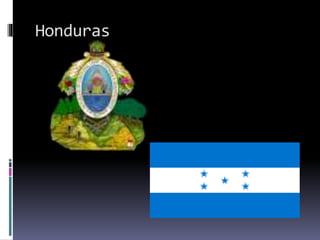
República de Honduras
 Central constitutional Republic
 Eighteen departmentos
 Capital,Tegucigalpa (and largest city)
 The country is bordered to the west
by Guatemala, to the southwest by El
Salvador, to the southeast by Nicaragua, to
the south by the Pacific Ocean at the Gulf of
Fonseca, and to the north by the Gulf of
Honduras, a large inlet of the Caribbean Sea.
 Official language: Spanish
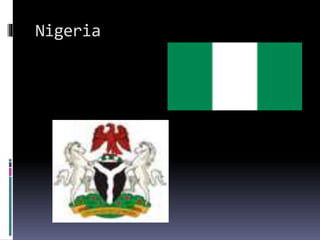
Nigeria
Honduras
Nigerian Politics
 Ethnocentrism, tribalism, religious persecution,
and prebendalism have played a visible role in Nigerian
politics both prior and subsequent to independence in
1960.
 Nigeria is a Federal Republic modeled after the United
States, with executive power exercised by
the president and with overtones of the Westminster
System model in the composition and management of the
upper and lower houses of the bicameral legislature.The
current president of Nigeria is Goodluck Jonathan, who
succeeded to the office in 2010.The president presides as
both Head of State and head of the national executive and
is elected by popular vote to a maximum of two four-year
terms.
Nigeria
 Law
 There are four distinct systems of law in Nigeria:
 English law which is derived from its colonial past with Britain;
 Common law, a development of its post colonial independence;
 Customary law which is derived from indigenous traditional
norms and practice, including the dispute resolution meetings of
pre-colonialYorubaland secret societies and the Èkpè and
Okónkò of Igboland and Ibibioland;
 Sharia law, used only in the predominantly Muslim north of the
country. It is an Islamic legal system which had been used long
before the colonial administration in Nigeria but recently
politicised and spearheaded in Zamfara in late 1999 and eleven
other states followed suit.These states
are Kano, Katsina, Niger, Bauchi, Borno, Kaduna, Gombe, Sokoto
Jigawa,Yobe, and Kebbi.
Honduran Politics
 In the last elections,Honduras had nine registered
political parties: National Party (Partido Nacional de
Honduras: PNH); Liberal Party (Partido Liberal de
Honduras: PLH); Social Democrats (Partido
Innovación y Unidad-Social Demócrata: PINU-SD),
Social Christians (Partido Demócrata-Cristiano de
Honduras: DCH); and Democratic Unification
(Partido Unificación Democrática, PAC, Libre, etc.
UD). PNH and PLH have ruled the country for
decades.
 Government ministries are often incapable of
carrying out their mandate due to budgetary
constraints.
Honduran 2009 crisis
 The 2009 Honduran constitutional crisis is an
ongoing constitutional crisis. President Manuel Zelaya had
attempted to hold a "non-binding referendum" on the 28th
of June on the desire of Hondurans to have a fourth ballot
box in the upcoming November elections, which would
then ask if the Honduran people wished to form a
ConstitutionalAssembly in the term of the newly elected
president.The Supreme Court upheld a lower court ruling
that had found a prior referendum based on the same issue
unconstitutional and had prohibited it.The Supreme Court
had not made any determination of the final, referendum,
having instead made the legal claim that any attempt by
Zelaya to poll on any matter, in any way, to be.
Nigerian Economy
 Nigeria is classified as an emerging market, and is
rapidly approaching middle income status, with its
abundant supply of resources, well-developed
financial, legal, communications, transport sectors
and stock exchange (the Nigerian Stock Exchange),
which is the second largest in Africa.
 During the oil boom of the 1970s, Nigeria
accumulated a significant foreign debt to finance
major infrastructural investments.With the fall of oil
prices during the 1980s oil glut Nigeria struggled to
keep up with its loan payments and eventually
defaulted on its principal debt repayments, limiting
repayment to the interest portion of the loans.
Honduran Economy
 The economy has continued to grow slowly, but
the distribution of wealth remains very polarized
with average wages remaining low. Economic
growth in the last few years has averaged 7% per
year, but 50%, approximately 3.7 million, of the
population still remains below the poverty line.
 Honduras was declared one of the Heavily
Indebted Poor Countries by theWorld Bank and
the International Monetary Fund which made it
eligible for debt relief in 2005.
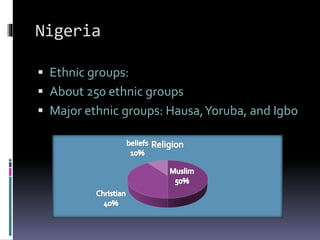
Nigeria
 Ethnic groups:
 About 250 ethnic groups
 Major ethnic groups: Hausa,Yoruba, and Igbo
Honduras
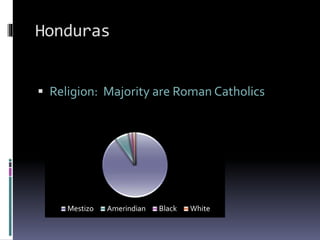
 Religion: Majority are Roman Catholics
Mestizo Amerindian Black White
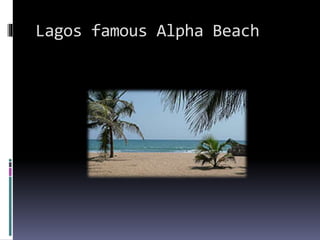
Lagos famous Alpha Beach
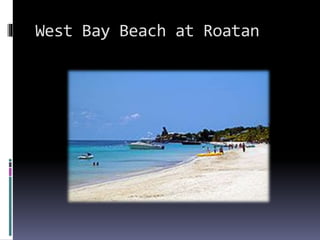
West Bay Beach at Roatan
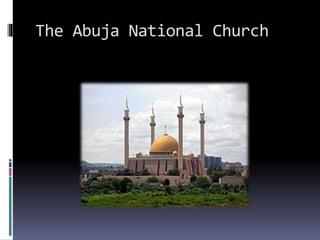
The Abuja National Church
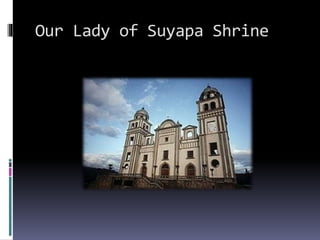
Our Lady of Suyapa Shrine
Honduran culture
 Hondurans are often referred to as Catracho in
Spanish.The word was coined by Nicaraguans and
derives from the last name of the Spanish Honduran
General Florencio Xatruch, who, in 1857, led
Honduran armed forces against an attempted
invasion by North American adventurerWilliam
Walker.The nickname is considered complimentary,
not derogatory.The main language is Spanish,
spoken by 94% as first language. Minority languages
are spoken by less than 4%.These are Amerindian
languages such as Garifuna, Miskito,
and Pech; Honduras Sign Language; and English on
the Bay Islands off the coast.
Honduran culture
 Legends and fairy tales are paramount within
the Honduras culture; Lluvia de Peces (Fish
Rain) is an example of this.The legend of
El Cadejo and La Ciguanaba (La Sucia) are
also popular.
Nigerian Culture
 Nigeria is home to a variety of religions which
tend to vary regionally.This situation
accentuates regional and ethnic distinctions
and has often been seen as a source of
sectarian conflict amongst the
population.The largest religions of Nigeria
are Islam and Christianity, including few
followers of indigenous religions.
Nigeria´s Foreign policy
 Nigeria's foreign policy was soon tested in the 1970s after the
country emerged united from its own civil war and quickly
committed itself to the liberation struggles going on in the
Southern Africa sub-region.Though Nigeria never sent an
expeditionary force in that struggle, it offered more than rhetoric
to the African National Congress (ANC) by taking a committed
tough line with regard to the racist regime and their incursions in
southern Africa, in addition to expediting large sums to aid anti-
colonial struggles. Nigeria was also a founding member of
the Organization for African Unity (now the African Union), and
has tremendous influence in West Africa and Africa on the whole.
Nigeria has additionally founded regional cooperative efforts in
West Africa, functioning as standard-bearer
for ECOWAS and ECOMOG, economic and military organizations
respectively.
Nigeria´s Foreign Policy
 Nigeria is also a member of the International Criminal
Court, and the Commonwealth of Nations, from which it
was temporarily expelled in 1995 under the Abacha regime.
 Nigeria has remained a key player in the international oil
industry since the 1970s, and maintains membership
in Organization of the Petroleum Exporting
Countries OPEC which it joined in July, 1971. Its status as a
major petroleum producer figures prominently in its
sometimes difficult international relations with
both developed countries, notably the United States and
more recently China and developing countries, notably
Ghana, Jamaica, and Kenya.
Nigeria´s Challenges
 Despite its vast government revenue from
the mining of petroleum, Nigeria is faced by a
number of societal issues due primarily to a
history of inefficiency in its governance.
 High dependency ratio
 Petroleum revenues are controlled by
foreigners.
 Pervasive corruption has been a problem ever
since the late colonial era.
Nigeria´s Challenges
 Social gap between the rich and the poor.
 Access to education is limited.
 Culture is deeply divided by ethnicity and
religion.

Honduras and nigeria

  • 1.
  • 2.
    Federal Republic ofNigeria  Federal constitutional Republic  Thirty-six states  Federal CapitalTerritory,Abuja.  The country is located in West Africa and shares land borders with the Republic of Benin in the west, Chad and Cameroon in the east, and Niger in the north.  Official language: English
  • 3.
    República de Honduras Central constitutional Republic  Eighteen departmentos  Capital,Tegucigalpa (and largest city)  The country is bordered to the west by Guatemala, to the southwest by El Salvador, to the southeast by Nicaragua, to the south by the Pacific Ocean at the Gulf of Fonseca, and to the north by the Gulf of Honduras, a large inlet of the Caribbean Sea.  Official language: Spanish
  • 4.
  • 5.
  • 6.
    Nigerian Politics  Ethnocentrism,tribalism, religious persecution, and prebendalism have played a visible role in Nigerian politics both prior and subsequent to independence in 1960.  Nigeria is a Federal Republic modeled after the United States, with executive power exercised by the president and with overtones of the Westminster System model in the composition and management of the upper and lower houses of the bicameral legislature.The current president of Nigeria is Goodluck Jonathan, who succeeded to the office in 2010.The president presides as both Head of State and head of the national executive and is elected by popular vote to a maximum of two four-year terms.
  • 7.
    Nigeria  Law  Thereare four distinct systems of law in Nigeria:  English law which is derived from its colonial past with Britain;  Common law, a development of its post colonial independence;  Customary law which is derived from indigenous traditional norms and practice, including the dispute resolution meetings of pre-colonialYorubaland secret societies and the Èkpè and Okónkò of Igboland and Ibibioland;  Sharia law, used only in the predominantly Muslim north of the country. It is an Islamic legal system which had been used long before the colonial administration in Nigeria but recently politicised and spearheaded in Zamfara in late 1999 and eleven other states followed suit.These states are Kano, Katsina, Niger, Bauchi, Borno, Kaduna, Gombe, Sokoto Jigawa,Yobe, and Kebbi.
  • 8.
    Honduran Politics  Inthe last elections,Honduras had nine registered political parties: National Party (Partido Nacional de Honduras: PNH); Liberal Party (Partido Liberal de Honduras: PLH); Social Democrats (Partido Innovación y Unidad-Social Demócrata: PINU-SD), Social Christians (Partido Demócrata-Cristiano de Honduras: DCH); and Democratic Unification (Partido Unificación Democrática, PAC, Libre, etc. UD). PNH and PLH have ruled the country for decades.  Government ministries are often incapable of carrying out their mandate due to budgetary constraints.
  • 9.
    Honduran 2009 crisis The 2009 Honduran constitutional crisis is an ongoing constitutional crisis. President Manuel Zelaya had attempted to hold a "non-binding referendum" on the 28th of June on the desire of Hondurans to have a fourth ballot box in the upcoming November elections, which would then ask if the Honduran people wished to form a ConstitutionalAssembly in the term of the newly elected president.The Supreme Court upheld a lower court ruling that had found a prior referendum based on the same issue unconstitutional and had prohibited it.The Supreme Court had not made any determination of the final, referendum, having instead made the legal claim that any attempt by Zelaya to poll on any matter, in any way, to be.
  • 10.
    Nigerian Economy  Nigeriais classified as an emerging market, and is rapidly approaching middle income status, with its abundant supply of resources, well-developed financial, legal, communications, transport sectors and stock exchange (the Nigerian Stock Exchange), which is the second largest in Africa.  During the oil boom of the 1970s, Nigeria accumulated a significant foreign debt to finance major infrastructural investments.With the fall of oil prices during the 1980s oil glut Nigeria struggled to keep up with its loan payments and eventually defaulted on its principal debt repayments, limiting repayment to the interest portion of the loans.
  • 11.
    Honduran Economy  Theeconomy has continued to grow slowly, but the distribution of wealth remains very polarized with average wages remaining low. Economic growth in the last few years has averaged 7% per year, but 50%, approximately 3.7 million, of the population still remains below the poverty line.  Honduras was declared one of the Heavily Indebted Poor Countries by theWorld Bank and the International Monetary Fund which made it eligible for debt relief in 2005.
  • 12.
    Nigeria  Ethnic groups: About 250 ethnic groups  Major ethnic groups: Hausa,Yoruba, and Igbo
  • 13.
    Honduras  Religion: Majorityare Roman Catholics Mestizo Amerindian Black White
  • 14.
  • 15.
    West Bay Beachat Roatan
  • 16.
  • 17.
    Our Lady ofSuyapa Shrine
  • 18.
    Honduran culture  Honduransare often referred to as Catracho in Spanish.The word was coined by Nicaraguans and derives from the last name of the Spanish Honduran General Florencio Xatruch, who, in 1857, led Honduran armed forces against an attempted invasion by North American adventurerWilliam Walker.The nickname is considered complimentary, not derogatory.The main language is Spanish, spoken by 94% as first language. Minority languages are spoken by less than 4%.These are Amerindian languages such as Garifuna, Miskito, and Pech; Honduras Sign Language; and English on the Bay Islands off the coast.
  • 19.
    Honduran culture  Legendsand fairy tales are paramount within the Honduras culture; Lluvia de Peces (Fish Rain) is an example of this.The legend of El Cadejo and La Ciguanaba (La Sucia) are also popular.
  • 20.
    Nigerian Culture  Nigeriais home to a variety of religions which tend to vary regionally.This situation accentuates regional and ethnic distinctions and has often been seen as a source of sectarian conflict amongst the population.The largest religions of Nigeria are Islam and Christianity, including few followers of indigenous religions.
  • 21.
    Nigeria´s Foreign policy Nigeria's foreign policy was soon tested in the 1970s after the country emerged united from its own civil war and quickly committed itself to the liberation struggles going on in the Southern Africa sub-region.Though Nigeria never sent an expeditionary force in that struggle, it offered more than rhetoric to the African National Congress (ANC) by taking a committed tough line with regard to the racist regime and their incursions in southern Africa, in addition to expediting large sums to aid anti- colonial struggles. Nigeria was also a founding member of the Organization for African Unity (now the African Union), and has tremendous influence in West Africa and Africa on the whole. Nigeria has additionally founded regional cooperative efforts in West Africa, functioning as standard-bearer for ECOWAS and ECOMOG, economic and military organizations respectively.
  • 22.
    Nigeria´s Foreign Policy Nigeria is also a member of the International Criminal Court, and the Commonwealth of Nations, from which it was temporarily expelled in 1995 under the Abacha regime.  Nigeria has remained a key player in the international oil industry since the 1970s, and maintains membership in Organization of the Petroleum Exporting Countries OPEC which it joined in July, 1971. Its status as a major petroleum producer figures prominently in its sometimes difficult international relations with both developed countries, notably the United States and more recently China and developing countries, notably Ghana, Jamaica, and Kenya.
  • 23.
    Nigeria´s Challenges  Despiteits vast government revenue from the mining of petroleum, Nigeria is faced by a number of societal issues due primarily to a history of inefficiency in its governance.  High dependency ratio  Petroleum revenues are controlled by foreigners.  Pervasive corruption has been a problem ever since the late colonial era.
  • 24.
    Nigeria´s Challenges  Socialgap between the rich and the poor.  Access to education is limited.  Culture is deeply divided by ethnicity and religion.