Agricultural Biotechnology Network for Regional Collaboration and Knowledge Sharing 
An Overview on 
Regional Agricultural Biotechnology Network 
of Near East and North Africa (RABNENA) 
Magdi Latif 
FAO Knowledge and Capacity for Development Division 
Knowledge Exchange, Research and Extension Office 
FAO/RNE, Cairo, Egypt 
July 2012 
Food and Agriculture Organization of the United Nations
Agricultural Biotechnology Network for Regional Collaboration and Knowledge Sharing 
What is RABNENA? 
Regional Agricultural Biotechnology Network 
oF Near East and North Africa (RABNENA) is a 
regional platform for strengthening 
knowledge sharing and cooperation for 
Agricultural Research and Development 
(ARD) for biotechnology target groups and 
stakeholders at national and regional levels. 
Food and Agriculture Organization of the United Nations
Agricultural Biotechnology Network for Regional Collaboration and Knowledge Sharing 
RABNENA Objectives 
• To create a regional gateway as a single access point for agricultural biotechnology 
where the different countries of the region can share a united vision of the 
agricultural biotechnology policies, regulations, research and innovations that will 
support agricultural development and food security at a country level. 
• To facilitate biotechnology knowledge sharing and information exchange for 
stakeholders at national and regional levels through the development of a thematic 
biotechnology knowledge management system for the collection, management and 
dissemination of information/knowledge on advances in agricultural biotechnology 
research and innovation results that will support strengthening performance of 
farmers and agrarian businesses. 
• To establish functional mechanism for cooperation and enhancement of 
communication and exchange of experiences and good practices on agricultural 
biotechnologies among different countries in the region in support of agricultural 
development and food security. 
Food and Agriculture Organization of the United Nations
Agricultural Biotechnology Network for Regional Collaboration and Knowledge Sharing 
RABNENA expected Outcomes 
 Prevent redundancy and duplication, 
 Create access to research information, knowledge 
and innovations, 
 Ensure maximum knowledge sharing among 
various agricultural research institutes, programs 
and personnel on regional, national and institutional 
levels, 
 Provide enable environment for good coordination 
and Cooperation. 
Food and Agriculture Organization of the United Nations
Agricultural Biotechnology Network for Regional Collaboration and Knowledge Sharing 
RABNENA Stakeholders 
• Policy-makers in agriculture and rural development, especially in 
the MOA and NARIs. 
• Biotechnology Department heads and professional technical 
officers within the MOA and NARIs. 
• Other Ministries related to rural development. 
• Universities and colleges with agricultural biotechnology-related 
faculties and departments. 
• Farmers’ and producers’ organizations. 
• Credit and marketing associations and Chambers of Commerce. 
• Private sector involved in agricultural biotechnology. 
• Non-Governmental Organizations involved in agricultural 
Biotechnology for agricultural development and food security. 
• Regional and International Organizations involved in agricultural 
development and food security and General Public. 
Food and Agriculture Organization of the United Nations
Agricultural Biotechnology Network for Regional Collaboration and Knowledge Sharing 
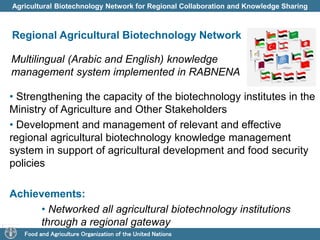
Regional Agricultural Biotechnology Network 
Multilingual (Arabic and English) knowledge 
management system implemented in RABNENA 
• Strengthening the capacity of the biotechnology institutes in the 
Ministry of Agriculture and Other Stakeholders 
• Development and management of relevant and effective 
regional agricultural biotechnology knowledge management 
system in support of agricultural development and food security 
policies 
Achievements: 
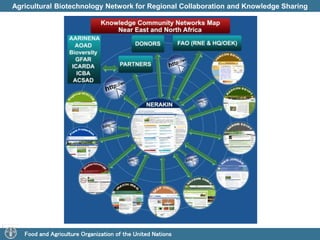
• Networked all agricultural biotechnology institutions 
through a regional gateway 
Food and Agriculture Organization of the United Nations
Agricultural Biotechnology Network for Regional Collaboration and Knowledge Sharing 
RABNENA Interfaces 
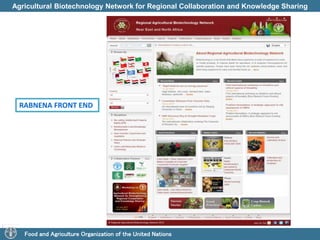
1- Front end Interface: 
The front end components provide the information 
browsing and retrieval functionalities, and are 
available to any site user. 
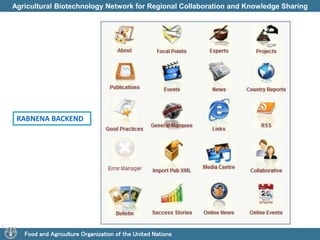
2- Back end Interface: 
The backend components provide the data 
management functionalities that enable system 
administrators to input/update/delete data items 
into the RABNENA database. These components are 
accessible by system administrators only. 
Food and Agriculture Organization of the United Nations
Agricultural Biotechnology Network for Regional Collaboration and Knowledge Sharing 
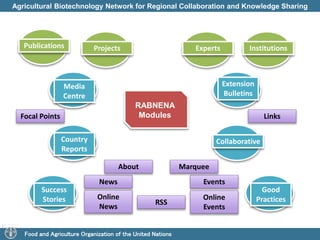
Publications Projects Experts Institutions 
RABNENA 
Modules 
Focal Points Links 
Country Collaborative 
Reports 
News Events 
Food and Agriculture Organization of the United Nations 
Extension 
Bulletins 
Media 
Centre 
Online 
News 
Online 
Events 
RSS 
Success 
Stories 
Good 
Practices 
About Marquee
Agricultural Biotechnology Network for Regional Collaboration and Knowledge Sharing 
RABNENA FRONT END 
Food and Agriculture Organization of the United Nations
Agricultural Biotechnology Network for Regional Collaboration and Knowledge Sharing 
RABNENA BACKEND 
Food and Agriculture Organization of the United Nations
Agricultural Biotechnology Network for Regional Collaboration and Knowledge Sharing 
Food and Agriculture Organization of the United Nations
Agricultural Biotechnology Network for Regional Collaboration and Knowledge Sharing 
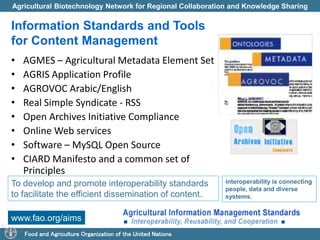
Information Standards and Tools 
for Content Management 
• AGMES – Agricultural Metadata Element Set 
• AGRIS Application Profile 
• AGROVOC Arabic/English 
• Real Simple Syndicate - RSS 
• Open Archives Initiative Compliance 
• Online Web services 
• Software – MySQL Open Source 
• CIARD Manifesto and a common set of 
Principles 
To develop and promote interoperability standards 
to facilitate the efficient dissemination of content. 
www.fao.org/aims 
Food and Agriculture Organization of the United Nations 
interoperability is connecting 
people, data and diverse 
systems.
Agricultural Biotechnology Network for Regional Collaboration and Knowledge Sharing 
Mobilizing and Providing Access to 
Agricultural Information 
• AGRIS – Providing agricultural research and development 
institutions with an avenue to publish and disseminate 
the outputs of their work 
• AGORA - Providing access to the world’s scientific 
literature in agriculture in peer-reviewed learned 
journals 
• CIARD – Providing commitment to promote the sharing 
of data, information, and knowledge in a global network 
of truly public collections of information, based on a 
Manifesto and a common set of Principles. 
Food and Agriculture Organization of the United Nations
Agricultural Biotechnology Network for Regional Collaboration and Knowledge Sharing 
Coherence in Information for Agricultural 
Research for Development (CIARD) 
Partners in the CIARD initiative have made a collective commitment 
to promote the sharing of data, information, and knowledge in a 
global network of truly public collections of information, based on a 
Manifesto and a common set of Principles. 
Accessibility: Information is openly accessible for all users, and easily located via the 
Internet from outside the institution using tools and services adopted by the international 
community. 
Availability: Information is stored in digital formats, with clearly defined copyright, 
managed in one or more institutionally-owned, thematic or other repositories, built 
and structured according to accepted international standards. 
Applicability: Research planning, implementation and communication are an inclusive 
process bringing together all perspectives and knowledge. Research outputs and 
messages are adapted for easy access, use and re-use by different stakeholders, 
increasing the public benefits derived from the research. 
Food and Agriculture Organization of the United Nations
Agricultural Biotechnology Network for Regional Collaboration and Knowledge Sharing 
Success Factors for Regional Network 
1. Commitment for contribution/collaboration at national level; 
2. Focus on capacity building at national level; 
3. Existence of a regional information strategy; 
4. Development of a Secretariat role for regional activities; 
5. Focus on community of practice amongst the info specialists; 
6. Raising awareness of ICM issues at Manager./political levels; 
7. Formation of strategic partnerships amongst the major 
stakeholder organizations. 
Food and Agriculture Organization of the United Nations
Agricultural Biotechnology Network for Regional Collaboration and Knowledge Sharing 
Thank You for your Attention 
Food and Agriculture Organization of the United Nations

An Overview on Regional Agricultural Biotechnology Network of Near East and North Africa (RABNENA)

  • 1.
    Agricultural Biotechnology Networkfor Regional Collaboration and Knowledge Sharing An Overview on Regional Agricultural Biotechnology Network of Near East and North Africa (RABNENA) Magdi Latif FAO Knowledge and Capacity for Development Division Knowledge Exchange, Research and Extension Office FAO/RNE, Cairo, Egypt July 2012 Food and Agriculture Organization of the United Nations
  • 2.
    Agricultural Biotechnology Networkfor Regional Collaboration and Knowledge Sharing What is RABNENA? Regional Agricultural Biotechnology Network oF Near East and North Africa (RABNENA) is a regional platform for strengthening knowledge sharing and cooperation for Agricultural Research and Development (ARD) for biotechnology target groups and stakeholders at national and regional levels. Food and Agriculture Organization of the United Nations
  • 3.
    Agricultural Biotechnology Networkfor Regional Collaboration and Knowledge Sharing RABNENA Objectives • To create a regional gateway as a single access point for agricultural biotechnology where the different countries of the region can share a united vision of the agricultural biotechnology policies, regulations, research and innovations that will support agricultural development and food security at a country level. • To facilitate biotechnology knowledge sharing and information exchange for stakeholders at national and regional levels through the development of a thematic biotechnology knowledge management system for the collection, management and dissemination of information/knowledge on advances in agricultural biotechnology research and innovation results that will support strengthening performance of farmers and agrarian businesses. • To establish functional mechanism for cooperation and enhancement of communication and exchange of experiences and good practices on agricultural biotechnologies among different countries in the region in support of agricultural development and food security. Food and Agriculture Organization of the United Nations
  • 4.
    Agricultural Biotechnology Networkfor Regional Collaboration and Knowledge Sharing RABNENA expected Outcomes  Prevent redundancy and duplication,  Create access to research information, knowledge and innovations,  Ensure maximum knowledge sharing among various agricultural research institutes, programs and personnel on regional, national and institutional levels,  Provide enable environment for good coordination and Cooperation. Food and Agriculture Organization of the United Nations
  • 5.
    Agricultural Biotechnology Networkfor Regional Collaboration and Knowledge Sharing RABNENA Stakeholders • Policy-makers in agriculture and rural development, especially in the MOA and NARIs. • Biotechnology Department heads and professional technical officers within the MOA and NARIs. • Other Ministries related to rural development. • Universities and colleges with agricultural biotechnology-related faculties and departments. • Farmers’ and producers’ organizations. • Credit and marketing associations and Chambers of Commerce. • Private sector involved in agricultural biotechnology. • Non-Governmental Organizations involved in agricultural Biotechnology for agricultural development and food security. • Regional and International Organizations involved in agricultural development and food security and General Public. Food and Agriculture Organization of the United Nations
  • 6.
    Agricultural Biotechnology Networkfor Regional Collaboration and Knowledge Sharing Regional Agricultural Biotechnology Network Multilingual (Arabic and English) knowledge management system implemented in RABNENA • Strengthening the capacity of the biotechnology institutes in the Ministry of Agriculture and Other Stakeholders • Development and management of relevant and effective regional agricultural biotechnology knowledge management system in support of agricultural development and food security policies Achievements: • Networked all agricultural biotechnology institutions through a regional gateway Food and Agriculture Organization of the United Nations
  • 7.
    Agricultural Biotechnology Networkfor Regional Collaboration and Knowledge Sharing RABNENA Interfaces 1- Front end Interface: The front end components provide the information browsing and retrieval functionalities, and are available to any site user. 2- Back end Interface: The backend components provide the data management functionalities that enable system administrators to input/update/delete data items into the RABNENA database. These components are accessible by system administrators only. Food and Agriculture Organization of the United Nations
  • 8.
    Agricultural Biotechnology Networkfor Regional Collaboration and Knowledge Sharing Publications Projects Experts Institutions RABNENA Modules Focal Points Links Country Collaborative Reports News Events Food and Agriculture Organization of the United Nations Extension Bulletins Media Centre Online News Online Events RSS Success Stories Good Practices About Marquee
  • 9.
    Agricultural Biotechnology Networkfor Regional Collaboration and Knowledge Sharing RABNENA FRONT END Food and Agriculture Organization of the United Nations
  • 10.
    Agricultural Biotechnology Networkfor Regional Collaboration and Knowledge Sharing RABNENA BACKEND Food and Agriculture Organization of the United Nations
  • 11.
    Agricultural Biotechnology Networkfor Regional Collaboration and Knowledge Sharing Food and Agriculture Organization of the United Nations
  • 12.
    Agricultural Biotechnology Networkfor Regional Collaboration and Knowledge Sharing Information Standards and Tools for Content Management • AGMES – Agricultural Metadata Element Set • AGRIS Application Profile • AGROVOC Arabic/English • Real Simple Syndicate - RSS • Open Archives Initiative Compliance • Online Web services • Software – MySQL Open Source • CIARD Manifesto and a common set of Principles To develop and promote interoperability standards to facilitate the efficient dissemination of content. www.fao.org/aims Food and Agriculture Organization of the United Nations interoperability is connecting people, data and diverse systems.
  • 13.
    Agricultural Biotechnology Networkfor Regional Collaboration and Knowledge Sharing Mobilizing and Providing Access to Agricultural Information • AGRIS – Providing agricultural research and development institutions with an avenue to publish and disseminate the outputs of their work • AGORA - Providing access to the world’s scientific literature in agriculture in peer-reviewed learned journals • CIARD – Providing commitment to promote the sharing of data, information, and knowledge in a global network of truly public collections of information, based on a Manifesto and a common set of Principles. Food and Agriculture Organization of the United Nations
  • 14.
    Agricultural Biotechnology Networkfor Regional Collaboration and Knowledge Sharing Coherence in Information for Agricultural Research for Development (CIARD) Partners in the CIARD initiative have made a collective commitment to promote the sharing of data, information, and knowledge in a global network of truly public collections of information, based on a Manifesto and a common set of Principles. Accessibility: Information is openly accessible for all users, and easily located via the Internet from outside the institution using tools and services adopted by the international community. Availability: Information is stored in digital formats, with clearly defined copyright, managed in one or more institutionally-owned, thematic or other repositories, built and structured according to accepted international standards. Applicability: Research planning, implementation and communication are an inclusive process bringing together all perspectives and knowledge. Research outputs and messages are adapted for easy access, use and re-use by different stakeholders, increasing the public benefits derived from the research. Food and Agriculture Organization of the United Nations
  • 15.
    Agricultural Biotechnology Networkfor Regional Collaboration and Knowledge Sharing Success Factors for Regional Network 1. Commitment for contribution/collaboration at national level; 2. Focus on capacity building at national level; 3. Existence of a regional information strategy; 4. Development of a Secretariat role for regional activities; 5. Focus on community of practice amongst the info specialists; 6. Raising awareness of ICM issues at Manager./political levels; 7. Formation of strategic partnerships amongst the major stakeholder organizations. Food and Agriculture Organization of the United Nations
  • 16.
    Agricultural Biotechnology Networkfor Regional Collaboration and Knowledge Sharing Thank You for your Attention Food and Agriculture Organization of the United Nations