The e-Agriculture Initiative: Achieving the MDGs through Sharing of Innovative Experiences Justin Chisenga Information Management Specialist FAO Regional Office for Africa, Accra, Ghana [email_address] WITFOR, Addis Ababa, Ethiopia, 22 – 24 August 2007
Millennium Development Goals (MDGs) MDGs and Information Communication Technology (ICTs) Innovative e-Agriculture Projects FAO’s e-Agriculture Initiative Presentation Outline
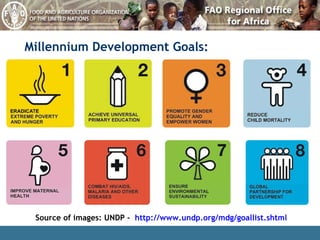
Millennium Development Goals: Source of images: UNDP -  http://www.undp.org/mdg/goallist.shtml
Millennium Development Goals… About 70% of MDGs’ target group live in rural areas They depend largely on agriculture They lack access to ICTs (rural digital divide) There is an information gap for rural stakeholders
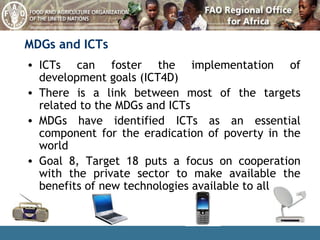
MDGs and ICTs ICTs can foster the implementation of development goals (ICT4D) There is a link between most of the targets related to the MDGs and ICTs MDGs have identified ICTs as an essential component for the eradication of poverty in the world Goal 8, Target 18 puts a focus on cooperation with the private sector to make available the benefits of new technologies available to all
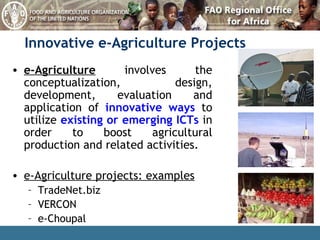
Innovative   e-Agriculture Projects e-Agriculture  involves the conceptualization, design, development, evaluation and application of  innovative ways  to utilize  existing or emerging ICTs  in order to boost agricultural production and related activities. e-Agriculture projects: examples TradeNet.biz VERCON  e-Choupal
Developed by Busylab Basic concept : to make African markets more transparent and efficient, improve intra-regional trading, and provide stakeholders with enough recent and accurate information to make better decisions on bringing products to market and at what price
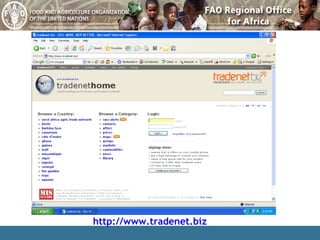
http://www.tradenet.biz
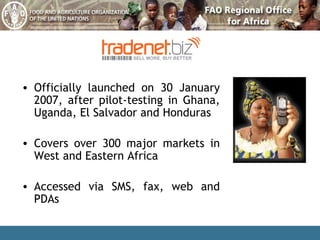
Officially launched on 30 January 2007, after pilot-testing in Ghana, Uganda, El Salvador and Honduras Covers over 300 major markets in West and Eastern Africa Accessed via SMS, fax, web and PDAs
Traders and buyers: have access to daily price information of goods have access to  identities  of potential buyers and sellers can post buy/sell offers to the community can download video/audio files have access to research documents
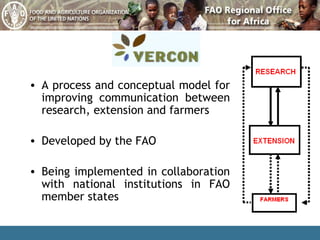
A process and conceptual model for improving communication between research, extension and farmers Developed by the FAO Being implemented in collaboration with national institutions in FAO member states
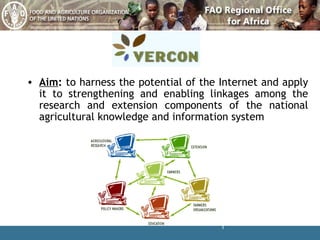
Aim :  to harness the potential of the Internet and apply it to strengthening and enabling linkages among the research and extension components of the national agricultural knowledge and information system
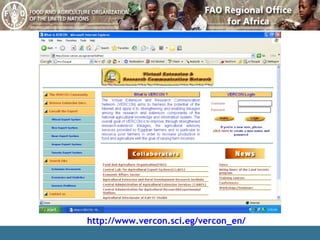
http://www.vercon.sci.eg/vercon_en/
Launched in April 2003 Major partners : Ministry of Agriculture & the Central Lab for Agricultural Expert Systems (CLAES) Overall goal : to improve, through strengthened research-extension linkages, the agricultural advisory services provided to Egyptian farmers and in particular to resource poor farmers in order to increase production in food and agriculture with the goal of raising farm incomes
Authorized users have access to: Expert/decision support systems for wheat, rice, beans, grapes and tomato Digitized extension brochures and bulletins produced by research institutes and central administration for extension  Statistical databases Growers’ problem solving database Facilitates communication between researchers and extension workers through online discussions, and announcements of news and events pages
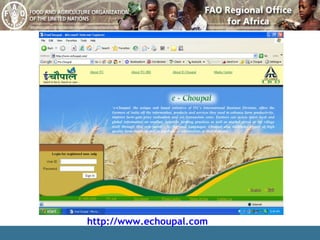
e- Choupal  (village gathering place in Hindi) is a  private company initiative Internet kiosks ( e-Choupals ) for e-commerce are being used to enable farmers in rural Indian villages to access crop-specific information, customized knowledge, products and services to enhance farm productivity, improve farm-gate price realization, and cut transaction costs Content is in local languages, including Hindi, Telegu and Kannada
http://www.echoupal.com
Launched in June 2000 by ITC's International Business Division (Agribusiness firm) e-Choupals in villages are managed by farmers known as ‘Sanchalaks’ Farmers have access to access information in local languages on: district level weather forecasts for short and medium term best practices in farming (generic as well as specific) supply of quality inputs (seed, herbicide, fertilizer, pesticides etc) in the village
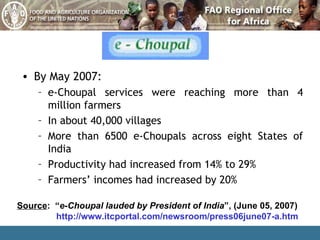
e-Choupals also facilitate the: Purchasing of farm produce from the farmers ordering and supply of high-quality agricultural inputs Winner of 2005 Development Gateway Award Gathering at an e-Choupal. Source: ITC
By May 2007: e-Choupal services were reaching more than 4 million farmers In about 40,000 villages More than 6500 e-Choupals across eight States of India Productivity had increased from 14% to 29%  Farmers’ incomes had increased by 20% Source :  “ e-Choupal lauded by President of India ”, ( June 05, 2007) http://www.itcportal.com/newsroom/press06june07-a.htm
FAO’s e-Agriculture Initiative There is an urgent need for a platform to promote innovative e-agriculture activities taking place in many parts of the world, and to share experiences If brought together in a more coherent and systematic way, the wide range of e-agriculture activities will have greater potential impact by learning from each other than if they remain isolated or fragmented
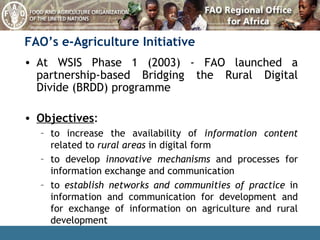
FAO’s e-Agriculture Initiative At WSIS Phase 1 (2003) - FAO launched a partnership-based Bridging the Rural Digital Divide (BRDD) programme Objectives : to increase the availability of  information content  related to  rural areas  in digital form to develop  innovative mechanisms  and processes for information exchange and communication to  establish networks and communities of practice  in information and communication for development and for exchange of information on agriculture and rural development
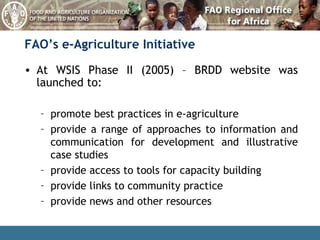
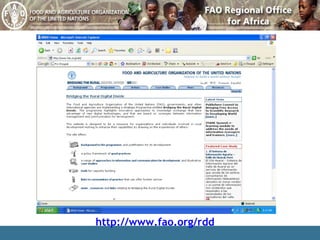
FAO’s e-Agriculture Initiative At WSIS Phase II (2005) – BRDD website was launched to: promote best practices in e-agriculture provide a range of approaches to information and communication for development and illustrative case studies provide access to tools for capacity building provide links to community practice provide news and other resources
http://www.fao.org/rdd
At WSIS Phase II (2005) FAO was assigned the responsibility of organizing activities related to the action line under  C.7 ICT Applications on e-Agriculture From 1 October to 15 November 2006, FAO conducted a global survey on e-agriculture FAO’s e-Agriculture Initiative…
4101 visitors to the web site survey 3433 (84%) participated in the survey 2121 (62 % of those participating in the survey), from 135 countries, requested to become part of an e-Agriculture Forum and provided their contact details FAO’s e-Agriculture Initiative…
In September 2007 FAO will launch an  e-Agriculture Community of Expertise  forum to foster: focused online dialogue and knowledge exchange  development of good practice guidelines  creation of opportunities to find and interact with other practitioners around the world  sharing resources and build relationships that can be applied to shared projects
The  Goal  of the Community will be to enhance  the contribution of ICT to agriculture  and rural development through  a  multi-stakeholder, people-centred, cross-sectoral platform that will bring together all stakeholders from relevant constituencies
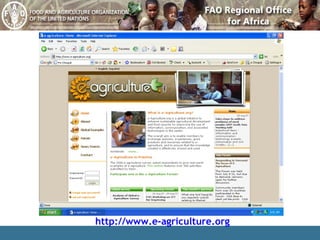
http://www.e-agriculture.org
e-Agriculture.org  portal provides access to: a forum for registered members news and events a collection of global examples of e-agriculture related projects and initiatives Results of the global survey on e-agriculture
As at 21 August 2007, the Forum had  1,116  registered users Over 150 projects, activities or practices illustrating e-agriculture have been submitted by participants from over  135 countries In July 2007, Forum members discussed:  Responding to Demand: the Focus of e-Agriculture
[email_address] http://www.fao.org http://www.fao.org/rdd http://www.e-agriculture.org THANK YOU!

The e-Agriculture Initiative: Achieving the MDGs through Sharing of Innovative Experiences

  • 1.
    The e-Agriculture Initiative: Achieving the MDGs throughSharing of Innovative Experiences Justin Chisenga Information Management Specialist FAO Regional Office for Africa, Accra, Ghana [email_address] WITFOR, Addis Ababa, Ethiopia, 22 – 24 August 2007
  • 2.
    Millennium Development Goals(MDGs) MDGs and Information Communication Technology (ICTs) Innovative e-Agriculture Projects FAO’s e-Agriculture Initiative Presentation Outline
  • 3.
    Millennium Development Goals:Source of images: UNDP - http://www.undp.org/mdg/goallist.shtml
  • 4.
    Millennium Development Goals…About 70% of MDGs’ target group live in rural areas They depend largely on agriculture They lack access to ICTs (rural digital divide) There is an information gap for rural stakeholders
  • 5.
    MDGs and ICTsICTs can foster the implementation of development goals (ICT4D) There is a link between most of the targets related to the MDGs and ICTs MDGs have identified ICTs as an essential component for the eradication of poverty in the world Goal 8, Target 18 puts a focus on cooperation with the private sector to make available the benefits of new technologies available to all
  • 6.
    Innovative e-Agriculture Projects e-Agriculture involves the conceptualization, design, development, evaluation and application of innovative ways to utilize existing or emerging ICTs in order to boost agricultural production and related activities. e-Agriculture projects: examples TradeNet.biz VERCON e-Choupal
  • 7.
    Developed by BusylabBasic concept : to make African markets more transparent and efficient, improve intra-regional trading, and provide stakeholders with enough recent and accurate information to make better decisions on bringing products to market and at what price
  • 8.
  • 9.
    Officially launched on30 January 2007, after pilot-testing in Ghana, Uganda, El Salvador and Honduras Covers over 300 major markets in West and Eastern Africa Accessed via SMS, fax, web and PDAs
  • 10.
    Traders and buyers:have access to daily price information of goods have access to identities of potential buyers and sellers can post buy/sell offers to the community can download video/audio files have access to research documents
  • 11.
    A process andconceptual model for improving communication between research, extension and farmers Developed by the FAO Being implemented in collaboration with national institutions in FAO member states
  • 12.
    Aim : to harness the potential of the Internet and apply it to strengthening and enabling linkages among the research and extension components of the national agricultural knowledge and information system
  • 13.
  • 14.
    Launched in April2003 Major partners : Ministry of Agriculture & the Central Lab for Agricultural Expert Systems (CLAES) Overall goal : to improve, through strengthened research-extension linkages, the agricultural advisory services provided to Egyptian farmers and in particular to resource poor farmers in order to increase production in food and agriculture with the goal of raising farm incomes
  • 15.
    Authorized users haveaccess to: Expert/decision support systems for wheat, rice, beans, grapes and tomato Digitized extension brochures and bulletins produced by research institutes and central administration for extension Statistical databases Growers’ problem solving database Facilitates communication between researchers and extension workers through online discussions, and announcements of news and events pages
  • 16.
    e- Choupal (village gathering place in Hindi) is a private company initiative Internet kiosks ( e-Choupals ) for e-commerce are being used to enable farmers in rural Indian villages to access crop-specific information, customized knowledge, products and services to enhance farm productivity, improve farm-gate price realization, and cut transaction costs Content is in local languages, including Hindi, Telegu and Kannada
  • 17.
  • 18.
    Launched in June2000 by ITC's International Business Division (Agribusiness firm) e-Choupals in villages are managed by farmers known as ‘Sanchalaks’ Farmers have access to access information in local languages on: district level weather forecasts for short and medium term best practices in farming (generic as well as specific) supply of quality inputs (seed, herbicide, fertilizer, pesticides etc) in the village
  • 19.
    e-Choupals also facilitatethe: Purchasing of farm produce from the farmers ordering and supply of high-quality agricultural inputs Winner of 2005 Development Gateway Award Gathering at an e-Choupal. Source: ITC
  • 20.
    By May 2007:e-Choupal services were reaching more than 4 million farmers In about 40,000 villages More than 6500 e-Choupals across eight States of India Productivity had increased from 14% to 29% Farmers’ incomes had increased by 20% Source : “ e-Choupal lauded by President of India ”, ( June 05, 2007) http://www.itcportal.com/newsroom/press06june07-a.htm
  • 21.
    FAO’s e-Agriculture InitiativeThere is an urgent need for a platform to promote innovative e-agriculture activities taking place in many parts of the world, and to share experiences If brought together in a more coherent and systematic way, the wide range of e-agriculture activities will have greater potential impact by learning from each other than if they remain isolated or fragmented
  • 22.
    FAO’s e-Agriculture InitiativeAt WSIS Phase 1 (2003) - FAO launched a partnership-based Bridging the Rural Digital Divide (BRDD) programme Objectives : to increase the availability of information content related to rural areas in digital form to develop innovative mechanisms and processes for information exchange and communication to establish networks and communities of practice in information and communication for development and for exchange of information on agriculture and rural development
  • 23.
    FAO’s e-Agriculture InitiativeAt WSIS Phase II (2005) – BRDD website was launched to: promote best practices in e-agriculture provide a range of approaches to information and communication for development and illustrative case studies provide access to tools for capacity building provide links to community practice provide news and other resources
  • 24.
  • 25.
    At WSIS PhaseII (2005) FAO was assigned the responsibility of organizing activities related to the action line under C.7 ICT Applications on e-Agriculture From 1 October to 15 November 2006, FAO conducted a global survey on e-agriculture FAO’s e-Agriculture Initiative…
  • 26.
    4101 visitors tothe web site survey 3433 (84%) participated in the survey 2121 (62 % of those participating in the survey), from 135 countries, requested to become part of an e-Agriculture Forum and provided their contact details FAO’s e-Agriculture Initiative…
  • 27.
    In September 2007FAO will launch an e-Agriculture Community of Expertise forum to foster: focused online dialogue and knowledge exchange development of good practice guidelines creation of opportunities to find and interact with other practitioners around the world sharing resources and build relationships that can be applied to shared projects
  • 28.
    The Goal of the Community will be to enhance the contribution of ICT to agriculture and rural development through a multi-stakeholder, people-centred, cross-sectoral platform that will bring together all stakeholders from relevant constituencies
  • 29.
  • 30.
    e-Agriculture.org portalprovides access to: a forum for registered members news and events a collection of global examples of e-agriculture related projects and initiatives Results of the global survey on e-agriculture
  • 31.
    As at 21August 2007, the Forum had 1,116 registered users Over 150 projects, activities or practices illustrating e-agriculture have been submitted by participants from over 135 countries In July 2007, Forum members discussed: Responding to Demand: the Focus of e-Agriculture
  • 32.
    [email_address] http://www.fao.org http://www.fao.org/rddhttp://www.e-agriculture.org THANK YOU!