Expository Writing: Writing an Engaging Opening
                                   Weeks 5 Lesson
Introduction
        “Invention Convention” is an integrated project combining learning from
language arts, science, and math curriculums allowing students to apply their
understandings of magnets and electricity by designing or improving an existing
invention.

Learning Outcomes
   • The learner will analyze slogans from famous inventions.
   • The learner will identify a sound, ability, or description that is unique to their
      invention.
   • The learner will write an engaging opening for their expository writing.

Curriculum Alignment
  • Fourth Grade, English Language Arts, Goal 4, Objective 4.06
  • Fourth Grade, English Language Arts, Goal 4, Objective 4.07

Classroom Time Required
   • At least a one-hour time block for the whole group mini lesson is needed, and
      possibly more time for students to complete their independent writing.

Materials Needed
  • Student Inventor’s Log
  • Opening / Conclusion Plan
  • ELL Opening / Conclusion Plan
  • Printed picture of the Nintendo Wii and Bounty Paper Towels (Google the names
      and then print the picture)
  • Possibly, depending how the lesson is facilitated, pictures of other products with
      their slogans written close by.

Pre-Activities
   • Prior to this lesson, students should have completed the “Focusing Expository
      Writing.”

Activities
   • Put a picture of the Nintendo Wii on the board and write it’s slogan, “Wii would
       like to play.” Ask the students to explain the picture and the words. They can
       work in partners for a minute or two, and then they can share with the group.
   • Afterwards, help the students to see that this advertising slogan is a “play on
       words,” or a double entendre that is catchy and describes what you can do with
       this invention.
   • Next, put a picture of the Bounty Paper Towels next to it’s slogan, “The quicker,
       picker upper.” Ask the students to explain the picture and the words.
   • Afterwards, help the students recognize that this slogan tells what the invention


                   Created by Briana Corke for “Invention Convention”
does and how it does it better.
•   Either as a whole group, or in small groups sharing pictures / slogans, expose
    the students to more inventions with slogans. Have the students identify the
    purpose behind the slogan. (Also, remind students that although these items
    seem common and are used everyday, at one point, they were an inventor’s
    great idea.) Possible slogans include:
        o Energizer, (bunny,) “It keeps going, and going, and going.” (Describes
            what it does and why it is helpful.)
        o Kleenex, (tissues,) “Don’t put a cold in your pocket.” (Describes how it
            prevents a problem.)
        o Hoover vacuum, “It eats, as it sweeps, as it cleans.” (Describes what it
            does.)
        o Michelin Tires, “A better way forward.” (Describes how it is better.)
        o Apple Computers, “Think outside the box.” (Play on words)
        o Yahoo, “Do you, Yahoo?” (Question)
        o Xbox 360, video games, “Jump in!”
        o Gillette Razor, “The best a man can get.” (Describes how it is better.)
•   As a whole group, list all the different slogan strategies that the class has found
    from the examples. Some include:
        o A sound the invention makes
        o Specific description of what the invention does
        o Describing an interesting ability of the invention
        o Use an anecdote of how the invention could be used
        o Telling why the invention is better
        o Using a play on words that describes the invention
        o Shows how to prevent a problem
        o Tells what it will not do.
•   Explain to the students that they will need a slogan to help their expository writing
    have an “engaging beginning.” In partners, allow the students to work together to
    decide on an engaging opening sentence. (You might remind them that at
    advertising agencies where they write expository articles about their inventions,
    often a team of people works for weeks to come up with catchy slogans or
    beginnings for the writing.) Students should record their “catchy beginning” on
    their “opening / conclusion plan.”
•   Remind students that expository writing is similar to narrative writing because it is
    important to give readers some useful information at the beginning. It is
    important for the opening paragraph to include the who, what, when, and where,
    but in a different way.
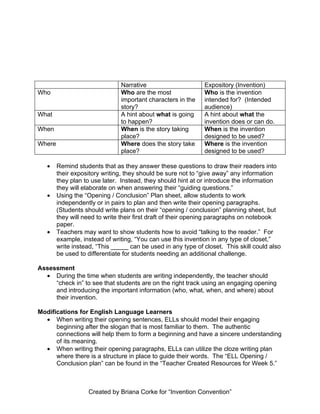
•   Create a three columned chart on the board. Have the students compare and
    contrast the “who, what, when, where” for narratives and expository writing. The
    table below can be used as a guide. See if the students can tell what question is
    answered by each question word in the two different types of writing.


                Created by Briana Corke for “Invention Convention”
Narrative                      Expository (Invention)
Who                            Who are the most               Who is the invention
                               important characters in the    intended for? (Intended
                               story?                         audience)
What                           A hint about what is going     A hint about what the
                               to happen?                     invention does or can do.
When                           When is the story taking       When is the invention
                               place?                         designed to be used?
Where                          Where does the story take      Where is the invention
                               place?                         designed to be used?

   •    Remind students that as they answer these questions to draw their readers into
        their expository writing, they should be sure not to “give away” any information
        they plan to use later. Instead, they should hint at or introduce the information
        they will elaborate on when answering their “guiding questions.”
   •    Using the “Opening / Conclusion” Plan sheet, allow students to work
        independently or in pairs to plan and then write their opening paragraphs.
        (Students should write plans on their “opening / conclusion” planning sheet, but
        they will need to write their first draft of their opening paragraphs on notebook
        paper.
   •    Teachers may want to show students how to avoid “talking to the reader.” For
        example, instead of writing, “You can use this invention in any type of closet,”
        write instead, “This _____ can be used in any type of closet. This skill could also
        be used to differentiate for students needing an additional challenge.

Assessment
  • During the time when students are writing independently, the teacher should
     “check in” to see that students are on the right track using an engaging opening
     and introducing the important information (who, what, when, and where) about
     their invention.

Modifications for English Language Learners
  • When writing their opening sentences, ELLs should model their engaging
      beginning after the slogan that is most familiar to them. The authentic
      connections will help them to form a beginning and have a sincere understanding
      of its meaning.
  • When writing their opening paragraphs, ELLs can utilize the cloze writing plan
      where there is a structure in place to guide their words. The “ELL Opening /
      Conclusion plan” can be found in the “Teacher Created Resources for Week 5.”


                   Created by Briana Corke for “Invention Convention”
Author Info
Briana Corke is a fourth grade teacher at Carrboro Elementary School, part of Chapel
Hill Carrboro City Schools. She has taught kindergarten, first, and second grades, and
is currently teaching fourth grade. Briana has taught both in traditional classrooms, and
Spanish / English Dual Immersion Classrooms. Briana graduated from the University of
North Carolina at Chapel Hill with BA degrees in English and Elementary Education and
a minor in Spanish. She is a 2006 Kenan Fellow. Briana is interested in finding ways to
meaningfully include English Language learners in inquiry science instruction.


                  Created by Briana Corke for “Invention Convention”

Famous slogans

  • 1.
    Expository Writing: Writingan Engaging Opening Weeks 5 Lesson Introduction “Invention Convention” is an integrated project combining learning from language arts, science, and math curriculums allowing students to apply their understandings of magnets and electricity by designing or improving an existing invention. Learning Outcomes • The learner will analyze slogans from famous inventions. • The learner will identify a sound, ability, or description that is unique to their invention. • The learner will write an engaging opening for their expository writing. Curriculum Alignment • Fourth Grade, English Language Arts, Goal 4, Objective 4.06 • Fourth Grade, English Language Arts, Goal 4, Objective 4.07 Classroom Time Required • At least a one-hour time block for the whole group mini lesson is needed, and possibly more time for students to complete their independent writing. Materials Needed • Student Inventor’s Log • Opening / Conclusion Plan • ELL Opening / Conclusion Plan • Printed picture of the Nintendo Wii and Bounty Paper Towels (Google the names and then print the picture) • Possibly, depending how the lesson is facilitated, pictures of other products with their slogans written close by. Pre-Activities • Prior to this lesson, students should have completed the “Focusing Expository Writing.” Activities • Put a picture of the Nintendo Wii on the board and write it’s slogan, “Wii would like to play.” Ask the students to explain the picture and the words. They can work in partners for a minute or two, and then they can share with the group. • Afterwards, help the students to see that this advertising slogan is a “play on words,” or a double entendre that is catchy and describes what you can do with this invention. • Next, put a picture of the Bounty Paper Towels next to it’s slogan, “The quicker, picker upper.” Ask the students to explain the picture and the words. • Afterwards, help the students recognize that this slogan tells what the invention Created by Briana Corke for “Invention Convention”
  • 2.
    does and howit does it better. • Either as a whole group, or in small groups sharing pictures / slogans, expose the students to more inventions with slogans. Have the students identify the purpose behind the slogan. (Also, remind students that although these items seem common and are used everyday, at one point, they were an inventor’s great idea.) Possible slogans include: o Energizer, (bunny,) “It keeps going, and going, and going.” (Describes what it does and why it is helpful.) o Kleenex, (tissues,) “Don’t put a cold in your pocket.” (Describes how it prevents a problem.) o Hoover vacuum, “It eats, as it sweeps, as it cleans.” (Describes what it does.) o Michelin Tires, “A better way forward.” (Describes how it is better.) o Apple Computers, “Think outside the box.” (Play on words) o Yahoo, “Do you, Yahoo?” (Question) o Xbox 360, video games, “Jump in!” o Gillette Razor, “The best a man can get.” (Describes how it is better.) • As a whole group, list all the different slogan strategies that the class has found from the examples. Some include: o A sound the invention makes o Specific description of what the invention does o Describing an interesting ability of the invention o Use an anecdote of how the invention could be used o Telling why the invention is better o Using a play on words that describes the invention o Shows how to prevent a problem o Tells what it will not do. • Explain to the students that they will need a slogan to help their expository writing have an “engaging beginning.” In partners, allow the students to work together to decide on an engaging opening sentence. (You might remind them that at advertising agencies where they write expository articles about their inventions, often a team of people works for weeks to come up with catchy slogans or beginnings for the writing.) Students should record their “catchy beginning” on their “opening / conclusion plan.” • Remind students that expository writing is similar to narrative writing because it is important to give readers some useful information at the beginning. It is important for the opening paragraph to include the who, what, when, and where, but in a different way. • Create a three columned chart on the board. Have the students compare and contrast the “who, what, when, where” for narratives and expository writing. The table below can be used as a guide. See if the students can tell what question is answered by each question word in the two different types of writing. Created by Briana Corke for “Invention Convention”
  • 3.
    Narrative Expository (Invention) Who Who are the most Who is the invention important characters in the intended for? (Intended story? audience) What A hint about what is going A hint about what the to happen? invention does or can do. When When is the story taking When is the invention place? designed to be used? Where Where does the story take Where is the invention place? designed to be used? • Remind students that as they answer these questions to draw their readers into their expository writing, they should be sure not to “give away” any information they plan to use later. Instead, they should hint at or introduce the information they will elaborate on when answering their “guiding questions.” • Using the “Opening / Conclusion” Plan sheet, allow students to work independently or in pairs to plan and then write their opening paragraphs. (Students should write plans on their “opening / conclusion” planning sheet, but they will need to write their first draft of their opening paragraphs on notebook paper. • Teachers may want to show students how to avoid “talking to the reader.” For example, instead of writing, “You can use this invention in any type of closet,” write instead, “This _____ can be used in any type of closet. This skill could also be used to differentiate for students needing an additional challenge. Assessment • During the time when students are writing independently, the teacher should “check in” to see that students are on the right track using an engaging opening and introducing the important information (who, what, when, and where) about their invention. Modifications for English Language Learners • When writing their opening sentences, ELLs should model their engaging beginning after the slogan that is most familiar to them. The authentic connections will help them to form a beginning and have a sincere understanding of its meaning. • When writing their opening paragraphs, ELLs can utilize the cloze writing plan where there is a structure in place to guide their words. The “ELL Opening / Conclusion plan” can be found in the “Teacher Created Resources for Week 5.” Created by Briana Corke for “Invention Convention”
  • 4.
    Author Info Briana Corkeis a fourth grade teacher at Carrboro Elementary School, part of Chapel Hill Carrboro City Schools. She has taught kindergarten, first, and second grades, and is currently teaching fourth grade. Briana has taught both in traditional classrooms, and Spanish / English Dual Immersion Classrooms. Briana graduated from the University of North Carolina at Chapel Hill with BA degrees in English and Elementary Education and a minor in Spanish. She is a 2006 Kenan Fellow. Briana is interested in finding ways to meaningfully include English Language learners in inquiry science instruction. Created by Briana Corke for “Invention Convention”