Family Relationships “ In a united family,  happiness springs of itself.” Chinese Proverb Is your family united?  How can you help unite and strengthen your family?
What are  the Secrets  of a Strong Family?
Frequently, short Appreciative of invisible work Deuche’s Law – Behavior is Contagious Don’t give up too quickly, it takes 4 weeks. Appreciation
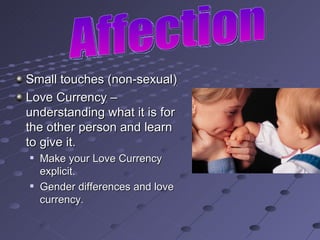
Small touches (non-sexual) Love Currency – understanding what it is for the other person and learn to give it. Make your Love Currency explicit. Gender differences and love currency. Affection
They go with each other when one of them has an activity. We should also tell them about our day – then we are sharing. Commitment = How you spend your time and money. The commitment is in writing – a mission statement.  Decide what you want to stand for.  Start with one sentence. Mission statements change as the family changes. Commitment
Quality time is a function of quantity time. Peak experiences Vacations Camping Continuous experiences Eating together Chores Doing homework The purpose of the task is to strengthen the relationship. Time Together
Strong families can solve problems in creative ways. Happy families have the same number of arguments, but they have spaces filled with happy times. It is ok to have problems, but the key is to solve them quickly. The longer you are in an argument, the harder it is to get out.  Why? Creative Problem Solving
The goal of communication is by far more important than the techniques. If my goal is to win….bad If my goal is to understand or help….good  As we communicate, we need to be aware of our goals.  If it is a good goal, our communication will go well. Techniques are good, but tend to be mechanical.  Say it in your own language. Communication
Family Placement Activity Students who are: The oldest child go to the NE corner of room. The youngest child go to the SE corner. The middle child go to the SW corner. Each group is to list the advantages and disadvantages of their birth order on a blank piece of paper.  Each group will present their findings.
Birth Order The order in which children are born into a family influences the development of the children. Oldest children bear the burden of the parents’ heaviest expectations and also of the parents’ inexperience in raising children. Second or third children are generally treated in a more relaxed way by the parents. Youngest children often have a more difficult time in making the transition to adulthood.
Oldest Child Usually set up as an example to the other children. Treated more like an adult by his/her parents. A high achiever. Given and accepts more responsibility than the other children. Usually college-bound. Independent. Affectionate.
Middle Child May work extra-hard to get recognition. Is usually a peacemaker. Is somewhat average in schoolwork, but is an all-around good student. Is usually a calm, even-tempered adult.
Youngest Child Gets a lot of attention, along with a lot of bossing. May be spoiled. Usually matures quickly. May be undisciplined and irresponsible. Is easy-going about school. Likes to associate with someone who takes charge of situations.
Toothpaste Activity Student draws a line on the black paper with the toothpaste for every degrading thing I say and a circle for every positive comment. Give the paper to another student. Have this student put the toothpaste back into the tube of toothpaste. Once  we  have  said  something,  we  can  never  take  the  words  back –  they  have  left  their  mark!
Sibling Rivalry Competition among children of the same family for their parents’ affections or for dominance. It can occur at any age, even into adult life. Next to the parent-child relationship, the sibling relationship is probably the strongest.

Family relationships

  • 1.
    Family Relationships “In a united family, happiness springs of itself.” Chinese Proverb Is your family united? How can you help unite and strengthen your family?
  • 2.
    What are the Secrets of a Strong Family?
  • 3.
    Frequently, short Appreciativeof invisible work Deuche’s Law – Behavior is Contagious Don’t give up too quickly, it takes 4 weeks. Appreciation
  • 4.
    Small touches (non-sexual)Love Currency – understanding what it is for the other person and learn to give it. Make your Love Currency explicit. Gender differences and love currency. Affection
  • 5.
    They go witheach other when one of them has an activity. We should also tell them about our day – then we are sharing. Commitment = How you spend your time and money. The commitment is in writing – a mission statement. Decide what you want to stand for. Start with one sentence. Mission statements change as the family changes. Commitment
  • 6.
    Quality time isa function of quantity time. Peak experiences Vacations Camping Continuous experiences Eating together Chores Doing homework The purpose of the task is to strengthen the relationship. Time Together
  • 7.
    Strong families cansolve problems in creative ways. Happy families have the same number of arguments, but they have spaces filled with happy times. It is ok to have problems, but the key is to solve them quickly. The longer you are in an argument, the harder it is to get out. Why? Creative Problem Solving
  • 8.
    The goal ofcommunication is by far more important than the techniques. If my goal is to win….bad If my goal is to understand or help….good As we communicate, we need to be aware of our goals. If it is a good goal, our communication will go well. Techniques are good, but tend to be mechanical. Say it in your own language. Communication
  • 9.
    Family Placement ActivityStudents who are: The oldest child go to the NE corner of room. The youngest child go to the SE corner. The middle child go to the SW corner. Each group is to list the advantages and disadvantages of their birth order on a blank piece of paper. Each group will present their findings.
  • 10.
    Birth Order Theorder in which children are born into a family influences the development of the children. Oldest children bear the burden of the parents’ heaviest expectations and also of the parents’ inexperience in raising children. Second or third children are generally treated in a more relaxed way by the parents. Youngest children often have a more difficult time in making the transition to adulthood.
  • 11.
    Oldest Child Usuallyset up as an example to the other children. Treated more like an adult by his/her parents. A high achiever. Given and accepts more responsibility than the other children. Usually college-bound. Independent. Affectionate.
  • 12.
    Middle Child Maywork extra-hard to get recognition. Is usually a peacemaker. Is somewhat average in schoolwork, but is an all-around good student. Is usually a calm, even-tempered adult.
  • 13.
    Youngest Child Getsa lot of attention, along with a lot of bossing. May be spoiled. Usually matures quickly. May be undisciplined and irresponsible. Is easy-going about school. Likes to associate with someone who takes charge of situations.
  • 14.
    Toothpaste Activity Studentdraws a line on the black paper with the toothpaste for every degrading thing I say and a circle for every positive comment. Give the paper to another student. Have this student put the toothpaste back into the tube of toothpaste. Once we have said something, we can never take the words back – they have left their mark!
  • 15.
    Sibling Rivalry Competitionamong children of the same family for their parents’ affections or for dominance. It can occur at any age, even into adult life. Next to the parent-child relationship, the sibling relationship is probably the strongest.