Emery’s Mediation Study
Used a high conflict group – families who had filed

for contested custody hearing
Used random assignment (the magic of science) –
a flip of a coin determined whether families went
to mediation or adversary settlement
Sample was young and low income
Mediation was short-term (5 hr average) and
problem-focused but sensitive to emotions,
especially grief
Was a longitudinal study – families were followed
for 12 years
Mediation Kept Most Families Out of Court
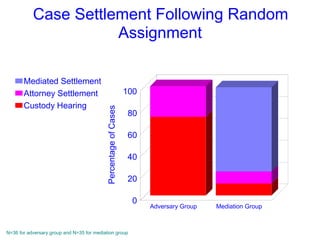
If the coin came up tails and they stayed in the

adversary system, 75% of families appeared before a
judge
But if the coin came up heads, less than 20%
appeared before a judge.
Even when mediation failed, parents tended to settle
out of court with the help of their lawyers.
What happens to angry families after they leave a
mediator’s office – and years later?
Mediator’s hope we’ve planted a seed. Have we?
Yes. If the coin came up heads, 5 hours of

mediation caused nonresidential parents to see
their children much more often 12 years later
Compare these rates to the dramatic drop off in
contact after the typical divorce in America
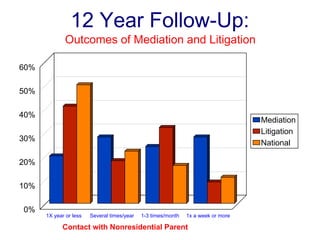
For example, 28% of nonresident parents who
mediated saw their children weekly 12 years later
compared to 9% who litigated and 11% in the
national averages
Changes in Telephone Contact
Were Even More Dramatic
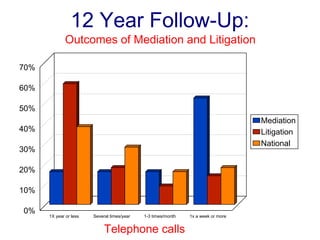
52% of nonresident parents who mediated talked

with their children weekly 12 years later
This compares with 14% of nonresident parents who
went to court and 18% in the national averages
Because of the random assignment, we know that 5
hours of mediation caused this difference
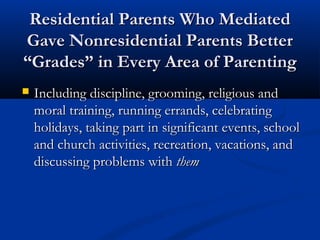
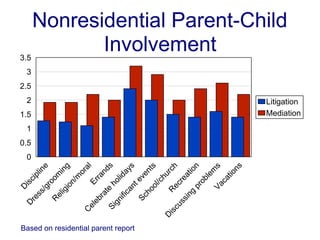
Residential Parents Who Mediated Gave Nonresidential Parents
Better “Grades” in Every Area of Parenting

Including discipline, grooming, religious and moral

training, running errands, celebrating holidays,
taking part in significant events, school and church
activities, recreation, vacations, and discussing
problems with them
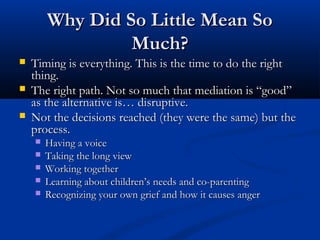
Why Did So Little Mean So Much?
Timing is everything. This is the time to do the

right thing.
The right path. Not so much that mediation is
“good” as the alternative is… disruptive.
Not the decisions reached (they were the same) but
the process.
Having a voice
 Taking the long view
 Working together
 Learning about children’s needs and co-parenting
 Recognizing your own grief and how it causes anger

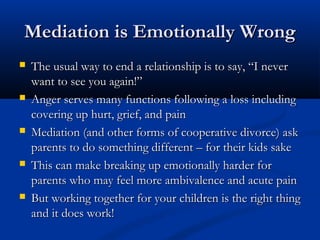
Mediation is Emotionally Wrong
 The usual way to end a relationship is to say, “I never

want to see you again!”
 Anger serves many functions following a loss including
covering up hurt, grief, and pain
 Mediation (and other forms of cooperative divorce) ask
parents to do something different – for their kids sake
 This can make breaking up emotionally harder for
parents who may feel more ambivalence and acute
pain
 But working together for your children is the right
thing and it does work!
Primary Reference
Emery, R.E., Laumann-Billings, L., Waldron,

M., Sbarra, D.A., and Dillon, P. (2001). Child
custody mediation and litigation: Custody,
contact, and co-parenting 12 years after initial
dispute resolution. Journal of Consulting and
Clinical Psychology, 69, 323-332.
Mediation Services

Visit us @ www.divorcethesmartway.ca

Emery’s mediation study - Divorce the Smartway

  • 1.
    Emery’s Mediation Study Useda high conflict group – families who had filed for contested custody hearing Used random assignment (the magic of science) – a flip of a coin determined whether families went to mediation or adversary settlement Sample was young and low income Mediation was short-term (5 hr average) and problem-focused but sensitive to emotions, especially grief Was a longitudinal study – families were followed for 12 years
  • 2.
    Mediation Kept MostFamilies Out of Court If the coin came up tails and they stayed in the adversary system, 75% of families appeared before a judge But if the coin came up heads, less than 20% appeared before a judge. Even when mediation failed, parents tended to settle out of court with the help of their lawyers.
  • 4.
    What happens toangry families after they leave a mediator’s office – and years later? Mediator’s hope we’ve planted a seed. Have we? Yes. If the coin came up heads, 5 hours of mediation caused nonresidential parents to see their children much more often 12 years later Compare these rates to the dramatic drop off in contact after the typical divorce in America For example, 28% of nonresident parents who mediated saw their children weekly 12 years later compared to 9% who litigated and 11% in the national averages
  • 6.
    Changes in TelephoneContact Were Even More Dramatic 52% of nonresident parents who mediated talked with their children weekly 12 years later This compares with 14% of nonresident parents who went to court and 18% in the national averages Because of the random assignment, we know that 5 hours of mediation caused this difference
  • 8.
    Residential Parents WhoMediated Gave Nonresidential Parents Better “Grades” in Every Area of Parenting Including discipline, grooming, religious and moral training, running errands, celebrating holidays, taking part in significant events, school and church activities, recreation, vacations, and discussing problems with them
  • 10.
    Why Did SoLittle Mean So Much? Timing is everything. This is the time to do the right thing. The right path. Not so much that mediation is “good” as the alternative is… disruptive. Not the decisions reached (they were the same) but the process. Having a voice  Taking the long view  Working together  Learning about children’s needs and co-parenting  Recognizing your own grief and how it causes anger 
  • 11.
    Mediation is EmotionallyWrong  The usual way to end a relationship is to say, “I never want to see you again!”  Anger serves many functions following a loss including covering up hurt, grief, and pain  Mediation (and other forms of cooperative divorce) ask parents to do something different – for their kids sake  This can make breaking up emotionally harder for parents who may feel more ambivalence and acute pain  But working together for your children is the right thing and it does work!
  • 12.
    Primary Reference Emery, R.E.,Laumann-Billings, L., Waldron, M., Sbarra, D.A., and Dillon, P. (2001). Child custody mediation and litigation: Custody, contact, and co-parenting 12 years after initial dispute resolution. Journal of Consulting and Clinical Psychology, 69, 323-332.
  • 13.
    Mediation Services Visit us@ www.divorcethesmartway.ca