From: Content Area Literacy
By: Bean, Readence and Baldwin
False Assumptions of Content Area
Teachers
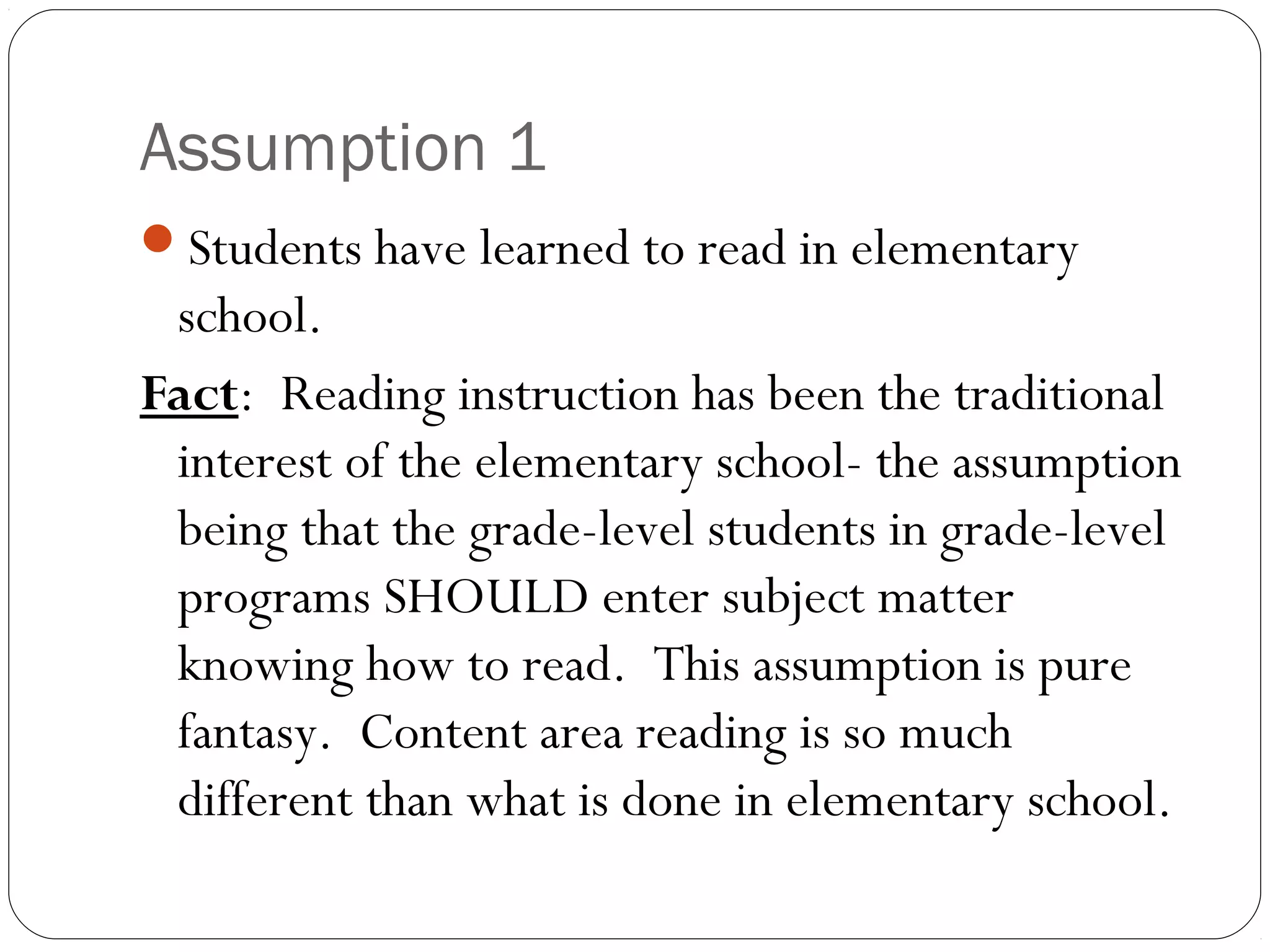
Assumption 1
Students have learned to read in elementary
school.
Fact: Reading instruction has been the traditional
interest of the elementary school- the assumption
being that the grade-level students in grade-level
programs SHOULD enter subject matter
knowing how to read. This assumption is pure
fantasy. Content area reading is so much
different than what is done in elementary school.
Assumption 2
Students have sufficient prior knowledge
to cope effectively with the important
information in content textbooks.
Fact: If material is foreign to your personal
experiences, adequate comprehension
won’t occur. Students usually lack
experiential backgrounds and are
unfamiliar with the vocabulary concepts in
content area.
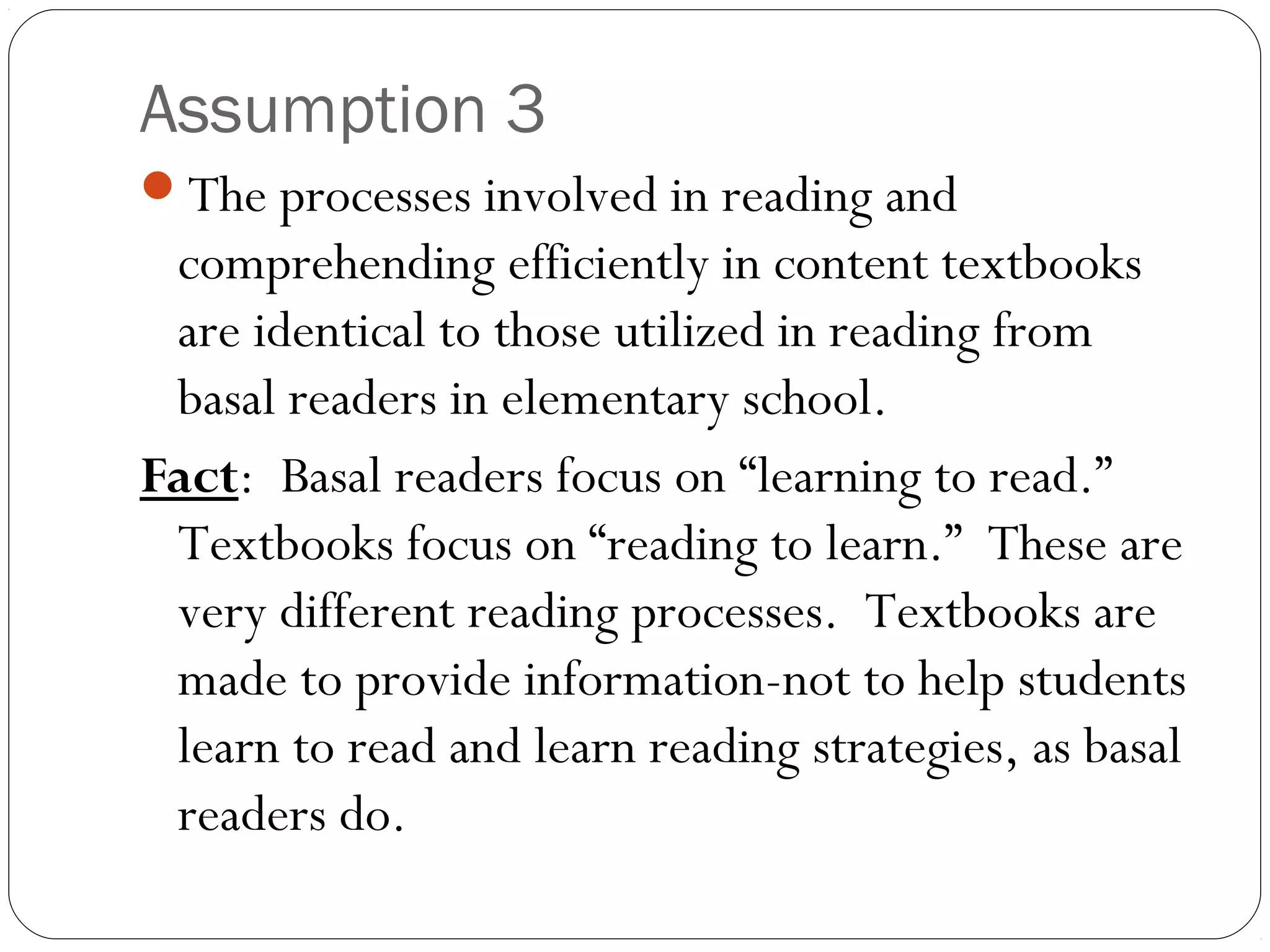
Assumption 3
The processes involved in reading and
comprehending efficiently in content textbooks
are identical to those utilized in reading from
basal readers in elementary school.
Fact: Basal readers focus on “learning to read.”
Textbooks focus on “reading to learn.” These are
very different reading processes. Textbooks are
made to provide information-not to help students
learn to read and learn reading strategies, as basal
readers do.
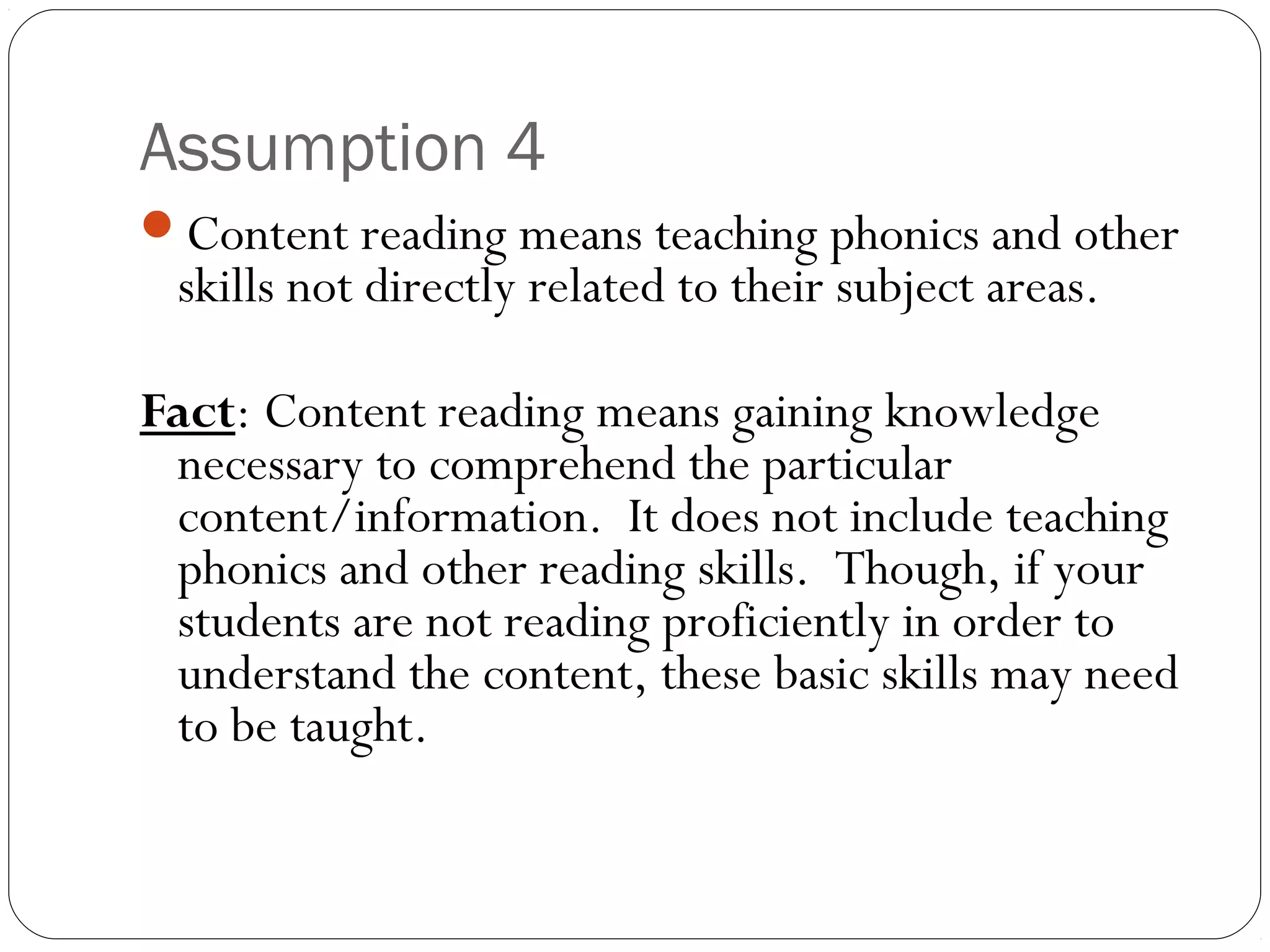
Assumption 4
Content reading means teaching phonics and other
skills not directly related to their subject areas.
Fact: Content reading means gaining knowledge
necessary to comprehend the particular
content/information. It does not include teaching
phonics and other reading skills. Though, if your
students are not reading proficiently in order to
understand the content, these basic skills may need
to be taught.
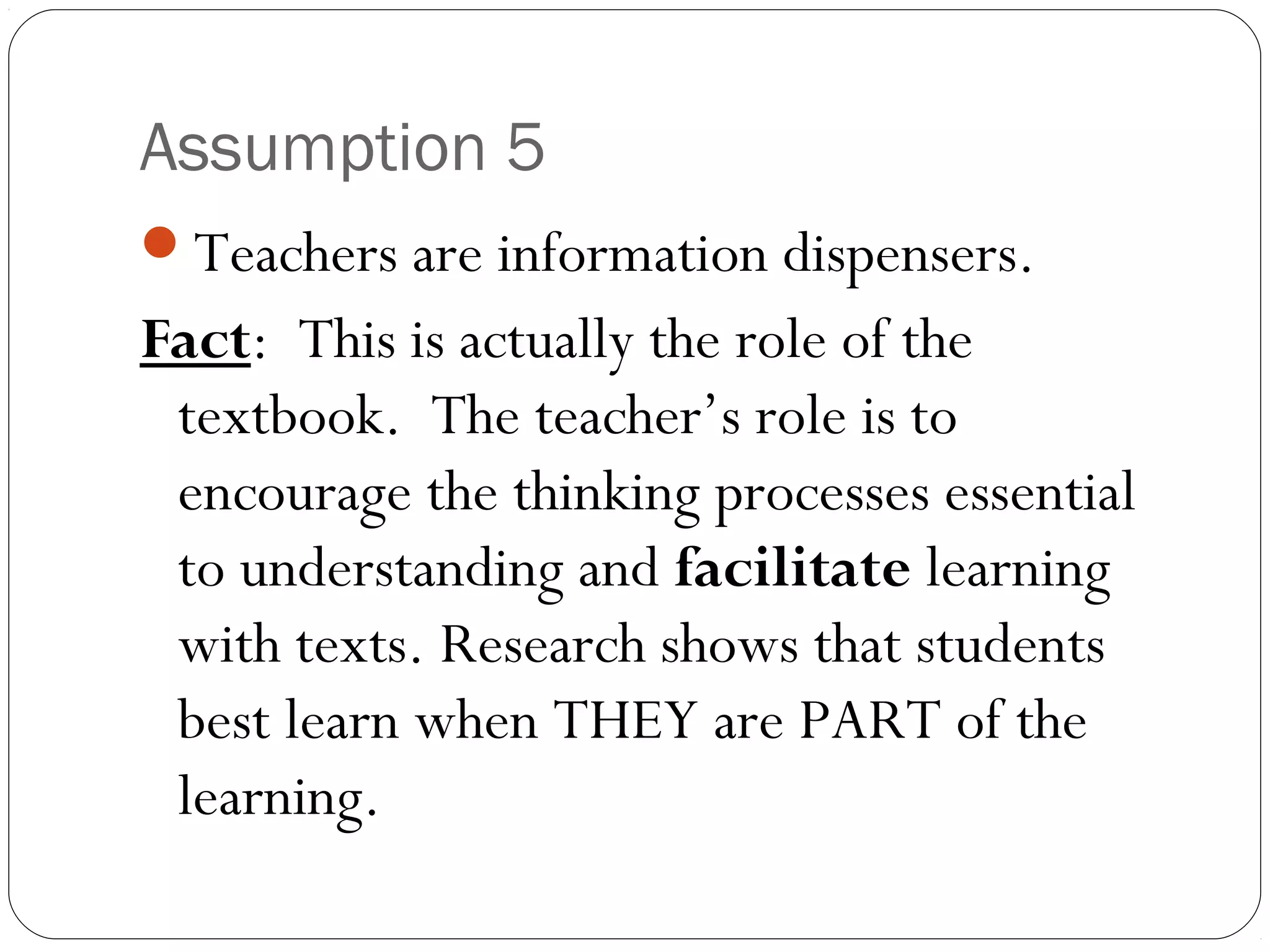
Assumption 5
Teachers are information dispensers.
Fact: This is actually the role of the
textbook. The teacher’s role is to
encourage the thinking processes essential
to understanding and facilitate learning
with texts. Research shows that students
best learn when THEY are PART of the
learning.
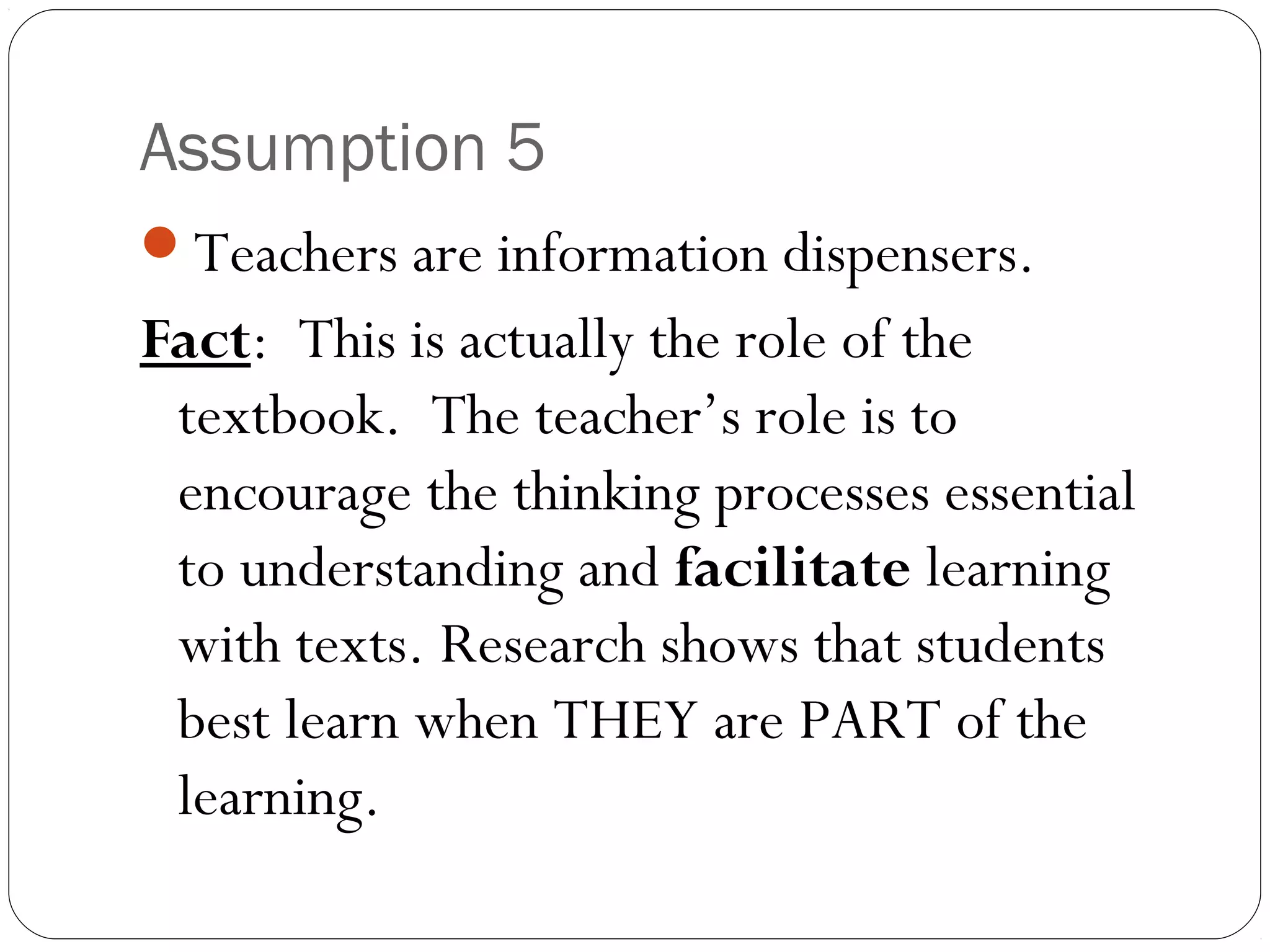
Assumption 5
Teachers are information dispensers.
Fact: This is actually the role of the
textbook. The teacher’s role is to
encourage the thinking processes essential
to understanding and facilitate learning
with texts. Research shows that students
best learn when THEY are PART of the
learning.

False Assumptions

  • 1.
    From: Content AreaLiteracy By: Bean, Readence and Baldwin False Assumptions of Content Area Teachers
  • 2.
    Assumption 1 Students havelearned to read in elementary school. Fact: Reading instruction has been the traditional interest of the elementary school- the assumption being that the grade-level students in grade-level programs SHOULD enter subject matter knowing how to read. This assumption is pure fantasy. Content area reading is so much different than what is done in elementary school.
  • 3.
    Assumption 2 Students havesufficient prior knowledge to cope effectively with the important information in content textbooks. Fact: If material is foreign to your personal experiences, adequate comprehension won’t occur. Students usually lack experiential backgrounds and are unfamiliar with the vocabulary concepts in content area.
  • 4.
    Assumption 3 The processesinvolved in reading and comprehending efficiently in content textbooks are identical to those utilized in reading from basal readers in elementary school. Fact: Basal readers focus on “learning to read.” Textbooks focus on “reading to learn.” These are very different reading processes. Textbooks are made to provide information-not to help students learn to read and learn reading strategies, as basal readers do.
  • 5.
    Assumption 4 Content readingmeans teaching phonics and other skills not directly related to their subject areas. Fact: Content reading means gaining knowledge necessary to comprehend the particular content/information. It does not include teaching phonics and other reading skills. Though, if your students are not reading proficiently in order to understand the content, these basic skills may need to be taught.
  • 6.
    Assumption 5 Teachers areinformation dispensers. Fact: This is actually the role of the textbook. The teacher’s role is to encourage the thinking processes essential to understanding and facilitate learning with texts. Research shows that students best learn when THEY are PART of the learning.
  • 7.
    Assumption 5 Teachers areinformation dispensers. Fact: This is actually the role of the textbook. The teacher’s role is to encourage the thinking processes essential to understanding and facilitate learning with texts. Research shows that students best learn when THEY are PART of the learning.