Reading Interventions
Diagnosis and Remediation of Literacy Disorders
(EDLI 636 – Spring 2014)

Dr. Hsu

Dallas Thompson, due – 2/18/2014
Requirement
Explain the structure of
reading interventions
Reading Interventions
The idea of reading intervention stems from the need to
address struggling readers in an individualized and methodical
way to ensure that all students receive instruction that helps
them achieve proficiency in literacy.
Literacy is the foundation of education and is essential for
academic success and success after school. Students who are
deficient in literacy skills will be unable to perform at an
adequate level to meet educational standards.
With the introduction of the CCSS, and the broader
implications of being capable of competing in a global society, it
is imperative that measures are implemented that give each
student an opportunity for success.
Reading Interventions
The assigned reading offers multiple techniques to address
specific areas of literacy, however, in a broad sense, effective
reading interventions must have several basic characteristics:
1.

Balanced with multiple theoretical perspectives and have a practical
justification for each component

2.

Be based on assessment and have multiple goals and contexts

3.

Include explicit and specific evidence based teaching goals

4.

Be done on a daily basis and support individual reading growth

5.

Position the teacher as the decision maker, but include staff
development components with reflection/discussion of practices

6.

Provide flexibility for individualized instruction and assessment
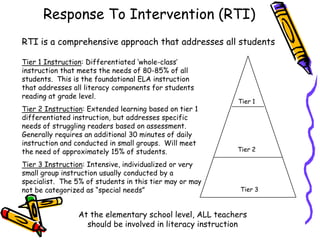
Response To Intervention (RTI)
RTI is a comprehensive approach that addresses all students
Tier 1 Instruction: Differentiated „whole-class‟
instruction that meets the needs of 80-85% of all
students. This is the foundational ELA instruction
that addresses all literacy components for students
reading at grade level.
Tier 2 Instruction: Extended learning based on tier 1
differentiated instruction, but addresses specific
needs of struggling readers based on assessment.
Generally requires an additional 30 minutes of daily
instruction and conducted in small groups. Will meet
the need of approximately 15% of students.
Tier 3 Instruction: Intensive, individualized or very
small group instruction usually conducted by a
specialist. The 5% of students in this tier may or may
not be categorized as “special needs”

Tier 1

Tier 2

Tier 3

At the elementary school level, ALL teachers
should be involved in literacy instruction
Reading Intervention Takeaway
As someone with no background in education, or any practical
experience to compare the techniques outlined in the assignment
to, I can only comment on my perspective on the value of what
I‟ve learned from the reading and my understanding of the
theories of reading interventions.
Personally, I believe the RTI approach is excellent. The value of
the program is its flexibility and comprehensive format that
takes into account specific methods to address students at all
levels.
The critical nature of literacy and its role in, not just academic
success, but learning in general requires an evidence based
assessment approach that helps to identify and address
struggling readers as early in their academic careers as possible.
Reading Intervention Takeaway
(cont.)
To be completely candid, I assumed a similar system had always
been in place and I‟m somewhat surprised that this is somewhat
of a recent development.

I‟ve observed the public debate about declining student scores
and the implementation of the CCSS as somewhat of an outsider.
One of the questions raised in the reading was of particular
concern to me…the question asked:

“Do teachers have the will to teach struggling readers?”
For me, this is the very essence of what we, as educators, should
be seeking to do. The importance of literacy, not only
individually, but collectively as a nation, will determine our
future.
I‟m a firm believer in the old saying that a chain is only
as strong as its weakest link. If we fail to holistically
develop our human capital, we will have difficulty
participating in the future global economy.

Week 4 assignment 2 (d. thompson)

  • 1.
    Reading Interventions Diagnosis andRemediation of Literacy Disorders (EDLI 636 – Spring 2014) Dr. Hsu Dallas Thompson, due – 2/18/2014
  • 2.
    Requirement Explain the structureof reading interventions
  • 3.
    Reading Interventions The ideaof reading intervention stems from the need to address struggling readers in an individualized and methodical way to ensure that all students receive instruction that helps them achieve proficiency in literacy. Literacy is the foundation of education and is essential for academic success and success after school. Students who are deficient in literacy skills will be unable to perform at an adequate level to meet educational standards. With the introduction of the CCSS, and the broader implications of being capable of competing in a global society, it is imperative that measures are implemented that give each student an opportunity for success.
  • 4.
    Reading Interventions The assignedreading offers multiple techniques to address specific areas of literacy, however, in a broad sense, effective reading interventions must have several basic characteristics: 1. Balanced with multiple theoretical perspectives and have a practical justification for each component 2. Be based on assessment and have multiple goals and contexts 3. Include explicit and specific evidence based teaching goals 4. Be done on a daily basis and support individual reading growth 5. Position the teacher as the decision maker, but include staff development components with reflection/discussion of practices 6. Provide flexibility for individualized instruction and assessment
  • 5.
    Response To Intervention(RTI) RTI is a comprehensive approach that addresses all students Tier 1 Instruction: Differentiated „whole-class‟ instruction that meets the needs of 80-85% of all students. This is the foundational ELA instruction that addresses all literacy components for students reading at grade level. Tier 2 Instruction: Extended learning based on tier 1 differentiated instruction, but addresses specific needs of struggling readers based on assessment. Generally requires an additional 30 minutes of daily instruction and conducted in small groups. Will meet the need of approximately 15% of students. Tier 3 Instruction: Intensive, individualized or very small group instruction usually conducted by a specialist. The 5% of students in this tier may or may not be categorized as “special needs” Tier 1 Tier 2 Tier 3 At the elementary school level, ALL teachers should be involved in literacy instruction
  • 6.
    Reading Intervention Takeaway Assomeone with no background in education, or any practical experience to compare the techniques outlined in the assignment to, I can only comment on my perspective on the value of what I‟ve learned from the reading and my understanding of the theories of reading interventions. Personally, I believe the RTI approach is excellent. The value of the program is its flexibility and comprehensive format that takes into account specific methods to address students at all levels. The critical nature of literacy and its role in, not just academic success, but learning in general requires an evidence based assessment approach that helps to identify and address struggling readers as early in their academic careers as possible.
  • 7.
    Reading Intervention Takeaway (cont.) Tobe completely candid, I assumed a similar system had always been in place and I‟m somewhat surprised that this is somewhat of a recent development. I‟ve observed the public debate about declining student scores and the implementation of the CCSS as somewhat of an outsider. One of the questions raised in the reading was of particular concern to me…the question asked: “Do teachers have the will to teach struggling readers?” For me, this is the very essence of what we, as educators, should be seeking to do. The importance of literacy, not only individually, but collectively as a nation, will determine our future. I‟m a firm believer in the old saying that a chain is only as strong as its weakest link. If we fail to holistically develop our human capital, we will have difficulty participating in the future global economy.