Mobile apps-user interaction measurement 
Prepared by 
Salah Amean Ahmmed Saeed 
Source: 1-Falling Asleep with Angry Birds, Facebook and 
Kindle – 
A Large Scale Study on Mobile Application Usage, by Matthias 
Böhmer 
& 
Apps ecosystem 
Presented at 
Prof. Choi Kae Won-Lab 
1
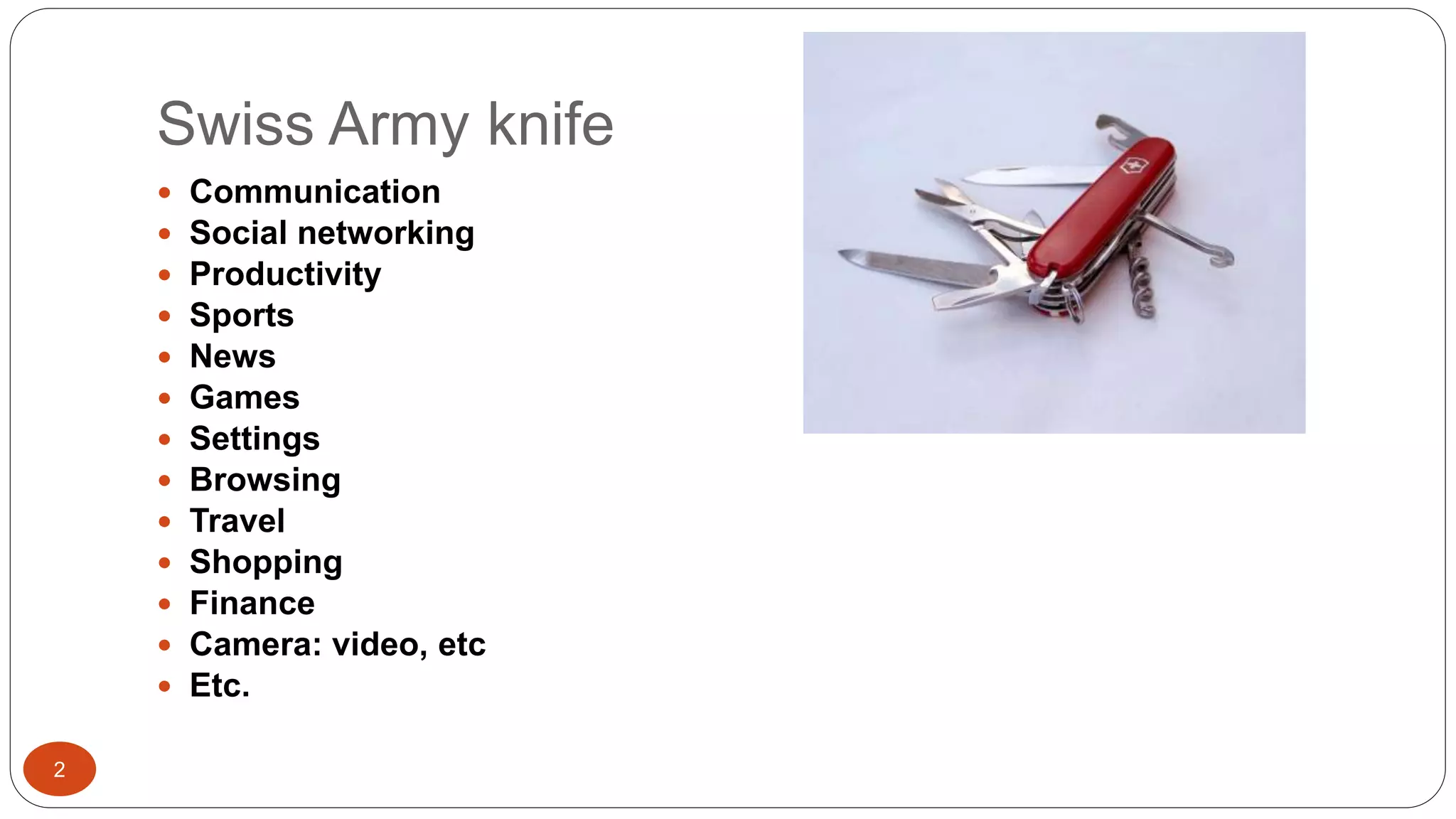
Swiss Army knife 
 Communication 
 Social networking 
 Productivity 
 Sports 
 News 
 Games 
 Settings 
 Browsing 
 Travel 
 Shopping 
 Finance 
 Camera: video, etc 
 Etc. 
2
Big Deal ? 
 Millions of Devices require apps. 
 Apps require developers 
 Developers Need to be paid 
 Apps need to be stored somewhere where 
 Huge demand on knowledge of usage behavior…(why?) 
 Essential for understanding usage pattern 
 In order to customize services 
 Provide specific users with specific apps recommendations 
 This knowledge could be utilized by app stores to cluster apps 
according to the contextual knowledge 
3
User Behavour 
4 
 How long does each interaction with an app last? 
 Less than a minute 
 More than a minute and less than 5 minutes 
 Does this vary by application category? 
 Social networking versus alarm or weather app 
 If so, which categories inspire the longest interactions with their 
users?
Contextual description 
 Example: 
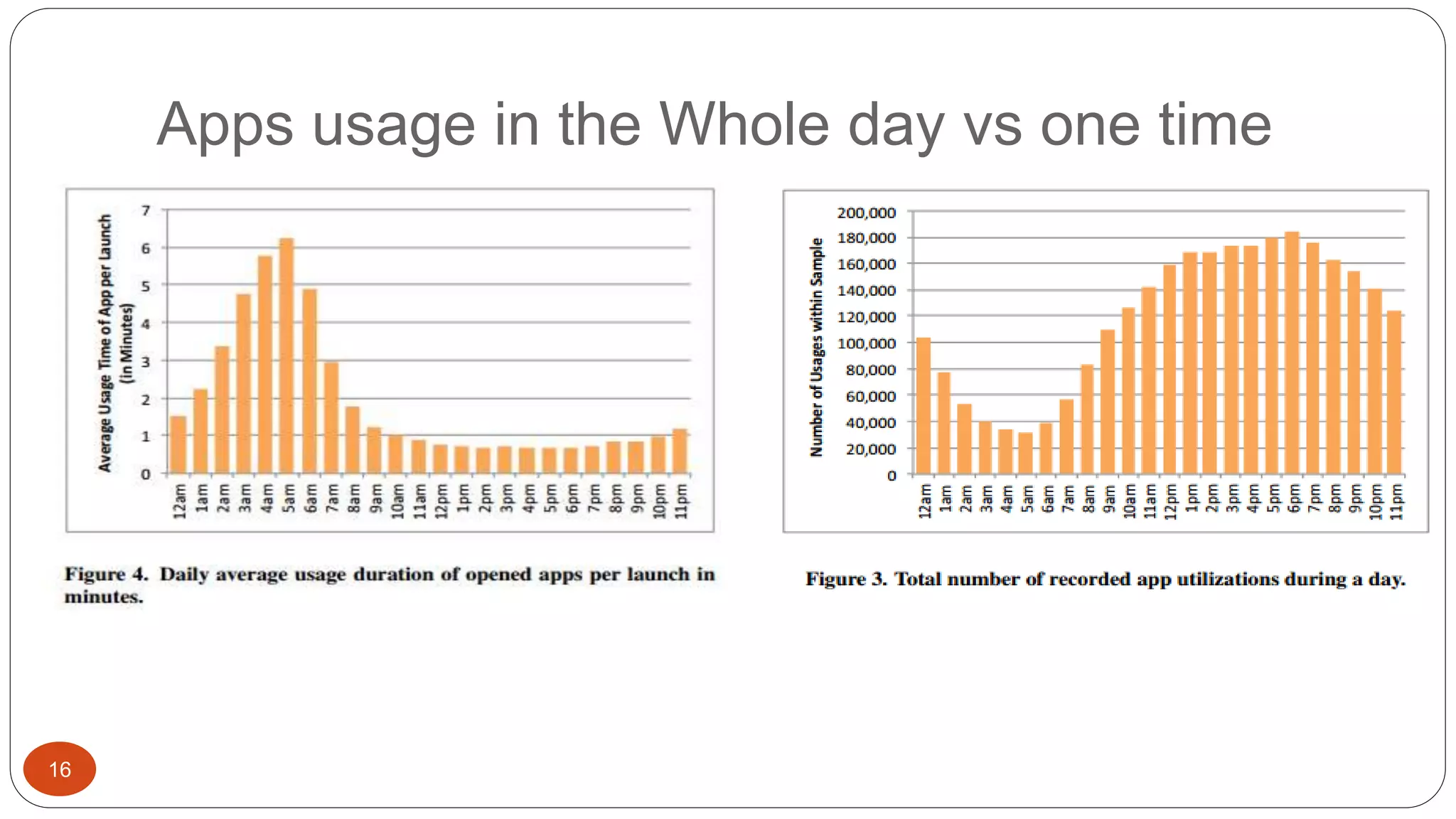
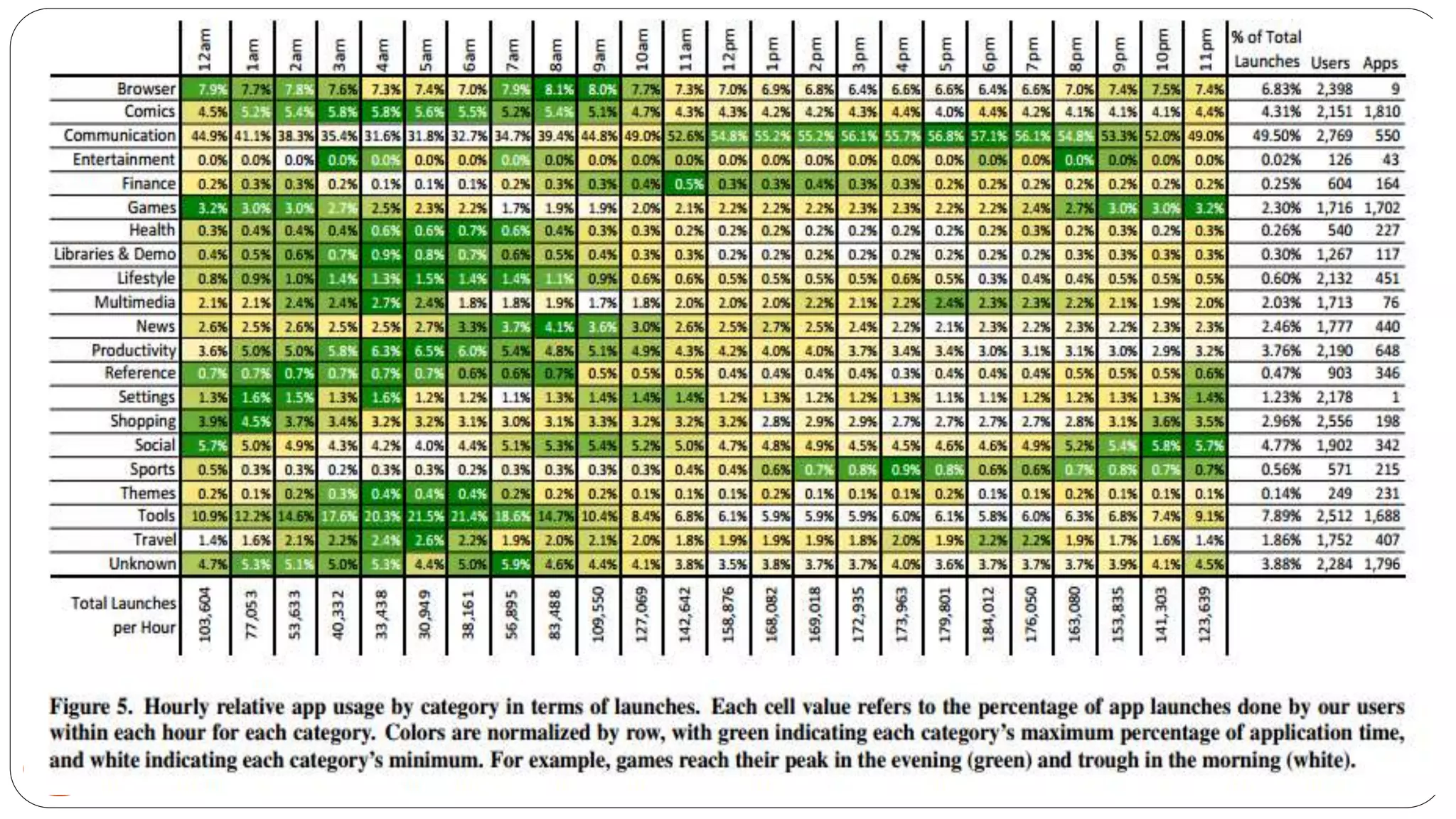
 News app is highly probable to be checked morning 
 Games in the evening 
 From this we know that certain apps are likely to be used at specific 
time 
 So far there is no user behavour study 
5
Contextual description 
 How does the user’s context – e.g. location and time of day – affect 
her app choices? 
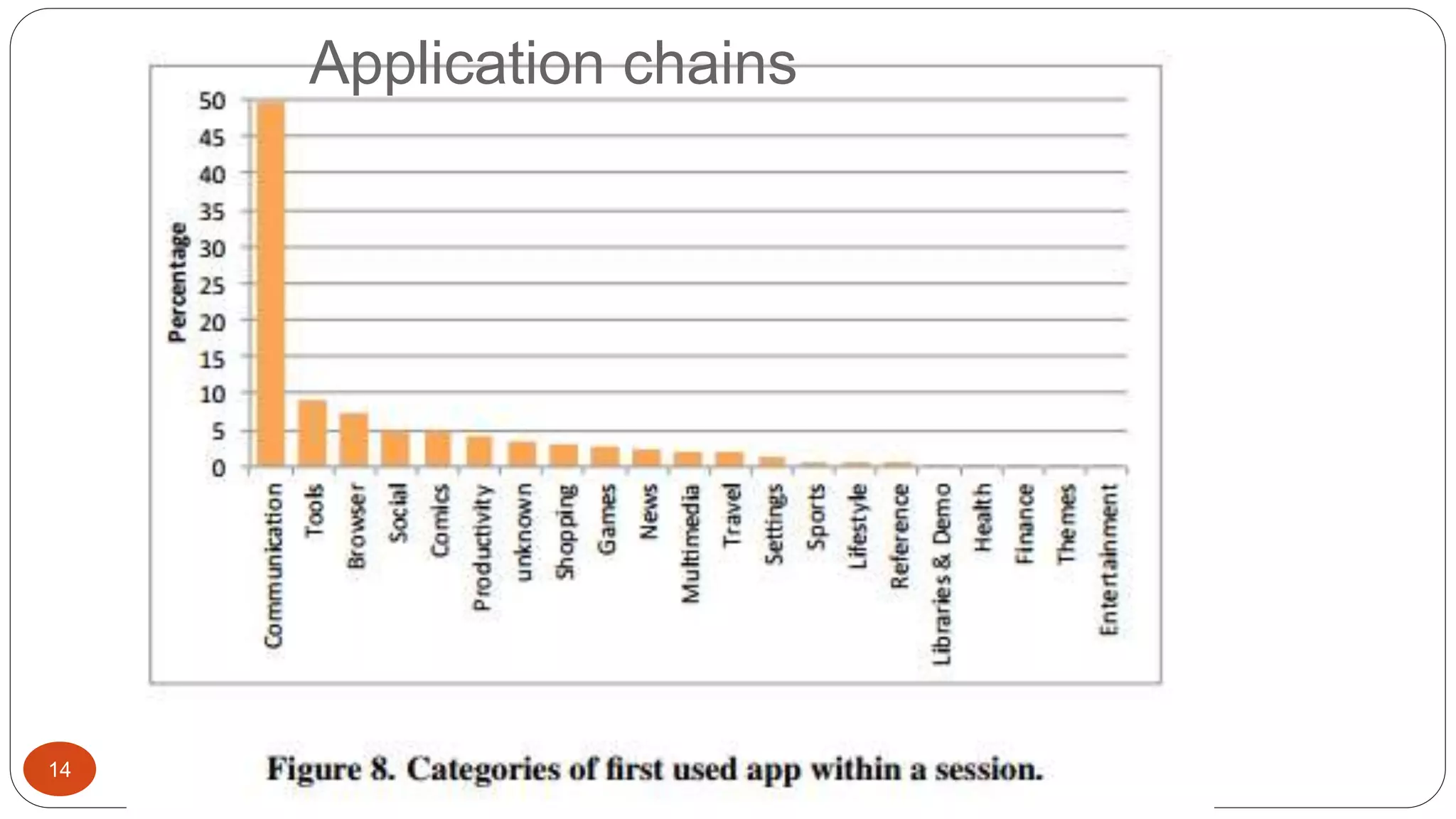
 What type of app is opened first? 
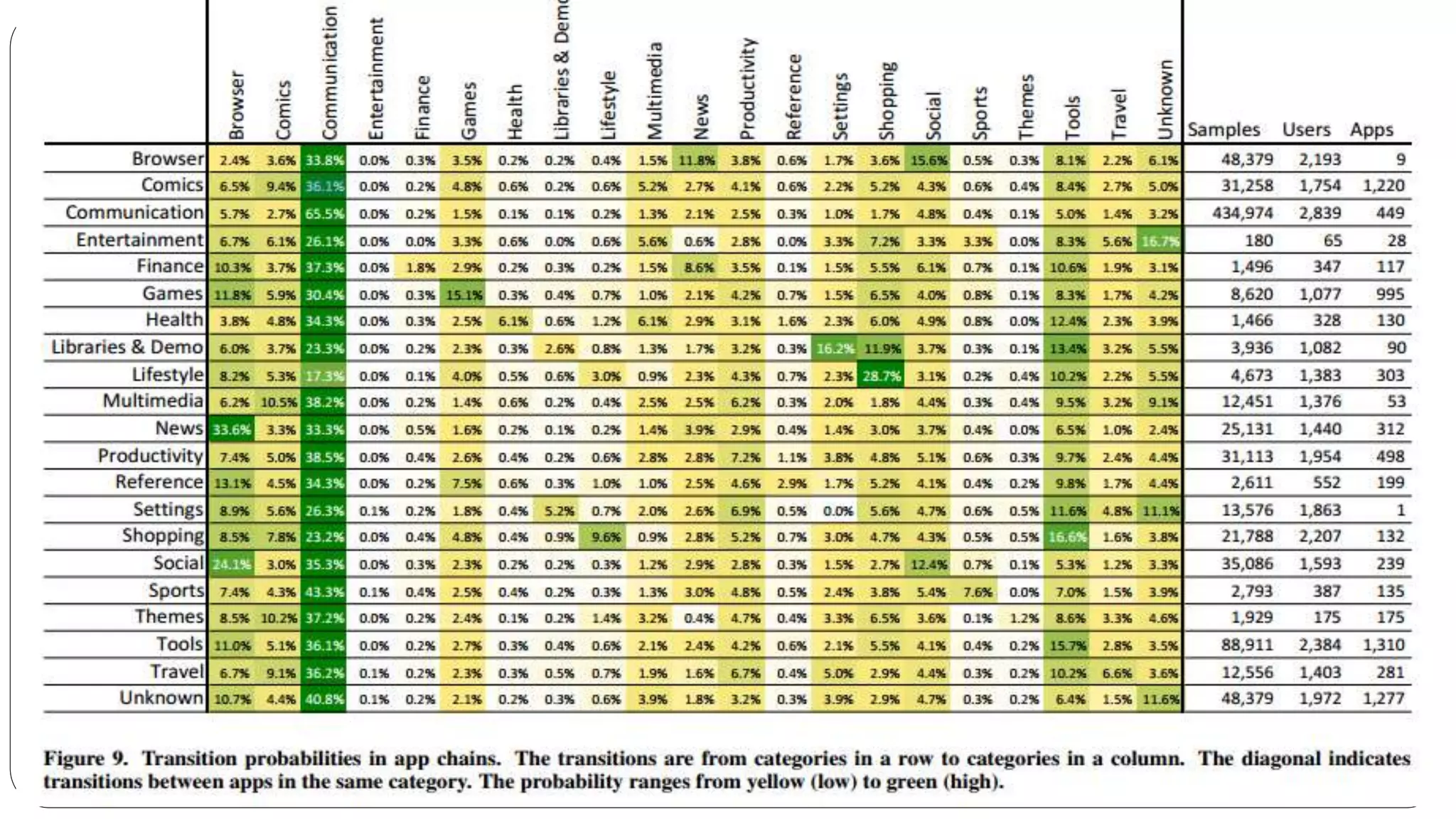
 Does the opening of one application predict the opening of 
another? 
 The interest of Böhmer et al.: 
 Is to provide data from a large-scale study that begins 
 to answer these basic app usage questions (especially those related to 
contextual usage.) 
6
Appazaar and AppSensor 
7 
 Previous needs are translated as Usage pattern which are 
gathered by Appazaar 
 Which was studied by Böhmer et al 
 Is used to recommend apps based on the Appstores gathered data 
 Based on the user’s current and past locations and app usage, the 
system recommends apps that might be of interest to the user. 
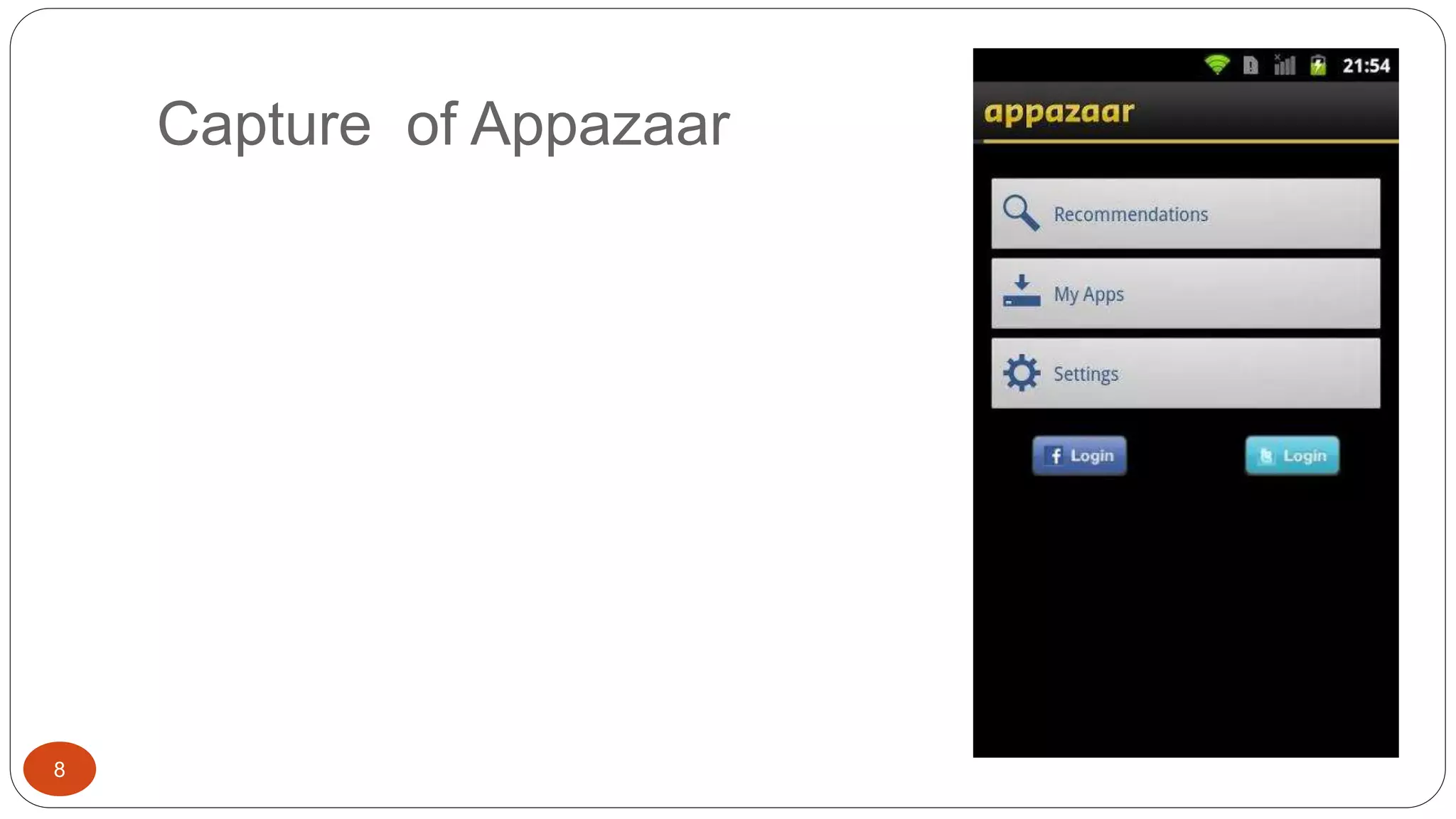
 Within the Appazaar app AppSensor, that does the job vital to this 
research of measuring which apps are used in which contexts.
Capture of Appazaar 
8
Life cycle of mobile app 
9 
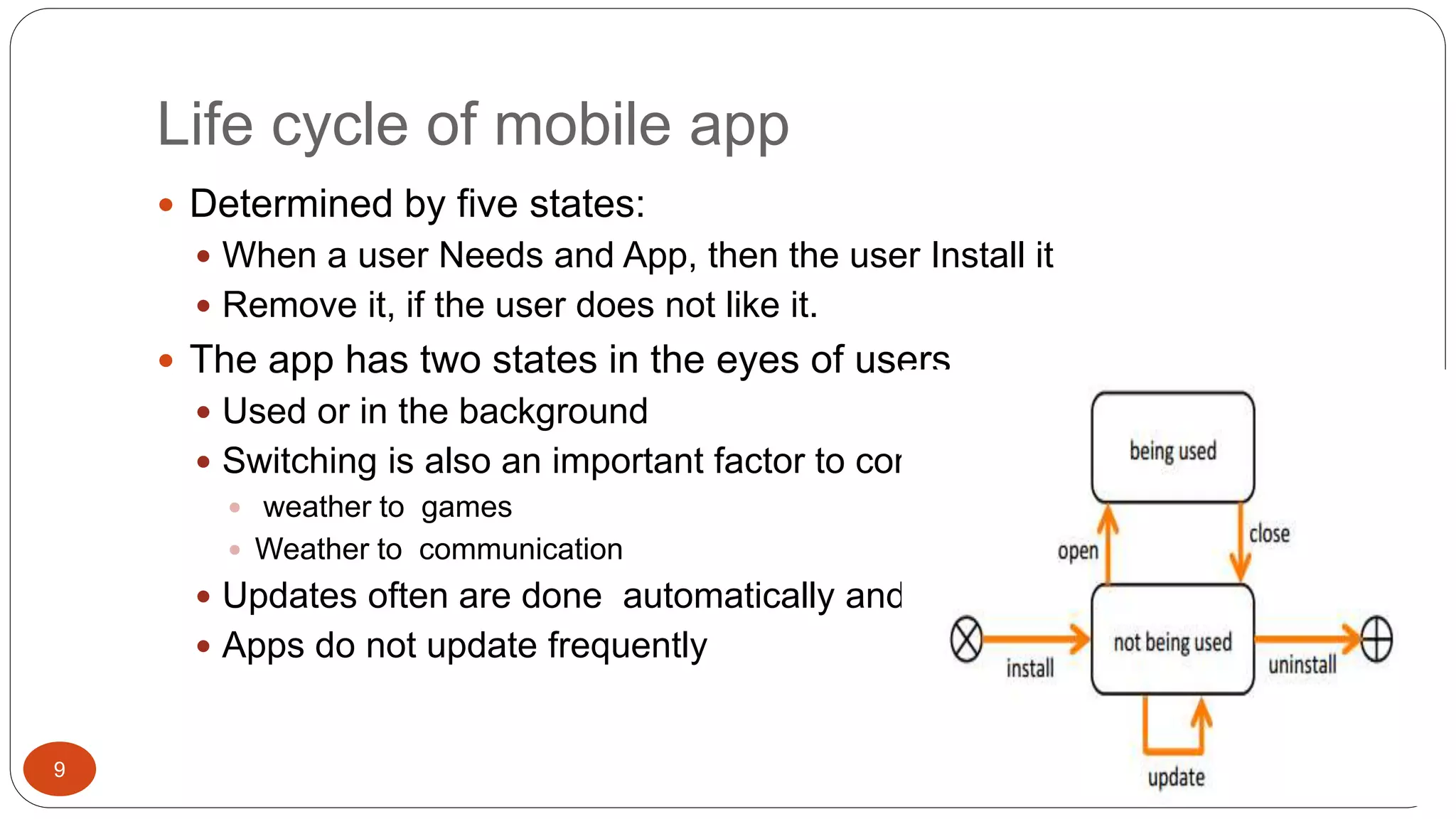
 Determined by five states: 
 When a user Needs and App, then the user Install it 
 Remove it, if the user does not like it. 
 The app has two states in the eyes of users 
 Used or in the background 
 Switching is also an important factor to consider 
 weather to games 
 Weather to communication 
 Updates often are done automatically and most 
 Apps do not update frequently
What is the benefits of App life cycle 
10 
 Since android OS system can report the most recently started 
application 
 They enable us to observe app usage on a more fine-grained level 
,and 
 Provide a much more accurate understanding of context’s effects on 
app usage. 
 This OS report functionalities to be captured by the AppSensor
Formal Description of AppSensor 
11 
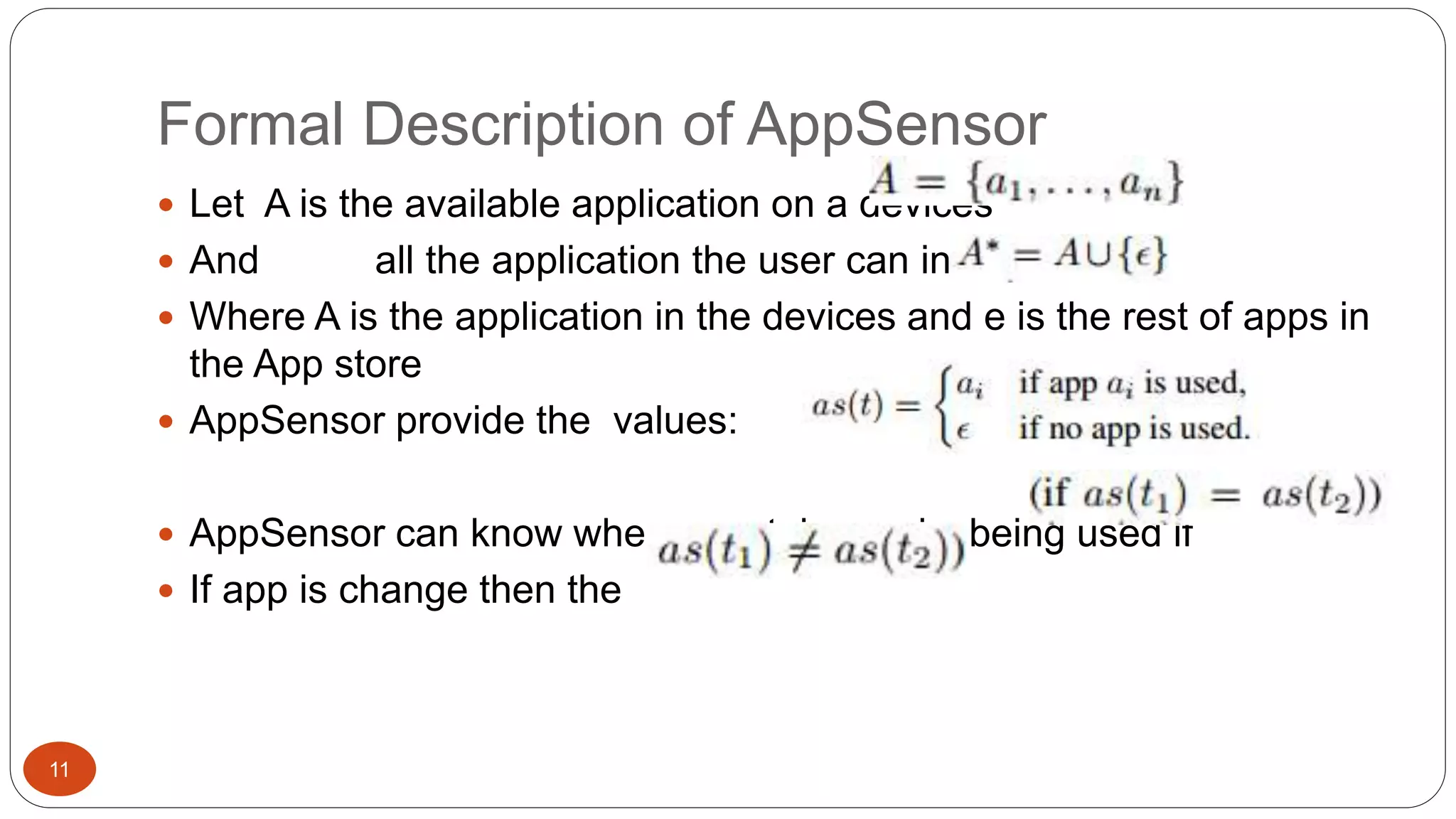
 Let A is the available application on a devices 
 And all the application the user can interact with 
 Where A is the application in the devices and e is the rest of apps in 
the App store 
 AppSensor provide the values: 
 AppSensor can know when a certain app is being used if 
 If app is change then the
Re 
12
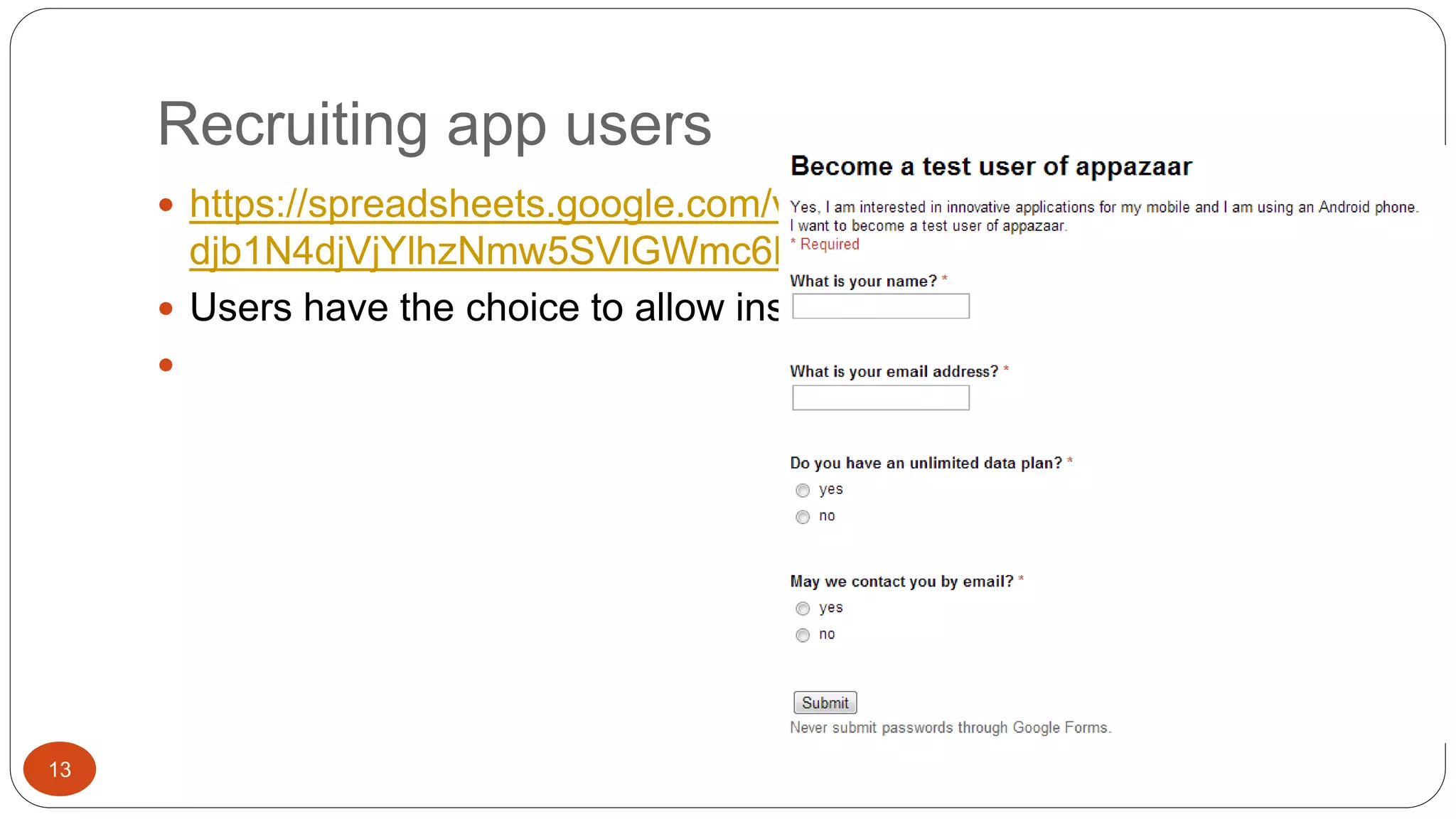
Recruiting app users 
13 
 https://spreadsheets.google.com/viewform?hl=de&formkey=dEtKRz 
djb1N4djVjYlhzNmw5SVlGWmc6MA 
 Users have the choice to allow installation 

Application chains 
14
15
Apps usage in the Whole day vs one time 
16
17
Mobile Ecosystem -2nd paper 
18 
 Mobile phones have gained a lot of popularity because of the 
continues advancement of telecommunication Technologies 
 640 million device (active July 2012) 
 Apps for android seven fold increase 
 Hundreds of thousands of Apps on the App stores 
 This huge number, urges: 
 Understanding about the users grouping 
 Providing a systematic approach for pricing
Motivation of App Ecosystem 
19 
 Analysis of Apps popularity 
 Measurement of Apps popularity 
 Modeling Apps popularity 
 Explore pricing
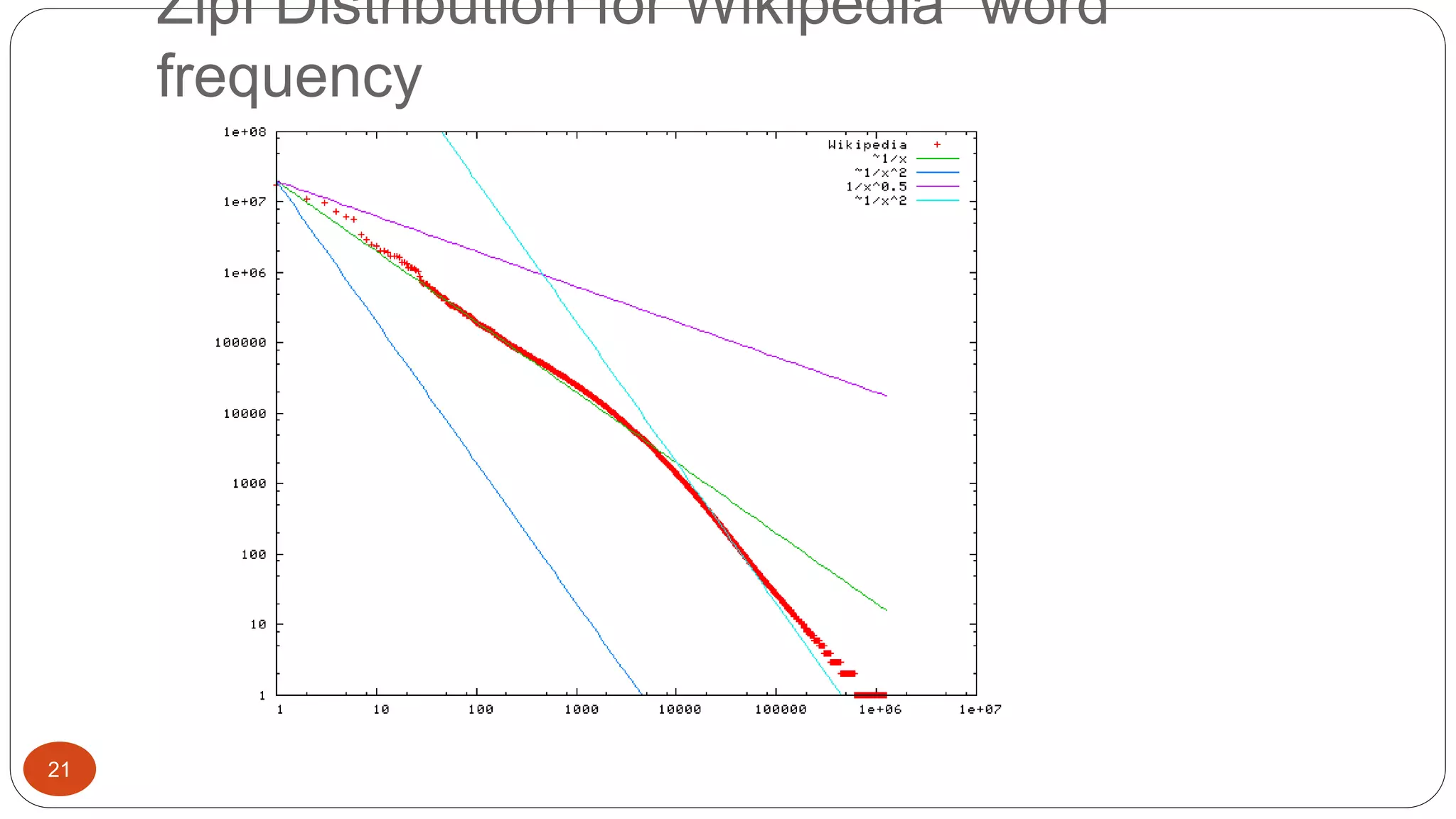
Zipf Distribution- Wikipedia 
20 
 Brown Corpus 
 The most frequently occurring word ( 7% out million 69,971)the 
 Then the second most frequent is half (3.5%344985.5) 
 x is rank of a word in the frequency table; (diagram in next slide) 
 y is the total number of the word’s occurrences. 
 Most popular words are "the", "of" and "and", 
 Zipf's law corresponds to the upper linear portion of the curve
Zipf Distribution for Wikipedia word 
frequency 
21
What is the significance of Zipf? 
22 
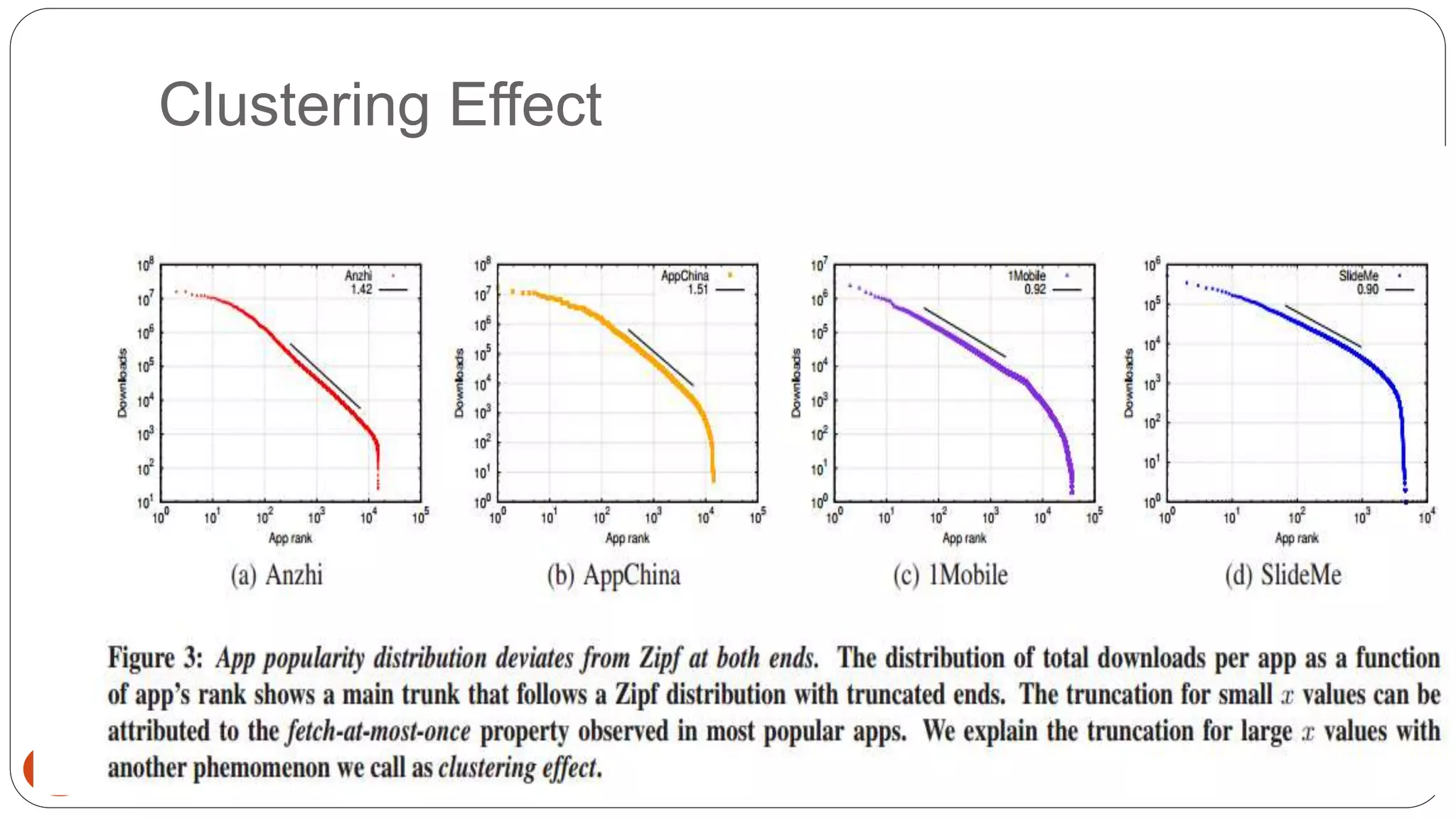
 Apps download partially follows Zipf 
 There is a deviation from the Zipf model 
 Due too clustering effect
Clustering Effect 
23
Pareto Effect-wiki 
24 
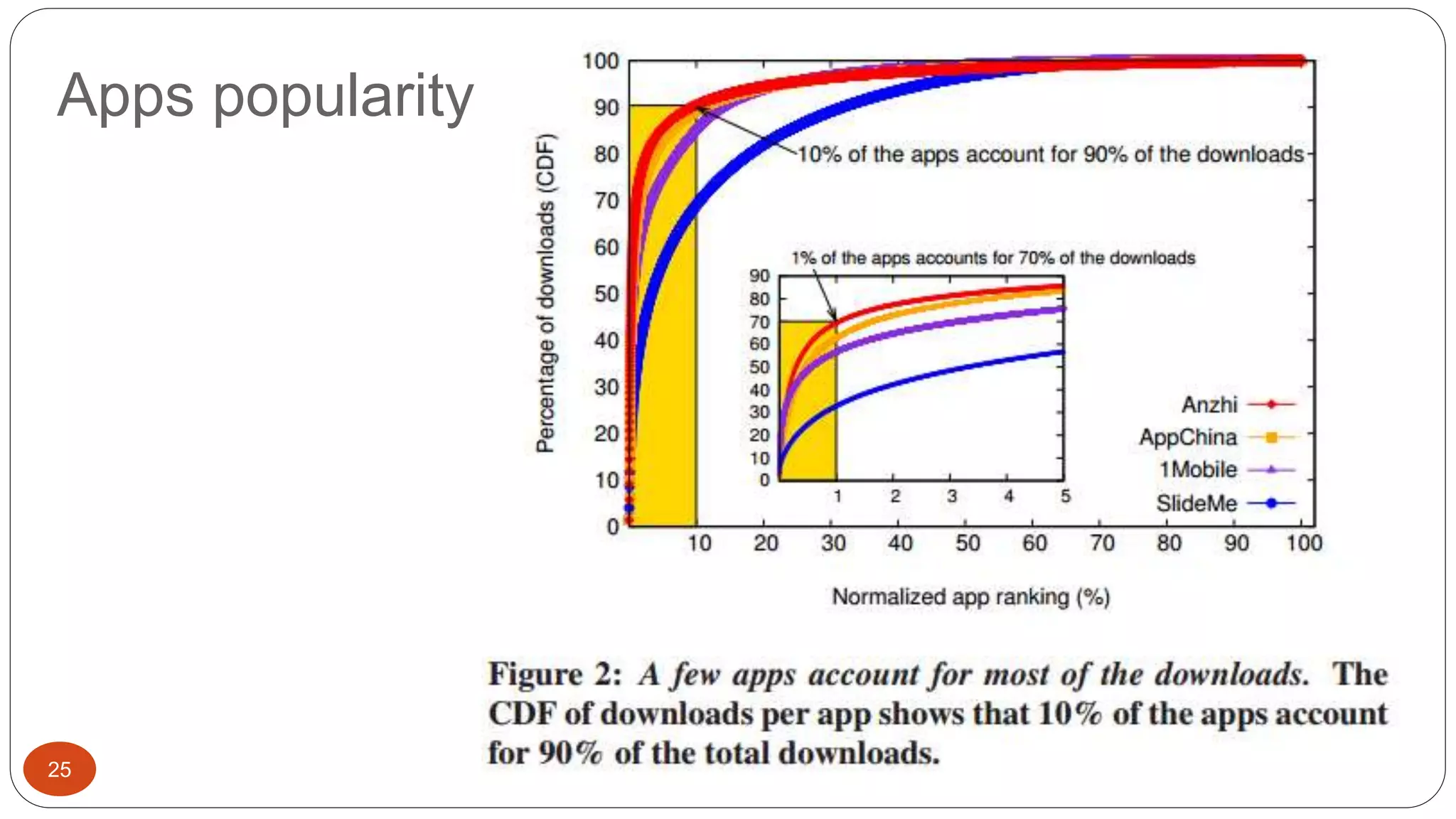
 80% of a company's complaints come from 20% of its customers 
 80% of a company's sales are made by 20% of its sales staff 
 Microsoft noted that: 
 Fixing the top 20% most reported bugs, 80% of the errors and crashes 
would be eliminated 
 90% of apps download comes for only 10% of Apps( Really ) 
 Big chance that users in same area tends to use same apps 
 Sharing of new and good apps 
 Trusting others review make a big difference
Apps popularity 
25
Data collection 
26 
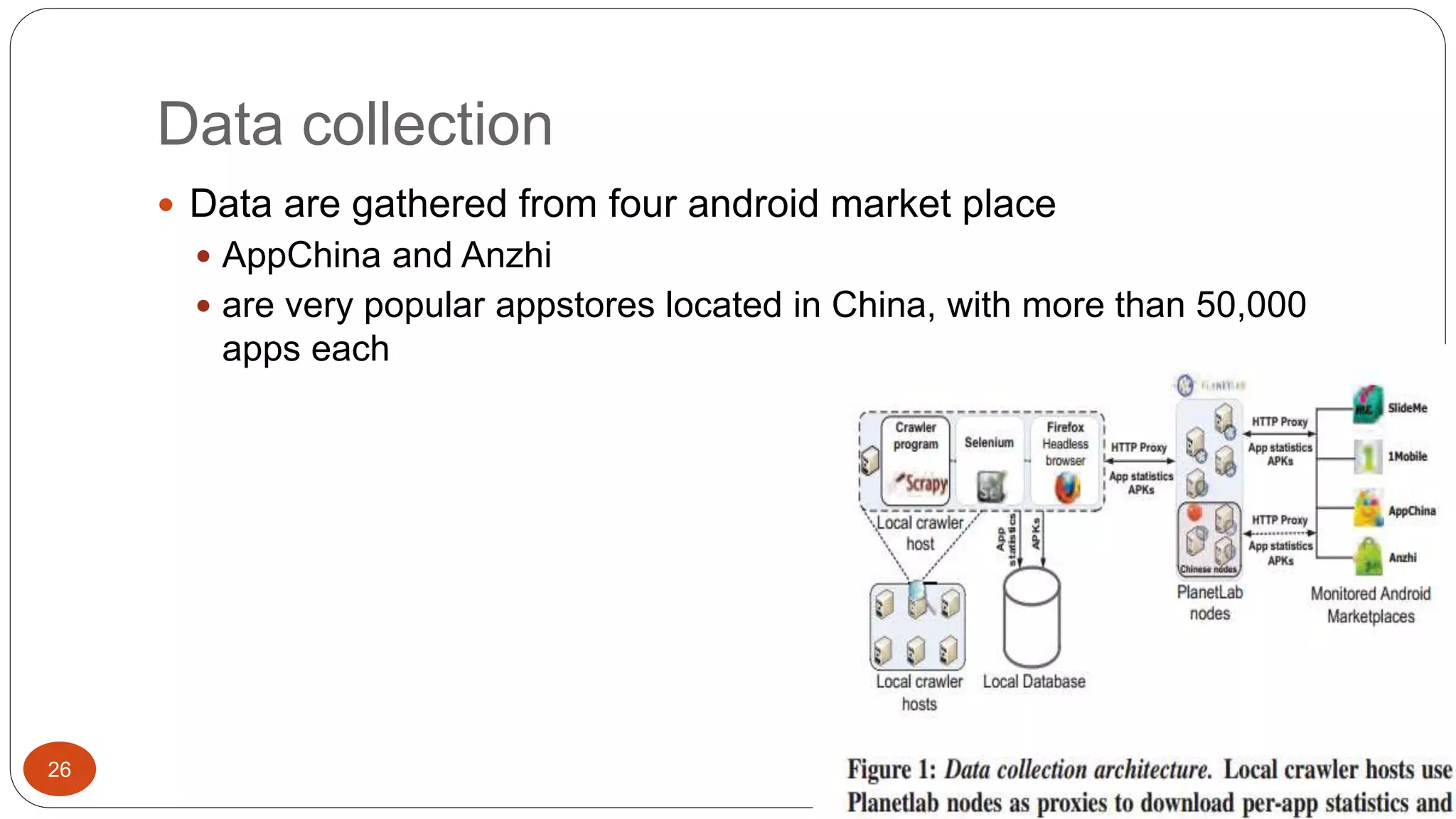
 Data are gathered from four android market place 
 AppChina and Anzhi 
 are very popular appstores located in China, with more than 50,000 
apps each
Data collection 
27 
 Data are gathered from four android market place 
 AppChina and Anzhi (Chinese) with more than 50,000 apps each 
 SlideMe is one of the oldest Android marketplaces, founded in 2008, 
containing more than 20,000 apps 
 1Mobile is one of the largest third-party appstores, 
 with more than 150,000 apps.
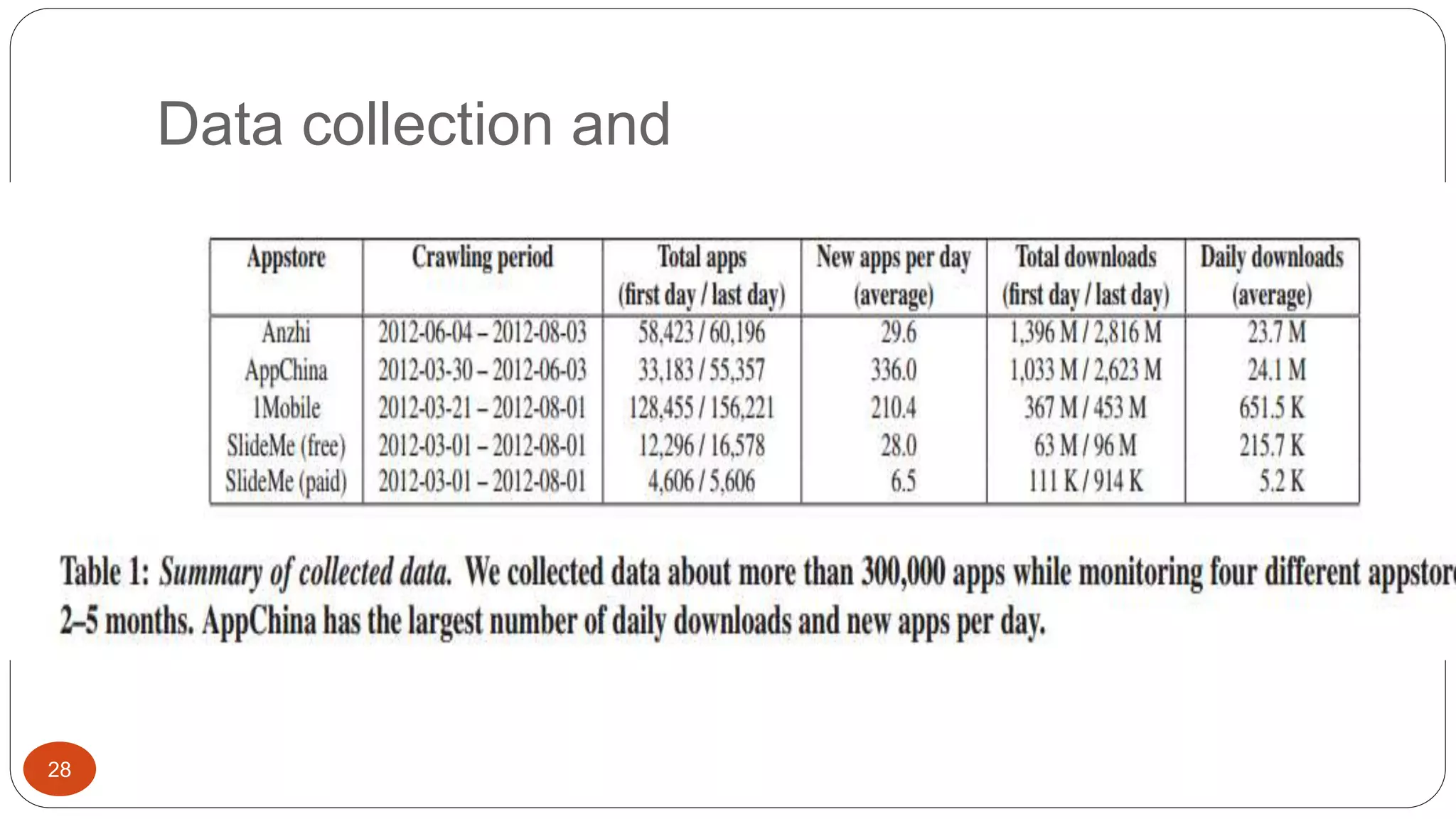
Data collection and 
28
Clustering 
29 
 Appstores are organized into groups of related apps 
 E-book 
 News 
 Games 
 Etc. 
 User focus on a single or few categories 
 Downloading news app and ignore finance app 
 This implies the clustering effect 
 App download is affected by the popularity of this App 
 Number of downloads, comments 
 E.g., one could download few games more than tools
Temporal affinity 
30 
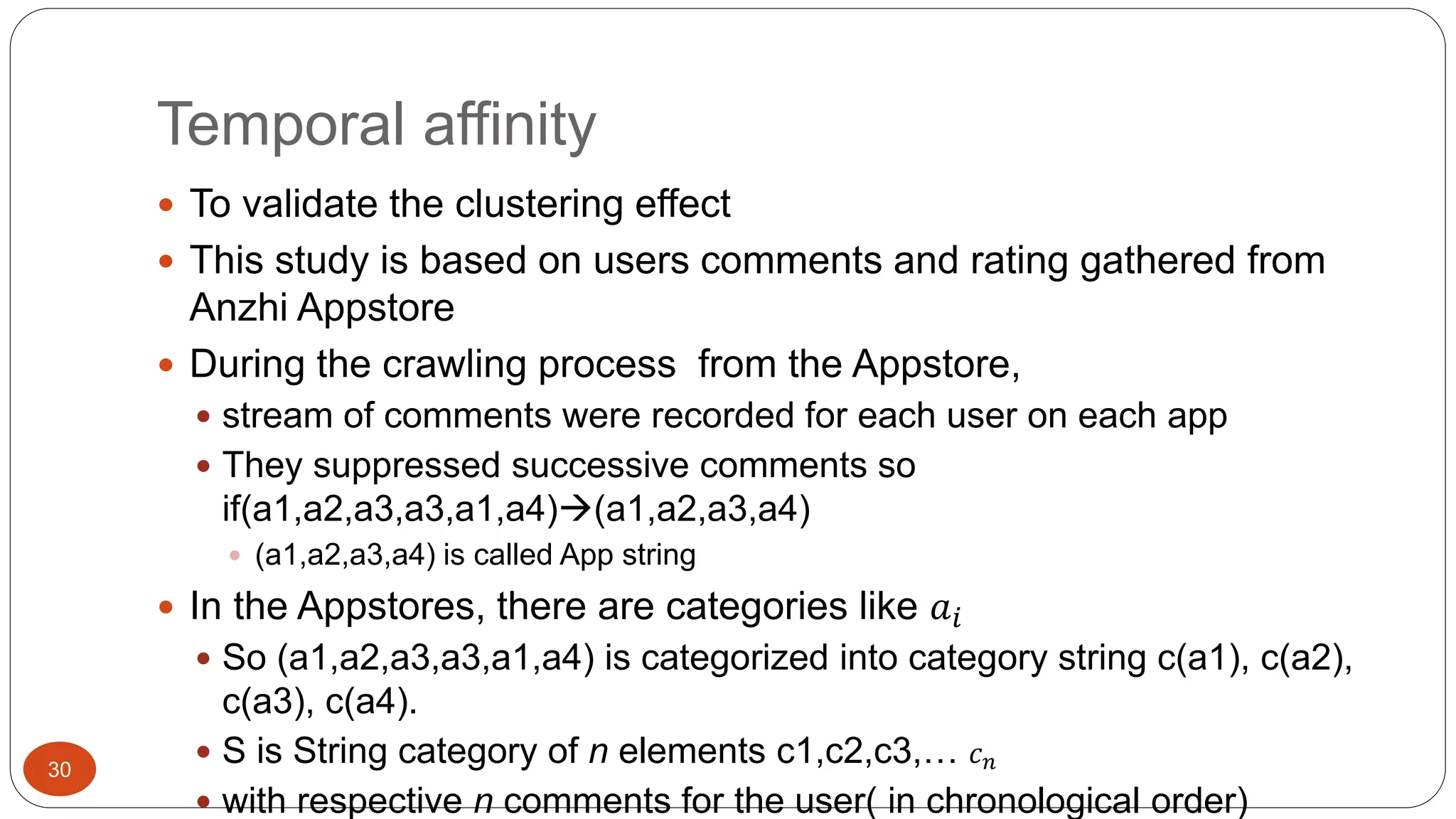
 To validate the clustering effect 
 This study is based on users comments and rating gathered from 
Anzhi Appstore 
 During the crawling process from the Appstore, 
 stream of comments were recorded for each user on each app 
 They suppressed successive comments so 
if(a1,a2,a3,a3,a1,a4)(a1,a2,a3,a4) 
 (a1,a2,a3,a4) is called App string 
 In the Appstores, there are categories like 푎푖 
 So (a1,a2,a3,a3,a1,a4) is categorized into category string c(a1), c(a2), 
c(a3), c(a4). 
 S is String category of n elements c1,c2,c3,… 푐푛 
 with respective n comments for the user( in chronological order)
31 
Temporal affinity- continued 
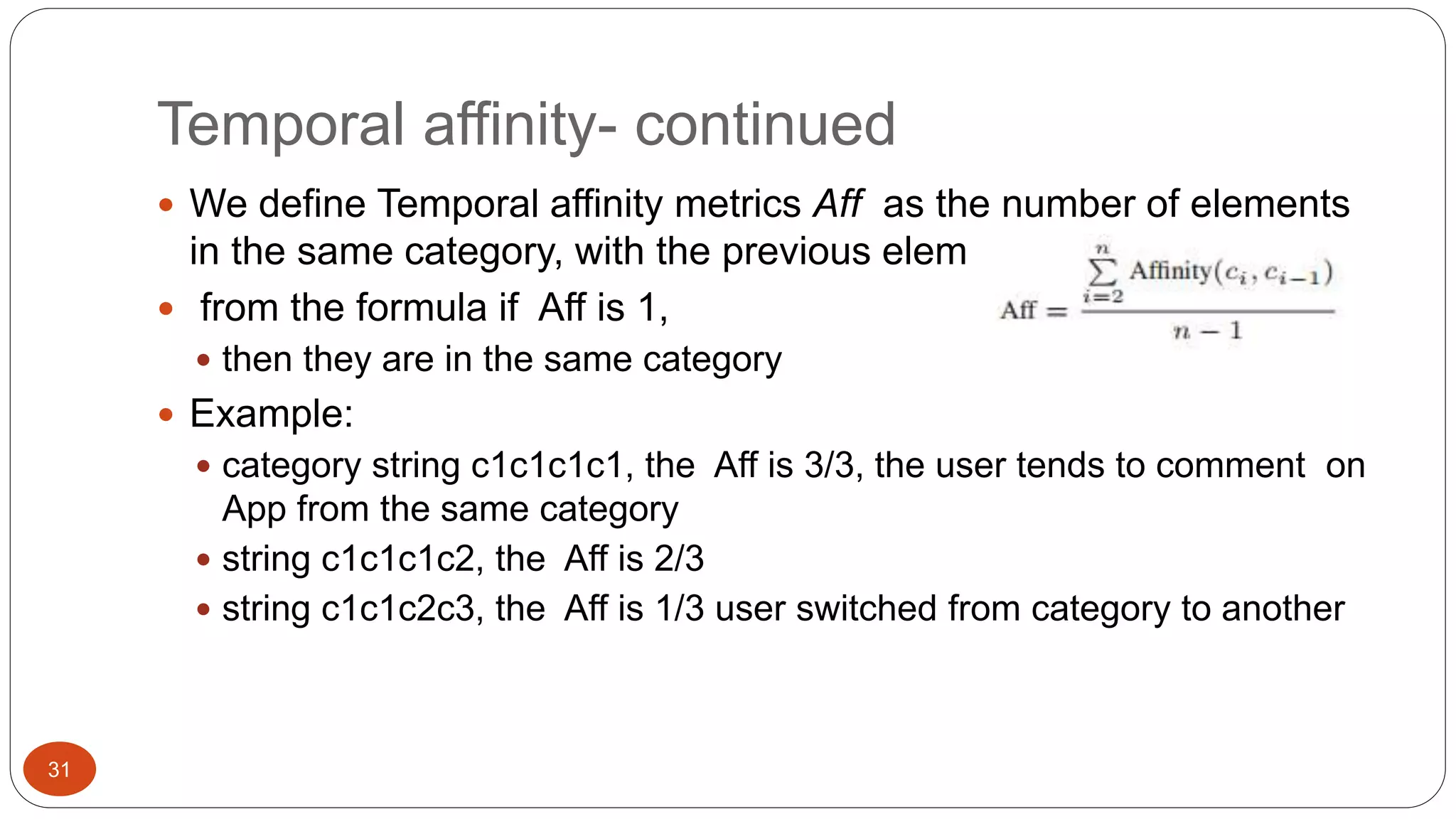
 We define Temporal affinity metrics Aff as the number of elements 
in the same category, with the previous element divided by n-1 
 from the formula if Aff is 1, 
 then they are in the same category 
 Example: 
 category string c1c1c1c1, the Aff is 3/3, the user tends to comment on 
App from the same category 
 string c1c1c1c2, the Aff is 2/3 
 string c1c1c2c3, the Aff is 1/3 user switched from category to another
32 
Temporal affinity- continued 
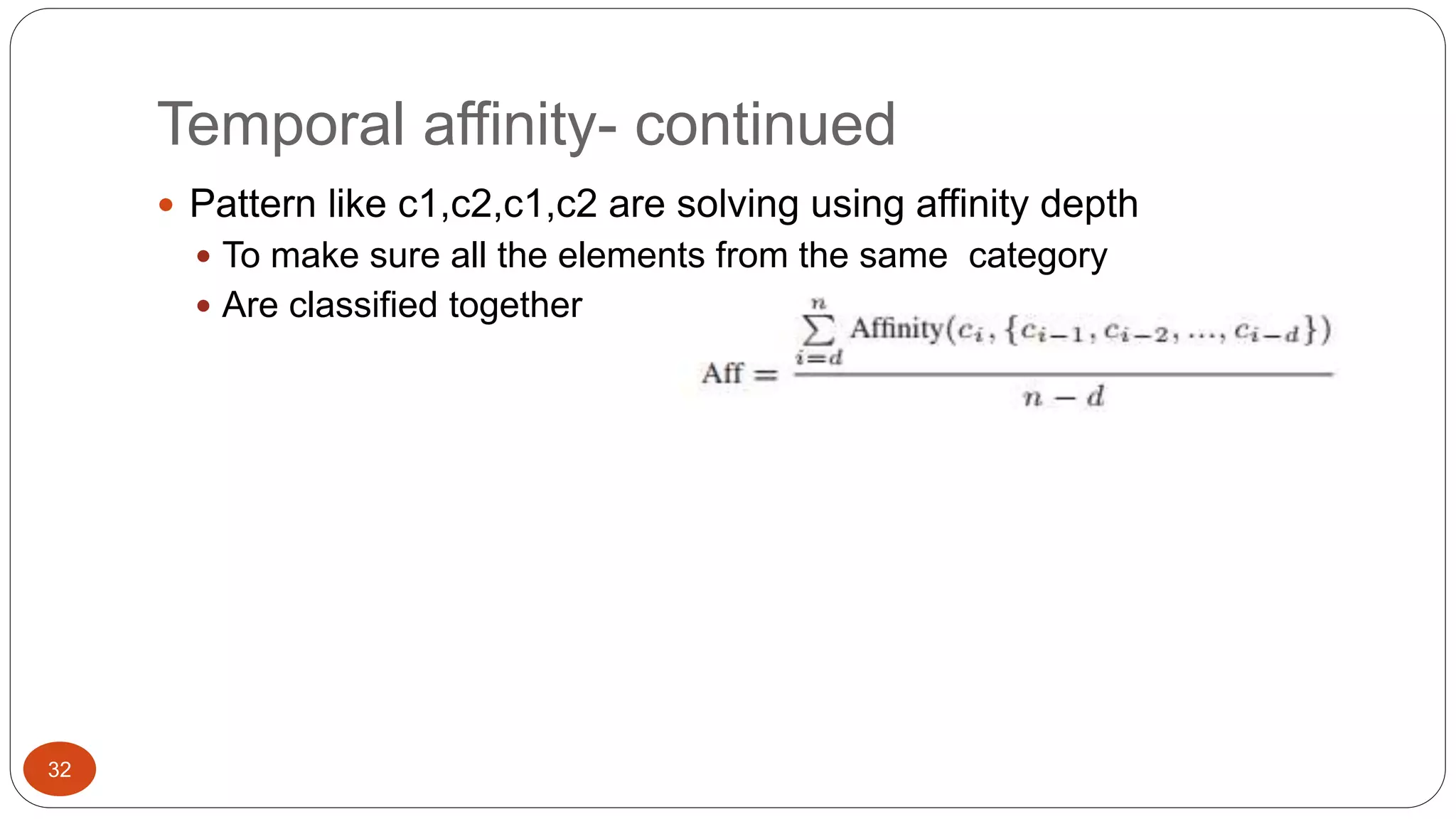
 Pattern like c1,c2,c1,c2 are solving using affinity depth 
 To make sure all the elements from the same category 
 Are classified together
33 
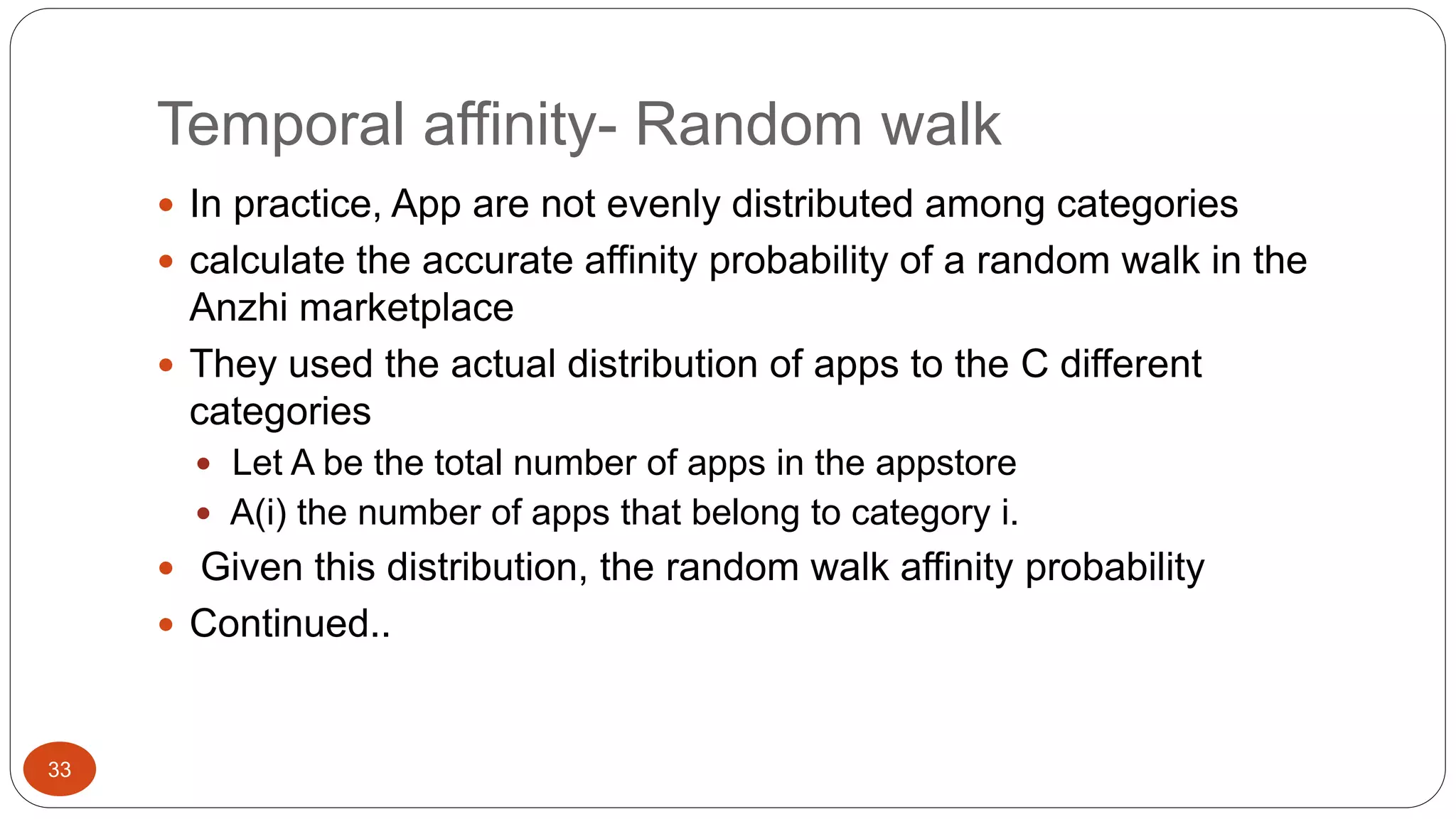
Temporal affinity- Random walk 
 In practice, App are not evenly distributed among categories 
 calculate the accurate affinity probability of a random walk in the 
Anzhi marketplace 
 They used the actual distribution of apps to the C different 
categories 
 Let A be the total number of apps in the appstore 
 A(i) the number of apps that belong to category i. 
 Given this distribution, the random walk affinity probability 
 Continued..
34 
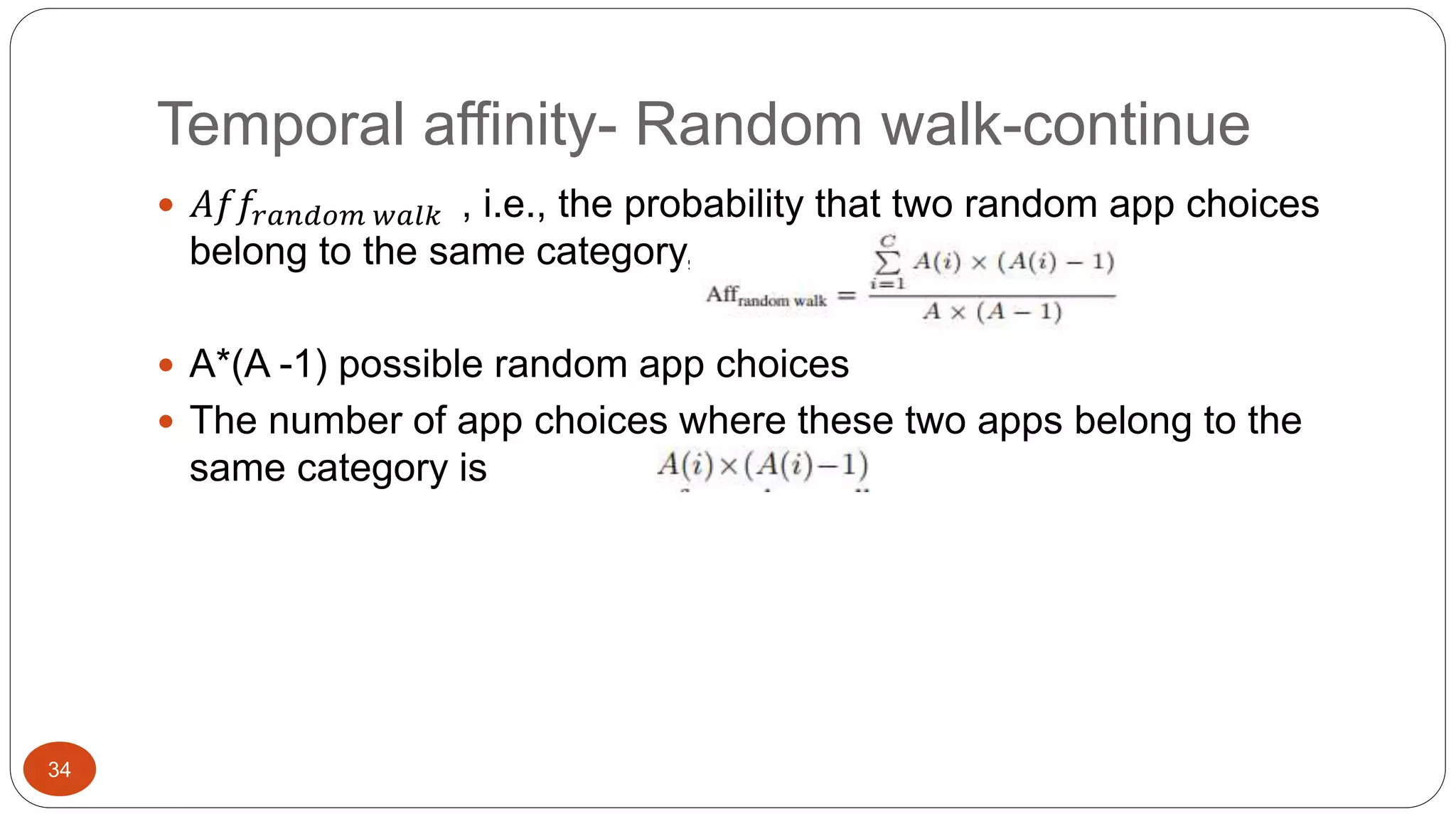
Temporal affinity- Random walk-continue 
 퐴푓푓푟푎푛푑표푚 푤푎푙푘 , i.e., the probability that two random app choices 
belong to the same category, is equal to: 
 A*(A -1) possible random app choices 
 The number of app choices where these two apps belong to the 
same category is
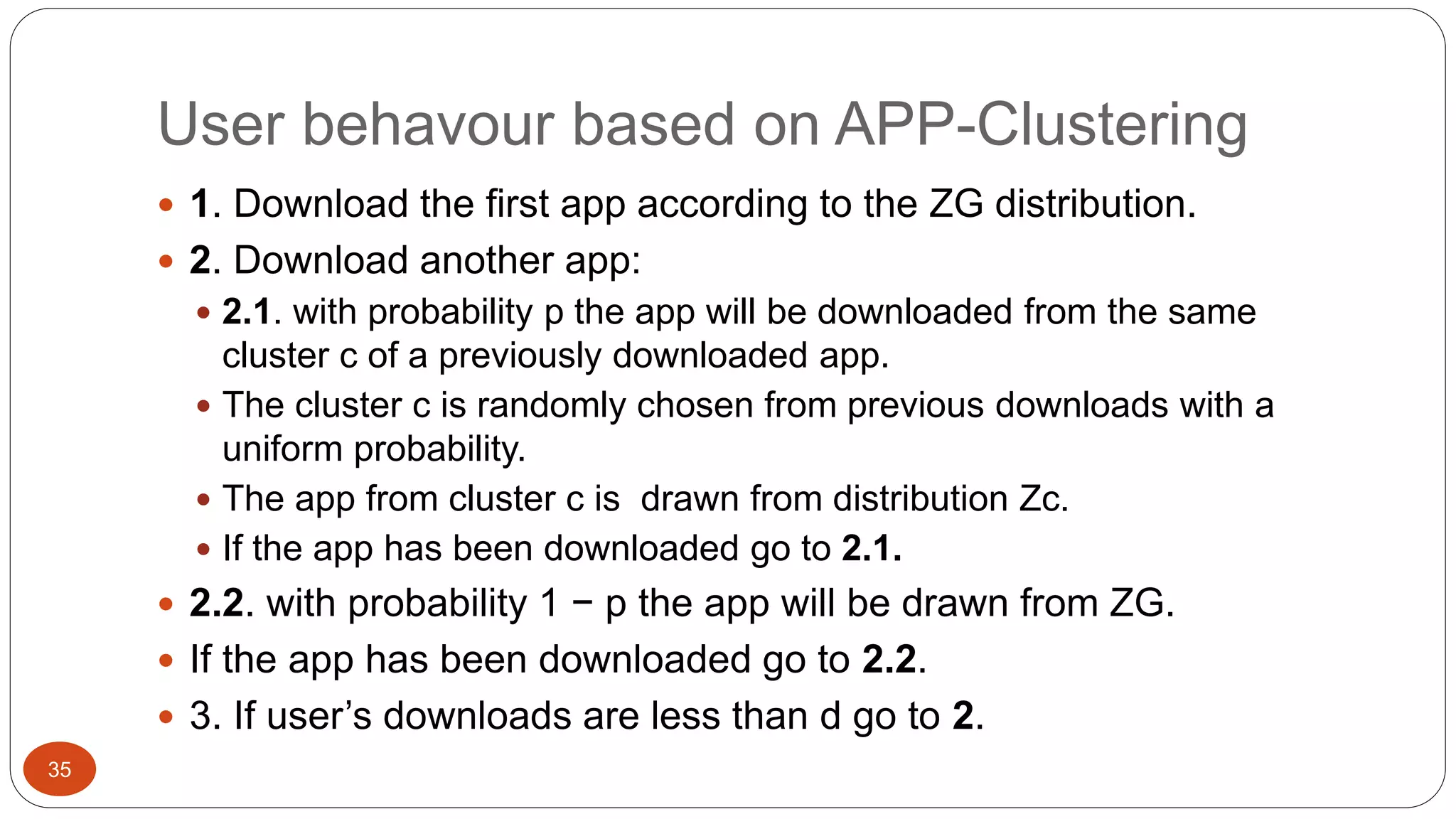
User behavour based on APP-Clustering 
35 
 1. Download the first app according to the ZG distribution. 
 2. Download another app: 
 2.1. with probability p the app will be downloaded from the same 
cluster c of a previously downloaded app. 
 The cluster c is randomly chosen from previous downloads with a 
uniform probability. 
 The app from cluster c is drawn from distribution Zc. 
 If the app has been downloaded go to 2.1. 
 2.2. with probability 1 − p the app will be drawn from ZG. 
 If the app has been downloaded go to 2.2. 
 3. If user’s downloads are less than d go to 2.
36 
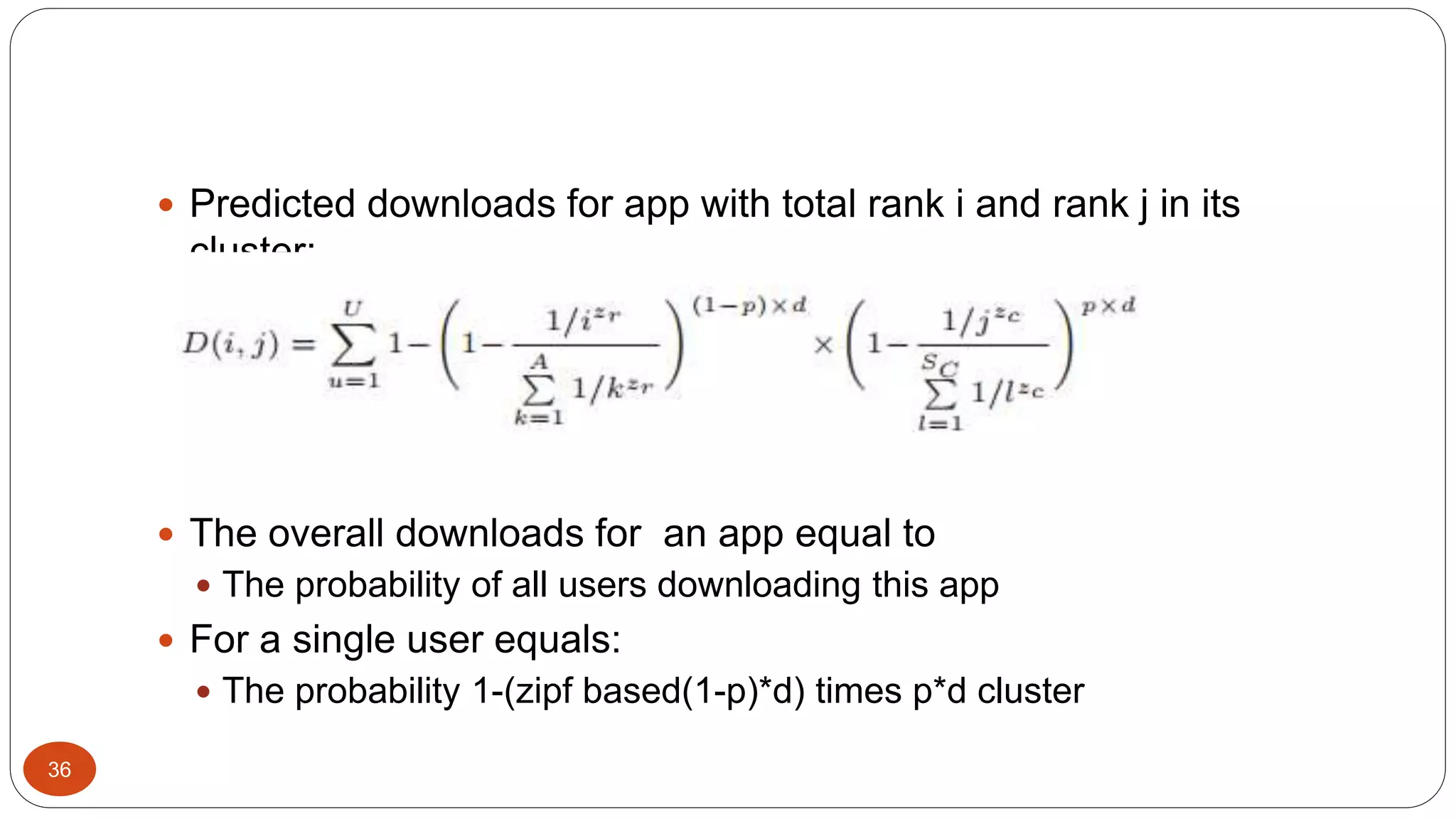
 Predicted downloads for app with total rank i and rank j in its 
cluster: 
 The overall downloads for an app equal to 
 The probability of all users downloading this app 
 For a single user equals: 
 The probability 1-(zipf based(1-p)*d) times p*d cluster
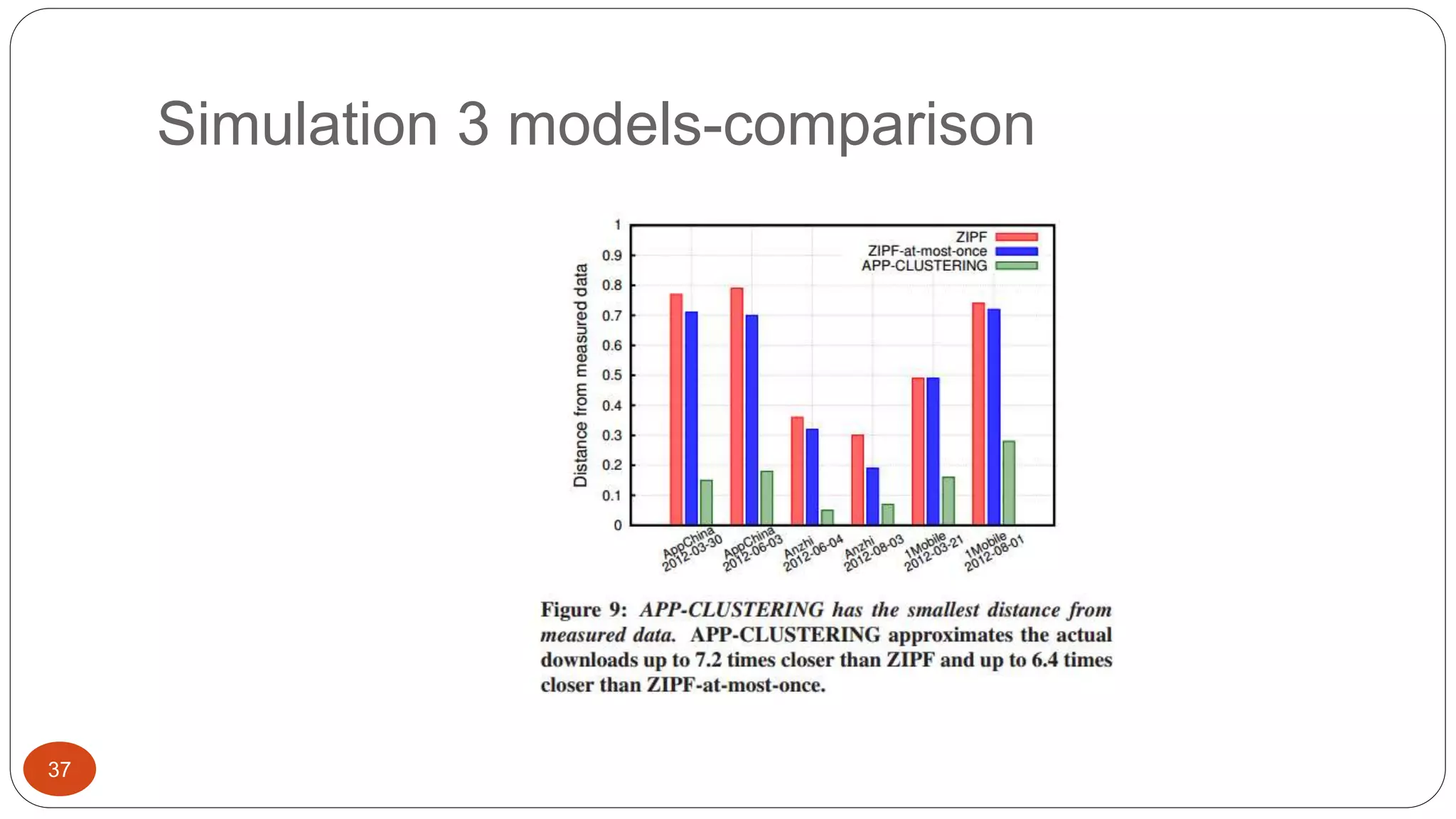
Simulation 3 models-comparison 
37
Pricing 
38 
 Universal fact  
 People prefer free stuff 
 Free Apps are more popular than free ones
End... 
39

Mobile apps-user interaction measurement & Apps ecosystem

  • 1.
    Mobile apps-user interactionmeasurement Prepared by Salah Amean Ahmmed Saeed Source: 1-Falling Asleep with Angry Birds, Facebook and Kindle – A Large Scale Study on Mobile Application Usage, by Matthias Böhmer & Apps ecosystem Presented at Prof. Choi Kae Won-Lab 1
  • 2.
    Swiss Army knife  Communication  Social networking  Productivity  Sports  News  Games  Settings  Browsing  Travel  Shopping  Finance  Camera: video, etc  Etc. 2
  • 3.
    Big Deal ?  Millions of Devices require apps.  Apps require developers  Developers Need to be paid  Apps need to be stored somewhere where  Huge demand on knowledge of usage behavior…(why?)  Essential for understanding usage pattern  In order to customize services  Provide specific users with specific apps recommendations  This knowledge could be utilized by app stores to cluster apps according to the contextual knowledge 3
  • 4.
    User Behavour 4  How long does each interaction with an app last?  Less than a minute  More than a minute and less than 5 minutes  Does this vary by application category?  Social networking versus alarm or weather app  If so, which categories inspire the longest interactions with their users?
  • 5.
    Contextual description Example:  News app is highly probable to be checked morning  Games in the evening  From this we know that certain apps are likely to be used at specific time  So far there is no user behavour study 5
  • 6.
    Contextual description How does the user’s context – e.g. location and time of day – affect her app choices?  What type of app is opened first?  Does the opening of one application predict the opening of another?  The interest of Böhmer et al.:  Is to provide data from a large-scale study that begins  to answer these basic app usage questions (especially those related to contextual usage.) 6
  • 7.
    Appazaar and AppSensor 7  Previous needs are translated as Usage pattern which are gathered by Appazaar  Which was studied by Böhmer et al  Is used to recommend apps based on the Appstores gathered data  Based on the user’s current and past locations and app usage, the system recommends apps that might be of interest to the user.  Within the Appazaar app AppSensor, that does the job vital to this research of measuring which apps are used in which contexts.
  • 8.
  • 9.
    Life cycle ofmobile app 9  Determined by five states:  When a user Needs and App, then the user Install it  Remove it, if the user does not like it.  The app has two states in the eyes of users  Used or in the background  Switching is also an important factor to consider  weather to games  Weather to communication  Updates often are done automatically and most  Apps do not update frequently
  • 10.
    What is thebenefits of App life cycle 10  Since android OS system can report the most recently started application  They enable us to observe app usage on a more fine-grained level ,and  Provide a much more accurate understanding of context’s effects on app usage.  This OS report functionalities to be captured by the AppSensor
  • 11.
    Formal Description ofAppSensor 11  Let A is the available application on a devices  And all the application the user can interact with  Where A is the application in the devices and e is the rest of apps in the App store  AppSensor provide the values:  AppSensor can know when a certain app is being used if  If app is change then the
  • 12.
  • 13.
    Recruiting app users 13  https://spreadsheets.google.com/viewform?hl=de&formkey=dEtKRz djb1N4djVjYlhzNmw5SVlGWmc6MA  Users have the choice to allow installation 
  • 14.
  • 15.
  • 16.
    Apps usage inthe Whole day vs one time 16
  • 17.
  • 18.
    Mobile Ecosystem -2ndpaper 18  Mobile phones have gained a lot of popularity because of the continues advancement of telecommunication Technologies  640 million device (active July 2012)  Apps for android seven fold increase  Hundreds of thousands of Apps on the App stores  This huge number, urges:  Understanding about the users grouping  Providing a systematic approach for pricing
  • 19.
    Motivation of AppEcosystem 19  Analysis of Apps popularity  Measurement of Apps popularity  Modeling Apps popularity  Explore pricing
  • 20.
    Zipf Distribution- Wikipedia 20  Brown Corpus  The most frequently occurring word ( 7% out million 69,971)the  Then the second most frequent is half (3.5%344985.5)  x is rank of a word in the frequency table; (diagram in next slide)  y is the total number of the word’s occurrences.  Most popular words are "the", "of" and "and",  Zipf's law corresponds to the upper linear portion of the curve
  • 21.
    Zipf Distribution forWikipedia word frequency 21
  • 22.
    What is thesignificance of Zipf? 22  Apps download partially follows Zipf  There is a deviation from the Zipf model  Due too clustering effect
  • 23.
  • 24.
    Pareto Effect-wiki 24  80% of a company's complaints come from 20% of its customers  80% of a company's sales are made by 20% of its sales staff  Microsoft noted that:  Fixing the top 20% most reported bugs, 80% of the errors and crashes would be eliminated  90% of apps download comes for only 10% of Apps( Really )  Big chance that users in same area tends to use same apps  Sharing of new and good apps  Trusting others review make a big difference
  • 25.
  • 26.
    Data collection 26  Data are gathered from four android market place  AppChina and Anzhi  are very popular appstores located in China, with more than 50,000 apps each
  • 27.
    Data collection 27  Data are gathered from four android market place  AppChina and Anzhi (Chinese) with more than 50,000 apps each  SlideMe is one of the oldest Android marketplaces, founded in 2008, containing more than 20,000 apps  1Mobile is one of the largest third-party appstores,  with more than 150,000 apps.
  • 28.
  • 29.
    Clustering 29 Appstores are organized into groups of related apps  E-book  News  Games  Etc.  User focus on a single or few categories  Downloading news app and ignore finance app  This implies the clustering effect  App download is affected by the popularity of this App  Number of downloads, comments  E.g., one could download few games more than tools
  • 30.
    Temporal affinity 30  To validate the clustering effect  This study is based on users comments and rating gathered from Anzhi Appstore  During the crawling process from the Appstore,  stream of comments were recorded for each user on each app  They suppressed successive comments so if(a1,a2,a3,a3,a1,a4)(a1,a2,a3,a4)  (a1,a2,a3,a4) is called App string  In the Appstores, there are categories like 푎푖  So (a1,a2,a3,a3,a1,a4) is categorized into category string c(a1), c(a2), c(a3), c(a4).  S is String category of n elements c1,c2,c3,… 푐푛  with respective n comments for the user( in chronological order)
  • 31.
    31 Temporal affinity-continued  We define Temporal affinity metrics Aff as the number of elements in the same category, with the previous element divided by n-1  from the formula if Aff is 1,  then they are in the same category  Example:  category string c1c1c1c1, the Aff is 3/3, the user tends to comment on App from the same category  string c1c1c1c2, the Aff is 2/3  string c1c1c2c3, the Aff is 1/3 user switched from category to another
  • 32.
    32 Temporal affinity-continued  Pattern like c1,c2,c1,c2 are solving using affinity depth  To make sure all the elements from the same category  Are classified together
  • 33.
    33 Temporal affinity-Random walk  In practice, App are not evenly distributed among categories  calculate the accurate affinity probability of a random walk in the Anzhi marketplace  They used the actual distribution of apps to the C different categories  Let A be the total number of apps in the appstore  A(i) the number of apps that belong to category i.  Given this distribution, the random walk affinity probability  Continued..
  • 34.
    34 Temporal affinity-Random walk-continue  퐴푓푓푟푎푛푑표푚 푤푎푙푘 , i.e., the probability that two random app choices belong to the same category, is equal to:  A*(A -1) possible random app choices  The number of app choices where these two apps belong to the same category is
  • 35.
    User behavour basedon APP-Clustering 35  1. Download the first app according to the ZG distribution.  2. Download another app:  2.1. with probability p the app will be downloaded from the same cluster c of a previously downloaded app.  The cluster c is randomly chosen from previous downloads with a uniform probability.  The app from cluster c is drawn from distribution Zc.  If the app has been downloaded go to 2.1.  2.2. with probability 1 − p the app will be drawn from ZG.  If the app has been downloaded go to 2.2.  3. If user’s downloads are less than d go to 2.
  • 36.
    36  Predicteddownloads for app with total rank i and rank j in its cluster:  The overall downloads for an app equal to  The probability of all users downloading this app  For a single user equals:  The probability 1-(zipf based(1-p)*d) times p*d cluster
  • 37.
  • 38.
    Pricing 38 Universal fact   People prefer free stuff  Free Apps are more popular than free ones
  • 39.