Matching Mobile Applications 
for Cross Promotion 
Gene Moo Lee! 
Ph.D. candidate 
University of Texas at Austin 
! 
Joint work with Joowon Lee and Andrew B. Whinston
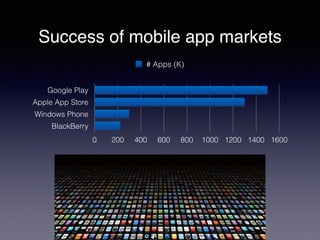
Success of mobile app markets 
# Apps (K) 
Big Data Marketing Analytics, Chicago, IL 
Google Play 
Apple App Store 
Windows Phone 
BlackBerry 
0 200 400 600 800 1000 1200 1400 1600
Success and challenges 
• App diversity is a key success factor ! 
• Too many apps: visibility/search issue! 
• Developers: difficult to gain visibility! 
• Users: hard to search for the right apps! 
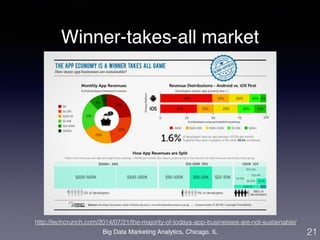
• Going towards a “winner-takes-all” market, not 
a long-tail market [Petsas et al. 2013], [Zhong 
and Michahelles 2013] 
Big Data Marketing Analytics, Chicago, IL 
3
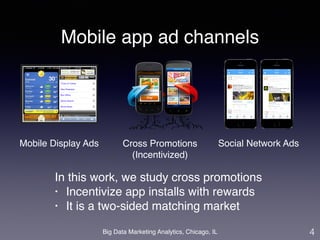
Mobile app ad channels 
Big Data Marketing Analytics, Chicago, IL 
Mobile Display Ads 
4 
Cross Promotions 
(Incentivized) 
Social Network Ads 
In this work, we study cross promotions! 
• Incentivize app installs with rewards! 
• It is a two-sided matching market
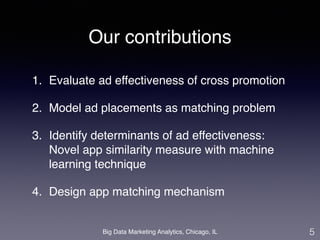
Our contributions 
1. Evaluate ad effectiveness of cross promotion! 
2. Model ad placements as matching problem! 
3. Identify determinants of ad effectiveness: 
Novel app similarity measure with machine 
learning technique! 
4. Design app matching mechanism 
Big Data Marketing Analytics, Chicago, IL 
5
Roadmap 
• Data! 
• Model! 
• App Similarity! 
• Empirical Analysis! 
• Matching Mechanism 
Big Data Marketing Analytics, Chicago, IL 
6
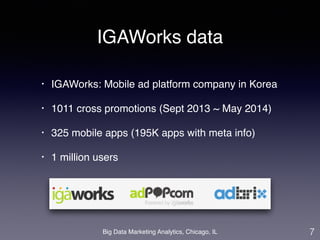
IGAWorks data 
• IGAWorks: Mobile ad platform company in Korea! 
• 1011 cross promotions (Sept 2013 ~ May 2014)! 
• 325 mobile apps (195K apps with meta info)! 
• 1 million users 
Big Data Marketing Analytics, Chicago, IL 
7
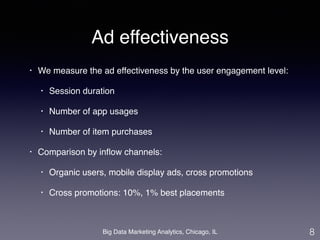
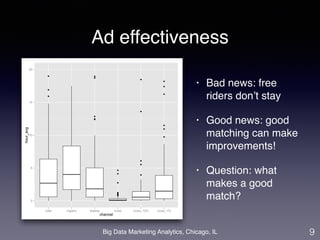
Ad effectiveness 
• We measure the ad effectiveness by the user engagement level: ! 
• Session duration! 
• Number of app usages! 
• Number of item purchases! 
• Comparison by inflow channels: ! 
• Organic users, mobile display ads, cross promotions ! 
• Cross promotions: 10%, 1% best placements 
Big Data Marketing Analytics, Chicago, IL 
8
Ad effectiveness 
• Bad news: free 
riders don’t stay! 
• Good news: good 
matching can make 
improvements!! 
• Question: what 
makes a good 
match? 
channel hour_avg 
Big Data Marketing Analytics, Chicago, IL 
9 
20 
15 
10 
5 
0 
total organic display cross cross_10% cross_1%
Model 
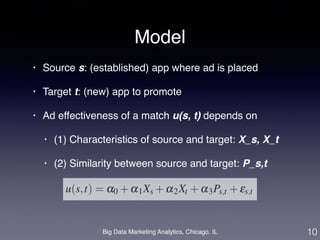
• Source s: (established) app where ad is placed! 
• Target t: (new) app to promote! 
• Ad effectiveness of a match u(s, t) depends on ! 
• (1) Characteristics of source and target: X_s, X_t! 
• (2) Similarity between source and target: P_s,t 
Big Data Marketing Analytics, Chicago, IL 
10
Individual app features 
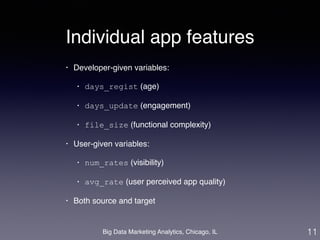
• Developer-given variables: ! 
• days_regist (age)! 
• days_update (engagement)! 
• file_size (functional complexity)! 
• User-given variables: ! 
• num_rates (visibility)! 
• avg_rate (user perceived app quality)! 
• Both source and target 
Big Data Marketing Analytics, Chicago, IL 
11
App similarity 
• Assumption: similar text descriptions -> similar apps! 
• Our approach: Apply latent Dirichlet allocation [Blei et al. 2003] 
algorithm on text descriptions of all apps! 
• App market is described by “topics”! 
• Each app is represented by a topic vector! 
• Calculate Topic_Similarity with cosine similarity 
Big Data Marketing Analytics, Chicago, IL 
12
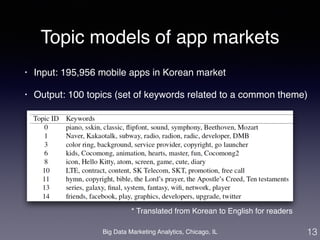
Topic models of app markets 
• Input: 195,956 mobile apps in Korean market! 
• Output: 100 topics (set of keywords related to a common theme) 
Big Data Marketing Analytics, Chicago, IL 
13 
* Translated from Korean to English for readers
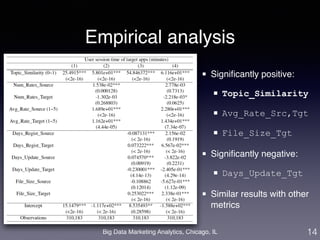
Empirical analysis 
Big Data Marketing Analytics, Chicago, IL 
14 
Significantly positive:! 
Topic_Similarity 
Avg_Rate_Src,Tgt 
File_Size_Tgt 
Significantly negative:! 
Days_Update_Tgt 
Similar results with other 
metrics
Matching in cross promotions 
• Problem definition: Given S andT, ad platform should find 
a stable matching m that maximizes expected utilities! 
• Utility is transferable between s and t! 
• Leverage our model to predict utility of a match (s, t)! 
• One-to-one matching: one s promotes one t! 
Big Data Marketing Analytics, Chicago, IL 
• Stability: ! 
• No matched pairs prefer to deviate from the resultant 
matching ! 
• [Gale and Shapley 1962], [Roth 1984], [Hatfield et al. 
2013] 
15 
s_1 
s_2 
s_3 
s_n 
t_1 
t_2 
t_3 
t_m
Matching mechanism 
• Linear Programming from 
[Gale 1960] and [Shapley and 
Shubik 1972]! 
• Stable matching! 
• Price suggestion! 
• Improved utility: ! 
• 260% (predicted) 
Big Data Marketing Analytics, Chicago, IL 
16
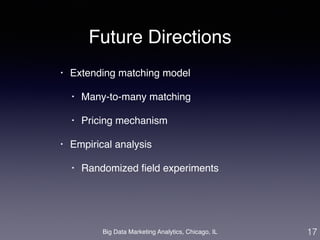
Future Directions 
• Extending matching model! 
• Many-to-many matching! 
• Pricing mechanism! 
• Empirical analysis! 
• Randomized field experiments 
Big Data Marketing Analytics, Chicago, IL 
17
Thank you!! 
! 
Contact Info: Gene Moo Lee! 
gene@cs.utexas.edu
References 
• Mobile app stats: http://en.wikipedia.org/wiki/List_of_mobile_software_distribution_platforms! 
• Mobile app revenue by developers: http://techcrunch.com/2014/07/21/the-majority-of-todays-app-businesses-are-not-sustainable/ ! 
• Facebook Mobile App Ad: https://developers.facebook.com/products/ads/! 
• Twitter mobile app promotion suite: https://blog.twitter.com/2014/a-new-way-to-promote-mobile-apps-to-1-billion-devices-both-on-and- 
Big Data Marketing Analytics, Chicago, IL 
off-twitter! 
• IGAWorks: http://www.igaworks.com/en/ ! 
• Petsas T., Papadogiannakis A., Polychronakis M., Markatos E. P., and Karagiannis T. (2013). “Rise of the Planet of the Apps: A 
Systematic Study of the Mobile App Ecosystem.” Proceedings of the Internet Measurement Conference, pp. 277-290.! 
• Zhong N. and Michahelles F. (2013). "Google Play Is Not A Long Tail Market: An Empirical Analysis of App Adoption on the Google 
Play App Market." Proceedings of the Annual ACM Symposium on Applied Computing: pp. 499-504.! 
• Blei D. B., Ng A. Y., and Jordan M. I. (2003). “Latent Dirichlet Allocation.” Journal of Machine Learning Research, 3: pp. 993-1022.! 
• Shapley L. and Shubik M. (1972). “The Assignment Game 1: The Core.” International Journal of Game Theory, 1: pp. 111-130.! 
• Roth A. E. (1984). “The Evolution of the Labor Market for Medical Interns and Residents: A Case Study in Game Theory.” Journal 
of Political Economy, 92(6): pp. 991–1016.! 
• Hatfield J.W., Kominers S. D., Nichifor A., Ostrovsky M., andWestkamp A. (2013). “Stability and Competitive Equilibrium in Trading 
Networks.” Journal of Political Economy, 12(5): pp. 966-1005.! 
• Gale D. (1960). “The Theory of Linear Economic Models.” New York: McGraw-Hill.
Backup Slides 
20
Winner-takes-all market 
Big Data Marketing Analytics, Chicago, IL 
21 
http://techcrunch.com/2014/07/21/the-majority-of-todays-app-businesses-are-not-sustainable/

Matching Mobile Applications for Cross Promotion

  • 1.
    Matching Mobile Applications for Cross Promotion Gene Moo Lee! Ph.D. candidate University of Texas at Austin ! Joint work with Joowon Lee and Andrew B. Whinston
  • 2.
    Success of mobileapp markets # Apps (K) Big Data Marketing Analytics, Chicago, IL Google Play Apple App Store Windows Phone BlackBerry 0 200 400 600 800 1000 1200 1400 1600
  • 3.
    Success and challenges • App diversity is a key success factor ! • Too many apps: visibility/search issue! • Developers: difficult to gain visibility! • Users: hard to search for the right apps! • Going towards a “winner-takes-all” market, not a long-tail market [Petsas et al. 2013], [Zhong and Michahelles 2013] Big Data Marketing Analytics, Chicago, IL 3
  • 4.
    Mobile app adchannels Big Data Marketing Analytics, Chicago, IL Mobile Display Ads 4 Cross Promotions (Incentivized) Social Network Ads In this work, we study cross promotions! • Incentivize app installs with rewards! • It is a two-sided matching market
  • 5.
    Our contributions 1.Evaluate ad effectiveness of cross promotion! 2. Model ad placements as matching problem! 3. Identify determinants of ad effectiveness: Novel app similarity measure with machine learning technique! 4. Design app matching mechanism Big Data Marketing Analytics, Chicago, IL 5
  • 6.
    Roadmap • Data! • Model! • App Similarity! • Empirical Analysis! • Matching Mechanism Big Data Marketing Analytics, Chicago, IL 6
  • 7.
    IGAWorks data •IGAWorks: Mobile ad platform company in Korea! • 1011 cross promotions (Sept 2013 ~ May 2014)! • 325 mobile apps (195K apps with meta info)! • 1 million users Big Data Marketing Analytics, Chicago, IL 7
  • 8.
    Ad effectiveness •We measure the ad effectiveness by the user engagement level: ! • Session duration! • Number of app usages! • Number of item purchases! • Comparison by inflow channels: ! • Organic users, mobile display ads, cross promotions ! • Cross promotions: 10%, 1% best placements Big Data Marketing Analytics, Chicago, IL 8
  • 9.
    Ad effectiveness •Bad news: free riders don’t stay! • Good news: good matching can make improvements!! • Question: what makes a good match? channel hour_avg Big Data Marketing Analytics, Chicago, IL 9 20 15 10 5 0 total organic display cross cross_10% cross_1%
  • 10.
    Model • Sources: (established) app where ad is placed! • Target t: (new) app to promote! • Ad effectiveness of a match u(s, t) depends on ! • (1) Characteristics of source and target: X_s, X_t! • (2) Similarity between source and target: P_s,t Big Data Marketing Analytics, Chicago, IL 10
  • 11.
    Individual app features • Developer-given variables: ! • days_regist (age)! • days_update (engagement)! • file_size (functional complexity)! • User-given variables: ! • num_rates (visibility)! • avg_rate (user perceived app quality)! • Both source and target Big Data Marketing Analytics, Chicago, IL 11
  • 12.
    App similarity •Assumption: similar text descriptions -> similar apps! • Our approach: Apply latent Dirichlet allocation [Blei et al. 2003] algorithm on text descriptions of all apps! • App market is described by “topics”! • Each app is represented by a topic vector! • Calculate Topic_Similarity with cosine similarity Big Data Marketing Analytics, Chicago, IL 12
  • 13.
    Topic models ofapp markets • Input: 195,956 mobile apps in Korean market! • Output: 100 topics (set of keywords related to a common theme) Big Data Marketing Analytics, Chicago, IL 13 * Translated from Korean to English for readers
  • 14.
    Empirical analysis BigData Marketing Analytics, Chicago, IL 14 Significantly positive:! Topic_Similarity Avg_Rate_Src,Tgt File_Size_Tgt Significantly negative:! Days_Update_Tgt Similar results with other metrics
  • 15.
    Matching in crosspromotions • Problem definition: Given S andT, ad platform should find a stable matching m that maximizes expected utilities! • Utility is transferable between s and t! • Leverage our model to predict utility of a match (s, t)! • One-to-one matching: one s promotes one t! Big Data Marketing Analytics, Chicago, IL • Stability: ! • No matched pairs prefer to deviate from the resultant matching ! • [Gale and Shapley 1962], [Roth 1984], [Hatfield et al. 2013] 15 s_1 s_2 s_3 s_n t_1 t_2 t_3 t_m
  • 16.
    Matching mechanism •Linear Programming from [Gale 1960] and [Shapley and Shubik 1972]! • Stable matching! • Price suggestion! • Improved utility: ! • 260% (predicted) Big Data Marketing Analytics, Chicago, IL 16
  • 17.
    Future Directions •Extending matching model! • Many-to-many matching! • Pricing mechanism! • Empirical analysis! • Randomized field experiments Big Data Marketing Analytics, Chicago, IL 17
  • 18.
    Thank you!! ! Contact Info: Gene Moo Lee! gene@cs.utexas.edu
  • 19.
    References • Mobileapp stats: http://en.wikipedia.org/wiki/List_of_mobile_software_distribution_platforms! • Mobile app revenue by developers: http://techcrunch.com/2014/07/21/the-majority-of-todays-app-businesses-are-not-sustainable/ ! • Facebook Mobile App Ad: https://developers.facebook.com/products/ads/! • Twitter mobile app promotion suite: https://blog.twitter.com/2014/a-new-way-to-promote-mobile-apps-to-1-billion-devices-both-on-and- Big Data Marketing Analytics, Chicago, IL off-twitter! • IGAWorks: http://www.igaworks.com/en/ ! • Petsas T., Papadogiannakis A., Polychronakis M., Markatos E. P., and Karagiannis T. (2013). “Rise of the Planet of the Apps: A Systematic Study of the Mobile App Ecosystem.” Proceedings of the Internet Measurement Conference, pp. 277-290.! • Zhong N. and Michahelles F. (2013). "Google Play Is Not A Long Tail Market: An Empirical Analysis of App Adoption on the Google Play App Market." Proceedings of the Annual ACM Symposium on Applied Computing: pp. 499-504.! • Blei D. B., Ng A. Y., and Jordan M. I. (2003). “Latent Dirichlet Allocation.” Journal of Machine Learning Research, 3: pp. 993-1022.! • Shapley L. and Shubik M. (1972). “The Assignment Game 1: The Core.” International Journal of Game Theory, 1: pp. 111-130.! • Roth A. E. (1984). “The Evolution of the Labor Market for Medical Interns and Residents: A Case Study in Game Theory.” Journal of Political Economy, 92(6): pp. 991–1016.! • Hatfield J.W., Kominers S. D., Nichifor A., Ostrovsky M., andWestkamp A. (2013). “Stability and Competitive Equilibrium in Trading Networks.” Journal of Political Economy, 12(5): pp. 966-1005.! • Gale D. (1960). “The Theory of Linear Economic Models.” New York: McGraw-Hill.
  • 20.
  • 21.
    Winner-takes-all market BigData Marketing Analytics, Chicago, IL 21 http://techcrunch.com/2014/07/21/the-majority-of-todays-app-businesses-are-not-sustainable/