Femoro-Acetabular impingement 
DR M.N.BASU MALLICK 
ARTHROSCOPY AND SPORTS SURGERY 
APOLLO GLENEAGLES HOSPITAL, 
KOLKATA 
Does Labrectomy have a role?
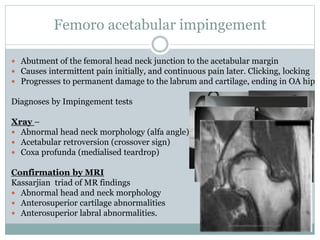
Femoro acetabular impingement 
 Abutment of the femoral head neck junction to the acetabular margin 
 Causes intermittent pain initially, and continuous pain later. Clicking, locking 
 Progresses to permanent damage to the labrum and cartilage, ending in OA hip 
Diagnoses by Impingement tests 
Xray – 
 Abnormal head neck morphology (alfa angle) 
 Acetabular retroversion (crossover sign) 
 Coxa profunda (medialised teardrop) 
Confirmation by MRI 
Kassarjian triad of MR findings 
 Abnormal head and neck morphology 
 Anterosuperior cartilage abnormalities 
 Anterosuperior labral abnormalities.
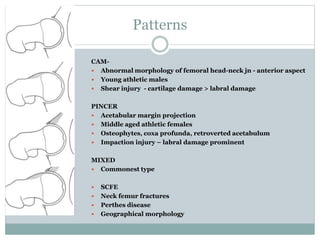
Patterns 
CAM- 
 Abnormal morphology of femoral head-neck jn - anterior aspect 
 Young athletic males 
 Shear injury - cartilage damage > labral damage 
PINCER 
 Acetabular margin projection 
 Middle aged athletic females 
 Osteophytes, coxa profunda, retroverted acetabulum 
 Impaction injury – labral damage prominent 
MIXED 
 Commonest type 
 SCFE 
 Neck femur fractures 
 Perthes disease 
 Geographical morphology
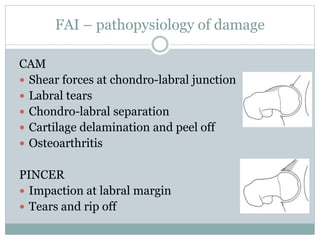
FAI – pathopysiology of damage 
CAM 
 Shear forces at chondro-labral junction 
 Labral tears 
 Chondro-labral separation 
 Cartilage delamination and peel off 
 Osteoarthritis 
PINCER 
 Impaction at labral margin 
 Tears and rip off
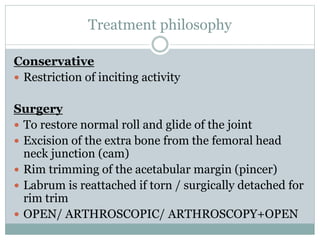
Treatment philosophy 
Conservative 
 Restriction of inciting activity 
Surgery 
 To restore normal roll and glide of the joint 
 Excision of the extra bone from the femoral head 
neck junction (cam) 
 Rim trimming of the acetabular margin (pincer) 
 Labrum is reattached if torn / surgically detached for 
rim trim 
 OPEN/ ARTHROSCOPIC/ ARTHROSCOPY+OPEN
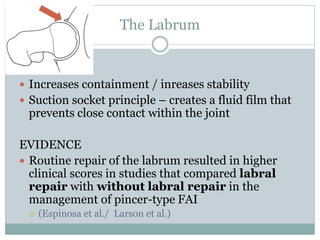
The Labrum 
 Increases containment / inreases stability 
 Suction socket principle – creates a fluid film that 
prevents close contact within the joint 
EVIDENCE 
 Routine repair of the labrum resulted in higher 
clinical scores in studies that compared labral 
repair with without labral repair in the 
management of pincer-type FAI 
 (Espinosa et al./ Larson et al.)
A case for LABRECTOMY 
 Role of labrum in containment and stability in non 
dysplastic hips – DOUBTFUL 
 Suction socket mechanism disrupted with damaged 
labrum, damaged cartilage, aspherical contour and 
inflammatory synovial fluid 
 Restoration of normal biomechanics in a repaired labrum 
– DOUBTFUL 
 Healing of labrum of limited vascularity - DOUBTFUL
A case for LABRECTOMY 
EVIDENCE 
 Sustained improvement in clinical scores after isolated 
labral débridement of various patterns of labral 
damage in patients without synovitis or arthritis 
 (Byrd and Jones / Santori and Villar / Farjo et al/ Haviv and 
O’Donnell ) 
 In vitro biomechanical data suggest there is nil 
deleterious effect after the removal or detachment of 
small amounts of the labrum 
 (Greaves et al/ Smith et al. )
Material And Method 
 10 hips, 8patients- 6males 2 females / Age 27-48 
 June 2011- June 2013 / follow up 13m – 36m 
 Diagnosis 
 Pincer type 3 (osteophyte 3) 
 Mixed type 7 ( healed AVN 2/ ?healed perthes 1/ Idio 4) 
 Cam type 1 excluded from this study 
 Arthroscopic labral excision for pincer/mixed FAI 
 Cartilage status evaluated by OUTERBRIDGE SCALE 
 Post op follow up at 1m/2m/6m/6monthly 
 FU evaluated by Roles-modesly Score / Oxford Hip Score 
 Hip arthroscopic instrumentation/30 deg 4mm scope
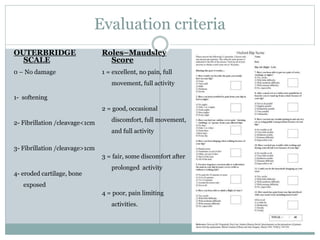
Evaluation criteria 
OUTERBRIDGE 
SCALE 
0 – No damage 
1- softening 
2- Fibrillation /cleavage<1cm 
3- Fibrillation /cleavage>1cm 
4- eroded cartilage, bone 
exposed 
Roles–Maudsley 
Score 
1 = excellent, no pain, full 
movement, full activity 
2 = good, occasional 
discomfort, full movement, 
and full activity 
3 = fair, some discomfort after 
prolonged activity 
4 = poor, pain limiting 
activities.
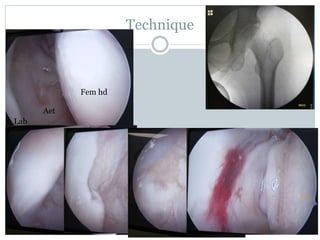
Technique 
Fem hd 
Lab 
Aet
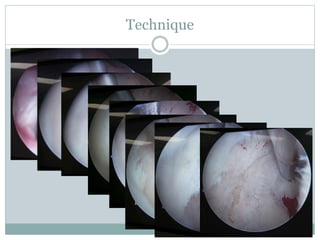
Technique
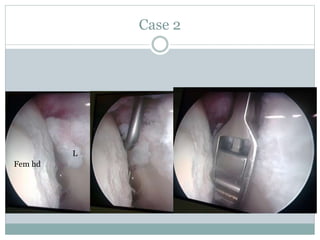
Case 2 
Fem hd 
L
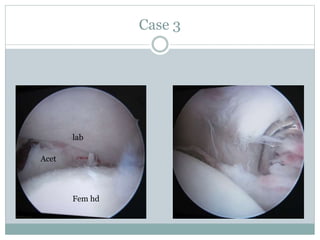
Case 3 
lab 
Fem hd 
Acet
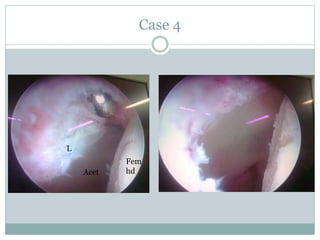
Case 4 
Fem 
hd 
L 
Acet
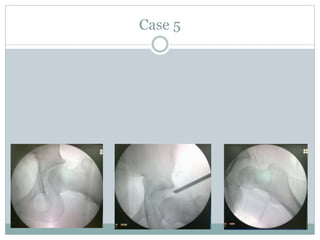
Case 5
DIAG PROCEDURE OUTE 
SL 
Results N 
RBRID 
GE 
O 
PRE-OP 
RM/Ox 
2M 6M 1YR 2YR 3YR 
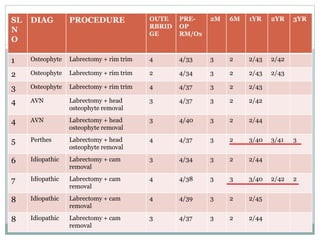
1 Osteophyte Labrectomy + rim trim 4 4/33 3 2 2/43 2/42 
2 Osteophyte Labrectomy + rim trim 2 4/34 3 2 2/43 2/43 
3 Osteophyte Labrectomy + rim trim 4 4/37 3 2 2/43 
4 AVN Labrectomy + head 
osteophyte removal 
3 4/37 3 2 2/42 
4 AVN Labrectomy + head 
osteophyte removal 
3 4/40 3 2 2/44 
5 Perthes Labrectomy + head 
osteophyte removal 
4 4/37 3 2 3/40 3/41 3 
6 Idiopathic Labrectomy + cam 
removal 
3 4/34 3 2 2/44 
7 Idiopathic Labrectomy + cam 
removal 
4 4/38 3 3 3/40 2/42 2 
8 Idiopathic Labrectomy + cam 
removal 
4 4/39 3 2 2/45 
8 Idiopathic Labrectomy + cam 
removal 
3 4/37 3 2 2/44
Discussion 
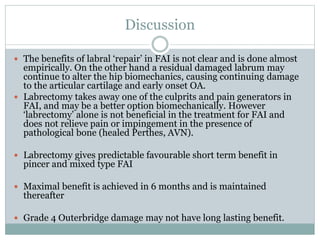
 The benefits of labral ‘repair’ in FAI is not clear and is done almost 
empirically. On the other hand a residual damaged labrum may 
continue to alter the hip biomechanics, causing continuing damage 
to the articular cartilage and early onset OA. 
 Labrectomy takes away one of the culprits and pain generators in 
FAI, and may be a better option biomechanically. However 
‘labrectomy’ alone is not beneficial in the treatment for FAI and 
does not relieve pain or impingement in the presence of 
pathological bone (healed Perthes, AVN). 
 Labrectomy gives predictable favourable short term benefit in 
pincer and mixed type FAI 
 Maximal benefit is achieved in 6 months and is maintained 
thereafter 
 Grade 4 Outerbridge damage may not have long lasting benefit.
Limitation of the study 
 No sportsmen in the group 
 Labral pathology was not the only pathology that was tackled 
 All patients had some degree of cartilage damage (outerbridge 3/4 
 No cohort group of labral repair 
 Follow up less than 2-3 years. Long term outcome unknown.

Femoro-Acetabular Impingement-Dr. M.N. Basu Mallick

  • 1.
    Femoro-Acetabular impingement DRM.N.BASU MALLICK ARTHROSCOPY AND SPORTS SURGERY APOLLO GLENEAGLES HOSPITAL, KOLKATA Does Labrectomy have a role?
  • 2.
    Femoro acetabular impingement  Abutment of the femoral head neck junction to the acetabular margin  Causes intermittent pain initially, and continuous pain later. Clicking, locking  Progresses to permanent damage to the labrum and cartilage, ending in OA hip Diagnoses by Impingement tests Xray –  Abnormal head neck morphology (alfa angle)  Acetabular retroversion (crossover sign)  Coxa profunda (medialised teardrop) Confirmation by MRI Kassarjian triad of MR findings  Abnormal head and neck morphology  Anterosuperior cartilage abnormalities  Anterosuperior labral abnormalities.
  • 3.
    Patterns CAM- Abnormal morphology of femoral head-neck jn - anterior aspect  Young athletic males  Shear injury - cartilage damage > labral damage PINCER  Acetabular margin projection  Middle aged athletic females  Osteophytes, coxa profunda, retroverted acetabulum  Impaction injury – labral damage prominent MIXED  Commonest type  SCFE  Neck femur fractures  Perthes disease  Geographical morphology
  • 4.
    FAI – pathopysiologyof damage CAM  Shear forces at chondro-labral junction  Labral tears  Chondro-labral separation  Cartilage delamination and peel off  Osteoarthritis PINCER  Impaction at labral margin  Tears and rip off
  • 5.
    Treatment philosophy Conservative  Restriction of inciting activity Surgery  To restore normal roll and glide of the joint  Excision of the extra bone from the femoral head neck junction (cam)  Rim trimming of the acetabular margin (pincer)  Labrum is reattached if torn / surgically detached for rim trim  OPEN/ ARTHROSCOPIC/ ARTHROSCOPY+OPEN
  • 6.
    The Labrum Increases containment / inreases stability  Suction socket principle – creates a fluid film that prevents close contact within the joint EVIDENCE  Routine repair of the labrum resulted in higher clinical scores in studies that compared labral repair with without labral repair in the management of pincer-type FAI  (Espinosa et al./ Larson et al.)
  • 7.
    A case forLABRECTOMY  Role of labrum in containment and stability in non dysplastic hips – DOUBTFUL  Suction socket mechanism disrupted with damaged labrum, damaged cartilage, aspherical contour and inflammatory synovial fluid  Restoration of normal biomechanics in a repaired labrum – DOUBTFUL  Healing of labrum of limited vascularity - DOUBTFUL
  • 8.
    A case forLABRECTOMY EVIDENCE  Sustained improvement in clinical scores after isolated labral débridement of various patterns of labral damage in patients without synovitis or arthritis  (Byrd and Jones / Santori and Villar / Farjo et al/ Haviv and O’Donnell )  In vitro biomechanical data suggest there is nil deleterious effect after the removal or detachment of small amounts of the labrum  (Greaves et al/ Smith et al. )
  • 9.
    Material And Method  10 hips, 8patients- 6males 2 females / Age 27-48  June 2011- June 2013 / follow up 13m – 36m  Diagnosis  Pincer type 3 (osteophyte 3)  Mixed type 7 ( healed AVN 2/ ?healed perthes 1/ Idio 4)  Cam type 1 excluded from this study  Arthroscopic labral excision for pincer/mixed FAI  Cartilage status evaluated by OUTERBRIDGE SCALE  Post op follow up at 1m/2m/6m/6monthly  FU evaluated by Roles-modesly Score / Oxford Hip Score  Hip arthroscopic instrumentation/30 deg 4mm scope
  • 10.
    Evaluation criteria OUTERBRIDGE SCALE 0 – No damage 1- softening 2- Fibrillation /cleavage<1cm 3- Fibrillation /cleavage>1cm 4- eroded cartilage, bone exposed Roles–Maudsley Score 1 = excellent, no pain, full movement, full activity 2 = good, occasional discomfort, full movement, and full activity 3 = fair, some discomfort after prolonged activity 4 = poor, pain limiting activities.
  • 11.
  • 12.
  • 13.
  • 14.
    Case 3 lab Fem hd Acet
  • 15.
    Case 4 Fem hd L Acet
  • 16.
  • 17.
    DIAG PROCEDURE OUTE SL Results N RBRID GE O PRE-OP RM/Ox 2M 6M 1YR 2YR 3YR 1 Osteophyte Labrectomy + rim trim 4 4/33 3 2 2/43 2/42 2 Osteophyte Labrectomy + rim trim 2 4/34 3 2 2/43 2/43 3 Osteophyte Labrectomy + rim trim 4 4/37 3 2 2/43 4 AVN Labrectomy + head osteophyte removal 3 4/37 3 2 2/42 4 AVN Labrectomy + head osteophyte removal 3 4/40 3 2 2/44 5 Perthes Labrectomy + head osteophyte removal 4 4/37 3 2 3/40 3/41 3 6 Idiopathic Labrectomy + cam removal 3 4/34 3 2 2/44 7 Idiopathic Labrectomy + cam removal 4 4/38 3 3 3/40 2/42 2 8 Idiopathic Labrectomy + cam removal 4 4/39 3 2 2/45 8 Idiopathic Labrectomy + cam removal 3 4/37 3 2 2/44
  • 18.
    Discussion  Thebenefits of labral ‘repair’ in FAI is not clear and is done almost empirically. On the other hand a residual damaged labrum may continue to alter the hip biomechanics, causing continuing damage to the articular cartilage and early onset OA.  Labrectomy takes away one of the culprits and pain generators in FAI, and may be a better option biomechanically. However ‘labrectomy’ alone is not beneficial in the treatment for FAI and does not relieve pain or impingement in the presence of pathological bone (healed Perthes, AVN).  Labrectomy gives predictable favourable short term benefit in pincer and mixed type FAI  Maximal benefit is achieved in 6 months and is maintained thereafter  Grade 4 Outerbridge damage may not have long lasting benefit.
  • 19.
    Limitation of thestudy  No sportsmen in the group  Labral pathology was not the only pathology that was tackled  All patients had some degree of cartilage damage (outerbridge 3/4  No cohort group of labral repair  Follow up less than 2-3 years. Long term outcome unknown.