CARING 
COUNSELING CENTER 
123 West Main Street 
_Ne_w_ Y_o_rk_, _NY_ _10_0_01____________ 
www.carecounseling.com 
123 West Main Street 
| P: 555.123.4568 
| www.carecounseling.com New York, NY 10001 F: 555.123.4567 
|P: 555.123.4568 
F: 555.123.4567 
Ethical Issues & 
Multiple Relationships in 
Supervision 
Presented by Mohamad Fadli 
SEMARANG STATE UNIVERSITY
123 West Main Street 
| P: 555.123.4568 
| www.carecounseling.com New York, NY 10001 F: 555.123.4567 
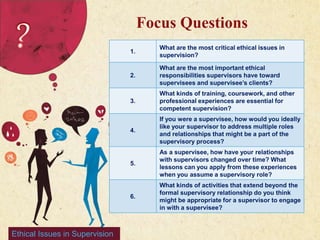
Focus Questions 
1. 
What are the most critical ethical issues in 
supervision? 
2. 
What are the most important ethical 
responsibilities supervisors have toward 
supervisees and supervisee’s clients? 
3. 
What kinds of training, coursework, and other 
professional experiences are essential for 
competent supervision? 
4. 
If you were a supervisee, how would you ideally 
like your supervisor to address multiple roles 
and relationships that might be a part of the 
supervisory process? 
5. 
As a supervisee, how have your relationships 
with supervisors changed over time? What 
lessons can you apply from these experiences 
when you assume a supervisory role? 
6. 
What kinds of activities that extend beyond the 
formal supervisory relationship do you think 
might be appropriate for a supervisor to engage 
in with a supervisee? 
Ethical Issues in Supervision
123 West Main Street 
| P: 555.123.4568 
| www.carecounseling.com New York, NY 10001 F: 555.123.4567 
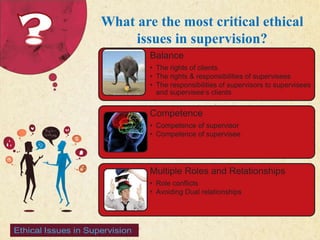
What are the most critical ethical 
issues in supervision? 
Balance 
• The rights of clients 
• The rights & responsibilities of supervisees 
• The responsibilities of supervisors to supervisees 
and supervisee’s clients 
Competence 
• Competence of supervisor 
• Competence of supervisee 
Multiple Roles and Relationships 
• Role conflicts 
• Avoiding Dual relationships
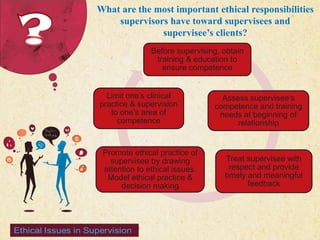
What are the most important ethical responsibilities 
supervisors have toward supervisees and 
supervisee’s clients? 
Limit one’s clinical 
practice & supervision 
to one’s area of 
competence 
123 West Main Street 
| P: 555.123.4568 
| www.carecounseling.com New York, NY 10001 F: 555.123.4567 
Before supervising, obtain 
training & education to 
ensure competence 
Assess supervisee’s 
competence and training 
needs at beginning of 
relationship 
Treat supervisee with 
respect and provide 
timely and meaningful 
feedback 
Promote ethical practice of 
supervisee by drawing 
attention to ethical issues. 
Model ethical practice & 
decision making
123 West Main Street 
| P: 555.123.4568 
| www.carecounseling.com New York, NY 10001 F: 555.123.4567 
MODELING ETHICAL PRACTICE
MODELING ETHICAL PRACTICE 
123 West Main Street 
| P: 555.123.4568 
| www.carecounseling.com New York, NY 10001 F: 555.123.4567 
Confidentiality 
• Model professional behavior by dealing 
appropriately with confidentiality issues with 
supervisees. 
• Supervisors have responsibility of keeping 
information obtained in supervisory 
relationship confidential. 
• Explain the limitations and parameters of 
confidentiality. 
• Explain what will be shared with 
supervisors, faculty, for evaluation 
• Do not share personal information shared 
in supervisory sessions 
• Maintain confidentiality of supervisee’s 
clients
ETHICAL DECISION MAKING 
123 West Main Street 
| P: 555.123.4568 
| www.carecounseling.com New York, NY 10001 F: 555.123.4567 
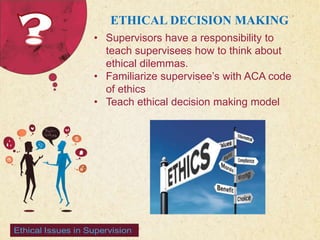
• Supervisors have a responsibility to 
teach supervisees how to think about 
ethical dilemmas. 
• Familiarize supervisee’s with ACA code 
of ethics 
• Teach ethical decision making model
ETHICAL DECISION MAKING 
123 West Main Street 
| P: 555.123.4568 
| www.carecounseling.com New York, NY 10001 F: 555.123.4567 
1. Identify the Problem 
2. Identify Potential Issues Involved 
3. Review Relevant Ethics Codes 
4. Know Applicable Laws & Regulations 
5. Obtain Consultation 
6. Consider Possible and Probable Courses 
of Action 
7. Enumerate the Consequences of Various 
Decisions 
8. Decide the Best Course of Action
ETHICAL DECISION MAKING 
123 West Main Street 
| P: 555.123.4568 
| www.carecounseling.com New York, NY 10001 F: 555.123.4567 
RESOURCES FOR CODE OF ETHICS 
American Counseling Association 
http://www.counseling.org/resources/codeofet 
hics/TP/home/ct2.aspx 
American School Counselors Association 
http://www.schoolcounselor.org/content.asp?c 
ontentid=136
ETHICAL DECISION MAKING 
123 West Main Street 
| P: 555.123.4568 
| www.carecounseling.com New York, NY 10001 F: 555.123.4567 
FULL HOUSE STYLE 
http://www.youtube.com/watch?v=OxRpGMeJPs8
123 West Main Street 
| P: 555.123.4568 
| www.carecounseling.com New York, NY 10001 F: 555.123.4567 
What kinds of training, coursework, and other 
professional experiences are essential for 
competent supervision? 
Competent Supervisors… 
1. Are trained in supervision and periodically update their 
knowledge and skills on supervision topics through 
workshops, continuing education conferences, and reading. 
2. Must have the education, training, and experience 
necessary to be competent in the areas of clinical expertise 
in which they are providing supervision 
3. Must have effective interpersonal skills and be able to work 
with a variety of group and individuals in supervision 
4. Must be cognizant of the fact that supervision is a 
situational process that is dependent on interaction 
between supervisor, supervisee, the setting and the clients 
5. Must be flexible and able to assume a variety of roles and 
responsibilities
123 West Main Street 
| P: 555.123.4568 
| www.carecounseling.com New York, NY 10001 F: 555.123.4567 
What kinds of training, coursework, and other 
professional experiences are essential for 
competent supervision? 
Competent Supervisors… 
6. Must have a broad knowledge of laws, ethics, and 
professional regulations that may apply in a variety of 
situations that could arise in supervision 
7. Stay focused on the fact that a primary goal of supervision to 
monitor clinical services so that the welfare of the client is 
protected 
8. Are willing to serve an evaluative function with supervisees 
and provide feedback about their performance on a regular 
basis 
9. Document supervision activities in a timely and accurate 
fashion 
10. Empower supervisees. Supervisors assist supervisees at 
both problem solving current situations and developing a 
problem solving approach that they can apply to nearly any 
clinical situation long after the supervision has ended.
123 West Main Street 
| P: 555.123.4568 
| www.carecounseling.com New York, NY 10001 F: 555.123.4567 
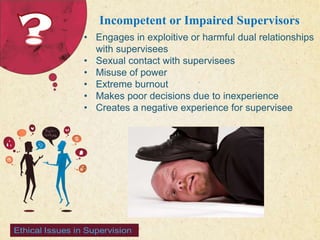
Incompetent or Impaired Supervisors 
• Engages in exploitive or harmful dual relationships 
with supervisees 
• Sexual contact with supervisees 
• Misuse of power 
• Extreme burnout 
• Makes poor decisions due to inexperience 
• Creates a negative experience for supervisee
123 West Main Street 
| P: 555.123.4568 
| www.carecounseling.com New York, NY 10001 F: 555.123.4567 
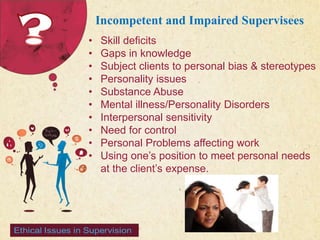
Incompetent and Impaired Supervisees 
• Skill deficits 
• Gaps in knowledge 
• Subject clients to personal bias & stereotypes 
• Personality issues 
• Substance Abuse 
• Mental illness/Personality Disorders 
• Interpersonal sensitivity 
• Need for control 
• Personal Problems affecting work 
• Using one’s position to meet personal needs 
at the client’s expense.
123 West Main Street 
| P: 555.123.4568 
| www.carecounseling.com New York, NY 10001 F: 555.123.4567 
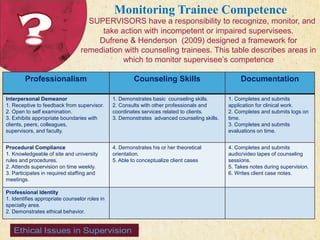
Monitoring Trainee Competence 
SUPERVISORS have a responsibility to recognize, monitor, and 
take action with incompetent or impaired supervisees. 
Dufrene & Henderson (2009) designed a framework for 
remediation with counseling trainees. This table describes areas in 
which to monitor supervisee’s competence 
Professionalism Counseling Skills Documentation 
Interpersonal Demeanor 
1. Receptive to feedback from supervisor. 
2. Open to self examination. 
3. Exhibits appropriate boundaries with 
clients, peers, colleagues, 
supervisors, and faculty. 
1. Demonstrates basic counseling skills. 
2. Consults with other professionals and 
coordinates services related to clients. 
3. Demonstrates advanced counseling skills. 
1. Completes and submits 
application for clinical work. 
2. Completes and submits logs on 
time. 
3. Completes and submits 
evaluations on time. 
Procedural Compliance 
1. Knowledgeable of site and university 
rules and procedures. 
2. Attends supervision on time weekly. 
3. Participates in required staffing and 
meetings. 
4. Demonstrates his or her theoretical 
orientation. 
5. Able to conceptualize client cases 
4. Completes and submits 
audio/video tapes of counseling 
sessions. 
5. Takes notes during supervision. 
6. Writes client case notes. 
Professional Identity 
1. Identifies appropriate counselor roles in 
specialty area. 
2. Demonstrates ethical behavior.
123 West Main Street 
| P: 555.123.4568 
| www.carecounseling.com New York, NY 10001 F: 555.123.4567 
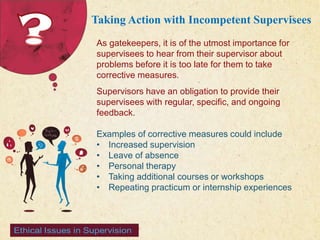
Taking Action with Incompetent Supervisees 
As gatekeepers, it is of the utmost importance for 
supervisees to hear from their supervisor about 
problems before it is too late for them to take 
corrective measures. 
Supervisors have an obligation to provide their 
supervisees with regular, specific, and ongoing 
feedback. 
Examples of corrective measures could include 
• Increased supervision 
• Leave of absence 
• Personal therapy 
• Taking additional courses or workshops 
• Repeating practicum or internship experiences
123 West Main Street 
| P: 555.123.4568 
| www.carecounseling.com New York, NY 10001 F: 555.123.4567 
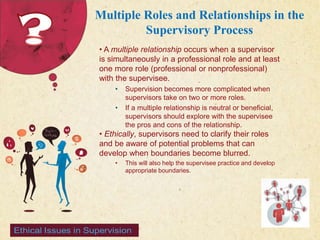
Multiple Roles and Relationships in the 
Supervisory Process 
• A multiple relationship occurs when a supervisor 
is simultaneously in a professional role and at least 
one more role (professional or nonprofessional) 
with the supervisee. 
• Supervision becomes more complicated when 
supervisors take on two or more roles. 
• If a multiple relationship is neutral or beneficial, 
supervisors should explore with the supervisee 
the pros and cons of the relationship. 
• Ethically, supervisors need to clarify their roles 
and be aware of potential problems that can 
develop when boundaries become blurred. 
• This will also help the supervisee practice and develop 
appropriate boundaries.
123 West Main Street 
| P: 555.123.4568 
| www.carecounseling.com New York, NY 10001 F: 555.123.4567 
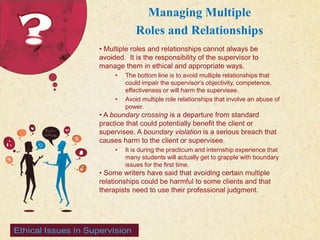
Managing Multiple 
Roles and Relationships 
• Multiple roles and relationships cannot always be 
avoided. It is the responsibility of the supervisor to 
manage them in ethical and appropriate ways. 
• The bottom line is to avoid multiple relationships that 
could impair the supervisor’s objectivity, competence, 
effectiveness or will harm the supervisee. 
• Avoid multiple role relationships that involve an abuse of 
power. 
• A boundary crossing is a departure from standard 
practice that could potentially benefit the client or 
supervisee. A boundary violation is a serious breach that 
causes harm to the client or supervisee. 
• It is during the practicum and internship experience that 
many students will actually get to grapple with boundary 
issues for the first time. 
• Some writers have said that avoiding certain multiple 
relationships could be harmful to some clients and that 
therapists need to use their professional judgment.
123 West Main Street 
| P: 555.123.4568 
| www.carecounseling.com New York, NY 10001 F: 555.123.4567 
Special Situations 
• MENTORING 
• If a supervisory relationship also takes on a mentor-mentee 
relationship, the critical point is that the person 
with the greater power initiates a discussion about this 
type of collaborative project. 
• To be a true mentor and allow a supervisee to know you 
outside of your authority role may leave you feeling 
vulnerable.
123 West Main Street 
| P: 555.123.4568 
| www.carecounseling.com New York, NY 10001 F: 555.123.4567 
Special Situations 
•DOCTORAL AND MASTER’S STUDENTS 
• In counselor education programs, doctoral students often 
are in roles with master’s level students in which they 
hold a position of authority. 
• These multiple relationships should not be discouraged, 
but there needs to be an open discussion about keeping 
watch for boundary violations. 
• SOCIALIZING 
• However minor the social situation may seem, 
supervisors still need to think about the potential issues 
that could surface and how attending a social function 
might either enhance or inhibit the professional 
relationship.
123 West Main Street 
| P: 555.123.4568 
| www.carecounseling.com New York, NY 10001 F: 555.123.4567 
More Special Situations 
• SEXUAL ATTRACTION 
• The attraction isn’t the problem. It is what individuals do 
with the attraction that determines if it is appropriate or 
inappropriate. 
• It is the supervisor’s responsibility to create a safe 
learning environment for supervisees. 
• If you find yourself sexually attracted to a supervisee, 
you should examine your feelings and consider that 
sexual harassment could be a real issue for you. You 
need to deal with this in your own therapy and 
supervision. 
• Preoccupation with clients is problematic, while transient 
sexual feelings are normal. 
• Sexual feelings for clients are common among students 
as well as professional practitioners. It is crucial for 
trainees acknowledge these feelings to themselves and 
to their supervisors and take steps to deal effectively with 
them. 
• It is important to normalize the feelings of attraction and 
distinguish them from feelings of sexual misconduct.
123 West Main Street 
| P: 555.123.4568 
| www.carecounseling.com New York, NY 10001 F: 555.123.4567 
And More Special Situations 
• SEXUAL INTIMACIES 
• Although multiple relationships are common in university 
settings, sex between students and their professors and 
supervisors is forbidden by ethical standards. 
• It results in a loss of objectivity and an abuse of 
power. 
• Additionally, it is poor modeling for supervisees and their 
relationships with clients. 
• If a problem does arise, the supervisor has the 
responsibility to take steps to resolve them in an ethical 
manner. 
• Bottom line: If you want to practice ethically, don’t 
do it. 
• Any form of sexual intimacy between supervisees and 
their clients is inappropriate and unethical. 
• The supervisor has a legal and ethical obligation to do 
everything possible to intervene immediately should sex 
between the supervisee and the client occurs.
123 West Main Street 
| P: 555.123.4568 
| www.carecounseling.com New York, NY 10001 F: 555.123.4567 
Combining Supervision and Counseling 
• There is a basic agreement that the supervision 
process should concentrate on the professional 
development of the supervisee rather than personal 
concerns. Supervision and counseling have 
different purposes. 
• Referrals should be made to a therapist when a 
supervisee experiences a personal problem that 
interferes with their providing care to the client. 
• Personal problems or limitations of supervisees 
should be challenged during supervision. 
• The purpose of discussing supervisee’s 
personal issues in supervision is to help them 
work with clients more successfully, not fix the 
problem.
123 West Main Street 
| P: 555.123.4568 
| www.carecounseling.com New York, NY 10001 F: 555.123.4567 
Changing Roles and Relationships 
• Students and supervisees can become valued 
colleagues 
• It is important to have open discussions to sort out 
any issues that may arise.
123 West Main Street 
| P: 555.123.4568 
| www.carecounseling.com New York, NY 10001 F: 555.123.4567 
References 
Corey, G., Haynes, R., Moulton, P., & Muratori, M. (2010). Clinical Supervision in the 
Helping Professions: A Practical Guide. Alexandria, VA: American Counseling 
Association. 
Dufrene, R. L., & Henderson, K. L. (2009). A framework for remediation plans 
for counseling trainees in G.R. Walz, J.C. Bleuer & R. K. Yep (Eds.), Compelling 
counseling interventions: VISTAS 2009 (pp 149-159). Alexandria,VA: American 
Counseling Association.

Fadli UNNES

  • 1.
    CARING COUNSELING CENTER 123 West Main Street _Ne_w_ Y_o_rk_, _NY_ _10_0_01____________ www.carecounseling.com 123 West Main Street | P: 555.123.4568 | www.carecounseling.com New York, NY 10001 F: 555.123.4567 |P: 555.123.4568 F: 555.123.4567 Ethical Issues & Multiple Relationships in Supervision Presented by Mohamad Fadli SEMARANG STATE UNIVERSITY
  • 2.
    123 West MainStreet | P: 555.123.4568 | www.carecounseling.com New York, NY 10001 F: 555.123.4567 Focus Questions 1. What are the most critical ethical issues in supervision? 2. What are the most important ethical responsibilities supervisors have toward supervisees and supervisee’s clients? 3. What kinds of training, coursework, and other professional experiences are essential for competent supervision? 4. If you were a supervisee, how would you ideally like your supervisor to address multiple roles and relationships that might be a part of the supervisory process? 5. As a supervisee, how have your relationships with supervisors changed over time? What lessons can you apply from these experiences when you assume a supervisory role? 6. What kinds of activities that extend beyond the formal supervisory relationship do you think might be appropriate for a supervisor to engage in with a supervisee? Ethical Issues in Supervision
  • 3.
    123 West MainStreet | P: 555.123.4568 | www.carecounseling.com New York, NY 10001 F: 555.123.4567 What are the most critical ethical issues in supervision? Balance • The rights of clients • The rights & responsibilities of supervisees • The responsibilities of supervisors to supervisees and supervisee’s clients Competence • Competence of supervisor • Competence of supervisee Multiple Roles and Relationships • Role conflicts • Avoiding Dual relationships
  • 4.
    What are themost important ethical responsibilities supervisors have toward supervisees and supervisee’s clients? Limit one’s clinical practice & supervision to one’s area of competence 123 West Main Street | P: 555.123.4568 | www.carecounseling.com New York, NY 10001 F: 555.123.4567 Before supervising, obtain training & education to ensure competence Assess supervisee’s competence and training needs at beginning of relationship Treat supervisee with respect and provide timely and meaningful feedback Promote ethical practice of supervisee by drawing attention to ethical issues. Model ethical practice & decision making
  • 5.
    123 West MainStreet | P: 555.123.4568 | www.carecounseling.com New York, NY 10001 F: 555.123.4567 MODELING ETHICAL PRACTICE
  • 6.
    MODELING ETHICAL PRACTICE 123 West Main Street | P: 555.123.4568 | www.carecounseling.com New York, NY 10001 F: 555.123.4567 Confidentiality • Model professional behavior by dealing appropriately with confidentiality issues with supervisees. • Supervisors have responsibility of keeping information obtained in supervisory relationship confidential. • Explain the limitations and parameters of confidentiality. • Explain what will be shared with supervisors, faculty, for evaluation • Do not share personal information shared in supervisory sessions • Maintain confidentiality of supervisee’s clients
  • 7.
    ETHICAL DECISION MAKING 123 West Main Street | P: 555.123.4568 | www.carecounseling.com New York, NY 10001 F: 555.123.4567 • Supervisors have a responsibility to teach supervisees how to think about ethical dilemmas. • Familiarize supervisee’s with ACA code of ethics • Teach ethical decision making model
  • 8.
    ETHICAL DECISION MAKING 123 West Main Street | P: 555.123.4568 | www.carecounseling.com New York, NY 10001 F: 555.123.4567 1. Identify the Problem 2. Identify Potential Issues Involved 3. Review Relevant Ethics Codes 4. Know Applicable Laws & Regulations 5. Obtain Consultation 6. Consider Possible and Probable Courses of Action 7. Enumerate the Consequences of Various Decisions 8. Decide the Best Course of Action
  • 9.
    ETHICAL DECISION MAKING 123 West Main Street | P: 555.123.4568 | www.carecounseling.com New York, NY 10001 F: 555.123.4567 RESOURCES FOR CODE OF ETHICS American Counseling Association http://www.counseling.org/resources/codeofet hics/TP/home/ct2.aspx American School Counselors Association http://www.schoolcounselor.org/content.asp?c ontentid=136
  • 10.
    ETHICAL DECISION MAKING 123 West Main Street | P: 555.123.4568 | www.carecounseling.com New York, NY 10001 F: 555.123.4567 FULL HOUSE STYLE http://www.youtube.com/watch?v=OxRpGMeJPs8
  • 11.
    123 West MainStreet | P: 555.123.4568 | www.carecounseling.com New York, NY 10001 F: 555.123.4567 What kinds of training, coursework, and other professional experiences are essential for competent supervision? Competent Supervisors… 1. Are trained in supervision and periodically update their knowledge and skills on supervision topics through workshops, continuing education conferences, and reading. 2. Must have the education, training, and experience necessary to be competent in the areas of clinical expertise in which they are providing supervision 3. Must have effective interpersonal skills and be able to work with a variety of group and individuals in supervision 4. Must be cognizant of the fact that supervision is a situational process that is dependent on interaction between supervisor, supervisee, the setting and the clients 5. Must be flexible and able to assume a variety of roles and responsibilities
  • 12.
    123 West MainStreet | P: 555.123.4568 | www.carecounseling.com New York, NY 10001 F: 555.123.4567 What kinds of training, coursework, and other professional experiences are essential for competent supervision? Competent Supervisors… 6. Must have a broad knowledge of laws, ethics, and professional regulations that may apply in a variety of situations that could arise in supervision 7. Stay focused on the fact that a primary goal of supervision to monitor clinical services so that the welfare of the client is protected 8. Are willing to serve an evaluative function with supervisees and provide feedback about their performance on a regular basis 9. Document supervision activities in a timely and accurate fashion 10. Empower supervisees. Supervisors assist supervisees at both problem solving current situations and developing a problem solving approach that they can apply to nearly any clinical situation long after the supervision has ended.
  • 13.
    123 West MainStreet | P: 555.123.4568 | www.carecounseling.com New York, NY 10001 F: 555.123.4567 Incompetent or Impaired Supervisors • Engages in exploitive or harmful dual relationships with supervisees • Sexual contact with supervisees • Misuse of power • Extreme burnout • Makes poor decisions due to inexperience • Creates a negative experience for supervisee
  • 14.
    123 West MainStreet | P: 555.123.4568 | www.carecounseling.com New York, NY 10001 F: 555.123.4567 Incompetent and Impaired Supervisees • Skill deficits • Gaps in knowledge • Subject clients to personal bias & stereotypes • Personality issues • Substance Abuse • Mental illness/Personality Disorders • Interpersonal sensitivity • Need for control • Personal Problems affecting work • Using one’s position to meet personal needs at the client’s expense.
  • 15.
    123 West MainStreet | P: 555.123.4568 | www.carecounseling.com New York, NY 10001 F: 555.123.4567 Monitoring Trainee Competence SUPERVISORS have a responsibility to recognize, monitor, and take action with incompetent or impaired supervisees. Dufrene & Henderson (2009) designed a framework for remediation with counseling trainees. This table describes areas in which to monitor supervisee’s competence Professionalism Counseling Skills Documentation Interpersonal Demeanor 1. Receptive to feedback from supervisor. 2. Open to self examination. 3. Exhibits appropriate boundaries with clients, peers, colleagues, supervisors, and faculty. 1. Demonstrates basic counseling skills. 2. Consults with other professionals and coordinates services related to clients. 3. Demonstrates advanced counseling skills. 1. Completes and submits application for clinical work. 2. Completes and submits logs on time. 3. Completes and submits evaluations on time. Procedural Compliance 1. Knowledgeable of site and university rules and procedures. 2. Attends supervision on time weekly. 3. Participates in required staffing and meetings. 4. Demonstrates his or her theoretical orientation. 5. Able to conceptualize client cases 4. Completes and submits audio/video tapes of counseling sessions. 5. Takes notes during supervision. 6. Writes client case notes. Professional Identity 1. Identifies appropriate counselor roles in specialty area. 2. Demonstrates ethical behavior.
  • 16.
    123 West MainStreet | P: 555.123.4568 | www.carecounseling.com New York, NY 10001 F: 555.123.4567 Taking Action with Incompetent Supervisees As gatekeepers, it is of the utmost importance for supervisees to hear from their supervisor about problems before it is too late for them to take corrective measures. Supervisors have an obligation to provide their supervisees with regular, specific, and ongoing feedback. Examples of corrective measures could include • Increased supervision • Leave of absence • Personal therapy • Taking additional courses or workshops • Repeating practicum or internship experiences
  • 17.
    123 West MainStreet | P: 555.123.4568 | www.carecounseling.com New York, NY 10001 F: 555.123.4567 Multiple Roles and Relationships in the Supervisory Process • A multiple relationship occurs when a supervisor is simultaneously in a professional role and at least one more role (professional or nonprofessional) with the supervisee. • Supervision becomes more complicated when supervisors take on two or more roles. • If a multiple relationship is neutral or beneficial, supervisors should explore with the supervisee the pros and cons of the relationship. • Ethically, supervisors need to clarify their roles and be aware of potential problems that can develop when boundaries become blurred. • This will also help the supervisee practice and develop appropriate boundaries.
  • 18.
    123 West MainStreet | P: 555.123.4568 | www.carecounseling.com New York, NY 10001 F: 555.123.4567 Managing Multiple Roles and Relationships • Multiple roles and relationships cannot always be avoided. It is the responsibility of the supervisor to manage them in ethical and appropriate ways. • The bottom line is to avoid multiple relationships that could impair the supervisor’s objectivity, competence, effectiveness or will harm the supervisee. • Avoid multiple role relationships that involve an abuse of power. • A boundary crossing is a departure from standard practice that could potentially benefit the client or supervisee. A boundary violation is a serious breach that causes harm to the client or supervisee. • It is during the practicum and internship experience that many students will actually get to grapple with boundary issues for the first time. • Some writers have said that avoiding certain multiple relationships could be harmful to some clients and that therapists need to use their professional judgment.
  • 19.
    123 West MainStreet | P: 555.123.4568 | www.carecounseling.com New York, NY 10001 F: 555.123.4567 Special Situations • MENTORING • If a supervisory relationship also takes on a mentor-mentee relationship, the critical point is that the person with the greater power initiates a discussion about this type of collaborative project. • To be a true mentor and allow a supervisee to know you outside of your authority role may leave you feeling vulnerable.
  • 20.
    123 West MainStreet | P: 555.123.4568 | www.carecounseling.com New York, NY 10001 F: 555.123.4567 Special Situations •DOCTORAL AND MASTER’S STUDENTS • In counselor education programs, doctoral students often are in roles with master’s level students in which they hold a position of authority. • These multiple relationships should not be discouraged, but there needs to be an open discussion about keeping watch for boundary violations. • SOCIALIZING • However minor the social situation may seem, supervisors still need to think about the potential issues that could surface and how attending a social function might either enhance or inhibit the professional relationship.
  • 21.
    123 West MainStreet | P: 555.123.4568 | www.carecounseling.com New York, NY 10001 F: 555.123.4567 More Special Situations • SEXUAL ATTRACTION • The attraction isn’t the problem. It is what individuals do with the attraction that determines if it is appropriate or inappropriate. • It is the supervisor’s responsibility to create a safe learning environment for supervisees. • If you find yourself sexually attracted to a supervisee, you should examine your feelings and consider that sexual harassment could be a real issue for you. You need to deal with this in your own therapy and supervision. • Preoccupation with clients is problematic, while transient sexual feelings are normal. • Sexual feelings for clients are common among students as well as professional practitioners. It is crucial for trainees acknowledge these feelings to themselves and to their supervisors and take steps to deal effectively with them. • It is important to normalize the feelings of attraction and distinguish them from feelings of sexual misconduct.
  • 22.
    123 West MainStreet | P: 555.123.4568 | www.carecounseling.com New York, NY 10001 F: 555.123.4567 And More Special Situations • SEXUAL INTIMACIES • Although multiple relationships are common in university settings, sex between students and their professors and supervisors is forbidden by ethical standards. • It results in a loss of objectivity and an abuse of power. • Additionally, it is poor modeling for supervisees and their relationships with clients. • If a problem does arise, the supervisor has the responsibility to take steps to resolve them in an ethical manner. • Bottom line: If you want to practice ethically, don’t do it. • Any form of sexual intimacy between supervisees and their clients is inappropriate and unethical. • The supervisor has a legal and ethical obligation to do everything possible to intervene immediately should sex between the supervisee and the client occurs.
  • 23.
    123 West MainStreet | P: 555.123.4568 | www.carecounseling.com New York, NY 10001 F: 555.123.4567 Combining Supervision and Counseling • There is a basic agreement that the supervision process should concentrate on the professional development of the supervisee rather than personal concerns. Supervision and counseling have different purposes. • Referrals should be made to a therapist when a supervisee experiences a personal problem that interferes with their providing care to the client. • Personal problems or limitations of supervisees should be challenged during supervision. • The purpose of discussing supervisee’s personal issues in supervision is to help them work with clients more successfully, not fix the problem.
  • 24.
    123 West MainStreet | P: 555.123.4568 | www.carecounseling.com New York, NY 10001 F: 555.123.4567 Changing Roles and Relationships • Students and supervisees can become valued colleagues • It is important to have open discussions to sort out any issues that may arise.
  • 25.
    123 West MainStreet | P: 555.123.4568 | www.carecounseling.com New York, NY 10001 F: 555.123.4567 References Corey, G., Haynes, R., Moulton, P., & Muratori, M. (2010). Clinical Supervision in the Helping Professions: A Practical Guide. Alexandria, VA: American Counseling Association. Dufrene, R. L., & Henderson, K. L. (2009). A framework for remediation plans for counseling trainees in G.R. Walz, J.C. Bleuer & R. K. Yep (Eds.), Compelling counseling interventions: VISTAS 2009 (pp 149-159). Alexandria,VA: American Counseling Association.