Factor Investigation
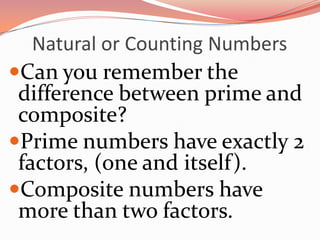
Natural or Counting NumbersCan you remember the difference between prime and composite?  Prime numbers have exactly 2 factors, (one and itself).Composite numbers have more than two factors.
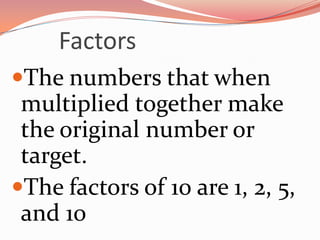
FactorsThe numbers that when multiplied together make the original number or target.The factors of 10 are 1, 2, 5, and 10
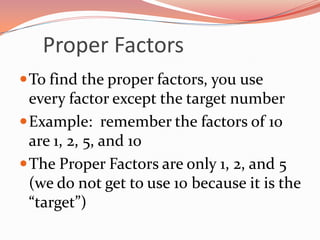
Proper FactorsTo find the proper factors, you use every factor except the target numberExample:  remember the factors of 10 are 1, 2, 5, and 10The Proper Factors are only 1, 2, and 5 (we do not get to use 10 because it is the “target”)
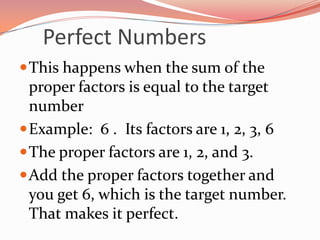
Perfect NumbersThis happens when the sum of the proper factors is equal to the target numberExample:  6 .  Its factors are 1, 2, 3, 6The proper factors are 1, 2, and 3.Add the proper factors together and you get 6, which is the target number.  That makes it perfect.
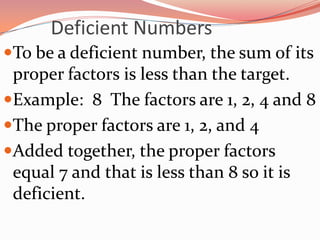
Deficient NumbersTo be a deficient number, the sum of its proper factors is less than the target.Example:  8  The factors are 1, 2, 4 and 8The proper factors are 1, 2, and 4Added together, the proper factors equal 7 and that is less than 8 so it is deficient.
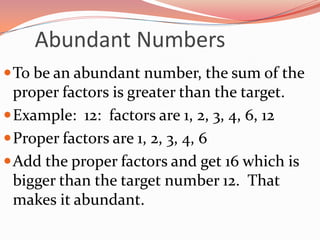
Abundant NumbersTo be an abundant number, the sum of the proper factors is greater than the target.Example:  12:  factors are 1, 2, 3, 4, 6, 12Proper factors are 1, 2, 3, 4, 6Add the proper factors and get 16 which is bigger than the target number 12.  That makes it abundant.
Factor Investigation

Factor Investigation

  • 1.
  • 2.
    Natural or CountingNumbersCan you remember the difference between prime and composite? Prime numbers have exactly 2 factors, (one and itself).Composite numbers have more than two factors.
  • 3.
    FactorsThe numbers thatwhen multiplied together make the original number or target.The factors of 10 are 1, 2, 5, and 10
  • 4.
    Proper FactorsTo findthe proper factors, you use every factor except the target numberExample: remember the factors of 10 are 1, 2, 5, and 10The Proper Factors are only 1, 2, and 5 (we do not get to use 10 because it is the “target”)
  • 5.
    Perfect NumbersThis happenswhen the sum of the proper factors is equal to the target numberExample: 6 . Its factors are 1, 2, 3, 6The proper factors are 1, 2, and 3.Add the proper factors together and you get 6, which is the target number. That makes it perfect.
  • 6.
    Deficient NumbersTo bea deficient number, the sum of its proper factors is less than the target.Example: 8 The factors are 1, 2, 4 and 8The proper factors are 1, 2, and 4Added together, the proper factors equal 7 and that is less than 8 so it is deficient.
  • 7.
    Abundant NumbersTo bean abundant number, the sum of the proper factors is greater than the target.Example: 12: factors are 1, 2, 3, 4, 6, 12Proper factors are 1, 2, 3, 4, 6Add the proper factors and get 16 which is bigger than the target number 12. That makes it abundant.