I collected 10 sunflowers from the garden, want to arrange them on my table in
Rows and columns. Please HELP!
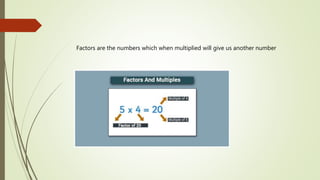
Factors are the numbers which when multiplied will give us another number
To check weather the given number is factor of another number or not,
we have to check weather the latter number is exactly divisible by given number or not.
For example :- 15 ÷ 5 = 3 and 15 ÷ 3 =5
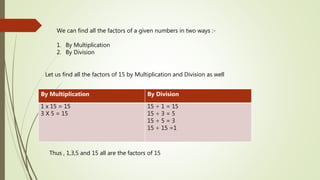
We can find all the factors of a given numbers in two ways :-
1. By Multiplication
2. By Division
Let us find all the factors of 15 by Multiplication and Division as well
By Multiplication By Division
1 x 15 = 15
3 X 5 = 15
15 ÷ 1 = 15
15 ÷ 3 = 5
15 ÷ 5 = 3
15 ÷ 15 =1
Thus , 1,3,5 and 15 all are the factors of 15
Finding Factors
Step 1 : Start with 1 x Number
Step 2 : Try with 2, 3,4 etc
Step 3: when you repeat your Factors, cross out the repeats- you are done
at this point
Step 4 :- If you get doubles(Such as 4 x 4 ), then you are done .
Repeats or Doubles let’s you know you are done.
What are the factors of 16?
 1 is a factor of each number and is called universal factor.
1 is a smallest factor
 Number is a factor of itself. Greatest factor of a number is
number itself.
 All the factors of a number are between 1 and number.
 All the numbers are factors of zero.
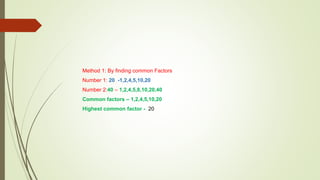
Method 1: By finding common Factors
Number 1: 20 -1,2,4,5,10,20
Number 2:40 – 1,2,4,5,8,10,20,40
Common factors – 1,2,4,5,10,20
Highest common factor - 20
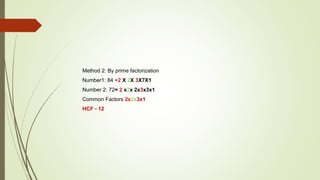
Method 2: By prime factorization
Number1: 84 =2 X 2X 3X7X1
Number 2: 72= 2 x2x 2x3x3x1
Common Factors 2x2x3x1
HCF - 12
Method 3: Long Division Method
Number1: 72
Number2 :90
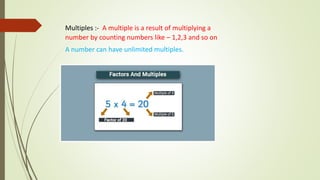
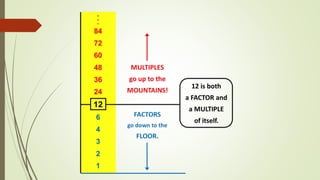
Multiples :- A multiple is a result of multiplying a
number by counting numbers like – 1,2,3 and so on
A number can have unlimited multiples.
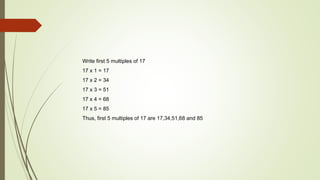
Write first 5 multiples of 17
17 x 1 = 17
17 x 2 = 34
17 x 3 = 51
17 x 4 = 68
17 x 5 = 85
Thus, first 5 multiples of 17 are 17,34,51,68 and 85
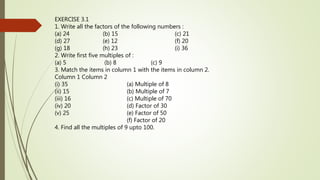
EXERCISE 3.1
1. Write all the factors of the following numbers :
(a) 24 (b) 15 (c) 21
(d) 27 (e) 12 (f) 20
(g) 18 (h) 23 (i) 36
2. Write first five multiples of :
(a) 5 (b) 8 (c) 9
3. Match the items in column 1 with the items in column 2.
Column 1 Column 2
(i) 35 (a) Multiple of 8
(ii) 15 (b) Multiple of 7
(iii) 16 (c) Multiple of 70
(iv) 20 (d) Factor of 30
(v) 25 (e) Factor of 50
(f) Factor of 20
4. Find all the multiples of 9 upto 100.
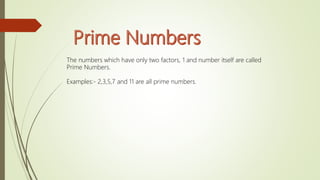
The numbers which have only two factors, 1 and number itself are called
Prime Numbers.
Examples:- 2,3,5,7 and 11 are all prime numbers.
The numbers(except 1) which are not prime are called composite numbers.
Composite Numbers always has more than two factors.
Example 4

Factors and Multiples.pptx

  • 2.
    I collected 10sunflowers from the garden, want to arrange them on my table in Rows and columns. Please HELP!
  • 3.
    Factors are thenumbers which when multiplied will give us another number
  • 4.
    To check weatherthe given number is factor of another number or not, we have to check weather the latter number is exactly divisible by given number or not. For example :- 15 ÷ 5 = 3 and 15 ÷ 3 =5
  • 5.
    We can findall the factors of a given numbers in two ways :- 1. By Multiplication 2. By Division Let us find all the factors of 15 by Multiplication and Division as well By Multiplication By Division 1 x 15 = 15 3 X 5 = 15 15 ÷ 1 = 15 15 ÷ 3 = 5 15 ÷ 5 = 3 15 ÷ 15 =1 Thus , 1,3,5 and 15 all are the factors of 15
  • 6.
    Finding Factors Step 1: Start with 1 x Number Step 2 : Try with 2, 3,4 etc Step 3: when you repeat your Factors, cross out the repeats- you are done at this point Step 4 :- If you get doubles(Such as 4 x 4 ), then you are done . Repeats or Doubles let’s you know you are done. What are the factors of 16?
  • 7.
     1 isa factor of each number and is called universal factor. 1 is a smallest factor  Number is a factor of itself. Greatest factor of a number is number itself.  All the factors of a number are between 1 and number.  All the numbers are factors of zero.
  • 8.
    Method 1: Byfinding common Factors Number 1: 20 -1,2,4,5,10,20 Number 2:40 – 1,2,4,5,8,10,20,40 Common factors – 1,2,4,5,10,20 Highest common factor - 20
  • 9.
    Method 2: Byprime factorization Number1: 84 =2 X 2X 3X7X1 Number 2: 72= 2 x2x 2x3x3x1 Common Factors 2x2x3x1 HCF - 12
  • 10.
    Method 3: LongDivision Method Number1: 72 Number2 :90
  • 11.
    Multiples :- Amultiple is a result of multiplying a number by counting numbers like – 1,2,3 and so on A number can have unlimited multiples.
  • 12.
    Write first 5multiples of 17 17 x 1 = 17 17 x 2 = 34 17 x 3 = 51 17 x 4 = 68 17 x 5 = 85 Thus, first 5 multiples of 17 are 17,34,51,68 and 85
  • 14.
    EXERCISE 3.1 1. Writeall the factors of the following numbers : (a) 24 (b) 15 (c) 21 (d) 27 (e) 12 (f) 20 (g) 18 (h) 23 (i) 36 2. Write first five multiples of : (a) 5 (b) 8 (c) 9 3. Match the items in column 1 with the items in column 2. Column 1 Column 2 (i) 35 (a) Multiple of 8 (ii) 15 (b) Multiple of 7 (iii) 16 (c) Multiple of 70 (iv) 20 (d) Factor of 30 (v) 25 (e) Factor of 50 (f) Factor of 20 4. Find all the multiples of 9 upto 100.
  • 15.
    The numbers whichhave only two factors, 1 and number itself are called Prime Numbers. Examples:- 2,3,5,7 and 11 are all prime numbers.
  • 16.
    The numbers(except 1)which are not prime are called composite numbers. Composite Numbers always has more than two factors. Example 4