INTRODUCTION
What isMaintenance?
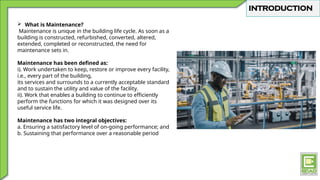
Maintenance is unique in the building life cycle. As soon as a
building is constructed, refurbished, converted, altered,
extended, completed or reconstructed, the need for
maintenance sets in.
Maintenance has been defined as:
i). Work undertaken to keep, restore or improve every facility,
i.e., every part of the building,
its services and surrounds to a currently acceptable standard
and to sustain the utility and value of the facility.
ii). Work that enables a building to continue to efficiently
perform the functions for which it was designed over its
useful service life.
Maintenance has two integral objectives:
a. Ensuring a satisfactory level of on-going performance; and
b. Sustaining that performance over a reasonable period
3.
WHY MAINTAIN?
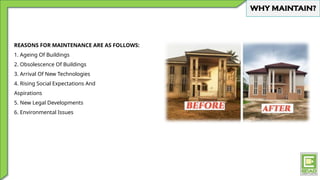
REASONS FORMAINTENANCE ARE AS FOLLOWS:
1. Ageing Of Buildings
2. Obsolescence Of Buildings
3. Arrival Of New Technologies
4. Rising Social Expectations And
Aspirations
5. New Legal Developments
6. Environmental Issues
4.
TYPES OF MAINTENANCE
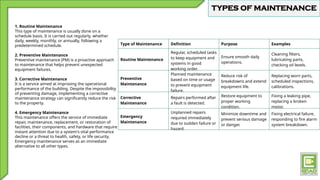
1.Routine Maintenance
This type of maintenance is usually done on a
schedule basis. It is carried out regularly, whether
daily, weekly, monthly, or annually, following a
predetermined schedule.
2. Preventive Maintenance
Preventive maintenance (PM) is a proactive approach
to maintenance that helps prevent unexpected
equipment failures.
3. Corrective Maintenance
It is a service aimed at improving the operational
performance of the building. Despite the impossibility
of preventing damage, implementing a corrective
maintenance strategy can significantly reduce the risk
to the property.
4. Emergency Maintenance
This maintenance offers the service of immediate
repair, maintenance, replacement, or restoration of
facilities, their components, and hardware that require
instant attention due to a system's vital performance
decline or a threat to health, safety, or life security.
Emergency maintenance serves as an immediate
alternative to all other types.
Type of Maintenance Definition Purpose Examples
Routine Maintenance
Regular, scheduled tasks
to keep equipment and
systems in good
working order.
Ensure smooth daily
operations.
Cleaning filters,
lubricating parts,
checking oil levels.
Preventive
Maintenance
Planned maintenance
based on time or usage
to prevent equipment
failure.
Reduce risk of
breakdowns and extend
equipment life.
Replacing worn parts,
scheduled inspections,
calibrations.
Corrective
Maintenance
Repairs performed after
a fault is detected.
Restore equipment to
proper working
condition.
Fixing a leaking pipe,
replacing a broken
motor.
Emergency
Maintenance
Unplanned repairs
required immediately
due to sudden failure or
hazard.
Minimize downtime and
prevent serious damage
or danger.
Fixing electrical failure,
responding to fire alarm
system breakdown.
5.
BUILDING MANAGEMENT
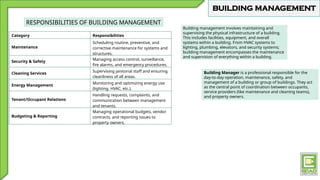
Building managementinvolves maintaining and
supervising the physical infrastructure of a building.
This includes facilities, equipment, and overall
systems within a building. From HVAC systems to
lighting, plumbing, elevators, and security systems;
building management encompasses the maintenance
and supervision of everything within a building.
Category Responsibilities
Maintenance
Scheduling routine, preventive, and
corrective maintenance for systems and
structures.
Security & Safety
Managing access control, surveillance,
fire alarms, and emergency procedures.
Cleaning Services
Supervising janitorial staff and ensuring
cleanliness of all areas.
Energy Management
Monitoring and optimizing energy use
(lighting, HVAC, etc.).
Tenant/Occupant Relations
Handling requests, complaints, and
communication between management
and tenants.
Budgeting & Reporting
Managing operational budgets, vendor
contracts, and reporting issues to
property owners.
RESPONSIBILITIES OF BUILDING MANAGEMENT
Building Manager is a professional responsible for the
day-to-day operation, maintenance, safety, and
management of a building or group of buildings. They act
as the central point of coordination between occupants,
service providers (like maintenance and cleaning teams),
and property owners.
6.
PLANNING AND SCHEDULING
MAINTENANCE
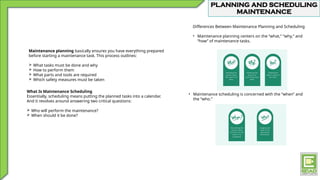
Maintenanceplanning basically ensures you have everything prepared
before starting a maintenance task. This process outlines:
What tasks must be done and why
How to perform them
What parts and tools are required
Which safety measures must be taken
What Is Maintenance Scheduling
Essentially, scheduling means putting the planned tasks into a calendar.
And it revolves around answering two critical questions:
Who will perform the maintenance?
When should it be done?
Differences Between Maintenance Planning and Scheduling
• Maintenance planning centers on the “what,” “why,” and
“how” of maintenance tasks.
• Maintenance scheduling is concerned with the “when” and
the “who.”
7.
ROLES OF ARCHITECTS&
FACILITY MANAGERS
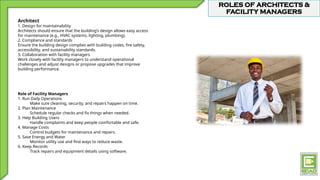
Architect
1. Design for maintainability
Architects should ensure that the building’s design allows easy access
for maintenance (e.g., HVAC systems, lighting, plumbing).
2. Compliance and standards
Ensure the building design complies with building codes, fire safety,
accessibility, and sustainability standards.
3. Collaboration with facility managers
Work closely with facility managers to understand operational
challenges and adjust designs or propose upgrades that improve
building performance.
Role of Facility Managers
1. Run Daily Operations
Make sure cleaning, security, and repairs happen on time.
2. Plan Maintenance
Schedule regular checks and fix things when needed.
3. Help Building Users
Handle complaints and keep people comfortable and safe.
4. Manage Costs
Control budgets for maintenance and repairs.
5. Save Energy and Water
Monitor utility use and find ways to reduce waste.
6. Keep Records
Track repairs and equipment details using software.
8.
COMMON BUILDING
MAINTENANCE PROBLEMS
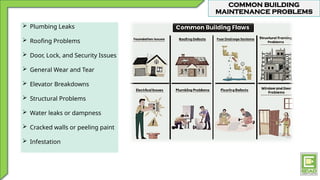
Plumbing Leaks
Roofing Problems
Door, Lock, and Security Issues
General Wear and Tear
Elevator Breakdowns
Structural Problems
Water leaks or dampness
Cracked walls or peeling paint
Infestation
9.
SUSTAINABLE
MAINTENANCE
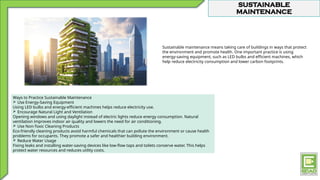
Sustainable maintenance meanstaking care of buildings in ways that protect
the environment and promote health. One important practice is using
energy-saving equipment, such as LED bulbs and efficient machines, which
help reduce electricity consumption and lower carbon footprints.
Ways to Practice Sustainable Maintenance
Use Energy-Saving Equipment
Using LED bulbs and energy-efficient machines helps reduce electricity use.
Encourage Natural Light and Ventilation
Opening windows and using daylight instead of electric lights reduce energy consumption. Natural
ventilation improves indoor air quality and lowers the need for air conditioning.
Use Non-Toxic Cleaning Products
Eco-friendly cleaning products avoid harmful chemicals that can pollute the environment or cause health
problems for occupants. They promote a safer and healthier building environment.
Reduce Water Usage
Fixing leaks and installing water-saving devices like low-flow taps and toilets conserve water. This helps
protect water resources and reduces utility costs.
10.
Costs
Maintenance vs. NewWork
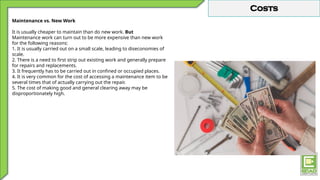
It is usually cheaper to maintain than do new work. But
Maintenance work can turn out to be more expensive than new work
for the following reasons:
1. It is usually carried out on a small scale, leading to diseconomies of
scale.
2. There is a need to first strip out existing work and generally prepare
for repairs and replacements.
3. It frequently has to be carried out in confined or occupied places.
4. It is very common for the cost of accessing a maintenance item to be
several times that of actually carrying out the repair.
5. The cost of making good and general clearing away may be
disproportionately high.
11.
CONCLUSION
In Conclusion,
Maintenance isas important as design and
construction.
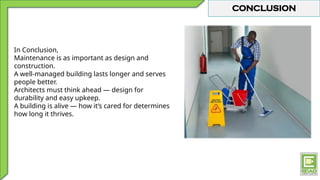
A well-managed building lasts longer and serves
people better.
Architects must think ahead — design for
durability and easy upkeep.
A building is alive — how it’s cared for determines
how long it thrives.



![Purdue finale [modalità compatibilità]](https://cdn.slidesharecdn.com/ss_thumbnails/purduefinalemodalitcompatibilit-130314130226-phpapp01-thumbnail.jpg?width=640&height=640&fit=bounds)


