Maintenance
Management
Property Management Lecture 4
Sr Dr Maimunah Sapri
Lecture Content
• Develop comprehensive maintenance management
• Monitoring the maintenance work
• Establishes an effective maintenance management
system and procedure
• Managing stock and inventory record
Introduction
• In the context of maintenance, the function of
the property manager is to maintain the
building to an appropriate and acceptable
standard at reasonable cost with minimum
inconvenience to the occupier.
Maintenance involves a wide range of activities, which
serve to keep the property in the best possible
condition.
Maintenance includes all activities in a building complex
which:
• improve the appearance of the building and
grounds;
• optimize the performance of its working parts;
correct physical, mechanical, and other defects;
• reduce accidents; and
• extend the productive life of the property.
Definition of maintenance
“The combination of all technical and associated administrative
actions intended to retain an item in, or bring it to, a state in which
it can perform its required function.”
BS 3811(1993)
Building maintenance Definition
Building maintenance is defined as “work undertaken in order to
keep, restore or improve every part of a building, its services and
surrounds, to a currently accepted standard, and to sustain the
utility and value of the building” (Seeley, 1976).
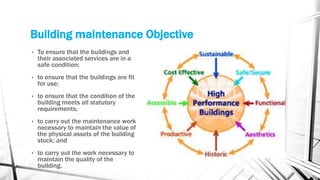
• To ensure that the buildings and
their associated services are in a
safe condition;
• to ensure that the buildings are fit
for use;
• to ensure that the condition of the
building meets all statutory
requirements;
• to carry out the maintenance work
necessary to maintain the value of
the physical assets of the building
stock; and
• to carry out the work necessary to
maintain the quality of the
building.
Building maintenance Objective
Property Managers Should Know
• What is to be maintained?
• When is it to be maintained?
• How is it to be maintained?
• Is the maintenance effective?
• What is the cost associated
• What is the level of quality
anticipated?
Develop Comprehensive Maintenance
Management Plan
Develop Comprehensive
Maintenance Management Plan
How To Establish A Maintenance Plan
• Assessing the Property’s Needs
• Identifying the Capabilities of On-site Staff and
Equipment
• Estimating the Time Each Job Will Take
• Re-arranging the Maintenance Tasks According
to Personnel
Effective Maintenance should:
Meet legislative requirements
 Reduce risk of unplanned failure
 Meet optimum equipment performance
 Maximise working life of plant
 Minimise disruption to normal working
 Provide input to financial forecasts
In maintaining a building,
there are usually several
strategic options available.
Thus, building maintenance can
be divided into three strategies:
• corrective;
• preventive;
• condition-based.
For example, the possibility of
reducing the demand for
maintenance by addressing
the actual cause of failure
and identifying its
consequences.
Corrective
Maintenance
Corrective maintenance is the simplest type
of maintenance strategy, where an element
in a building is used until it breaks down. It
covers all activities, including replacement
or repair of an element that has failed to a
point at which it cannot perform its
required function. Corrective maintenance
is sometimes referred to as failure-based or
unplanned maintenance. Corrective
maintenance tasks often take places in an
ad hoc manner in response to breakdowns
or user requests (David and Arthur, 1989)
Thus, corrective maintenance can be
extremely expensive for two reasons:
(1)The failure of an item can cause a large
amount of consequential damage to other
elements in the building. For example,
failure of the roof could cause damage to
the ceiling and the interior of the
building.
(2) Failure of an item can occur at a time
which is inconvenient to both the user and
the maintaining authority. This can make
manpower and spare parts planning
extremely difficult.
Preventive
maintenance
Preventive maintenance was introduced to
overcome the disadvantages of corrective
maintenance, by reducing the probability of
occurrence of failure and avoiding sudden
failure.
This strategy is referred to as time-based
maintenance, planned maintenance or
cyclic maintenance.
Preventive maintenance tasks are
performed in accordance with a
predetermined plan at regular, fixed
intervals, which may be based for example
on operating time. Such a strategy is
frequently applied to external or internal
paint work.
The advantages of preventive over
corrective maintenance (Raymond and
Joan,1991):
• maintenance can be planned ahead and
performed when it is convenient to the
building’s user;
• maintenance costs can be reduced by
avoiding the cost of consequential damage;
• downtime, the time that an element of the
building or the whole building is out of
service, can be minimized so the
habitability of the building can
be increased; and
• the health and safety of the user can be
improved.
Condition-based
maintenance
“Maintenance carried out in response to a significant
deterioration in a unit as indicated by a change in
monitored parameter of the unit condition or
performance” (Kelly and Harris, 1978).
The condition-based maintenance concept recognizes
that a change in condition and/or performance of an
item is the principal reason for carrying out
maintenance. Thus, the optimal time to perform
maintenance is determined from a condition survey
used to determine the actual state of each constituent
item in a building. In this strategy, maintenance tasks
are determined and planned by efficiently monitoring
the building’s elements such as walls, floors, roof and
service equipment such as boilers, pumps, and heating
system, to identify which element or piece of equipment
requires maintenance before a major failure occurs.
To gain the full advantage of C-base
maintenance, the condition of an item must
be monitored to identify whether there is any
evidence of change from a normal to an
abnormal condition. This can be done by
selecting the parameter which best describes
the condition of the item and monitoring
changes using suitable condition monitoring
tools.
Condition assessments can vary from simple
visual inspections to more advanced
inspections using a variety of condition
monitoring tools and techniques.
Discussions on
strategy
Current building maintenance strategies,
whether based on planned or
unplanned maintenance, are most likely
to be budget driven.
This means that maintenance is not
carried out according to actual need, but
is dictated by financial priorities
decided at the time or during the previous
12 months.
The approach being decide should allow the
PM to make decisions in advance about:
• selecting the most cost-effective
maintenance strategy for each
individual item in the building; and
• the optimal allocation of logistics resources
such as spare parts, tools, and personnel
which are needed for the execution of
maintenance activities.
Conclusions
To determine an optimal maintenance strategy for a building, it is necessary to integrate the three
types of maintenance strategy because:
• not all items are significant;
• not all significant items can be condition monitored;
• condition monitoring techniques are not always available; and
• the application of condition monitoring techniques is not always cost effective
Reading material
Building maintenance strategy: a new management approach
R.M.W. Horner, M.A. El-Haram and A.K. Munns
Construction Management Research Unit, Department of Civil Engineering,
University of Dundee, Dundee, Scotland

Property Management Lecture 4.pptx

  • 1.
  • 2.
    Lecture Content • Developcomprehensive maintenance management • Monitoring the maintenance work • Establishes an effective maintenance management system and procedure • Managing stock and inventory record
  • 3.
    Introduction • In thecontext of maintenance, the function of the property manager is to maintain the building to an appropriate and acceptable standard at reasonable cost with minimum inconvenience to the occupier.
  • 4.
    Maintenance involves awide range of activities, which serve to keep the property in the best possible condition. Maintenance includes all activities in a building complex which: • improve the appearance of the building and grounds; • optimize the performance of its working parts; correct physical, mechanical, and other defects; • reduce accidents; and • extend the productive life of the property.
  • 5.
    Definition of maintenance “Thecombination of all technical and associated administrative actions intended to retain an item in, or bring it to, a state in which it can perform its required function.” BS 3811(1993)
  • 6.
    Building maintenance Definition Buildingmaintenance is defined as “work undertaken in order to keep, restore or improve every part of a building, its services and surrounds, to a currently accepted standard, and to sustain the utility and value of the building” (Seeley, 1976).
  • 7.
    • To ensurethat the buildings and their associated services are in a safe condition; • to ensure that the buildings are fit for use; • to ensure that the condition of the building meets all statutory requirements; • to carry out the maintenance work necessary to maintain the value of the physical assets of the building stock; and • to carry out the work necessary to maintain the quality of the building. Building maintenance Objective
  • 8.
    Property Managers ShouldKnow • What is to be maintained? • When is it to be maintained? • How is it to be maintained? • Is the maintenance effective? • What is the cost associated • What is the level of quality anticipated? Develop Comprehensive Maintenance Management Plan
  • 9.
  • 10.
    How To EstablishA Maintenance Plan • Assessing the Property’s Needs • Identifying the Capabilities of On-site Staff and Equipment • Estimating the Time Each Job Will Take • Re-arranging the Maintenance Tasks According to Personnel
  • 11.
    Effective Maintenance should: Meetlegislative requirements  Reduce risk of unplanned failure  Meet optimum equipment performance  Maximise working life of plant  Minimise disruption to normal working  Provide input to financial forecasts
  • 12.
    In maintaining abuilding, there are usually several strategic options available. Thus, building maintenance can be divided into three strategies: • corrective; • preventive; • condition-based. For example, the possibility of reducing the demand for maintenance by addressing the actual cause of failure and identifying its consequences.
  • 13.
    Corrective Maintenance Corrective maintenance isthe simplest type of maintenance strategy, where an element in a building is used until it breaks down. It covers all activities, including replacement or repair of an element that has failed to a point at which it cannot perform its required function. Corrective maintenance is sometimes referred to as failure-based or unplanned maintenance. Corrective maintenance tasks often take places in an ad hoc manner in response to breakdowns or user requests (David and Arthur, 1989) Thus, corrective maintenance can be extremely expensive for two reasons: (1)The failure of an item can cause a large amount of consequential damage to other elements in the building. For example, failure of the roof could cause damage to the ceiling and the interior of the building. (2) Failure of an item can occur at a time which is inconvenient to both the user and the maintaining authority. This can make manpower and spare parts planning extremely difficult.
  • 14.
    Preventive maintenance Preventive maintenance wasintroduced to overcome the disadvantages of corrective maintenance, by reducing the probability of occurrence of failure and avoiding sudden failure. This strategy is referred to as time-based maintenance, planned maintenance or cyclic maintenance. Preventive maintenance tasks are performed in accordance with a predetermined plan at regular, fixed intervals, which may be based for example on operating time. Such a strategy is frequently applied to external or internal paint work. The advantages of preventive over corrective maintenance (Raymond and Joan,1991): • maintenance can be planned ahead and performed when it is convenient to the building’s user; • maintenance costs can be reduced by avoiding the cost of consequential damage; • downtime, the time that an element of the building or the whole building is out of service, can be minimized so the habitability of the building can be increased; and • the health and safety of the user can be improved.
  • 15.
    Condition-based maintenance “Maintenance carried outin response to a significant deterioration in a unit as indicated by a change in monitored parameter of the unit condition or performance” (Kelly and Harris, 1978). The condition-based maintenance concept recognizes that a change in condition and/or performance of an item is the principal reason for carrying out maintenance. Thus, the optimal time to perform maintenance is determined from a condition survey used to determine the actual state of each constituent item in a building. In this strategy, maintenance tasks are determined and planned by efficiently monitoring the building’s elements such as walls, floors, roof and service equipment such as boilers, pumps, and heating system, to identify which element or piece of equipment requires maintenance before a major failure occurs. To gain the full advantage of C-base maintenance, the condition of an item must be monitored to identify whether there is any evidence of change from a normal to an abnormal condition. This can be done by selecting the parameter which best describes the condition of the item and monitoring changes using suitable condition monitoring tools. Condition assessments can vary from simple visual inspections to more advanced inspections using a variety of condition monitoring tools and techniques.
  • 16.
    Discussions on strategy Current buildingmaintenance strategies, whether based on planned or unplanned maintenance, are most likely to be budget driven. This means that maintenance is not carried out according to actual need, but is dictated by financial priorities decided at the time or during the previous 12 months. The approach being decide should allow the PM to make decisions in advance about: • selecting the most cost-effective maintenance strategy for each individual item in the building; and • the optimal allocation of logistics resources such as spare parts, tools, and personnel which are needed for the execution of maintenance activities.
  • 17.
    Conclusions To determine anoptimal maintenance strategy for a building, it is necessary to integrate the three types of maintenance strategy because: • not all items are significant; • not all significant items can be condition monitored; • condition monitoring techniques are not always available; and • the application of condition monitoring techniques is not always cost effective
  • 18.
    Reading material Building maintenancestrategy: a new management approach R.M.W. Horner, M.A. El-Haram and A.K. Munns Construction Management Research Unit, Department of Civil Engineering, University of Dundee, Dundee, Scotland