CONTENT
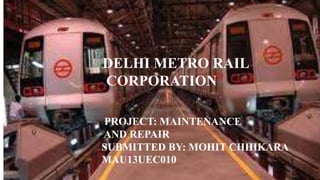
DELHI METRO RAIL
CORPORATION
PROJECT: MAINTENANCE
AND REPAIR
SUBMITTED BY: MOHIT CHHIKARA
MAU13UEC010
• INDUSTRY
• MAINTENANCE
• PLANNING
• OBJECTIVE
• EFFLORESENCE
• POREVENTION
• SNAP FROM FIELD
• SEWERAGE
• REPAIR
CONTENT
INDUSTRY : DMRC
 A rapid transit system serving Delhi, Gurgaon and Noida in the National Capital Region of India.
 Network consists of six lines.
 160 stations of which 35 are underground.
 The power output is supplied by 25 kv,50 Hertz alternating current through overhead catenary.
 The trains have six coaches after CWG.
 Has a carrying capacity as high as 60,000 – 80,000 phpdt (peak hour peak direction traffic).
 The metro has an average daily ridership of millions of commuters .
MAINTENANCE
• It is the work undertaken to restore or improve every facility in every
part of a building , its services and surroundings to currently accepted
standards and to sustain utility values of the facility.
•maintenance is the combination of technical and
administrative actions to ensure the items and elements of a
building in an acceptable standard to perform its required
function.
• IN DMRC WE PERFORMED JOB
• PAINT ,DECCATILE, UTILISATION OF FREE SPACE,PIPE LEAKAGE ETC
MAINTENANCE PLANNING
• Maintenance planning should start at the design stage of any building
project and should continue throughout the life of that building
• many buildings are destroyed not by outside forces such as
weathering factors like heavy rains or drought but by
insufficient/improper design during the design stage, through bad
housekeeping, inadequate maintenance and neglect during its full
operation.
• minor problem which can grow into a major one through neglect, and
which can be multiplied in many buildings
OBJECTIVE
• To preserve in good condition buildings and services.
• When deterioration occurs due to any reason it is inevitable to restore it to its
original standard.
• To make improvements whenever required.
• To sustain utility value.
A good maintenance team has to ensure
1. Safety
2. Efficiency
3. Reliability
Maintenance operations have many facts such as :
1. Condition based
maintenance :
2. Fixed time maintenance :
3. Preventative maintenance :
4. Opportunity maintenance :
5. Day to day maintenance :
6. Shutdown maintenance :
• It is the work initiated after
inspection.
• Activities repeated at
predetermined intervals.
• This is intended to preserve by
preventing failure and detecting
incipient faults.
• Work done as and when
possible within the limits of
operational demand.
• Its involves maintenance that
has to be performed daily.
• Through overhaul and
maintenance after closing.
Maintenance of walls to avoid efflorescence
Efflorescence is caused due to entry of moisture into the brickwork
and soaking it to saturation. Once the moisture has entered it moves
upward due to capillary action; reasons for entry of moisture are-
• Porous nature of structure
• Cracks in the wall
• Existing voids left due to bad workmanship
• Small trees and plants in the wall
• Nonexistence of damp proof course or failure of DPC
STEPS TO AVOID EFFLOROSCENCE
Eradication of efflorescence is quite difficult and it is often termed
as cancer of buildings .The first step to check efflorescence is to
check the ingress of moisture in buildings if there is no failure of
DPC efflorescence can be checked easily .
• Step one- ingress of water is checked
• Step two- plaster is removed both inside and outside and is left to
dry
• Step three- voids in the wall are filled
• Step four- walls are washed with tamarind water to remove stains
• Step five- walls are replastered with cement mortar not leaner than
1:4 and a water proofing admixtures
VAISHALI METRO STATION
BASEMENT
SNAP FROM THE FIELD
Backing up and overflow of foul water and sewage systems are a not uncommon consequence of flooding.
The decontamination works required then have a significant effect on the cost of refurbishment and the
length of time to re-occupancy.
The installation of additional breather vents and manholes may reduce this risk, and detailing of access and
drainage to under-floor spaces or cellars can reduce the cost of decontamination. It is also important to cheek
that the system conforms to all building regulations, British standards and bylaws.
SEWERAGE
Marine Structural Maintenance
For many owners of waterfront
facilities, the marine structure is the
essential component of their
operation, without which their
business operation could not
continue. To ensure continued
operation, maintenance inspections
should be conducted at frequent,
planned intervals.
INFRASTRUCTURE MAINTENANCE
What is repair ?
It is defined as the process of restoration of a broken,
damaged, or failed device, equipment, part, or property
to an acceptable operating or usable condition or state.
Some common types of repairs are as follows :
1. Patching up of defects such as cracks and fall of plaster.
2. Repairing doors, windows, replacement of glass panes.
3. Checking and repairing electric wiring.
4. Checking and repairing gas pipes, water pipes and plumbing
services.
5. Re-building non-structural walls, smoke chimneys, boundary walls,
etc.
6. Re-plastering of walls as required.
7. Rearranging disturbed roofing tiles.
8. Relaying cracked flooring at ground level.
9. Redecoration — whitewashing, painting, etc.
Examples of some common repair works in a building are
as follows : -
REPAIR OF CRACKS IN WALLS
Cracks are signs of distress in structural and non-structural
members caused due to separation of joints , development of
fissures , shearing, separation of members built with different
materials . Cracks may be at different locations like – vertical,
horizontal, inclined ,separation at the roof level just below the
junction of RCC slab and masonry wall , in parapet , at junctions of
RCC columns etc. They may be wide narrow or hairline and can be
of varying depths. They are classified broadly as structural and non
structural cracks; with structural cracks forming due to incorrect
design faulty construction, and non structural cracks forming due to
internal stresses .
THANK YOU

DMRC

  • 1.
    CONTENT DELHI METRO RAIL CORPORATION PROJECT:MAINTENANCE AND REPAIR SUBMITTED BY: MOHIT CHHIKARA MAU13UEC010
  • 2.
    • INDUSTRY • MAINTENANCE •PLANNING • OBJECTIVE • EFFLORESENCE • POREVENTION • SNAP FROM FIELD • SEWERAGE • REPAIR CONTENT
  • 3.
    INDUSTRY : DMRC A rapid transit system serving Delhi, Gurgaon and Noida in the National Capital Region of India.  Network consists of six lines.  160 stations of which 35 are underground.  The power output is supplied by 25 kv,50 Hertz alternating current through overhead catenary.  The trains have six coaches after CWG.  Has a carrying capacity as high as 60,000 – 80,000 phpdt (peak hour peak direction traffic).  The metro has an average daily ridership of millions of commuters .
  • 4.
    MAINTENANCE • It isthe work undertaken to restore or improve every facility in every part of a building , its services and surroundings to currently accepted standards and to sustain utility values of the facility. •maintenance is the combination of technical and administrative actions to ensure the items and elements of a building in an acceptable standard to perform its required function. • IN DMRC WE PERFORMED JOB • PAINT ,DECCATILE, UTILISATION OF FREE SPACE,PIPE LEAKAGE ETC
  • 5.
    MAINTENANCE PLANNING • Maintenanceplanning should start at the design stage of any building project and should continue throughout the life of that building • many buildings are destroyed not by outside forces such as weathering factors like heavy rains or drought but by insufficient/improper design during the design stage, through bad housekeeping, inadequate maintenance and neglect during its full operation. • minor problem which can grow into a major one through neglect, and which can be multiplied in many buildings
  • 6.
    OBJECTIVE • To preservein good condition buildings and services. • When deterioration occurs due to any reason it is inevitable to restore it to its original standard. • To make improvements whenever required. • To sustain utility value. A good maintenance team has to ensure 1. Safety 2. Efficiency 3. Reliability
  • 7.
    Maintenance operations havemany facts such as : 1. Condition based maintenance : 2. Fixed time maintenance : 3. Preventative maintenance : 4. Opportunity maintenance : 5. Day to day maintenance : 6. Shutdown maintenance : • It is the work initiated after inspection. • Activities repeated at predetermined intervals. • This is intended to preserve by preventing failure and detecting incipient faults. • Work done as and when possible within the limits of operational demand. • Its involves maintenance that has to be performed daily. • Through overhaul and maintenance after closing.
  • 8.
    Maintenance of wallsto avoid efflorescence Efflorescence is caused due to entry of moisture into the brickwork and soaking it to saturation. Once the moisture has entered it moves upward due to capillary action; reasons for entry of moisture are- • Porous nature of structure • Cracks in the wall • Existing voids left due to bad workmanship • Small trees and plants in the wall • Nonexistence of damp proof course or failure of DPC
  • 9.
    STEPS TO AVOIDEFFLOROSCENCE Eradication of efflorescence is quite difficult and it is often termed as cancer of buildings .The first step to check efflorescence is to check the ingress of moisture in buildings if there is no failure of DPC efflorescence can be checked easily . • Step one- ingress of water is checked • Step two- plaster is removed both inside and outside and is left to dry • Step three- voids in the wall are filled • Step four- walls are washed with tamarind water to remove stains • Step five- walls are replastered with cement mortar not leaner than 1:4 and a water proofing admixtures VAISHALI METRO STATION BASEMENT
  • 10.
  • 12.
    Backing up andoverflow of foul water and sewage systems are a not uncommon consequence of flooding. The decontamination works required then have a significant effect on the cost of refurbishment and the length of time to re-occupancy. The installation of additional breather vents and manholes may reduce this risk, and detailing of access and drainage to under-floor spaces or cellars can reduce the cost of decontamination. It is also important to cheek that the system conforms to all building regulations, British standards and bylaws. SEWERAGE
  • 13.
    Marine Structural Maintenance Formany owners of waterfront facilities, the marine structure is the essential component of their operation, without which their business operation could not continue. To ensure continued operation, maintenance inspections should be conducted at frequent, planned intervals. INFRASTRUCTURE MAINTENANCE
  • 14.
    What is repair? It is defined as the process of restoration of a broken, damaged, or failed device, equipment, part, or property to an acceptable operating or usable condition or state.
  • 15.
    Some common typesof repairs are as follows : 1. Patching up of defects such as cracks and fall of plaster. 2. Repairing doors, windows, replacement of glass panes. 3. Checking and repairing electric wiring. 4. Checking and repairing gas pipes, water pipes and plumbing services. 5. Re-building non-structural walls, smoke chimneys, boundary walls, etc. 6. Re-plastering of walls as required. 7. Rearranging disturbed roofing tiles. 8. Relaying cracked flooring at ground level. 9. Redecoration — whitewashing, painting, etc.
  • 16.
    Examples of somecommon repair works in a building are as follows : - REPAIR OF CRACKS IN WALLS Cracks are signs of distress in structural and non-structural members caused due to separation of joints , development of fissures , shearing, separation of members built with different materials . Cracks may be at different locations like – vertical, horizontal, inclined ,separation at the roof level just below the junction of RCC slab and masonry wall , in parapet , at junctions of RCC columns etc. They may be wide narrow or hairline and can be of varying depths. They are classified broadly as structural and non structural cracks; with structural cracks forming due to incorrect design faulty construction, and non structural cracks forming due to internal stresses .
  • 17.