Digital Literacies


   Skills for the future
        Pat Parslow
p.parslow@reading.ac.uk
On Blackboard…
• SSEPart1-11-2NR: SSE Part 1
• Post Exam Events
• SSE All of Part 1 (Transition mentoring and
  Digital Literacy)
• Digital Literacies
Skills for the future
• Digital Literacies:
   – Make your life easier
   – Increase your employability
   – Allow you to have an Agile approach
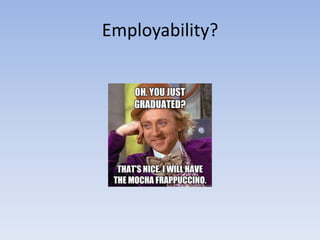
Employability?
What are “Digital Literacies”?


Yes, that is a question – that means you get to answer it!

           Please fill in Questionnaire 1 now
The JISC defines them as:

    By digital literacy we mean those
 capabilities which fit an individual for
living, learning and working in a digital
  society: for example, the skills to use
   digital tools to undertake academic
 research, writing and critical thinking;
    as part of personal development
 planning; and as a way of showcasing
              achievements.
The JISC defines them as:

    By digital literacy we mean those
capabilities which fit an individual for
living, learning and working in a digital
  society: for example, the skills to use
   digital tools to undertake academic
 research, writing and critical thinking;
    as part of personal development
 planning; and as a way of showcasing
              achievements.
The JISC defines them as:

    By digital literacy we mean those
 capabilities which fit an individual for
  living, learning and working in a
 digital society: for example, the skills
    to use digital tools to undertake
academic research, writing and critical
      thinking; as part of personal
development planning; and as a way of
       showcasing achievements.
The JISC defines them as:

    By digital literacy we mean those
 capabilities which fit an individual for
living, learning and working in a digital
society: for example, the skills to use
  digital tools to undertake academic
 research, writing and critical thinking;
    as part of personal development
 planning; and as a way of showcasing
              achievements.
The JISC defines them as:

    By digital literacy we mean those
 capabilities which fit an individual for
living, learning and working in a digital
  society: for example, the skills to use
  digital tools to undertake academic
research, writing and critical thinking;
    as part of personal development
 planning; and as a way of showcasing
              achievements.
The JISC defines them as:

    By digital literacy we mean those
 capabilities which fit an individual for
living, learning and working in a digital
  society: for example, the skills to use
   digital tools to undertake academic
research, writing and critical thinking;
    as part of personal development
 planning; and as a way of showcasing
              achievements.
The JISC defines them as:

    By digital literacy we mean those
 capabilities which fit an individual for
living, learning and working in a digital
  society: for example, the skills to use
   digital tools to undertake academic
      research, writing and critical
      thinking; as part of personal
development planning; and as a way of
        showcasing achievements.
The JISC defines them as:

    By digital literacy we mean those
 capabilities which fit an individual for
living, learning and working in a digital
  society: for example, the skills to use
   digital tools to undertake academic
 research, writing and critical thinking;
   as part of personal development
planning; and as a way of showcasing
              achievements.
The JISC defines them as:

    By digital literacy we mean those
 capabilities which fit an individual for
living, learning and working in a digital
  society: for example, the skills to use
   digital tools to undertake academic
 research, writing and critical thinking;
    as part of personal development
planning; and as a way of showcasing
             achievements.
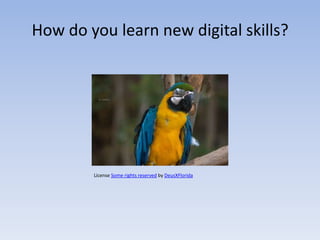
How do you learn new digital skills?


        License Some rights reserved by DeusXFlorida
Parrot fashion

Or…
Trial and error
Networking – learning from friends
Web searches
Methodical exploration of tools
Training courses …


How do you work out the best way to learn, for you?
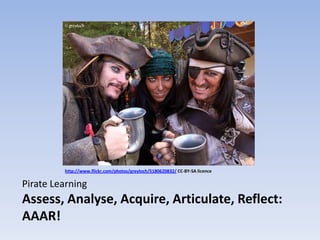
http://www.flickr.com/photos/greyloch/5180620832/ CC-BY-SA licence

Pirate Learning
Assess, Analyse, Acquire, Articulate, Reflect:
AAAR!
Why?

Maybe a little motivational song…
The ‘Elevator pitch’:
• http://www.youtube.com/watch?v=begvbqFA
  YnM
The Digitally Ready project is funded by JISC and the University of Reading

Neither of those organisations is in any way responsible for this song!


You are welcome to take the lyrics and make something better… (CC-SA)

Lyrics and vocals by Pat Parslow (who has no shame), music by Microsoft Songsmith
Learning goals
• Understand need for continuous improvement
  of digital literacies
• Recognise importance of self assessment
• Understand importance of Digital Literacies
  for Employability
• Understand the Pirate Model of learning
  (AAAAR!)
Need for continuous improvement of
           digital literacies
• Rapid rate of innovation
• Adaptation of skills to new working
  environments
• Always-beta style of software
• Knock on effect to your learning in general…
Importance of self assessment
•   Provision of courses is sub-optimal
•   You need to understand your own skills
•   You need to be in charge of your learning
•   Understanding your “knowledge gaps” is
    critical
Importance of Digital Literacies for
              Employability
• e-Skills UK research reported in their ‘Technology
  Insights 2011’ demonstrates the demand for digital
  literacies for employability:
• Across the UK economy, 22 million people, 77% of the
  workforce, use IT in their jobs, and this will continue to
  rise. 92% of job advertisements require applicants to
  have basic IT skills and 1 in 10 UK businesses report
  gaps in IT user skills.
• 1.5 million people in the UK are currently employed in
  the IT sector and 500,000 new staff will be required in
  this sector over the next 5 years.
http://www.e-skills.com/research/research-publications/insights-reports-and-
videos/technology-insights-2011/technology-insights-2011-key-findings
Pirate Model of learning (AAAAR!)
• AAAR!
• Assess – yourself, and your needs
• Analyse – the gaps between these two
• Acquire – gain skills and competencies
• Articulate – communicate your skills to
  others
• Reflect – on the process, how you can learn
  better
And now…..
• A chance to have a look at some of the
  support materials

• Make sure you are logged in to Blackboard first
• https://reading-ac-
  uk.campuspack.eu/Groups/RDXPARSLOW-
  DEV/Digitally_Ready
What are “Digital Literacies”?


Yes, that is a question – that means you get to answer it!

           Please fill in Questionnaire 2 now

Example digLit workshop slides

  • 1.
    Digital Literacies Skills for the future Pat Parslow p.parslow@reading.ac.uk
  • 2.
    On Blackboard… • SSEPart1-11-2NR:SSE Part 1 • Post Exam Events • SSE All of Part 1 (Transition mentoring and Digital Literacy) • Digital Literacies
  • 3.
    Skills for thefuture • Digital Literacies: – Make your life easier – Increase your employability – Allow you to have an Agile approach
  • 4.
  • 5.
    What are “DigitalLiteracies”? Yes, that is a question – that means you get to answer it! Please fill in Questionnaire 1 now
  • 6.
    The JISC definesthem as: By digital literacy we mean those capabilities which fit an individual for living, learning and working in a digital society: for example, the skills to use digital tools to undertake academic research, writing and critical thinking; as part of personal development planning; and as a way of showcasing achievements.
  • 7.
    The JISC definesthem as: By digital literacy we mean those capabilities which fit an individual for living, learning and working in a digital society: for example, the skills to use digital tools to undertake academic research, writing and critical thinking; as part of personal development planning; and as a way of showcasing achievements.
  • 8.
    The JISC definesthem as: By digital literacy we mean those capabilities which fit an individual for living, learning and working in a digital society: for example, the skills to use digital tools to undertake academic research, writing and critical thinking; as part of personal development planning; and as a way of showcasing achievements.
  • 9.
    The JISC definesthem as: By digital literacy we mean those capabilities which fit an individual for living, learning and working in a digital society: for example, the skills to use digital tools to undertake academic research, writing and critical thinking; as part of personal development planning; and as a way of showcasing achievements.
  • 10.
    The JISC definesthem as: By digital literacy we mean those capabilities which fit an individual for living, learning and working in a digital society: for example, the skills to use digital tools to undertake academic research, writing and critical thinking; as part of personal development planning; and as a way of showcasing achievements.
  • 11.
    The JISC definesthem as: By digital literacy we mean those capabilities which fit an individual for living, learning and working in a digital society: for example, the skills to use digital tools to undertake academic research, writing and critical thinking; as part of personal development planning; and as a way of showcasing achievements.
  • 12.
    The JISC definesthem as: By digital literacy we mean those capabilities which fit an individual for living, learning and working in a digital society: for example, the skills to use digital tools to undertake academic research, writing and critical thinking; as part of personal development planning; and as a way of showcasing achievements.
  • 13.
    The JISC definesthem as: By digital literacy we mean those capabilities which fit an individual for living, learning and working in a digital society: for example, the skills to use digital tools to undertake academic research, writing and critical thinking; as part of personal development planning; and as a way of showcasing achievements.
  • 14.
    The JISC definesthem as: By digital literacy we mean those capabilities which fit an individual for living, learning and working in a digital society: for example, the skills to use digital tools to undertake academic research, writing and critical thinking; as part of personal development planning; and as a way of showcasing achievements.
  • 15.
    How do youlearn new digital skills? License Some rights reserved by DeusXFlorida
  • 16.
    Parrot fashion Or… Trial anderror Networking – learning from friends Web searches Methodical exploration of tools Training courses … How do you work out the best way to learn, for you?
  • 17.
    http://www.flickr.com/photos/greyloch/5180620832/ CC-BY-SA licence PirateLearning Assess, Analyse, Acquire, Articulate, Reflect: AAAR!
  • 18.
    Why? Maybe a littlemotivational song…
  • 19.
    The ‘Elevator pitch’: •http://www.youtube.com/watch?v=begvbqFA YnM
  • 20.
    The Digitally Readyproject is funded by JISC and the University of Reading Neither of those organisations is in any way responsible for this song! You are welcome to take the lyrics and make something better… (CC-SA) Lyrics and vocals by Pat Parslow (who has no shame), music by Microsoft Songsmith
  • 21.
    Learning goals • Understandneed for continuous improvement of digital literacies • Recognise importance of self assessment • Understand importance of Digital Literacies for Employability • Understand the Pirate Model of learning (AAAAR!)
  • 22.
    Need for continuousimprovement of digital literacies • Rapid rate of innovation • Adaptation of skills to new working environments • Always-beta style of software • Knock on effect to your learning in general…
  • 23.
    Importance of selfassessment • Provision of courses is sub-optimal • You need to understand your own skills • You need to be in charge of your learning • Understanding your “knowledge gaps” is critical
  • 24.
    Importance of DigitalLiteracies for Employability • e-Skills UK research reported in their ‘Technology Insights 2011’ demonstrates the demand for digital literacies for employability: • Across the UK economy, 22 million people, 77% of the workforce, use IT in their jobs, and this will continue to rise. 92% of job advertisements require applicants to have basic IT skills and 1 in 10 UK businesses report gaps in IT user skills. • 1.5 million people in the UK are currently employed in the IT sector and 500,000 new staff will be required in this sector over the next 5 years. http://www.e-skills.com/research/research-publications/insights-reports-and- videos/technology-insights-2011/technology-insights-2011-key-findings
  • 25.
    Pirate Model oflearning (AAAAR!) • AAAR! • Assess – yourself, and your needs • Analyse – the gaps between these two • Acquire – gain skills and competencies • Articulate – communicate your skills to others • Reflect – on the process, how you can learn better
  • 26.
    And now….. • Achance to have a look at some of the support materials • Make sure you are logged in to Blackboard first • https://reading-ac- uk.campuspack.eu/Groups/RDXPARSLOW- DEV/Digitally_Ready
  • 27.
    What are “DigitalLiteracies”? Yes, that is a question – that means you get to answer it! Please fill in Questionnaire 2 now