
Achieving Horizontal scaling
for Enterprise Messaging
using Fabric8
Rob Davies
June 2015
RED HAT | Fabric8 Rocks!2
Rob Davies
•  Director, Engineering xPaaS
•  Technical Director of Fuse
Engineering
•  Over 20 years experience of
developing large scale solutions for
telcos and finance
•  Creator of ActiveMQ and ServiceMix
•  Committer on open source projects,
including Apache Camel …
RED HAT | Fabric8 Rocks!3
Agenda
• Introduction to Fabric8
• Enterprise messaging
• Fabric8MQ
• Demo
RED HAT | Fabric8 Rocks!4
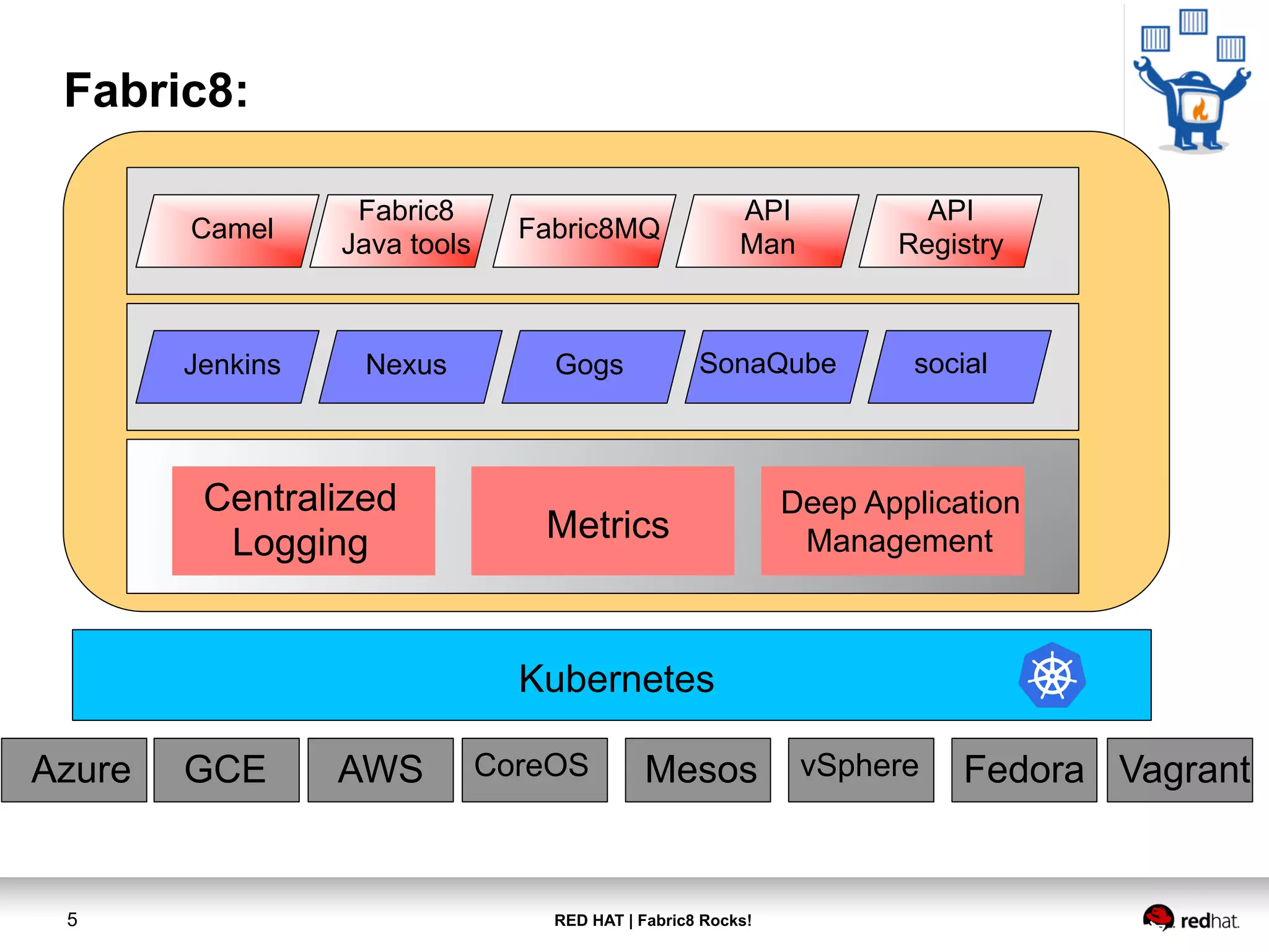
Fabric8
•  Open source, ASL 2.0 licensed project, built to provide
the management infrastructure for Microservices
deployments
•  Management: console, logging, metrics, API
Management
•  Continuous Delivery - workflow
•  Integration Platform as a Service – Camel route
visualization, API registry, Messaging as a Service, …
•  Tools – Kubernetes/OpenShift build integration,
Kubernetes component test support, CDI extensions
RED HAT | Fabric8 Rocks!5
Fabric8:
GCE AWS CoreOS Mesos vSphere Fedora VagrantAzure
Kubernetes
Centralized
Logging Metrics
Deep Application
Management
API
Registry
API
Man
Fabric8MQCamel
Fabric8
Java tools
socialSonaQubeGogsJenkins Nexus
RED HAT | Fabric8 Rocks!6
Agenda
• Introduction to Fabric8
• Enterprise messaging
• Fabric8MQ
• Demo
RED HAT | Fabric8 Rocks!7
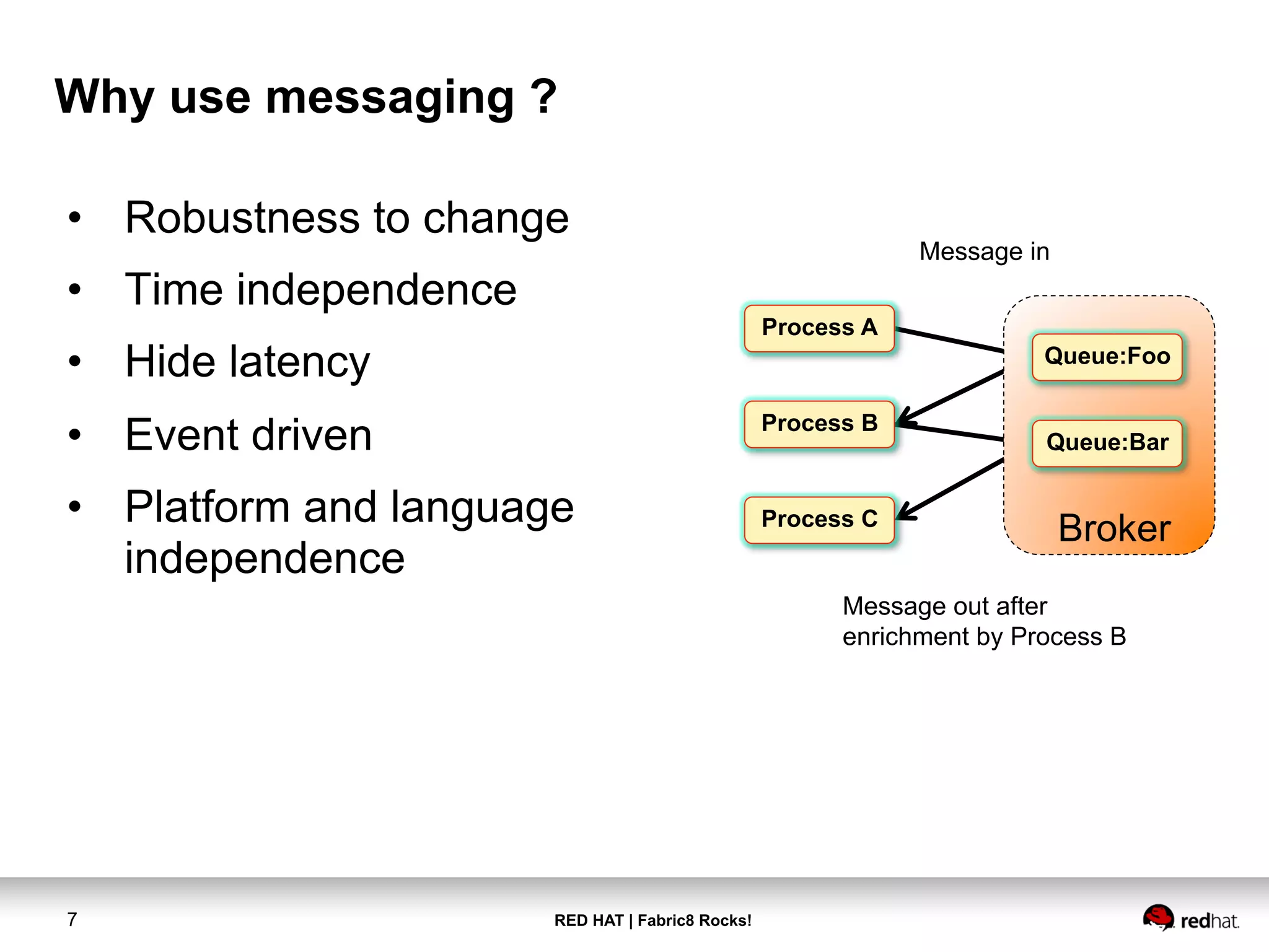
Why use messaging ?
•  Robustness to change
•  Time independence
•  Hide latency
•  Event driven
•  Platform and language
independence
Broker
Message in
Message out after
enrichment by Process B
Process C
Process B
Process A
Queue:Foo
Queue:Bar
RED HAT | Fabric8 Rocks!8
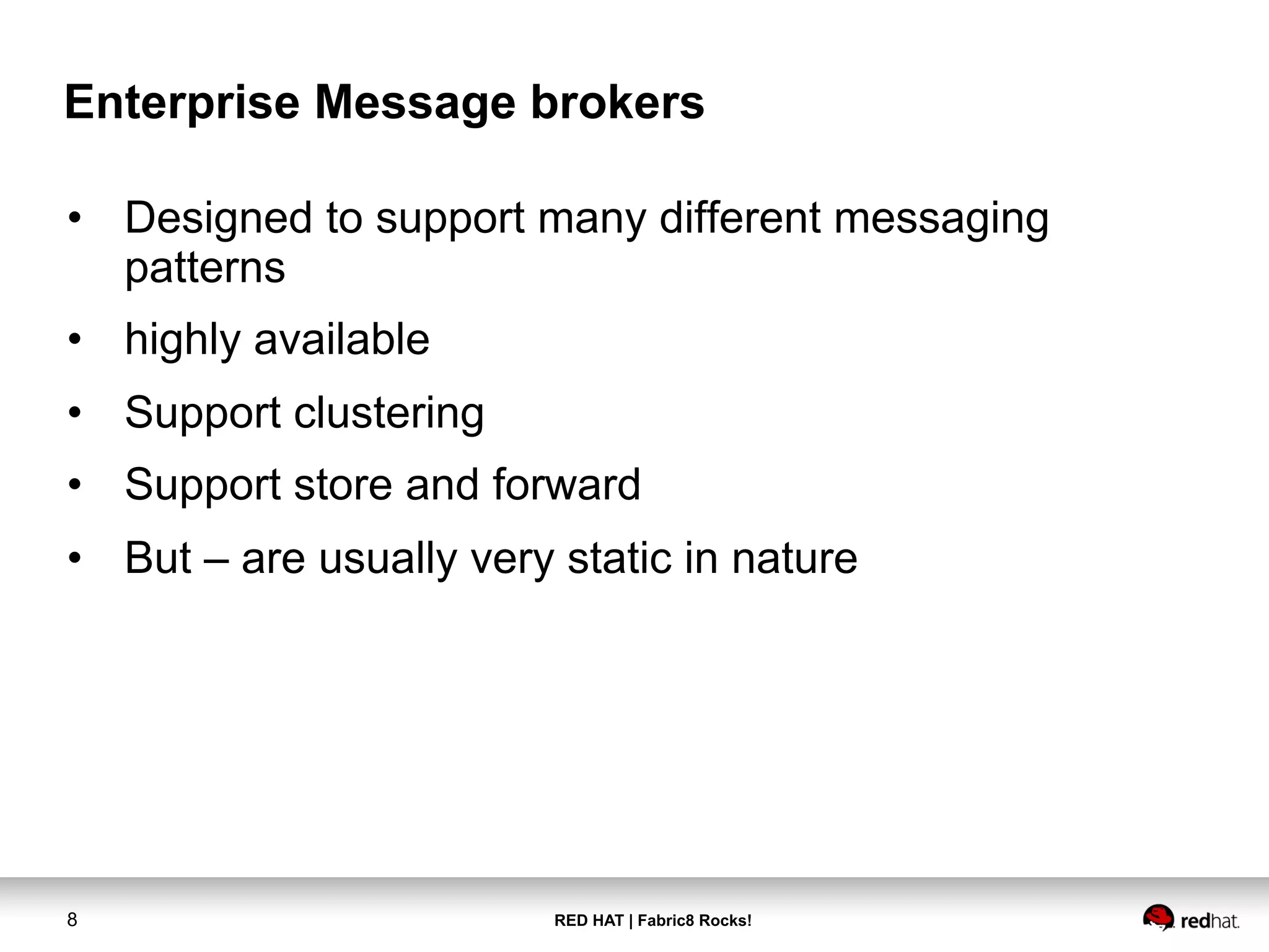
Enterprise Message brokers
•  Designed to support many different messaging
patterns
•  highly available
•  Support clustering
•  Support store and forward
•  But – are usually very static in nature
RED HAT | Fabric8 Rocks!9
•  Top Level Apache Software Foundation Project
•  Wildly popular, high performance, reliable message broker
•  Connects to nearly everything
• Native Java, C/C++, .Net,
• AMQP 1.0, MQTT 3.1, STOMP (1.0-1.2) and OpenWire
• STOMP enables Ruby, JS, Perl, Python, PHP, ActionScript
…
•  Embedded and standalone deployment options
RED HAT | Fabric8 Rocks!10
Message Channels and Routing
•  Message Channels
•  Named communication between interested parties
•  JMS calls them ‘Destinations’
•  Can “tune-in” to multiple channels using wildcards
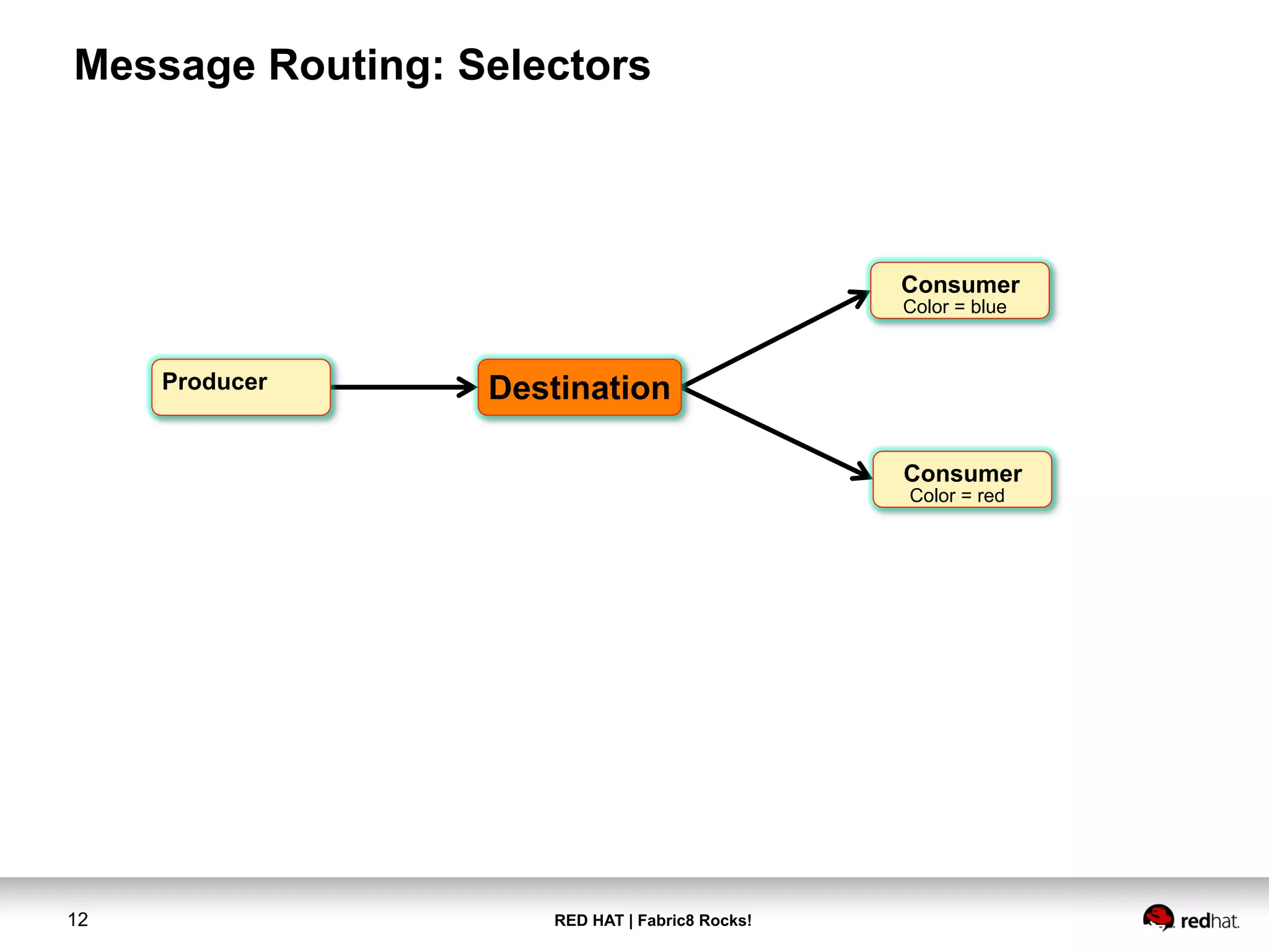
•  Can fine-tune message consumption with selectors
•  Can route a message based on content
RED HAT | Fabric8 Rocks!11
Message Channels = JMS Destinations
Broker Consumer
Consumer
Destination
WIDGET
Destination
ORDER
Producer
Consumer
RED HAT | Fabric8 Rocks!12
Message Routing: Selectors
Producer Destination
Consumer
Color = red
Consumer
Color = blue
RED HAT | Fabric8 Rocks!13
Message Routing: Destination Wildcards
•  * matches a subject
•  > matches sub-tree
Topic:
BAR.BEER.WHITE
Topic:
BAR.WINE.WHITE
Producer
Consumer
Topic:BAR.WINE.WHITE
Consumer
Topic:BAR.BEER.WHITE
Consumer
Topic:BAR.*.WHITE
Consumer
Topic:BAR.>
RED HAT | Fabric8 Rocks!14
Message Groups
Producer
Consumer
Consumer
Consumer
Queue:Prices
Message message = session.createTextMessage(“hi JBCNConf”);
message.setStringProperty("JMSXGroupID", ”JavaRocks");
producer.send(message);
RED HAT | Fabric8 Rocks!15
High Availability clustering:
MasterClient Slave Slave
Only one broker is active (the master) at any one time.
1. send
3. receipt
2. store
RED HAT | Fabric8 Rocks!16
Network of Brokers:
Producer
Highly reliable, store and forward
Consumer
1. send
Broker1
2. store
Broker2
5. store
4. Network
send
6. Network
receipt
3. receipt
7. delete
6. Network
send
7. acknowledge
8. delete
RED HAT | Fabric8 Rocks!17
Networks of Brokers: some limitations
•  Performance – messages are always stored by the
broker to disk before forwarding to another broker –
this can increase latency by at least a factor of 10
•  Networks are chatty – routing information is passed
from broker to broker every time a consumer starts or
stops
•  Networks are a bottleneck – networks are
implemented as one TCP/IP connection – this is
natural choke point for high throughput scenarios
•  Messages can be orphaned – If a broker goes down,
locally stored messages won’t get delivered until the
broker is recovered
RED HAT | Fabric8 Rocks!18
Networks of Brokers: Worst bit …
Producer ConsumerBroker1 Broker2
This is
configured
differently to …
RED HAT | Fabric8 Rocks!19
Networks of Brokers: Worst bit …
Producer ConsumerBroker1 Broker2
To this
Broker3
RED HAT | Fabric8 Rocks!20
ActiveMQ is static:
RED HAT | Fabric8 Rocks!21
ActiveMQ Key Features
Fast Storage
Connections
A-MQ
Embedded Camel
OpenWire,
STOMP
MQTT
AMQP
WebSockets
Scaling Connections
A problem
KahaDB/LevelDB
Lots and Lots of
these
RED HAT | Fabric8 Rocks!22
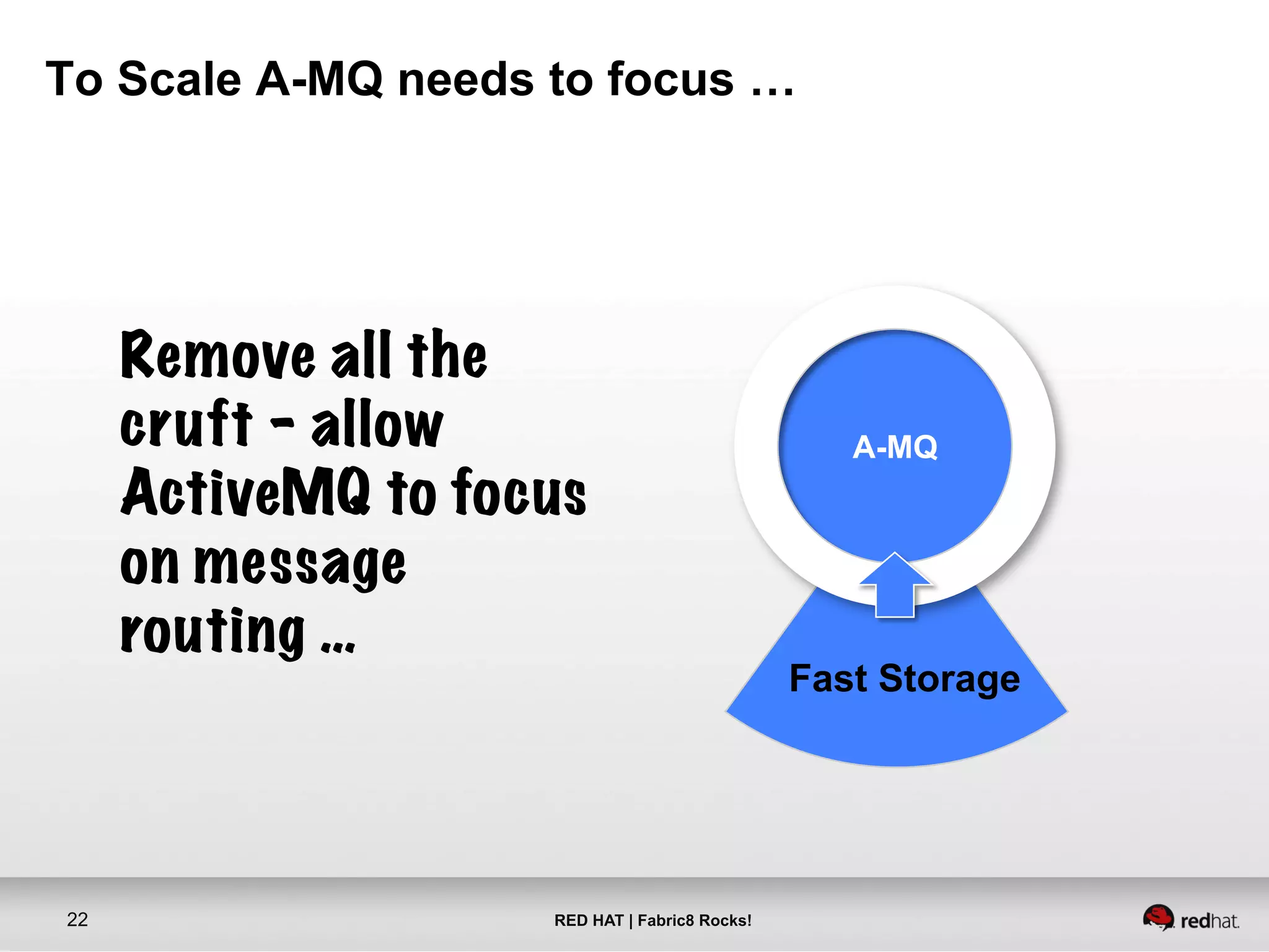
To Scale A-MQ needs to focus …
Fast Storage
A-MQ
Remove all the
cruft – allow
ActiveMQ to focus
on message
routing …
RED HAT | Fabric8 Rocks!23
Messaging for cloud based deployments
•  Needs to support many thousands of clients
•  Flexible, brokers need to be spun up and down, based
on demand
•  Client connections may need to be multiplexed, to
decrease the load on individual message brokers
•  Popular messaging protocols support
•  Flexible routing needs to be supported
RED HAT | Fabric8 Rocks!24
Agenda
• Introduction to Fabric8
• Enterprise messaging
• Fabric8MQ
• Demo
RED HAT | Fabric8 Rocks!25
Fabric8 MQ is built on Vert.x
•  Lightweight, multi-reactive, application platform
•  Inspired from Erlang/OTP
•  Polygot
•  High performance
•  Asynchronous, non-blocking: – high level of
concurrency
RED HAT | Fabric8 Rocks!26
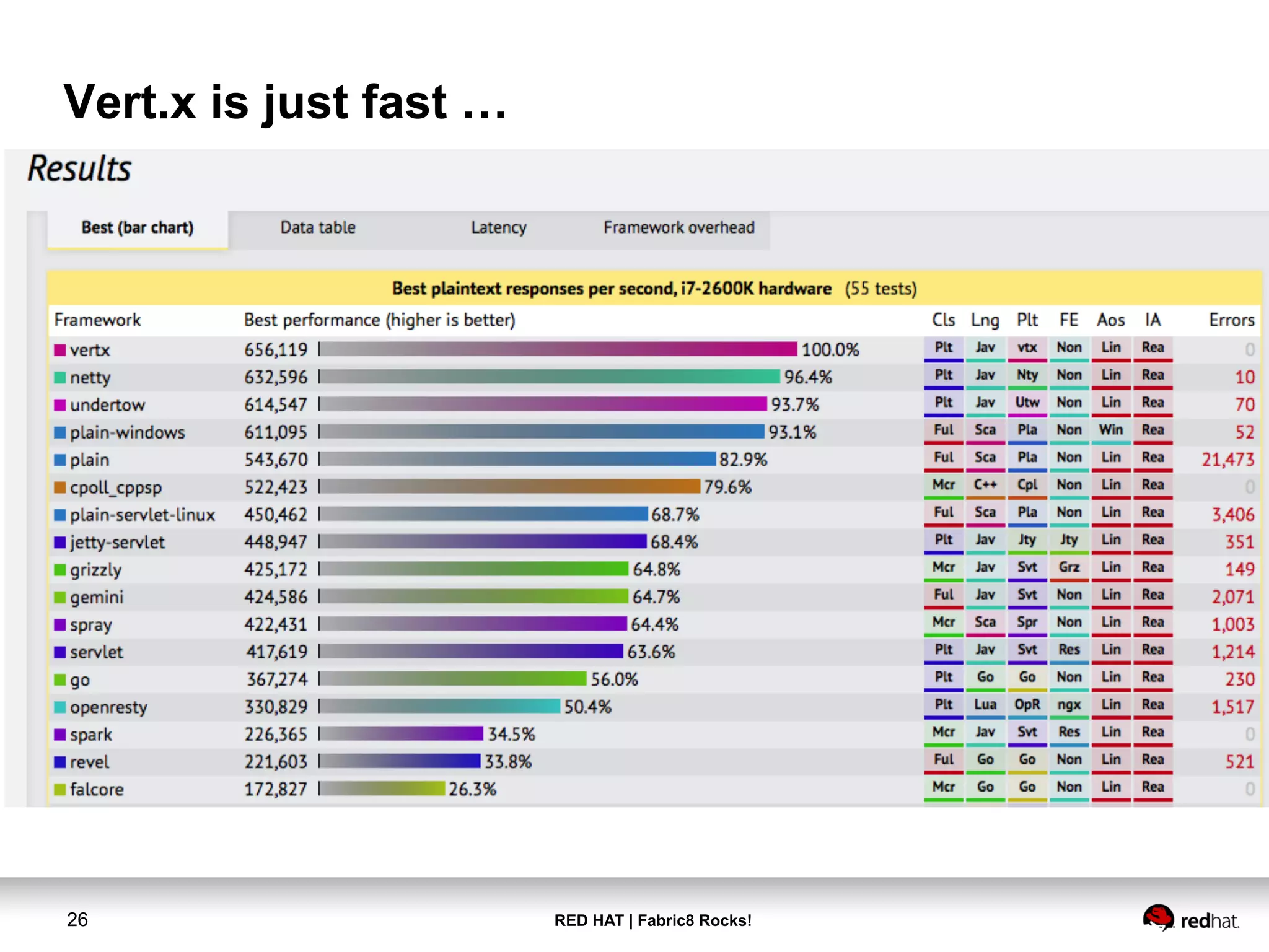
Vert.x is just fast …
RED HAT | Fabric8 Rocks!27
Fabric8 MQ Message Flow:
Protocol
Conversion
Camel
Routing
API
Management Multiplexer
Destination
Sharding
Broker
Control
RED HAT | Fabric8 Rocks!28
Fabric8 MQ Protocol Conversion
•  We convert to ActiveMQ OpenWire. This saves
ActiveMQ doing this, allowing it to expend all its
resources to pushing messages in and out of Queues
•  Protocols currently supported:
•  OpenWire
•  Stomp
•  MQTT
•  AMQP 1.0
RED HAT | Fabric8 Rocks!29
Camel Routing:
Camel is embedded to allow flexible routing:
Topic:Foo
MessageMessage Message
Queue:Foo
Channel
RED HAT | Fabric8 Rocks!30
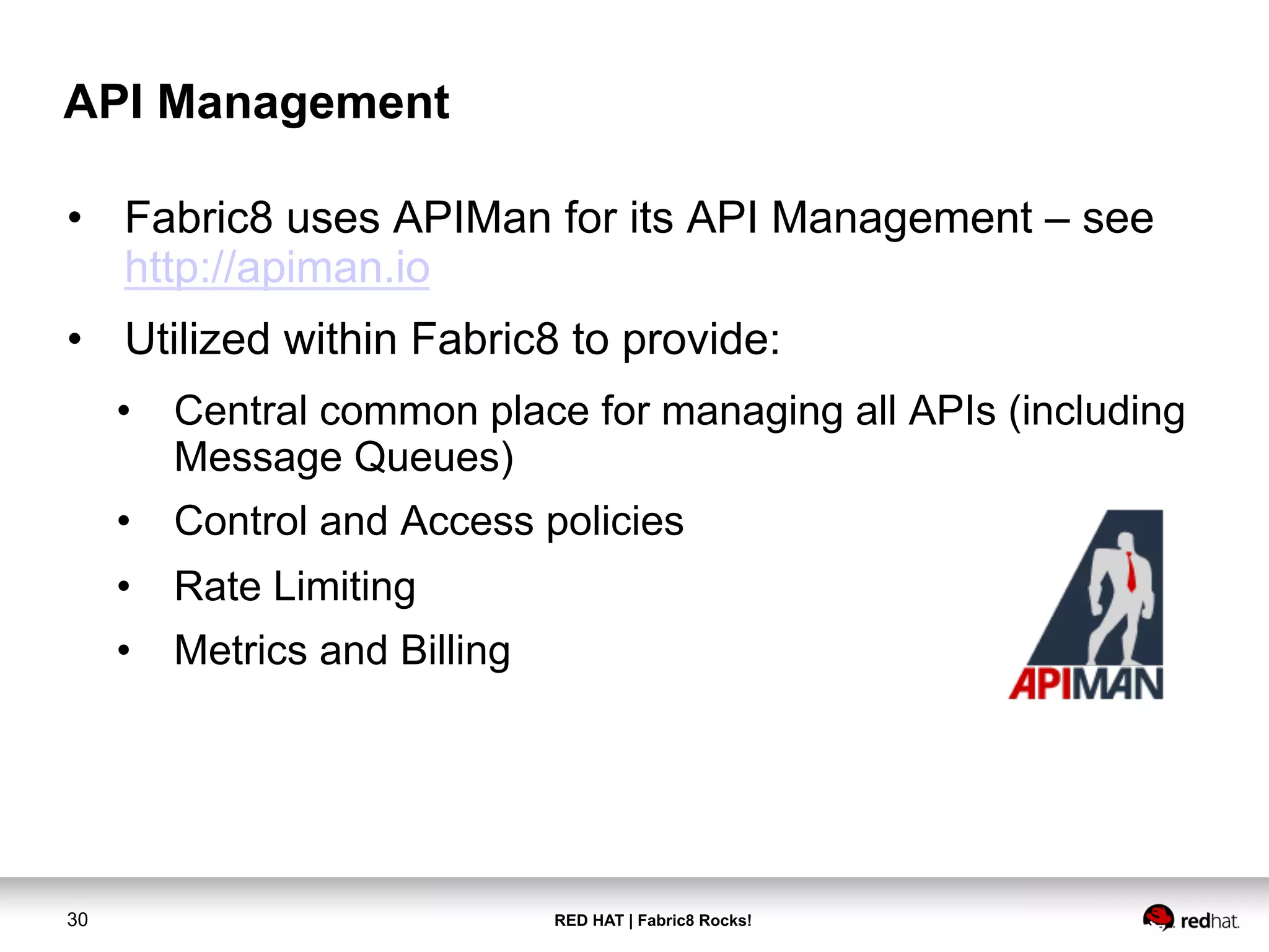
API Management
•  Fabric8 uses APIMan for its API Management – see
http://apiman.io
•  Utilized within Fabric8 to provide:
•  Central common place for managing all APIs (including
Message Queues)
•  Control and Access policies
•  Rate Limiting
•  Metrics and Billing
RED HAT | Fabric8 Rocks!31
Multiplexing
•  ActiveMQ performs better the lower
the number of connections – less
contention
•  IoT applications have long lived
connections, but small amount of
traffic
•  All configurable – you can decide
how fine or coarse grained you want
multiplexing
•  Fabric8MQ scales up/down
multiplexers as required
RED HAT | Fabric8 Rocks!32
Destination Sharding: Benefits
•  There is an overhead associated with a
Destination – restrict the number of
Destinations per Broker to improve
performance
•  Co-locate producers and consumers of a
Destination to the same broker reduces latency
and improves overall performance
•  Increased scalability for your messaging
solution
•  This is done automatically by Fabric8 MQ
RED HAT | Fabric8 Rocks!33
Destination Sharding: Fabric8 MQ Internal Model
•  Discover and track all allocated
brokers
•  Fabric8 MQ regularly updates its
internal model by examining
internals of brokers running via
Jolokia allowing multiple
Fabric8-MQ instances to run
(co-operatively scalable)
•  Scales up and down brokers –
moving destinations and clients
between brokers
•  Can dynamically set limits on
number of brokers, and broker
limits
Broker1
Connections count
Depth
Consumers
Producers
Queue://foo.1
Depth
Consumers
Producers
Queue://foo.2
Depth
Consumers
Producers
Queue://foo.3
Broker2
Connections count
Depth
Consumers
Producers
Queue://bar.1
Depth
Consumers
Producers
Queue://bar.2
Depth
Consumers
Producers
Queue://bar.3
RED HAT | Fabric8 Rocks!34
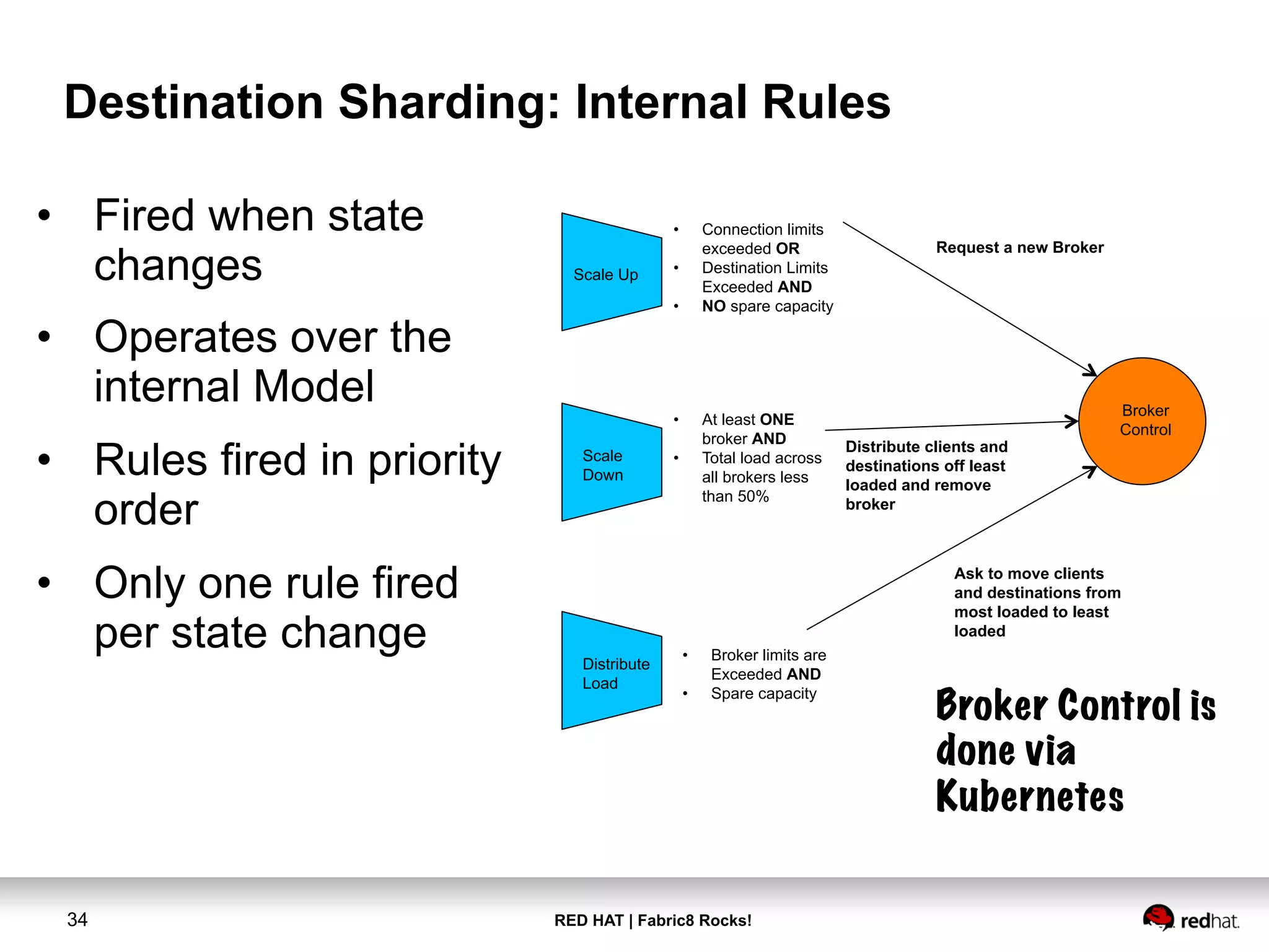
Destination Sharding: Internal Rules
•  Fired when state
changes
•  Operates over the
internal Model
•  Rules fired in priority
order
•  Only one rule fired
per state change
Scale Up
•  Connection limits
exceeded OR
•  Destination Limits
Exceeded AND
•  NO spare capacity
Broker
Control
Scale
Down
•  At least ONE
broker AND
•  Total load across
all brokers less
than 50%
Distribute
Load
•  Broker limits are
Exceeded AND
•  Spare capacity
Ask to move clients
and destinations from
most loaded to least
loaded
Distribute clients and
destinations off least
loaded and remove
broker
Request a new Broker
Broker Control is
done via
Kubernetes
RED HAT | Fabric8 Rocks!35
ActiveMQ hates
unexpected
Acks…
RED HAT | Fabric8 Rocks!36
Fabric8MQ has to
1.  Work out which destinations to migrate
2.  Stop dispatching to consumers
3.  Wait until the all in flight messages are acked
4.  Do the migration
5.  Update the internal destination map
6.  Then resume processing
RED HAT | Fabric8 Rocks!37
Kubernetes
•  Created by Google from
experience with GCE
•  Lightweight, simple and
accessible orchestration
system for Docker
containers
•  Schedules onto nodes in a
compute cluster and
actively manages
workloads to ensure state
is “correct”
•  Provides easy
management and
Discovery
Kubernetes
Master
Node Node Node
User containers
Scheduled and packed dynamically onto nodes
RED HAT | Fabric8 Rocks!38
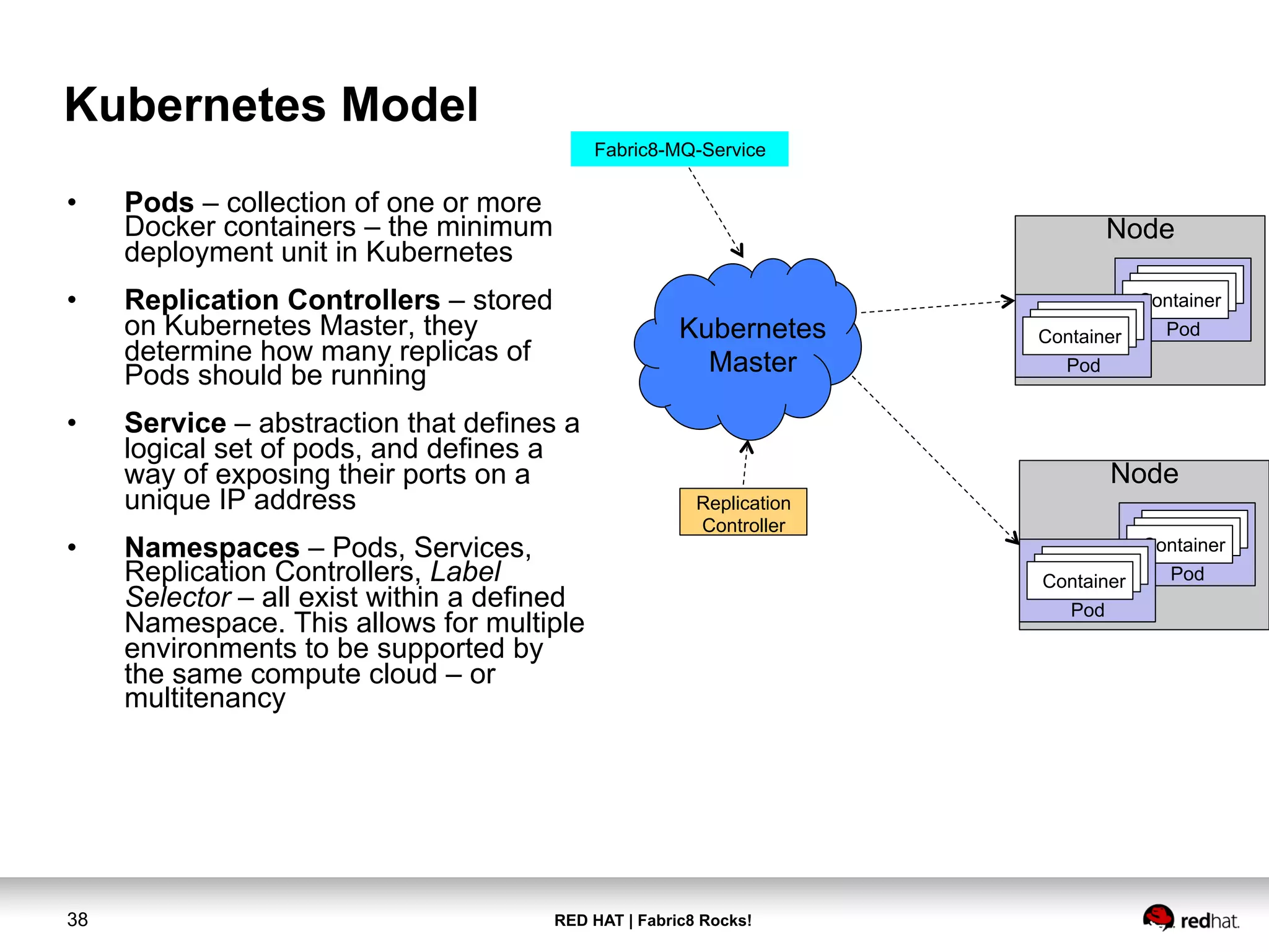
Kubernetes Model
•  Pods – collection of one or more
Docker containers – the minimum
deployment unit in Kubernetes
•  Replication Controllers – stored
on Kubernetes Master, they
determine how many replicas of
Pods should be running
•  Service – abstraction that defines a
logical set of pods, and defines a
way of exposing their ports on a
unique IP address
•  Namespaces – Pods, Services,
Replication Controllers, Label
Selector – all exist within a defined
Namespace. This allows for multiple
environments to be supported by
the same compute cloud – or
multitenancy
Kubernetes
Master
Node
Container
PodContainer
Pod
Node
Container
PodContainer
Pod
Replication
Controller
Fabric8-MQ-Service
RED HAT | Fabric8 Rocks!39
Fabric8 MQ Broker Control:
•  Fabric8 MQ controls a
headless Replication
Controller to spin up and
down ActiveMQ Brokers
•  Monitors the state of
running ActiveMQ
brokers via Jolokia – and
fires changes to the
internal rules engine.
•  Communicates with the
Replication Controller to
spin up – or delete Pods
containing ActiveMQ
Brokers
Node
Pod
ActiveMQ
Broker
AMQ
Replication
Controller
Node
Pod
ActiveMQ
Broker
Node
Pod
ActiveMQ
Broker
RED HAT | Fabric8 Rocks!40
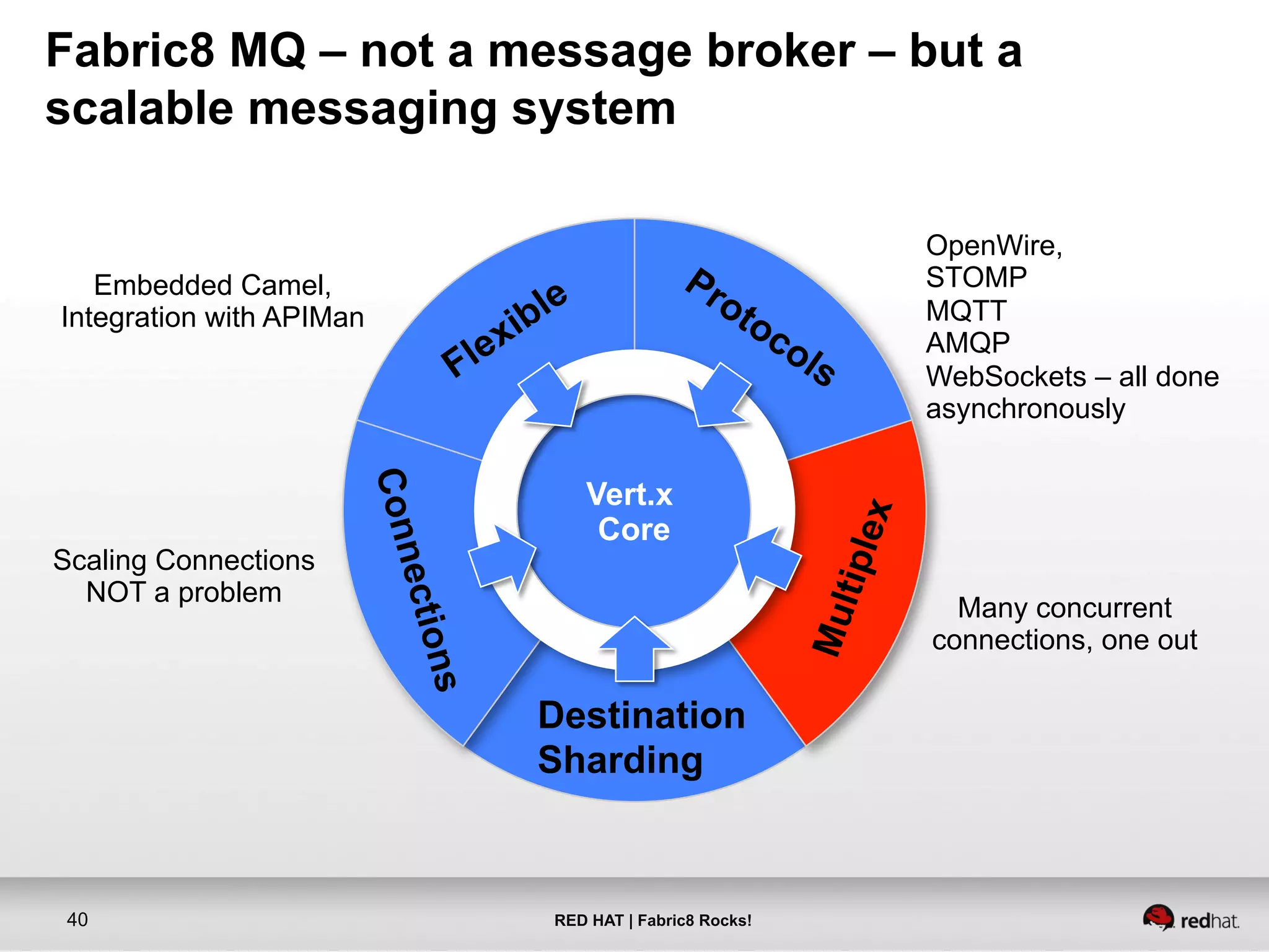
Fabric8 MQ – not a message broker – but a
scalable messaging system
Many concurrent
connections, one out
Connections
Vert.x
Core
Embedded Camel,
Integration with APIMan
OpenWire,
STOMP
MQTT
AMQP
WebSockets – all done
asynchronously
Scaling Connections
NOT a problem
Destination
Sharding
RED HAT | Fabric8 Rocks!41
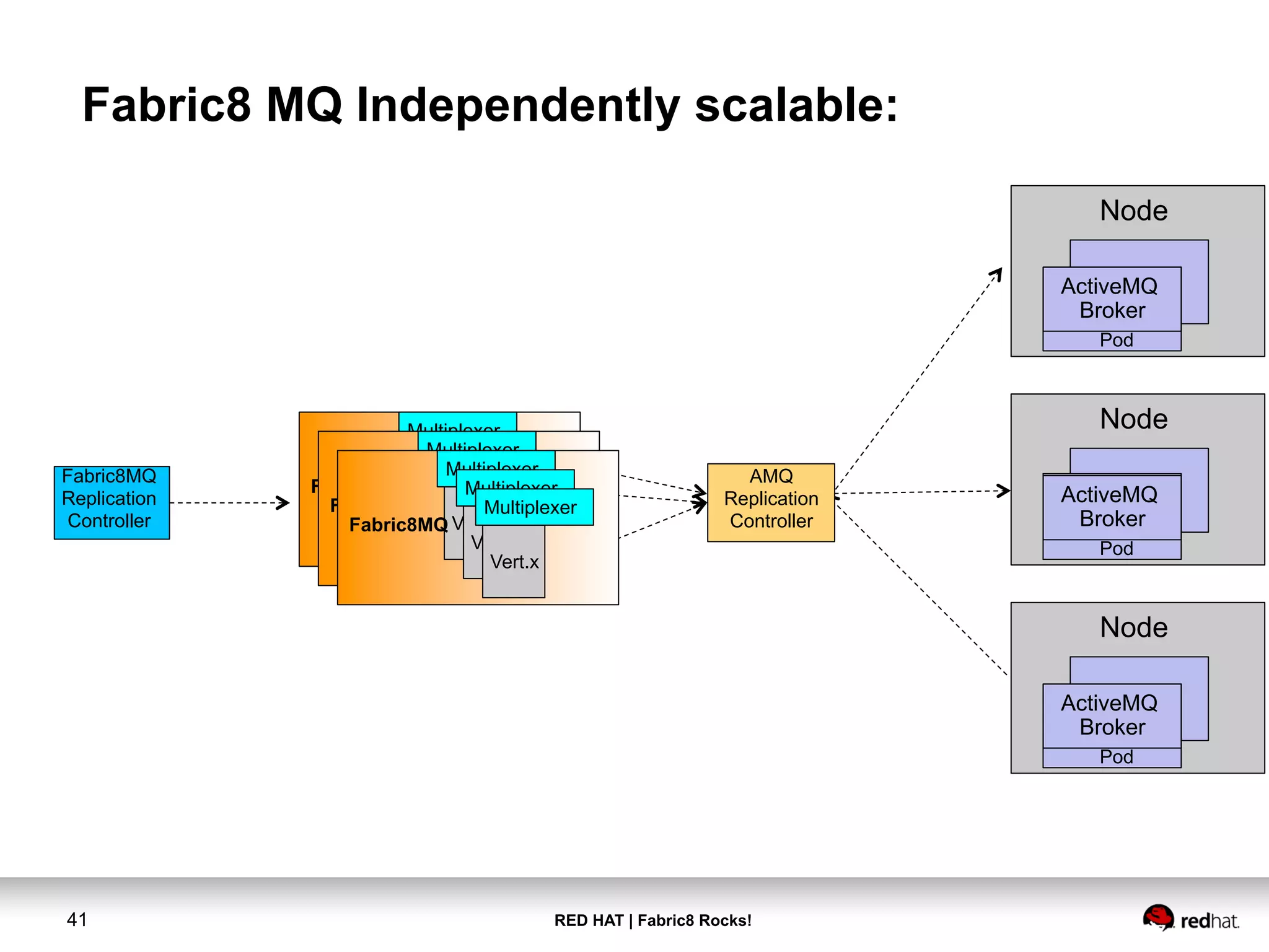
Fabric8 MQ Independently scalable:
Node
Pod
ActiveMQ
Broker
AMQ
Replication
Controller
Node
Pod
ActiveMQ
Broker
Node
Pod
ActiveMQ
Broker
Fabric8MQ
Replication
Controller
Vert.x
Vert.x
Vert.x
Multiplexer
Multiplexer
Multiplexer
Fabric8MQ
Vert.x
Vert.x
Vert.x
Multiplexer
Multiplexer
Multiplexer
Fabric8MQ
Vert.x
Vert.x
Vert.x
Multiplexer
Multiplexer
Multiplexer
Fabric8MQ
RED HAT | Fabric8 Rocks!42
RED HAT | Fabric8 Rocks!43
What I’m gonna try and attempt to do ...
Fabric8MQ
MQTT
Device
MQTT
DeviceMQTT
DeviceMQTT
Device
MQTT
DeviceMQTT
Device
MQTT
DeviceMQTT
DeviceMQTT
Device
RED HAT | Fabric8 Rocks!44
Destination Sharding: Internal Rules
Limits are set low:
5 Destinations per
Broker
Scale Up
•  Connection limits
exceeded OR
•  Destination Limits
Exceeded AND
•  NO spare capacity
Broker
Control
Scale
Down
•  At least ONE
broker AND
•  Total load across
all brokers less
than 50%
Distribute
Load
•  Broker limits are
Exceeded AND
•  Spare capacity
Ask to move clients
and destinations from
most loaded to least
loaded
Distribute clients and
destinations off least
loaded and remove
broker
Request a new Broker
Broker Control is
done via
Kubernetes
RED HAT | Fabric8 Rocks!45
Client code
final String host =
System.getenv("FABRIC8MQ_SERVICE_HOST");
final String portStr =
System.getenv("FABRIC8MQ_SERVICE_PORT");
Kubernetes injects
services as Environment
variables
RED HAT | Fabric8 Rocks!46
Questions
and
Discussion

Fabric8 mq

  • 1.
    Achieving Horizontal scaling forEnterprise Messaging using Fabric8 Rob Davies June 2015
  • 2.
    RED HAT |Fabric8 Rocks!2 Rob Davies •  Director, Engineering xPaaS •  Technical Director of Fuse Engineering •  Over 20 years experience of developing large scale solutions for telcos and finance •  Creator of ActiveMQ and ServiceMix •  Committer on open source projects, including Apache Camel …
  • 3.
    RED HAT |Fabric8 Rocks!3 Agenda • Introduction to Fabric8 • Enterprise messaging • Fabric8MQ • Demo
  • 4.
    RED HAT |Fabric8 Rocks!4 Fabric8 •  Open source, ASL 2.0 licensed project, built to provide the management infrastructure for Microservices deployments •  Management: console, logging, metrics, API Management •  Continuous Delivery - workflow •  Integration Platform as a Service – Camel route visualization, API registry, Messaging as a Service, … •  Tools – Kubernetes/OpenShift build integration, Kubernetes component test support, CDI extensions
  • 5.
    RED HAT |Fabric8 Rocks!5 Fabric8: GCE AWS CoreOS Mesos vSphere Fedora VagrantAzure Kubernetes Centralized Logging Metrics Deep Application Management API Registry API Man Fabric8MQCamel Fabric8 Java tools socialSonaQubeGogsJenkins Nexus
  • 6.
    RED HAT |Fabric8 Rocks!6 Agenda • Introduction to Fabric8 • Enterprise messaging • Fabric8MQ • Demo
  • 7.
    RED HAT |Fabric8 Rocks!7 Why use messaging ? •  Robustness to change •  Time independence •  Hide latency •  Event driven •  Platform and language independence Broker Message in Message out after enrichment by Process B Process C Process B Process A Queue:Foo Queue:Bar
  • 8.
    RED HAT |Fabric8 Rocks!8 Enterprise Message brokers •  Designed to support many different messaging patterns •  highly available •  Support clustering •  Support store and forward •  But – are usually very static in nature
  • 9.
    RED HAT |Fabric8 Rocks!9 •  Top Level Apache Software Foundation Project •  Wildly popular, high performance, reliable message broker •  Connects to nearly everything • Native Java, C/C++, .Net, • AMQP 1.0, MQTT 3.1, STOMP (1.0-1.2) and OpenWire • STOMP enables Ruby, JS, Perl, Python, PHP, ActionScript … •  Embedded and standalone deployment options
  • 10.
    RED HAT |Fabric8 Rocks!10 Message Channels and Routing •  Message Channels •  Named communication between interested parties •  JMS calls them ‘Destinations’ •  Can “tune-in” to multiple channels using wildcards •  Can fine-tune message consumption with selectors •  Can route a message based on content
  • 11.
    RED HAT |Fabric8 Rocks!11 Message Channels = JMS Destinations Broker Consumer Consumer Destination WIDGET Destination ORDER Producer Consumer
  • 12.
    RED HAT |Fabric8 Rocks!12 Message Routing: Selectors Producer Destination Consumer Color = red Consumer Color = blue
  • 13.
    RED HAT |Fabric8 Rocks!13 Message Routing: Destination Wildcards •  * matches a subject •  > matches sub-tree Topic: BAR.BEER.WHITE Topic: BAR.WINE.WHITE Producer Consumer Topic:BAR.WINE.WHITE Consumer Topic:BAR.BEER.WHITE Consumer Topic:BAR.*.WHITE Consumer Topic:BAR.>
  • 14.
    RED HAT |Fabric8 Rocks!14 Message Groups Producer Consumer Consumer Consumer Queue:Prices Message message = session.createTextMessage(“hi JBCNConf”); message.setStringProperty("JMSXGroupID", ”JavaRocks"); producer.send(message);
  • 15.
    RED HAT |Fabric8 Rocks!15 High Availability clustering: MasterClient Slave Slave Only one broker is active (the master) at any one time. 1. send 3. receipt 2. store
  • 16.
    RED HAT |Fabric8 Rocks!16 Network of Brokers: Producer Highly reliable, store and forward Consumer 1. send Broker1 2. store Broker2 5. store 4. Network send 6. Network receipt 3. receipt 7. delete 6. Network send 7. acknowledge 8. delete
  • 17.
    RED HAT |Fabric8 Rocks!17 Networks of Brokers: some limitations •  Performance – messages are always stored by the broker to disk before forwarding to another broker – this can increase latency by at least a factor of 10 •  Networks are chatty – routing information is passed from broker to broker every time a consumer starts or stops •  Networks are a bottleneck – networks are implemented as one TCP/IP connection – this is natural choke point for high throughput scenarios •  Messages can be orphaned – If a broker goes down, locally stored messages won’t get delivered until the broker is recovered
  • 18.
    RED HAT |Fabric8 Rocks!18 Networks of Brokers: Worst bit … Producer ConsumerBroker1 Broker2 This is configured differently to …
  • 19.
    RED HAT |Fabric8 Rocks!19 Networks of Brokers: Worst bit … Producer ConsumerBroker1 Broker2 To this Broker3
  • 20.
    RED HAT |Fabric8 Rocks!20 ActiveMQ is static:
  • 21.
    RED HAT |Fabric8 Rocks!21 ActiveMQ Key Features Fast Storage Connections A-MQ Embedded Camel OpenWire, STOMP MQTT AMQP WebSockets Scaling Connections A problem KahaDB/LevelDB Lots and Lots of these
  • 22.
    RED HAT |Fabric8 Rocks!22 To Scale A-MQ needs to focus … Fast Storage A-MQ Remove all the cruft – allow ActiveMQ to focus on message routing …
  • 23.
    RED HAT |Fabric8 Rocks!23 Messaging for cloud based deployments •  Needs to support many thousands of clients •  Flexible, brokers need to be spun up and down, based on demand •  Client connections may need to be multiplexed, to decrease the load on individual message brokers •  Popular messaging protocols support •  Flexible routing needs to be supported
  • 24.
    RED HAT |Fabric8 Rocks!24 Agenda • Introduction to Fabric8 • Enterprise messaging • Fabric8MQ • Demo
  • 25.
    RED HAT |Fabric8 Rocks!25 Fabric8 MQ is built on Vert.x •  Lightweight, multi-reactive, application platform •  Inspired from Erlang/OTP •  Polygot •  High performance •  Asynchronous, non-blocking: – high level of concurrency
  • 26.
    RED HAT |Fabric8 Rocks!26 Vert.x is just fast …
  • 27.
    RED HAT |Fabric8 Rocks!27 Fabric8 MQ Message Flow: Protocol Conversion Camel Routing API Management Multiplexer Destination Sharding Broker Control
  • 28.
    RED HAT |Fabric8 Rocks!28 Fabric8 MQ Protocol Conversion •  We convert to ActiveMQ OpenWire. This saves ActiveMQ doing this, allowing it to expend all its resources to pushing messages in and out of Queues •  Protocols currently supported: •  OpenWire •  Stomp •  MQTT •  AMQP 1.0
  • 29.
    RED HAT |Fabric8 Rocks!29 Camel Routing: Camel is embedded to allow flexible routing: Topic:Foo MessageMessage Message Queue:Foo Channel
  • 30.
    RED HAT |Fabric8 Rocks!30 API Management •  Fabric8 uses APIMan for its API Management – see http://apiman.io •  Utilized within Fabric8 to provide: •  Central common place for managing all APIs (including Message Queues) •  Control and Access policies •  Rate Limiting •  Metrics and Billing
  • 31.
    RED HAT |Fabric8 Rocks!31 Multiplexing •  ActiveMQ performs better the lower the number of connections – less contention •  IoT applications have long lived connections, but small amount of traffic •  All configurable – you can decide how fine or coarse grained you want multiplexing •  Fabric8MQ scales up/down multiplexers as required
  • 32.
    RED HAT |Fabric8 Rocks!32 Destination Sharding: Benefits •  There is an overhead associated with a Destination – restrict the number of Destinations per Broker to improve performance •  Co-locate producers and consumers of a Destination to the same broker reduces latency and improves overall performance •  Increased scalability for your messaging solution •  This is done automatically by Fabric8 MQ
  • 33.
    RED HAT |Fabric8 Rocks!33 Destination Sharding: Fabric8 MQ Internal Model •  Discover and track all allocated brokers •  Fabric8 MQ regularly updates its internal model by examining internals of brokers running via Jolokia allowing multiple Fabric8-MQ instances to run (co-operatively scalable) •  Scales up and down brokers – moving destinations and clients between brokers •  Can dynamically set limits on number of brokers, and broker limits Broker1 Connections count Depth Consumers Producers Queue://foo.1 Depth Consumers Producers Queue://foo.2 Depth Consumers Producers Queue://foo.3 Broker2 Connections count Depth Consumers Producers Queue://bar.1 Depth Consumers Producers Queue://bar.2 Depth Consumers Producers Queue://bar.3
  • 34.
    RED HAT |Fabric8 Rocks!34 Destination Sharding: Internal Rules •  Fired when state changes •  Operates over the internal Model •  Rules fired in priority order •  Only one rule fired per state change Scale Up •  Connection limits exceeded OR •  Destination Limits Exceeded AND •  NO spare capacity Broker Control Scale Down •  At least ONE broker AND •  Total load across all brokers less than 50% Distribute Load •  Broker limits are Exceeded AND •  Spare capacity Ask to move clients and destinations from most loaded to least loaded Distribute clients and destinations off least loaded and remove broker Request a new Broker Broker Control is done via Kubernetes
  • 35.
    RED HAT |Fabric8 Rocks!35 ActiveMQ hates unexpected Acks…
  • 36.
    RED HAT |Fabric8 Rocks!36 Fabric8MQ has to 1.  Work out which destinations to migrate 2.  Stop dispatching to consumers 3.  Wait until the all in flight messages are acked 4.  Do the migration 5.  Update the internal destination map 6.  Then resume processing
  • 37.
    RED HAT |Fabric8 Rocks!37 Kubernetes •  Created by Google from experience with GCE •  Lightweight, simple and accessible orchestration system for Docker containers •  Schedules onto nodes in a compute cluster and actively manages workloads to ensure state is “correct” •  Provides easy management and Discovery Kubernetes Master Node Node Node User containers Scheduled and packed dynamically onto nodes
  • 38.
    RED HAT |Fabric8 Rocks!38 Kubernetes Model •  Pods – collection of one or more Docker containers – the minimum deployment unit in Kubernetes •  Replication Controllers – stored on Kubernetes Master, they determine how many replicas of Pods should be running •  Service – abstraction that defines a logical set of pods, and defines a way of exposing their ports on a unique IP address •  Namespaces – Pods, Services, Replication Controllers, Label Selector – all exist within a defined Namespace. This allows for multiple environments to be supported by the same compute cloud – or multitenancy Kubernetes Master Node Container PodContainer Pod Node Container PodContainer Pod Replication Controller Fabric8-MQ-Service
  • 39.
    RED HAT |Fabric8 Rocks!39 Fabric8 MQ Broker Control: •  Fabric8 MQ controls a headless Replication Controller to spin up and down ActiveMQ Brokers •  Monitors the state of running ActiveMQ brokers via Jolokia – and fires changes to the internal rules engine. •  Communicates with the Replication Controller to spin up – or delete Pods containing ActiveMQ Brokers Node Pod ActiveMQ Broker AMQ Replication Controller Node Pod ActiveMQ Broker Node Pod ActiveMQ Broker
  • 40.
    RED HAT |Fabric8 Rocks!40 Fabric8 MQ – not a message broker – but a scalable messaging system Many concurrent connections, one out Connections Vert.x Core Embedded Camel, Integration with APIMan OpenWire, STOMP MQTT AMQP WebSockets – all done asynchronously Scaling Connections NOT a problem Destination Sharding
  • 41.
    RED HAT |Fabric8 Rocks!41 Fabric8 MQ Independently scalable: Node Pod ActiveMQ Broker AMQ Replication Controller Node Pod ActiveMQ Broker Node Pod ActiveMQ Broker Fabric8MQ Replication Controller Vert.x Vert.x Vert.x Multiplexer Multiplexer Multiplexer Fabric8MQ Vert.x Vert.x Vert.x Multiplexer Multiplexer Multiplexer Fabric8MQ Vert.x Vert.x Vert.x Multiplexer Multiplexer Multiplexer Fabric8MQ
  • 42.
    RED HAT |Fabric8 Rocks!42
  • 43.
    RED HAT |Fabric8 Rocks!43 What I’m gonna try and attempt to do ... Fabric8MQ MQTT Device MQTT DeviceMQTT DeviceMQTT Device MQTT DeviceMQTT Device MQTT DeviceMQTT DeviceMQTT Device
  • 44.
    RED HAT |Fabric8 Rocks!44 Destination Sharding: Internal Rules Limits are set low: 5 Destinations per Broker Scale Up •  Connection limits exceeded OR •  Destination Limits Exceeded AND •  NO spare capacity Broker Control Scale Down •  At least ONE broker AND •  Total load across all brokers less than 50% Distribute Load •  Broker limits are Exceeded AND •  Spare capacity Ask to move clients and destinations from most loaded to least loaded Distribute clients and destinations off least loaded and remove broker Request a new Broker Broker Control is done via Kubernetes
  • 45.
    RED HAT |Fabric8 Rocks!45 Client code final String host = System.getenv("FABRIC8MQ_SERVICE_HOST"); final String portStr = System.getenv("FABRIC8MQ_SERVICE_PORT"); Kubernetes injects services as Environment variables
  • 46.
    RED HAT |Fabric8 Rocks!46 Questions and Discussion