Emails,
Memos and
Letters
Effective Business
Communication
Guidelines
for Effective
Business
Emails
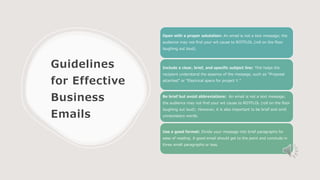
Open with a proper salutation: An email is not a text message; the
audience may not find your wit cause to ROTFLOL (roll on the floor
laughing out loud).
Include a clear, brief, and specific subject line: This helps the
recipient understand the essence of the message, such as “Proposal
attached” or “Electrical specs for project Y.”
Be brief but avoid abbreviations: An email is not a text message;
the audience may not find your wit cause to ROTFLOL (roll on the floor
laughing out loud). However, it is also important to be brief and omit
unnecessary words.
Use a good format: Divide your message into brief paragraphs for
ease of reading. A good email should get to the point and conclude in
three small paragraphs or less.
Email
Etiquette
Use “Reply All” sparingly: Do not send your reply to everyone who received
the initial email unless your message needs to be read by the entire group.
Reply promptly: Watch out for an emotional response—never reply in anger—
but make a habit of responding to all emails within twenty-four hours, even if
only to say that you will provide the requested information in forty-eight or
seventy-two hours.
Reread, revise, and review: Catch and correct spelling and grammar
mistakes before you press “send.” It will take more time and effort to undo the
problems caused by a hasty, poorly written email than to take the time to get
it right the first time. If you include a web link, test it to ensure it works.
Email Etiquette
Avoid using all caps: Capital letters
are used on the Internet to
communicate emphatic emotion or
yelling and are considered rude.
Email ahead of time if you are going
to attach large files: Audio and visual
files are often quite large; be careful
not to exceed the recipient’s mailbox
limit or trigger the spam filter.
Give feedback or follow up: Email or
call if you don’t get a response in
twenty-four hours. Spam filters may
have intercepted your message, so
your recipient may never have received
it.
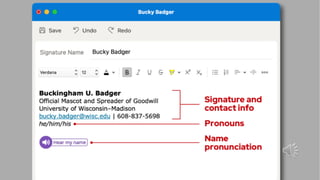
Close with a signature: Identify
yourself by creating a signature block
that automatically contains your name
and business contact information.
Memo
Place a horizontal line under your header block, and place your message below.
Memo Header Block: The Header Block appears in large, bold, capitalised letters at the top left of your memo, directly under
the word MEMO or MEMORANDUM. This section contains detailed information on the recipient, sender, and purpose. It
includes the following lines:
TO: Give the recipient’s full name and
position or title within the
organization.
FROM: include the sender’s (your) full
name and position or title.
DATE: include the full date on which
you sent the memo.
SUBJECT or RE: write a brief phrase
that concisely describes the main
content of your memo.
Memo
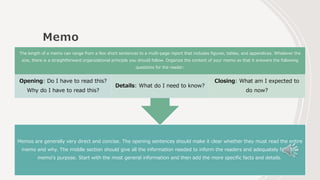
Memos are generally very direct and concise. The opening sentences should make it clear whether they must read the entire
memo and why. The middle section should give all the information needed to inform the readers and adequately fulfil the
memo's purpose. Start with the most general information and then add the more specific facts and details.
The length of a memo can range from a few short sentences to a multi-page report that includes figures, tables, and appendices. Whatever the
size, there is a straightforward organizational principle you should follow. Organize the content of your memo so that it answers the following
questions for the reader:
Opening: Do I have to read this?
Why do I have to read this?
Details: What do I need to know?
Closing: What am I expected to
do now?
Strategies for Effective Letters
A typical letter has 7 main parts:
•Letterhead/logo: Sender’s name and return address.
•The heading names the recipient, often including address and date.
•Salutation: “Dear ______ ” use the recipient’s name, if known.
•The introduction establishes the overall purpose of the letter.
•The body articulates the details of the message.
•The conclusion restates the main point and may include a call to action.
•The signature line sometimes includes the contact information.
Letters and
the Sender
Keep in mind that letters represent you
and your company in your absence. In
order to communicate effectively and
project a positive image, remember
that
•Your language should be clear, concise, specific,
and respectful.
•Each word should contribute to your purpose.
•Each paragraph should focus on one idea.
•The parts of the letter should form a complete
message and be free of errors.
TYPES OF
LETTERS
Transmittal
Letters
When you send a report or other
document, such as a resumé, to an
external audience, include a cover
letter that briefly explains the
purpose of the enclosed document
and a summary.
Letters of Inquiry
You may want to request information about a
company or organization, such as whether they
anticipate job openings shortly or whether they
fund grant proposals from non-profit groups. In
this case, you would send a letter of inquiry asking
for additional information.
As with most business letters, keep your request
brief. Introduce yourself in the opening paragraph
and clearly state your purpose and request in the
second paragraph. Consider placing your requests
in list form for clarity if you need specific
information. Conclude in a friendly way that shows
appreciation for the help you will receive.
Follow-up Letters
Any time you request something from
someone, write a follow-up letter
expressing your appreciation for the
time the letter recipient has taken to
respond to your needs or consider your
job application.
For example, suppose you have had a
job interview. In that case, the follow-
up letter thanking the interviewer for
their time is essential for demonstrating
your professionalism and attention to
detail.
COMMENT THE ANSWER
FOR A CERTIFICATE
Why is it important to review and
revise an email or a letter before
sending?

Emails, Memos, and Letters: Guidelines for Effective Communication

  • 1.
  • 2.
    Guidelines for Effective Business Emails Open witha proper salutation: An email is not a text message; the audience may not find your wit cause to ROTFLOL (roll on the floor laughing out loud). Include a clear, brief, and specific subject line: This helps the recipient understand the essence of the message, such as “Proposal attached” or “Electrical specs for project Y.” Be brief but avoid abbreviations: An email is not a text message; the audience may not find your wit cause to ROTFLOL (roll on the floor laughing out loud). However, it is also important to be brief and omit unnecessary words. Use a good format: Divide your message into brief paragraphs for ease of reading. A good email should get to the point and conclude in three small paragraphs or less.
  • 4.
    Email Etiquette Use “Reply All”sparingly: Do not send your reply to everyone who received the initial email unless your message needs to be read by the entire group. Reply promptly: Watch out for an emotional response—never reply in anger— but make a habit of responding to all emails within twenty-four hours, even if only to say that you will provide the requested information in forty-eight or seventy-two hours. Reread, revise, and review: Catch and correct spelling and grammar mistakes before you press “send.” It will take more time and effort to undo the problems caused by a hasty, poorly written email than to take the time to get it right the first time. If you include a web link, test it to ensure it works.
  • 5.
    Email Etiquette Avoid usingall caps: Capital letters are used on the Internet to communicate emphatic emotion or yelling and are considered rude. Email ahead of time if you are going to attach large files: Audio and visual files are often quite large; be careful not to exceed the recipient’s mailbox limit or trigger the spam filter. Give feedback or follow up: Email or call if you don’t get a response in twenty-four hours. Spam filters may have intercepted your message, so your recipient may never have received it. Close with a signature: Identify yourself by creating a signature block that automatically contains your name and business contact information.
  • 7.
    Memo Place a horizontalline under your header block, and place your message below. Memo Header Block: The Header Block appears in large, bold, capitalised letters at the top left of your memo, directly under the word MEMO or MEMORANDUM. This section contains detailed information on the recipient, sender, and purpose. It includes the following lines: TO: Give the recipient’s full name and position or title within the organization. FROM: include the sender’s (your) full name and position or title. DATE: include the full date on which you sent the memo. SUBJECT or RE: write a brief phrase that concisely describes the main content of your memo.
  • 8.
    Memo Memos are generallyvery direct and concise. The opening sentences should make it clear whether they must read the entire memo and why. The middle section should give all the information needed to inform the readers and adequately fulfil the memo's purpose. Start with the most general information and then add the more specific facts and details. The length of a memo can range from a few short sentences to a multi-page report that includes figures, tables, and appendices. Whatever the size, there is a straightforward organizational principle you should follow. Organize the content of your memo so that it answers the following questions for the reader: Opening: Do I have to read this? Why do I have to read this? Details: What do I need to know? Closing: What am I expected to do now?
  • 10.
    Strategies for EffectiveLetters A typical letter has 7 main parts: •Letterhead/logo: Sender’s name and return address. •The heading names the recipient, often including address and date. •Salutation: “Dear ______ ” use the recipient’s name, if known. •The introduction establishes the overall purpose of the letter. •The body articulates the details of the message. •The conclusion restates the main point and may include a call to action. •The signature line sometimes includes the contact information.
  • 11.
    Letters and the Sender Keepin mind that letters represent you and your company in your absence. In order to communicate effectively and project a positive image, remember that •Your language should be clear, concise, specific, and respectful. •Each word should contribute to your purpose. •Each paragraph should focus on one idea. •The parts of the letter should form a complete message and be free of errors.
  • 12.
  • 13.
    Transmittal Letters When you senda report or other document, such as a resumé, to an external audience, include a cover letter that briefly explains the purpose of the enclosed document and a summary.
  • 14.
    Letters of Inquiry Youmay want to request information about a company or organization, such as whether they anticipate job openings shortly or whether they fund grant proposals from non-profit groups. In this case, you would send a letter of inquiry asking for additional information. As with most business letters, keep your request brief. Introduce yourself in the opening paragraph and clearly state your purpose and request in the second paragraph. Consider placing your requests in list form for clarity if you need specific information. Conclude in a friendly way that shows appreciation for the help you will receive.
  • 15.
    Follow-up Letters Any timeyou request something from someone, write a follow-up letter expressing your appreciation for the time the letter recipient has taken to respond to your needs or consider your job application. For example, suppose you have had a job interview. In that case, the follow- up letter thanking the interviewer for their time is essential for demonstrating your professionalism and attention to detail.
  • 17.
    COMMENT THE ANSWER FORA CERTIFICATE Why is it important to review and revise an email or a letter before sending?